
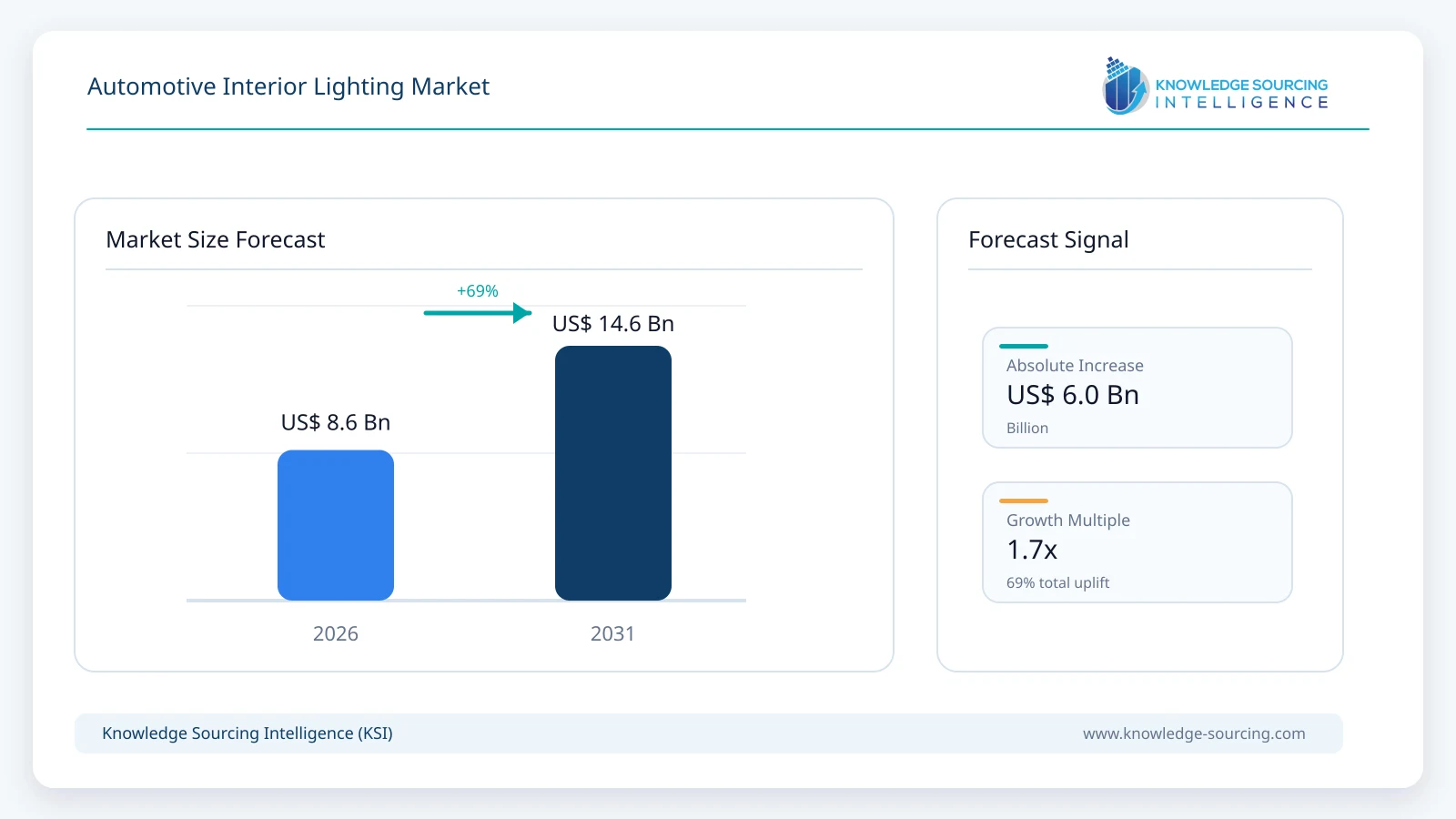
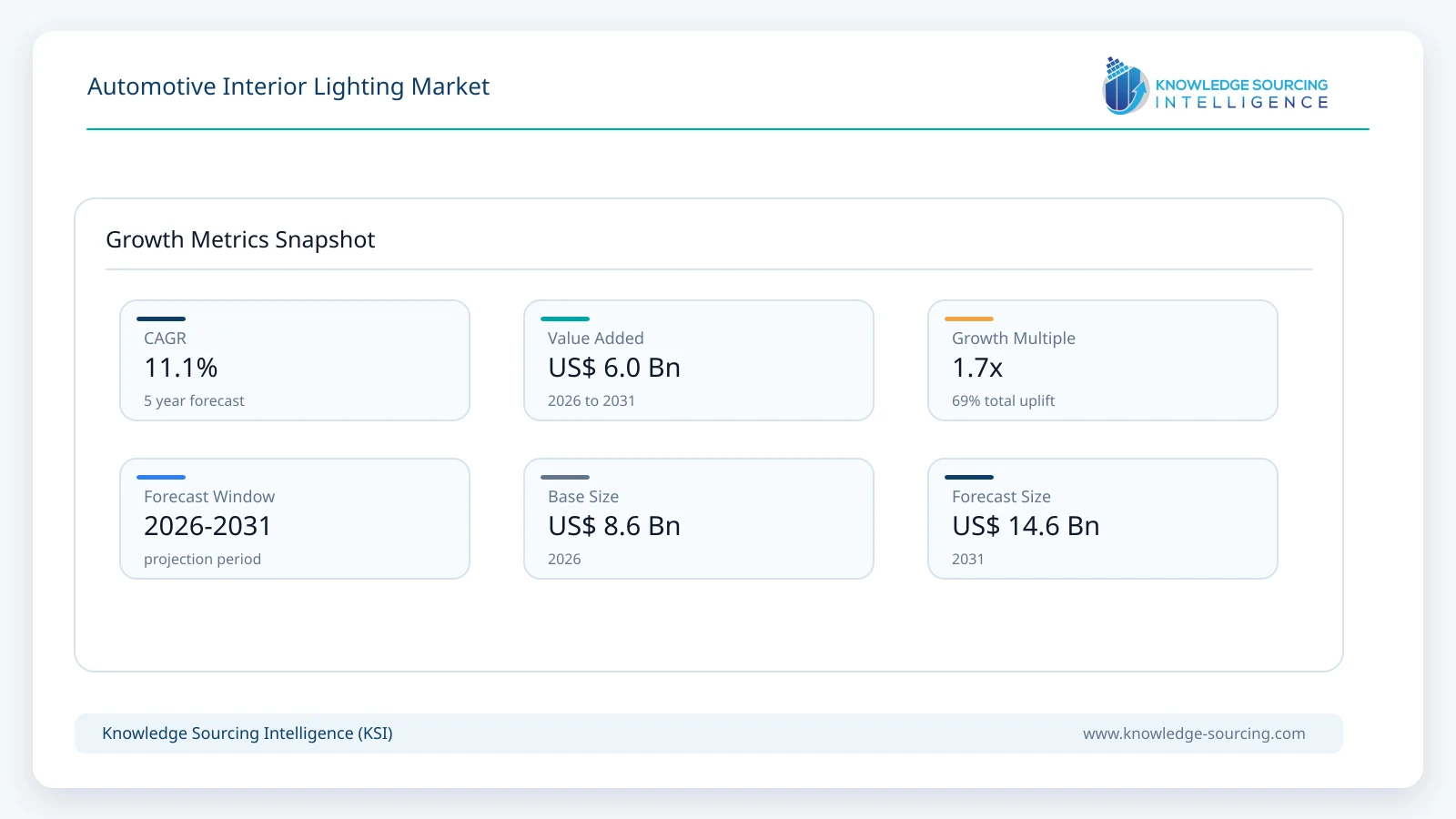
The automotive interior lighting market is projected to expand at a CAGR of 11.1%, reaching USD 14.55 billion in 2031 from USD 8.60 billion in 2026.
Highlights:
- 1Ambient and personalization lighting accounts for approximately 52% of global market value in 2026, reflecting the rapid increase in multi-zone RGB and contour lighting across passenger-vehicle cabins.
- 2Intelligent interior lighting represents approximately two-thirds of 2026 market value and is gaining share as static lamps are replaced by digitally controlled, networked and context-responsive lighting architectures.
- 3Roof and overhead lighting remains a major value pool because dome, map, reading and premium overhead modules retain near-universal fitment even as advanced ambient systems expand elsewhere in the cabin.
- 4User-selectable and networked dynamic control together represent more than half of 2026 market value, while fixed and manual lighting remains important in high-volume cost-sensitive vehicles.
- 5Passenger vehicles account for approximately 93% of global market value in 2026, supported by high production volume and the strongest adoption of premium ambient, smart-surface and intelligent-lighting content.
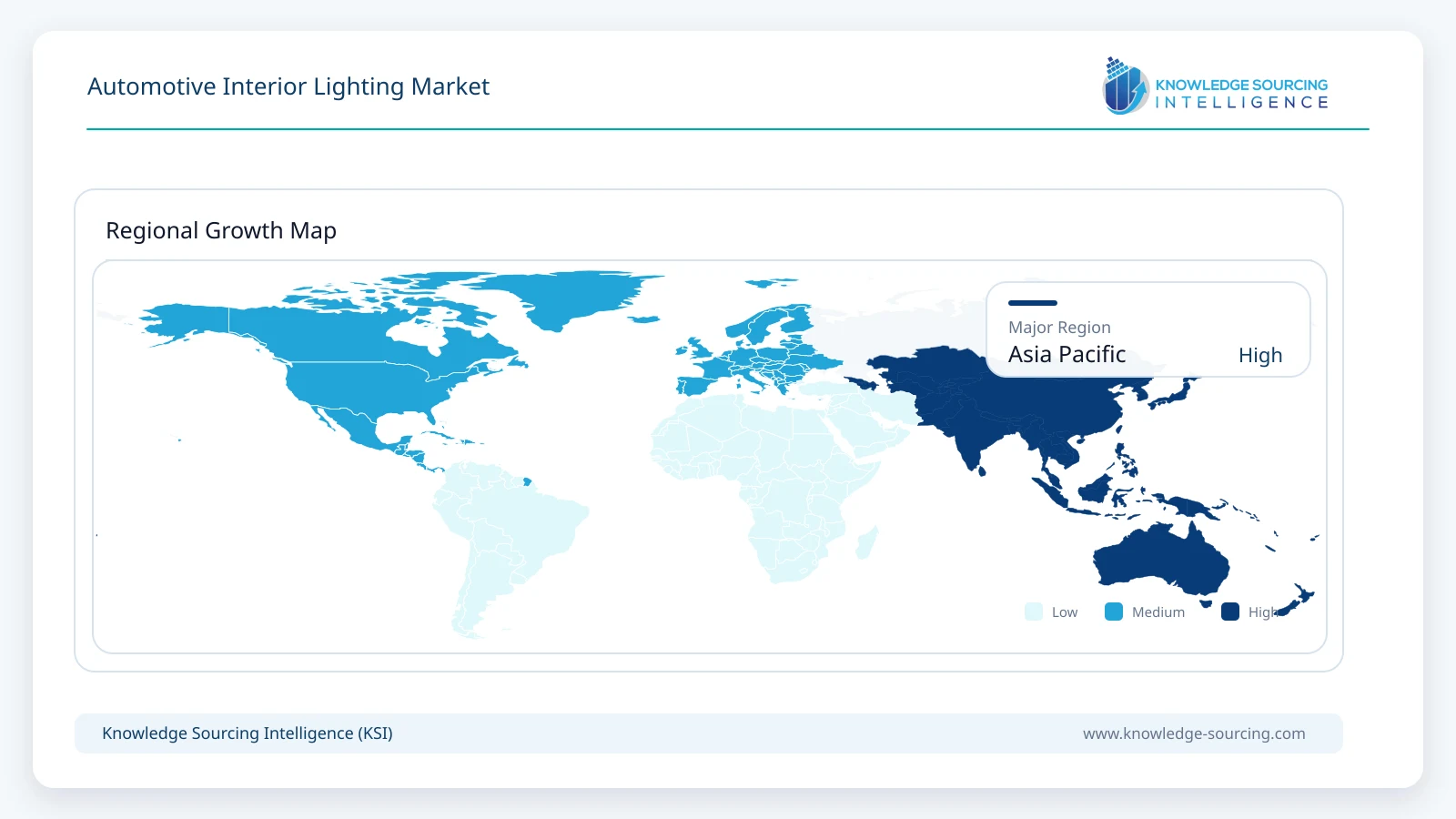
- 6Asia Pacific represents approximately 46% of global market value in 2026, supported by vehicle-production scale and rapid adoption of high-content smart cabins in China, Japan and South Korea.
Interior lighting is moving from a small group of independent lamps toward a distributed cabin system that combines functional illumination with ambience, personalization and visual communication.
Ambient and decorative lighting now represents the largest value pool because doors, dashboards, consoles, footwells and roof areas increasingly carry multi-zone RGB or white-light illumination. Functional reading, dome and courtesy lamps remain important across nearly every vehicle, while intelligent lighting is growing faster as addressable LEDs, networked control and software-defined scenes increase electronic content.
The market measures the value of complete interior-lighting hardware, optical elements, local electronics and attributable software supplied for vehicle installation. Display backlighting, exterior lighting systems and the full value of illuminated trim assemblies are excluded unless the value can be attributed specifically to the lighting function, while overlapping intelligent and ambient-lighting categories are treated as nested or intersecting subsets rather than additive markets.
Market Overview
Interior lighting serves several purposes that increasingly share the same electrical and software architecture. A conventional roof lamp provides visibility when entering the vehicle, an ambient system shapes the visual character of the cabin, a reading lamp supports task use, and an intelligent light strip can provide personalization or reinforce a warning, yet all of these functions are progressively being connected to centralized or zonal controllers.
LED technology has already displaced most incandescent interior lighting because it offers lower power consumption, longer life, smaller packaging and greater design flexibility. The next transition is architectural rather than simply optical: individually addressable LEDs, serial communication, factory calibration and software control are allowing OEMs to manage many light points as one coordinated cabin network.
The commercial value per vehicle rises when lighting is integrated into trim, roof modules, door panels and digital-cockpit experiences rather than purchased as a set of isolated lamps. Suppliers with optical, electronic, software and interior-integration capability are therefore gaining importance as vehicle manufacturers seek consistent color, low wiring complexity and scalable lighting platforms across several trim levels.
Market Trends
Interior Lighting Is Moving toward Networked Cabin Architectures
Serially connected RGB and white-light devices are reducing the need for one dedicated control path per lamp, allowing dozens or hundreds of light points to be managed through distributed electronics. ams OSRAM's OSIRE E3731i deployment in the NIO ES9 shows how factory-calibrated intelligent LEDs can be independently addressed through an open protocol while maintaining consistent brightness and color across the cabin.
The architectural shift improves scalability because the same communication backbone can support simple ambient functions on one vehicle grade and more complex dynamic or interactive lighting on another.
Large-Area Illumination Is Expanding beyond Conventional Lamp Modules
Translucent skins, optical films, light guides and illuminated trim are allowing the light-emitting area to become much larger than the physical LED source. Toyota Boshoku's illuminated door trim for the Lexus ES uses surface-material and light-transmission technologies to create uniform large-area lighting with animated effects.
Broader illuminated surfaces increase perceived quality and design freedom, but they also move more lighting value into interior-system suppliers that can manage materials, optics and electronics within the same assembly.
Lighting Is Becoming Part of the Digital Cabin Theme
Premium vehicles increasingly coordinate lighting with displays, drive modes, audio and user profiles so the cabin presents one consistent visual environment. Mercedes-Benz's 2026 GLA combines 64 ambient-light colors, multiple brightness zones and coordinated display backgrounds, showing how the lighting system is becoming part of the digital-cockpit experience.
Software coordination allows OEMs to differentiate trim levels through features and scenes rather than changing the complete lighting hardware, improving reuse across vehicle platforms.
Functional and Ambient Lighting Are Converging
A light source that once served only ambience can now reinforce an ADAS warning, show charging or vehicle status, guide attention or change behavior during a rest mode. FORVIA HELLA's 2026 commercial-vehicle concept combines ambience, visual communication and safety-related functions within one integrated RGB lighting surface.
This convergence raises the value of common controllers and intelligent LEDs because one installed lighting network can support several cabin functions instead of operating as separate lamp systems.
Commercial Vehicles Are Adding Higher-Content Cabin Lighting
Truck and bus interiors are increasingly treated as working and living environments, creating demand for better task lighting, dimmable ambience and adaptive illumination during rest phases. Long operating hours also strengthen the need for lighting that can move between functional brightness and lower-glare comfort settings.
Commercial vehicles remain a smaller market than passenger vehicles, but content per cabin is increasing as manufacturers adopt more sophisticated electronics, larger sleeper compartments and premium driver-comfort packages.
Segment Analysis
By Lighting Function: Ambient and Personalization Lighting
Ambient lighting has become the largest interior-lighting function because it extends across several cabin zones and can add substantial optical and electronic content without requiring a large physical module. Doors, dashboards, consoles, footwells and roof areas can all participate in the same color theme or dynamic scene.
Ambient and personalization lighting accounts for approximately USD 4.47 billion in 2026 and is projected to reach about USD 8.38 billion by 2031. Its share increases gradually as multi-zone RGB systems spread further into mainstream passenger vehicles.
By Technology: Conventional and Networked LED Modules
LED modules remain the foundation of the market because they serve both simple dome or reading lamps and more sophisticated ambient systems. High efficiency, compact packaging and long service life make LEDs suitable across nearly every interior location.
Conventional and networked LED modules represent approximately USD 4.13 billion in 2026 and are projected to reach about USD 6.39 billion by 2031. Their share declines as addressable RGB, surface-lighting and other advanced formats grow faster, but LEDs remain the dominant underlying light source.
By Control Architecture: User-Selectable and Profile-Based Lighting
User-selectable control represents the largest programmable architecture because occupants increasingly expect control over color, brightness and selected zones without requiring continuous sensor adaptation. Stored profiles allow preferred settings to return automatically when the driver enters the vehicle.
User-selectable and profile-based lighting accounts for approximately USD 2.49 billion in 2026 and is projected to reach about USD 4.10 billion by 2031. Networked dynamic and sensor-adaptive control will grow faster, but manual selection will remain the main entry point for personalization.
By Application Location: Roof and Overhead Lighting
Roof and overhead modules remain one of the largest application areas because dome, map, reading and passenger lights are fitted across a broad range of vehicle segments. Premium roof consoles can also integrate microphones, sensors, ambient lighting and emergency-call electronics, increasing content beyond the lamp itself.
Roof and overhead lighting accounts for approximately USD 2.06 billion in 2026 and is projected to approach USD 3.05 billion by 2031. Door and dashboard lighting will grow faster, but overhead lighting retains a large installed base across both passenger and commercial vehicles.
By Vehicle Type: Passenger Vehicles
Passenger cars, SUVs and MPVs dominate market value because they combine the highest production volume with the strongest adoption of ambient, smart-surface and personalized lighting. Premium EVs and technology-focused vehicles are particularly important because interior experience has become a major point of differentiation.
Passenger vehicles account for approximately USD 8.00 billion in 2026 and are projected to reach about USD 13.38 billion by 2031. Commercial vehicles will grow steadily as higher-content driver cabins and passenger environments become more common.
Market Drivers
Cabin Premiumization Is Increasing Lighting Content per Vehicle
Lighting is one of the most visible ways to improve perceived interior quality without adding heavy mechanical systems. OEMs can use indirect light, color control and illuminated surfaces to emphasize materials, create depth and differentiate trim levels across the same physical cabin architecture.
The effect is particularly strong in EVs, where a quieter cabin and simplified dashboard place more attention on digital features, surface design and sensory quality.
Smart-Cockpit Development Is Connecting Previously Independent Lamps
Centralized cockpit and zonal electronic architectures allow roof lamps, ambient lighting, storage illumination and warning cues to share vehicle-state and user-profile information. This reduces the need for isolated control logic and makes lighting behavior more consistent across the cabin.
Common software also allows manufacturers to add new scenes or interactions after start of production, increasing the useful life of the installed lighting hardware.
LED and Smart-LED Integration Is Lowering System Complexity
Integrated drivers, serial communication and factory calibration reduce the number of external components needed to operate large lighting networks. The benefit becomes more important as cabins use more light points and several suppliers must maintain the same color and brightness targets.
Lower wiring and calibration burden improves the economics of advanced lighting and makes it easier to spread high-content systems into upper-midrange and eventually mainstream vehicles.
Electric Vehicles Are Making Interior Experience More Important
Electric platforms provide fewer traditional mechanical cues through engine sound and powertrain behavior, increasing the importance of displays, lighting, sound and materials in defining vehicle character. Ambient and illuminated-surface features can create a distinctive identity without reducing passenger space or adding significant mass.
Rapid competition among Chinese EV manufacturers is accelerating this shift by bringing dense RGB lighting and smart-cabin features into vehicles below conventional luxury price points.
Interior Lighting Is Adding Communication and Safety Functions
Dynamic interior light can reinforce blind-spot warnings, door-opening alerts, charging status, assistance-system states and incoming-call notifications without requiring another dedicated display. Placing the cue near the relevant door, mirror or cabin zone can make the information easier to recognize.
Functional use strengthens the commercial case for advanced lighting because the same network supports ambience, interaction and selected safety functions rather than remaining a purely decorative feature.
Market Restraints
Cost Pressure Remains High in Entry-Level Vehicle Segments
Basic dome and reading lamps have low unit value, while multi-zone RGB systems require more LEDs, optics, control electronics and software. The incremental cost can be difficult to justify in vehicles where interior equipment is tightly constrained by purchase-price targets.
Platform reuse and common electronics are therefore important for extending advanced lighting into mainstream segments without creating a separate architecture for each trim level.
Color and Brightness Consistency Become Harder in Large Networks
Small differences in LED output, temperature, aging and optical materials become more visible as the number of cabin light points increases. A premium system must maintain consistent color across doors, dashboards and roof modules even when those parts come from different suppliers.
Factory calibration, thermal compensation and optical simulation reduce the problem but add engineering and validation requirements that are unnecessary in simple fixed lamps.
Driver Distraction Limits Dynamic Lighting Behavior
Rapid animations, high brightness or strongly contrasting colors can draw attention away from the road during night driving. Dynamic effects therefore require operating limits that depend on vehicle speed, driving state and the location of the light source.
Safety-related cues must also take visual priority over decorative scenes so the occupant can distinguish an alert from ordinary ambience.
Integrated Lighting Can Increase Repair and Replacement Cost
When light sources, optical elements and electronics are built into door trim, consoles or roof modules, damage to the surrounding component can require replacement of lighting content that remains functional. This raises service cost compared with a simple replaceable bulb or standalone lamp.
Modular connectors and repair-oriented architecture will become more important as illuminated surfaces occupy larger and more exposed cabin areas.
Multi-Material Lighting Assemblies Complicate Recycling
Interior-lighting assemblies can combine polymers, optical films, electronics, conductors, adhesives and surface materials within one part. The same integration that reduces assembly complexity can make end-of-life separation more difficult.
OEM sustainability targets will increasingly favor lighting systems that use recyclable polymers, fewer material combinations and modular electronic content without compromising optical quality.
Regional Outlook
Asia Pacific
Asia Pacific is the largest automotive interior-lighting market because it combines the highest vehicle-production scale with rapid adoption of high-content cabins in China, Japan and South Korea. Chinese EV manufacturers are increasing the number of illuminated zones and smart-lighting functions per vehicle, while regional electronics and lighting suppliers provide strong local manufacturing capability.
The NIO ES9's intelligent RGB network, Toyoda Gosei's new Mazda CX-5 illumination unit and Toyota Boshoku's large-area Lexus ES door lighting illustrate how regional programs are moving from conventional lamps toward distributed, software-controlled interior lighting. India and Southeast Asia provide additional volume growth as premium cabin content expands across locally produced vehicles.
Europe
Europe remains a high-value market because premium OEMs use interior lighting extensively for ambience, personalization, digital-cockpit integration and brand differentiation. Mercedes-Benz continues to expand coordinated ambient lighting across doors, displays, roof structures and consoles, while European suppliers such as FORVIA HELLA, Valeo and Antolin are developing adaptive and surface-integrated technologies.
The region's slower vehicle-production growth is partly offset by higher content per vehicle and stronger demand for premium optical quality. Sustainability requirements will also push suppliers toward lower-mass modules, recyclable materials and lighting architectures that reduce wiring and component count.
Competitive Landscape
The automotive interior-lighting market includes traditional lighting Tier 1 suppliers, semiconductor companies, interior-system integrators and smart-surface specialists. FORVIA HELLA, Valeo, Marelli and Toyoda Gosei compete through complete lighting modules and vehicle integration, while ams OSRAM supplies intelligent LED devices and network technologies that support increasingly complex cabin systems.
Interior suppliers such as Yanfeng, Antolin and Toyota Boshoku are capturing more lighting value as illumination becomes embedded into doors, dashboards, consoles and roof surfaces. This shifts competition away from isolated lamp modules toward integrated illuminated zones that require material, optical and electronic capability.
Supplier advantage will increasingly depend on scalable electronics, color consistency, software compatibility, thin packaging and global manufacturing quality. OEMs are likely to favor platforms that can support conventional functional lamps, ambient personalization and intelligent light-based communication without multiplying controller and wiring architectures.
Recent Developments
3 September 2026: FORVIA HELLA presented adaptive RGB interior lighting for commercial vehicles, combining homogeneous full-color ambience, visual communication and safety-related functions in a seamlessly integrated cabin-surface concept.
20 August 2026: Genesis unveiled the GV90 with Ambient Glow mood lighting extending from the dashboard to the doors, headliner and console, with sequential door illumination and brightness changes linked to voice recognition and vehicle status.
29 July 2026: Mercedes-Benz introduced the new GLA with 64 ambient-light colors, ten color schemes, 20 brightness levels and three brightness zones coordinated with display backgrounds and control graphics.
11 June 2026: Toyota Boshoku announced adoption of its new large-area illuminated door trim on the Lexus ES, using surface and light-transmission technologies to provide uniform illumination and multiple animated effects.
29 May 2026: Toyoda Gosei announced adoption of its LIN-supported interior full-color illumination unit on the new Mazda CX-5, enabling more flexible installation and networked control of interior lighting.
12 May 2026: ams OSRAM announced integration of its OSIRE E3731i intelligent RGB LED in the NIO ES9, using nearly one hundred factory-calibrated light points across the instrument panel and door panels.
Market Outlook
Rising lighting content per vehicle and the transition from independent lamps to connected cabin-lighting networks are expected to expand the automotive interior lighting market from approximately USD 8.600 billion in 2026 to about USD 14.550 billion by 2031. Ambient and intelligent lighting will drive most of the incremental value, while conventional dome, reading and courtesy lighting grows more closely with vehicle production.
The market will become progressively more software-defined as addressable LEDs, serial communication and common controllers allow OEMs to coordinate functional, ambient and communication lighting through one architecture. This should raise intelligent-lighting penetration while reducing the number of separate control systems required across the cabin.
Asia Pacific is expected to retain the largest regional position, while Europe continues to generate high value per vehicle through premium integration and design quality. Long-term supplier success will depend on scalable electronics, optical consistency, low wiring complexity, repairability and the ability to combine functional and experiential lighting without reducing clarity or driver comfort.
Automotive Interior Lighting Market Scope
| Report Metric | Details |
|---|---|
| Total Market Size in 2026 | USD 8.60 billion |
| Total Market Size in 2031 | USD 14.55 billion |
| Forecast Unit | Billion |
| Growth Rate | 11.1% |
| Study Period | 2021 to 2031 |
| Historical Data | 2021 to 2024 |
| Base Year | 2025 |
| Forecast Period | 2026 – 2031 |
| Segmentation | Lighting Function, Technology, Control Architecture, Application Location, Vehicle Type, Geography |
| Companies |
|
Market Segmentation
By Lighting Function
Ambient and Personalization Lighting
Reading and Task Lighting
Courtesy, Entry and Access Lighting
HMI, Safety and Communication Lighting
Storage, Utility and Other Interior Lighting
By Technology
Conventional and Networked LED Modules
Intelligent RGB and Addressable LED Systems
Light-Guide and Optical Distribution Systems
Surface and Backlit Interior Lighting
OLED, MicroLED and Other Advanced Technologies
By Control Architecture
Fixed and Manual Lighting
User-Selectable and Profile-Based Lighting
Networked Dynamic Lighting
Sensor- and ADAS-Adaptive Lighting
By Application Location
Roof and Overhead
Door and Side Trim
Instrument Panel and Dashboard
Center Console and Storage Areas
Footwell, Seat and Rear-Passenger Areas
Cargo, Luggage and Other Interior Areas
By Vehicle Type
Passenger Vehicles
Light Commercial Vehicles
Medium and Heavy Commercial Vehicles and Buses
By Geography
North America
United States
Canada
Mexico
South America
Brazil
Argentina
Others
Europe
Germany
United Kingdom
France
Italy
Spain
Others
Middle East and Africa
Saudi Arabia
UAE
South Africa
Others
Asia Pacific
China
Japan
South Korea
India
Indonesia
Thailand
Others
Table of Contents
1. INTRODUCTION
1.1. Market Overview
1.2. Market Definition
1.3. Scope of the Study
1.4. Market Segmentation
1.5. Currency
1.6. Assumptions
1.7. Base and Forecast Years
1.8. Key Benefits to Stakeholders
2. RESEARCH METHODOLOGY
2.1. Research Design
2.2. Secondary Research
2.3. Primary Research
2.4. Market Estimation
2.5. Segment Modelling
2.6. Data Triangulation and Validation
3. EXECUTIVE SUMMARY
3.1. Key Findings
3.2. Automotive Interior Lighting Market Size, 2026-2031
3.3. Lighting Function Outlook
3.4. Technology Outlook
3.5. Control Architecture Outlook
3.6. Application Location Outlook
3.7. Vehicle Type Outlook
3.8. Regional Opportunity Summary
4. MARKET DYNAMICS
4.1. Market Drivers
4.1.1. Cabin Premiumization Is Increasing Lighting Content per Vehicle
4.1.2. Smart-Cockpit Development Is Connecting Previously Independent Lamps
4.1.3. LED and Smart-LED Integration Is Lowering System Complexity
4.1.4. Electric Vehicles Are Making Interior Experience More Important
4.1.5. Interior Lighting Is Adding Communication and Safety Functions
4.2. Market Restraints
4.2.1. Cost Pressure Remains High in Entry-Level Vehicle Segments
4.2.2. Color and Brightness Consistency Become Harder in Large Networks
4.2.3. Driver Distraction Limits Dynamic Lighting Behavior
4.2.4. Integrated Lighting Can Increase Repair and Replacement Cost
4.2.5. Multi-Material Lighting Assemblies Complicate Recycling
4.3. Market Opportunities
4.4. Porter's Five Forces Analysis
4.5. Industry Value Chain Analysis
4.6. Interior Lighting Cost and Integration Economics
4.7. Interior Lighting, Driver-Distraction and Electrical Requirements
5. TECHNOLOGY OUTLOOK
5.1. LED Dome, Map and Reading Lamps
5.2. RGB and RGBW Ambient Lighting
5.3. Intelligent Addressable RGB LEDs
5.4. Rigid and Flexible Light Guides
5.5. Surface-Integrated and Hidden-Until-Lit Lighting
5.6. Large-Area Illuminated Trim
5.7. Adaptive Task and Reading Lighting
5.8. Footwell, Console and Storage Lighting
5.9. Interior Safety and HMI Lighting
5.10. Serial Lighting Networks and Open Protocols
5.11. Centralized and Zonal Lighting Control
5.12. Color Calibration, Thermal Compensation and Diagnostics
6. AUTOMOTIVE INTERIOR LIGHTING MARKET BY LIGHTING FUNCTION
6.1. Introduction
6.2. Ambient and Personalization Lighting
6.3. Reading and Task Lighting
6.4. Courtesy, Entry and Access Lighting
6.5. HMI, Safety and Communication Lighting
6.6. Storage, Utility and Other Interior Lighting
7. AUTOMOTIVE INTERIOR LIGHTING MARKET BY TECHNOLOGY
7.1. Introduction
7.2. Conventional and Networked LED Modules
7.3. Intelligent RGB and Addressable LED Systems
7.4. Light-Guide and Optical Distribution Systems
7.5. Surface and Backlit Interior Lighting
7.6. OLED, MicroLED and Other Advanced Technologies
8. AUTOMOTIVE INTERIOR LIGHTING MARKET BY CONTROL ARCHITECTURE
8.1. Introduction
8.2. Fixed and Manual Lighting
8.3. User-Selectable and Profile-Based Lighting
8.4. Networked Dynamic Lighting
8.5. Sensor- and ADAS-Adaptive Lighting
9. AUTOMOTIVE INTERIOR LIGHTING MARKET BY APPLICATION LOCATION
9.1. Introduction
9.2. Roof and Overhead
9.3. Door and Side Trim
9.4. Instrument Panel and Dashboard
9.5. Center Console and Storage Areas
9.6. Footwell, Seat and Rear-Passenger Areas
9.7. Cargo, Luggage and Other Interior Areas
10. AUTOMOTIVE INTERIOR LIGHTING MARKET BY VEHICLE TYPE
10.1. Introduction
10.2. Passenger Vehicles
10.3. Light Commercial Vehicles
10.4. Medium and Heavy Commercial Vehicles and Buses
11. AUTOMOTIVE INTERIOR LIGHTING MARKET BY GEOGRAPHY
11.1. North America
11.1.1. United States
11.1.2. Canada
11.1.3. Mexico
11.2. South America
11.2.1. Brazil
11.2.2. Argentina
11.2.3. Others
11.3. Europe
11.3.1. Germany
11.3.2. United Kingdom
11.3.3. France
11.3.4. Italy
11.3.5. Spain
11.3.6. Others
11.4. Middle East and Africa
11.4.1. Saudi Arabia
11.4.2. UAE
11.4.3. South Africa
11.4.4. Others
11.5. Asia Pacific
11.5.1. China
11.5.2. Japan
11.5.3. South Korea
11.5.4. India
11.5.5. Indonesia
11.5.6. Thailand
11.5.7. Others
12. COMPETITIVE ENVIRONMENT AND ANALYSIS
12.1. Major Players and Strategy Analysis
12.2. Market Share Analysis
12.3. Functional and Overhead Lighting Benchmarking
12.4. Ambient and RGB Lighting Benchmarking
12.5. Intelligent LED and Network Architecture Benchmarking
12.6. Surface-Integrated Lighting Benchmarking
12.7. OEM Programs and Series-Production Readiness
12.8. Competitive Dashboard
13. COMPANY PROFILES
13.1. FORVIA HELLA
13.2. Valeo
13.3. ams OSRAM
13.4. Toyoda Gosei Co., Ltd.
13.5. Marelli
13.6. Antolin
13.7. Yanfeng Automotive Interiors
13.8. Toyota Boshoku Corporation
13.9. Hyundai Mobis
13.10. Stanley Electric Co., Ltd.
14. APPENDIX
14.1. Currency
14.2. Assumptions
14.3. Base and Forecast Years Timeline
14.4. Key Benefits for Stakeholders
14.5. Research Methodology
14.6. Abbreviations
14.7. Data Sources
Navigate
Trusted by the world's leading organizations











