
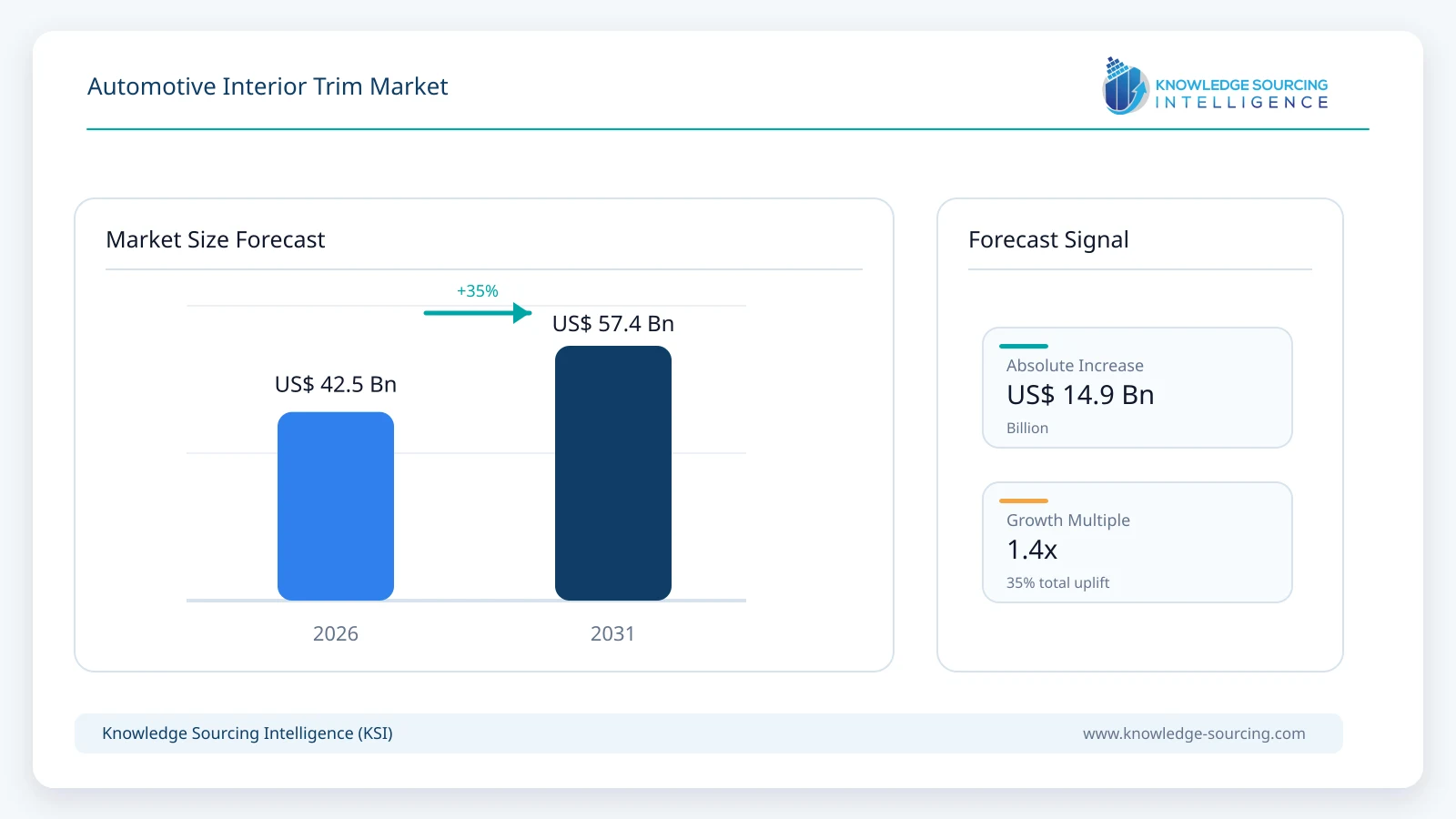
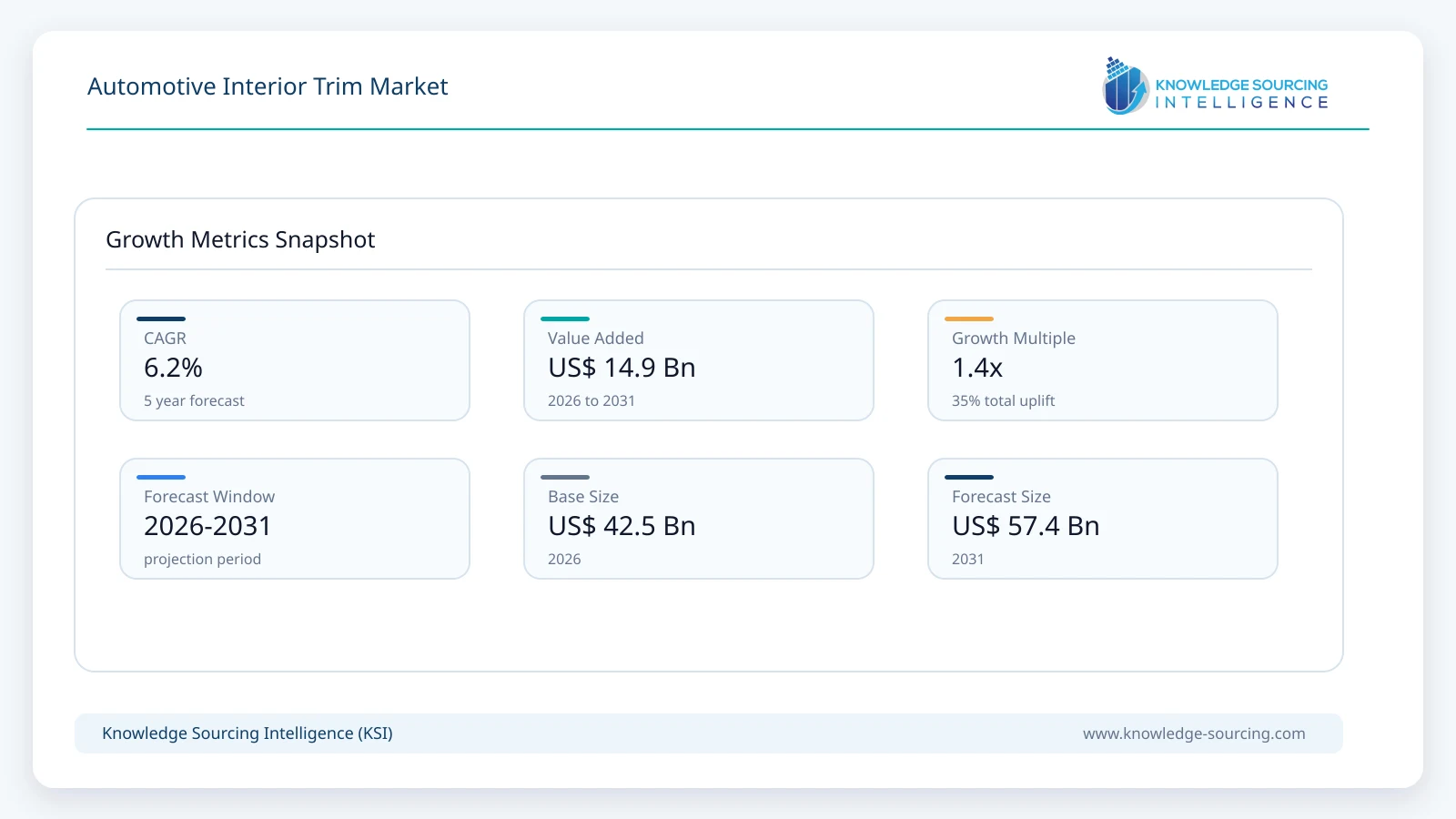
The automotive interior trim market is estimated at approximately USD 42.5 billion in 2026 and is projected to reach about USD 57.4 billion by 2031, representing a CAGR of 6.2% during the forecast period.
Highlights:
- 1Door trim and interior door-surface systems account for approximately 36% of global market value in 2026 because they combine large visible areas with high content in soft trim, decorative inserts, lighting and HMI.
- 2Instrument-panel, dashboard and console trim surfaces represent approximately 29% of 2026 market value, supported by the expansion of large displays, hidden controls and premium decorative materials across front-cabin surfaces.
- 3Soft-touch, wrapped and stitched trim represents approximately 41% of 2026 market value, while hard decorative and molded trim remains important in high-volume cost-sensitive vehicles.
- 4Polymer and polymer-composite trim substrates account for approximately 61% of market value in 2026, but natural-fiber, recycled-PET and mono-material constructions are gaining share through OEM circularity programs.
- 5Electronics-enabled and illuminated trim represents approximately 18% of 2026 market value and is the fastest-growing integration class as ambient lighting, hidden-until-lit graphics and touch controls migrate into interior surfaces.
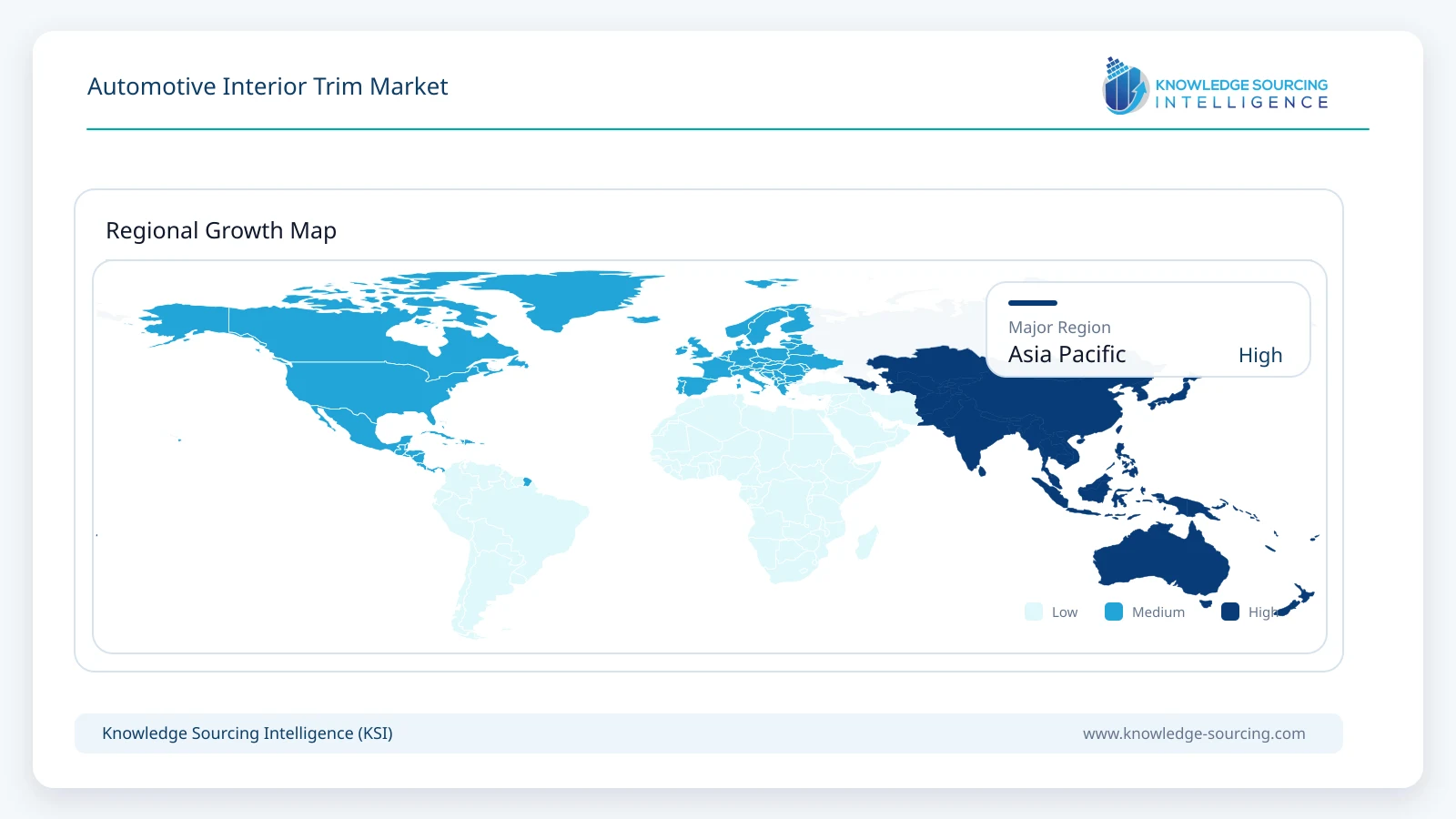
- 6Asia Pacific represents approximately 45% of global market value in 2026, supported by vehicle-production scale and particularly rapid adoption of smart, illuminated and premium interior surfaces in China, Japan and South Korea.
Interior trim is evolving from conventional molded and wrapped surfaces into engineered cabin systems that combine appearance, tactility, illumination, touch interaction, acoustic performance and lower-carbon material construction. Door trim remains the largest product area because each vehicle contains multiple door panels that integrate visible surfaces, armrests, storage, decorative inserts, controls and lighting, while instrument-panel skins, console surfaces, pillar trim and roof-facing materials add substantial value as OEMs coordinate color, grain, stitching and material continuity across the cabin.
Competitive differentiation is increasingly determined by surface technology and system integration rather than molded-part scale alone. Antolin, Yanfeng, FORVIA, Toyota Boshoku, Toyoda Gosei, IAC, Motherson, NBHX and Dräxlmaier are expanding capabilities in smart surfaces, sustainable substrates, decorative films and automated soft-trim production, moving interior trim beyond a styling layer toward a technology-bearing interface. The resulting components must integrate illumination, controls and sensing while still meeting demanding requirements for scratch resistance, VOCs, color harmony, craftsmanship and long-term durability.
Market Overview
Automotive interior trim forms the visible and tactile surface architecture through which occupants experience the cabin, spanning rigid carriers, skins, foam-backed coverings, textiles, decorative films, veneers, metal-like inserts, stitch lines and illuminated surfaces across doors, pillars, dashboards, consoles, roof linings and cargo-side areas. These components must maintain coordinated color, grain, gloss and tactile quality while meeting requirements for heat aging, UV stability, scratch resistance, fogging, odor and flammability. Manufacturing therefore combines injection molding, thermoforming, lamination, wrapping, foaming, vacuum forming, sewing and decorative processes, with hard molded polypropylene remaining common in lower-cost zones and premium areas increasingly using foamed skins, TPO, PVC, polyurethane, synthetic leather, fabric, microfiber and wrapped decorative materials.
Functional integration and sustainability are reshaping trim development at the same time. Light-transmitting skins, decorative films and smart surfaces allow graphics, controls and warnings to remain hidden until activated; Antolin and UltraSense are developing solid-state HMI through automotive surface materials, Toyota Boshoku has commercialized large-area illuminated door trim, and Toyoda Gosei is combining animated lighting with electronically controlled air outlets. In parallel, natural-fiber carriers, recycled polypropylene, recycled PET textiles, mono-material olefin constructions and lower-VOC adhesives are gaining importance as OEMs pursue lower embedded carbon and easier end-of-life recovery, forcing suppliers to balance circularity with appearance, dimensional stability and process consistency.
Market Trends
Smart Surfaces Are Converting Trim into an HMI Layer
Mechanical controls are gradually being replaced by touch, force and haptic interfaces embedded beneath decorative surfaces. Antolin and UltraSense advanced a global-platform Smart Surface HMI initiative in September 2026 that combines solid-state sensing, lighting and feedback within thin interior surfaces, with applications spanning instrument panels, center consoles, doors and overhead systems.
Embedding controls beneath decorative surfaces increases design freedom by allowing HMI elements to disappear when not required, but it also expands the trim supplier's engineering responsibility. Surface opacity, sensor response, haptic transmission, backlighting, EMC and accidental-touch rejection must be developed together, pushing trim suppliers further into electronics integration.
Illuminated Trim Is Moving from Accent Lighting to Large Functional Surfaces
Ambient lighting is expanding beyond thin light guides into backlit and surface-emitting trim. Toyota Boshoku's large-area illuminated door trim adopted on the 2026 Lexus ES uses surface materials and light-transmission technology to create uniform illumination and animated effects across a broader panel area. Toyoda Gosei is likewise using patterned dynamic illumination to create moving light within door interiors.
Large-area illuminated trim creates a new value layer in which decorative surfaces, optics and electronics are engineered as one product rather than sourced as separate elements. The same architecture can support personalization, warnings and visual communication, but achieving uniform brightness and acceptable daylight appearance requires tighter process control than conventional trim.
Automated Sewing Is Reducing Dependence on Skilled Manual Soft-Trim Labor
Soft trim has historically relied on skilled manual sewing and wrapping, especially for three-dimensional surfaces and exposed stitch lines. Toyoda Gosei announced an automated sewing technology in July 2026 that controls flexible outer materials and complex shapes through improved fixtures, machine hardware and control software.
Automated sewing improves stitch consistency, reduces dependence on skilled manual labor and makes localized production more viable in higher-cost regions. The commercial opportunity is strongest in instrument-panel skins, console coverings, armrests and other premium trim where visible stitch quality is part of the brand identity.
Natural-Fiber and Mono-Material Trim Is Gaining Commercial Relevance
FORVIA secured 2026 business for door panels incorporating natural-fiber materials, while Toyota Boshoku continues to develop mono-material interior components and PET circular-economy technologies. These programs show that sustainable trim is moving from concept demonstrators into production-oriented sourcing decisions.
Sustainable interior trim is likely to develop through several material routes rather than one universal solution because each pathway addresses a different part of the lifecycle challenge. Natural fibers reduce mass and fossil-plastic content, recycled polymers lower virgin-resin demand, and mono-material systems simplify end-of-life separation, while each route carries different constraints around stiffness, surface quality, odor, moisture resistance and process compatibility.
Cabin Personalization Is Increasing the Number of Surface Variants per Platform
Automakers increasingly use trim color, texture, lighting and decorative inserts to differentiate trim grades and regional variants from a common vehicle platform. EV brands in particular use the cabin as a visible technology and lifestyle differentiator, with tactile smart materials, wrap-around lighting and coordinated surface themes becoming common in concept and production programs.
Greater use of color, texture, lighting and decorative themes raises variant complexity for trim suppliers as OEMs seek more differentiation from common vehicle platforms. Flexible decoration, digital printing, laser processing and modular inserts therefore become valuable because they expand design choice without requiring a unique hard tool for every theme.
Segment Analysis
By Trim Type: Door Trim and Door-Surface Systems
Door trim is the largest product segment because every passenger vehicle uses multiple door panels and because these surfaces combine high area with high functionality. A complete trim package may include the carrier, soft upper zone, armrest, insert, storage pocket, speaker grille, decorative film, stitching, lighting and HMI interface. Premium vehicles often extend coordinated materials across both front and rear doors.
Door trim and door-surface systems represent approximately USD 15.30 billion in 2026 and could approach USD 20.6 billion by 2031. Growth will be driven by large-area illumination, smart controls, premium soft surfaces and lower-carbon substrates rather than by unit production alone.
By Surface Technology: Soft-Touch, Wrapped and Stitched Trim
Soft-touch and wrapped trim is the largest surface-technology group because occupant-contact areas increasingly use foam-backed skins, synthetic leather, textiles, microfiber and stitched coverings to improve perceived quality. Dashboard uppers, door armrests, center consoles and knee-contact zones carry particularly high soft-trim content.
Soft-touch, wrapped and stitched trim accounts for approximately USD 17.43 billion of market value in 2026 and is expected to benefit from continued cabin premiumization and more automated processing through 2031. Suppliers will nevertheless face pressure to reduce leather-like material thickness, VOCs, adhesives and labor intensity without weakening tactile quality.
By Material Platform: Polymer and Polymer-Composite Trim
Polypropylene, TPO, ABS, PC/ABS, polyurethane and related polymers dominate trim substrates and visible surfaces because they provide design flexibility, low mass and cost-effective high-volume processing. Decorative films and foamed skins can be bonded to these carriers to create premium visual effects without changing the structural base.
Polymer and polymer-composite trim represents approximately USD 25.93 billion in 2026 and should remain the dominant material platform because of its processing flexibility, low mass and cost position. The mix within this category will increasingly shift toward recycled polypropylene, natural-fiber reinforcement, lower-density structures and compatible material families that simplify recycling.
By Functional Integration: Conventional Decorative Trim
Conventional decorative trim remains the largest functional class because a substantial share of pillars, lower-door surfaces, cargo-side panels and hard console parts are still primarily aesthetic and protective rather than electronically active. These parts prioritize fit, finish, durability and cost.
Conventional decorative trim accounts for approximately USD 34.85 billion of 2026 market value and will remain the largest functional class even as illuminated and interactive surfaces expand more quickly. Absolute value should continue to increase through higher vehicle production and broader use of premium decorative processes.
By Vehicle Type: Passenger Vehicles
Passenger cars, SUVs, crossovers and MPVs dominate interior trim demand because they combine the highest global production volumes with the widest variety of decorative surfaces, soft touch points, lighting and personalization options. SUVs are especially important because larger cabins and more trim area raise material and component content per vehicle.
Passenger vehicles represent approximately USD 39.53 billion in 2026 and could approach USD 53 billion by 2031 because they combine high production volumes with the greatest concentration of decorative, soft-touch and smart-surface content. Commercial vehicles remain an important secondary market for durable door, pillar, dashboard and roof trim but generally carry lower premium-surface and smart-HMI content.
Market Drivers
Cabin Premiumization as a Primary Vehicle Differentiator
Vehicle manufacturers increasingly use the cabin as a primary expression of brand positioning because surface grain, stitching, trim inserts, soft-touch zones and coordinated lighting are visible at every occupant interaction. These elements therefore have a direct influence on perceived quality and the differentiation between trim grades.
Interior-led differentiation supports content growth even in mature vehicle markets as mid-range models adopt trim features that were previously limited to luxury segments. The shift expands demand for wrapped surfaces, premium decorative films and illuminated components without relying solely on higher vehicle production.
Expansion of Ambient Lighting and Smart-Surface HMI
Lighting and interactive controls are moving directly into trim surfaces as OEMs pursue cleaner cabin designs with fewer protruding buttons and more context-aware interfaces. Integrating these functions into the surface also creates greater scope for personalized visual themes and hidden-until-needed controls.
Integration of lighting and smart HMI directly increases trim-system value through LEDs, optics, sensors, electronics and software interfaces, shifting revenue toward suppliers that can engineer the complete functional surface. Companies with combined surface and electronics capability are therefore positioned to capture more content per vehicle than conventional plastics processors.
Sustainability, Recycled Content and Circularity Targets
Automakers are tightening recycled-material and lifecycle-carbon requirements across cabin components, making interior trim a major target because doors, pillars, dashboards, consoles and roof surfaces collectively consume significant quantities of polymers, foam and textiles. The scale of this material use gives trim programs meaningful leverage over embedded carbon and end-of-life recovery.
Natural fibers, recycled PET, recycled polypropylene and mono-material architectures can lower environmental impact while retaining high production volume. Supplier competitiveness increasingly depends on proving material traceability and lifecycle benefits alongside conventional cost and quality metrics.
Growth of EV and Software-Defined Vehicle Interiors
Electric and software-defined vehicles are changing the cabin from a control-heavy environment into a cleaner digital living space. This favors seamless surfaces, hidden controls, large decorative areas and coordinated illumination across doors, instrument panels, consoles and roof zones.
Software-defined and EV cabin architectures often carry more electronics within the surface while eliminating separate switch bezels and standalone control elements. Suppliers that can integrate smart surfaces into lightweight trim structures therefore benefit directly from the redesign of the cabin interface.
Automation and Flexible Decoration Technologies
Labor-intensive sewing, wrapping and decorative assembly can constrain premium-trim economics, especially as OEMs increase visible stitch lines and variant complexity. Automated sewing, laser decoration, digital printing and flexible film processing improve consistency while allowing greater design variation without proportional labor growth.
Automation and flexible decoration also support more regionalized manufacturing by reducing dependence on low-cost manual labor and improving process repeatability. Suppliers can therefore locate production closer to OEM plants while maintaining competitive cost and responding more quickly to design changes.
Market Restraints
High Styling Variability and Vehicle-Specific Tooling
Interior trim is tightly tied to each vehicle's styling theme and geometry because door panels, pillar trim, dashboard skins and console parts require vehicle-specific molds, wrapping fixtures and decorative tools. Color, grain and material variants then multiply the number of production combinations that must be controlled within the same program.
Late styling or geometry changes can create substantial tooling rework and validation cost because trim components depend heavily on dedicated molds, fixtures and decorative processes. The financial risk is particularly high on low-volume derivatives where premium trim may not achieve sufficient tooling utilization.
Durability, VOC and Surface-Quality Requirements
Trim surfaces must withstand UV exposure, heat, humidity, cleaning chemicals, abrasion and repeated occupant contact without fading, peeling or developing odor. Soft materials and recycled feedstocks can be especially challenging because variations in composition may affect appearance and emissions.
Qualification of new trim materials remains demanding because OEMs require extensive aging, fogging, odor, abrasion and appearance validation before established constructions can be replaced. These requirements can slow adoption of sustainable materials and adhesives even when their environmental case is attractive.
Complex Recycling of Multi-Layer Premium Trim
Premium trim often combines a rigid carrier, foam, skin, adhesive, stitching, decorative insert and electronics. These layers can use incompatible polymers and are difficult to separate economically at end of life.
Mono-material concepts can improve recyclability, but they may limit tactile feel, decorative options or structural performance. Circularity therefore requires redesign of the complete trim architecture rather than a simple substitution of one material.
Cost Pressure on High-Volume Interior Components
Large portions of the trim market remain highly cost sensitive because OEMs expect recurring productivity improvements from high-volume door, pillar and console components even as raw-material, energy and labor costs fluctuate. This creates continuous pressure on process efficiency and material utilization.
Premium surfaces and embedded electronics raise revenue per vehicle but also increase warranty exposure, process complexity and validation requirements. Suppliers therefore need automation, localized sourcing and platform reuse to prevent higher technology content from eroding program margins.
Cross-Domain Integration Complexity for Smart Trim
Smart surfaces require collaboration across trim, electronics, software, lighting and vehicle-network teams. A visually simple panel can conceal substantial complexity in sensing, illumination, diagnostics and EMC performance.
Responsibility can become fragmented between the surface supplier and electronics provider, increasing program-management risk. This favors larger Tier 1 suppliers with systems-integration capability but can slow adoption on cost-sensitive platforms.
Regional Outlook
Asia Pacific
Asia Pacific is the largest automotive interior trim market, supported by high vehicle production in China, Japan, South Korea, India and Southeast Asia. China is the strongest content-growth market because domestic EV manufacturers use lighting, tactile materials, large decorative surfaces and smart HMI as visible differentiators in increasingly technology-focused cabins.
Asia Pacific also benefits from a deep interior-systems supplier base that supports rapid industrialization of new surface technologies. Yanfeng combines complete interior systems with smart materials and lighting, Toyota Boshoku is advancing illuminated and circular trim technologies, Toyoda Gosei is automating premium sewing and expanding Indian production, and global suppliers including FORVIA and Antolin maintain broad Asian manufacturing footprints.
Asia Pacific growth through 2031 will be supported by both vehicle production and rising trim value per cabin as advanced surfaces move beyond premium models. China will lead smart and illuminated trim adoption, while India and Southeast Asia provide additional expansion for cost-optimized molded and soft-trim systems supported by new localized capacity.
Europe
Europe is a major high-value interior trim market because premium vehicle production, stringent surface-quality expectations and sustainability targets support advanced decorative materials and lower-carbon substrates. European OEMs increasingly specify natural fibers, recycled polymers, premium soft surfaces and hidden digital controls across coordinated cabin themes.
Europe's competitive base is led by suppliers with strong capabilities in premium surfaces, sustainable materials and integrated interior modules. FORVIA secured 2026 business for instrument and door panels using natural-fiber materials, while Antolin is integrating solid-state HMI into interior surfaces and expanding AI-assisted engineering; Motherson, IAC, NBHX and Dräxlmaier add broad regional capabilities in decorative trim and integrated modules.
Regional vehicle volumes may grow slowly, but value per vehicle should increase through smart surfaces, premium material execution and stricter circularity requirements. Europe will remain an important development base for sustainable surface technologies and automation of high-quality soft trim.
Competitive Landscape
The automotive interior trim market is fragmented across large global Tier 1 interior suppliers, specialist decorative-surface companies and textile or material providers. Antolin, Yanfeng, FORVIA, Toyota Boshoku, Toyoda Gosei, IAC, Motherson, NBHX and Dräxlmaier compete across broad OEM programs, while Sage Automotive Interiors, Hayashi Telempu and other specialists contribute fabrics, technical textiles and premium surface technologies.
Competitive differentiation increasingly depends on how broadly suppliers can combine decorative surfaces, sustainable materials, lighting and electronics within validated interior systems. Antolin combines trim with lighting and smart-surface electronics; Yanfeng combines materials, illumination and complete cabin integration; FORVIA emphasizes sustainable materials and integrated interior architectures; Toyota Boshoku combines surface innovation with circular-material development; and Toyoda Gosei is improving production economics through automated sewing and optical technologies.
Manufacturing capability remains a critical competitive factor because interior trim is both highly visible and variant intensive, requiring consistent color, grain, gloss and stitch quality across plants and vehicle derivatives. Suppliers with automated decoration, strong process control and localized production can reduce launch risk while supporting more customization without disproportionate cost.
Future competition will increasingly center on the ability to integrate circular materials and electronics within one validated trim architecture rather than treat them as separate development tracks. Suppliers able to combine lower-carbon substrates, premium tactile surfaces, lighting and HMI can capture more value while reducing the number of interfaces managed by the OEM.
Recent Developments
24 September 2026: Toyoda Gosei announced a new automotive interior and exterior plant in Maharashtra, India, scheduled to begin operations in 2029 and equipped for large molded interior products including instrument panels, supporting localization of interior-trim production in a high-growth market.
8 September 2026: Antolin and UltraSense Systems advanced a global-platform Smart Surface HMI development initiative that integrates touch, force sensing, lighting and haptic feedback directly into automotive interior surfaces.
24 July 2026: Toyoda Gosei announced an automated sewing technology for three-dimensional automotive interior outer surfaces, reducing dependence on skilled manual sewing and improving stitch consistency for premium trim products.
29 June 2026: Yanfeng unveiled the production-ready XiM27 smart cabin, combining sustainable and recyclable materials with tactile smart surfaces, wrap-around lighting and integrated interior functions.
11 June 2026: Toyota Boshoku announced adoption of its large-area illuminated door trim on the new Lexus ES, using surface and light-transmission technologies to create uniform animated illumination.
29 January 2026: FORVIA announced major new business with a European automaker covering instrument and door panels, including natural-fiber materials in the door panels to support lighter and more sustainable interiors.
Market Outlook
The automotive interior trim market is expected to expand from approximately USD 42.500 billion in 2026 to about USD 57.413 billion by 2031. Door trim will remain the largest product area, while smart, illuminated and soft-touch surfaces grow faster than conventional hard trim.
Interior trim will become more technology intensive even as visible cabin design becomes simpler, because hidden controls, large-area lighting, integrated vents and fewer mechanical interfaces shift more engineering beneath the surface. This increases the value of electronics-ready trim architectures and flexible decorative processes through the forecast period.
Asia Pacific will remain the largest regional market, while Europe continues to generate high value per vehicle through premium craftsmanship and sustainability-led sourcing. Supplier success will depend on combining low-carbon materials, automation, consistent surface quality and smart-function integration within cost-competitive global platforms.
Automotive Interior Trim Market Scope
| Report Metric | Details |
|---|---|
| Total Market Size in 2026 | USD 42.5 billion |
| Total Market Size in 2031 | USD 57.4 billion |
| Forecast Unit | Billion |
| Growth Rate | 6.2% |
| Study Period | 2021 to 2031 |
| Historical Data | 2021 to 2024 |
| Base Year | 2025 |
| Forecast Period | 2026 – 2031 |
| Segmentation | Trim Type, Surface Technology, Material Platform, Functional Integration, Vehicle Type, Geography |
| Companies |
|
Market Segmentation
By Trim Type
Door Trim and Door-Surface Systems
Instrument Panel and Dashboard Trim
Center Console and Floor-Console Trim
Pillar, Side and Quarter Trim
Headliner and Roof-Facing Trim
Cargo, Trunk and Other Interior Trim
By Surface Technology
Hard-Molded Decorative Trim
Soft-Touch, Wrapped and Stitched Trim
Textile and Microfiber Trim
Illuminated and Smart Functional Surfaces
By Material Platform
Polymer and Polymer-Composite Trim
Textile, Synthetic Leather and Soft Surface Materials
Natural-Fiber and Bio-Composite Trim
Recycled and Mono-Material Trim
Wood, Metal, Stone and Premium Decorative Materials
By Functional Integration
Conventional Decorative Trim
Acoustic and Comfort-Integrated Trim
Lighting-Integrated Trim
Electronics and HMI-Integrated Smart Trim
By Vehicle Type
Passenger Vehicles
Light Commercial Vehicles
Medium and Heavy Commercial Vehicles
Buses and Specialty Vehicles
By Geography
North America
United States
Canada
Mexico
South America
Brazil
Argentina
Others
Europe
Germany
United Kingdom
France
Italy
Spain
Others
Middle East and Africa
Saudi Arabia
UAE
South Africa
Others
Asia Pacific
China
Japan
South Korea
India
Indonesia
Thailand
Others
Table of Contents
1. INTRODUCTION
1.1. Market Overview
1.2. Market Definition
1.3. Scope of the Study
1.4. Market Segmentation
1.5. Currency
1.6. Assumptions
1.7. Base and Forecast Years
1.8. Key Benefits to Stakeholders
2. RESEARCH METHODOLOGY
2.1. Research Design
2.2. Secondary Research
2.3. Primary Research
2.4. Market Estimation
2.5. Segment Modelling
2.6. Data Triangulation and Validation
3. EXECUTIVE SUMMARY
3.1. Key Findings
3.2. Automotive Interior Trim Market Size, 2026-2031
3.3. Trim Type Outlook
3.4. Surface Technology Outlook
3.5. Material Platform Outlook
3.6. Functional Integration Outlook
3.7. Vehicle Type Outlook
3.8. Regional Opportunity Summary
4. MARKET DYNAMICS
4.1. Market Drivers
4.1.1. Cabin Premiumization as a Primary Vehicle Differentiator
4.1.2. Expansion of Ambient Lighting and Smart-Surface HMI
4.1.3. Sustainability, Recycled Content and Circularity Targets
4.1.4. Growth of EV and Software-Defined Vehicle Interiors
4.1.5. Automation and Flexible Decoration Technologies
4.2. Market Restraints
4.2.1. High Styling Variability and Vehicle-Specific Tooling
4.2.2. Durability, VOC and Surface-Quality Requirements
4.2.3. Complex Recycling of Multi-Layer Premium Trim
4.2.4. Cost Pressure on High-Volume Interior Components
4.2.5. Cross-Domain Integration Complexity for Smart Trim
4.3. Market Opportunities
4.4. Porter's Five Forces Analysis
4.5. Industry Value Chain Analysis
4.6. Trim Content, Decoration and Tooling Economics
4.7. Flammability, VOC, Surface Durability and Circularity Requirements
5. TECHNOLOGY OUTLOOK
5.1. Injection-Molded Hard Trim and Decorative Substrates
5.2. Soft-Touch, Wrapped and Foam-Backed Surfaces
5.3. Automated Sewing and Decorative Stitching
5.4. Decorative Films, Foils and In-Mold Decoration
5.5. Natural-Fiber and Bio-Composite Trim Carriers
5.6. Recycled Polymer and PET-Based Trim
5.7. Mono-Material Interior Trim Architectures
5.8. Backlit and Large-Area Illuminated Surfaces
5.9. Smart Surface Touch, Force and Haptic HMI
5.10. Digital Printing, Laser Decoration and Personalization
5.11. Integrated Air Vents, Speakers and Local Controls
5.12. Design-for-Disassembly and End-of-Life Material Recovery
6. AUTOMOTIVE INTERIOR TRIM MARKET BY TRIM TYPE
6.1. Introduction
6.2. Door Trim and Door-Surface Systems
6.3. Instrument Panel and Dashboard Trim
6.4. Center Console and Floor-Console Trim
6.5. Pillar, Side and Quarter Trim
6.6. Headliner and Roof-Facing Trim
6.7. Cargo, Trunk and Other Interior Trim
7. AUTOMOTIVE INTERIOR TRIM MARKET BY SURFACE TECHNOLOGY
7.1. Introduction
7.2. Hard-Molded Decorative Trim
7.3. Soft-Touch, Wrapped and Stitched Trim
7.4. Textile and Microfiber Trim
7.5. Illuminated and Smart Functional Surfaces
8. AUTOMOTIVE INTERIOR TRIM MARKET BY MATERIAL PLATFORM
8.1. Introduction
8.2. Polymer and Polymer-Composite Trim
8.3. Textile, Synthetic Leather and Soft Surface Materials
8.4. Natural-Fiber and Bio-Composite Trim
8.5. Recycled and Mono-Material Trim
8.6. Wood, Metal, Stone and Premium Decorative Materials
9. AUTOMOTIVE INTERIOR TRIM MARKET BY FUNCTIONAL INTEGRATION
9.1. Introduction
9.2. Conventional Decorative Trim
9.3. Acoustic and Comfort-Integrated Trim
9.4. Lighting-Integrated Trim
9.5. Electronics and HMI-Integrated Smart Trim
10. AUTOMOTIVE INTERIOR TRIM MARKET BY VEHICLE TYPE
10.1. Introduction
10.2. Passenger Vehicles
10.3. Light Commercial Vehicles
10.4. Medium and Heavy Commercial Vehicles
10.5. Buses and Specialty Vehicles
11. AUTOMOTIVE INTERIOR TRIM MARKET BY GEOGRAPHY
11.1. North America
11.1.1. United States
11.1.2. Canada
11.1.3. Mexico
11.2. South America
11.2.1. Brazil
11.2.2. Argentina
11.2.3. Others
11.3. Europe
11.3.1. Germany
11.3.2. United Kingdom
11.3.3. France
11.3.4. Italy
11.3.5. Spain
11.3.6. Others
11.4. Middle East and Africa
11.4.1. Saudi Arabia
11.4.2. UAE
11.4.3. South Africa
11.4.4. Others
11.5. Asia Pacific
11.5.1. China
11.5.2. Japan
11.5.3. South Korea
11.5.4. India
11.5.5. Indonesia
11.5.6. Thailand
11.5.7. Others
12. COMPETITIVE ENVIRONMENT AND ANALYSIS
12.1. Major Players and Strategy Analysis
12.2. Market Share Analysis
12.3. Door, Dashboard and Console Trim Portfolio Benchmarking
12.4. Soft-Trim and Decorative Process Benchmarking
12.5. Smart Surface and Lighting Integration Benchmarking
12.6. Sustainable Material and Circularity Benchmarking
12.7. Manufacturing Footprint, Automation and OEM Programs
12.8. Competitive Dashboard
13. COMPANY PROFILES
13.1. Antolin
13.2. Yanfeng Automotive Interiors
13.3. FORVIA
13.4. Toyota Boshoku Corporation
13.5. Toyoda Gosei Co., Ltd.
13.6. International Automotive Components (IAC) Group
13.7. Motherson Group
13.8. NBHX
13.9. Dräxlmaier Group
13.10. Sage Automotive Interiors
13.11. Hayashi Telempu Corporation
13.12. Seoyon E-Hwa
14. APPENDIX
14.1. Currency
14.2. Assumptions
14.3. Base and Forecast Years Timeline
14.4. Key Benefits for Stakeholders
14.5. Research Methodology
14.6. Abbreviations
14.7. Data Sources
Navigate
Trusted by the world's leading organizations











