
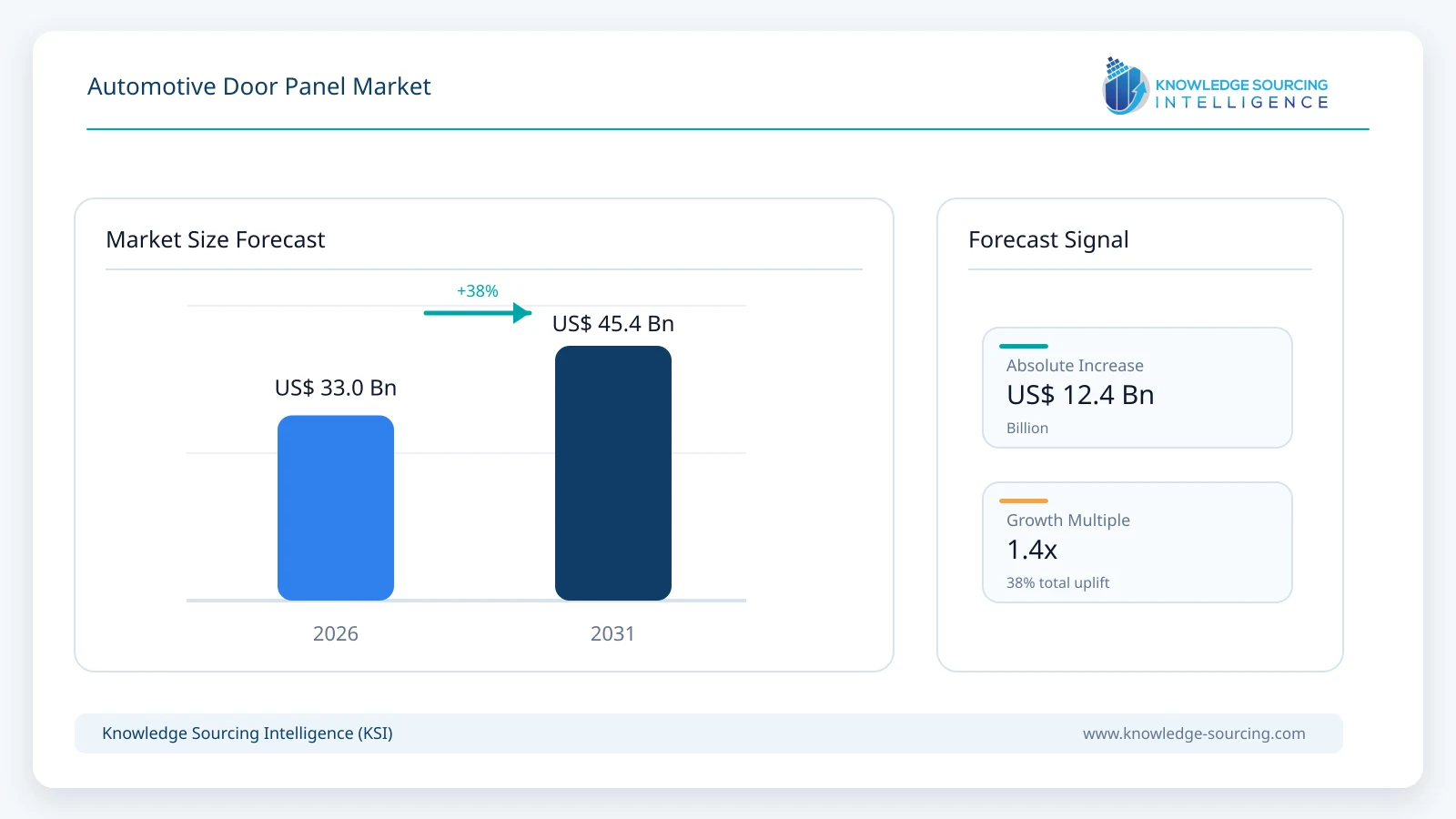
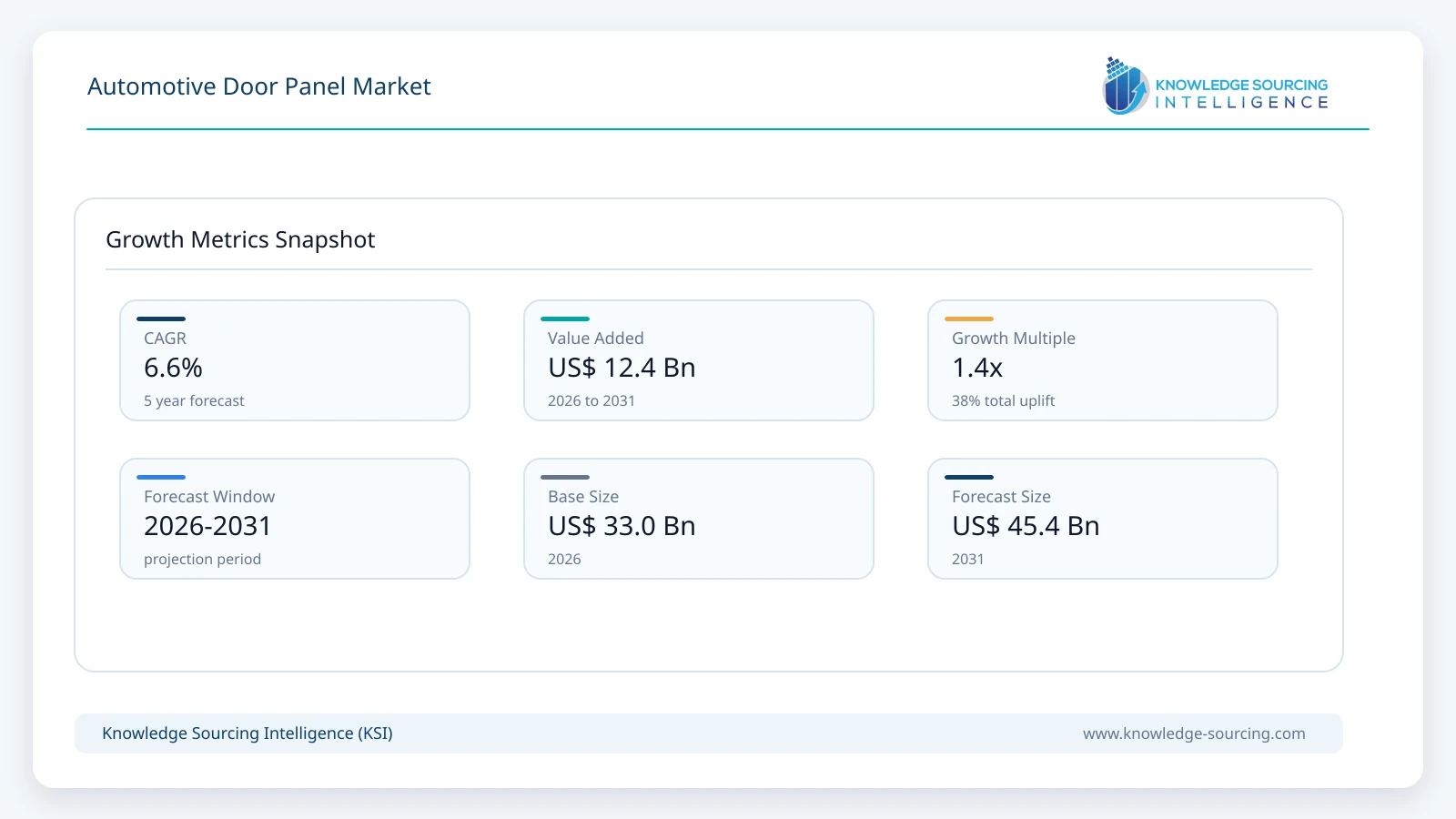
The automotive door panel market is estimated at approximately USD 33.0 billion in 2026 and is projected to reach about USD 45.4 billion by 2031, representing a CAGR of 6.6% during the forecast period.
Highlights:
- 1Conventional molded and partially trimmed door panels account for approximately 47% of global market value in 2026 because they remain the dominant architecture across high-volume passenger vehicles.
- 2Soft-touch, wrapped and premium-surfaced panels represent approximately 32% of 2026 market value, supported by higher use of foam-backed skins, stitched inserts, decorative films and premium tactile zones.
- 3Electronics-integrated smart door panels account for approximately 21% of 2026 market value and are the fastest-growing architecture as lighting, solid-state controls, sensing and information surfaces migrate into the door trim.
- 4Polymer and polymer-composite assemblies represent approximately 69% of market value in 2026, while natural-fiber and recycled-material carriers are gaining share through lightweighting and circularity programs.
- 5Front door panels account for approximately 58% of 2026 market value because they carry higher HMI, armrest, switchgear, speaker and decorative content than rear panels.
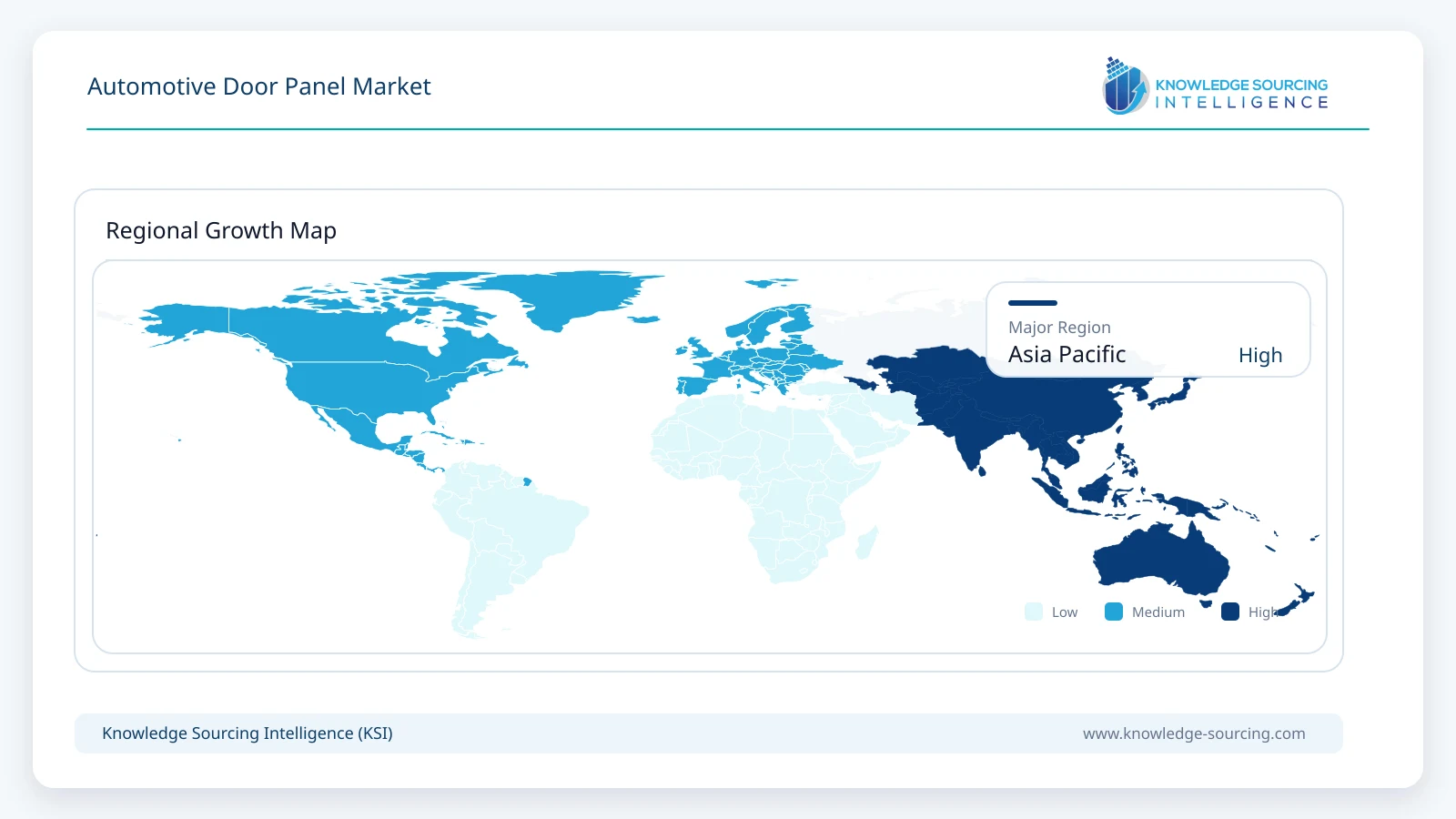
- 6Asia Pacific represents approximately 46% of global market value in 2026, supported by vehicle-production scale and rapid adoption of premium lighting and smart interior surfaces in China, Japan and South Korea.
Door panels are evolving from predominantly molded trim assemblies into higher-value systems that combine visible surfaces, storage, speakers, lighting, electronic controls, sensor interfaces and increasingly software-configurable HMI. Their large visible area gives them substantial perceived-quality importance, which is driving wider use of soft-touch materials, stitching, decorative foils, backlighting and illuminated inserts across premium and increasingly mainstream vehicle segments.
Material and technology integration are becoming the main sources of value growth within the door-panel system. Hidden carriers are being redesigned with natural fibers, recycled polymers, chemical foaming and mono-material concepts to reduce mass and improve recyclability, while suppliers are adding lighting, sensing and information functions to the visible surface. Antolin positions the door as an integration point for electronics, lighting and decorative inserts, Toyota Boshoku has commercialized large-area illuminated door trim on the Lexus ES, and FORVIA is developing transparent and projected-door concepts, shifting competition away from plastic molding alone toward multi-technology integration.
Market Overview
A complete automotive door panel combines several functional layers within one vehicle-specific assembly: the hidden carrier provides stiffness, mounting points and impact support; visible upper and lower surfaces deliver styling and tactile quality; armrests and pull handles carry occupant loads; and storage pockets, speaker grilles, switches and decorative inserts complete the user interface. Premium systems add foam-backed skins, leather or synthetic coverings, RGB lighting and high-value trim, while the same panel increasingly carries window, mirror and seat-memory controls alongside capacitive or force-sensitive HMI, backlit graphics, proximity sensing and ambient lighting. These functions must be integrated without increasing visible seams, part count or assembly complexity.
Material engineering, acoustic behavior and electronics integration are reshaping the door panel beyond its traditional trim role. Toyota Boshoku has developed lightweight foam-molded door trims and mono-material olefin concepts, while FORVIA has commercialized and demonstrated natural-fiber and lower-carbon door-panel solutions that reduce weight and improve end-of-life performance without compromising impact, odor, dimensional or surface-quality requirements. At the same time, substrates, foams and inserts contribute to sound absorption, vibration control and speaker sealing, making squeak-and-rattle performance increasingly important as quieter electric powertrains expose interior noise that was previously masked.
Market Trends
Door Panels Are Becoming Multi-Technology Interior Platforms
The door panel is no longer only a decorative trim component. Antolin's current door portfolio combines trim, mechanisms, electronics, lighting and decorative inserts, while concept programs such as NEXUS position the panel as a platform for HMI, active visual information, storage and comfort functions. Similar integration is appearing across premium and EV platforms.
Multi-technology door architectures increase the share of electronics and system-integration value within each panel because plastics, surfaces, lighting, sensors and local controls must increasingly function as one validated assembly. Suppliers able to coordinate these domains can capture more content than component-only molders while also simplifying OEM sourcing.
Large-Area Illumination Is Moving Beyond Decorative Light Strips
Door lighting is shifting from narrow ambient light guides toward broader illuminated surfaces. Toyota Boshoku's 2026 Lexus ES door trim uses surface materials and transmission technology to create large-area uniform illumination and animated visual effects, demonstrating a production path for lighting integrated directly into the visible door surface.
Large-area illuminated door surfaces expand design freedom while also raising optical, thermal and material-performance requirements. Light diffusion, color uniformity, daylight appearance and surface durability must be engineered together, making the illuminated door panel a combined trim-and-electronics product rather than a conventional molded assembly.
Smart-Surface Controls Are Replacing Standalone Switch Modules
Touch, force sensing and hidden-until-lit graphics are increasingly being embedded in interior trim. Antolin and UltraSense announced a next-generation solid-state Smart Surface HMI initiative in September 2026, combining touch and force sensing with visual and haptic feedback for future interior applications.
Door panels are a natural target for smart-surface HMI because they already host window, mirror and seat-memory controls within a confined visible area. Moving these functions into the surface can reduce bezels and separate switch parts, but it also increases requirements for accidental-touch rejection, haptic quality, EMC performance and software validation.
Natural-Fiber, Recycled and Mono-Material Panels Are Gaining Strategic Importance
Door panels are large contributors to interior polymer mass, which makes them a priority for carbon reduction and circularity. FORVIA won 2026 business for natural-fiber door panels, while Toyota Boshoku has developed mono-material olefin door trims and expanded use of kenaf-based carriers. Antolin also offers natural-fiber and chemically foamed door-panel solutions.
Door-panel sustainability strategies are developing along two complementary paths: lower-carbon multi-material systems that reduce weight and mono-material architectures that simplify recycling. Full mono-material implementation remains technically demanding because armrests, soft surfaces, lighting and electronics often require different material properties.
Transparent and Informative Door Surfaces Are Emerging
FORVIA's Gen 2 Transparent Door uses projection technology in the upper door panel to provide external visibility and safety information while also supporting dynamic ambient-lighting functions. The concept illustrates how the door panel can become a display or communication surface in future vehicles.
Projected and informative door surfaces are likely to remain concentrated in premium and technology-led programs in the near term because projection, optics and sensor integration add cost and validation complexity. Even so, the concept points toward a broader shift in which trim surfaces can provide context-aware information without adding conventional screens.
Segment Analysis
By Panel Architecture: Conventional Molded and Partially Trimmed Door Panels
Conventional molded and partially trimmed panels remain the largest architecture because they offer the best balance of cost, durability and styling flexibility for high-volume vehicles. These systems typically use injection-molded polypropylene or engineered thermoplastics with selected fabric, film or soft-touch inserts in occupant-contact areas.
Conventional molded and partially trimmed door panels represent approximately USD 15.51 billion in 2026 and could approach USD 19.4 billion by 2031, preserving their role as the volume foundation of the market despite faster growth in premium surfaces and electronics. Their cost and manufacturing advantages will keep the architecture particularly important in compact cars, entry SUVs and commercial vehicles.
By Surface Type: Soft-Touch, Wrapped and Premium Door Panels
Soft-touch and premium door panels combine molded carriers with foam, leather, synthetic leather, textile, decorative film or stitched inserts to improve perceived quality. Upper door zones and armrests receive the highest premium treatment because they are visible and frequently touched.
Soft-touch, wrapped and premium door panels account for approximately USD 10.56 billion in 2026 and could exceed USD 15 billion by 2031 as SUVs, EVs and higher trims adopt more tactile and decorative content. Lower-carbon synthetic materials and more automated wrapping or forming processes will be important for controlling cost as this premiumization broadens.
By Functional Integration: Electronics-Integrated Smart Door Panels
Smart door panels combine conventional trim and storage functions with lighting, HMI, sensors, display or connectivity features. These systems can integrate capacitive controls, backlit graphics, RGB illumination, proximity sensing and information projection within a single visible surface.
Electronics-integrated smart door panels represent approximately USD 6.93 billion in 2026 and are expected to grow faster than the overall market as OEMs move more lighting, HMI and sensing into the visible surface. The strongest opportunity lies in platforms where a common electronics architecture can be reused across multiple door variants while supporting a cleaner visual design.
By Material Platform: Polymer and Polymer-Composite Assemblies
Thermoplastics remain the dominant material platform because they enable complex geometry, low mass, integrated attachment features and cost-effective high-volume production. Natural-fiber reinforcement, chemical foaming and recycled polymers are increasingly added to reduce weight and carbon footprint.
Polymer and polymer-composite assemblies account for approximately USD 22.77 billion of market value in 2026 and will remain the dominant material platform through 2031 because of their cost, weight and manufacturing advantages. The composition within this category will increasingly shift toward recycled polypropylene, foamed structures, kenaf and other lower-carbon materials, particularly in hidden carriers.
By Door Position: Front Door Panels
Front door panels carry higher content than rear panels because they usually integrate window and mirror controls, larger armrests, more complex speaker systems, premium decorative zones and sometimes seat-memory or door-access controls. Driver-side panels also carry additional switchgear and ergonomic requirements.
Front door panels represent approximately USD 19.14 billion of market value in 2026 and could approach USD 26 billion by 2031 because they carry the highest concentration of controls, speakers, armrest content and decorative treatment. Rear panels will gain content as ambient lighting and premium surfaces expand across the full cabin, but front doors will remain the larger value pool.
Market Drivers
Interior Premiumization and Higher Perceived-Quality Requirements
The door panel is one of the first surfaces occupants see and touch when entering a vehicle. OEMs therefore use soft materials, stitching, decorative inserts, metal-like accents and lighting to create a stronger quality impression, particularly in SUVs, premium vehicles and EVs.
Interior premiumization raises average value per door panel even when underlying vehicle production is stable because higher-value surfaces, lighting and decorative processes add content without changing the basic component count. Suppliers with advanced surface technologies and automated finishing processes benefit by delivering premium appearance without relying entirely on labor-intensive assembly.
Growth of Ambient, Functional and Informative Lighting
Ambient lighting is spreading from premium models into mid-market vehicles and is increasingly extended through doors, instrument panels and consoles as one coordinated interior theme. Newer door-panel systems use backlighting and surface illumination rather than only narrow light strips.
Ambient and functional lighting increase door-panel value through LEDs, optics, electronics and software-controlled effects while also requiring tighter coordination between visible surface materials and electronic subsystems. This favors suppliers with in-house lighting, optical or smart-surface capability rather than those focused only on molded trim.
Lightweighting Pressure from EV and Efficiency Programs
Door panels are large components and therefore offer meaningful mass-reduction opportunities. Foamed molding, natural-fiber substrates and optimized carrier structures can reduce weight without changing the visible design or customer-facing features.
Door-panel lightweighting carries particular value in battery-electric vehicles because lower mass supports range and energy efficiency without reducing visible cabin functionality. Toyota Boshoku states that its lightweight molded foam door trim can reduce weight by roughly 20% compared with conventional materials while maintaining impact resistance.
Circularity and Recycled-Content Targets
Automakers are setting higher recycled-content and lifecycle-emissions targets for interior plastics. Door trims are a major focus because they use substantial quantities of polymer and often contain several materials that are difficult to separate at end of life.
Mono-material designs, recycled polypropylene, natural-fiber carriers and removable electronics can improve door-panel circularity by reducing virgin-resin demand and simplifying end-of-life separation. Suppliers that deliver these gains without sacrificing tactile quality, impact resistance or cost are increasingly attractive during new-platform sourcing.
Integration of HMI, Controls and Smart Interior Functions
Window switches, mirror controls and seat-memory functions have traditionally been mounted as separate modules in the door panel. Smart-surface HMI allows these functions to be integrated into one continuous decorative surface, reducing visible part count and supporting software-configurable interfaces.
Smart-surface HMI increases the technology content of the door panel and gives interior suppliers a larger role in electronics integration as more controls move into decorative surfaces. The opportunity is strongest where OEMs want a consistent HMI language across the dashboard, console and door surfaces.
Market Restraints
High Tooling Cost and Vehicle-Specific Geometry
Door panels require large injection molds, surface tools, wrapping fixtures and assembly equipment tailored to a specific door aperture and interior design. Front and rear panels often have different geometry, and left-hand and right-hand variants can further increase tooling complexity.
Late changes to styling, speaker packaging, switch placement or storage geometry can require expensive mold and fixture revisions because door panels are tightly tied to each vehicle aperture and interior theme. Program economics therefore depend heavily on planned volumes and platform life, creating financial exposure when launches are delayed or production is reduced.
Complex Multi-Material Construction and End-of-Life Separation
Premium door panels combine rigid polymers, foams, fabrics, leather alternatives, decorative films, adhesives, metal inserts, speakers, lighting and electronics. This makes recycling more difficult than for a single-material molded component.
Mono-material concepts can reduce end-of-life separation complexity, but soft armrests, premium surfaces and electronic functions often require different mechanical, tactile and thermal properties. Achieving circularity without compromising comfort, design freedom and system performance therefore remains a significant engineering challenge.
Squeak, Rattle and Long-Term Surface Durability
Door panels experience repeated closing shocks, temperature cycles, vibration and frequent occupant contact. Loose clips, dimensional drift or interaction between different materials can create squeak-and-rattle issues that become especially noticeable in quiet electric vehicles.
Premium door-panel surfaces must resist scratching, fading, cleaning chemicals and long-term UV exposure while also maintaining consistent color and tactility across the vehicle life. These durability requirements increase validation cost and can limit the use of new recycled or bio-based materials until lifecycle performance is proven.
Cost Pressure on High-Volume Interior Components
Despite increasing technology content, door panels remain high-volume parts subject to aggressive OEM cost targets. Plastic resin, labor, textiles and electronics can all experience inflation, while annual productivity requirements compress supplier margins.
Sustaining margins in high-volume door-panel programs increasingly requires high automation, localized production and design-for-assembly because materials, labor and electronics costs can rise faster than OEM price allowances. Higher-value smart functions improve revenue per vehicle but also create additional warranty and validation exposure that must be managed carefully.
Packaging Constraints from Speakers, Side Airbags and Door Electronics
The door panel must package speakers, handles, storage, wiring, window mechanisms and side-impact or airbag interfaces within limited thickness. Increasing lighting and electronic content competes for the same space and can complicate serviceability.
Packaging pressure becomes particularly acute in thinner EV door designs and premium audio systems where large speakers, wiring, lighting and electronic modules compete for limited depth. Suppliers must therefore coordinate closely with complete door-module and body-in-white teams to avoid conflicts late in development.
Regional Outlook
Asia Pacific
Asia Pacific is the largest automotive door panel market, supported by vehicle-production scale in China, Japan, South Korea and India. China is the strongest content-growth market because domestic EV manufacturers use ambient lighting, smart surfaces, premium decorative materials and integrated HMI to differentiate cabin experience.
Asia Pacific also benefits from a deep supplier ecosystem capable of industrializing both high-volume molded panels and more advanced smart-surface systems. Yanfeng, Toyota Boshoku, Hyundai Mobis, Seoyon E-Hwa and major global suppliers including FORVIA and Antolin maintain significant local manufacturing and engineering capacity, while Toyota Boshoku's 2026 illuminated door trim for the Lexus ES demonstrates the region's ability to commercialize advanced surface and lighting technologies.
Asia Pacific growth through 2031 will be supported by both vehicle volume and higher content per door panel as advanced lighting, HMI and premium surfaces expand across more programs. China should remain the fastest adopter of smart and illuminated panels, while India and Southeast Asia provide additional growth for cost-optimized molded and partially trimmed systems.
Europe
Europe is a major high-value door panel market due to premium vehicle production, sustainability requirements and strong demand for soft-touch surfaces, natural fibers and ambient lighting. European OEMs increasingly expect door panels to combine perceived quality with lower lifecycle carbon and higher recycled content.
Europe's competitive base includes suppliers with strong capabilities in premium surfaces, low-carbon carriers and electronics integration. FORVIA's 2026 award with a major European automaker includes natural-fiber door panels, while Antolin combines door trim, lighting, mechanisms and electronics within one product portfolio; Motherson, IAC, NBHX and other suppliers also maintain extensive regional operations.
European door-panel growth is expected to be driven more by value per vehicle than by unit volume, with smart HMI, lighting, premium surfaces and sustainable materials increasing content across new programs. The region is also likely to remain a leading development base for natural-fiber, recycled and other low-carbon door-panel structures.
Competitive Landscape
The automotive door panel market is led by global interior suppliers with capabilities across substrates, soft trim, decoration, lighting, electronics and just-in-time assembly. Antolin, FORVIA, Yanfeng, Toyota Boshoku, International Automotive Components, Motherson, NBHX and Seoyon E-Hwa compete across major OEM platforms and multiple regional production footprints.
Antolin differentiates through combined door-trim, mechanism, lighting and electronics capability. FORVIA combines interiors with sustainable material technologies and advanced concepts such as projected transparent-door surfaces. Toyota Boshoku has strong material and process capability in kenaf, lightweight foam and mono-material door trims, while Yanfeng competes through integrated interior systems and smart-surface content.
Competitive advantage increasingly depends on the ability to integrate surface technology, low-carbon materials, lighting and HMI within one validated door-panel architecture rather than on molding scale alone. Suppliers that combine these capabilities can capture higher value while reducing the number of interfaces managed by the OEM.
Manufacturing footprint remains a structural advantage in the door-panel market because panels are bulky, highly vehicle-specific and usually delivered close to final assembly plants. Cost competitiveness therefore depends on high tooling utilization, automation, local sourcing and reliable launch execution across numerous color and trim variants.
Recent Developments
September 2026: Antolin and UltraSense Systems announced a next-generation solid-state Smart Surface HMI initiative for a future global vehicle platform, combining touch and force sensing with visual and haptic feedback for integrated interior surfaces.
June 2026: Toyota Boshoku announced that its newly developed large-area illuminated door trim was adopted on the new Lexus ES, using surface materials and transmission technology to create uniform lighting and animated visual effects.
January 2026: FORVIA announced new interior business with a major European automaker covering instrument and door panels, with natural-fiber materials incorporated into the door panels for a lighter and more sustainable interior architecture.
November 2025: Toyota Boshoku published its 2025 integrated report detailing development of a mono-material door trim made entirely from olefin-based materials to improve disassembly and recycling efficiency.
April 2025: FORVIA presented its Gen 2 Transparent Door at Auto Shanghai 2025, using projection technology in the upper door panel to provide external visibility, safety alerts and dynamic interior-lighting functions.
April 2025: FORVIA disclosed that it supplied the dashboard, door panels and center console for the Renault Emblème demo car, with the interior package designed to achieve a major lifecycle CO2 reduction versus the company's 2019 reference.
Market Outlook
The automotive door panel market is expected to expand from approximately USD 33.000 billion in 2026 to about USD 45.426 billion by 2031. Conventional molded panels will remain the volume base, but premium surfaces, lighting and smart electronics will account for an increasing share of value.
Material evolution will be as important as electronics integration through 2031, with natural fibers, foamed structures, recycled polymers and mono-material concepts gaining adoption as OEMs pursue lower weight and higher circularity. The strongest commercial solutions will combine sustainability with automated high-volume manufacturing rather than treating low-carbon materials as a premium-only feature.
Asia Pacific will remain the largest regional market, while Europe continues to generate high value per vehicle through premium surfaces and sustainability-led sourcing. Supplier success will depend on the ability to integrate visible quality, low mass, lighting, HMI and recyclability within one cost-effective door-panel platform.
Automotive Door Panel Market Scope
| Report Metric | Details |
|---|---|
| Total Market Size in 2026 | USD 33.0 billion |
| Total Market Size in 2031 | USD 45.4 billion |
| Forecast Unit | Billion |
| Growth Rate | 6.6% |
| Study Period | 2021 to 2031 |
| Historical Data | 2021 to 2024 |
| Base Year | 2025 |
| Forecast Period | 2026 – 2031 |
| Segmentation | Panel Architecture, Surface Type, Functional Integration, Material Platform, Door Position, Vehicle Type, Geography |
| Companies |
|
Market Segmentation
By Panel Architecture
Conventional Molded and Partially Trimmed Door Panels
Premium Multi-Layer Door Panels
Electronics-Integrated Smart Door Panels
Modular and Highly Integrated Door Panel Systems
By Surface Type
Hard-Molded Surfaces
Soft-Touch, Wrapped and Premium Surfaces
Illuminated and Functional Smart Surfaces
By Functional Integration
Trim, Armrest and Storage Functions
Lighting and Decorative Functions
HMI, Switch and Electronic Functions
Acoustic, Speaker and Comfort Functions
By Material Platform
Polymer and Polymer-Composite Assemblies
Natural-Fiber and Bio-Composite Assemblies
Recycled and Mono-Material Assemblies
Premium Multi-Material Assemblies
By Door Position
Front Door Panels
Rear Door Panels
Sliding Door and Specialty Panels
By Vehicle Type
Passenger Vehicles
Light Commercial Vehicles
Medium and Heavy Commercial Vehicles
Buses and Specialty Vehicles
By Geography
North America
United States
Canada
Mexico
South America
Brazil
Argentina
Others
Europe
Germany
United Kingdom
France
Italy
Spain
Others
Middle East and Africa
Saudi Arabia
UAE
South Africa
Others
Asia Pacific
China
Japan
South Korea
India
Indonesia
Thailand
Others
Table of Contents
1. INTRODUCTION
1.1. Market Overview
1.2. Market Definition
1.3. Scope of the Study
1.4. Market Segmentation
1.5. Currency
1.6. Assumptions
1.7. Base and Forecast Years
1.8. Key Benefits to Stakeholders
2. RESEARCH METHODOLOGY
2.1. Research Design
2.2. Secondary Research
2.3. Primary Research
2.4. Market Estimation
2.5. Segment Modelling
2.6. Data Triangulation and Validation
3. EXECUTIVE SUMMARY
3.1. Key Findings
3.2. Automotive Door Panel Market Size, 2026-2031
3.3. Panel Architecture Outlook
3.4. Surface Type Outlook
3.5. Functional Integration Outlook
3.6. Material Platform Outlook
3.7. Door Position Outlook
3.8. Vehicle Type Outlook
3.9. Regional Opportunity Summary
4. MARKET DYNAMICS
4.1. Market Drivers
4.1.1. Interior Premiumization and Higher Perceived-Quality Requirements
4.1.2. Growth of Ambient, Functional and Informative Lighting
4.1.3. Lightweighting Pressure from EV and Efficiency Programs
4.1.4. Circularity and Recycled-Content Targets
4.1.5. Integration of HMI, Controls and Smart Interior Functions
4.2. Market Restraints
4.2.1. High Tooling Cost and Vehicle-Specific Geometry
4.2.2. Complex Multi-Material Construction and End-of-Life Separation
4.2.3. Squeak, Rattle and Long-Term Surface Durability
4.2.4. Cost Pressure on High-Volume Interior Components
4.2.5. Packaging Constraints from Speakers, Side Airbags and Door Electronics
4.3. Market Opportunities
4.4. Porter's Five Forces Analysis
4.5. Industry Value Chain Analysis
4.6. Door Panel Content, Tooling and Assembly Economics
4.7. Material, Flammability, Impact and Sustainability Requirements
5. TECHNOLOGY OUTLOOK
5.1. Injection-Molded Door Panel Carriers and Substrates
5.2. Soft-Touch, Wrapped and Stitched Surface Technologies
5.3. Natural-Fiber and Kenaf-Based Door Panel Structures
5.4. Chemical Foaming and Lightweight Molding
5.5. Mono-Material and Recycled-Polymer Door Panels
5.6. Ambient, Backlit and Surface Illumination
5.7. Smart Surface Touch, Force and Haptic Controls
5.8. Speaker, Acoustic and NVH Integration
5.9. Door Storage, Armrest and Pull-Handle Integration
5.10. Projected and Informative Door Surfaces
5.11. Local Electronics and Zonal Door Interfaces
5.12. Automated Assembly and Design-for-Disassembly
6. AUTOMOTIVE DOOR PANEL MARKET BY PANEL ARCHITECTURE
6.1. Introduction
6.2. Conventional Molded and Partially Trimmed Door Panels
6.3. Premium Multi-Layer Door Panels
6.4. Electronics-Integrated Smart Door Panels
6.5. Modular and Highly Integrated Door Panel Systems
7. AUTOMOTIVE DOOR PANEL MARKET BY SURFACE TYPE
7.1. Introduction
7.2. Hard-Molded Surfaces
7.3. Soft-Touch, Wrapped and Premium Surfaces
7.4. Illuminated and Functional Smart Surfaces
8. AUTOMOTIVE DOOR PANEL MARKET BY FUNCTIONAL INTEGRATION
8.1. Introduction
8.2. Trim, Armrest and Storage Functions
8.3. Lighting and Decorative Functions
8.4. HMI, Switch and Electronic Functions
8.5. Acoustic, Speaker and Comfort Functions
9. AUTOMOTIVE DOOR PANEL MARKET BY MATERIAL PLATFORM
9.1. Introduction
9.2. Polymer and Polymer-Composite Assemblies
9.3. Natural-Fiber and Bio-Composite Assemblies
9.4. Recycled and Mono-Material Assemblies
9.5. Premium Multi-Material Assemblies
10. AUTOMOTIVE DOOR PANEL MARKET BY DOOR POSITION
10.1. Introduction
10.2. Front Door Panels
10.3. Rear Door Panels
10.4. Sliding Door and Specialty Panels
11. AUTOMOTIVE DOOR PANEL MARKET BY VEHICLE TYPE
11.1. Introduction
11.2. Passenger Vehicles
11.3. Light Commercial Vehicles
11.4. Medium and Heavy Commercial Vehicles
11.5. Buses and Specialty Vehicles
12. AUTOMOTIVE DOOR PANEL MARKET BY GEOGRAPHY
12.1. North America
12.1.1. United States
12.1.2. Canada
12.1.3. Mexico
12.2. South America
12.2.1. Brazil
12.2.2. Argentina
12.2.3. Others
12.3. Europe
12.3.1. Germany
12.3.2. United Kingdom
12.3.3. France
12.3.4. Italy
12.3.5. Spain
12.3.6. Others
12.4. Middle East and Africa
12.4.1. Saudi Arabia
12.4.2. UAE
12.4.3. South Africa
12.4.4. Others
12.5. Asia Pacific
12.5.1. China
12.5.2. Japan
12.5.3. South Korea
12.5.4. India
12.5.5. Indonesia
12.5.6. Thailand
12.5.7. Others
13. COMPETITIVE ENVIRONMENT AND ANALYSIS
13.1. Major Players and Strategy Analysis
13.2. Market Share Analysis
13.3. Door Panel Architecture and Integration Benchmarking
13.4. Surface, Lighting and Smart HMI Benchmarking
13.5. Sustainable Material and Lightweighting Benchmarking
13.6. Manufacturing Automation and JIT Capability
13.7. OEM Programs and Production Readiness
13.8. Competitive Dashboard
14. COMPANY PROFILES
14.1. Antolin
14.2. FORVIA
14.3. Yanfeng Automotive Interiors
14.4. Toyota Boshoku Corporation
14.5. International Automotive Components (IAC) Group
14.6. Motherson Group
14.7. NBHX
14.8. Seoyon E-Hwa
14.9. Hyundai Mobis
14.10. Dräxlmaier Group
14.11. Magna International Inc.
14.12. Kasai Kogyo Co., Ltd.
15. APPENDIX
15.1. Currency
15.2. Assumptions
15.3. Base and Forecast Years Timeline
15.4. Key Benefits for Stakeholders
15.5. Research Methodology
15.6. Abbreviations
15.7. Data Sources
Navigate
Trusted by the world's leading organizations











