
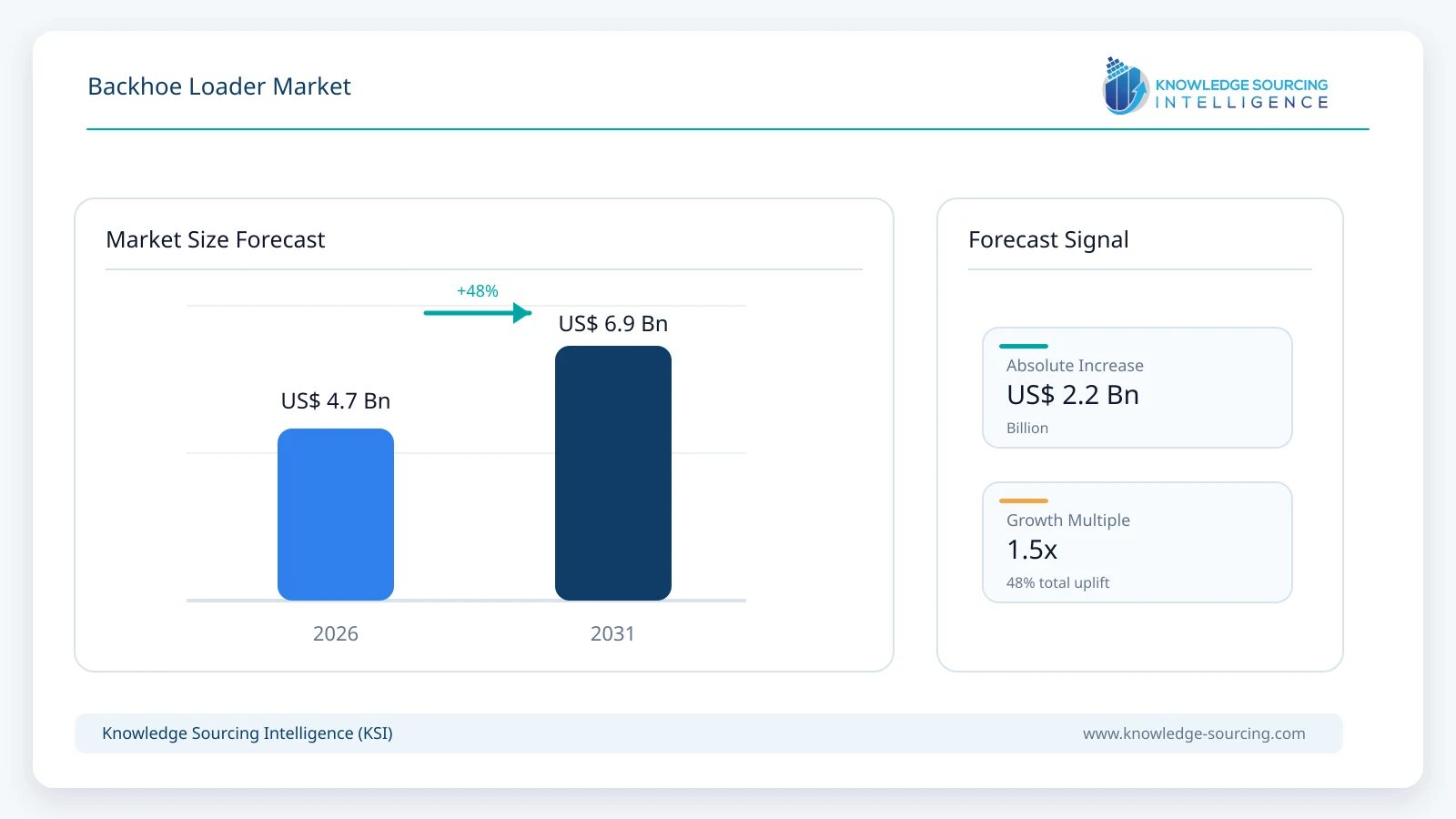
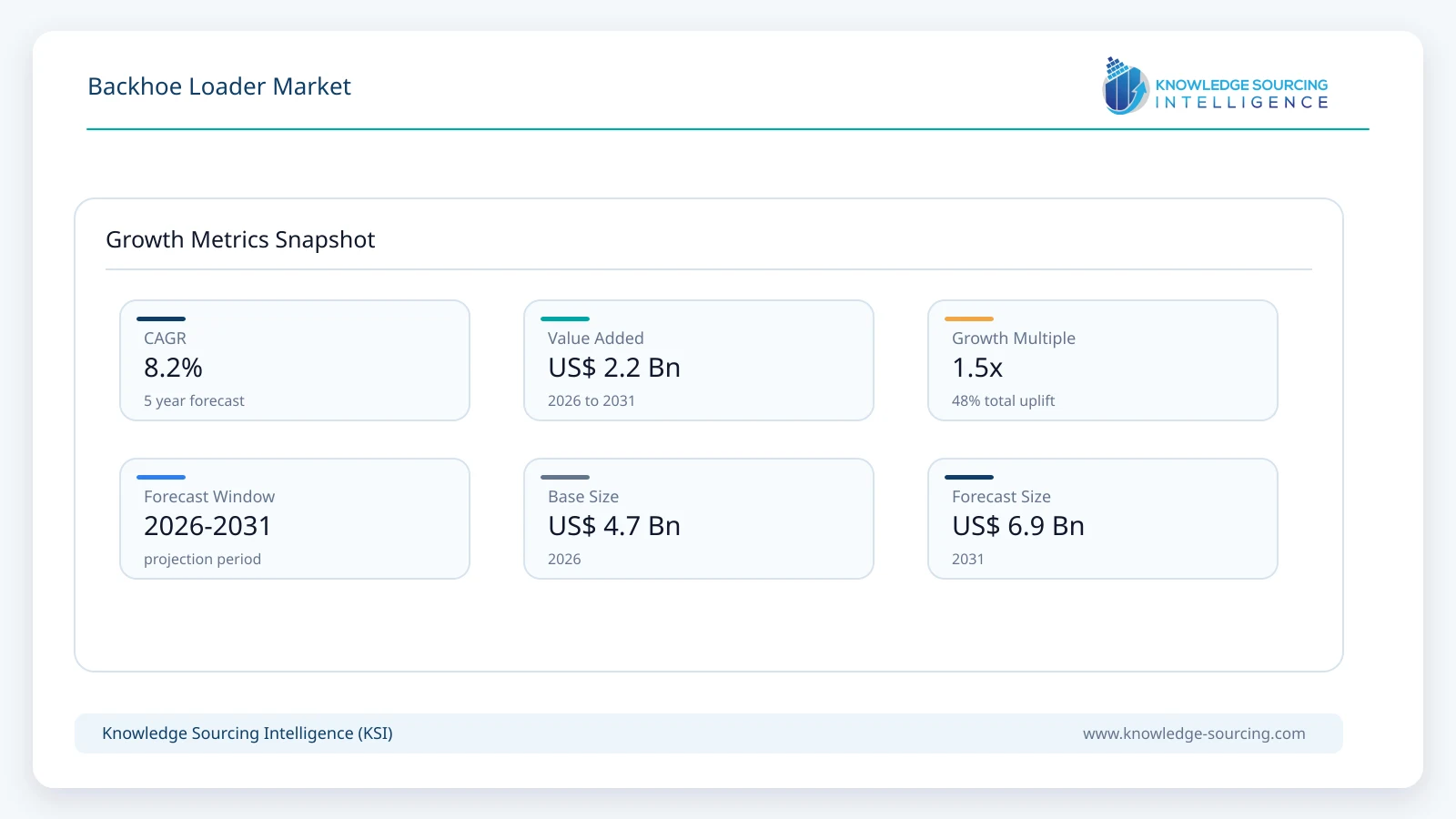
The Backhoe Loader Market is projected to grow at a CAGR of 8.2%, increasing from USD 4.66 billion in 2026 to USD 6.90 billion by 2031.
Highlights:
- 1Side Shift machines account for more than 60% of global market value in 2026, supported by strong adoption across India, Europe and other space-constrained construction markets.
- 2Construction and Infrastructure represents the largest customer segment and is estimated at more than USD 2 billion in 2026.
- 3Rental and Leasing is projected to record double-digit growth through 2031 as contractors seek greater flexibility and higher equipment utilisation without committing capital to permanent ownership.
- 4Indirect dealer-based sales represent approximately two-thirds of market value, reflecting the importance of local financing, service, spare parts and machine support.
- 5Asia Pacific remains the largest regional market, supported particularly by India, where 53,133 backhoe loaders were sold during FY2025.
- 6Electric and hydrogen machines move from prototype activity toward commercial production, although conventional diesel continues to account for the overwhelming majority of machines sold during the forecast period.
Backhoe loaders continue to occupy a distinct position within construction equipment because they combine front-loader and rear-excavator functions on a road-mobile platform, allowing one machine to perform loading, trenching, excavation, grading, breaking and material-handling work. This versatility remains particularly valuable for contractors, public works departments, utilities and rental fleets that need high equipment utilisation but cannot economically maintain separate machines for every task. The market is therefore being supported not only by expansion of construction activity, but also by a shift toward machines that provide higher productivity per operator, lower fuel consumption, greater attachment compatibility and improved digital fleet management.
India provides one of the clearest indicators of the category’s continuing relevance. The Indian Construction Equipment Manufacturers’ Association reported that the country’s construction equipment industry sold 140,191 machines in FY2025, with Earthmoving Equipment accounting for 99,159 units. Backhoe loaders alone represented 53,133 units, equivalent to 54% of the earthmoving category, reinforcing the importance of multipurpose machines in infrastructure, road, utility and distributed construction projects. India also remained the world’s third-largest construction equipment market, while exports of Indian-manufactured equipment increased 10% during the year. The figures are significant to the global market because India combines high backhoe penetration with a substantial domestic manufacturing base operated by global and local manufacturers.
Product development is strengthening the category rather than simply replacing existing machines with larger excavators. JCB launched a new 3CX Sitemaster in May 2026 at £55,000, positioning the machine specifically for owner-operators, smaller contractors and rental companies that need a loader, excavator and attachment carrier in one platform. Its higher-specification 3CX Pro uses Dual Drive technology, allowing the operator to reposition the machine while facing the excavator controls, reducing repeated seat rotation during trenching and earthmoving. Caterpillar’s latest 440 and 450 backhoe loaders similarly incorporate updated hydraulics, advanced machine controls and Product Link telematics, while Tata Hitachi’s Shinrai range and multiple Indian manufacturers continue to expand fuel-efficient Stage 5-compliant offerings.
Decarbonisation is adding another technology layer. CASE’s 580EV is the industry’s first electric backhoe loader in full production, combining conventional backhoe functionality with zero tailpipe emissions and lower operating noise for municipal, utility and urban applications. JCB formally launched its production 3CX Hydrogen Backhoe Loader in May 2026 following more than £100 million of investment in hydrogen-combustion technology. Neither technology is expected to displace diesel across the global market during the forecast period, but both demonstrate that manufacturers are developing alternative powertrains for applications where emissions, noise, refuelling or local operating regulations justify the additional investment.
Market Growth Drivers and Trends
Infrastructure Investment Is Sustaining Demand for Multipurpose Equipment
Roads, drainage networks, water infrastructure, urban construction, industrial sites and distributed public works generate continuous demand for excavation and material handling. Backhoe loaders are particularly competitive on projects where individual tasks are too small or dispersed to justify separate excavators, loaders and material-handling equipment. Their ability to travel independently between nearby sites further improves utilisation because contractors do not always need low-bed transport to reposition the machine.
This operating model is particularly important in India and other developing infrastructure markets. ICEMA reported that Earthmoving Equipment represented 71% of Indian construction equipment sales in FY2025, while backhoe loaders remained the largest individual earthmoving category at 53,133 units. Domestic construction equipment sales increased despite election-related delays during the year, while exports expanded 10%, indicating that Indian manufacturing is also becoming a larger supply base for overseas markets.
Developed markets provide a different form of support. CECE reported that European construction equipment sales increased 4.6% in 2025 after the previous downturn, while civil engineering and infrastructure activity expanded by around 3% even as residential construction remained weaker. Infrastructure therefore continues to support equipment demand in mature markets where overall building activity is comparatively subdued.
Versatility Is Strengthening the Economics for Contractors and Rental Fleets
Backhoe loaders compete primarily through asset utilisation rather than through maximum productivity in a single task. A crawler excavator generally provides greater continuous excavation performance, while a dedicated wheel loader offers higher material-loading capacity, but a backhoe can perform both functions and accept additional tools including breakers, augers, forks and specialized buckets. This reduces the number of machines needed on smaller projects and makes the backhoe particularly attractive to owner-operators and contractors working across several types of job.
JCB’s May 2026 3CX Sitemaster launch explicitly targets this market. The company positions the machine as a lower-capital alternative for start-up businesses and rental fleets and offers a loader, backhoe, integrated forks, road mobility and attachment capability in a single platform. Mecalac similarly positions its TLB range for civil engineering, highway construction, maintenance, utilities and agriculture, reflecting the wide operating envelope manufacturers are trying to preserve.
Rental companies benefit from the same characteristics because one backhoe can address a broader range of customer requests than highly specialized equipment. Rental & Leasing consequently records one of the strongest forecast growth rates within the market as contractors use rental to manage short-duration projects, reduce capital commitment and access newer machines without maintaining large owned fleets.
Machine Controls and Telematics Are Improving Operator Productivity
Technology investment is increasingly directed toward reducing the amount of non-productive operator activity rather than simply increasing engine output. JCB’s Dual Drive system allows operators to drive and reposition selected 3CX and 4CX machines while seated in the rear-facing excavator position, reducing repeated seat rotation and front-control operation during trenching. The company highlighted the system again at PWX 2026, positioning it as a way to increase productivity and reduce operator fatigue.
Caterpillar’s next-generation 440 and 450 machines include updated displays, selectable loader and excavator modulation, improved hydraulics and Product Link connectivity. Escorts Kubota integrates GPS- and GSM-based monitoring into its DIGMAX II XP, while Mahindra’s EarthMaster uses iMAXX telematics for machine monitoring. Tata Hitachi’s current Shinrai products similarly incorporate InSite telematics.
These features become more valuable as fleets grow because machine location, fuel consumption, maintenance status and utilisation can be managed centrally. For rental companies and larger contractors, telematics also reduces unauthorized use and helps determine whether equipment is being deployed productively. The forecast-period technology transition therefore centres increasingly on productivity per operating hour rather than headline horsepower alone.
Alternative Powertrains Are Creating New Urban and Municipal Applications
Battery-electric and hydrogen machines remain small-volume products, but commercial availability is improving. CASE’s 580EV is already in full production and is designed particularly for municipal, utility and urban construction work where zero tailpipe emissions and lower noise can provide an operational advantage. The machine maintains the core backhoe-loader architecture while replacing the diesel drivetrain with a 400-volt battery-electric system.
JCB is pursuing hydrogen combustion as an alternative. Its production 3CX Hydrogen uses a 55 kW hydrogen engine designed to provide power and torque comparable with the diesel machine while allowing rapid on-site refuelling. The company has invested more than £100 million in hydrogen-engine development and obtained EU type approval for non-road mobile machinery.
The two approaches address different constraints. Battery-electric machines are particularly suited to predictable duty cycles and locations with charging access, while hydrogen could eventually support longer operating periods where rapid refuelling is critical. Conventional diesel nevertheless remains dominant because infrastructure, acquisition cost, resale markets and fuel availability favour established powertrains across most construction sites.
Fuel Economy and Lifecycle Cost Are Becoming More Important Purchase Criteria
Fuel remains one of the largest controllable operating expenses over a backhoe loader’s working life. Manufacturers are therefore improving engine efficiency, hydraulic systems, idle management and operating modes even where the underlying machine architecture changes only incrementally.
Caterpillar states that its current 424 can provide fuel savings of up to 20% versus the previous model in Eco mode, while JCB’s Indian 3DX range uses Stage 5 engines and productivity-oriented hydraulic systems. Tata Hitachi’s Shinrai CEV 5 products combine updated engines with revised hydraulics and telematics, and Bobcat’s B760 uses a load-sensing variable-displacement hydraulic pump that adjusts flow according to demand.
Lifecycle cost also includes maintenance access, service intervals, parts availability and resale value. This gives established dealer networks a significant competitive advantage because contractors depend on rapid parts availability when the machine performs several essential tasks on the same project. The market therefore continues to reward fuel efficiency and uptime more consistently than isolated increases in engine output.
Market Restraints
Dedicated Excavators and Wheel Loaders Compete in High-Utilisation Applications
The same versatility that makes the backhoe attractive on mixed-duty jobs can reduce its competitiveness where one task dominates machine hours. Dedicated hydraulic excavators typically provide greater digging productivity, reach and stability for continuous excavation, while wheel loaders offer higher loading capacity and faster production in repetitive material-handling work.
Large infrastructure, mining and earthmoving projects can therefore shift toward specialized fleets once project scale is sufficient to keep each machine continuously utilised. Backhoe loaders remain strongest in smaller and medium projects, maintenance, utilities and distributed work where flexibility is more valuable than maximum task-specific output.
Upfront Capital and Financing Conditions Affect Smaller Buyers
Backhoe loaders are frequently purchased by small contractors and owner-operators whose ability to invest depends on financing availability and expected equipment utilisation. Higher interest rates or weak construction demand can delay replacement because owners may choose to extend the life of existing equipment rather than commit capital to a new machine.
Manufacturers increasingly respond with financing and leasing packages. JCB’s new 3CX Sitemaster is marketed in the UK with financing from approximately £208 per week, while John Deere and other manufacturers use subsidized financing offers to support equipment purchases.
The importance of financing also explains part of the growth in rental and leasing, where contractors can convert fixed capital expenditure into project-linked operating costs.
Skilled Operator Availability Can Limit Machine Productivity
Backhoe loaders require operators to handle both front-loader and rear-excavator functions, often with different controls and visibility requirements. Experienced operators can use the machine as a highly productive multipurpose asset, while inexperienced operation can reduce cycle times, fuel efficiency and component life.
Manufacturers are reducing this barrier through servo controls, automation and easier repositioning. JCB’s Dual Drive, Bobcat’s Smart Assistance functions and increasingly sophisticated electrohydraulic controls simplify individual operations, but they do not eliminate the need for operator training.
Operator shortages can therefore encourage greater automation over the forecast period while simultaneously limiting effective utilization in markets where construction labour skills remain constrained.
Electric and Hydrogen Adoption Remains Infrastructure-Constrained
Alternative powertrains solve specific emissions and noise problems but introduce new operational constraints. Battery-electric equipment requires reliable charging access, while hydrogen machines require a fuel supply chain that remains limited across most construction markets.
These constraints are particularly relevant because backhoe loaders are valued for mobility and flexibility. A machine expected to work at multiple sites may be less attractive if its refuelling infrastructure is substantially less available than diesel.
Electric and hydrogen models therefore expand first in municipal fleets, fixed urban work, regulated sites and customers pursuing formal decarbonisation targets rather than replacing diesel uniformly across the market.
Construction Cyclicality Can Delay Fleet Replacement
Backhoe loader purchases are exposed to infrastructure budgets, building activity, contractor confidence and interest rates. The European construction equipment market contracted sharply in 2024 before beginning to stabilize in 2025, illustrating how quickly machine demand can respond to broader investment conditions. CECE expects a moderate European recovery in 2026, but housing remains weaker than infrastructure.
The rental and aftermarket businesses moderate this exposure because existing machines continue to require maintenance and contractors can rent instead of buying. However, prolonged weakness in construction activity can still reduce new-equipment orders and extend replacement cycles.
Backhoe Loader Market Segmentation Analysis
By Type
Side Shift Backhoe Loaders account for approximately 64% of global market value in 2026 and remain the dominant configuration through 2031. The rear excavator carriage can move laterally across the machine, allowing operators to excavate closer to walls, curbs and other obstacles without repositioning the complete vehicle. This configuration is widely used in Europe, India and other markets where construction and utility work frequently occurs in constrained areas. JCB’s 2026 3CX Sitemaster uses a sideshift configuration, while Manitou, Tata Hitachi, Bobcat and several Indian manufacturers maintain similar products for infrastructure and urban work.
Centre Mount Backhoe Loaders are projected to grow at approximately 6.6% annually through 2031. The configuration remains particularly important in North America and applications where operators value central rear-boom alignment, structural simplicity and digging stability. Caterpillar, John Deere and other North American manufacturers maintain centre-mount product ranges, while Mecalac offers both centre-mount and sideshift configurations.
By Customer Type
Construction & Infrastructure represents an estimated USD 2.14 billion market in 2026 and remains the largest customer group. General contractors, road builders and smaller infrastructure firms use backhoes for trenching, excavation, grading, loading and site preparation, particularly where one machine must perform several functions during the same project. The category continues to expand in absolute value through 2031, although its share moderates as rental, utilities and municipal fleets grow faster.
Municipal & Public Works customers account for approximately 16% of market value in 2026. Local governments use backhoes for drainage, street maintenance, water and sewer repair, landscaping and emergency work. The ability to travel between locations without specialist transport makes the machine well suited to geographically dispersed public works.
Utilities are projected to grow at close to 10% annually through 2031, driven by electricity, telecom, water and gas network construction and maintenance. Trenching, road opening and rapid site restoration create a particularly strong fit for multipurpose backhoes, while electric machines can gain early adoption in urban utility work where noise and local emissions matter.
Rental & Leasing records the strongest growth among the principal customer groups. Rental companies benefit from the broad addressable application base and can deploy the same asset across construction, utility, landscaping and municipal users. The launch positioning of JCB’s 3CX Sitemaster and Mecalac’s TLB880 specifically includes rental fleets, reinforcing the category’s commercial relevance.
Agriculture, mining, industrial sites and other users account for the remaining demand. Backhoes can perform farm drainage, handling, maintenance, small-scale quarrying and industrial-site work, although dedicated specialist machinery becomes more competitive as operating scale increases.
By Distribution Channel
Indirect Sales through dealers and distributors account for approximately 67% of market value in 2026. Dealer networks are particularly important because equipment purchases require local demonstrations, financing, spare parts, field service and resale support. A contractor’s machine can be central to several activities on the site, increasing the commercial importance of short repair times and locally stocked parts.
Direct Sales account for the remaining market and are projected to reach approximately USD 2.14 billion by 2031. Direct procurement is more important among large contractors, government agencies, major rental companies and fleet operators purchasing several machines under centralized commercial agreements.
The channel balance changes only gradually because digital lead generation and online configuration do not eliminate the physical service requirements associated with heavy construction machinery.
Geographical Outlook
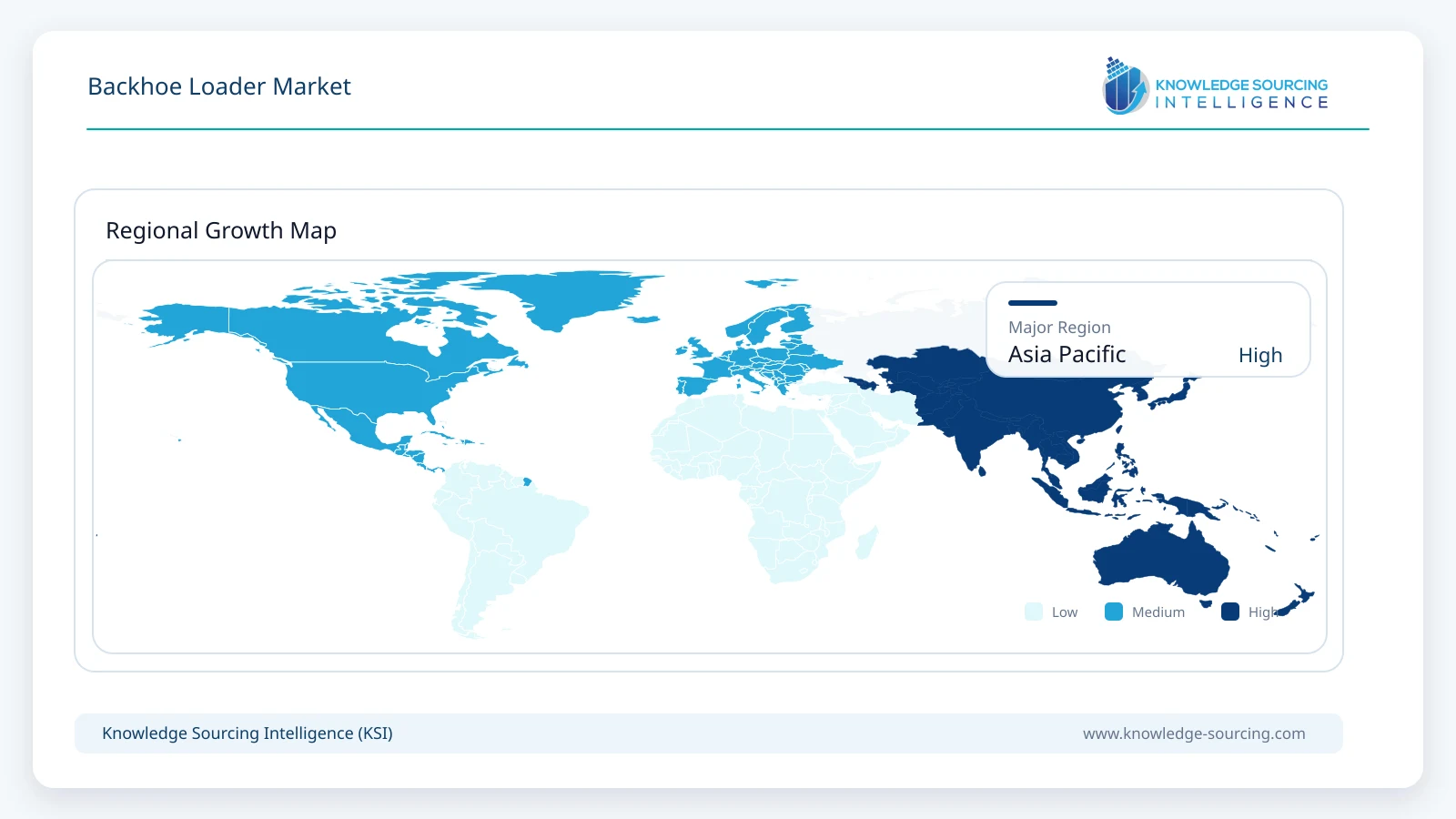
Asia Pacific represents an estimated USD 2.10 billion market in 2026 and remains the largest region through 2031. India is central to this position because backhoe loaders continue to dominate its earthmoving equipment mix, with more than 53,000 units sold in FY2025. JCB, Tata Hitachi, CASE, Bobcat, Manitou, Mahindra, Escorts Kubota, ACE and other manufacturers maintain substantial product portfolios targeted at Indian construction conditions. China contributes through domestic manufacturers including XCMG and LiuGong, while infrastructure investment across Southeast Asia provides additional demand.
North America accounts for approximately 22% of global market value in 2026. Centre-mount machines have a stronger position than in India and Europe, while Caterpillar, John Deere, CASE and Bobcat provide established product ranges. The region is also an important early market for electric backhoes through municipal and utility customers, with CASE positioning the 580EV specifically toward these applications.
Europe is projected to grow at approximately 6.8% annually through 2031. Infrastructure and civil engineering provide greater support than residential construction, while sideshift designs remain well suited to dense urban and utility work. JCB, Komatsu, Hidromek, Mecalac and Hydrema maintain active backhoe products in the region, while tighter emissions requirements encourage fuel-efficiency improvements and alternative-powertrain development.
Middle East & Africa continue to provide demand from infrastructure, municipal works, utilities and construction, with the ability to operate one multipurpose machine across varied tasks supporting adoption. South America remains an important regional market led by Brazil, where CASE, New Holland, Caterpillar and other manufacturers maintain strong dealer and product coverage.
Recent Developments
August 2026, JCB announced that it would showcase its Dual Drive technology at PWX 2026. The system allows selected 3CX and 4CX backhoe loaders to be driven and repositioned while the operator remains facing the excavator controls, reducing repeated seat rotation during trenching and public-works applications.
May 2026, JCB launched a new 3CX Sitemaster priced at £55,000, targeting owner-operators, smaller construction businesses and rental fleets. The model combines a sideshift backhoe, 6-in-1 loader shovel, integrated forks and LiveLink monitoring in a lower-cost configuration.
May 2026, JCB formally launched the production 3CX Hydrogen Backhoe Loader. The machine uses a 55 kW hydrogen-combustion engine and follows more than £100 million of JCB investment in hydrogen-engine development.
During 2026, Caterpillar continued commercial rollout of its next-generation 440 and 450 backhoe loaders, which incorporate updated C3.6 engines, hydraulic improvements, configurable machine controls and Product Link telematics.
Tata Hitachi continued deployment of its Shinrai CEV 5 product family after the 2025 launch, combining Stage 5 compliance, improved hydraulics, operator-safety features and InSite telematics for the Indian market.
Competitive Environment
The Backhoe Loader Market combines a small group of globally recognized construction-equipment manufacturers with strong regional competitors, particularly in India, China, Europe and Türkiye. JCB holds a particularly prominent position and describes itself as the world’s leading backhoe-loader manufacturer. Its range extends from Indian 3DX machines to European and North American 3CX/4CX products, while recent investment covers Dual Drive, hydrogen engines, telematics and lower-cost owner-operator machines.
Caterpillar competes through a broad global dealer network and product families ranging from the Indian 424 to the latest 440 and 450 models. Deere & Company maintains an established North American backhoe range, while CNH Industrial participates through CASE Construction Equipment and retains substantial experience in both conventional and battery-electric backhoes. Bobcat has expanded its presence with the B760 in North America and a broader B760/B900 range across Asian markets.
Asia contains a particularly deep manufacturer base. Tata Hitachi, Mahindra Construction Equipment, Escorts Kubota, Action Construction Equipment, Bull Machines and Manitou compete within India, while XCMG and LiuGong provide multiple backhoe models for China and export markets. European and neighbouring markets add Komatsu, Hidromek, Mecalac, Hydrema and MST Construction Equipment. This makes the market more competitive than the five-company universe shown on the existing page and requires the competitive chapter to reflect both multinational scale and regionally important manufacturers.
Competition through 2031 is increasingly centred on total cost of ownership rather than engine power alone. Fuel efficiency, hydraulic productivity, operator controls, telematics, financing, dealer response time and residual value directly influence customer economics. Alternative powertrains add another differentiator, but manufacturers able to combine a reliable conventional product with broad attachments, service coverage and fleet-management capabilities remain best positioned across the majority of the market.
Analyst View
The Backhoe Loader Market is supported by infrastructure development and the continuing economic appeal of a machine capable of performing several tasks with one operator. The category is not displacing dedicated excavators or loaders in large-volume work. Instead, it remains strongest where equipment utilisation, mobility and versatility matter more than maximum productivity in a single task.
Asia Pacific remains the centre of market growth, with India’s unusually high backhoe penetration providing both a substantial demand base and a large manufacturing ecosystem. Developed markets provide a different opportunity through utilities, municipalities, rental companies and fleet replacement. Side Shift machines retain the largest global position, while Centre Mount products remain structurally important in North America.
The technology transition is also likely to be gradual rather than disruptive. Telematics, automation and fuel-efficiency improvements affect mainstream machines today, while battery-electric and hydrogen backhoes develop around applications where their operating advantages justify the added infrastructure or capital requirements. Manufacturers that combine machine versatility with low lifecycle cost, digital fleet support and strong local service networks should therefore capture the largest share of forecast-period value growth.
Backhoe Loader Market Scope:
| Report Metric | Details |
|---|---|
| Total Market Size in 2026 | USD 4.66 billion |
| Total Market Size in 2031 | USD 6.90 billion |
| Forecast Unit | Billion |
| Growth Rate | 8.2% |
| Study Period | 2021 to 2031 |
| Historical Data | 2021 to 2024 |
| Base Year | 2025 |
| Forecast Period | 2026 – 2031 |
| Segmentation | Type, Customer Type, Distribution Channel, Geography |
| Companies |
|
Market Segmentation
By Type
Centre Mount
Side Shift
By Customer Type
Construction & Infrastructure Contractors
Municipal & Public Works
Utilities
Rental & Leasing Companies
Agriculture, Mining & Other Industries
By Distribution Channel
Direct Sales
Indirect Sales
By Geography
North America
United States
Canada
Mexico
South America
Brazil
Argentina
Others
Europe
Germany
France
United Kingdom
Italy
Spain
Others
Middle East and Africa
Saudi Arabia
UAE
Israel
Others
Asia Pacific
China
Japan
South Korea
India
Thailand
Taiwan
Indonesia
Others
Table of Contents
1. INTRODUCTION
1.1. Market Overview
1.2. Market Definition
1.3. Scope of the Study
1.4. Market Segmentation
1.5. Currency
1.6. Assumptions
1.7. Base and Forecast Years Timeline
1.8. Key Benefits for Stakeholders
2. RESEARCH METHODOLOGY
2.1. Research Design
2.2. Research Process
3. EXECUTIVE SUMMARY
3.1. Key Findings
4. MARKET DYNAMICS
4.1. Market Drivers
4.2. Market Restraints
4.3. Porter’s Five Forces Analysis
4.3.1. Bargaining Power of Suppliers
4.3.2. Bargaining Power of Buyers
4.3.3. Threat of New Entrants
4.3.4. Threat of Substitutes
4.3.5. Competitive Rivalry in the Industry
4.4. Industry Value Chain Analysis
4.5. Analyst View
5. BACKHOE LOADER MARKET BY TYPE
5.1. Introduction
5.2. Centre Mount
5.3. Side Shift
6. BACKHOE LOADER MARKET BY CUSTOMER TYPE
6.1. Introduction
6.2. Construction & Infrastructure Contractors
6.3. Municipal & Public Works
6.4. Utilities
6.5. Rental & Leasing Companies
6.6. Agriculture, Mining & Other Industries
7. BACKHOE LOADER MARKET BY DISTRIBUTION CHANNEL
7.1. Introduction
7.2. Direct Sales
7.3. Indirect Sales
8. BACKHOE LOADER MARKET BY GEOGRAPHY
8.1. Introduction
8.2. North America
8.2.1. By Type
8.2.2. By Customer Type
8.2.3. By Distribution Channel
8.2.4. By Country
8.2.4.1. United States
8.2.4.2. Canada
8.2.4.3. Mexico
8.3. South America
8.3.1. By Type
8.3.2. By Customer Type
8.3.3. By Distribution Channel
8.3.4. By Country
8.3.4.1. Brazil
8.3.4.2. Argentina
8.3.4.3. Others
8.4. Europe
8.4.1. By Type
8.4.2. By Customer Type
8.4.3. By Distribution Channel
8.4.4. By Country
8.4.4.1. Germany
8.4.4.2. France
8.4.4.3. United Kingdom
8.4.4.4. Italy
8.4.4.5. Spain
8.4.4.6. Others
8.5. Middle East and Africa
8.5.1. By Type
8.5.2. By Customer Type
8.5.3. By Distribution Channel
8.5.4. By Country
8.5.4.1. Saudi Arabia
8.5.4.2. UAE
8.5.4.3. Israel
8.5.4.4. Others
8.6. Asia Pacific
8.6.1. By Type
8.6.2. By Customer Type
8.6.3. By Distribution Channel
8.6.4. By Country
8.6.4.1. China
8.6.4.2. Japan
8.6.4.3. South Korea
8.6.4.4. India
8.6.4.5. Thailand
8.6.4.6. Taiwan
8.6.4.7. Indonesia
8.6.4.8. Others
9. COMPETITIVE ENVIRONMENT AND ANALYSIS
9.1. Major Players and Strategy Analysis
9.2. Market Share Analysis
9.3. Mergers, Acquisitions, Agreements and Collaborations
9.4. Competitive Dashboard
10. COMPANY PROFILES
10.1. J.C. Bamford Excavators Ltd. (JCB)
10.2. Caterpillar Inc.
10.3. CASE Construction Equipment
10.4. Deere & Company
10.5. Komatsu Ltd.
10.6. Doosan Bobcat Inc.
10.7. Tata Hitachi Construction Machinery Company Pvt. Ltd.
10.8. Manitou Group
10.9. XCMG Group
10.10. Guangxi LiuGong Machinery Co., Ltd.
10.11. HiDROMEK
10.12. Mecalac Group
10.13. Hydrema A/S
10.14. Mahindra Construction Equipment
10.15. Escorts Kubota Limited
10.16. Action Construction Equipment Ltd.
10.17. Bull Machines Pvt. Ltd.
10.18. MST Construction and Agricultural Machinery
11. APPENDIX
11.1. Currency
11.2. Assumptions
11.3. Base and Forecast Years Timeline
11.4. Key Benefits for Stakeholders
11.5. Research Methodology
11.6. Abbreviations
Navigate
Trusted by the world's leading organizations











