
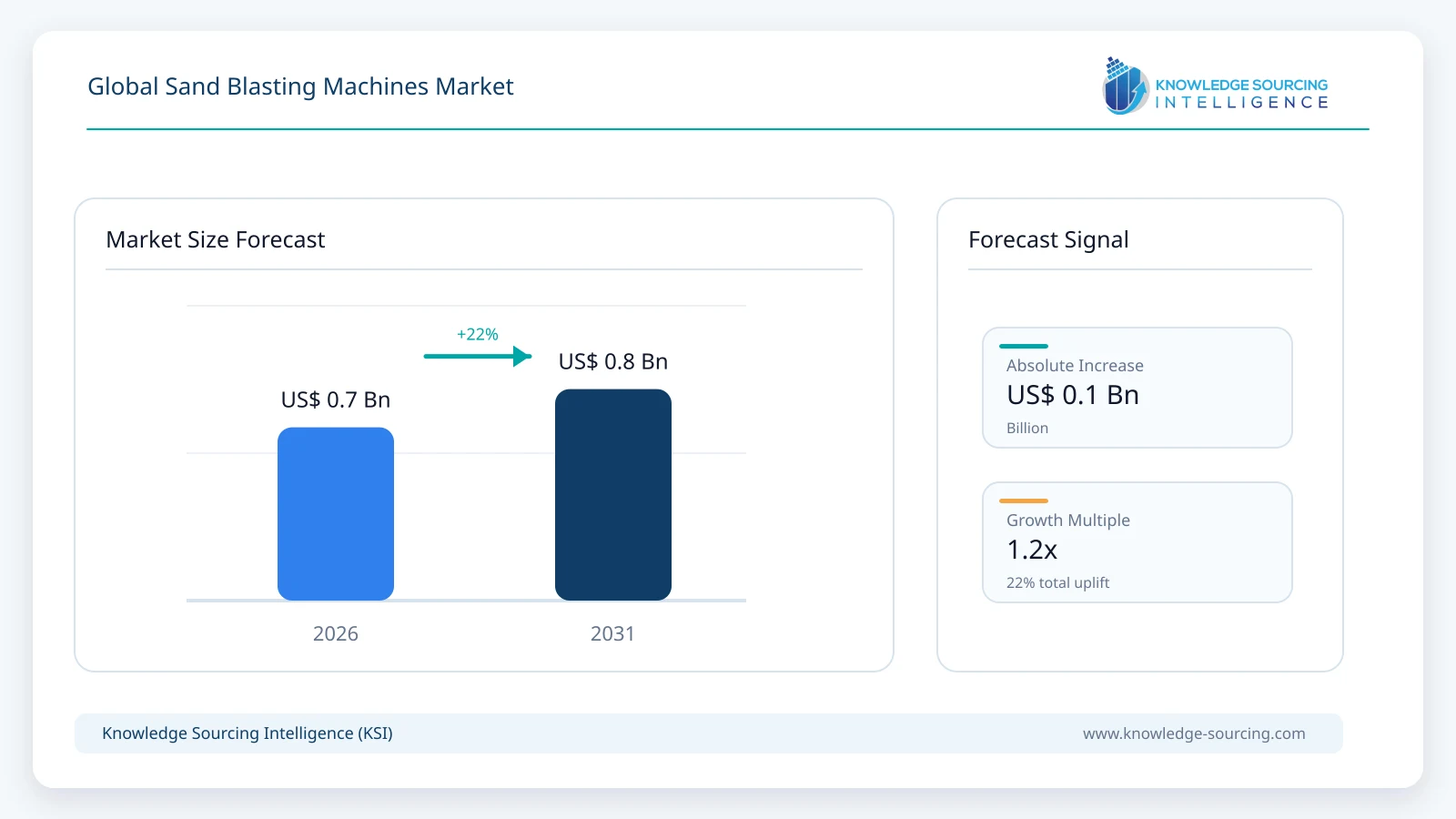
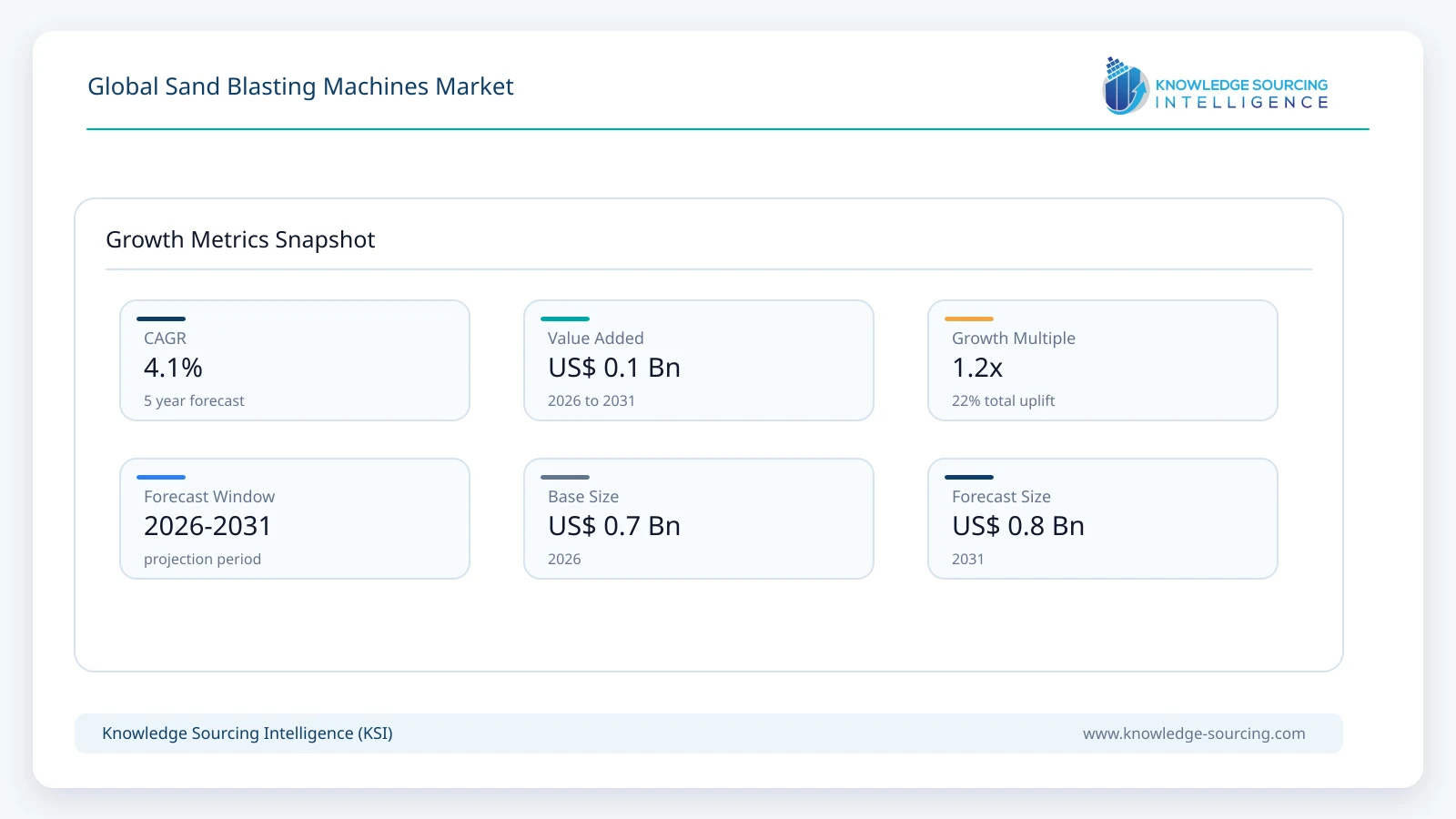
The Sand Blasting Machines Market is forecast to grow at a CAGR of 4.07%, reaching USD 0.83 billion in 2031 from USD 0.68 billion in 2026.
Highlights:
- 1Primary demand catalystExpansion of industrial maintenance, infrastructure rehabilitation, and steel fabrication projects requiring high-quality surface preparation.
- 2Leading commercial segmentPortable sand blasting machines maintain strong commercial demand due to their suitability for field maintenance, infrastructure repair, and offshore applications.
- 3Regional opportunityAsia Pacific continues attracting manufacturing investment, creating sustained demand for industrial surface preparation equipment.
- 4Technology trendAutomation, robotic blasting systems, abrasive recycling technologies, and dust collection integration are improving operational efficiency and workplace safety.
- 5Regulatory influenceOccupational health, environmental emission standards, and industrial safety regulations encourage adoption of enclosed and dust-controlled blasting systems.
- 6Competitive trendSuppliers increasingly differentiate through engineering customization, lifecycle service support, automation capabilities, and energy-efficient equipment designs.
The sand blasting machines market comprises equipment used to clean, prepare, texture, and finish surfaces by propelling abrasive media at high velocity. These systems are widely deployed across manufacturing, construction, marine, oil and gas, automotive, and heavy industrial sectors where surface preparation is essential before coating, welding, inspection, or refurbishment. Demand is closely linked to industrial production, infrastructure maintenance, fabrication activities, and asset life-extension programs. Buyers seek equipment capable of delivering consistent surface profiles while reducing abrasive consumption, minimizing downtime, and complying with increasingly stringent occupational safety and environmental requirements.
Commercial demand is driven by the need to improve coating adhesion, remove corrosion, eliminate contaminants, and restore aging infrastructure. Steel fabricators, shipyards, vehicle manufacturers, equipment maintenance contractors, and energy companies consider surface preparation a critical stage in production and maintenance workflows. Procurement decisions extend beyond purchase price and increasingly evaluate lifecycle operating costs, abrasive recovery efficiency, energy consumption, dust containment, automation capability, and equipment reliability. Consequently, manufacturers compete by offering integrated blasting solutions supported by engineering services, aftermarket parts, operator training, and maintenance support.
The market includes stationary systems designed for high-volume industrial operations and portable equipment intended for field applications such as bridge rehabilitation, pipeline maintenance, offshore platforms, storage tanks, and construction sites. Industrial users continue investing in automated blasting cabinets, robotic blasting cells, and enclosed blasting rooms to improve productivity, maintain consistent surface quality, and reduce worker exposure to airborne particulates. Wet blasting technologies are also receiving greater attention in applications where dust suppression and environmental compliance are operational priorities.
Supply chain dynamics are influenced by the availability of fabricated steel components, pressure vessels, compressors, blast hoses, nozzles, valves, automation controls, and abrasive materials. Manufacturers continue strengthening supplier networks while expanding localized assembly and service capabilities to reduce lead times for industrial customers. After-sales support remains a major competitive factor because industrial operators require rapid replacement parts, preventive maintenance, and technical assistance to minimize equipment downtime.
Demand patterns also reflect capital expenditure cycles across construction, transportation, manufacturing, marine repair, and energy infrastructure. Projects involving structural steel fabrication, shipbuilding, refinery maintenance, renewable energy installations, and industrial equipment refurbishment generate recurring demand for surface preparation equipment. As industrial asset owners prioritize equipment longevity and coating performance, investment in efficient blasting systems is expected to remain an important component of maintenance and production strategies.
Market Drivers
Expansion of Industrial Maintenance and Asset Refurbishment
Industrial facilities, transportation infrastructure, marine vessels, and energy assets require periodic surface treatment to maintain structural integrity and coating performance. Corrosion control programs across refineries, power plants, bridges, storage tanks, and offshore installations generate recurring demand for sand blasting machines. Asset owners increasingly schedule preventive maintenance to extend equipment life and reduce unplanned shutdowns. Equipment manufacturers respond by developing machines capable of operating continuously in demanding industrial environments while supporting multiple abrasive media and application requirements. This creates recurring equipment replacement opportunities alongside aftermarket service revenues.
Rising Infrastructure Construction Supports Equipment Procurement
Governments and private investors continue allocating capital toward transportation networks, industrial facilities, commercial buildings, ports, and energy infrastructure. Structural steel components require effective surface preparation before protective coatings are applied to ensure long-term corrosion resistance. Construction contractors and steel fabricators therefore procure blasting equipment capable of maintaining production schedules while meeting project quality specifications. Equipment suppliers strengthen their market position by offering portable solutions, customized blasting rooms, and integrated dust collection systems suitable for large infrastructure projects.
Automation Improves Productivity and Surface Quality
Industrial manufacturers increasingly seek automated blasting solutions to improve production consistency and reduce dependence on manual labor. Robotic blasting systems, programmable control platforms, and automated abrasive recovery technologies help maintain uniform surface finishes while lowering operating costs. Buyers evaluate equipment based on productivity improvements, maintenance requirements, and integration with existing manufacturing processes. Manufacturers continue investing in automation, remote monitoring capabilities, and intelligent control systems that enable higher throughput and repeatable blasting performance across industrial applications.
Occupational Safety and Environmental Compliance Encourage Equipment Upgrades
Industrial employers face stricter workplace safety requirements governing worker exposure to airborne dust, noise, and hazardous materials during abrasive blasting operations. Environmental regulations also encourage improved containment and waste management practices. These requirements are increasing demand for enclosed blasting cabinets, wet blasting systems, advanced dust collectors, and abrasive recycling equipment. Suppliers capable of delivering compliant solutions supported by engineering expertise gain stronger competitive positions among industrial buyers seeking regulatory compliance and improved workplace safety.
Market Restraints and Challenges
High Capital Investment Limits Adoption Among Small Enterprises
Industrial blasting systems require substantial investment in equipment, compressors, dust collection systems, blasting media recovery, installation, and facility modifications. Small fabrication workshops and independent maintenance contractors may postpone equipment purchases because of limited capital budgets. This extends equipment replacement cycles and encourages continued reliance on outsourced blasting services. Manufacturers increasingly address this challenge through modular equipment designs, equipment financing options, and scalable product portfolios suitable for businesses of varying sizes.
Volatility in Industrial Investment Cycles
Demand for sand blasting machines is closely associated with capital expenditure across manufacturing, construction, marine, and energy industries. Economic uncertainty, delayed infrastructure projects, or reduced industrial investment can postpone equipment procurement decisions. Equipment manufacturers experience fluctuating order volumes that affect production planning and revenue stability. Geographic diversification and expansion into aftermarket services help reduce dependence on new equipment sales during weaker investment periods.
Regulatory Restrictions on Abrasive Materials
Several jurisdictions maintain strict controls on abrasive blasting operations involving hazardous materials or excessive airborne particulate emissions. Compliance requires investment in dust suppression technologies, containment systems, operator protection, and waste disposal procedures. Industrial users must also train personnel and maintain certified operating practices. Manufacturers mitigate these challenges by developing wet blasting equipment, enclosed systems, advanced filtration technologies, and equipment compatible with environmentally preferred abrasive materials.
Skilled Operator Shortages Affect Equipment Utilization
Effective abrasive blasting requires trained personnel capable of selecting appropriate blasting parameters, abrasive media, and operating techniques for different substrates. Shortages of experienced operators can reduce productivity, increase abrasive consumption, and affect finished surface quality. Equipment suppliers increasingly provide technical training, operator certification programs, digital monitoring systems, and automated process controls that reduce dependence on manual adjustments while improving operational consistency.
Major Segment Analysis
Portable Sand Blasting Machines Lead Commercial Demand
Portable sand blasting machines represent the most commercially significant product segment because they provide operational flexibility across a wide range of maintenance, construction, and industrial service applications. Unlike permanently installed systems, portable units can be transported directly to project sites, enabling contractors to perform surface preparation on bridges, pipelines, storage tanks, offshore structures, heavy machinery, ships, and steel frameworks without relocating large components. This mobility substantially reduces project complexity and minimizes operational disruption for asset owners.
Demand remains particularly strong among industrial maintenance contractors, marine service providers, oil and gas operators, construction companies, and infrastructure rehabilitation specialists that perform work across multiple locations. Buyers prioritize equipment durability, pressure consistency, abrasive efficiency, mobility, and compatibility with different blasting media. Equipment reliability under demanding field conditions often carries greater procurement importance than acquisition cost because downtime directly affects project schedules and labor productivity.
Competition within the portable equipment segment increasingly centers on operational efficiency and safety features. Manufacturers differentiate their offerings through improved pressure vessel designs, reduced abrasive consumption, integrated moisture control systems, enhanced operator ergonomics, and compatibility with advanced dust suppression technologies. Portable systems that support rapid deployment, simplified maintenance, and compliance with workplace safety standards provide stronger commercial value for contractors operating under demanding project timelines.
From a revenue perspective, portable machines generate sustained demand because infrastructure maintenance, industrial refurbishment, and corrosion control activities occur continuously across numerous industries regardless of new construction cycles. Their broad application base, relatively lower installation requirements, and suitability for both planned maintenance and emergency repair projects position portable sand blasting machines as the leading revenue-generating segment within the global market.
Regional Analysis
North America
North America represents a mature market supported by extensive industrial maintenance activities, energy infrastructure, bridge rehabilitation, ship repair, and advanced manufacturing. The United States accounts for the largest regional demand owing to continuous investment in industrial fabrication, defense manufacturing, transportation infrastructure, and oil and gas maintenance. Buyers increasingly procure automated blasting systems with integrated dust collection, abrasive recovery, and remote monitoring capabilities to improve productivity while complying with workplace safety standards. Canada contributes through mining, energy, and heavy equipment refurbishment, while Mexico benefits from expanding automotive and industrial manufacturing facilities. Capital-intensive purchasing decisions and stringent occupational safety regulations encourage replacement of aging equipment with enclosed, higher-efficiency systems, although elevated equipment costs can extend procurement cycles for smaller contractors.
Europe
Europe maintains stable demand for sand blasting machines through its automotive, aerospace, marine, rail, and heavy engineering industries. Industrial operators prioritize equipment that complies with worker protection requirements, environmental regulations, and emission control standards. Countries including Germany, France, the United Kingdom, and Spain continue investing in manufacturing modernization, infrastructure maintenance, and corrosion protection programs, supporting demand for both stationary and portable blasting equipment. Buyers increasingly evaluate suppliers based on energy efficiency, dust containment, automation capability, and lifecycle maintenance support rather than initial purchase cost. Market expansion is moderated by strict environmental compliance requirements and relatively mature industrial infrastructure, encouraging suppliers to differentiate through advanced engineering and service capabilities.
Asia Pacific
Asia Pacific is expected to remain the most attractive region for new equipment installations due to expanding manufacturing capacity, infrastructure development, shipbuilding activity, and industrialization. China continues to account for substantial equipment demand across steel fabrication, construction machinery, shipbuilding, and manufacturing industries. India is experiencing increased procurement from infrastructure contractors, railway projects, fabrication workshops, and energy developments. Japan and South Korea sustain demand through precision manufacturing, marine engineering, and industrial automation, while Southeast Asian economies benefit from growing industrial investment. Buyers emphasize equipment durability, operational efficiency, and cost-effective maintenance, creating opportunities for manufacturers offering scalable solutions supported by local service networks.
Middle East & Africa
The Middle East & Africa market is supported by investments in oil and gas facilities, petrochemical plants, desalination projects, marine infrastructure, and commercial construction. Saudi Arabia and the United Arab Emirates generate considerable demand through refinery maintenance, pipeline rehabilitation, industrial coatings, and large infrastructure developments. Equipment buyers seek portable blasting systems capable of operating under demanding environmental conditions while maintaining productivity. Suppliers compete through regional distribution partnerships, technical support, and maintenance services. Growth is constrained by dependence on energy-sector investment cycles and project timing, although long-term infrastructure diversification programs continue supporting demand for industrial surface preparation equipment.
Competitive Landscape
The sand blasting machines market demonstrates moderate fragmentation, with established global manufacturers competing alongside specialized engineering firms serving industrial surface preparation applications. Competition is primarily based on equipment performance, operational reliability, engineering customization, automation capability, safety features, and lifecycle support rather than pricing alone.
Companies including Sinto Group, Shandong Kaitai Group Co., Ltd., Torbo ENGINEERING KEIZERS GmbH, Clemco Industries Corp., Midwest Finishing Systems, Trinco Trinity Tool Company, BlastOne International, Vixen Surface Treatments Ltd., SCV SYSTEM SRL, and MHG Strahlanlagen GmbH continue expanding product portfolios to address evolving industrial requirements. Suppliers increasingly develop integrated solutions combining blasting equipment, abrasive recovery systems, dust collection units, automation controls, and digital monitoring technologies that improve productivity while reducing operating costs.
Strategic competition also reflects investments in regional service centers, engineering consultation, equipment modernization, and aftermarket support. Long-term customer relationships are strengthened through preventive maintenance programs, operator training, spare parts availability, and customized system integration. Manufacturers with broad geographic coverage and strong technical service capabilities are well positioned to secure contracts from multinational industrial operators managing complex maintenance and fabrication projects.
Recent Developments
April 2026: Raise3D unveiled the B520 SLS sandblaster at Rapid + TCT 2026, introducing an automated industrial blasting system designed for efficient post-processing of additive manufacturing parts.
September 2025: Shandong-based ATHI Group introduced a new automatic sandblasting machine series designed for industrial surface treatment applications, reflecting broader industry investment in automated blasting technologies that improve production efficiency and process consistency.
May 2025: Dura-Blast introduced the 3660 Spinner Hanger abrasive blasting machine, featuring dual blast wheel assemblies, touchscreen PLC controls, variable frequency drives, and enhanced capabilities for industrial cleaning and peening operations.
Regulatory and Policy Environment
The sand blasting machines market operates within a regulatory framework emphasizing occupational safety, environmental protection, industrial emissions, and machinery safety. Employers are required to implement engineering controls that minimize worker exposure to airborne dust, hazardous materials, and excessive noise generated during abrasive blasting operations.
In North America, occupational safety requirements established by regulatory authorities encourage enclosed blasting systems, respiratory protection, ventilation controls, and dust collection equipment for many industrial applications. Similar requirements across Europe, supported by machinery safety directives and workplace health legislation, have accelerated investment in enclosed blasting cabinets, automated systems, and abrasive recovery technologies that reduce operator exposure and environmental emissions.
Environmental regulations governing waste disposal, airborne particulate emissions, and hazardous abrasive materials continue influencing equipment specifications. Industrial operators increasingly prefer machines compatible with recyclable abrasive media and integrated filtration systems capable of supporting regulatory compliance while lowering operating costs. These requirements encourage manufacturers to invest in engineering improvements that balance productivity with environmental performance.
Outlook and Strategic Implications
Between 2026 and 2031, market expansion is expected to be supported by sustained industrial maintenance requirements, infrastructure rehabilitation programs, manufacturing modernization, and continued investment in corrosion protection across transportation, marine, energy, and heavy industrial sectors.
Procurement strategies are expected to emphasize total cost of ownership rather than acquisition cost alone. Industrial buyers will increasingly evaluate blasting equipment based on abrasive efficiency, maintenance requirements, energy consumption, automation capability, regulatory compliance, and long-term operational reliability. This purchasing approach is expected to favor manufacturers capable of demonstrating measurable productivity improvements and reduced lifecycle operating expenses.
Technology investment will continue toward robotic blasting systems, intelligent process controls, remote equipment diagnostics, automated abrasive recycling, and advanced dust management solutions. These developments will help industrial operators address labor shortages, improve workplace safety, and maintain consistent surface preparation quality across high-volume production environments.
Competitive conditions are likely to evolve through product innovation, engineering partnerships, localized manufacturing, and expanded aftermarket service capabilities. Suppliers that combine advanced equipment design with technical consulting, preventive maintenance, and strong regional support networks are expected to strengthen customer retention and improve recurring revenue opportunities.
Despite positive demand fundamentals, manufacturers will continue managing risks associated with fluctuating industrial investment, raw material costs, environmental compliance expenditures, and skilled labor availability. Organizations that maintain flexible production strategies, invest in automation, and align equipment development with evolving regulatory requirements will be better positioned to capture long-term opportunities within the global sand blasting machines market.
Sand Blasting Machine Market Scope
| Report Metric | Details |
|---|---|
| Total Market Size in 2026 | USD 0.68 billion |
| Total Market Size in 2031 | USD 0.83 billion |
| Forecast Unit | Billion |
| Growth Rate | 4.07% |
| Study Period | 2021 to 2031 |
| Historical Data | 2021 to 2024 |
| Base Year | 2025 |
| Forecast Period | 2026 – 2031 |
| Segmentation | Product Type, Process, End-User, Geography |
| Companies |
|
Market Segmentation
By Product Type
By Process
By End-user
By Geography
Table of Contents
1. EXECUTIVE SUMMARY
2. MARKET SNAPSHOT
2.1. Market Overview
2.2. Market Definition
2.3. Scope of the Study
2.4. Market Segmentation
3. BUSINESS LANDSCAPE
3.1. Market Drivers
3.2. Market Restraints
3.3. Market Opportunities
3.4. Porter’s Five Forces Analysis
3.5. Industry Value Chain Analysis
3.6. Policies and Regulations
3.7. Strategic Recommendations
4. TECHNOLOGICAL OUTLOOK
5. GLOBAL SANDBLASTING MACHINES MARKET BY PRODUCT TYPE
5.1. Introduction
5.2. Stationary
5.3. Portable
6. GLOBAL SANDBLASTING MACHINES MARKET BY PROCESS
6.1. Introduction
6.2. Dry Blasting
6.3. Wet Blasting
7. GLOBAL SANDBLASTING MACHINES MARKET BY END-USER
7.1. Introduction
7.2. Construction
7.3. Marine
7.4. Oil & Gas
7.5. Automotive
7.6. Manufacturing
7.7. Others
8. GLOBAL SANDBLASTING MACHINES MARKET BY GEOGRAPHY
8.1. Introduction
8.2. North America
8.2.1. USA
8.2.2. Canada
8.2.3. Mexico
8.3. South America
8.3.1. Brazil
8.3.2. Argentina
8.3.3. Others
8.4. Europe
8.4.1. Germany
8.4.2. France
8.4.3. United Kingdom
8.4.4. Spain
8.4.5. Others
8.5. Middle East and Africa
8.5.1. Saudi Arabia
8.5.2. UAE
8.5.3. Others
8.6. Asia Pacific
8.6.1. China
8.6.2. India
8.6.3. Japan
8.6.4. South Korea
8.6.5. Indonesia
8.6.6. Thailand
8.6.7. Others
9. COMPETITIVE ENVIRONMENT AND ANALYSIS
9.1. Major Players and Strategy Analysis
9.2. Market Share Analysis
9.3. Mergers, Acquisitions, Agreements, and Collaborations
9.4. Competitive Dashboard
10. COMPANY PROFILES
10.1. Sinto Group
10.2. Shandong Kaitai Group Co., Ltd.
10.3. Torbo ENGINEERING KEIZERS GmbH
10.4. Clemco Industries Corp.
10.5. Midwest Finishing Systems
10.6. Trinco Trinity Tool Company
10.7. BlastOne International
10.8. Vixen Surface Treatments Ltd.
10.9. SCV SYSTEM SRL
10.10. MHG Strahlanlagen GmbH
11. APPENDIX
11.1. Currency
11.2. Assumptions
11.3. Base and Forecast Years Timeline
11.4. Key Benefits for Stakeholders
11.5. Research Methodology
11.6. Abbreviations
LIST OF FIGURES
LIST OF TABLES
Navigate
Trusted by the world's leading organizations











