
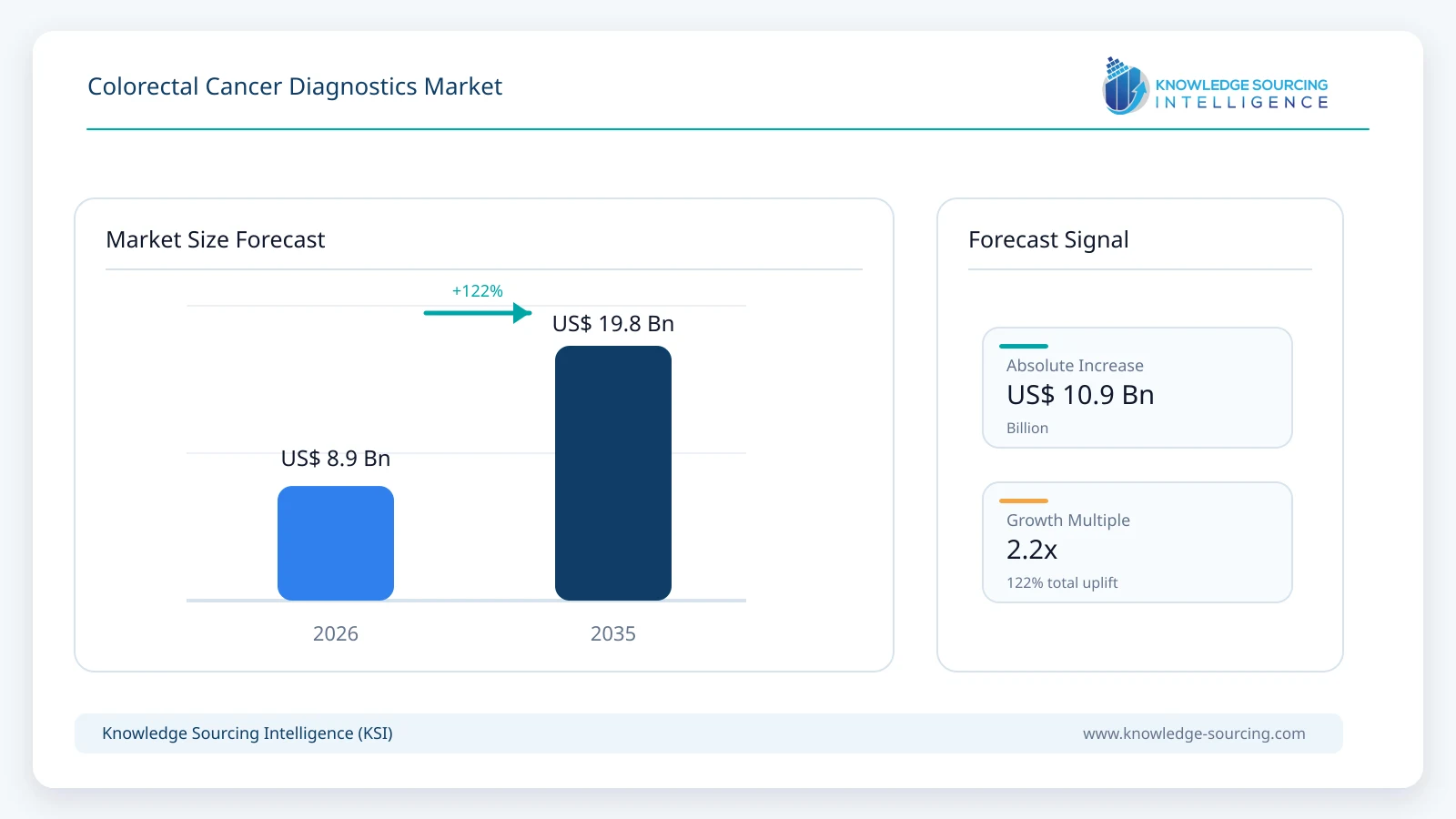
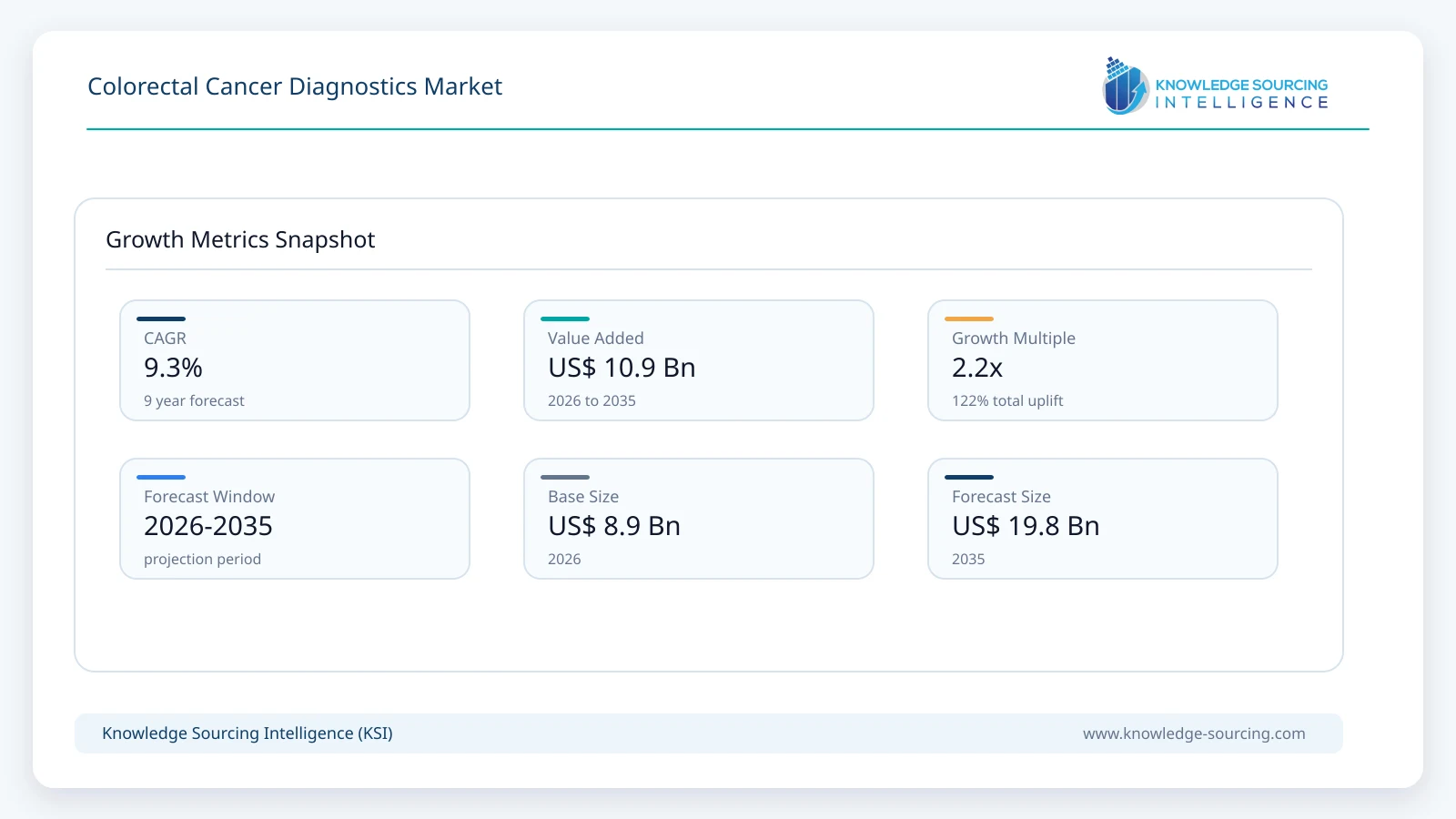
The Colorectal Cancer Diagnostics Market is anticipated to grow at a CAGR of 9.3% from USD 8.91 billion in 2026 to USD 19.81 billion in 2035.
Highlights:
- 1Expansion of population screening programs is increasing demand for non-invasive colorectal cancer detection technologies.
- 2Growing adoption of precision oncology is increasing demand for molecular and genomic biomarker testing.
- 3Rising awareness of early-stage cancer detection is strengthening utilization of stool-based and blood-based screening tests.
- 4Healthcare providers are reducing dependence on invasive procedures by incorporating molecular screening alternatives.
Colorectal cancer diagnostics serve as a critical component of cancer management because clinical outcomes depend heavily on detection timing and diagnostic accuracy. The market supports screening, disease confirmation, molecular profiling, recurrence monitoring, and treatment optimization. Demand continues rising as healthcare providers emphasize preventive oncology strategies and population-level screening programs.
Healthcare systems are expanding screening initiatives because colorectal cancer remains one of the most frequently diagnosed malignancies worldwide. Screening adoption is increasing among average-risk populations as clinical guidelines promote earlier intervention. Diagnostic laboratories are expanding testing capacity to accommodate higher screening volumes. This expansion strengthens the role of advanced diagnostic technologies throughout the patient journey.
Regulatory authorities continue emphasizing diagnostic quality because clinical decisions increasingly depend on molecular and genomic information. Diagnostic manufacturers are investing in validation studies and companion diagnostic development programs. These efforts improve confidence in test performance and support broader clinical integration.
Market Dynamics
Market Drivers
Expansion of Organized Screening Programs: Population screening programs improve early detection because asymptomatic disease frequently remains undiagnosed without routine testing. Participation rates are increasing across several healthcare systems. Diagnostic laboratories are processing larger testing volumes as screening coverage expands. Earlier diagnosis therefore supports sustained demand for colorectal cancer diagnostics.
Increasing Adoption of Precision Oncology: Precision medicine requires biomarker-driven treatment selection because therapeutic response varies among patient populations. Molecular testing demand is increasing as targeted therapies become more widely utilized. Diagnostic providers are expanding genomic profiling capabilities to support oncology decision-making. This evolution strengthens demand for advanced diagnostic platforms.
Growing Preference for Non-Invasive Testing: Patient compliance remains a critical determinant of screening effectiveness because invasive procedures discourage participation. Demand is shifting toward stool-based and blood-based tests that reduce procedural burden. Diagnostic developers are enhancing test sensitivity while maintaining convenience. Improved accessibility therefore supports broader screening adoption.
Rising Healthcare Investment in Cancer Prevention: Healthcare systems prioritize preventive interventions because treatment costs increase substantially during advanced disease stages. Funding is expanding for screening infrastructure and diagnostic services. Healthcare providers are integrating earlier detection pathways into routine care delivery. This strategy increases long-term utilization of colorectal cancer diagnostics.
Market Restraints
Limited screening participation persists in several regions despite growing awareness initiatives.
Reimbursement disparities reduce adoption of advanced molecular diagnostic technologies.
False-positive and false-negative outcomes create challenges for screening program optimization.
Market Opportunities
Development of Blood-Based Screening Technologies: Conventional screening pathways face participation limitations because procedural preparation and patient discomfort remain concerns. Demand is increasing for blood-based screening alternatives that simplify testing. Diagnostic developers are advancing liquid biopsy platforms to improve accessibility. This innovation creates significant commercial opportunities.
Expansion of Companion Diagnostics: Targeted oncology therapies require biomarker identification because treatment efficacy depends on molecular characteristics. Pharmaceutical developers are increasing collaboration with diagnostic companies. Companion diagnostic adoption is therefore expanding alongside precision oncology programs.
Integration of Artificial Intelligence: Diagnostic interpretation requires increasing efficiency because testing complexity continues rising. AI-enabled platforms are improving analytical consistency and workflow productivity. Laboratories are incorporating automated interpretation tools to manage larger testing volumes. This transition supports innovation across the diagnostic ecosystem.
Emerging Market Screening Expansion: Several developing healthcare systems are strengthening cancer prevention initiatives because disease burden continues to increase. Screening infrastructure investments are expanding access to diagnostic services. Diagnostic providers are increasing regional presence to capture emerging demand. This expansion creates long-term growth potential.
Supply Chain Analysis
The colorectal cancer diagnostics supply chain begins with manufacturers producing diagnostic instruments, assay kits, reagents, sequencing technologies, and analytical software. Demand is increasing for integrated diagnostic workflows because healthcare providers seek greater efficiency and clinical consistency. Technology developers are expanding partnerships with laboratory service providers to improve workflow adoption.
Diagnostic laboratories occupy a central position because they convert testing technologies into clinical results. Screening volumes are increasing as healthcare systems expand population-based detection programs. Laboratories are investing in automation and molecular testing infrastructure to improve throughput. This investment strengthens operational scalability.
Healthcare providers generate downstream demand because treatment pathways increasingly depend on diagnostic information. Early detection initiatives are expanding testing requirements across hospitals, cancer centers, and screening programs. This interconnected ecosystem supports sustained demand throughout the value chain.
Government Regulations
Region | Regulatory Authority | Key Regulatory Focus |
United States | FDA | Approval and oversight of colorectal cancer diagnostic tests |
United States | CMS (CLIA) | Laboratory quality and testing standards |
European Union | European Commission (IVDR) | Clinical performance and diagnostic compliance |
United Kingdom | MHRA | In vitro diagnostic oversight |
Market Segmentation
By Product & Service
Diagnostic testing services represent a significant demand center because healthcare providers increasingly outsource specialized molecular analysis. Demand is increasing for integrated testing solutions that combine screening, molecular characterization, and reporting capabilities. Reagents and consumables maintain recurring utilization because every diagnostic procedure requires assay-specific materials. Software platforms are becoming more important because molecular testing generates increasingly complex datasets. This transition strengthens demand for comprehensive diagnostic ecosystems.
By Diagnostic Technology
Stool-based testing remains widely utilized because it supports non-invasive population screening. Demand is shifting toward molecular diagnostics and liquid biopsy technologies because healthcare providers seek higher sensitivity and earlier detection capabilities. Colonoscopy continues serving as the diagnostic confirmation standard where positive screening results require further investigation. Technology diversification improves screening accessibility while supporting broader clinical adoption.
By Application
Screening and early detection generate substantial testing demand because healthcare systems prioritize prevention-focused oncology strategies. Diagnostic confirmation remains essential because treatment planning depends on accurate disease characterization. Molecular profiling is becoming more important as precision oncology expands. Recurrence monitoring is increasing because clinicians require ongoing assessment following therapeutic intervention. These trends support growth across multiple diagnostic applications.
Regional Analysis
North America
North America represents the largest regional market because colorectal cancer screening programs remain well established across healthcare systems. Demand is increasing for non-invasive screening technologies as providers seek to improve patient participation rates. Precision oncology adoption remains strong because biomarker-driven treatment strategies are widely integrated into clinical practice. Diagnostic laboratories are expanding molecular testing capabilities to support growing screening and treatment requirements. Reimbursement support remains stronger than many global regions, which improves technology adoption. These factors reinforce regional leadership.
Europe
Europe maintains significant demand because organized screening initiatives continue expanding across national healthcare systems. Participation rates are increasing as governments strengthen public awareness campaigns. Molecular diagnostics adoption is rising because precision medicine programs are becoming more integrated into oncology care pathways. Healthcare providers continue emphasizing earlier detection to reduce treatment burden associated with advanced disease. This environment supports continued demand for colorectal cancer diagnostic technologies.
Asia Pacific
Asia Pacific is experiencing rapid market development because cancer incidence and healthcare investment continue increasing. Screening infrastructure is expanding as governments prioritize early detection strategies. Demand is rising for affordable and scalable diagnostic solutions that support large population bases. Diagnostic providers are increasing regional investments to address growing testing needs. This combination of healthcare modernization and expanding cancer awareness supports strong market momentum.
Rest of the World
The Rest of the World region is demonstrating gradual adoption because healthcare systems increasingly recognize the value of early cancer detection. Screening implementation remains variable across countries, creating uneven market development. Diagnostic access is improving as healthcare infrastructure investments continue increasing. Regional demand therefore continues strengthening despite ongoing operational challenges.
Regulatory Landscape
Regulatory agencies prioritize diagnostic accuracy because screening outcomes directly influence treatment decisions and patient management. Clinical validation requirements continue increasing as molecular diagnostics become more sophisticated. These requirements strengthen confidence in test performance.
Healthcare authorities are encouraging evidence-based screening practices because early detection reduces long-term disease burden. Diagnostic manufacturers are investing in clinical studies to demonstrate utility and performance. This investment supports broader regulatory acceptance.
Precision oncology applications continue expanding because biomarker-driven treatment strategies require reliable diagnostic support. Regulatory frameworks therefore increasingly address companion diagnostics and molecular testing integration. This evolution strengthens the strategic importance of advanced colorectal cancer diagnostics.
Pipeline Analysis
The diagnostic pipeline increasingly focuses on blood-based screening technologies because patient participation remains a major determinant of screening effectiveness. Developers are advancing liquid biopsy approaches that identify cancer-associated biomarkers through minimally invasive procedures. These innovations seek to improve compliance while maintaining diagnostic performance.
Multi-omics platforms are receiving increased attention because colorectal cancer development involves complex molecular changes. Developers are combining genomic, epigenomic, transcriptomic, and proteomic markers to improve early-stage detection accuracy. This strategy supports more comprehensive disease characterization.
Artificial intelligence integration is expanding because large molecular datasets require efficient interpretation. Diagnostic developers are incorporating machine learning tools to improve analytical performance and workflow efficiency. These advancements continue reshaping future diagnostic pathways.
Competitive Landscape
Exact Sciences Corporation
Exact Sciences maintains a leading position because colorectal cancer screening remains a core strategic focus. The company differentiates itself through established non-invasive screening technologies and extensive commercial reach. Growing emphasis on early detection supports continued demand for its diagnostic portfolio.
Guardant Health, Inc.
Guardant Health focuses on liquid biopsy innovation because minimally invasive testing continues gaining clinical acceptance. The company benefits from expertise in molecular oncology and genomic profiling. Expansion of blood-based cancer detection strengthens its long-term market positioning.
F. Hoffmann-La Roche Ltd
Roche leverages extensive oncology expertise because precision medicine increasingly depends on integrated diagnostic and therapeutic strategies. The company maintains strong biomarker testing capabilities supporting targeted treatment selection. This integration provides significant competitive advantage.
QIAGEN N.V.
QIAGEN supports colorectal cancer diagnostics through molecular testing and biomarker analysis solutions. Demand is increasing for genomic characterization because oncology treatment pathways require deeper molecular understanding. The company benefits from broad diagnostic workflow capabilities.
Abbott Laboratories
Abbott maintains a strong diagnostic presence because healthcare providers require scalable testing solutions. Its global commercial footprint supports broad market access. Continued investment in diagnostic innovation strengthens competitive relevance.
Thermo Fisher Scientific Inc.
Thermo Fisher Scientific benefits from comprehensive genomic and molecular diagnostic capabilities. The company supports testing workflows from sample preparation through analysis. This integrated approach enhances strategic positioning within precision oncology.
Danaher Corporation
Danaher participates through multiple diagnostic and life science businesses supporting cancer testing applications. The company benefits from broad technology capabilities and extensive laboratory relationships. Ongoing innovation supports continued market participation.
Bio-Rad Laboratories, Inc.
Bio-Rad provides molecular analysis solutions supporting cancer biomarker testing. Growing demand for precision diagnostics strengthens the relevance of its technologies. The company remains well positioned within advanced diagnostic workflows.
Future Market Outlook
The colorectal cancer diagnostics market is moving toward earlier, less invasive detection because healthcare systems increasingly prioritize preventive oncology strategies. Demand continues shifting toward molecular and blood-based screening technologies that improve participation rates. This transition is reducing reliance on traditional diagnostic pathways alone.
Precision oncology is increasing dependence on molecular characterization because treatment decisions require detailed biomarker information. Diagnostic providers are expanding genomic and liquid biopsy capabilities to address evolving clinical requirements. This evolution strengthens the strategic role of advanced diagnostics.
Artificial intelligence, multi-omics analysis, and liquid biopsy innovation continue transforming diagnostic workflows because healthcare providers require greater accuracy, efficiency, and scalability. These technologies are supporting broader access to personalized cancer care while improving screening effectiveness.
The long-term trajectory of the colorectal cancer diagnostics market remains closely tied to early detection initiatives, precision medicine adoption, and expanding molecular testing capabilities.
Colorectal Cancer Diagnostics Market Scope:
| Report Metric | Details |
|---|---|
| Total Market Size in 2026 | USD 8.91 billion |
| Total Market Size in 2035 | USD 19.81 billion |
| Forecast Unit | USD Billion |
| Growth Rate | 9.3% |
| Study Period | 2021 to 2035 |
| Historical Data | 2021 to 2024 |
| Base Year | 2025 |
| Forecast Period | 2026 – 2035 |
| Segmentation | Product & Service, Diagnostic Technology, Application, Geography |
| Companies |
|
Market Segmentation
Product & Service
Diagnostic Technology
Application
Geography
- North America
- South America
- Europe
- Middle East and Africa
- Asia Pacific
Table of Contents
1. EXECUTIVE SUMMARY
1.1 Market Snapshot
1.2 Key Findings
1.3 Analyst Insights
1.4 Strategic Recommendations
2. RESEARCH METHODOLOGY
2.1 Research Design
2.2 Data Collection Methodology
2.3 Market Size Estimation
2.4 Forecasting Model
2.5 Assumptions & Limitations
3. COLORECTAL CANCER DIAGNOSTICS MARKET OVERVIEW, SIZE & FORECAST
3.1 Market Definition & Scope
3.2 Disease Overview
3.3 Industry Evolution
3.4 Key Market Trends
3.5 Historical Market Size Analysis (2021–2025)
3.6 Market Forecast Analysis (2026–2035)
3.7 Disease Burden and Unmet Diagnostic Needs
3.8 Epidemiology and Prevalence Analysis
3.9 Diagnosed Patient Population Analysis
3.10 Screening and Testing Volume Analysis
3.11 Patient Journey Analysis
3.12 Colorectal Cancer Screening Landscape
3.13 Precision Oncology Diagnostics Overview
4. MARKET DYNAMICS
4.1 Market Drivers
4.2 Market Restraints
4.3 Market Opportunities
4.4 Market Challenges
5. INDUSTRY LANDSCAPE
5.1 Industry Value Chain Analysis
5.2 Pricing Analysis
5.3 Reimbursement Landscape
6. INNOVATION LANDSCAPE
6.1 Emerging Technologies in Colorectal Cancer Diagnostics
6.2 Product Innovation Analysis
6.3 Liquid Biopsy Advancements
6.4 Molecular and Genomic Biomarker Developments
6.5 Multi-Cancer Early Detection Technologies
6.6 Clinical Trial Analysis
6.7 Pipeline Analysis
6.8 AI Integration in Colorectal Cancer Detection
6.9 Digital Pathology and Diagnostic Workflow Integration
6.10 Technology Roadmap
7. REGULATORY LANDSCAPE
7.1 Regulatory Framework
7.2 Approval Pathways
7.3 Compliance Requirements
8. COLORECTAL CANCER DIAGNOSTICS MARKET LANDSCAPE ANALYSIS
8.1 Analysis by Technology Platform
8.2 Analysis by Biomarker Type
8.3 Analysis by Sample Type
8.4 Analysis by Clinical Application
8.5 Analysis by Testing Methodology
8.6 Analysis by Screening versus Diagnostic Testing
8.7 Analysis by End User
9. COLORECTAL CANCER DIAGNOSTICS MARKET SEGMENT ANALYSIS (2021–2035)
9.1 By Product & Service
9.1.1 Instruments
9.1.2 Reagents & Consumables
9.1.3 Software & Diagnostic Analytics Solutions
9.1.4 Diagnostic Testing Services
9.2 By Diagnostic Technology
9.2.1 Fecal Immunochemical Test (FIT)
9.2.2 Guaiac Fecal Occult Blood Test (gFOBT)
9.2.3 Stool DNA Testing
9.2.4 Colonoscopy-Based Diagnostics
9.2.5 Flexible Sigmoidoscopy
9.2.6 CT Colonography
9.2.7 Molecular and Genomic Testing
9.2.8 Liquid Biopsy Testing
9.3 By Application
9.3.1 Screening and Early Detection
9.3.2 Diagnosis and Disease Confirmation
9.3.3 Prognostic Assessment
9.3.4 Treatment Selection and Companion Diagnostics
9.3.5 Recurrence Monitoring
9.4 By End User
9.4.1 Hospitals
9.4.2 Diagnostic Laboratories
9.4.3 Cancer Centers
9.4.4 Academic & Research Institutes
9.4.5 Other End Users
10. COLORECTAL CANCER DIAGNOSTICS MARKET GEOGRAPHICAL ANALYSIS (2021–2035)
10.1 North America
10.2 Europe
10.3 Asia-Pacific
10.4 South America
10.5 Middle East & Africa
11. COLORECTAL CANCER DIAGNOSTICS MARKET COUNTRY ANALYSIS (2021–2035)
11.1 United States
11.2 Canada
11.3 Germany
11.4 United Kingdom
11.5 France
11.6 Italy
11.7 Spain
11.8 Netherlands
11.9 China
11.10 Japan
11.11 South Korea
11.12 Australia
11.13 India
11.14 Brazil
11.15 Saudi Arabia
12. COMPETITIVE LANDSCAPE
12.1 Market Share Analysis
12.2 Strategic Developments
12.3 Mergers & Acquisitions, Partnerships & Collaborations
12.4 Product Launches
13. COMPANY PROFILES
13.1 Exact Sciences Corporation
13.2 Guardant Health, Inc.
13.3 F. Hoffmann-La Roche Ltd
13.4 QIAGEN N.V.
13.5 Abbott Laboratories
13.6 Thermo Fisher Scientific Inc.
13.7 Danaher Corporation
13.8 Bio-Rad Laboratories, Inc.
13.9 Sysmex Corporation
13.10 Epigenomics AG
13.11 Freenome Holdings, Inc.
13.12 Geneoscopy, Inc.
13.13 Novigenix SA
13.14 Mainz Biomed N.V.
13.15 Eiken Chemical Co., Ltd.
14. COLORECTAL CANCER DIAGNOSTICS MARKET COMMERCIAL FORECAST ANALYSIS
14.1 Forecast by Instruments
14.2 Forecast by Reagents & Consumables
14.3 Forecast by Software & Diagnostic Analytics Solutions
14.4 Forecast by Diagnostic Testing Services
14.5 Forecast by Stool-Based Testing
14.6 Forecast by Colonoscopy-Based Diagnostics
14.7 Forecast by Molecular and Genomic Testing
14.8 Forecast by Liquid Biopsy Testing
15. INVESTMENT & FUNDING ANALYSIS
15.1 Venture Capital Trends
15.2 Government Funding
15.3 R&D Investments
16. FUTURE OUTLOOK
16.1 Key Growth Opportunities
16.2 Future Industry Trends
Navigate
Trusted by the world's leading organizations











