
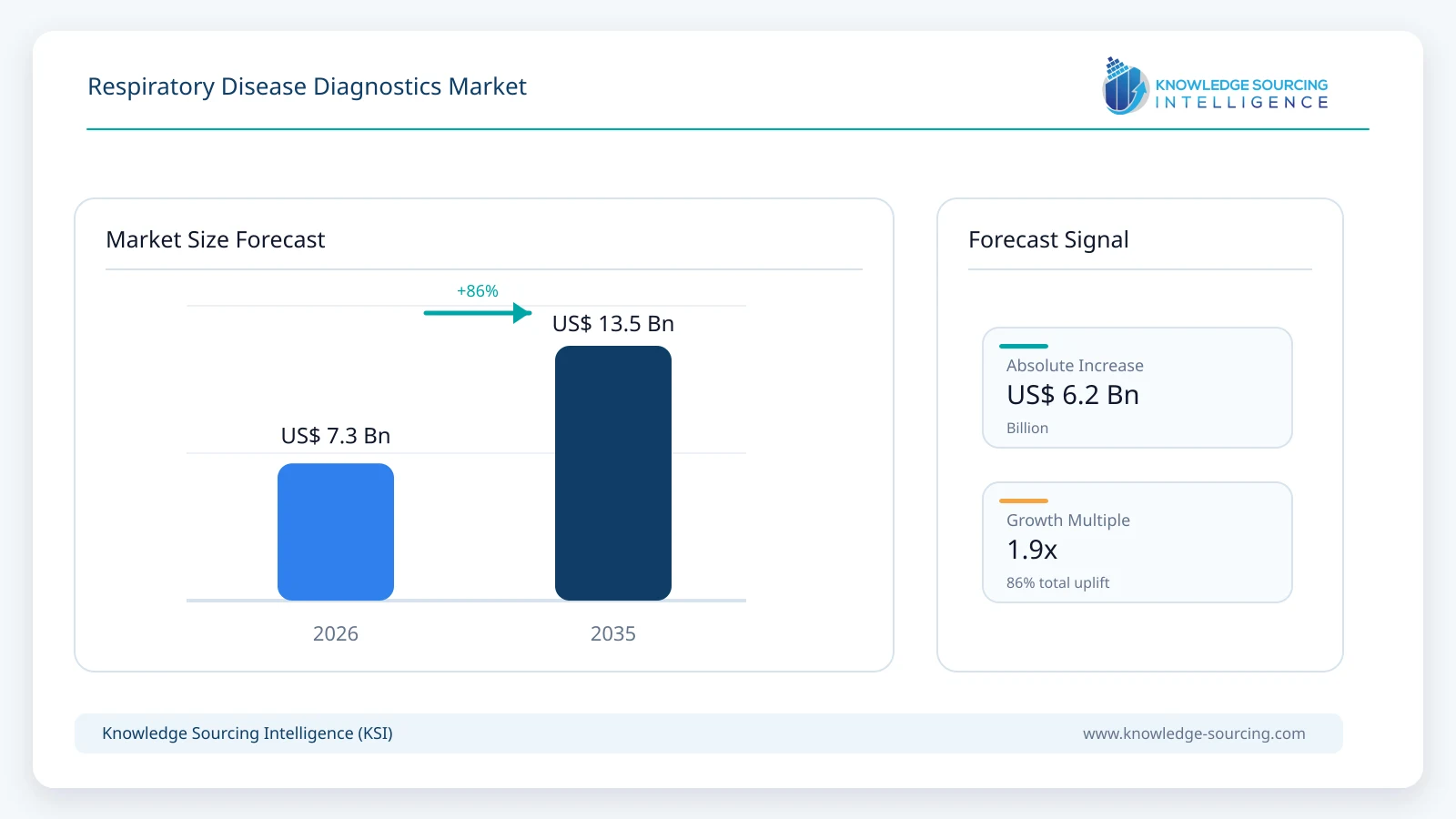
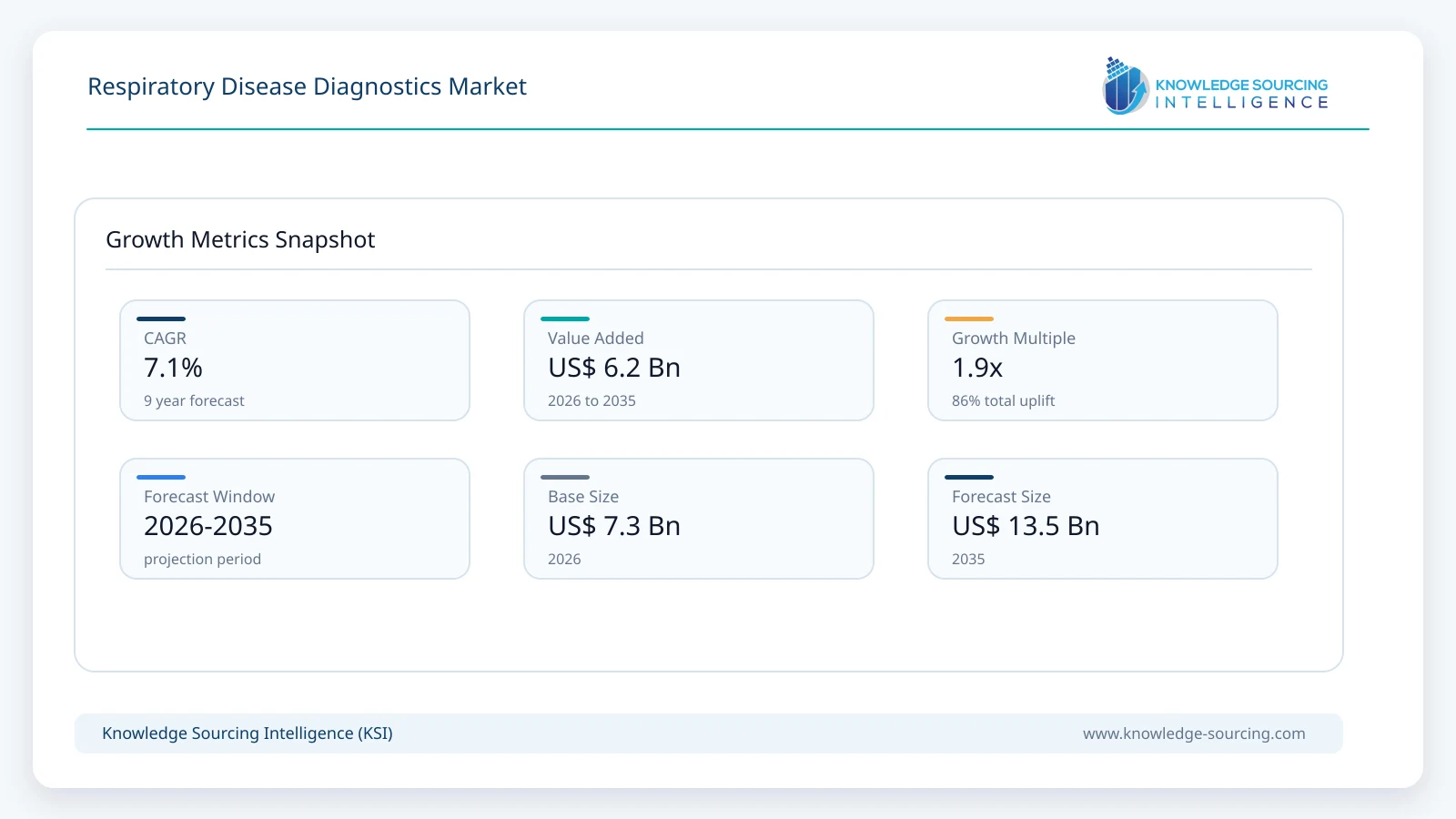
The Respiratory Disease Diagnostics Market is forecast to grow at a CAGR of 7.1%, reaching USD 13.52 billion in 2035 from USD 7.28 billion in 2026.
Highlights:
- 1Rising respiratory infection surveillance requirements are increasing demand for multiplex molecular diagnostics because healthcare providers are seeking simultaneous detection of multiple pathogens from limited patient samples.
- 2Growing antimicrobial resistance concerns are strengthening adoption of microbiological and molecular testing because accurate pathogen identification reduces unnecessary antibiotic administration.
- 3Expansion of decentralized diagnostic models is increasing demand for rapid antigen and molecular testing because healthcare facilities are requiring faster clinical decisions outside centralized laboratories.
- 4Regulatory focus on respiratory outbreak preparedness is supporting diagnostic innovation because governments are maintaining testing capabilities for emerging respiratory threats.
Respiratory Disease Diagnostics Market represents the healthcare diagnostic ecosystem focused on identifying respiratory pathogens, monitoring disease progression, and supporting therapeutic decisions through laboratory and point-of-care testing technologies. The market structure depends on molecular assays, immunoassays, microbiology techniques, and automated diagnostic platforms that improve detection accuracy.
Demand is increasing for respiratory diagnostics because healthcare providers are requiring rapid differentiation between viral, bacterial, and chronic respiratory conditions. Multiplex testing solutions are gaining importance because respiratory symptoms often overlap across multiple diseases, making pathogen-specific identification essential for effective treatment selection.
Respiratory diagnostics are becoming increasingly dependent on regulatory frameworks because diagnostic accuracy directly influences infection control measures, public health surveillance, and clinical outcomes. Regulatory bodies such as the U.S. Food and Drug Administration (FDA), European Medicines Agency (EMA), and national health authorities are continuously updating diagnostic evaluation requirements to ensure reliability during routine care and outbreak situations.
Healthcare systems are prioritizing respiratory diagnostics as strategic tools because delayed diagnosis increases hospitalization risk, unnecessary antibiotic usage, and healthcare expenditure. The integration of automated workflows, molecular detection technologies, and decentralized testing capabilities is supporting a transition toward faster and more accessible respiratory disease management.
Market Dynamics
Market Drivers
Increasing Burden of Respiratory Infections: Respiratory infections remain a major healthcare challenge because diseases such as influenza, RSV, tuberculosis, and pneumonia require timely diagnosis to prevent complications. Global surveillance systems are continuously monitoring respiratory pathogen circulation, which is increasing reliance on accurate diagnostic testing. Demand is shifting toward molecular respiratory panels because healthcare providers are requiring broader pathogen identification during periods of overlapping seasonal infections. The expansion of respiratory testing capacity is supporting early intervention, infection control, and improved patient management.
Growth of Multiplex Molecular Diagnostics: Molecular diagnostics are transforming respiratory disease detection because they provide high sensitivity and enable identification of multiple pathogens within a single testing workflow. Healthcare laboratories are increasingly adopting syndromic testing platforms because conventional sequential testing approaches are creating delays in treatment decisions. Demand is moving toward automated molecular systems as hospitals are seeking operational efficiency, reduced manual intervention, and improved diagnostic consistency. Companies are developing expanded respiratory panels that are supporting broader pathogen coverage and faster clinical responses.
Rising Chronic Respiratory Disease Monitoring Requirements: Chronic respiratory disorders such as COPD and asthma are increasing diagnostic dependency because patients require continuous monitoring and disease assessment. Pulmonary diagnostics are supporting disease management by enabling evaluation of respiratory function and associated complications. Demand is expanding for diagnostic technologies that integrate with long-term care pathways because healthcare providers are focusing on reducing hospital admissions and improving disease control. Diagnostic manufacturers are developing solutions that support both infectious and chronic respiratory applications.
Expansion of Point-of-Care Respiratory Testing: Point-of-care respiratory diagnostics are gaining adoption because healthcare facilities require rapid testing capabilities in emergency departments, outpatient centers, and decentralized settings. Faster results are improving treatment decisions, particularly during respiratory infection surges. Demand is increasing for compact molecular and antigen-based systems because healthcare providers are reducing dependence on centralized laboratories. Manufacturers are developing portable testing solutions that improve accessibility while maintaining diagnostic accuracy.
Market Restraints
High regulatory requirements increase development timelines because respiratory diagnostic manufacturers must demonstrate analytical accuracy, clinical performance, and reliability across diverse patient populations.
Cost limitations restrict adoption in emerging healthcare markets because advanced molecular diagnostic platforms require significant investment in equipment, reagents, and laboratory infrastructure.
Sample quality variability affects diagnostic performance because respiratory specimens can differ in pathogen concentration and collection accuracy.
Market Opportunities
Expansion of Syndromic Testing Platforms: Syndromic respiratory panels are creating market opportunities because healthcare providers are seeking comprehensive diagnostic solutions that identify multiple pathogens simultaneously. Manufacturers are expanding assay coverage to improve clinical utility and reduce diagnostic uncertainty. Demand is increasing for integrated respiratory panels because overlapping symptoms between respiratory diseases are making pathogen differentiation more important.
Growth in Emerging Healthcare Systems: Developing healthcare markets are creating opportunities because investments in laboratory infrastructure and infectious disease preparedness are increasing. Governments are strengthening diagnostic networks to improve outbreak response capabilities. Demand is expanding for affordable respiratory testing solutions because healthcare systems require scalable technologies that balance accuracy with accessibility.
Integration of Digital Diagnostics: Digital connectivity is creating opportunities because healthcare providers are requiring improved data management, remote monitoring, and surveillance capabilities. Diagnostic platforms are increasingly incorporating connectivity features to support centralized reporting and epidemiological analysis.
Development of Next-Generation Respiratory Assays: Innovation in assay technologies is creating opportunities because emerging pathogens and changing epidemiological patterns require adaptable diagnostic solutions. Companies are investing in improved molecular detection methods and expanded respiratory panels.Demand is increasing for flexible diagnostic platforms because healthcare systems require preparedness against future respiratory disease outbreaks.
Disease & Epidemiology Analysis
Respiratory diseases represent a broad group of infectious and chronic conditions that require differentiated diagnostic approaches because clinical symptoms frequently overlap across pathogens and disease categories. The respiratory diagnostics landscape includes viral infections such as influenza, respiratory syncytial virus (RSV), and COVID-19, bacterial infections such as tuberculosis and pneumonia, and chronic conditions including COPD and other pulmonary disorders.
Respiratory infection patterns are continuously changing because pathogen circulation is being influenced by seasonal transmission cycles, population mobility, vaccination coverage, and emerging variants. Healthcare systems are strengthening respiratory surveillance capabilities because early pathogen identification is becoming essential for infection control, treatment selection, and outbreak response.
Influenza remains a major driver of respiratory testing demand because seasonal outbreaks create recurring requirements for rapid identification and public health monitoring. The World Health Organization (WHO) Global Influenza Surveillance and Response System is continuously monitoring influenza activity through national surveillance networks, which is supporting diagnostic preparedness and vaccine strategy development.
Treatment Guidelines Landscape
Disease Category | Diagnostic Requirement | Treatment Approach | Impact on Diagnostics |
Influenza | Molecular tests, antigen detection tests | Antiviral therapy, supportive care, vaccination strategies | Early pathogen confirmation supports timely antiviral administration and infection control |
RSV Infection | Molecular assays, antigen detection | Supportive management, preventive immunization strategies for high-risk groups | Expanding preventive options are increasing demand for accurate RSV identification |
Tuberculosis | Molecular testing, microbiological culture | Multi-drug antibiotic therapy based on susceptibility profile | Drug resistance monitoring is increasing demand for advanced molecular diagnostics |
COVID-19 and Emerging Respiratory Viruses | PCR-based molecular testing, antigen tests | Antiviral treatment, vaccination, supportive care | Surveillance requirements continue to support respiratory testing infrastructure |
Market Segmentation
By Test Type
Molecular tests represent a major respiratory diagnostics segment because nucleic acid amplification technologies provide high sensitivity and pathogen-specific identification. Healthcare providers are increasingly adopting molecular platforms because respiratory symptoms frequently overlap across multiple infections, requiring accurate differentiation. Demand is shifting toward multiplex molecular systems because laboratories are reducing sequential testing approaches and improving turnaround times through integrated respiratory panels. Automated molecular platforms are supporting this transition by enabling standardized workflows and reducing operational complexity. The segment is becoming strategically important because molecular testing supports outbreak surveillance, antimicrobial stewardship, and early therapeutic decisions.
By Sample Type
Nasopharyngeal and nasal samples represent a major respiratory diagnostics sample category because they provide direct access to upper respiratory tract pathogens responsible for influenza, RSV, COVID-19, and other viral infections. Diagnostic workflows widely rely on these samples because respiratory viruses often demonstrate detectable pathogen loads in nasal passages during early infection stages. Demand is shifting toward nasal sampling approaches because healthcare providers are seeking less invasive collection methods that support decentralized testing and improve patient acceptance. The adoption of self-collected nasal samples is increasing because it enables broader testing access outside traditional laboratory environments.
By Application
Infectious respiratory disease represents the largest application area because viral and bacterial respiratory infections require rapid identification for treatment decisions, isolation measures, and public health response. Diseases such as influenza, RSV, tuberculosis, and COVID-19 continue generating recurring diagnostic demand because transmission control depends on early detection. Demand is shifting toward multiplex respiratory diagnostics because healthcare providers are managing overlapping seasonal infections and require simultaneous pathogen identification. Syndromic testing platforms are expanding because they reduce diagnostic delays and improve treatment accuracy. Regulatory agencies are strengthening respiratory surveillance frameworks because emerging pathogens continue creating preparedness requirements. Diagnostic companies are investing in expanded respiratory panels because healthcare systems are prioritizing rapid outbreak detection capabilities.
Regional Analysis
North America Market Analysis
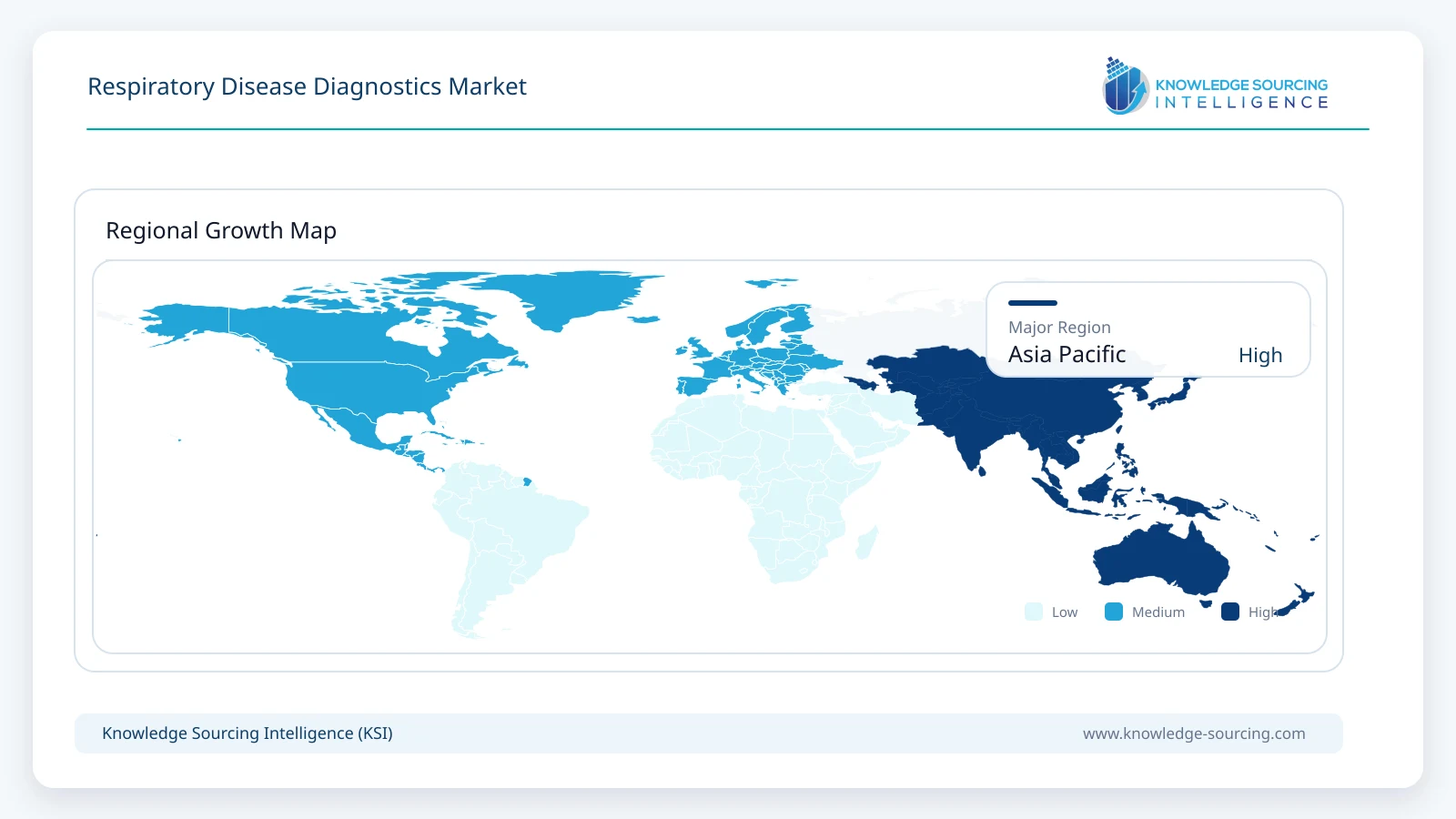
North America represents a mature respiratory diagnostics market because healthcare systems maintain advanced laboratory infrastructure, extensive infectious disease surveillance networks, and strong regulatory oversight. The region is experiencing increasing demand for respiratory diagnostics because seasonal respiratory infections, emerging pathogens, and chronic respiratory disorders continue creating testing requirements. The United States is strengthening respiratory diagnostic capabilities because public health agencies are prioritizing pathogen surveillance and outbreak preparedness. The Centers for Disease Control and Prevention (CDC) is operating respiratory virus surveillance programs that monitor influenza, RSV, and COVID-19 activity, supporting diagnostic planning and healthcare response. The region is also experiencing increased adoption of point-of-care respiratory diagnostics because healthcare delivery models are moving toward decentralized testing environments. Emergency departments and outpatient facilities are requiring rapid diagnostic solutions to manage patient volumes during seasonal outbreaks.
Europe Market Analysis
Europe represents a significant respiratory diagnostics market because healthcare systems maintain structured infectious disease surveillance networks, established laboratory infrastructure, and strong regulatory frameworks. The region is experiencing increasing demand for respiratory diagnostics because seasonal infections, antimicrobial resistance concerns, and aging populations are increasing testing requirements. Respiratory disease monitoring is becoming more coordinated across European healthcare systems because organizations are strengthening surveillance capabilities for influenza, RSV, and emerging respiratory pathogens. The European Centre for Disease Prevention and Control (ECDC) is supporting respiratory virus surveillance activities, which is increasing the importance of reliable diagnostic data. Demand is shifting toward molecular and multiplex respiratory diagnostics because healthcare providers are seeking comprehensive pathogen identification during periods of overlapping respiratory infections. Hospitals are adopting automated testing workflows because laboratory efficiency and turnaround time are becoming important operational priorities.
Asia Pacific Market Analysis
Asia Pacific represents a rapidly developing respiratory diagnostics market because the region carries a high burden of infectious respiratory diseases, expanding healthcare infrastructure, and increasing investment in diagnostic capabilities. Countries across the region are experiencing rising demand for respiratory testing because dense urban populations, seasonal outbreaks, and environmental risk factors are increasing respiratory disease management requirements. Respiratory disease surveillance is expanding because governments are strengthening diagnostic networks for influenza, tuberculosis, COVID-19, and other respiratory infections. National public health programs are increasing laboratory capacity because early detection is becoming critical for controlling transmission and reducing disease burden. Demand is shifting toward molecular respiratory diagnostics because healthcare providers are requiring faster and more accurate pathogen identification. Hospitals are adopting automated molecular platforms because they are reducing turnaround times and improving diagnostic consistency compared with conventional testing approaches.
Rest of the World
Rest of the World markets, including Latin America, the Middle East, and Africa, are developing respiratory diagnostic capabilities because infectious respiratory diseases continue creating significant healthcare challenges. These regions are experiencing increasing demand for diagnostic solutions because healthcare systems are improving disease surveillance and strengthening laboratory capacity. Respiratory infections remain a major healthcare priority because limited diagnostic accessibility has historically contributed to delayed disease identification and treatment initiation. Governments and international health organizations are expanding testing infrastructure because improved detection supports disease control and public health planning. Demand is shifting toward affordable and scalable diagnostic technologies because healthcare systems are balancing disease burden with resource limitations. Rapid antigen tests and cost-effective molecular platforms are gaining importance because they enable broader testing coverage across resource-constrained environments.
Regulatory Landscape
Respiratory diagnostics are regulated through strict performance evaluation requirements because diagnostic accuracy directly affects clinical treatment decisions, infection control practices, and public health responses. Regulatory agencies are requiring manufacturers to demonstrate analytical sensitivity, specificity, clinical performance, and manufacturing consistency before commercial adoption.
The U.S. Food and Drug Administration (FDA) regulates respiratory diagnostic devices through pathways including 510(k) clearance, De Novo classification, and Emergency Use Authorization (EUA) mechanisms during public health emergencies. These pathways are influencing product development because companies are aligning respiratory diagnostic innovation with regulatory evidence requirements.
European respiratory diagnostic manufacturers are adapting to the In Vitro Diagnostic Regulation (IVDR) because the framework requires stronger clinical validation and post-market surveillance. The regulation is increasing development complexity because manufacturers must generate additional evidence to maintain market access.
Global diagnostic companies are strengthening regulatory strategies because respiratory pathogens are evolving and creating demand for adaptable testing solutions. Companies are investing in expanded assay validation because broader pathogen coverage requires regulatory approval across multiple indications.
Pipeline Analysis
The respiratory diagnostics pipeline is focusing on expanding multiplex detection, improving point-of-care capabilities, and integrating digital technologies because healthcare providers are requiring faster and more comprehensive respiratory disease identification.
Multiplex molecular respiratory panels are advancing because clinicians are facing overlapping symptoms from multiple pathogens during seasonal respiratory infection periods. Companies are developing broader assay menus because simultaneous detection reduces diagnostic uncertainty and supports targeted treatment decisions.
bioMérieux continues strengthening syndromic respiratory testing through its multiplex molecular diagnostic capabilities. Its respiratory testing strategy focuses on identifying multiple pathogens from a single sample, supporting faster clinical decision-making in hospital settings.
Roche Diagnostics is advancing molecular diagnostic workflows because laboratories are demanding automation, scalability, and broader respiratory pathogen coverage. The company’s diagnostic development strategy focuses on integrated systems that improve laboratory efficiency.
Point-of-care respiratory diagnostics are also progressing because healthcare providers are seeking testing solutions that deliver rapid results outside centralized laboratories. Developers are focusing on compact molecular platforms and improved antigen detection technologies because decentralized care models are increasing.
Reimbursement Landscape
Respiratory diagnostic reimbursement is influenced by healthcare payment systems, clinical guidelines, and demonstrated value because payers evaluate testing technologies based on their ability to improve outcomes and reduce healthcare costs.
In the United States, respiratory diagnostic reimbursement is primarily influenced by coverage policies from government programs such as Medicare and private insurers. Reimbursement decisions are increasingly considering clinical utility because diagnostic tests that support appropriate treatment selection provide measurable healthcare value.
European reimbursement systems are focusing on cost-effectiveness because healthcare organizations are evaluating diagnostic technologies within broader healthcare expenditure frameworks. Respiratory diagnostics are gaining support when they demonstrate reduced hospitalization burden and improved resource utilization.
Emerging markets are experiencing reimbursement limitations because advanced molecular diagnostics often require higher healthcare spending capacity. Manufacturers are adapting pricing and access strategies because affordability remains a key factor influencing adoption.
Competitive Landscape
Roche Diagnostics
Roche Diagnostics is strategically distinct because it combines broad molecular diagnostic capabilities with integrated laboratory automation and a global healthcare infrastructure. The company is strengthening its respiratory diagnostics position through molecular testing platforms that support high-throughput pathogen identification and laboratory efficiency.
Abbott Laboratories
Abbott Laboratories is strategically distinct because it combines laboratory diagnostics with decentralized testing technologies, allowing the company to address both hospital-based and point-of-care respiratory testing requirements. The company’s respiratory diagnostics strategy focuses on improving accessibility and speed of testing.
Thermo Fisher Scientific
Thermo Fisher Scientific is strategically distinct because it provides a broad life sciences and diagnostic technology ecosystem spanning molecular biology, laboratory instruments, reagents, and testing workflows. The company supports respiratory diagnostics through molecular technologies and laboratory solutions.
bioMérieux
bioMérieux is strategically distinct because it specializes in infectious disease diagnostics and has strong expertise in syndromic testing approaches. The company’s respiratory diagnostics strategy focuses on improving pathogen identification through multiplex molecular technologies.
Danaher Corporation
Danaher Corporation is strategically distinct because it operates through multiple diagnostic and life science businesses that provide technologies supporting molecular testing, automation, and laboratory workflows. The company’s respiratory diagnostics capabilities are strengthened through its diagnostic platforms and scientific technology portfolio.
QIAGEN
QIAGEN is strategically distinct because it focuses strongly on molecular sample preparation and nucleic acid-based diagnostic technologies. The company supports respiratory diagnostics through molecular testing solutions designed for accurate pathogen detection.
Key Developments
July 2026: Respiro Diagnostics raised £1 million in pre-seed funding to advance its breath-based lung diagnostics platform. The company is developing a non-invasive system to detect and molecularly profile lung cancer and other respiratory diseases from exhaled breath.
November 2025: Cipla opened a dedicated lung diagnostics and wellness center in New Delhi, designed to make advanced respiratory diagnostics more accessible and affordable. The center offers 60+ tests covering lung physiology, microbiology, imaging, and related respiratory evaluations.
June 2025: BioMérieux launched VETFIRE, a ready-to-use PCR kit for equine infectious respiratory diseases, performed on the BIOFIRE SPOTFIRE system. The test detects seven pathogens in less than 20 minutes and was first made commercially available in the UK, Ireland, and France.
Strategic Insights and Future Market Outlook
The Respiratory Disease Diagnostics Market is evolving from conventional pathogen identification toward integrated diagnostic ecosystems because healthcare providers require faster, broader, and clinically actionable information. Molecular multiplex testing is becoming a central technology direction because respiratory symptoms frequently overlap across multiple diseases and require accurate differentiation.
Diagnostic companies are expanding their strategies toward automation, decentralization, and digital connectivity because healthcare systems are improving testing efficiency while reducing operational complexity. Point-of-care molecular platforms and connected diagnostic workflows are gaining importance because healthcare delivery is moving closer to patients.
Future market development is expected to depend on the ability of diagnostic manufacturers to balance accuracy, affordability, regulatory compliance, and accessibility. Companies that combine broad respiratory assay portfolios with scalable deployment models are strengthening their competitive position because healthcare systems require adaptable solutions for both routine infections and emerging respiratory threats.
The respiratory diagnostics landscape is becoming increasingly integrated with public health surveillance because governments and healthcare organizations are prioritizing preparedness against future outbreaks. Diagnostic innovation is therefore shifting toward platforms that provide rapid detection, expanded pathogen coverage, and actionable clinical insights.
Respiratory diagnostics are becoming a foundational healthcare capability because disease management increasingly depends on early identification, targeted treatment, and continuous monitoring. The market’s long-term direction is being shaped by technological advancement, regulatory evolution, and healthcare system demand for efficient diagnostic pathways.
Respiratory Disease Diagnostics Market Scope:
| Report Metric | Details |
|---|---|
| Total Market Size in 2026 | USD 7.28 billion |
| Total Market Size in 2035 | USD 13.52 billion |
| Forecast Unit | Billion |
| Growth Rate | 7.1% |
| Study Period | 2021 to 2035 |
| Historical Data | 2021 to 2024 |
| Base Year | 2025 |
| Forecast Period | 2026 – 2035 |
| Segmentation | Technology, Test Type, Sample Type, Application, End User, Geography |
| Companies |
|
Market Segmentation
Technology
Test Type
Sample Type, Application, End User
Geography
- North America
- South America
- Europe
- Middle East and Africa
- Asia Pacific
Table of Contents
1. EXECUTIVE SUMMARY
1.1 Market Snapshot
1.2 Key Findings
1.3 Analyst Insights
1.4 Strategic Recommendations
2. RESEARCH METHODOLOGY
2.1 Research Design
2.2 Data Collection Methodology
2.3 Market Size Estimation
2.4 Forecasting Model
2.5 Assumptions & Limitations
3. RESPIRATORY DISEASE DIAGNOSTICS MARKET OVERVIEW, SIZE & FORECAST
3.1 Market Definition & Scope
3.2 Respiratory Disease Overview
3.3 Respiratory Disease Diagnostics Industry Evolution
3.4 Key Market Trends
3.5 Respiratory Disease Burden & Unmet Clinical Needs
3.6 Epidemiology and Prevalence Analysis
3.6.1 Global Respiratory Disease Prevalence
3.6.2 Diagnosed Patient Population for Major Respiratory Diseases
3.6.3 Burden of Acute and Chronic Respiratory Infections
3.7 Respiratory Disease Diagnostics Testing Landscape
3.7.1 Diagnostic Testing Volume Analysis
3.7.2 Screening and Surveillance Testing Trends
3.8 Patient Journey Analysis in Respiratory Disease Diagnosis
3.9 Treatment and Disease Management Landscape
3.10 Historical Market Size (2021-2025)
3.11 Market Forecast (2026-2035)
4. MARKET DYNAMICS
4.1 Market Drivers
4.1.1 Rising Global Burden of Respiratory Diseases
4.1.2 Increasing Adoption of Molecular Diagnostic Technologies
4.1.3 Growing Demand for Rapid Point-of-Care Respiratory Testing
4.1.4 Expansion of Respiratory Disease Surveillance Programs
4.1.5 Increasing Need for Multiplex Respiratory Pathogen Detection
4.2 Market Restraints
4.2.1 High Cost Associated with Advanced Diagnostic Platforms
4.2.2 Limited Diagnostic Infrastructure in Emerging Economies
4.2.3 Regulatory and Reimbursement Challenges
4.2.4 Variability in Respiratory Disease Testing Practices
4.3 Market Opportunities
4.3.1 Development of Next-Generation Multiplex Diagnostic Platforms
4.3.2 Integration of Artificial Intelligence in Respiratory Diagnostics
4.3.3 Expansion of Decentralized and Home-Based Testing
4.3.4 Increasing Demand for Syndromic Testing Approaches
4.4 Market Challenges
4.4.1 Antimicrobial Resistance Impact on Diagnostic Requirements
4.4.2 Challenges in Accurate Pathogen Identification
4.4.3 Supply Chain and Accessibility Issues for Diagnostic Tests
5. INDUSTRY LANDSCAPE
5.1 Respiratory Disease Diagnostics Value Chain Analysis
5.2 Pricing Analysis
5.3 Reimbursement Landscape
6. INNOVATION LANDSCAPE
6.1 Emerging Technologies in Respiratory Disease Diagnostics
6.2 Product Innovation and Technology Advancements
6.3 Clinical Trial Analysis
6.4 Pipeline Analysis of Emerging Respiratory Diagnostic Technologies
6.5 Technology Roadmap
6.6 Artificial Intelligence Integration in Respiratory Diagnostics
6.7 Digital Health Integration in Respiratory Disease Monitoring and Diagnostics
7. REGULATORY LANDSCAPE
7.1 Regulatory Framework
7.2 Approval Pathways
7.3 Compliance Requirements
8. RESPIRATORY DISEASE DIAGNOSTICS MARKET LANDSCAPE ANALYSIS
8.1 Analysis by Technology
8.2 Analysis by Biomarker
8.3 Analysis by Sample Type
8.4 Analysis by Application
8.5 Analysis by Test Type
8.6 Analysis by End User
9. RESPIRATORY DISEASE DIAGNOSTICS MARKET SEGMENT ANALYSIS (2021-2035)
9.1 By Technology
9.1.1 Molecular Diagnostics
9.1.2 Immunoassay-Based Diagnostics
9.1.3 Microbiology Diagnostics
9.1.4 Other Technologies
9.2 By Test Type
9.2.1 Molecular Tests
9.2.2 Antigen Detection Tests
9.2.3 Microbiological Tests
9.2.4 Others
9.3 By Sample Type
9.3.1 Nasopharyngeal and Nasal Samples
9.3.2 Sputum Samples
9.3.3 Blood Samples
9.3.4 Other Sample Types
9.4 By Application
9.4.1 Infectious Respiratory Disease
9.4.2 Chronic Respiratory Disease
9.4.3 Respiratory Disease
9.4.4 Others
9.5 By End User
9.5.1 Hospitals and Clinics
9.5.2 Diagnostic Laboratories
9.5.3 Academic and Research Institutions
9.5.4 Home Care Settings
10. RESPIRATORY DISEASE DIAGNOSTICS MARKET GEOGRAPHICAL ANALYSIS (2021-2035)
10.1 North America
10.1.1 United States
10.1.2 Canada
10.2 Europe
10.2.1 Germany
10.2.2 United Kingdom
10.2.3 France
10.2.4 Italy
10.2.5 Spain
10.3 Asia-Pacific
10.3.1 China
10.3.2 Japan
10.3.3 India
10.3.4 South Korea
10.3.5 Australia
10.4 South America
10.4.1 Brazil
10.4.2 Argentina
10.5 Middle East & Africa
10.5.1 Saudi Arabia
10.5.2 United Arab Emirates
10.5.3 South Africa
11. RESPIRATORY DISEASE DIAGNOSTICS MARKET COUNTRY ANALYSIS (2021-2035)
11.1 United States
11.2 Germany
11.3 United Kingdom
11.4 France
11.5 China
11.6 Japan
11.7 India
11.8 South Korea
11.9 Brazil
11.10 Others
12. COMPETITIVE LANDSCAPE
12.1 Market Share Analysis
12.2 Strategic Developments
12.3 Mergers & Acquisitions, Partnerships & Collaborations
12.4 Product Launches
13. COMPANY PROFILES
13.1 Roche Diagnostics
13.1.1 Company Overview
13.1.2 Financials
13.1.3 Product Portfolio
13.1.4 Recent Developments
13.2 Abbott Laboratories
13.3 Thermo Fisher Scientific
13.4 bioMérieux
13.5 Danaher Corporation
13.6 QIAGEN
13.7 Hologic
13.8 Becton, Dickinson and Company (BD)
13.9 Siemens Healthineers
13.10 DiaSorin S.p.A.
14. RESPIRATORY DISEASE DIAGNOSTICS MARKET COMMERCIAL FORECAST ANALYSIS
14.1 Forecasting Framework for Commercialized Respiratory Diagnostic Technologies
14.2 Molecular Respiratory Diagnostic Platforms Forecast Analysis
14.3 Multiplex Respiratory Panel Testing Forecast Analysis
14.4 Point-of-Care Respiratory Testing Forecast Analysis
14.5 Influenza Diagnostic Testing Forecast Analysis
14.6 RSV Diagnostic Testing Forecast Analysis
14.7 COVID-19 Diagnostic Testing Forecast Analysis
14.8 Tuberculosis Diagnostic Testing Forecast Analysis
15. INVESTMENT & FUNDING ANALYSIS
15.1 Venture Capital Trends
15.2 Government Funding
15.3 R&D Investments
16. FUTURE OUTLOOK
16.1 Key Growth Opportunities
16.2 Future Industry Trends
Navigate
Trusted by the world's leading organizations











