
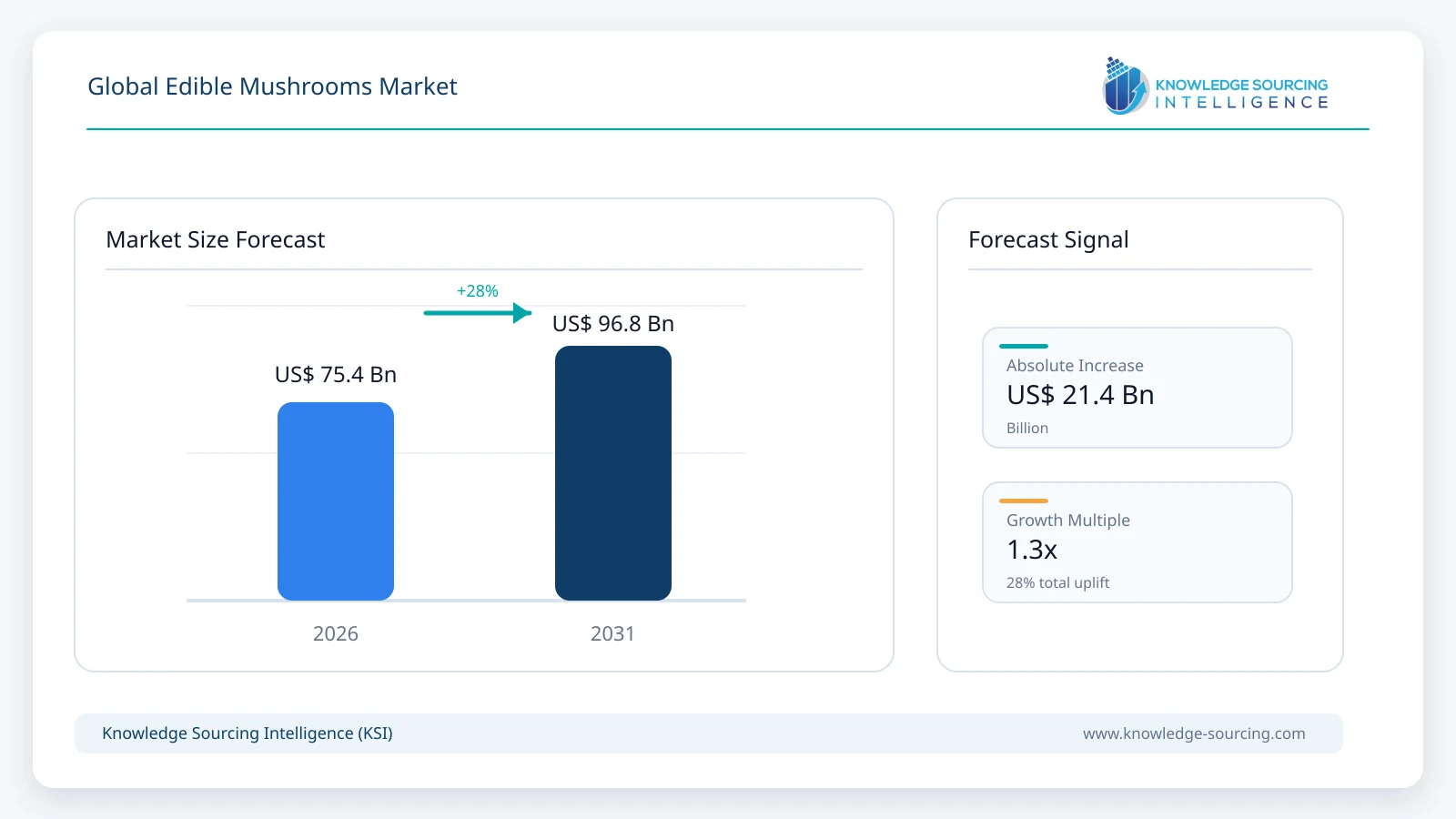
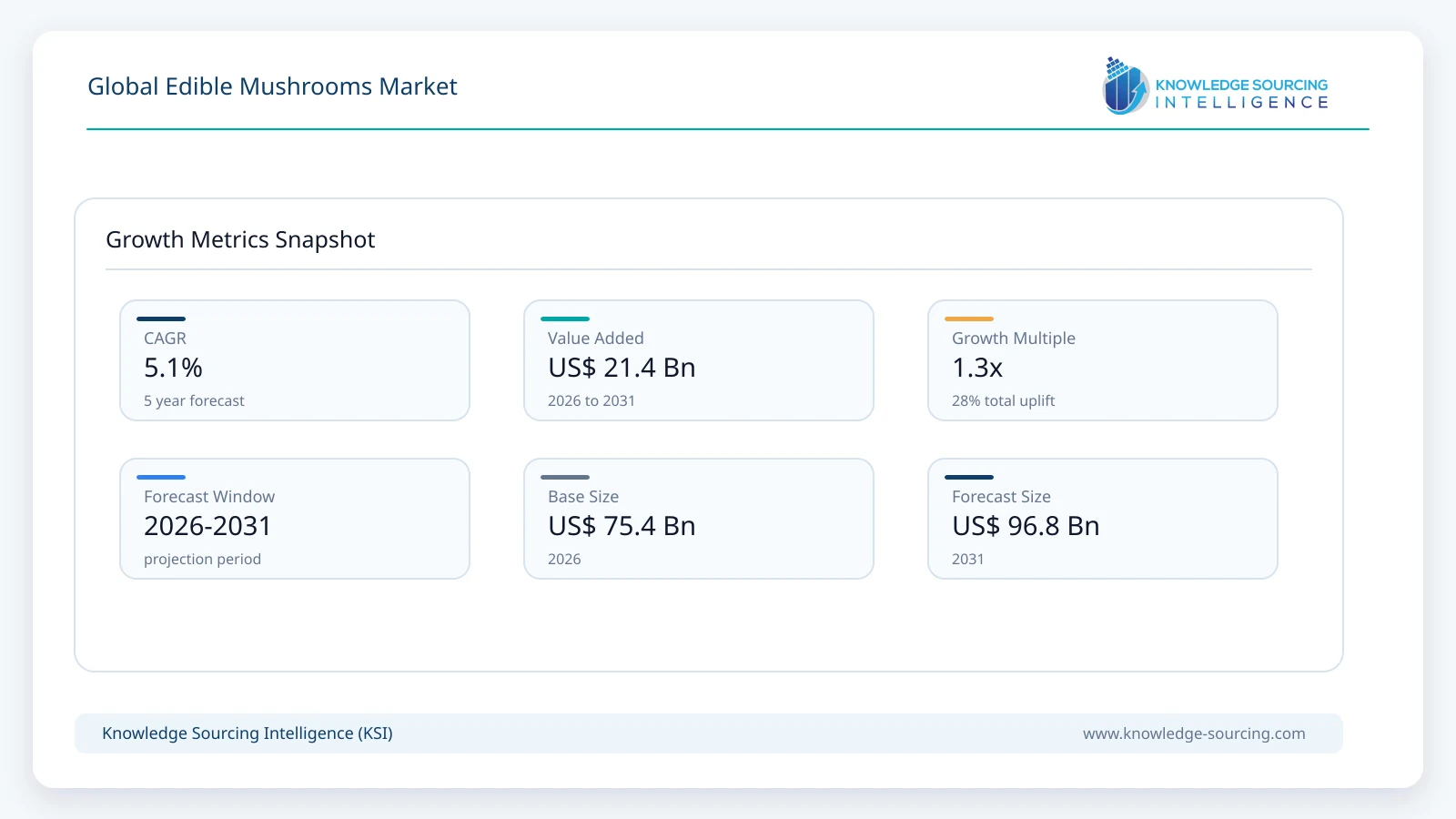
The global edible mushrooms market is projected to grow at a CAGR of 5.1% over the forecast period, from USD 75.4 billion in 2026, and is expected to reach USD 96.8 billion by 2031.
Highlights:
- 1Shiitake mushrooms account for approximately 29% of global edible mushroom market value in 2026, supported by their scale in China and established consumption across East Asia.
- 2Fresh mushrooms account for approximately 72% of global market value in 2026, reflecting their dominant role in household and foodservice consumption.
- 3Retail households account for approximately 53% of global edible mushroom demand in 2026, remaining the largest end-use channel.
- 4Asia Pacific accounts for approximately 88% of global market value in 2026, reflecting China's exceptionally large edible fungi industry.
- 5China represents more than four-fifths of global edible mushroom market value in 2026, making developments in Chinese production and consumption central to the global outlook.
Edible mushrooms include commercially cultivated and harvested mushroom fruiting bodies sold primarily for human food consumption. The market includes shiitake, Agaricus bisporus mushrooms such as white button, cremini, and portobello, oyster mushrooms, wood ear, enoki, king oyster, and other commercially traded specialty varieties. Products are sold fresh as well as dried, frozen, canned, and in other processed food formats. Standalone truffles, pharmaceutical mushroom ingredients, concentrated nutraceutical extracts and mycelium-only alternative-protein products are excluded.
China remains the structural center of the industry because of its scale across shiitake, wood ear, oyster, and numerous other cultivated fungi. Commercial production in North America and Europe is substantially more concentrated in Agaricus mushrooms, although specialty mushroom availability is increasing. This creates two distinct growth patterns: Asian markets benefit from broad species diversity and deep existing consumption, while Western markets increasingly generate value through premium varieties, organic products, differentiated packaging and specialty mushroom adoption.
The market is also becoming more industrialized. Larger growers are investing in controlled growing environments, substrate handling, environmental monitoring, harvesting technology, and refrigerated distribution. These investments improve consistency and year-round availability but also favor producers with sufficient scale to absorb higher capital costs.
Market Trends
Specialty Mushrooms Are Expanding Beyond Traditional Asian Markets
Specialty mushrooms are becoming more visible in mainstream retail and foodservice channels outside Asia. Shiitake and oyster mushrooms are already widely distributed internationally, while lion's mane, maitake, king oyster, enoki, and mixed specialty packs are appearing more frequently in North American and European supermarkets. Companies such as Monterey Mushrooms have expanded specialty portfolios alongside established white and brown mushroom offerings, allowing retailers to address consumers seeking more distinctive flavors and textures.
The trend gives producers an opportunity to generate category value without relying entirely on higher conventional mushroom volumes. Specialty mushrooms typically occupy more differentiated positions than commodity white button mushrooms and can be marketed around culinary usage, premium quality, organic production, or specific cuisine applications. This is gradually broadening the competitive landscape beyond traditional Agaricus producers.
Mushroom Production Is Becoming More Industrialized
Commercial mushroom cultivation is increasingly moving toward larger controlled-environment facilities capable of managing temperature, humidity, ventilation, and substrate conditions consistently throughout the year. Factory cultivation is particularly established for varieties such as enoki, king oyster, and other mushrooms that can be produced efficiently under standardized indoor conditions.
The transition improves production predictability and supports organized retail and foodservice customers that require consistent volumes and specifications. It also increases the importance of technical cultivation expertise, environmental controls, and automation. Larger producers are better positioned to spread these investments across significant production volumes, contributing to gradual consolidation within commercially developed mushroom markets.
Automation Is Increasingly Important to Production Economics
Mushroom cultivation remains labor-intensive, particularly during harvesting, grading, and packing. Labor availability and wage costs therefore directly influence the economics of large commercial operations, especially in North America and Europe.
Producers are investing in automated substrate movement, climate management, packing systems, and harvesting technologies where mushroom varieties and production configurations allow them to do so. Automation does not remove the need for skilled cultivation or manual handling, but it can improve consistency and reduce exposure to labor shortages. As conventional mushroom categories become more mature, productivity improvements become increasingly important because producers have less ability to depend on strong volume growth to offset rising costs.
Processing Is Expanding the Reach of Mushroom Products
Fresh mushrooms remain the industry's core format, but their comparatively short shelf life limits long-distance distribution. Drying, freezing, canning, and other preservation technologies allow producers to serve wider geographic markets and different customer groups.
Dried shiitake and wood ear mushrooms already have established international trade, while frozen and preserved mushrooms are used by foodservice companies and food manufacturers. Processing also allows growers to utilize mushrooms across different quality grades rather than depending entirely on premium fresh-market sales. This supports the development of soups, sauces, frozen meals, seasonings, and other value-added food applications.
Market Drivers
Specialty Mushroom Consumption Is Broadening the Addressable Market
Traditional mushroom consumption remains concentrated around familiar varieties in many countries, but retailers and restaurants are exposing consumers to a much wider range of mushrooms. Shiitake, oyster and king oyster mushrooms are increasingly positioned as mainstream culinary ingredients rather than products available only through specialist Asian retailers.
Greater product availability creates additional consumption occasions because mushroom varieties differ considerably in texture, flavor and cooking characteristics. Specialty mushrooms can consequently compete across stir-fries, grilling, meat substitutes, soups, premium restaurant dishes and home cooking. Their wider availability also provides established mushroom companies with an opportunity to expand category value while using existing retailer and distributor relationships.
Controlled-Environment Cultivation Supports Reliable Year-Round Supply
Mushrooms can be produced indoors throughout the year, allowing commercial growers to operate independently of many seasonal conditions affecting conventional field crops. Modern cultivation facilities provide precise management of temperature, humidity, ventilation and growing substrates, improving output consistency and enabling repeated production cycles.
This production structure is particularly valuable for supermarkets, foodservice distributors and industrial buyers requiring predictable supply. Factory-based cultivation has expanded significantly in Asia for varieties such as enoki and king oyster mushrooms, while European and North American producers continue investing in modern growing rooms and environmental controls. Increasing standardization supports larger commercial supply agreements and reduces dependence on highly fragmented seasonal production.
Greater Retail Availability Is Supporting Specialty Category Penetration
Large supermarkets increasingly stock multiple mushroom varieties rather than limiting the fresh category to white button and brown mushrooms. Improved packaging and refrigerated distribution allow growers to place premium varieties alongside traditional products, giving consumers greater opportunity to experiment with specialty mushrooms.
Retail expansion is particularly important because many consumers first encounter new mushroom varieties through restaurants or specialist stores but develop repeat household consumption only once products become consistently available through mainstream grocery channels. Broader retail distribution therefore strengthens demand beyond niche culinary users and supports gradual category diversification.
Market Restraints and Challenges
Conventional Mushroom Categories Are Mature in Developed Markets
Market expansion is not uniform across mushroom varieties or geographies. White button and other conventional Agaricus mushrooms already have high household penetration in several North American and European markets, limiting the potential for rapid underlying volume growth.
Producers are responding by shifting attention toward brown mushrooms, organic products, specialty varieties and differentiated packaging rather than relying solely on traditional white mushroom consumption. This creates opportunities for premiumization but also intensifies competition for supermarket shelf space. Companies that remain concentrated entirely in undifferentiated conventional mushrooms face greater exposure to retailer price pressure and production-cost inflation.
Labor, Energy and Shelf-Life Requirements Increase Operating Costs
Commercial mushroom farms require controlled environmental conditions and substantial manual handling, while harvested mushrooms must move quickly through packing, refrigeration and distribution. These characteristics expose producers to labor, electricity, refrigeration and logistics costs simultaneously.
Perishability further limits the ability of distant low-cost producers to compete in premium fresh markets. Large suppliers therefore increasingly combine geographically distributed production, refrigerated logistics and processing capabilities. Smaller growers without sufficient scale can face greater difficulty financing automation, environmental improvements and distribution infrastructure, contributing to gradual consolidation within the industry.
Segment Analysis
By Type: Shiitake Mushrooms
Shiitake mushrooms are projected to generate approximately USD 27.9 billion by 2031, remaining the largest individual mushroom category during the forecast period. Their position reflects particularly strong production and household consumption in China together with established demand in Japan and other Asian markets. Shiitake also has a well-developed international market because the mushroom can be commercialized in both fresh and dried forms, allowing producers to serve consumers beyond immediate cultivation areas.
The category is considerably more established than many emerging specialty mushrooms, so growth increasingly depends on organized cultivation, processing, and international distribution rather than initial consumer adoption. Outside Asia, shiitake continues gaining supermarket and foodservice availability as consumers become more familiar with Asian cooking and premium mushroom varieties. Oyster, king oyster, and other specialty mushrooms expand from smaller bases, but shiitake retains the largest value pool through 2031.
By Form: Fresh Mushrooms
Fresh mushrooms are projected to generate approximately USD 67.3 billion by 2031, remaining the dominant product format. Large producing countries consume substantial quantities close to the production source, particularly in Asia, while fresh mushrooms remain the principal supermarket and restaurant format across Europe and North America.
Growth is supported by improved refrigeration, regional production networks and packaging designed to maintain product quality during distribution. Producers are also widening fresh assortments beyond conventional white and brown mushrooms by introducing packaged shiitake, oyster, maitake, lion's mane and mixed specialty products. Processed mushrooms gain importance through drying, freezing and preservation, particularly where shelf life or long-distance distribution makes fresh supply less economical, but fresh products continue to account for the majority of market demand.
By End Use: Retail Households
Retail household demand is projected to reach approximately USD 49.3 billion by 2031, remaining the largest end-use category. Mushrooms are routinely purchased as fresh culinary ingredients across China, Japan, Europe and North America, giving the category a substantial recurring household consumption base.
Retail assortments are also becoming more diverse. Conventional white and brown mushrooms remain important, but supermarkets increasingly offer shiitake, oyster and other specialty varieties in packaged formats. This broadens consumer choice while allowing mushroom suppliers to expand value through premium products rather than depending entirely on conventional mushroom volumes. Foodservice and food processing continue growing as restaurants use more specialty varieties and manufacturers incorporate mushrooms into prepared foods, but household retail remains the industry's largest demand channel.
Major Region: Asia Pacific
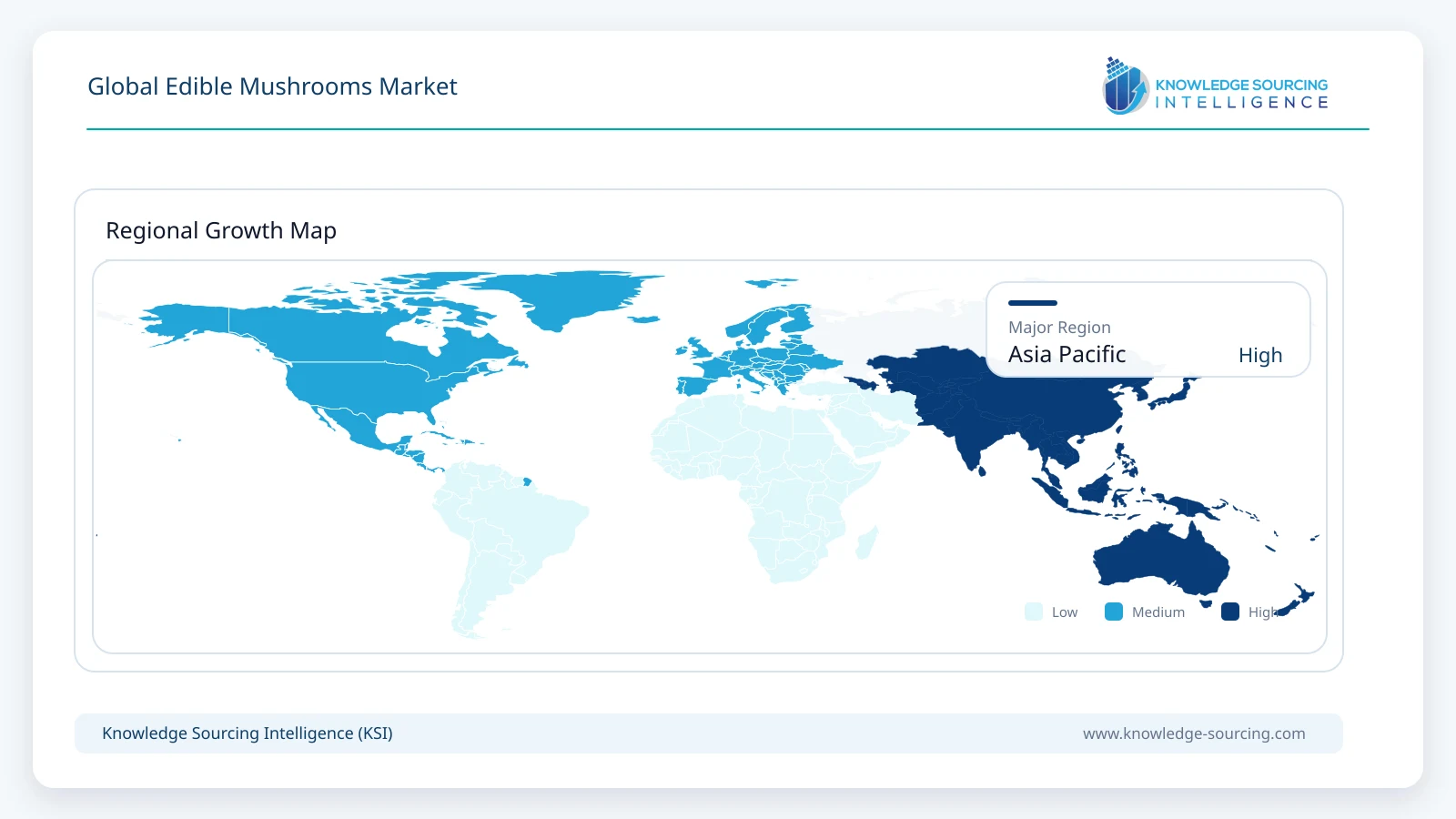
Asia Pacific is projected to generate approximately USD 84.2 billion in edible mushroom revenue by 2031, maintaining its dominant position in the global market. China accounts for the overwhelming majority of regional production, with large industries across shiitake, wood ear, oyster, enoki, king oyster and numerous other edible fungi.
Japan also maintains a highly developed commercial mushroom industry supported by large specialized growers such as Hokuto and YUKIGUNI FACTORY, while South Korea and other Asian countries have established household consumption of multiple mushroom varieties. The region's growth increasingly reflects higher-value products, industrial cultivation and processing rather than only expansion in cultivated volume. Its broad species diversity also contrasts with North American and European markets, where Agaricus mushrooms remain considerably more important.
Major Country: China
China remains the world's largest individual edible mushroom market and is projected to generate approximately USD 78 billion by 2031. The country's importance extends beyond overall cultivation volume because it supports commercially significant industries across a far wider range of mushroom varieties than most other producing countries.
Large-scale shiitake and wood ear production coexists with oyster, enoki, king oyster and numerous regional varieties, while factory cultivation is expanding for mushrooms suited to controlled-environment production. The industry is gradually moving toward larger producers, cooperative structures, automated growing facilities, and greater processing of mushrooms into dried, frozen, and other value-added formats. China's scale means relatively modest changes in domestic production, product value, or consumption patterns have a disproportionate impact on global market development.
Competitive Environment and Analysis
The edible mushrooms market combines large integrated growers, regional fresh-mushroom suppliers, specialized Asian producers and companies focused on particular mushroom varieties. Competition differs significantly by geography. North American and European companies historically developed around Agaricus mushrooms, while Chinese and Japanese producers participate across a much broader range of cultivated varieties.
Monterey Mushrooms, Monaghan Mushrooms, South Mill Champs, Highline Mushrooms and Phillips Mushroom Farms maintain strong positions in North American and European fresh-mushroom supply. Hokuto and YUKIGUNI FACTORY operate large-scale specialized production systems in Japan, while Shanghai Xuerong Bio-Technology, Jiangsu Chinagreen Biological Technology and Shandong Qihe Bio-Technology participate in China's increasingly industrialized mushroom sector.
Competitive advantage depends on cultivation efficiency, product consistency, retail relationships, specialty-variety capability, refrigerated distribution and processing infrastructure. Automation is becoming increasingly important as larger growers seek to reduce labor dependence, while specialty mushrooms provide an avenue for differentiation in markets where conventional button mushroom consumption is mature.
Recent Developments
July 2026: YUKIGUNI FACTORY opened its Kinoko Mirai Lab in Saitama, Japan, to support research involving mushroom varieties, functional materials and production technologies.
September 2025: Monterey Mushrooms expanded its specialty mushroom offering with lion's mane, king trumpet, maitake, shiitake and oyster varieties.
April 2025: South Mill Champs worked with Sprouts Farmers Market on mushroom packaging using flow-wrapped bamboo tills as part of its packaging sustainability initiatives.
November 2024: Monaghan Mushrooms announced commercial peat-free mushroom production in the United Kingdom and Ireland following development work on alternative casing materials.
Market Outlook
The global edible mushrooms market demonstrates strong growth, supported by rising consumer demand for nutritious foods, increasing culinary applications, and expanding mushroom cultivation. Asia Pacific remains the dominant regional market, while shiitake maintains a leading position among individual mushroom varieties.
Market development increasingly shifts toward specialty varieties, automated cultivation, improved packaging, and processed products rather than uniform increases in conventional mushroom consumption. Fresh mushrooms remain the primary format, although drying, freezing, and preservation expand opportunities for longer-distance distribution and industrial food applications.
China continues to determine the overall direction of the global market because of its cultivation scale and variety diversity. North American and European growth is comparatively more dependent on specialty mushroom adoption, premiumization, and productivity improvements as conventional mushroom categories mature.
Edible Mushrooms Market Scope:
| Report Metric | Details |
|---|---|
| Total Market Size in 2026 | USD 75.4 billion |
| Total Market Size in 2031 | USD 96.8 billion |
| Forecast Unit | Billion |
| Growth Rate | 5.1% |
| Study Period | 2021 to 2031 |
| Historical Data | 2021 to 2024 |
| Base Year | 2025 |
| Forecast Period | 2026 – 2031 |
| Segmentation | Type, Form, End User, Geography |
| Companies |
|
Market Segmentation
BY TYPE
Shiitake
Agaricus Mushrooms
White Button
Cremini
Portobello
Oyster Mushrooms
Wood Ear Mushrooms
Enoki Mushrooms
King Oyster Mushrooms
Others
BY FORM
Fresh
Processed
Dried
Canned and Preserved
Frozen
Others
BY END USE
Retail Households
Foodservice
Food Processing
BY REGION
North America
United States
Canada
Mexico
South America
Brazil
Argentina
Others
Europe
United Kingdom
Germany
France
Italy
Spain
Poland
Netherlands
Others
Middle East and Africa
Saudi Arabia
UAE
Israel
South Africa
Others
Asia Pacific
China
India
Japan
South Korea
Indonesia
Thailand
Australia
Others
Table of Contents
1. EXECUTIVE SUMMARY
2. MARKET SNAPSHOT
2.1. Market Overview
2.2. Market Definition
2.3. Scope of the Study
2.4. Market Segmentation
3. BUSINESS LANDSCAPE
3.1. Market Drivers
3.2. Market Restraints
3.3. Market Opportunities
3.4. Porter's Five Forces Analysis
3.5. Industry Value Chain Analysis
3.6. Specialty Mushroom Outlook
3.7. Industrial Cultivation and Automation Trends
3.8. Processing and Cold-Chain Environment
3.9. Strategic Recommendations
4. EDIBLE MUSHROOMS MARKET BY TYPE
4.1. Introduction
4.2. Shiitake
4.3. Agaricus Mushrooms
4.3.1. White Button
4.3.2. Cremini
4.3.3. Portobello
4.4. Oyster Mushrooms
4.5. Wood Ear Mushrooms
4.6. Enoki Mushrooms
4.7. King Oyster Mushrooms
4.8. Others
5. EDIBLE MUSHROOMS MARKET BY FORM
5.1. Introduction
5.2. Fresh
5.3. Processed
5.3.1. Dried
5.3.2. Canned and Preserved
5.3.3. Frozen
5.3.4. Others
6. EDIBLE MUSHROOMS MARKET BY END USE
6.1. Introduction
6.2. Retail Households
6.3. Foodservice
6.4. Food Processing
7. EDIBLE MUSHROOMS MARKET BY GEOGRAPHY
7.1. Introduction
7.2. North America
7.2.1. By Type
7.2.2. By Form
7.2.3. By End Use
7.2.4. By Country
7.2.4.1. United States
7.2.4.2. Canada
7.2.4.3. Mexico
7.3. South America
7.3.1. By Type
7.3.2. By Form
7.3.3. By End Use
7.3.4. By Country
7.3.4.1. Brazil
7.3.4.2. Argentina
7.3.4.3. Others
7.4. Europe
7.4.1. By Type
7.4.2. By Form
7.4.3. By End Use
7.4.4. By Country
7.4.4.1. United Kingdom
7.4.4.2. Germany
7.4.4.3. France
7.4.4.4. Italy
7.4.4.5. Spain
7.4.4.6. Poland
7.4.4.7. Netherlands
7.4.4.8. Others
7.5. Middle East and Africa
7.5.1. By Type
7.5.2. By Form
7.5.3. By End Use
7.5.4. By Country
7.5.4.1. Saudi Arabia
7.5.4.2. UAE
7.5.4.3. Israel
7.5.4.4. South Africa
7.5.4.5. Others
7.6. Asia Pacific
7.6.1. By Type
7.6.2. By Form
7.6.3. By End Use
7.6.4. By Country
7.6.4.1. China
7.6.4.2. India
7.6.4.3. Japan
7.6.4.4. South Korea
7.6.4.5. Indonesia
7.6.4.6. Thailand
7.6.4.7. Australia
7.6.4.8. Others
8. COMPETITIVE ENVIRONMENT AND ANALYSIS
8.1. Major Players and Strategy Analysis
8.2. Market Share Analysis
8.3. Mergers, Acquisitions, Agreements, and Collaborations
8.4. Competitive Dashboard
9. COMPANY PROFILES
9.1. Monterey Mushrooms, LLC
9.2. Monaghan Mushrooms
9.3. South Mill Champs
9.4. Highline Mushrooms
9.5. Phillips Mushroom Farms
9.6. To-Jo Mushrooms, Inc.
9.7. Hughes Group
9.8. Hokuto Corporation
9.9. YUKIGUNI FACTORY CO., LTD.
9.10. OKECHAMP Group
9.11. Banken Champignons B.V.
9.12. Shanghai Xuerong Bio-Technology Co., Ltd.
9.13. Jiangsu Chinagreen Biological Technology Co., Ltd.
9.14. Shandong Qihe Bio-Technology Co., Ltd.
9.15. Gourmet Mushrooms, Inc.
10. APPENDIX
10.1. Market Definition and Scope
10.2. Currency
10.3. Assumptions
10.4. Base and Forecast Years
10.5. Research Methodology
10.6. Segment Modelling
10.7. Data Triangulation and Validation
10.8. Abbreviations
Navigate
Trusted by the world's leading organizations











