
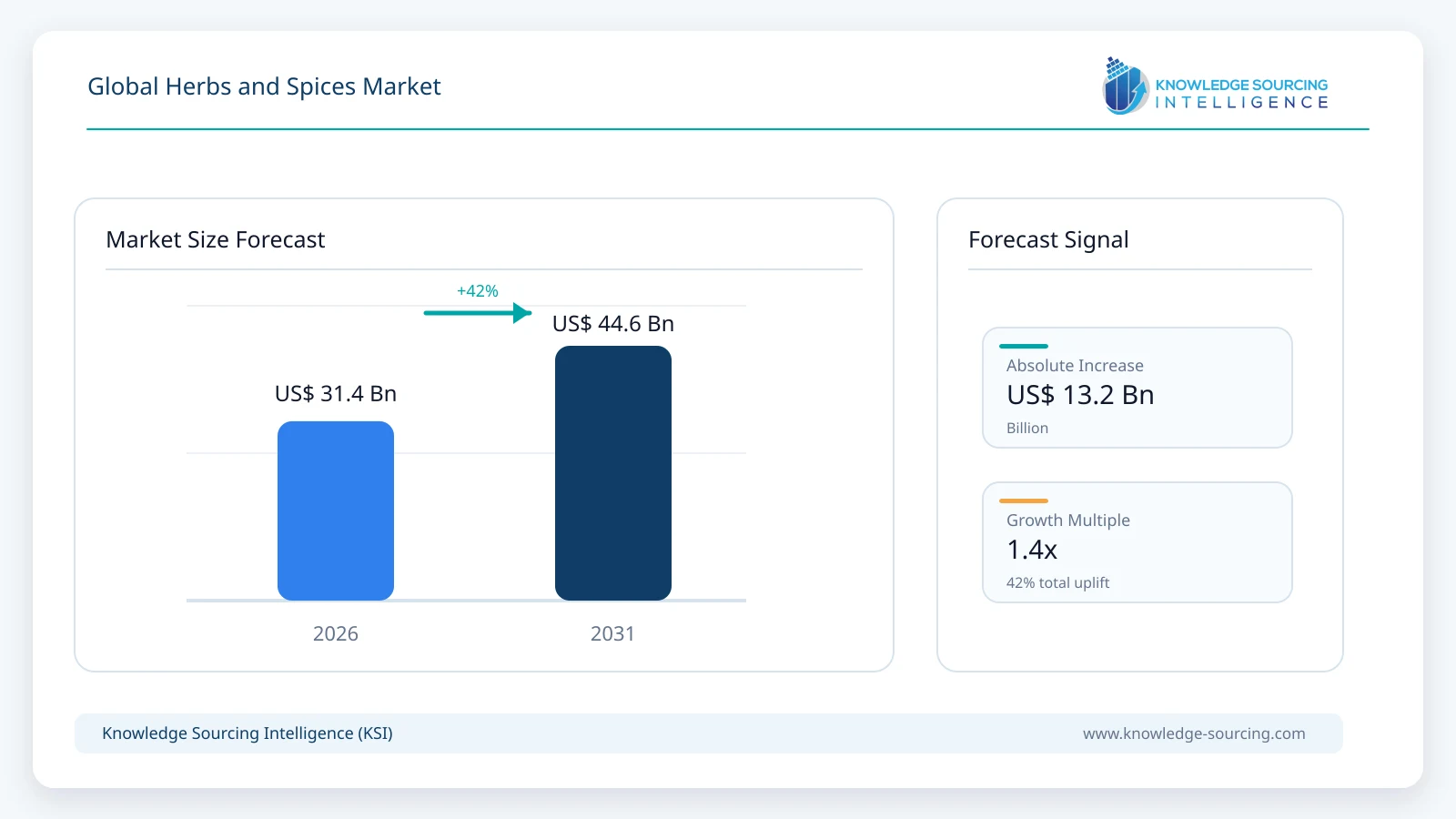
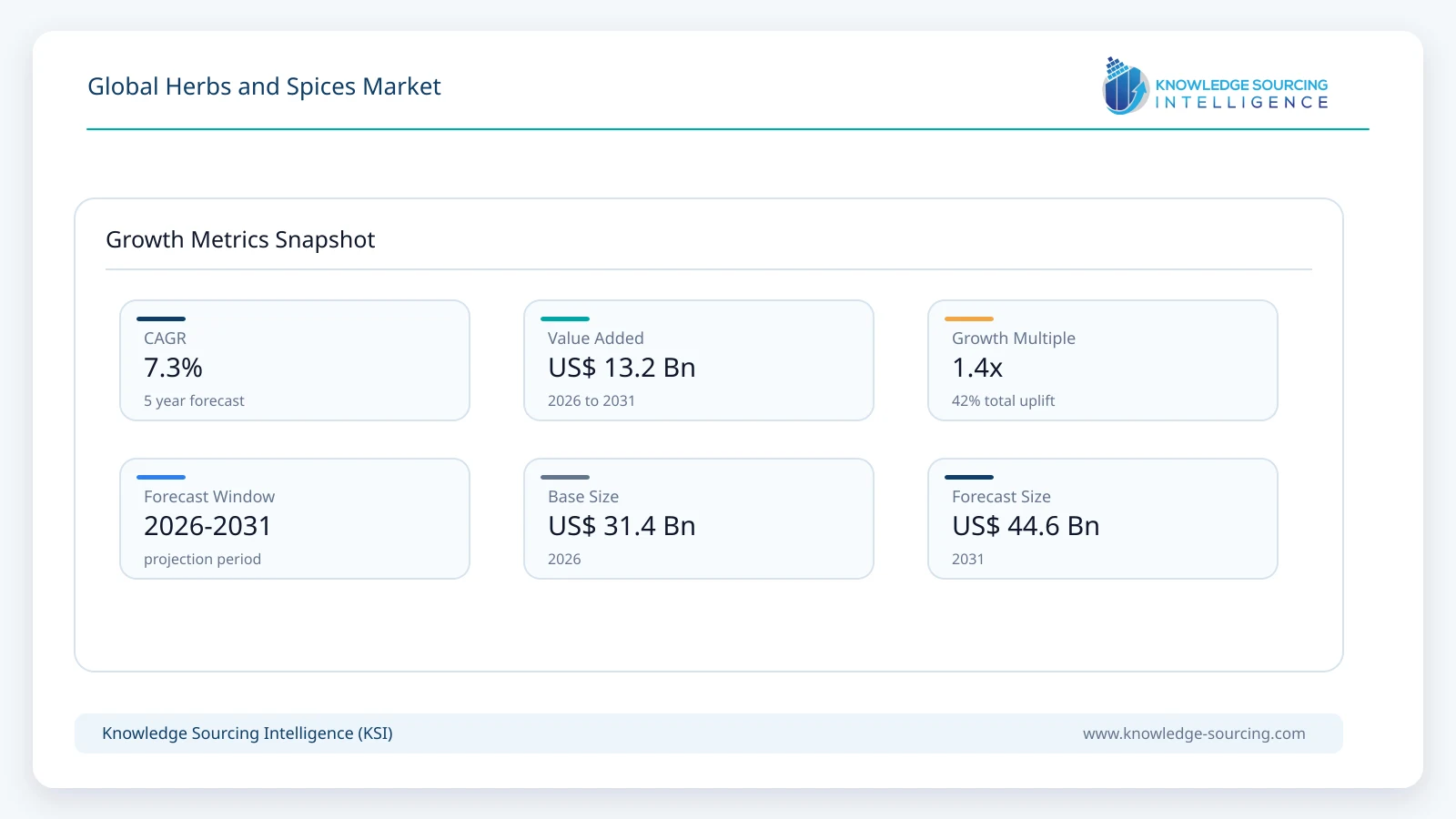
The global herbs and spices market is forecast to grow from USD 31.4 billion in 2026 to USD 44.6 billion by 2031, representing a CAGR of approximately 7.3% during the forecast period.
Highlights:
- 1Spices account for approximately 76% of global market value in 2026.
- 2Ground and powdered products represent approximately 64% of market value in 2026.
- 3Pouches and sachets account for approximately 42% of packaged market value in 2026.
- 4Food and beverage applications represent approximately 90% of market demand in 2026.
- 5Asia Pacific accounts for approximately 45% of global herbs and spices revenue in 2026.
Herbs and spices are widely used in food and beverages to enhance taste, aroma, color and overall sensory characteristics. They form an essential part of household cooking as well as industrial food production, foodservice, beverages and selected nutraceutical and pharmaceutical applications. Global demand is supported by increasing exposure to international cuisines, greater consumption of packaged foods and growing interest in naturally derived ingredients. Consumers are also using a wider range of herbs and spices at home as restaurant-style and regional cuisines become more accessible through digital recipes, food delivery and modern retail.
The market growth is supported by higher value realization, wider product availability, premium spice blends, convenience packaging and increasing consumption in emerging markets. However, individual categories remain exposed to agricultural production cycles and price volatility. India, one of the world’s most important spice-producing and exporting countries, exported 1.734 million tonnes of spices and spice products valued at USD 4.43 billion during 2025-26. Export volume declined 4% and dollar value declined 6% from the previous year, illustrating the effect of changing crop supply, pricing and international demand conditions.
Spices are also increasingly incorporated into beverages and wellness-oriented products. Ginger, cardamom, cinnamon, turmeric, mint, basil and lemongrass are used across teas, flavored beverages and traditional preparations, extending demand beyond conventional savory foods. Turmeric, ginger and other botanicals additionally serve nutraceutical and pharmaceutical applications where their positioning is connected with antioxidant, digestive or other functional attributes.
Large branded and ingredient suppliers continue to invest in the category. McCormick operates across approximately 150 countries and territories and sources agricultural ingredients from more than 90 countries. Its consumer portfolio includes herbs, spices, seasonings and related flavor products, while its Flavor Solutions business serves food manufacturers and foodservice customers. McCormick reported 1.7% organic sales growth during the second quarter of 2026, with Consumer organic sales increasing 0.8% and Flavor Solutions increasing 2.9%.
Major Market Drivers
Increasing Demand for Natural Ingredients and Diverse Flavor Profiles
Consumer preference for recognizable and naturally derived ingredients continues to support herbs and spices across retail and industrial food formulations. Herbs, spices and botanical ingredients fit naturally within products marketed around shorter ingredient lists, traditional cooking methods and regional authenticity. Demand is particularly visible in prepared meals, snacks, sauces, bakery products, meat products and beverages where manufacturers use spice blends to create differentiated flavor profiles without relying exclusively on synthetic flavor systems.
At the same time, consumers are increasingly exposed to cuisines outside their home markets. Chili blends, pepper varieties, cardamom, turmeric, coriander, cumin, cinnamon and herb combinations increasingly move between regional cuisines and mainstream packaged foods. McCormick’s 2026 Flavor Forecast reflects this shift toward globally influenced and more layered flavor experiences, while its product portfolio continues to expand across seasoning blends and specialty flavor concepts.
Expansion of Processed Food, Foodservice and Convenient Spice Formats
Urbanization and growth in packaged food consumption are increasing demand for consistent spice formulations at industrial scale. Food manufacturers require standardized color, aroma, particle size and microbiological quality so that products can be reproduced across production batches and locations. This benefits established spice processors that can provide traceability, sterilization, blending and quality-assurance services rather than supplying only raw agricultural commodities.
Convenience is simultaneously reshaping retail formats. Consumers increasingly purchase pre-ground spices, mixed seasonings, grinders, resealable pouches and application-specific blends rather than relying entirely on individual whole spices. Product innovation allows brands to target grilling, baking, beverages, global cuisines and seasonal occasions. McCormick introduced new seasoning and finishing products during 2026 and continued expanding redesigned and recycled-content packaging across multiple markets.
Major Market Restraints
Agricultural Supply and Price Volatility
Herbs and spices depend heavily on agricultural conditions, making supply sensitive to weather, crop disease, acreage decisions and local farming economics. Pepper, chili, cardamom, turmeric, cumin, ginger and other major products can experience sharp changes in availability and price between harvests. Because production is concentrated geographically for several spices, local disruptions can influence international markets quickly.
India’s 2025-26 export data demonstrates this volatility. Although the country exported 1.734 million tonnes of spices and spice products, volume was 4% lower than the previous year and export value in U.S. dollars declined 6%. Chili represented 27% of export earnings, followed by cumin at 12%, spice oils and oleoresins at 12%, small cardamom at 9%, mint products at 8% and turmeric at 7%. Dependence on a relatively concentrated group of crops increases procurement risk for manufacturers and traders.
Stricter Residue, Contaminant and Import Compliance Requirements
International spice trade is subject to increasingly strict food-safety and contaminant requirements. Exporters must manage pesticide residues, microbiological contamination, adulteration, mineral-oil contamination and documentation requirements that vary across importing countries.
India’s Spices Board issued multiple trade advisories during 2026 covering pesticide-residue requirements for Taiwan, certification for exports to the UK, registration requirements for China and proposed EU limits for mineral oil aromatic hydrocarbons in spices. These requirements improve food safety but can increase testing, certification, traceability and compliance costs throughout the supply chain, particularly for smaller processors and exporters.
Herbs and Spices Market Trends
Premium and Application-Specific Blends Are Expanding
The retail spice category is becoming increasingly differentiated through blends designed around cuisines, dishes and specific cooking occasions. Consumers can purchase seasonings for grilling, roasting, baking, beverages or regional cuisine rather than combining individual spices independently.
McCormick’s 2026 innovation program includes renewed seasoning blends and additional flavor variants. In March 2026, the company introduced Black Currant Seasoning as part of its Flavor of the Year program, extending an ingredient more commonly associated with fruit applications into a seasoning format. The expansion of such concepts demonstrates how major brands are using flavor trends and limited releases to create additional value within otherwise mature retail categories.
Ground and Powdered Spices Continue to Gain Convenience-Led Demand
Ground spices account for approximately 64% of global herbs and spices market value in 2026. They offer convenience, standardized dosing and easier incorporation into packaged food, sauces, seasoning blends and household cooking.
Industrial users also prefer powders when ingredient dispersion and batch consistency are important. Whole spices remain significant in traditional cuisine, foodservice and premium retail, but processing into ground, crushed and blended forms creates greater opportunities for differentiation, packaging and value addition. Ground and powdered products are projected to reach approximately 66% of market value by 2031.
Sustainable and Traceable Sourcing Is Becoming More Important
Major spice companies increasingly emphasize agricultural traceability, responsible sourcing and farm-level resilience because supply quality depends directly on grower practices and climate conditions. McCormick identifies pepper, capsicums and other agricultural ingredients among its important raw materials and sources ingredients across countries including India, Indonesia, Vietnam, Mexico and other major producing regions.
The company has also continued expanding recycled-content packaging for herbs, spices and seasoning products. By July 2026, products using its post-consumer recycled packaging initiative included 20 bottles containing 50% PCR material, while recycled content represented 6% of its overall plastic packaging use.
Food-Safety Controls Are Increasing Across International Spice Trade
Testing and certification are becoming increasingly important differentiators for exporters. Spices can be exposed to pesticide residues, microbial contamination and environmental contaminants during cultivation, drying, processing and storage.
In 2026, India’s Spices Board issued industry guidelines on preventing and mitigating MOSH/MOAH contamination and separate trade advisories addressing pesticide limits and export certification. Exporters able to provide consistent traceability and compliance are increasingly better positioned to supply large international food manufacturers and retailers.
Herbs and Spices Market Segmentation Analysis
By Product Type
Spices
Spices account for approximately 76% of global herbs and spices market value in 2026, equivalent to around USD 23.9 billion. Major categories include chili, pepper, ginger, turmeric, cumin, cardamom, cinnamon, clove and coriander seeds. Their dominant market position reflects extensive use across household cooking, industrial food production, sauces, snacks, meat products, ready meals and beverages.
India’s export structure demonstrates the breadth of international spice demand. Chili generated 27% of Indian spice-export value during 2025-26, followed by cumin at 12%, small cardamom at 9%, turmeric at 7%, ginger and pepper at approximately 3% each and coriander at 2%. Spices are projected to increase to approximately 77% of overall market value by 2031, supported by wider use of global flavor profiles and processed spice blends.
By Packaging Type
Pouches and Sachets
Pouches and sachets account for approximately 42% of packaged herbs and spices market value in 2026, making them the largest packaging format. Their position reflects lower packaging cost, efficient shelf space, suitability for refill formats and widespread adoption across price-sensitive emerging markets.
Resealable pouches also provide improved convenience for consumers purchasing larger pack sizes. The format is particularly important across India and other Asian markets where spices are purchased frequently and in a wide variety of pack sizes. Pouches and sachets are projected to increase to approximately 44% of market value by 2031 as flexible packaging expands across branded retail products.
By Application
Food and Beverage
Food and beverage applications account for approximately 90% of global herbs and spices market value in 2026. Demand spans household products, snacks, sauces, ready meals, meat and poultry, bakery, beverages, foodservice and industrial seasoning blends.
The category continues to broaden as spices move into beverages and non-traditional applications. Ginger, cardamom, cinnamon, mint, turmeric and lemongrass are increasingly incorporated into teas, functional beverages and specialty drinks. Food and beverage remains the overwhelmingly dominant application through 2031, while pharmaceutical and nutraceutical applications grow somewhat faster from a smaller base.
By Form
Ground and Powdered
Ground and powdered products represent approximately 64% of global herbs and spices market value in 2026. The format offers convenience and consistent incorporation into finished foods, making it especially important to packaged-food manufacturers, foodservice operators and household consumers.
Ground spices are projected to increase to approximately 66% of market value by 2031 as processed foods and ready-to-use seasoning blends expand. Whole spices remain important in traditional cuisines and premium applications where freshness and aroma preservation are valued.
Herbs and Spices Market by Geography
Asia Pacific
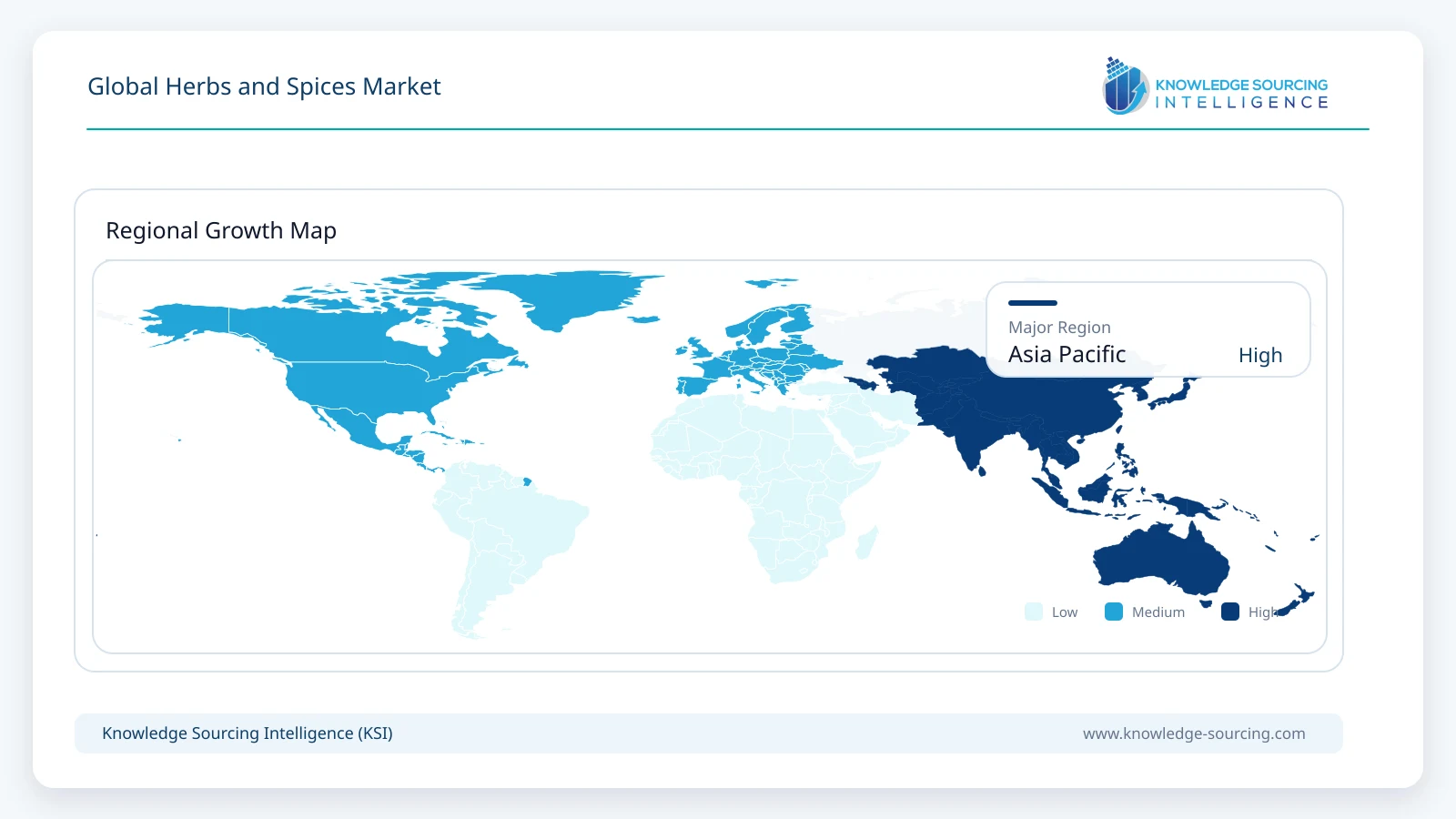
Asia Pacific accounts for approximately 45% of global herbs and spices market value in 2026, making it the largest region. The market benefits from deeply established culinary traditions, major spice-producing countries and extensive use of herbs and spices across household, foodservice and industrial food applications.
India plays a particularly important role in international supply. During 2025-26, Indian spice exports were valued at USD 4.43 billion, with the United States accounting for 14% of export earnings, China 12%, the UAE 9% and Bangladesh 8%. China, India, Indonesia, Vietnam and other regional markets also provide substantial domestic consumption bases.
Asia Pacific is projected to increase to approximately 47% of global market value by 2031, supported by packaged-food production, rising household incomes and continued growth in branded and premium spice consumption.
Competitive Landscape
The herbs and spices market includes multinational flavor companies, large regional spice processors and numerous specialized suppliers. McCormick & Company maintains one of the broadest international consumer and food-industry portfolios, with operations spanning retail herbs and spices, seasoning blends and Flavor Solutions. The company’s portfolio reaches approximately 150 countries and territories.
ofi participates upstream and downstream through sourcing, processing and ingredient solutions across major spice origins. Kerry Group provides taste systems and culinary solutions to food manufacturers, while regional companies such as Everest Food Products, MDH, DS Group and Orkla India’s Eastern and MTR businesses have strong positions in South Asian spices and blended seasonings.
Competition depends on raw-material sourcing, food safety, consistency, brand recognition, distribution and the ability to develop application-specific blends. Larger companies also differentiate through consumer insights, formulation support and sustainable sourcing programs.
Recent Developments
July 2026: McCormick reported continued expansion of post-consumer recycled packaging across its herbs, spices, seasonings and related portfolio, including 20 bottle formats containing 50% recycled content.
June 2026: McCormick reported 1.7% organic sales growth during its second quarter, including 0.8% organic growth in Consumer and 2.9% in Flavor Solutions.
June 2026: India’s Spices Board issued an advisory covering exports of spices and spice products to China as producers and exporters adapted to evolving registration and compliance requirements.
May 2026: India’s Spices Board released guidelines for preventing and mitigating MOSH/MOAH contamination in spices.
March 2026: McCormick launched Sweet & Smoky Naturally Flavored Black Currant Seasoning as part of its 2026 Flavor of the Year product program.
Market Outlook
The global herbs and spices market growth is being driven on account of expansion in packaged foods, international cuisines, premium and blended seasonings and naturally positioned ingredients.
Spices remain the largest product category, supported by extensive use of chili, pepper, ginger, turmeric, cumin, cardamom and other high-volume products. Herbs continue to expand across food, beverage and wellness applications but represent a smaller value pool.
Ground and powdered products are gaining share through convenience and industrial-food usage, while pouches remain the leading packaging format. Asia Pacific will continue to account for the largest regional market and witness robust market share expansion through the end of forecast period.
Supply-chain quality is becoming increasingly important as importers tighten pesticide, contaminant and certification requirements. Companies with strong agricultural sourcing, traceability and processing capabilities are therefore expected to maintain an advantage as global trade in spices becomes more regulated.
Market Segmentation
By Product Type
Herbs
Basil
Mint
Coriander Leaves
Thyme
Lemongrass
Rosemary
Oregano
Others
Spices
Chili
Ginger
Pepper
Cardamom
Cinnamon
Clove
Turmeric
Cumin
Coriander Seed
Others
By Packaging Type
Bottles and Jars
Shaker
Grinder
Standard Jar/Bottle
Pouches and Sachets
Bulk Packs and Containers
By Application
Food and Beverage
Pharmaceutical and Nutraceutical
By Form
Whole
Ground and Powdered
By Geography
North America
United States
Canada
Mexico
South America
Brazil
Argentina
Others
Europe
United Kingdom
Germany
France
Italy
Spain
Netherlands
Others
Middle East and Africa
Saudi Arabia
UAE
South Africa
Egypt
Others
Asia Pacific
China
India
Japan
South Korea
Taiwan
Thailand
Indonesia
Vietnam
Others
Table of Contents
1. INTRODUCTION
1.1. Market Overview
1.2. Market Definition
1.3. Scope of the Study
1.4. Market Segmentation
1.5. Currency
1.6. Assumptions
1.7. Base and Forecast Years Timeline
1.8. Key Benefits for Stakeholders
2. RESEARCH METHODOLOGY
2.1. Research Design
2.2. Research Process
2.3. Primary Research Framework
2.4. Secondary Research Framework
2.5. Data Triangulation
2.6. Forecast Methodology
3. EXECUTIVE SUMMARY
3.1. Key Findings
3.2. Analyst View
4. MARKET DYNAMICS
4.1. Market Drivers
4.1.1. Increasing Demand for Natural Ingredients and Global Flavor Profiles
4.1.2. Expansion of Packaged Food and Foodservice Applications
4.1.3. Growth of Premium, Blended and Application-Specific Spice Products
4.1.4. Expansion of Herbs and Spices Into Beverages and Wellness Applications
4.2. Market Restraints
4.2.1. Agricultural Supply and Spice Price Volatility
4.2.2. Pesticide Residue, Contaminant and Import Compliance Requirements
4.2.3. Climate and Crop-Yield Variability in Major Producing Countries
4.2.4. Adulteration and Quality-Control Risks Across Fragmented Supply Chains
4.3. Market Opportunities
4.4. Porter’s Five Forces Analysis
4.5. Industry Value Chain Analysis
4.6. Regulatory and Food-Safety Environment
4.7. Strategic Recommendations
5. GLOBAL HERBS AND SPICES MARKET BY PRODUCT TYPE
5.1. Herbs
5.1.1. Basil
5.1.2. Mint
5.1.3. Coriander Leaves
5.1.4. Thyme
5.1.5. Lemongrass
5.1.6. Rosemary
5.1.7. Oregano
5.1.8. Others
5.2. Spices
5.2.1. Chili
5.2.2. Ginger
5.2.3. Pepper
5.2.4. Cardamom
5.2.5. Cinnamon
5.2.6. Clove
5.2.7. Turmeric
5.2.8. Cumin
5.2.9. Coriander Seed
5.2.10. Others
6. GLOBAL HERBS AND SPICES MARKET BY PACKAGING TYPE
6.1. Bottles and Jars
6.1.1. Shaker
6.1.2. Grinder
6.1.3. Standard Jar/Bottle
6.2. Pouches and Sachets
6.3. Bulk Packs and Containers
7. GLOBAL HERBS AND SPICES MARKET BY APPLICATION
7.1. Food and Beverage
7.2. Pharmaceutical and Nutraceutical
8. GLOBAL HERBS AND SPICES MARKET BY FORM
8.1. Whole
8.2. Ground and Powdered
9. GLOBAL HERBS AND SPICES MARKET BY GEOGRAPHY
9.1. North America
9.1.1. United States
9.1.2. Canada
9.1.3. Mexico
9.2. South America
9.2.1. Brazil
9.2.2. Argentina
9.2.3. Others
9.3. Europe
9.3.1. United Kingdom
9.3.2. Germany
9.3.3. France
9.3.4. Italy
9.3.5. Spain
9.3.6. Netherlands
9.3.7. Others
9.4. Middle East and Africa
9.4.1. Saudi Arabia
9.4.2. UAE
9.4.3. South Africa
9.4.4. Egypt
9.4.5. Others
9.5. Asia Pacific
9.5.1. China
9.5.2. India
9.5.3. Japan
9.5.4. South Korea
9.5.5. Taiwan
9.5.6. Thailand
9.5.7. Indonesia
9.5.8. Vietnam
9.5.9. Others
10. COMPETITIVE ENVIRONMENT AND ANALYSIS
10.1. Major Players and Strategy Analysis
10.2. Market Share Analysis
10.3. Mergers, Acquisitions, Agreements and Collaborations
10.4. Competitive Dashboard
11. COMPANY PROFILES
11.1. McCormick & Company, Inc.
11.2. ofi
11.3. Kerry Group plc
11.4. Fuchs Gruppe
11.5. Everest Food Products Pvt. Ltd.
11.6. MDH Pvt. Ltd.
11.7. DS Group
11.8. Orkla India Pvt. Ltd.
11.9. Nedspice Group
11.10. Euroma
11.11. Bart Ingredients
11.12. Badia Spices, Inc.
12. APPENDIX
Navigate
Trusted by the world's leading organizations











