
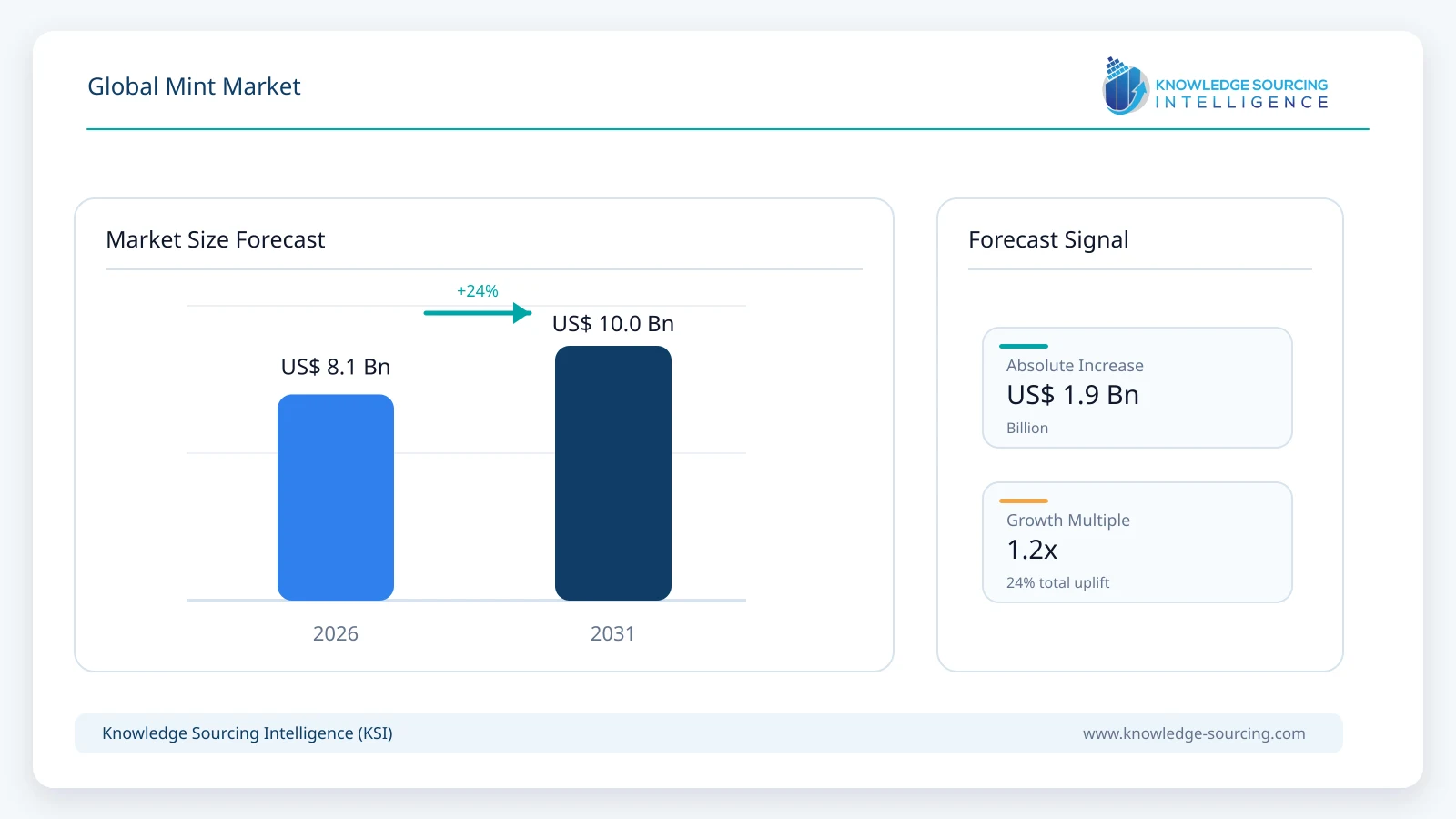
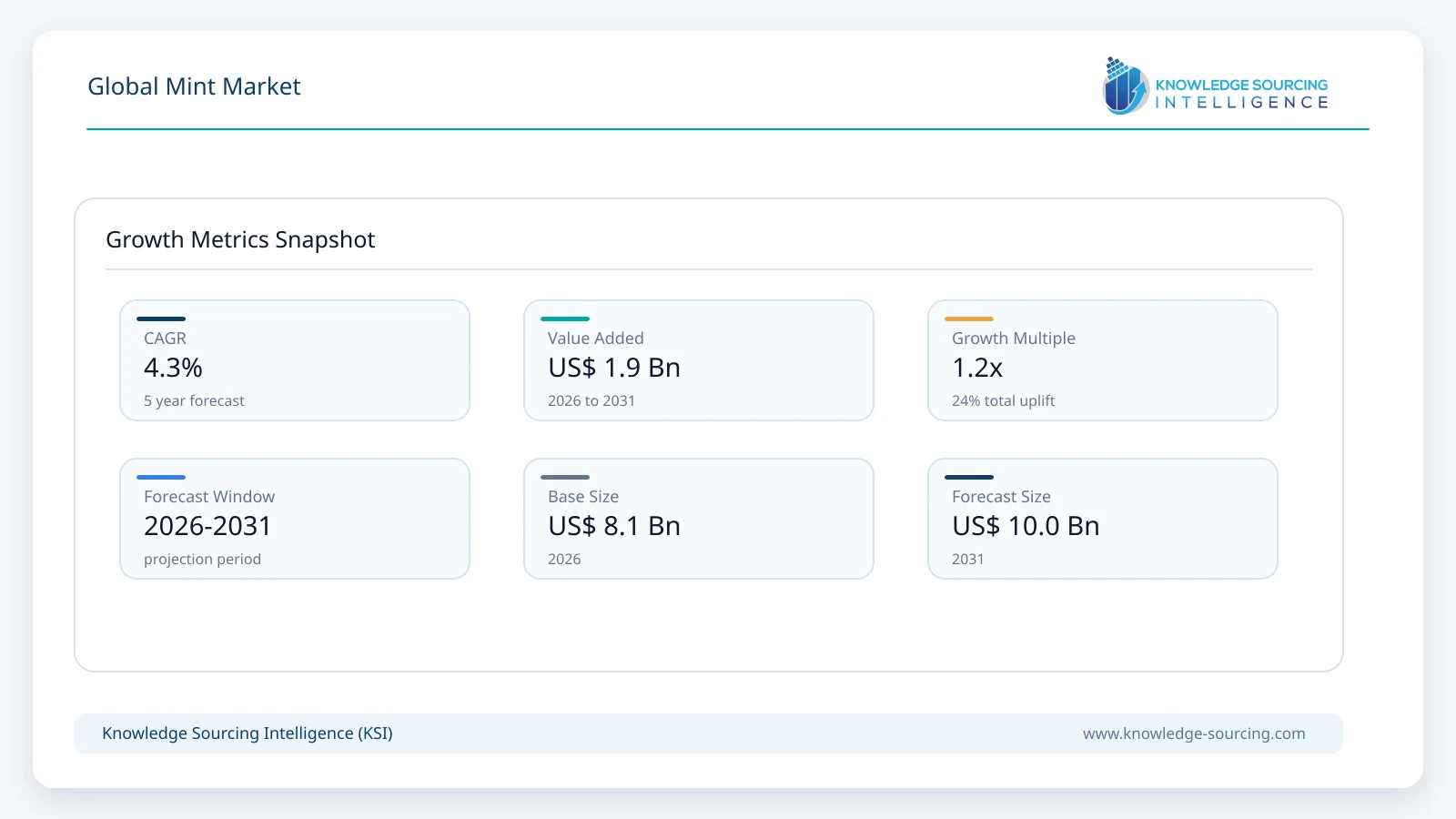
The Global Mint market is forecast to grow at a CAGR of 4.3%, reaching USD 10.01 billion in 2031 from USD 8.10 billion in 2026.
Highlights:
- 1Spearmint accounts for approximately 37% of the market in 2026, supported by broad use across confectionery, gum, beverages and oral-care products.
- 2Cornmint is projected to grow at approximately 5.2% CAGR through 2031, reflecting its strategic importance as a source of natural menthol.
- 3Food and beverage applications represent approximately 44% of market value in 2026, although oral-care and pharmaceutical uses are growing faster.
- 4Oral care is projected to expand at approximately 5.3% CAGR, supported by the continued use of mint and menthol in toothpaste, mouthwash and freshness-oriented formulations.
- 5Asia Pacific accounts for approximately 38% of the global market in 2026, combining large-scale production, processing and consumption.
- 6Supply-chain resilience is increasingly being shaped by water efficiency, farmer productivity, traceability and long-term sourcing programs in key cultivation regions.
The market is supported by a diverse set of end uses spanning confectionery, chewing gum, oral care, pharmaceuticals, beverages, personal care and flavor manufacturing, but its underlying economics remain strongly influenced by agricultural supply, menthol yield and processing capability.
Mint differs from many specialty herbs because value is created at several stages of the supply chain. Peppermint, spearmint, cornmint and other varieties are sold as agricultural products, distilled into essential oils, processed into extracts or used as feedstock for natural menthol and related ingredients. ADM, Givaudan and Symrise all maintain dedicated mint portfolios for applications ranging from toothpaste and chewing gum to beverages, personal care and pharmaceutical formulations, reinforcing the industry’s role as both an agricultural and functional-ingredient market.
Supply concentration remains one of the defining features of the market. Mars states that India produces about 80% of the world’s mint supply within its sourcing network, while its Shubh Mint program works with farmers in Uttar Pradesh to improve yields, water efficiency and income. The strategic importance of India is also visible in trade data: the country exported approximately USD 118.2 million of menthol in 2024, with China, the United States, Singapore, Japan and the Netherlands among the largest destinations.
This concentration creates both efficiency and risk. Large processors and multinational buyers benefit from established farmer networks, distillation infrastructure and trading relationships, but the market remains exposed to localized weather conditions, water availability, crop disease, agricultural economics and menthol yield. As a result, sustainability, traceability and agricultural productivity are becoming direct commercial considerations rather than secondary ESG issues.
Market Growth Drivers and Trends
Expansion of Traceable Natural Menthol Supply Chains
Large buyers are increasingly treating mint sourcing as a strategic supply-chain issue rather than a commodity-purchasing function. Mars’ Shubh Mint program in India now engages more than 24,000 farmers and is being integrated into the company’s European chewing-gum supply chain, including factories in the United Kingdom and Poland. The initiative focuses on farmer income, production economics and traceable sourcing, demonstrating how downstream buyers are investing directly in agricultural resilience where natural menthol availability is concentrated.
This trend supports demand for processors and suppliers capable of documenting origin, agricultural practice and quality consistency. Traceability is particularly important for large global buyers because a substantial portion of natural mint and menthol supply originates from a relatively concentrated production base.
Growing Functional Use of Mint in Oral Care
Mint remains a core flavor and sensory ingredient in oral care because it provides both freshness and cooling perception. ADM describes mint as a cornerstone of toothpaste and mouthwash applications, while Symrise identifies oral care as one of its most important mint-related businesses and supplies natural mint oils, menthols and cooling systems across the category.
This supports faster growth in oral-care applications than in mature food uses. Demand is not limited to flavor masking; cooling intensity, freshness duration and compatibility with active oral-care ingredients increasingly influence formulation decisions. Suppliers able to provide standardized flavor profiles and reliable cooling performance are therefore positioned to capture higher-value demand.
Cornmint’s Role in Natural Menthol Production
Cornmint, particularly Mentha arvensis, remains central to the natural menthol supply chain. Givaudan notes that arvensis oil can contain roughly 75–80% menthol before processing and identifies India as the principal modern production base. The oil is distilled and then partly dementholized, allowing processors to separate natural menthol while retaining valuable residual mint oil.
This processing relationship gives cornmint greater strategic importance than its direct consumer recognition would suggest. KSI therefore expects cornmint to gain modest share through 2031 as oral-care, pharmaceutical and cooling applications maintain demand for natural menthol and mint derivatives.
Continued Product Innovation in Gum, Mints and Refreshment Categories
Mint remains deeply embedded in chewing gum, breath-freshening and confectionery portfolios. Perfetti Van Melle continues to market Mentos, Smint, Vivident, Dentyne and other freshness-oriented brands, while Hershey maintains Ice Breakers across peppermint, spearmint, coolmint and related variants. Mars is also extending mint-based product lines while adapting formulations to changing consumer preferences.
These categories provide a stable demand base for mint oils and flavor systems. Growth is not necessarily driven by large increases in unit consumption, but by reformulation, premium flavor profiles, sugar-free products, natural positioning and the introduction of new refreshment formats.
Agricultural Innovation Is Becoming a Commercial Growth Enabler
Yield improvement and crop resilience are increasingly important because expansion through acreage alone can intensify water and land pressures. ADM’s SustainMINT program uses proprietary varieties designed to improve disease resistance and extend plantation life, while Mars and Symrise have supported farmer programs in Uttar Pradesh aimed at improving productivity and reducing resource intensity.
These initiatives can expand usable mint output without requiring proportional increases in cultivated area. They also help processors maintain more consistent oil quality and reduce volatility in procurement, which supports long-term supply agreements with large multinational customers.
Market Restraints
Geographic Concentration of Natural Mint Supply
The concentration of natural mint cultivation in India, particularly Uttar Pradesh, remains the most significant structural risk. The region benefits from established farming and distillation infrastructure, but adverse weather, water stress, labor conditions or crop disease can influence global availability. Mars’ sourcing programs themselves reflect the commercial importance of strengthening resilience within this concentrated supply base.
Water Intensity and Climate Exposure
Mint cultivation can require substantial irrigation, making water availability a material long-term issue in major growing regions. Mars’ Shubh Mint program has explicitly targeted reductions in water use, while ADM’s breeding and agricultural programs focus on varieties capable of performing under changing environmental conditions.
Climate variability can also affect essential-oil concentration and menthol content, meaning supply risk extends beyond crop tonnage. A season with acceptable biomass output can still generate weaker economics if oil yield or active-compound concentration deteriorates.
Competition from Synthetic Menthol
Natural mint and menthol face direct competition from synthetic alternatives. Symrise is a major producer of synthetic l-menthol and describes the synthetic product as chemically equivalent to natural menthol for many applications. Synthetic production provides manufacturers with an alternative supply route that is less dependent on agricultural variability, particularly in applications where natural-origin claims are not commercially essential.
This limits pricing power for natural menthol during periods of tight supply and creates a ceiling on how far agricultural shortages can be passed through to industrial customers.
Traceability Requirements Increase Costs for Smaller Suppliers
Large multinational customers increasingly require documentation relating to farm origin, sustainability, quality and regulatory compliance. These requirements strengthen supply-chain transparency but can create additional costs for small processors and fragmented farmer networks. Suppliers without robust traceability systems can face difficulty accessing premium multinational contracts even when their underlying product quality is acceptable.
Agricultural Yield and Menthol-Content Variability
Mint is not a standardized industrial raw material at the farm level. Oil recovery, menthol concentration and sensory profile can vary with variety, soil condition, irrigation, harvest timing and distillation practice. This creates procurement complexity because downstream processors need consistent specifications even when agricultural output is variable. Large suppliers increasingly use blending, breeding programs and contracted sourcing to manage this variation, but smaller operators remain more exposed.
Mint Market Segment Analysis
By Product Type
Spearmint
Spearmint represents approximately 37% of market value in 2026 and remains widely used in chewing gum, confectionery, beverages and oral-care products. Its milder sensory profile makes it suitable for products where freshness is required without the stronger cooling intensity associated with menthol-heavy varieties. Perfetti Van Melle, Hershey and Mars all maintain spearmint-oriented product portfolios, supporting recurring demand for both natural oils and formulated flavor systems.
Peppermint
Peppermint is projected to grow at approximately 4.3% CAGR through 2031. It remains important across food, beverages, oral care and personal care because its flavor profile combines strong aromatic character with cooling perception. Givaudan continues to source and process peppermint oil from India, while ADM offers multiple peppermint oils and blends for industrial formulation.
Cornmint
Cornmint is projected to reach approximately 24% of market value by 2031. Its principal commercial importance lies in natural menthol production rather than direct consumer recognition, making the segment closely linked to oral care, pharmaceuticals, cooling agents and flavor manufacturing. Continued demand for natural menthol supports faster segment growth than the broader market.
Other Mint Varieties
Other mint varieties serve more specialized culinary, fragrance, herbal and regional applications. Growth broadly tracks the market because these products benefit from botanical and natural-ingredient demand but lack the same industrial-scale demand base as peppermint, spearmint or cornmint.
By Application
Food & Beverage
Food and beverage remains the largest application and is projected to account for approximately 42% of market value by 2031. Mint is used in confectionery, gum, beverages, desserts, dairy products and flavor systems, but growth is relatively mature compared with functional uses. ADM’s mint portfolio illustrates this breadth, spanning gum, confectionery, beverages, dairy and snack applications.
Oral Care
Oral care is projected to grow at approximately 5.3% CAGR, supported by toothpaste, mouthwash and breath-freshening formulations. The segment requires reliable flavor consistency and cooling performance, creating opportunities for suppliers with integrated natural mint, menthol and formulation capabilities.
Pharmaceuticals & Nutraceuticals
Pharmaceutical and nutraceutical applications are projected to expand at approximately 5.5% CAGR, making them the fastest-growing major application group in the KSI model. Menthol remains relevant in topical, respiratory, throat and cooling products, while botanical positioning also supports selected wellness applications. Symrise identifies pharmaceutical use alongside oral care, confectionery and cosmetics within its broader menthol portfolio.
Personal Care & Cosmetics
Mint and menthol are used across shower gels, skin-care formulations and fragrance systems where cooling or freshness is required. The category grows broadly in line with the total market, supported by continued interest in sensory differentiation and botanical ingredients.
Geographical Outlook
Asia Pacific
Asia Pacific accounts for approximately 38% of the global market in 2026 and is projected to gain share through 2031. India is central to natural menthol and cornmint supply, while China, Japan and other Asian markets provide substantial demand across oral care, food and personal care. India’s USD 118.2 million in 2024 menthol exports demonstrate the region’s role in international ingredient flows.
North America
North America remains an important cultivation and consumption market, particularly for peppermint and spearmint. ADM notes that much of the world’s peppermint and spearmint is grown in northern North American regions suited to high-quality oil production, while Mars also sources mint from the United States and Canada.
Europe
European demand is shaped by confectionery, gum, oral care, pharmaceutical and premium natural-ingredient applications. Mars’ decision to bring Shubh Mint-sourced menthol directly into its UK and Polish gum operations illustrates the region’s increasing focus on traceable supply rather than only product cost.
South America and the Middle East & Africa remain smaller markets, with demand supported by food processing, confectionery, oral care and imported ingredient requirements.
Key Developments
August 2026: Mars Snacking released new U.S. product options made without FD&C colors, including Extra Gum in Spearmint flavor. The development supports the KSI view that mint demand remains resilient within mature refreshment categories while formulation changes create recurring ingredient-development requirements.
July 2026: Mars announced that traceable natural menthol sourced through its Shubh Mint program would be integrated into European chewing-gum manufacturing in the UK and Poland. The program had engaged more than 24,000 farmers in India, linking European confectionery demand directly with sustainable natural-menthol sourcing. This supports KSI’s expectation that traceability and supply resilience will become increasingly important competitive factors.
June 2026: Ricola introduced Mouthwatering Drops, combining citrus, Swiss Alpine salt and mint notes. The launch demonstrates continued product innovation in the refreshment and functional-confectionery category, supporting stable food and beverage demand for mint flavors.
June 2025: Symrise’s mint-farmer program in Uttar Pradesh received recognition through the AB InBev Eclipse Bold Steps Ecosystem Awards. The initiative focuses on sustainable farming practices, productivity and farmer income, providing evidence that major flavor suppliers are investing directly in the resilience of the natural-mint supply chain.
Competitive Environment
The competitive landscape includes flavor and ingredient groups, essential-oil processors, mint specialists and downstream consumer-product companies. Large ingredient suppliers such as Symrise, Givaudan, IFF, ADM and McCormick benefit from global customer relationships, blending capabilities, formulation expertise and diversified sourcing. Specialist suppliers in India and other producing regions compete through access to raw material, distillation capacity, natural menthol processing and export capability.
Downstream buyers also exert considerable influence. Mars, Perfetti Van Melle, Hershey and Ricola purchase mint ingredients at scale and influence supplier expectations relating to quality, traceability and sustainability. Competition is therefore not based on price alone; buyers increasingly evaluate consistency, sensory performance, regulatory compliance, sustainability credentials and long-term supply security.
Mint Market Scope:
| Report Metric | Details |
|---|---|
| Total Market Size in 2026 | USD 8.10 billion |
| Total Market Size in 2031 | USD 10.01 billion |
| Forecast Unit | Billion |
| Growth Rate | 4.3% |
| Study Period | 2021 to 2031 |
| Historical Data | 2021 to 2024 |
| Base Year | 2025 |
| Forecast Period | 2026 – 2031 |
| Segmentation | Product Type, Form, Application, Distribution Channel, Geography |
| Companies |
|
Market Segmentation
By Product Type
Spearmint
Peppermint
Cornmint
Other Mint Varieties
By Form
Fresh Mint
Dried Mint
Mint Oil
Mint Extract
Menthol and Other Mint Derivatives
By Application
Food and Beverages
Pharmaceuticals
Oral Care
Personal Care and Cosmetics
Flavors and Fragrances
Aromatherapy and Wellness
Other Applications
By Distribution Channel
Direct and B2B Sales
Distributors and Wholesalers
Retail
Supermarkets/Hypermarkets
Grocery Stores
Specialty Stores
Others
Online Retail
By Geography
North America
United States
Canada
Mexico
South America
Brazil
Argentina
Rest of South America
Europe
United Kingdom
Germany
France
Italy
Spain
Rest of Europe
Middle East and Africa
Saudi Arabia
United Arab Emirates
Rest of Middle East and Africa
Asia-Pacific
China
India
Japan
South Korea
Australia
Thailand
Indonesia
Rest of Asia-Pacific
Table of Contents
1. INTRODUCTION
1.1 Market Overview
1.2 Market Definition
1.3 Scope of the Study
1.4 Market Segmentation
1.5 Currency
1.6 Assumptions
1.7 Base and Forecast Years Timeline
1.8 Key Benefits for Stakeholders
2. RESEARCH METHODOLOGY
2.1 Research Design
2.2 Research Process
2.3 Data Collection and Validation
2.4 Market Size Estimation
2.5 Forecasting Methodology
3. EXECUTIVE SUMMARY
3.1 Key Findings
3.2 Analyst's View
3.3 Market Snapshot
4. MARKET DYNAMICS
4.1 Market Drivers
4.2 Market Restraints
4.3 Market Opportunities
4.4 Porter’s Five Forces Analysis
4.4.1 Bargaining Power of Suppliers
4.4.2 Bargaining Power of Buyers
4.4.3 Threat of New Entrants
4.4.4 Threat of Substitutes
4.4.5 Competitive Rivalry in the Industry
4.5 Industry Value Chain Analysis
5. GLOBAL MINT MARKET BY PRODUCT TYPE
5.1 Introduction
5.2 Peppermint
5.3 Spearmint
5.4 Cornmint
5.5 Other Mint Varieties
6. GLOBAL MINT MARKET BY DISTRIBUTION CHANNEL
6.1 Introduction
6.2 Online Retail
6.3 Offline Retail
6.3.1 Supermarkets/Hypermarkets
6.3.2 Grocery Stores
6.3.3 Specialty Stores
6.3.4 Others
7. GLOBAL MINT MARKET BY GEOGRAPHY
7.1 Global Overview
7.2 North America
7.2.1 United States
7.2.2 Canada
7.2.3 Mexico
7.3 South America
7.3.1 Brazil
7.3.2 Argentina
7.3.3 Rest of South America
7.4 Europe
7.4.1 United Kingdom
7.4.2 Germany
7.4.3 France
7.4.4 Italy
7.4.5 Spain
7.4.6 Rest of Europe
7.5 Middle East and Africa
7.5.1 Saudi Arabia
7.5.2 United Arab Emirates
7.5.3 Rest of Middle East and Africa
7.6 Asia-Pacific
7.6.1 China
7.6.2 India
7.6.3 Japan
7.6.4 South Korea
7.6.5 Australia
7.6.6 Thailand
7.6.7 Indonesia
7.6.8 Rest of Asia-Pacific
8. COMPETITIVE ENVIRONMENT AND ANALYSIS
8.1 Major Players and Strategy Analysis
8.2 Market Share Analysis
8.3 Mergers, Acquisitions, Agreements, and Collaborations
8.4 Competitive Dashboard
8.5 Competitive Positioning Matrix
8.6 Recent Developments
9. COMPANY PROFILES
9.1. Symrise AG
9.2. Givaudan SA
9.3. International Flavors & Fragrances Inc.
9.4. Archer-Daniels-Midland Company
9.5. McCormick & Company, Inc.
9.6. Berjé Inc.
9.7. The Lebermuth Company, Inc.
9.8. Hindustan Mint & Agro Products Pvt. Ltd.
9.9. Kelvin Natural Mint Pvt. Ltd.
9.10. AOS Products Pvt. Ltd.
9.11. Vinayak Ingredients (India) Pvt. Ltd.
9.12. Ultra International Ltd.
9.13. Plant Lipids Pvt. Ltd.
9.14. Aromaaz International Pvt. Ltd.
9.15. Kancor Ingredients Ltd.
9.16. Mentha & Allied Products Pvt. Ltd.
9.17. Jindal Drugs Pvt. Ltd.
9.18. Neeru Menthol Pvt. Ltd.
9.19. SVA Organics
9.20. Natural Aroma Products Pvt. Ltd.
LIST OF TABLES
LIST OF FIGURES
Navigate
Trusted by the world's leading organizations











