
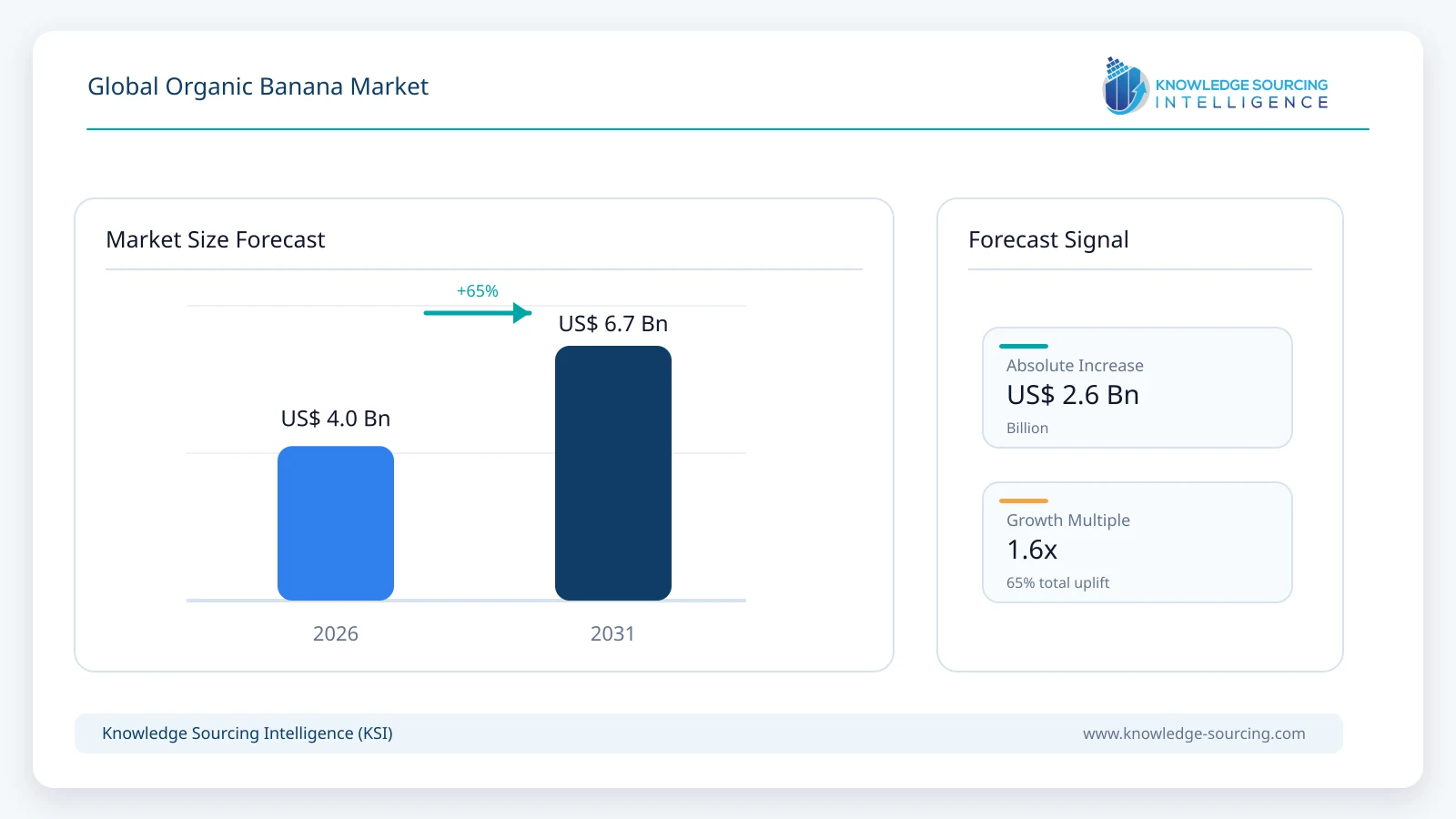
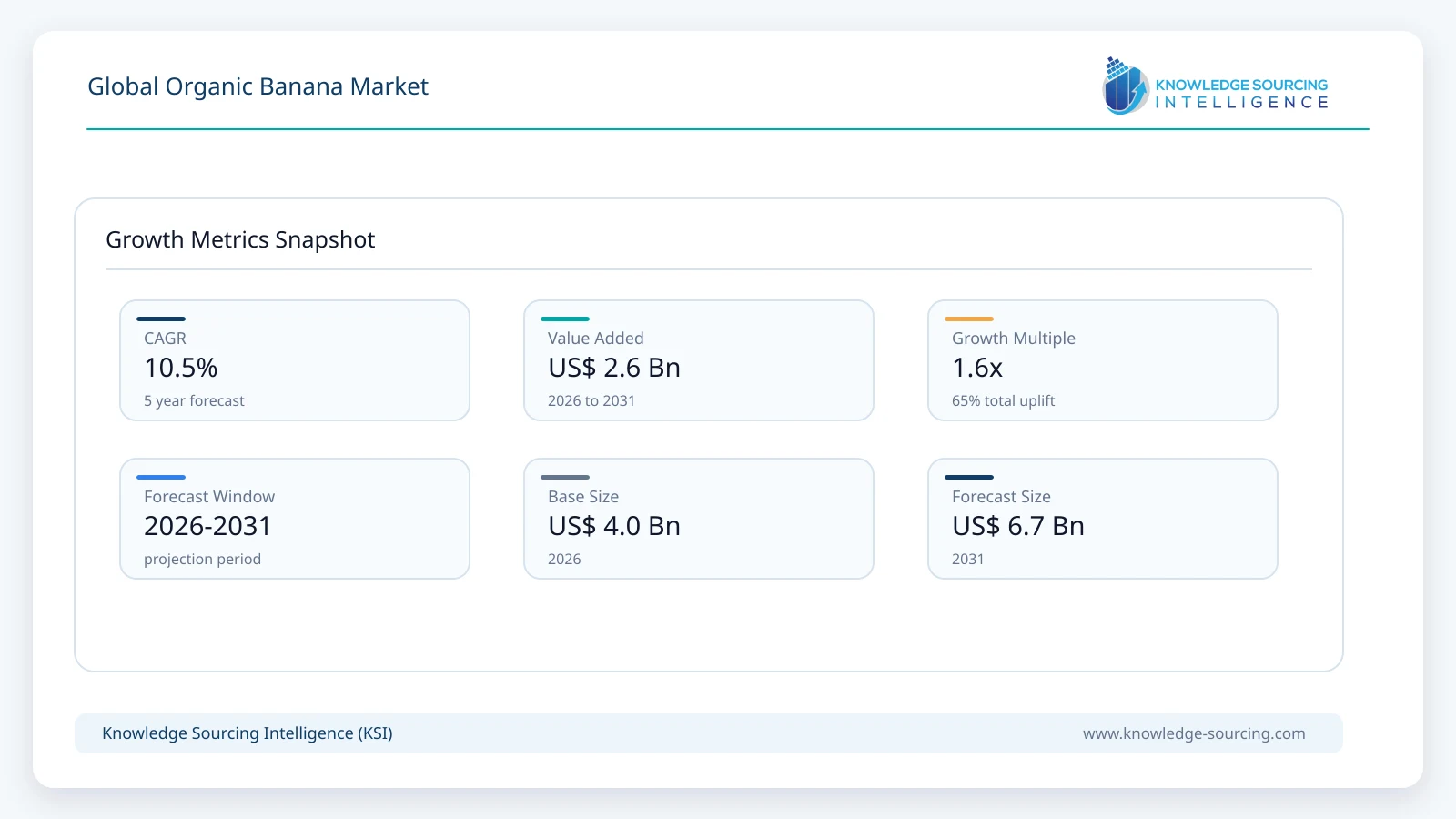
The Global Organic Banana market is forecast to grow at a CAGR of 10.5%, reaching USD 6.68 billion in 2031 from USD 4.05 billion in 2026.
Highlights:
- 1The global organic banana market is projected to grow from USD 4.05 billion in 2026 to USD 6.68 billion by 2031.
- 2Organic bananas represented 13.4% of EU banana import volume in 2024, showing established demand for certified fruit in a large import market.
- 3EU imports of organic bananas from Ecuador increased 4.5% in 2024, reinforcing Ecuador's commercial role in European organic banana supply.
- 4Supermarkets and hypermarkets are commercially important because they combine frequent grocery purchases with the shelf space and distribution networks needed for fresh fruit.
- 5Organic Cavendish bananas are a commercially important product segment because familiar fruit characteristics support broad household use and routine retail sales.
- 6South America is a core supply region, with Ecuador, Colombia, Peru, and other Latin American producers connected to export markets in Europe and North America.
Organic bananas occupy a distinct position in the fresh fruit trade, combining everyday consumer demand with certified production, traceable sourcing, and specialist supply chains. The market is shaped by organic food purchasing trends, retailer sourcing policies, farm productivity, and the costs of certification and distribution. Commercial performance depends on reliable year-round supply, competitive retail prices, and the ability to maintain organic certification throughout the supply chain, from farm to shelf. Producers and distributors must also manage weather-related disruptions, transportation costs, quality standards, and changing consumer preferences to maintain consistent availability and strengthen their position in the global fresh fruit trade.
Market Overview
Organic bananas are sold through mainstream grocery retailers, specialist organic stores, and online channels. Unlike many premium fruit categories, bananas are bought frequently and compete directly with conventional produce on price, appearance, ripeness, and availability. Suppliers must therefore balance the higher costs of certified production with the need to keep the product accessible to regular grocery shoppers.
The European Commission reported that EU imports of organic agri-food products reached 2.64 million tonnes in 2024, up 6.4% from 2023. Organic bananas were among the products supporting this increase, with import volumes from Ecuador rising by 4.5%. Bananas accounted for 13.4% of EU banana import volume in organic form, showing that organic supply has a measurable position in the European fresh fruit market.
The market extends beyond farming. Exporters and importers coordinate certification, packing, cold-chain transport, ripening, quality checks, and retailer delivery schedules. A failure at any stage can reduce saleable volumes or cause delays. Buyers also need consistent fruit quality across shipments, which can be difficult when weather, disease, and harvest conditions vary between growing regions.
Organic banana supply depends on farms that can meet certification rules while maintaining yields and managing pests without prohibited inputs. Exporters must also preserve the integrity of organic shipments through packing, storage, transport, and handling. These operating needs influence supplier selection and can limit how quickly producers expand supply into new markets.
Key Market Indicators
Indicator | Latest Evidence | Commercial Meaning |
|---|---|---|
EU organic agri-food imports | 2.64 million tonnes in 2024 | Organic imports provide a broad indicator of demand for certified food, including fresh fruit. |
Change in EU organic agri-food imports | 6.4% increase in 2024 | Recovery in organic imports creates opportunities for exporters that can meet buyer specifications. |
Organic share of EU banana imports | 13.4% in 2024 | Organic bananas have an established position in European banana sourcing. |
EU organic banana imports from Ecuador | 4.5% volume increase in 2024 | Ecuador remains an important source for organic banana supply into Europe. |
U.S. organic import tracking | Import-certificate data available for 2025 | Shipment-level organic import records help monitor supply origins and compliance. |
These indicators point to a market where access to reliable certified supply matters as much as consumer interest. Exporters must meet buyer specifications, maintain documentation, and control losses across the supply chain. Retailers, in turn, need consistent deliveries and clear product claims to sustain repeat purchases.
Market Drivers
Retail demand for certified organic produce. Organic bananas benefit from their role as a familiar, frequently purchased fruit rather than an occasional specialty product. Retailers can place them beside conventional bananas and serve shoppers who want certified organic food without changing their broader shopping habits. The European Commission's import data shows that bananas already form a measurable part of the EU organic food basket.
For producers and exporters, this creates a route to differentiated sales, but the premium must cover certification, farm management, packing, and handling costs. Retailers will continue to weigh organic credentials against price, shelf life, appearance, and the ability to supply stores consistently.
Established export routes from Latin America. Ecuador and other Latin American producers supply international banana markets through established export networks. These networks provide access to packing facilities, shipping services, importers, and ripening centres. The increase in EU organic banana imports from Ecuador in 2024 shows how existing trade links can support organic shipments when demand and supply align.
Exporters with access to certified farms and dependable shipping can serve large retail contracts more effectively than suppliers that rely on small or irregular volumes. However, export growth depends on farm output, quality control, freight capacity, and the ability to meet destination-market standards.
Retailer demand for dependable year-round supply. Supermarkets need a steady flow of fruit with predictable ripening and shelf life. Organic banana suppliers must coordinate harvesting, packing, transit, and ripening so stores receive fruit within a narrow quality window. Retail buyers may favor suppliers with multiple sourcing areas, mature quality systems, and the ability to respond when a growing region faces weather or disease pressure.
This demand can favor larger exporters and established importers. Smaller organic producers can still compete through specialist retailers or direct relationships, but they may face higher costs per shipment and less flexibility when customers require large, frequent deliveries.
Consumer access through mainstream and specialist retail. Mainstream supermarkets offer scale and convenience, while organic food stores can attract shoppers who place greater weight on certification and sourcing practices. Online retail adds another route for grocery orders, although fresh bananas require careful picking, packaging, and delivery to limit bruising and over-ripening.
Channel choice affects margins. Large retailers may seek competitive prices and regular volumes, while specialist outlets may offer more room to explain organic certification and sourcing. Suppliers must match their product, pack size, and service model to each channel rather than assume that all organic buyers have the same priorities.
Market Restraints and Challenges
Higher production and certification costs. Organic producers must follow approved production rules, keep records, prevent prohibited inputs from contaminating certified crops, and maintain the required certification. These steps can increase labor, monitoring, and administration costs. Producers may also face yield or pest-management challenges where organic methods provide fewer treatment options than conventional production.
The cost burden falls heavily on farms that lack scale or stable buyer contracts. Exporters may be reluctant to expand certified acreage unless retailers commit to volumes and prices that cover additional costs. If consumers resist the price premium, suppliers may have limited room to pass those costs through the chain.
Weather and crop disease. Banana output is sensitive to rainfall, temperature, wind damage, and plant disease. Fresh Del Monte's 2025 annual report identified adverse weather and crop diseases, including Black Sigatoka, among the factors that raised production and procurement costs. It also reported that lower banana sales volumes in some markets reflected reduced supply and weak demand.
Organic growers must manage these risks within the rules that apply to certified production. Disease pressure can raise labor and crop-management costs, reduce yields, and disrupt shipment schedules. Exporters that depend on a narrow supply area may face greater exposure than those with diversified sourcing.
Price pressure and limited consumer willingness to pay. Organic bananas compete with conventional bananas, which are widely available and often sold at low prices. Retailers must decide how much of the added cost to pass on to shoppers. When household budgets tighten, some buyers may switch to conventional fruit, leaving organic suppliers to absorb part of the price difference or accept lower sales volumes.
This pressure makes cost control important at every stage. Farms need efficient field operations, while exporters must limit packing losses and freight costs. Suppliers that cannot maintain quality at a competitive price may struggle to secure repeat retail orders, even where organic demand remains intact.
Traceability and supply-chain separation. Organic status must remain clear from the farm through packing, storage, transport, import, and retail handling. Suppliers need records that link certified production to the goods delivered. Separate handling, documentation, and audits add work for exporters and importers, particularly when they manage organic and conventional bananas through the same facilities.
In the United States, the USDA National Organic Program publishes import data drawn from organic import certificates, while products with designated organic tariff codes are tracked through separate trade records. For exporters, this highlights the importance of accurate shipment documentation and consistent compliance procedures across destination markets.
Major Segment Analysis
Organic Cavendish Bananas
Organic Cavendish bananas are a commercially important segment because the variety is familiar to consumers and fits established retail systems. Standardized fruit size, appearance, packing formats, and ripening practices help retailers manage stock across multiple stores. This makes Cavendish a practical option for large grocery chains seeking to offer an organic alternative alongside conventional bananas.
The segment's economics depend on consistent quality and regular supply. Buyers need fruit that can withstand transport, ripen predictably, and remain saleable through the retail window. Organic production adds requirements for farm management and certification, so suppliers must control yield variation, crop health, packing losses, and shipping schedules. The ability to meet these requirements can matter more to a large retailer than a small difference in the purchase price.
Competition in organic Cavendish bananas rests on sourcing networks, certification controls, export execution, and customer relationships. Dole, Chiquita, Fresh Del Monte, Compagnie Fruitière, Fyffes, and the Latin American producers in the supplied company set operate in the wider banana supply chain. Chiquita also markets an organic banana product that it describes as meeting USDA organic certification requirements.
Geographical Outlook
North America
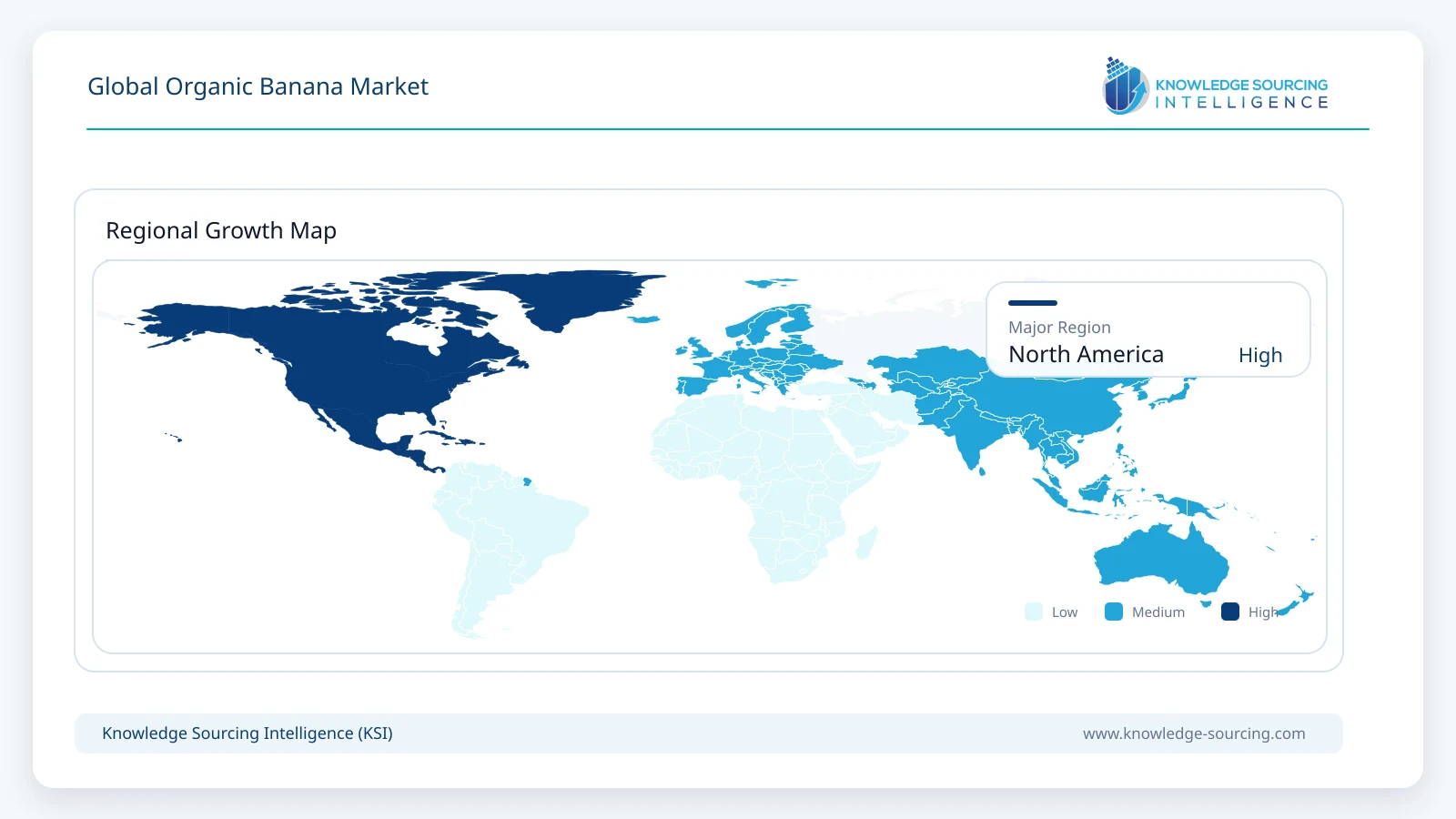
The United States and Canada offer opportunities through mainstream grocery retail, natural-food retailers, and online grocery services. Organic banana suppliers need to meet local certification and import rules while maintaining consistent fruit quality through long-distance transport and ripening. The USDA's organic import records provide a formal basis for tracking certified shipments entering the U.S. market.
Mexico has a different role because it is both a consumer market and part of the wider North American agricultural trade network. Supplier competitiveness depends on distribution access, price, certification, and the ability to deliver fruit at the right ripeness. Retailers may also compare imported organic bananas with conventional options when deciding how much shelf space to allocate.
Europe
Europe is an important destination for organic bananas, supported by established organic food retail and a broad import network. The European Commission reported that EU imports of organic bananas from Ecuador rose by 4.5% in 2024, while bananas represented 13.4% of EU banana import volume in organic form.
Germany, the United Kingdom, France, the Netherlands, Italy, and Spain provide important retail and distribution markets within the region. Importers must maintain organic documentation and meet EU rules for imported organic products. Buyers also need dependable supply, competitive prices, and fruit that can move through ripening and distribution systems without excessive losses.
Asia Pacific
Asia Pacific combines banana-producing countries with large and varied consumer markets. India, China, Thailand, Indonesia, and the Philippines have important roles in regional banana production and trade, while Japan, South Korea, and Australia provide markets for imported fruit. The scale of domestic production in some countries can reduce reliance on imports for conventional bananas, but certified organic supply depends on local production methods, consumer demand, and the reach of organic retail channels.
Market access differs by country. Suppliers must assess organic standards, import rules, retail structure, and consumer willingness to pay before entering a market. For exporters, a local partner can help manage documentation and distribution, while large retail contracts may require regular volumes and strict quality controls.
South America
South America is central to the international supply chain, with Ecuador, Colombia, Peru, and other Latin American producers serving overseas markets. Ecuador's growth in EU organic banana shipments during 2024 illustrates the role of the region in supplying certified fruit to Europe.
Export performance depends on farm productivity, certification, packing capacity, port access, and freight schedules. Weather and disease can affect both volumes and costs, while exporters must maintain organic integrity across farms and packing facilities. Producers that combine certified acreage with reliable export logistics are better placed to meet retailer delivery programs.
Middle East and Africa
Saudi Arabia, the United Arab Emirates, and South Africa offer potential demand through modern grocery retail, specialist food stores, and import distribution. Organic banana sales depend on the reach of certified-product retail, household purchasing power, and the availability of importers that can maintain cold-chain and ripening standards.
The region is not uniform. Importers in markets with smaller organic retail bases may prefer limited volumes or mixed fruit shipments, while larger urban retail networks can support more regular orders. Suppliers need to balance freight cost, product shelf life, certification requirements, and local retail demand before committing to dedicated organic programs.
Competitive Landscape
The organic banana market combines global fruit companies with regional growers, exporters, and specialist organic suppliers. Competition depends on access to certified farms, volume consistency, packing quality, shipping reliability, retailer relationships, and the ability to document organic status. The product itself is familiar, so supplier differentiation often rests on dependable service and cost control rather than visible differences in the fruit.
Dole plc, Chiquita Brands International, Fresh Del Monte Produce, Compagnie Fruitière, and Fyffes have established roles in the broader banana supply chain. Chiquita offers an organic banana product, while Dole publishes sustainability reports covering its farm-to-market operations. These company materials show how organic offerings and sourcing practices fit within broader produce operations.
The supplied competitive set also includes Grupo Iren Fruits, Grupo HAME, Grupo Acón, AgroAmerica, Coliman Group, Organics Unlimited, AgroFair, Grupo DAABON, Reybanpac, and Uniban. Regional producers and organic-focused suppliers can compete through certified farm networks, local knowledge, and links with specialist buyers. Their ability to maintain consistent export volumes and meet destination-market rules influences access to large retail contracts.
The main operating challenge is balancing scale with control. Large exporters can spread logistics and compliance costs across broader shipment volumes, but they still face weather, disease, freight, and price risks. Organic specialists may offer focused sourcing and certification expertise, yet smaller operations can face higher costs per shipment and less flexibility during supply disruptions.
Recent Developments
March 2026: Dole plc announced the availability of its 2025 annual report, providing updated company-level information on its operations and financial performance. The report offers buyers and suppliers a current reference for evaluating the operating conditions of a large international produce company.
February 2026: Fresh Del Monte Produce filed its annual report for fiscal 2025, describing the effects of adverse weather, crop disease, distribution costs, and changing banana sales volumes on its results. The disclosure shows how farm and logistics risks can affect the economics of the wider banana supply chain.
Regulatory and Policy Environment
Organic banana trade depends on recognized certification and controls that protect the integrity of organic claims. Producers must follow the rules of the relevant certification system, keep records of farm inputs and handling, and prevent certified goods from being mixed with non-organic products. Exporters and importers must ensure that documents and shipment records match the requirements of the destination market.
In the United States, the USDA National Organic Program sets the framework for organic certification and publishes import information tied to organic import certificates. In the European Union, organic imports are tracked through the Commission's TRACES system, which supports oversight of certified agricultural products entering the market.
Compliance affects both cost and market access. Farms may need changes to production practices, while packers and exporters must maintain segregation, traceability, and audit-ready records. Suppliers that serve several regions must manage differing certification and import procedures, which can add administrative work and delay shipments if documents are incomplete.
Outlook and Strategic Implications
The global organic banana market is shaped by the ability of suppliers to expand certified production while maintaining cost efficiency and reliable delivery. European import activity demonstrates that organic bananas have an established presence in a major destination market, while highlighting the importance of sourcing origins, shipment consistency, and supply chain performance. Commercial development will depend on certification compliance, farm productivity, distribution efficiency, and the capacity of producers and exporters to meet growing demand for organically produced fruit.
Organic Cavendish bananas are likely to remain commercially important because they fit familiar retail formats and regular household purchasing. Specialty varieties can serve narrower demand, but suppliers need to match variety, volume, and channel to customer needs. Across the market, consistent fruit quality and dependable delivery will remain central to repeat orders.
Four strategic priorities will shape market performance:
Certified supply: Exporters should build dependable relationships with certified farms and maintain clear records across packing and shipment stages.
Cost control: Producers and distributors need to reduce crop losses, packing waste, and freight inefficiencies while protecting fruit quality.
Retail alignment: Suppliers should match volume, pack format, ripeness, and delivery schedules to the needs of supermarket, specialist, and online channels.
Risk management: Diversified sourcing, crop-health monitoring, and reliable logistics can reduce exposure to weather, disease, and shipment disruption.
For growers and exporters, the commercial task is to make certified production dependable at scale. For retailers and importers, the priority is to secure traceable fruit at prices that support repeat purchases. Suppliers that combine certification, consistent quality, and efficient logistics will be better placed to convert demand for organic bananas into durable business.
Organic Banana Market Scope:
| Report Metric | Details |
|---|---|
| Total Market Size in 2026 | USD 4.05 billion |
| Total Market Size in 2031 | USD 6.68 billion |
| Forecast Unit | Billion |
| Growth Rate | 10.5 |
| Study Period | 2021 to 2031 |
| Historical Data | 2021 to 2024 |
| Base Year | 2025 |
| Forecast Period | 2026 – 2031 |
| Segmentation | Product Type, Distribution Channel, Geography |
| Companies |
|
| Customization Scope | 15% Free Customization included with purchase — Request Custom Breakdown → |
| Sample & Data Access | PDF Sample, Excel Databook & Analyst Briefing — Download Free Sample → |
Market Segmentation
By Product Type
Organic Cavendish Bananas
Organic Specialty Bananas
Other Organic Banana Varieties
By Distribution Channel
Supermarkets and Hypermarkets
Convenience Stores
Specialty and Organic Food Stores
Online Retail
Other Distribution Channels
By Geography
North America
United States
Canada
Mexico
Others
South America
Ecuador
Brazil
Argentina
Colombia
Peru
Others
Europe
Germany
United Kingdom
France
Netherlands
Italy
Spain
Others
Middle East and Africa
Saudi Arabia
United Arab Emirates
South Africa
Others
Asia Pacific
China
India
Japan
South Korea
Thailand
Indonesia
Australia
Others
Table of Contents
1. INTRODUCTION
1.1. Market Overview
1.2. Market Definition
1.3. Scope of the Study
1.4. Market Segmentation
1.5. Currency
1.6. Assumptions
1.7. Base and Forecast Years Timeline
1.8. Key Benefits for the Stakeholders
2. RESEARCH METHODOLOGY
2.1. Research Design
2.2. Research Process
3. EXECUTIVE SUMMARY
3.1. Key Findings
4. MARKET DYNAMICS
4.1. Market Drivers
4.2. Market Restraints
4.3. Market Opportunities
4.4. Porter’s Five Forces Analysis
4.4.1. Bargaining Power of Suppliers
4.4.2. Bargaining Power of Buyers
4.4.3. Threat of New Entrants
4.4.4. Threat of Substitutes
4.4.5. Competitive Rivalry in the Industry
4.5. Industry Value Chain Analysis
4.6. Analyst View
5. GLOBAL ORGANIC BANANA MARKET BY PRODUCT TYPE
5.1. Introduction
5.2. Organic Cavendish Bananas
5.3. Organic Specialty Bananas
5.4. Other Organic Banana Varieties
6. GLOBAL ORGANIC BANANA MARKET BY DISTRIBUTION CHANNEL
6.1. Introduction
6.2. Supermarkets and Hypermarkets
6.3. Convenience Stores
6.4. Specialty and Organic Food Stores
6.5. Online Retail
6.6. Other Distribution Channels
7. GLOBAL ORGANIC BANANA MARKET BY GEOGRAPHY
7.1. Introduction
7.2. North America
7.2.1. By Product Type
7.2.2. By Distribution Channel
7.2.3. By Country
7.2.3.1. United States
7.2.3.2. Canada
7.2.3.3. Mexico
7.2.3.4. Others
7.3. South America
7.3.1. By Product Type
7.3.2. By Distribution Channel
7.3.3. By Country
7.3.3.1. Ecuador
7.3.3.2. Brazil
7.3.3.3. Argentina
7.3.3.4. Colombia
7.3.3.5. Peru
7.3.3.6. Others
7.4. Europe
7.4.1. By Product Type
7.4.2. By Distribution Channel
7.4.3. By Country
7.4.3.1. Germany
7.4.3.2. United Kingdom
7.4.3.3. France
7.4.3.4. Netherlands
7.4.3.5. Italy
7.4.3.6. Spain
7.4.3.7. Others
7.5. Middle East and Africa
7.5.1. By Product Type
7.5.2. By Distribution Channel
7.5.3. By Country
7.5.3.1. Saudi Arabia
7.5.3.2. United Arab Emirates
7.5.3.3. South Africa
7.5.3.4. Others
7.6. Asia Pacific
7.6.1. By Product Type
7.6.2. By Distribution Channel
7.6.3. By Country
7.6.3.1. China
7.6.3.2. India
7.6.3.3. Japan
7.6.3.4. South Korea
7.6.3.5. Thailand
7.6.3.6. Indonesia
7.6.3.7. Australia
7.6.3.8. Others
8. COMPETITIVE ENVIRONMENT AND ANALYSIS
8.1. Major Players and Strategy Analysis
8.2. Market Share Analysis
8.3. Mergers, Acquisitions, Agreements, and Collaborations
8.4. Competitive Dashboard
9. COMPANY PROFILES
9.1. Dole plc
9.2. Chiquita Brands International
9.3. Fresh Del Monte Produce Inc.
9.4. Compagnie Fruitière
9.5. Fyffes Limited
9.6. Grupo Iren Fruits, S.L.
9.7. Grupo HAME
9.8. Grupo Acón
9.9. AgroAmerica
9.10. Coliman Group
9.11. Organics Unlimited
9.12. AgroFair
9.13. Grupo DAABON
9.14. Reybanpac
9.15. Uniban
List of Figures
List of Tables





Frequently asked questions
What is the Global Organic Banana Market's projected size by 2031?
The Global Organic Banana Market is forecast to reach USD 6.68 billion by 2031.
What is the Compound Annual Growth Rate (CAGR) for this market?
The Global Organic Banana Market is projected to grow at a 10.5% CAGR.
Which region is a core supply area for organic bananas?
South America, including Ecuador, is a core supply region.
What is a commercially important product segment in the market?
Organic Cavendish bananas are a commercially important product segment.
Which distribution channels are commercially important for organic bananas?
Supermarkets and hypermarkets are commercially important for fresh fruit.
What are key factors shaping the organic banana market?
Organic food trends, retailer policies, and certification costs shape the market.
Cite this report
Knowledge Sourcing Intelligence. (Nov 2026). Global Organic Banana Market - Strategic Insights and Forecasts (2026-2031). https://www.knowledge-sourcing.com/report/global-organic-banana-market