
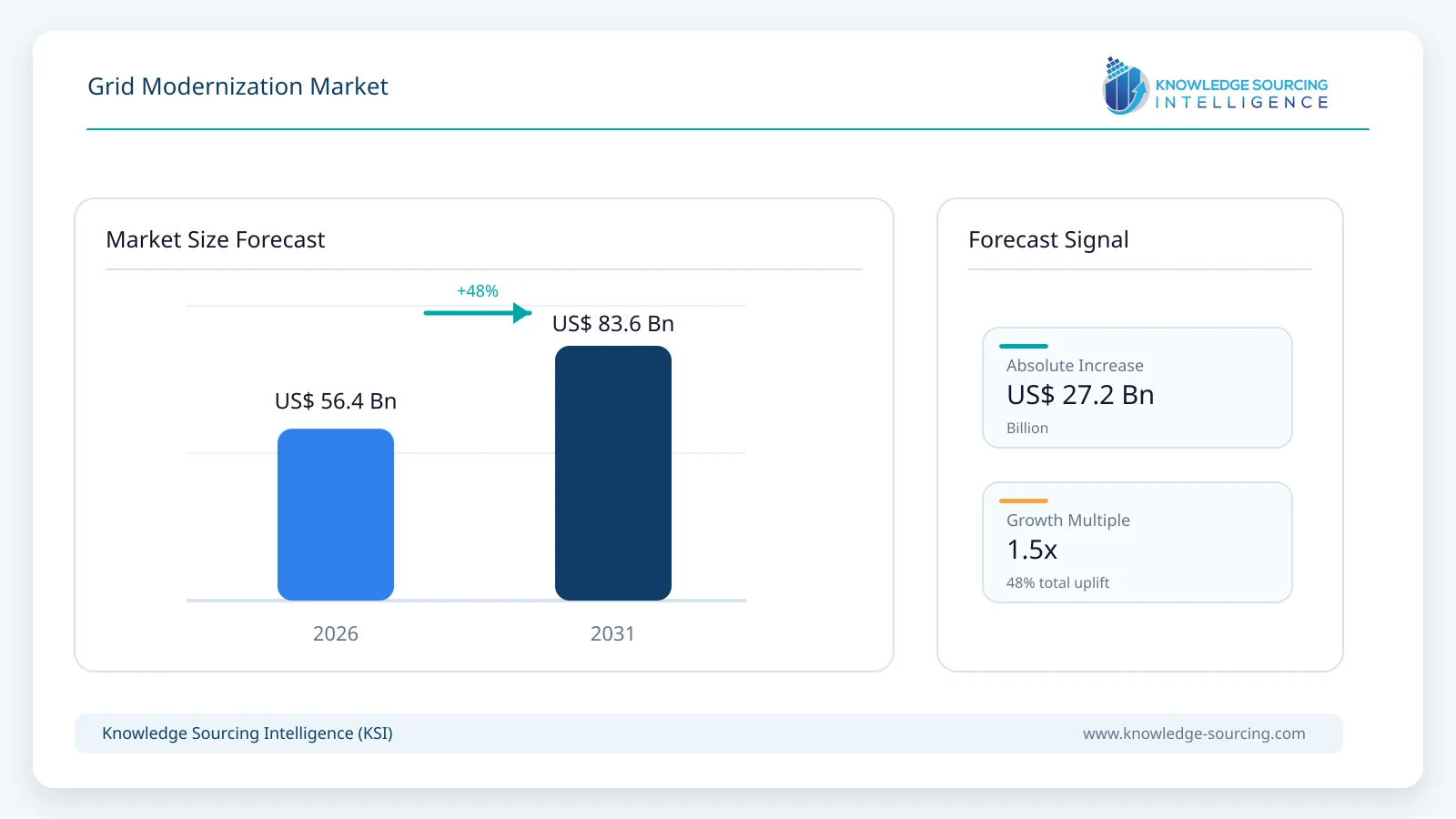
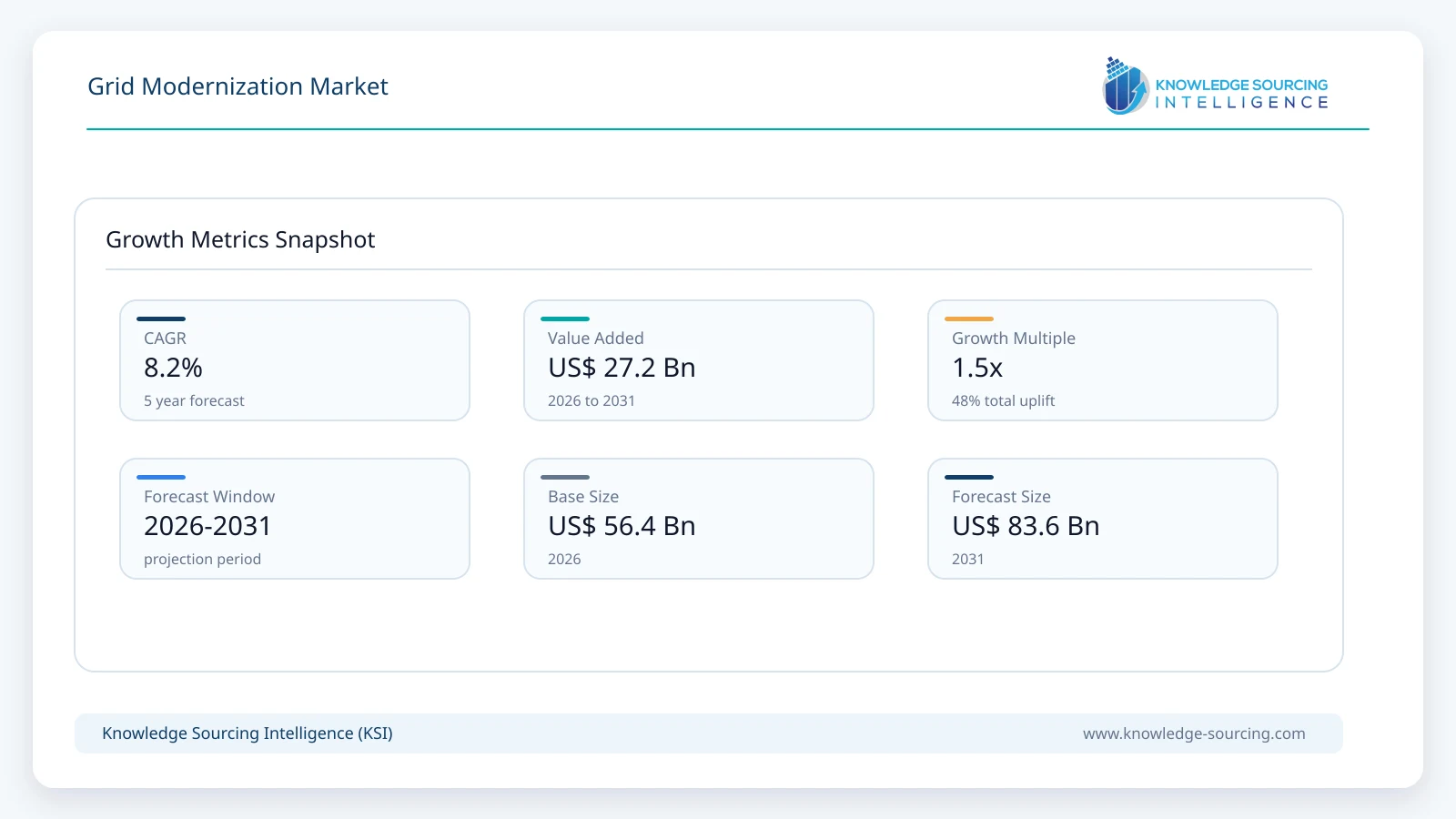
The Grid Modernization Market is forecast to grow at a CAGR of 8.2%, reaching USD 83.6 billion in 2031 from USD 56.4 billion in 2026.
Highlights:
- 1Component leaderHardware remains the dominant component in the Grid Modernization Market, reaching USD 28.2 billion in 2026 and capturing a 50.0% market share.
- 2Growth standoutRenewable Energy Integration is set to record the highest segment CAGR of 9.4% during the 2026–2031 forecast period, driven by the increasing integration of renewable power into electricity networks.
- 3Distribution grid outlookThe Distribution Grid segment is projected to expand from USD 25.38 billion in 2026 to USD 38.62 billion by 2031, strengthening its position as the largest grid-type segment.
- 4Smart technology scaleSmart Grid Technologies account for 30.0% of the technology segment in 2026, corresponding to an estimated market value of USD 16.92 billion.
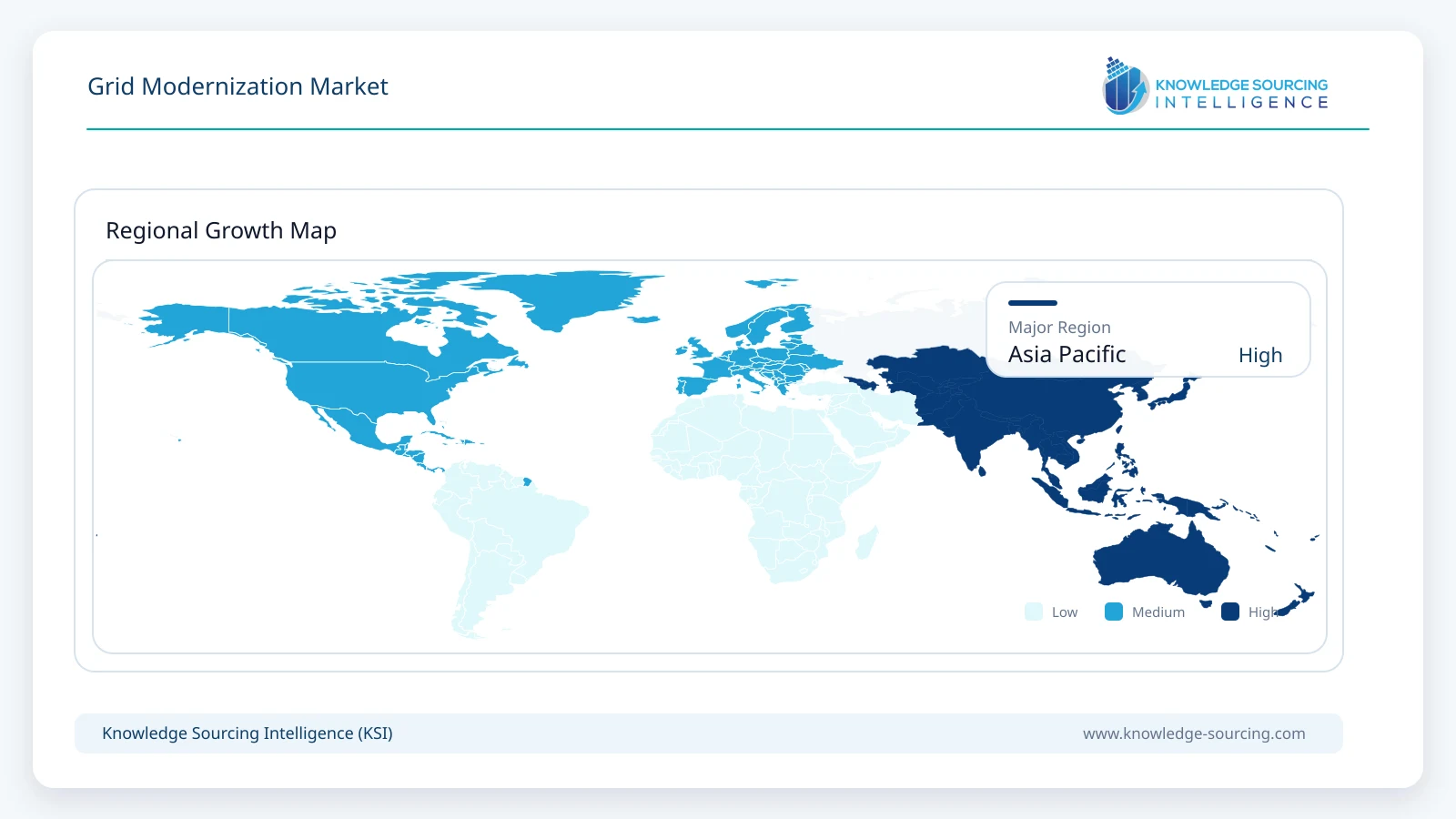
- 5North American presenceNorth America is forecast to reach USD 23.40 billion by 2031, representing 28.0% of the global Grid Modernization Market at the end of the forecast period.
The global grid modernization market is expected to grow due to growing penetration of renewable energy generation, grid electrification, and aging grid infrastructure. Further, the growing need for more electricity-system resiliency and reliability through digitalization of major components is another key trend observed in the global grid modernization market.
Additionally, the market is using automated feedback loops to evolve traditional electricity grids from predominantly unidirectional networks into smart, bi-directional systems that can optimize electricity flows between central generation and demand. This includes more centralized renewables as well as distributed resources such as batteries and electric vehicles on the supply side, and commercial facilities and residential consumers on the demand side.
The shift towards the grid is driven in part by solar PV and wind power, which are variable in nature as their generation correlates with weather, making it complicated to operate the grid. Utilities need greater monitoring and forecasting, automation, and distributed energy resource management to uphold grid balance.
Market Dynamics
Market Drivers
Aging Grid Infrastructure and the Need for Replacement: One of the key drivers of grid modernization is aging electrical infrastructure in developed electricity markets. Many transformers, substations, transmission lines, distribution equipment, protection systems, and control infrastructure are reaching the end of their operating lives, in need of replacement or modernisation. Digital upgrades are increasingly incorporated into their asset replacement. Instead of replacing with similar legacy systems, operators are bringing in sensors, communications, automation, and monitoring capability across the process base.
Increasing Renewable Energy Integration: The rise of solar and wind generation is altering the way operators operate electricity systems. Conventional power plants offer more dependable and controllable generation, while renewable resources are less predictable and can vary with weather. As a result, in order to cope with increasing levels of renewable penetration, utilities will need sophisticated forecasting and grid automation systems for voltage management, storage coordination, and distributed energy resource management systems.
Growth of Distributed Energy Resources: New distribution resource connected to distribution networks due to rooftop solar, batteries, EV chargers, flexible loads, and microgrids. The old grids were built to move electricity from larger power plants through the transmission and distribution system to the customers. However, the emergence of distributed generation contributes to bidirectional power flows and adds complexity to the management of networks, leading to the need for grid modernization.
Rising Electricity Demand from Electrification: The rise of electrification of transportation, heating, industrial processes, and buildings is contributing to electricity demand. Data centers and AI infrastructure are another massive source of electricity consumption. This leads to utilities investing in transmission and distribution capacity while investing in implementing digital technologies to more efficiently manage demand.
Market Restraints & Opportunities
High capital investments due to grid modernization continue as a key market restraint. That means utilities are investing simultaneously in physical infrastructure, communications, software, cybersecurity, workforce training, and system integration.
There are also significant interoperability challenges created by legacy infrastructure. Utilities often run equipment across multiple generations of technology and vendors, making the integration between new digital technologies and existing infrastructure technically challenging.
These challenges are also creating opportunities for vendors offering modular modernization platforms, interoperable communication systems, cybersecurity solutions, cloud-based grid analytics, and AI-based predictive maintenance. This is achieved through a widespread asset management solution, such as an integrated workstation to interact with the distribution area in the managed grid services market.
An increasing number of utilities are being drawn to distributed energy resources because they need new software platforms that can integrate millions of individual assets.
Key Developments
August 2026: Guyana fast-tracked its grid-modernization initiative, leading to Caribbean Energy Week 2027. The country made significant investments in transmission lines, distribution networks, substations, and smart meters to lower electricity losses, increase reliability, integrate renewable energy into the grid, and accommodate the 300 MW Wales Gas-to-Energy project.
July 2026: University of New Mexico announced receiving $9.6 million in total under the New Mexico Grid Modernization Program. The project sought to electrify campus heating, which included water-to-water heat pumps, battery-energy storage, carbon-reduction efforts, peak-demand management, and energy resilience, in addition to providing a blueprint for future campus geoexchange heating systems.
Market Segmentation
The market is segmented by component, grid type, technology, application, end user industry, and geography.
By Component: Hardware
Hardware is projected to have a major share of the grid modernization market, accounting for 48.0% in 2031, with a segment value of USD 40.10 billion and a CAGR of 7.3% during the forecast period, as modernization programs demand extensive physical upgrades across distribution, transmission, substations, and grid-edge infrastructure.
Hardware is composed of sensors, smart meters, transformers, switchgear, circuit breakers, communication equipment, protection systems, power quality devices, digital substations, and grid-edge devices. Utilities are increasingly deploying sensors on transformers and distribution assets to measure temperature, voltage, current, vibration, and other operating conditions. The data generated by these devices can be analyzed by grid management software to identify abnormal conditions and detect potential equipment failures.
Digital substations also replace traditional electromechanical equipment with intelligent electronic devices, digital protection, fiber-optic communication, and automated control. For instance, Hitachi Energy's Digital Substations integrate protection, automation, communication, and monitoring functions to support more intelligent, reliable, and connected substation operations.
By Grid Type: Distribution Grid
The distribution grid is expected to register a CAGR of 8.8%, supported by the growing integration of distributed energy resources and electrification loads that connect primarily to distribution networks.
Rooftop solar, EV charging infrastructure, residential batteries, commercial energy storage, heat pumps, and flexible industrial loads are increasing operational complexity across distribution networks. This growth is driving utilities to strengthen grid visibility, flexibility, and automated control capabilities.
Historically, distribution networks were designed mainly for one-way electricity flows from centralized generation to end users. The expansion of distributed generation is creating bidirectional power flows, requiring more proactive voltage management, automated switching, advanced protection, and real-time grid monitoring.
Utilities are also deploying smart meters, automated reclosers, distribution management systems, intelligent transformers, voltage regulators, and Distributed Energy Resource Management Systems (DERMS) to improve network performance. Eaton’s Distribution Automation portfolio supports enhanced grid visibility, reliability, and operational control, aligning with the increasing modernization of distribution infrastructure.
By Technology: Smart Grid Technologies
The ever-widening technology segment of the smart grid represents the largest and most strategic enabled technology category, accounting for a 29.5% share in 2031 with a segment value of USD 24.68 billion, driven by its integrated communications, monitoring, automation, analytics, and intelligent control capabilities across increasingly complex electricity networks.
Smart grids enable utilities to gain real-time data from substations, meters, sensors, distributed resources, and grid assets. This data supports automated fault detection, demand management, predictive maintenance, voltage optimization, and the seamless integration of renewable energy sources.
More advanced smart-grid platforms are increasingly incorporating artificial intelligence and machine learning across applications. These technologies help identify abnormal equipment behavior compared with normal operating conditions, forecast electricity demand, optimize grid performance, and support faster operational decision-making.
Itron Smart Grid Solutions offers smart-network and grid-edge technologies that enable utility visibility and management. Similarly, Mitsubishi Electric Energy & Systems provides technologies supporting monitoring, automation, and electricity-system management.
Regional Analysis
North America Market Analysis
The North America grid modernization market has become one of the most significant as utilities address aging infrastructure, rising electricity demand, renewable integration, and extreme weather risks. The US is investing in transmission expansion, distribution automation, smart meters, digital substations, grid resilience, and DER management. The growing scale of data centres and AI infrastructure is further driving requirements for additional grid capacity and advanced load-management capabilities. The segment is projected to register a 6.7% CAGR, supported by increasing investments in reliable, flexible, and digitally enabled electricity networks.
South America Market Analysis
South America has an emerging market for grid modernization backed by growing renewable energy needs, electrification, and urbanization, coupled with the need to improve electricity reliability. Brazil is the major regional opportunity due to its vast electricity network and the fastest-growing solar and wind generation. As distributed solar penetration rises, distribution-grid visibility and voltage management demands are increasing in the region.
Europe Market Analysis
Europe has a considerable grid modernization market because of ambitious renewable energy targets, electrification, distributed energy resources, and aging electricity infrastructure. Investments in grid expansion and digitalisation are being undertaken to adjust the systems for climbing renewable generation and electrified transport mainly in Germany, the United Kingdom, France, Italy, Spain, and Nordic countries.
Middle East and Africa Market Analysis
The Middle East & Africa grid modernization market is expanding, supported by large-scale renewable energy projects in the region along with urbanization, electrification, as well as smart-city development initiatives. The Saudis and the UAE are developing solar generation, smart cities, digital infrastructure, and advanced electricity networks. The region is working to enhance forecasting, monitoring, and power-flow management capabilities among grid operators for the rapid deployment of renewable generation.
Asia Pacific Market Analysis
Asia-Pacific is projected to remain one of the fastest-growing regional markets, supported by rising electricity demand, rapid industrialization, urbanization, renewable energy deployment, and infrastructure investment. The region accounted for 35.0% share in 2026, representing a segment value of USD 19.74 billion, and its share is expected to reach 38.0% by 2031. Significant investments are being directed toward smart grids, ultra-high-voltage transmission, renewable integration, digital substations, energy storage, and advanced distribution networks. Increasing grid sophistication is further driven by the large-scale deployment of solar and wind power capacity across the region.
List of Companies
Eaton Corporation
Hitachi Energy
Landis+Gyr
Mitsubishi Electric
Prysmian
NKT
AspenTech
SMA Solar Technology
Itron
Nexans S.A.
Eaton Corporation
Eaton specializes in electrical distribution, grid automation, power management, circuit protection, energy storage, and digital technologies. The company has a portfolio of utility offerings for grid visibility, reliability, and resilience through distribution automation and intelligent electrical equipment. The company has major exposure to data centers, industrial facilities, and distributed energy resources, which means multiple paths for grid modernization.
Hitachi Energy
Hitachi Energy is a global leader in power-grid technologies for transmission, distribution, substations, power quality, grid automation, and digitalization. The company has a digital grid portfolio of asset management, automation, monitoring, and grid-edge technologies needed to manage the growing complexity for utilities in electricity networks.
Landis+Gyr
Landis+Gyr develops smart metering, advanced metering infrastructure, grid-edge intelligence, and utility software. It has smart-meter technologies that enable utilities to have deep electricity consumption data while also providing better demand management, outage detection, and network visibility.
Analyst View
The grid modernization market is evolving from traditional infrastructure replacement to fully integrated digital transformation, with utilities combining hardware, software, communications, and services in coordinated modernization programs. Hardware will remain a key investment vector as historically high numbers of transformers, substations, meters, cables, and grid equipment need to be replaced by connected, digitally controllable assets. While the distribution grid will remain the most active modernization area, as rooftop solar plus batteries, EVs plus heat pumps, and flexible loads change electricity flows at the grid edge. Smart grid technologies will continue to be a key technology domain as utilities need real-time visibility, automation, predictive analytics, and DER coordination. This implies that the competitiveness and resilience of modern electricity networks will increasingly depend on the convergence of advanced metering, digital substations, grid automation, DERMS, AI-enabled asset management, and cybersecurity over the forecast period.
Grid Modernization Market Scope:
| Report Metric | Details |
|---|---|
| Total Market Size in 2026 | USD 56.4 billion |
| Total Market Size in 2031 | USD 83.6 billion |
| Forecast Unit | Billion |
| Growth Rate | 8.2% |
| Study Period | 2021 to 2031 |
| Historical Data | 2021 to 2024 |
| Base Year | 2025 |
| Forecast Period | 2026 – 2031 |
| Segmentation | Component, Grid Type, Technology, Application, End User, Geography |
| Companies |
|
Market Segmentation
By Component
Hardware
Software
Services
By Grid Type
Transmission Grid
Distribution Grid
Substation Grid
Others
By Technology
Smart Grid Technologies
Advanced Metering Infrastructure
Digital Substations
Grid Automation
Distributed Energy Resource Management Systems
Others
By Application
Transmission Modernization
Renewable Energy Integration
Distributed Energy Resource Management
Electric Vehicle Integration
Energy Storage Integration
Others
By End User
Residential
Commercial
Industrial
By Geography
North America
USA
Canada
Mexico
South America
Brazil
Argentina
Others
Europe
United Kingdom
Germany
France
Others
Middle East and Africa
Saudi Arabia
UAE
Others
Asia Pacific
China
Japan
India
South Korea
Others
Table of Contents
1. EXECUTIVE SUMMARY
2. MARKET SNAPSHOT
2.1. Market Overview
2.2. Market Definition
2.3. Scope of the Study
2.4. Market Segmentation
3. MARKET DYNAMIC
3.1. Market Drivers
3.2. Market Restraints
3.3. Market Opportunities
3.4. Porter’s Five Forces Analysis
3.5. Industry Value Chain Analysis
4. BUSINESS LANDSCAPE
4.1. Regulatory, Grid Codes & Standards Landscape
4.2. Utility Grid Modernization Investment Landscape
4.3. Grid Resilience, Reliability & Electrification Planning Landscape
4.4. Input–Output Analysis
4.5. Strategic Recommendations
5. TECHNOLOGICAL OUTLOOK
5.1. Smart Grid, Grid Automation & Digital Substation Technologies
5.2. Advanced Metering, Sensors & Grid Monitoring Technologies
5.3. Distributed Energy Resource, Energy Storage & Power Electronics Technologies
5.4. Grid Intelligence, AI, Cybersecurity & Digital Twin Technologies
6. GRID MODERNIZATION MARKET BY COMPONENT
6.1. Introduction
6.2. Hardware
6.3. Software
6.4. Services
7. GRID MODERNIZATION MARKET BY GRID TYPE
7.1. Introduction
7.2. Transmission Grid
7.3. Distribution Grid
7.4. Substation Grid
7.5. Others
8. GRID MODERNIZATION MARKET BY TECHNOLOGY
8.1. Introduction
8.2. Smart Grid Technologies
8.3. Advanced Metering Infrastructure
8.4. Digital Substations
8.5. Grid Automation
8.6. Distributed Energy Resource Management Systems
8.7. Others
9. GRID MODERNIZATION MARKET BY APPLICATION
9.1. Introduction
9.2. Transmission Modernization
9.3. Renewable Energy Integration
9.4. Distributed Energy Resource Management
9.5. Electric Vehicle Integration
9.6. Energy Storage Integration
9.7. Others
10. GRID MODERNIZATION MARKET BY END USER
10.1. Introduction
10.2 Residential
10.3. Commercial
10.4. Industrial
11. GRID MODERNIZATION MARKET BY GEOGRAPHY
11.1. Introduction
11.2. North America
11.2.1. USA
11.2.2. Canada
11.2.3. Mexico
11.3. South America
11.3.1. Brazil
11.3.2. Argentina
11.3.3. Others
11.4. Europe
11.4.1. United Kingdom
11.4.2. Germany
11.4.3. France
11.4.4. Others
11.5. Middle East and Africa
11.5.1. Saudi Arabia
11.5.2. UAE
11.5.3. Others
11.6. Asia Pacific
11.6.1. China
11.6.2. Japan
11.6.3. India
11.6.4. South Korea
11.6.5. Others
12. COMPETITIVE ENVIRONMENT AND ANALYSIS
12.1. Major Players and Strategy Analysis
12.2. Market Share Analysis
12.3. Mergers, Acquisitions, Agreements, and Collaborations
12.4. Competitive Dashboard
13. COMPANY PROFILES
13.1. Eaton Corporation
13.2. Hitachi Energy
13.3. Landis+Gyr
13.4. Mitsubishi Electric
13.5. Prysmian
13.6. NKT
13.7. AspenTech
13.8. SMA Solar Technology
13.9. Itron
13.10. Nexans S.A.
14. APPENDIX
14.1. Currency
14.2. Assumptions
14.3. Base and Forecast Years Timeline
14.4. Key benefits for the stakeholders
14.5. Research Methodology
14.6. Abbreviations
Navigate
Trusted by the world's leading organizations











