
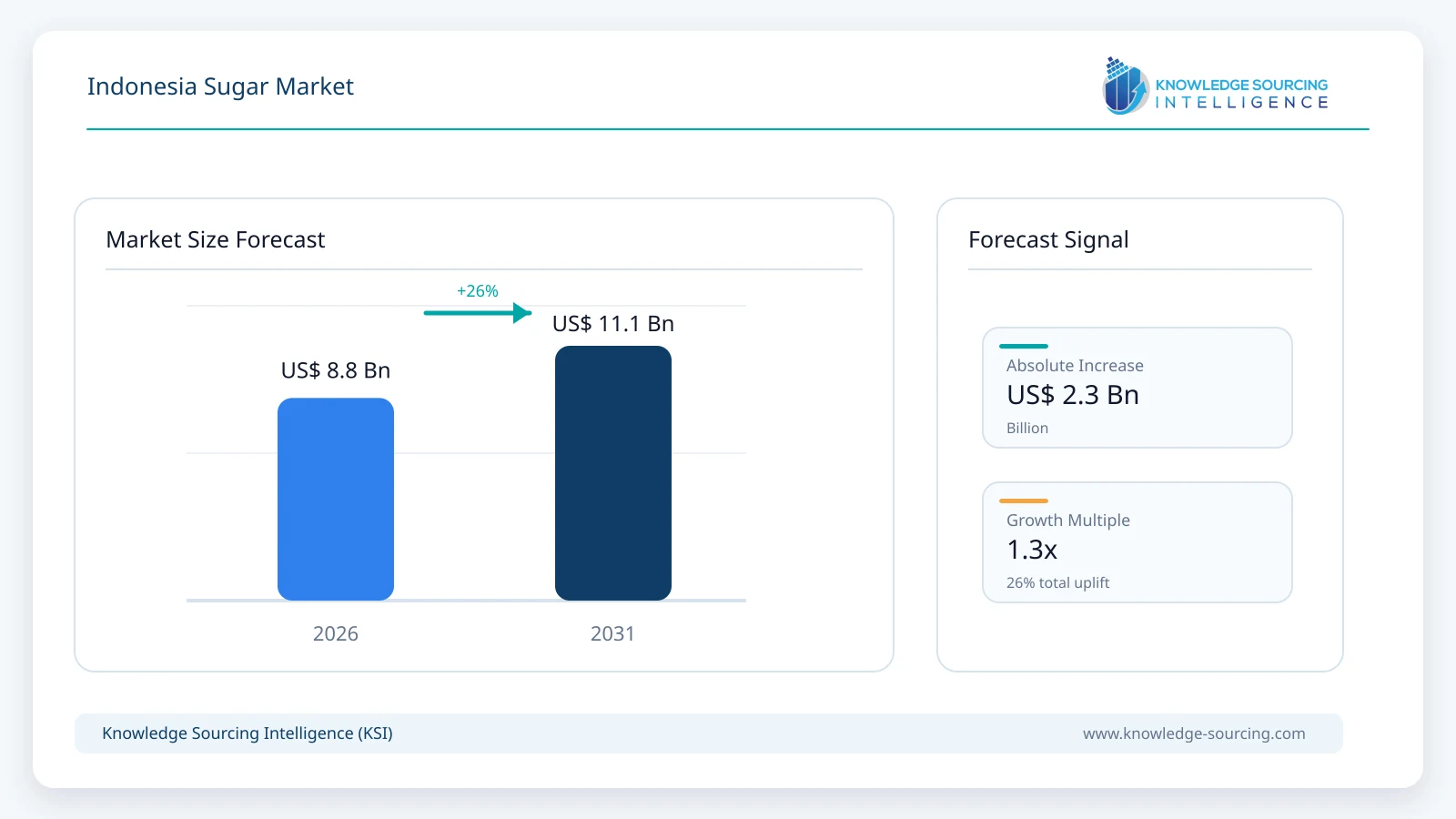
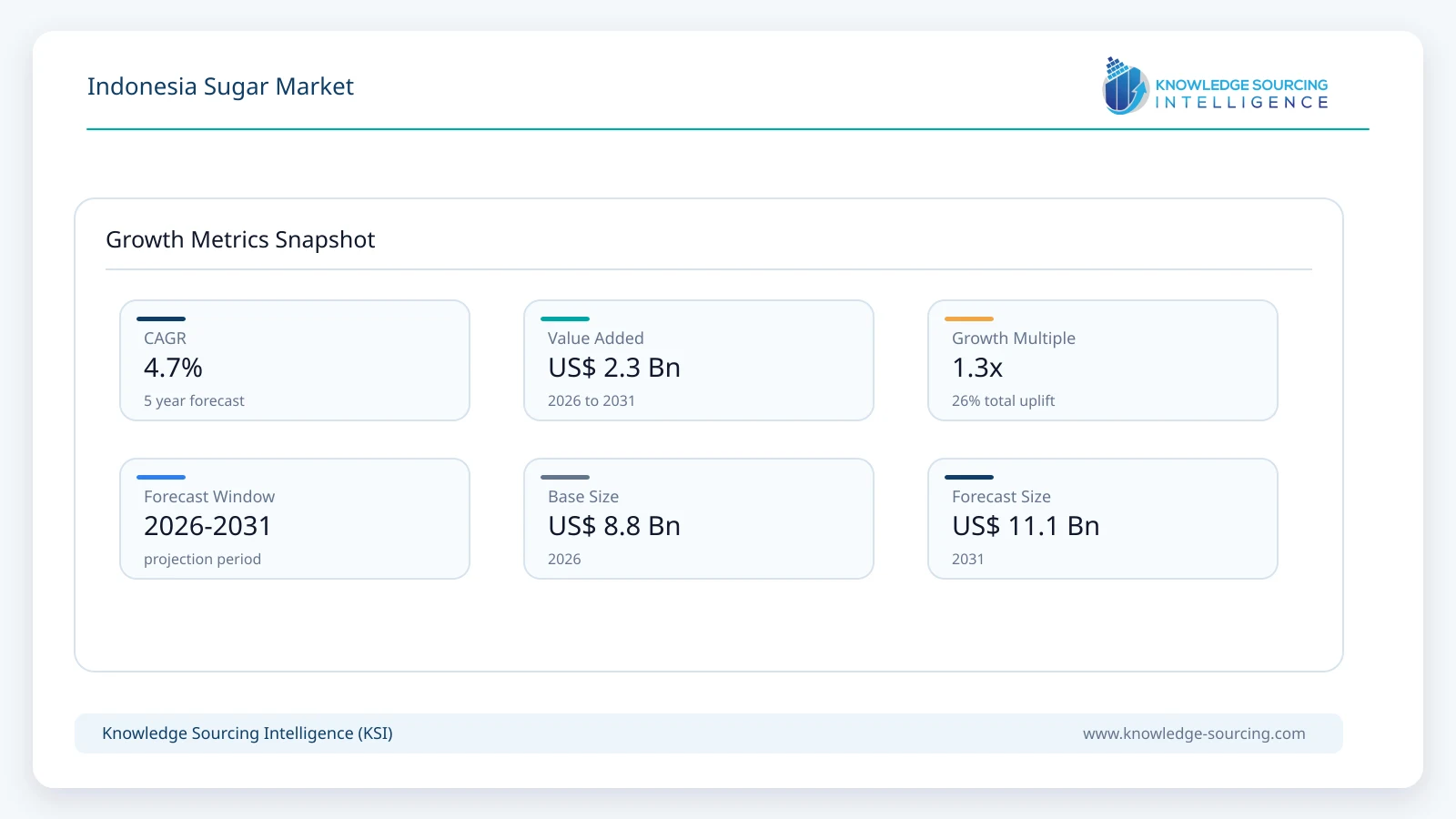
The Indonesia sugar market is forecast to grow at a CAGR of 4.7%, reaching USD 11.13 billion in 2031 from USD 8.85 billion in 2026.
Highlights:
- 1sugar self-sufficiencyThe Indonesian government is aggressively pursuing , accelerating plantation expansion, mill modernization, and productivity improvements to meet domestic demand and reduce reliance on imports.
- 2State-owned enterprises are consolidating control through entities like PT Sinergi Gula Nusantara, aiming to dominate the national sugar sector, similar to the palm oil industry model.
- 3Significant efforts focus on revitalizing outdated sugar mills and expanding sugarcane cultivation areas, particularly in East Java and outer islands like Papua, to boost local production capacity.
- 4Policy measures emphasize strengthening food security by increasing domestic output while strategically managing imports to stabilize supply and support both consumer and industrial needs.
Granulated sugar is the fastest-growing segment due to its extensive use in household consumption, food processing, bakery, and beverage applications across Indonesia.
In 2025, cane sugar was the major segment by source, accounting for X% share by value, followed by beet sugar accounting for X% share in the same year.
Cane sugar is the highest-growing segment owing to Indonesia’s strong sugarcane cultivation base and increasing government support for domestic cane production.
Food and beverage is the highest-growing segment, driven by rising demand for processed foods, soft drinks, confectionery, and bakery products.
Offline distribution is the fastest-growing segment as supermarkets, convenience stores, wholesalers, and traditional retail outlets remain the primary sales channels for sugar products in Indonesia.
Government initiatives supporting domestic sugar production and sugar mill modernization are driving market growth.
Market Dynamics
Drivers
Rising Demand from the Food and Beverage Industry
One of the main factors driving the expansion of the sugar market in Indonesia is the growing demand of the food and beverage industry. The consumption of processed and convenience foods has been rising significantly nationwide due to rapid urbanization, changing consumer lifestyles, and increasing disposable incomes. Moreover, sugar plays a vital role in the production of bakery products, confectionery, dairy items, carbonated beverages, flavored drinks, sauces, and packaged snacks, which explains the strong industrial demand from food manufacturers.
The spread of fast-food outlets, coffee shops, and contemporary retail chains has contributed significantly to the rise in sugar consumption in urban as well as semi-urban areas.
In Apr 2026, the change in the food and non-alcoholic beverage CPI in Indonesia was reported at 3.064 %.
This reflects a drop compared to the previous figure of 3.340% for Mar 2026.
Furthermore, an increasing young population in Indonesia and a change in their taste pattern towards ready-to-eat items are factors that lead food processing companies to increase their production capacities. As a result, the demand for refined and industrial-grade sugar is rising.
Continuous investment in Indonesia’s food processing sector, along with the growth of domestic and international food brands, is expected to further strengthen sugar demand over the coming years.
Key Developments
September 2026: PT Rajawali Nusantara Indonesia (ID FOOD) opened an open tender to procure 150,000 tons of imported raw crystalline sugar (GKM) in 2026 for the requirements of PT PG Rajawali II.
July 2026: PT Sinergi Gula Nusantara supported Indonesia’s 2026 simultaneous sugarcane planting program, strengthening farmer partnerships, productivity, downstream processing, and national sugar self-sufficiency efforts.
May 2026: PT Sinergi Gula Nusantara officially began the 2026 crushing season, operating 36 sugar factories nationwide to strengthen domestic sugar production and national food security.
May 2026: PT Kebon Agung launched eight new PSKA superior sugarcane varieties alongside 500-gram retail and 50-kilogram premium sugar products, supporting productivity and domestic sugar self-sufficiency.
April 2026: PT Gunung Madu Plantations opened its 49th harvesting and milling season, targeting 250,000 tonnes of sugar production from company-owned and partner-farmer plantations.
Market Segmentation
By Source: Cane Sugar
By source, the Indonesian Sugar Market is segmented by source into cane sugar and beet sugar. Cane Sugar is set to grow at a significant rate, fueled by the growing plantation areas.
The growth of both sources is significantly driven by stringent national initiatives and policies, and increasing industry requirements. The cane sugar segment is expected to show considerable growth, fueled by the government mandates for domestic production.
Cane sugar is a refined sugar derived from sugar cane and is a pure source of carbohydrates. Indonesia holds high potential for cane sugar production, as the country is witnessing positive growth in the expansion of its private sugar mills, which use domestically produced sugarcane to produce sugar.
According to the United States Department of Agriculture (USDA) official report, cane sugar production in Indonesia reached 2,600 thousand metric tons in 2025/2026, an increase from the 2,600 thousand metric tons in 2024/2025.
As per the same source, for the marketing year 2025/26, production of sugarcane and plantation of white sugar in Indonesia are predicted to increase further to reach 35.0 million metric tons (MMT) and 2.6 million metric tons (MMT), respectively.
Additionally, recent industry developments underscore a strategic move towards increasing production capacity and minimizing import reliance. For instance, according to the Indonesian Ministry of Agriculture, 5.9 billion sugarcane buds are planned to be supplied in 2026. It would cover plantations over 99,547 hectares in ten provinces and seventy-four districts, mainly for small-scale farmers.
The programs offering financial support, including Kredit Usaha Rakyat (KUR), fund sugarcane farmers as well as processing units to have consistent production volumes. To encourage domestic production, the government has implemented price-support schemes by raising the purchasing price of sugar from farmers.
Similarly, in March 2025, the ASEAN Centre for Biodiversity, in collaboration with RELUNG Indonesia, provided support to 40 sugar palm farmers near the Gunung Leuser National Park. Through the Small Grants Programme, these farmers upgraded their skills in producing and selling high-value pure crystal palm sugar (ant sugar). As a result, they increased their profits and allowed them to sell their products via the internet, including in Malaysia.
By Use: Food and Beverage
By use, the Indonesian Sugar Market is segmented into food and beverage and pharmaceuticals. The food and beverage segment is the dominant segment, fueled by a growing population and their growing inclination towards consuming processed foods and drinks.
The pharmaceutical sector has consistent demand for high-purity sugar and sugar alcohol as excipients and sweeteners. The demand is growing due to the increased production of drugs and probiotics in the domestic industry. The food and beverage segment is expected to show considerable growth, fueled by the expansion of modern retail and rising middle-class consumption.
The Indonesian sugar market for the food and beverage sector is witnessing consistent growth due to increasing consumer demand, rising urbanization, and expanding industrial uses. The increasing population, coupled with a change in eating habits toward processed and packaged foods, has driven the demand for sugar as an essential ingredient in confectionery, bakery items, dairy products, and beverages.
Aligning with this, the World Bank, in its report, stated that in 2024, the total population of Indonesia was 283.5 million. Additionally, according to the United States Census Bureau data, the population increased to 285.6 million in 2025 and is predicted to rise to 320.7 million by 2060.
Another key growth driver is the accelerated growth in the food and beverage processing industry, which has a significant dependence on sugar for recipe preparation. For instance, as per the Indonesian Cold Chain Association (ARPI), the Indonesian frozen food market value is expected to rise and account for $13.5 billion in 2025.
Retail sales are driven by rising levels of affluence, particularly in urban areas, where a growing number of middle-to upper-income consumers are purchasing higher-quality, premium products. According to the 2025 USDA report, the food retail sales environment is rising in the country. The number of supermarket outlets was 1,427 in 2019, which increased to 1,585 outlets in 2024. This is projected to further grow to 1,762 outlets by 2029.
Moreover, the growth in multinational food brands and indigenous food manufacturers has raised production capacity, necessitating a stable and sufficient supply of sugar. Furthermore, the government initiatives to drive growth in the local food and beverage industry through incentives and infrastructure development have spurred investment in sugar processing and refining.
List of Companies
Wilmar International Limited
Olam International Limited (OFI)
PT Medan Sugar Industry (MSI)
PT Sinergi Gula Nusantara
Cargill, Incorporated
Louis Dreyfus Company B.V.
PT Rajawali Nusantara Indonesia (ID FOOD)
PT Sentra Usahatama Jaya
PT Gunung Madu Plantations
PT Kebon Agung
Olam International Limited operates in the Indonesian sugar market through its integrated agri-business ecosystem, leveraging its global supply chain and sourcing capabilities. The company ensures efficient procurement, processing, and distribution of sugar while addressing demand driven by population growth and increased food and beverage consumption.
Its strategy focuses on integrating global origination with local operations, strengthening farmer partnerships, and promoting sustainable agricultural practices. Through this approach, Olam enhances supply chain efficiency, mitigates price volatility, and supports long-term growth in Indonesia’s sugar industry.
Indonesia Sugar Market Scope:
| Report Metric | Details |
|---|---|
| Total Market Size in 2026 | USD 8.85 billion |
| Total Market Size in 2031 | USD 11.13 billion |
| Forecast Unit | Billion |
| Growth Rate | 4.7% |
| Study Period | 2021 to 2031 |
| Historical Data | 2021 to 2024 |
| Base Year | 2025 |
| Forecast Period | 2026 – 2031 |
| Segmentation | Form , Source , Use, Distribution Channel |
| Companies |
|
Market Segmentation
By Form
By Source
By End Use
By Distribution Channel
Table of Contents
1. EXECUTIVE SUMMARY
2. MARKET SNAPSHOT
2.1. Market Overview
2.2. Market Definition
2.3. Scope of the Study
2.4. Market Segmentation
3. BUSINESS LANDSCAPE
3.1. Market Drivers
3.2. Market Restraints
3.3. Market Opportunities
3.4. Porter’s Five Forces Analysis
3.5. Industry Value Chain Analysis
3.6. Policies and Regulations
3.7. Strategic Recommendations
4. TECHNOLOGICAL OUTLOOK
5. INDONESIA SUGAR MARKET BY FORM
5.1. Introduction
5.2. Sugar Cubes
5.3. Granulated Sugar
5.4. Powdered Sugar
5.5. Sugar Syrup
6. INDONESIA SUGAR MARKET BY SOURCE
6.1. Introduction
6.2. Cane Sugar
6.3. Beet Sugar
7. INDONESIA SUGAR MARKET BY END USE
7.1. Introduction
7.2. Food and Beverage
7.3. Pharmaceuticals
7.4. Household Consumption
7.5. Industrial Processing
8. INDONESIA SUGAR MARKET BY DISTRIBUTION CHANNEL
8.1. Introduction
8.2. Online
8.3. Offline
9. COMPETITIVE ENVIRONMENT AND ANALYSIS
9.1. Major Players and Strategy Analysis
9.2. Market Share Analysis
9.3. Mergers, Acquisitions, Agreements, and Collaborations
9.4. Competitive Dashboard
10. COMPANY PROFILES
10.1. Wilmar International Limited
10.2. OFI (Olam Food Ingredients)
10.3. PT Medan Sugar Industry (MSI)
10.4. PT Sinergi Gula Nusantara
10.5. Cargill, Incorporated
10.6. Louis Dreyfus Company B.V.
10.7. PT Rajawali Nusantara Indonesia (ID FOOD)
10.8. PT Sentra Usahatama Jaya
10.9. PT Gunung Madu Plantations
10.10. PT Kebon Agung
11. LIST OF FIGURES
12. LIST OF TABLES
Navigate
Trusted by the world's leading organizations











