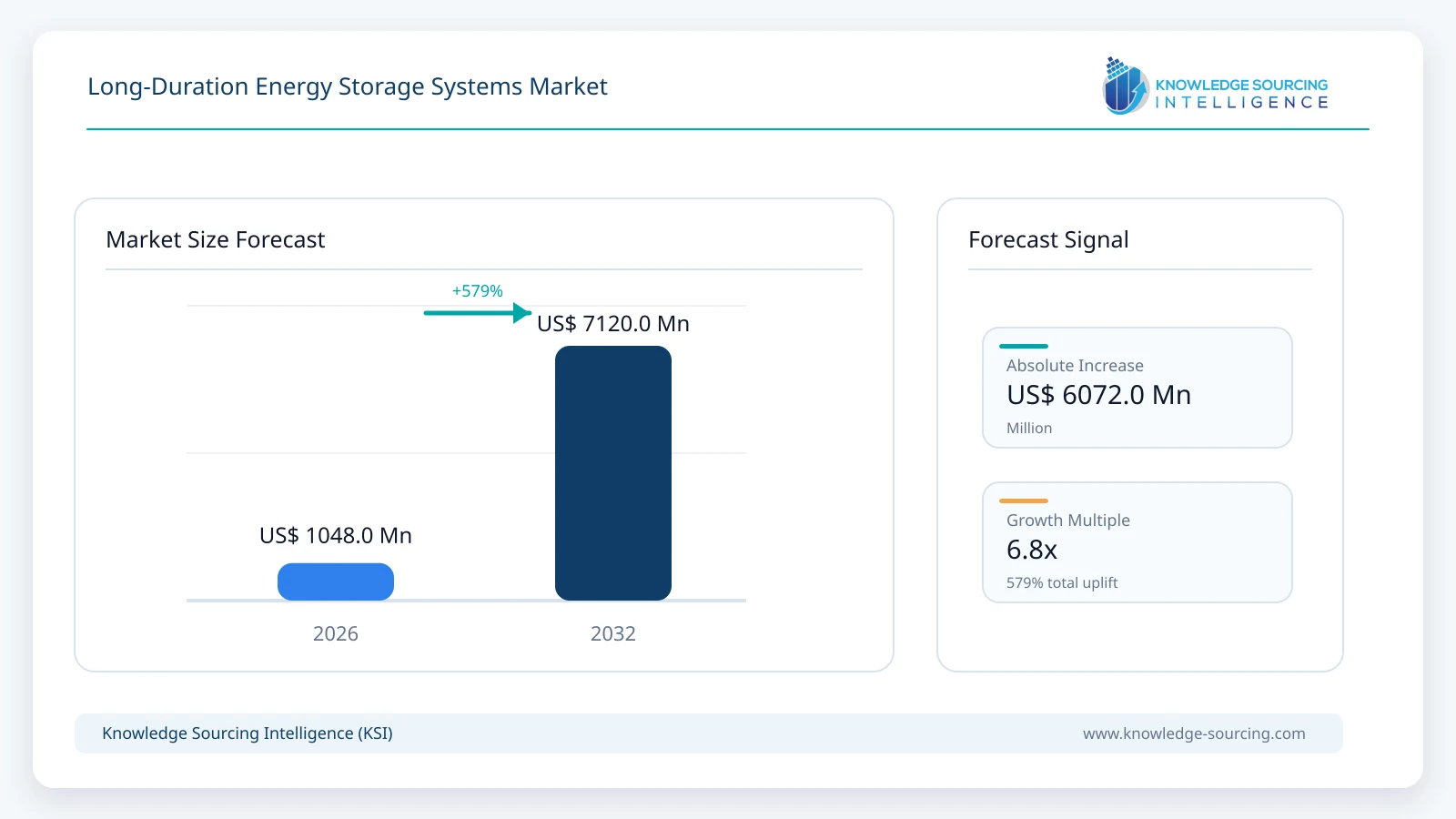
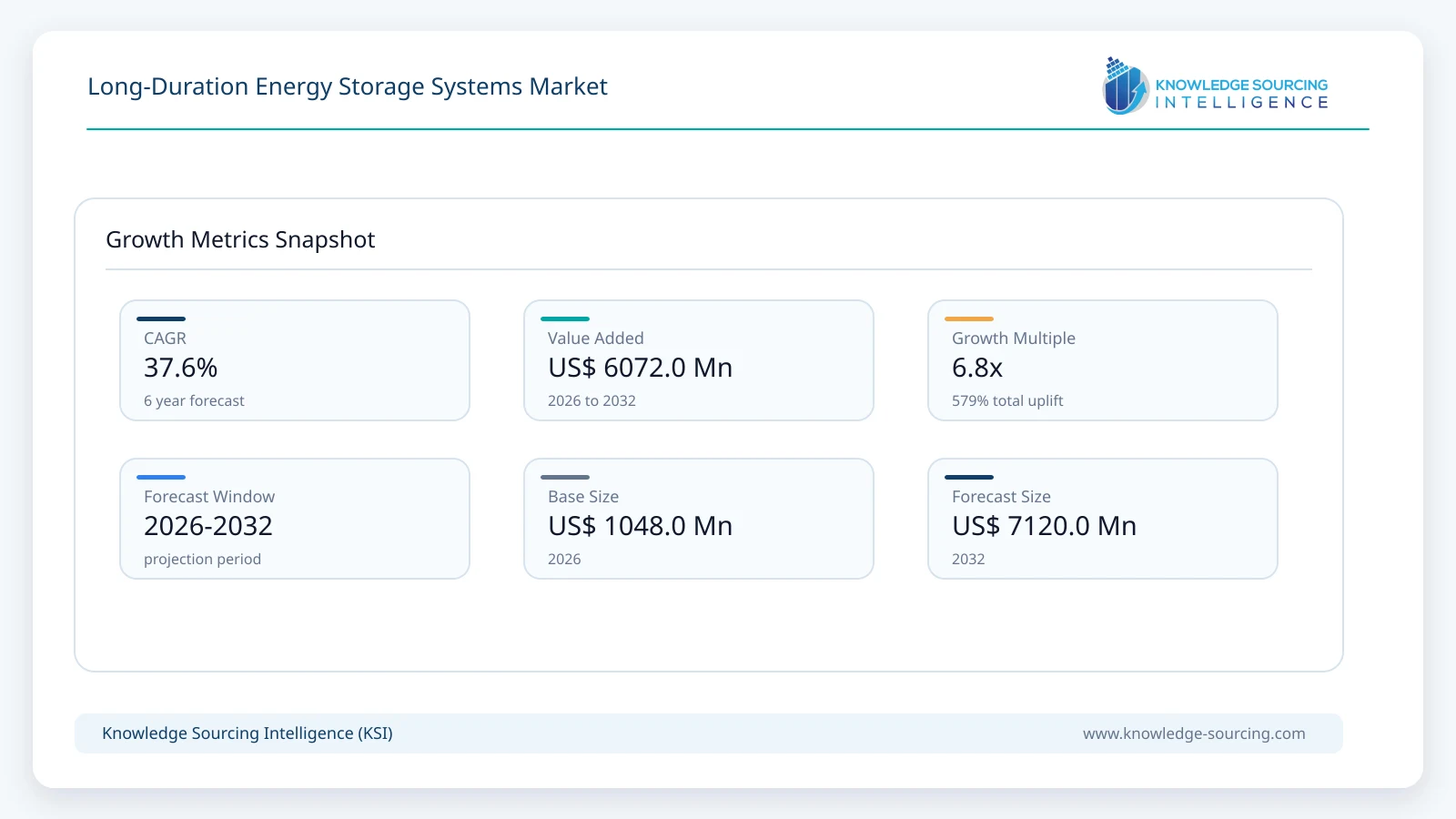
Global revenue for emerging long-duration energy storage systems is estimated at USD 1,048 million in 2026 and is forecast to reach USD 7,120 million by 2032, representing a 37.6% compound annual growth rate.
Highlights:
- 1California has directed load-serving entities to procure 1,000 MW of long-duration storage resources.
- 2Hydrostor is advancing the 500 MW / 4,000 MWh Willow Rock A-CAES project in California with multiple offtake agreements.
- 3Energy Dome signed a 20-year agreement for a 19 MW ten-hour carbon-dioxide battery with Salt River Project in Arizona.
- 4Form Energy is commercializing 100-hour iron-air storage and expanded its project and manufacturing pipeline during 2026.
- 5Eos expanded zinc-based LDES manufacturing capacity and secured multi-gigawatt-hour commercial commitments during 2026.
- 6Invinity was selected in 2026 to design a gigawatt-hour-scale vanadium flow battery project in Switzerland.
Market Overview
Long-duration energy storage serves a different operating role from the four-hour lithium-ion systems that dominate current utility-scale deployment. An eight-hour system can move solar generation further into the evening and overnight period, while ten-hour to multi-day storage can provide capacity through extended weather events, transmission outages or periods of low renewable output. The United States Department of Energy generally defines LDES as storage capable of delivering electricity for ten hours or longer, while California planning and procurement also uses eight-hour systems as long duration resources. These overlapping definitions reflect the fact that the commercial market is developing across several duration bands rather than around a single threshold.
Technology economics vary sharply by use case. Flow batteries and zinc systems separate energy capacity from power components and are suited to frequent cycling over long asset lives. Iron-air batteries sacrifice round-trip efficiency in exchange for very low-cost energy capacity and multi-day duration. Compressed-air and gravity systems use long-lived mechanical infrastructure but require suitable sites and larger civil works. Carbon-dioxide and liquid-air systems use thermodynamic cycles with conventional industrial equipment, while thermal storage is particularly attractive where electricity can be converted into heat and later used directly in industrial processes or converted back to power.
The commercial transition is increasingly visible in project structures. Early LDES projects relied heavily on grants, demonstrations and strategic investors. Newer projects are adding long-term tolling agreements, resource-adequacy contracts, capacity reservations and insurance frameworks. Energy Dome's Arizona project is being developed under a 20-year tolling agreement, Hydrostor has secured multiple offtake arrangements for Willow Rock, and Eos is pairing manufacturing scale with project-finance structures intended to support repeat deployment. These mechanisms lower revenue uncertainty and make it easier for lenders and utilities to compare newer storage technologies with established generation and lithium-ion alternatives.
Market Trends
Eight-to-Twelve-Hour Storage Is Reaching Commercial Utility Procurement
The first large commercial market is emerging around eight-to-twelve-hour projects because this duration can address evening and overnight reliability without requiring the economics of multi-day storage systems. California's Tumbleweed project became the first eight-hour battery completed under the state's Integrated Resource Planning process in 2026. The same market is supporting Willow Rock at eight hours and the Energy Dome project in Arizona at ten hours. This duration class can compete for resource adequacy, capacity replacement and renewable shifting while still cycling often enough to support predictable project economics.
Multi-Day Storage Is Moving From Pilot Scale Toward Large Commercial Pipelines
Iron-air storage is creating a separate multi-day segment. Form Energy's technology is designed for 100-hour discharge, and the company completed additional validation and manufacturing milestones in 2026. Its international pipeline expanded through a 10 MW / 1,000 MWh Irish project targeted for 2029, while a 12 GWh strategic capacity agreement with Crusoe introduced AI data centers as a potential new customer class for multi-day storage. The commercial case differs from daily cycling batteries because multi-day systems are expected to operate less frequently but provide firm capacity during prolonged grid stress.
Manufacturing Scale and Finance Are Becoming Competitive Differentiators
Technology performance remains essential, but project execution is increasingly tied to production capacity and finance. Eos began commercial production at a second manufacturing line in June 2026 and is targeting a larger annual production base for zinc storage. Form Energy raised additional capital in August 2026 to scale iron-air manufacturing, while Hydrostor secured new project financing and execution support for advanced compressed-air developments. These moves indicate that the next stage of competition will depend on the ability to manufacture, warrant and finance repeat projects rather than only prove technical feasibility.
Representative Long-Duration energy storage Projects
Project and Developer | Technology | Capacity / Duration | Region | Status |
Willow Rock / Hydrostor | Advanced compressed air | 500 MW / 4,000 MWh | California, USA | Late-stage development with 2026 offtake agreements and construction activity. |
SRP Coronado / Energy Dome | CO2 battery | 19 MW / ~190 MWh | Arizona, USA | 20-year tolling agreement announced June 2026. |
Project New Horizon / ESS Tech | Iron-flow battery | 5 MW / 50 MWh | Arizona, USA | Utility pilot with SRP and Google collaboration. |
Redwood Valley / Form Energy | Iron-air battery | 1.5 MW / 150 MWh | California, USA | CEC-supported project expected to commission in 2027. |
Cambridge / Form Energy | Iron-air battery | 1.5 MW / 150 MWh | Minnesota, USA | First commercial demonstration; full system expected online in 2026. |
FlexBase Laufenburg / Invinity | Vanadium flow battery | GWh-scale design | Switzerland | Invinity selected in May 2026 to design the project. |
Silver City / Hydrostor | Advanced compressed air | 200 MW / 1,600 MWh | New South Wales, Australia | Received grid connection approval in September 2026. |
Market Drivers
Higher Renewable Penetration Increases the Need for Overnight and Multi-Day Flexibility
Solar-heavy grids increasingly require storage that can continue discharging after four-hour batteries have exhausted their energy. Eight-hour systems can shift daytime solar through the evening peak and into the night, while multi-day technologies can support the system during cloudy periods, wind lulls or prolonged transmission constraints. California's planning framework and demonstration portfolio reflect this progression from short-duration batteries toward a more diversified storage stack.
Capacity and Resource-Adequacy Requirements Support Contracted Revenue
LDES becomes easier to finance when utilities procure dependable capacity rather than relying only on merchant energy-price spreads. California's 1,000 MW long-duration procurement requirement, community-choice offtake agreements for Willow Rock and utility tolling structures for newer technologies provide clearer revenue visibility. This is particularly important for capital-intensive mechanical storage technologies with long asset lives and for newer electrochemical technologies that need lender confidence before scaling manufacturing.
Data-Center and Industrial Loads Are Broadening the Customer Base
Large electricity users are beginning to consider long-duration storage as part of firm power and resilience strategies. Form Energy's 12 GWh capacity agreement with Crusoe is one of the clearest examples of multi-day storage moving beyond utility procurement. Industrial users can also combine storage with renewable generation or process-heat requirements, creating opportunities for thermal and electrochemical systems that can reduce exposure to grid constraints and power-price volatility.
Market Restraints
Bankability Remains Uneven Across Technologies
Many LDES technologies have strong technical characteristics but limited operating history at commercial scale. Utilities and lenders therefore scrutinize warranties, degradation, maintenance requirements, round-trip efficiency, equipment replacement and supplier balance sheets. Long development cycles can also expose projects to changing capital costs and market rules. Performance insurance, strategic investors and long-term offtake agreements are increasingly used to reduce these risks.
Low Utilization Can Make Capital Recovery Difficult
Multi-day storage may provide the greatest system value during infrequent periods of prolonged grid stress, but low annual utilization can make revenue recovery difficult without capacity payments or reliability contracts. Technologies with lower efficiency can still be economic when they use very low-cost energy storage media and cycle infrequently, but merchant energy arbitrage alone may not support the full capital cost. Market design therefore remains an important determinant of deployment.
Segment Analysis
By Technology - Electrochemical Long-Duration Storage
Electrochemical systems represent the largest near-term commercial segment because they can be deployed modularly at substations, renewable plants, industrial sites and data centers without the geological requirements of compressed-air or pumped-hydro projects. Vanadium flow, iron flow, zinc and iron-air technologies each address different duration and cycling profiles. Flow batteries are well suited to repeated long-duration cycling with low degradation, zinc systems are being commercialized around four-to-twelve-hour use cases, and iron-air targets multi-day storage where very low energy-capacity cost is more important than high round-trip efficiency.
By Duration - Eight-to-Twelve-Hour Systems
Eight-to-twelve-hour systems form the most commercially mature LDES duration band because they align with daily renewable shifting and capacity needs. California's operating Tumbleweed lithium-ion project demonstrates demand for eight-hour storage, while Willow Rock, the ESS iron-flow pilot and Energy Dome's planned Arizona project illustrate the emerging non-lithium technology pipeline. Multi-day systems above 24 hours remain smaller in commissioned capacity but are gaining strategic importance for extreme-weather resilience, firm clean power and high-renewable grids.
By Application - Renewable Energy Shifting and Capacity
Renewable energy shifting and capacity replacement represent the principal utility applications. LDES stores surplus solar or wind output and delivers it during periods when renewable generation falls but system demand remains high. Transmission deferral, congestion management, resilience and microgrid backup provide additional value. Industrial and data-center applications are increasing, but utility-scale capacity procurement remains the strongest driver of large project finance during the forecast period.
By Project Model - Utility-Owned and Contracted Independent Power Producer Projects
Large projects are increasingly developed through independent power producers under long-term tolling, capacity or service agreements rather than direct utility ownership alone. This structure allows specialized developers to finance, build and operate emerging technologies while utilities secure dispatch rights or capacity. Energy Dome's SRP agreement and Hydrostor's California offtake contracts illustrate this model. Utility-owned pilots remain important for new technologies, particularly where the objective is operational learning before wider procurement.
Technology Positioning for Grid-Scale LDES
Technology | Typical Duration Positioning | Commercial Strength | Principal Constraint |
Vanadium / iron flow batteries | 8-20+ hours | High cycle life, modular energy expansion, low degradation | Electrolyte and system cost; lower energy density than lithium-ion. |
Zinc-based batteries | 4-12+ hours | Non-flammable chemistries and domestic material options | Manufacturing scale and long-term field bankability still developing. |
Iron-air batteries | ~100 hours | Very low-cost storage media and multi-day capability | Lower round-trip efficiency and early commercial deployment stage. |
Advanced compressed air | 8-20+ hours | Long asset life, large project scale and conventional turbomachinery | Requires suitable subsurface geology and large project development. |
CO2 / liquid-air thermodynamic storage | 6-20+ hours | Uses industrial equipment and can scale energy independently | Complex balance-of-plant and lower maturity than lithium-ion. |
Gravity storage | 4-24+ hours | Long life, limited storage-medium degradation | Site, civil works and project footprint can constrain deployment. |
Thermal storage | 8 hours to multi-day | Low-cost heat-storage media; strong fit with industrial heat | Electricity-to-electricity efficiency and application specificity. |
By Geography - North America
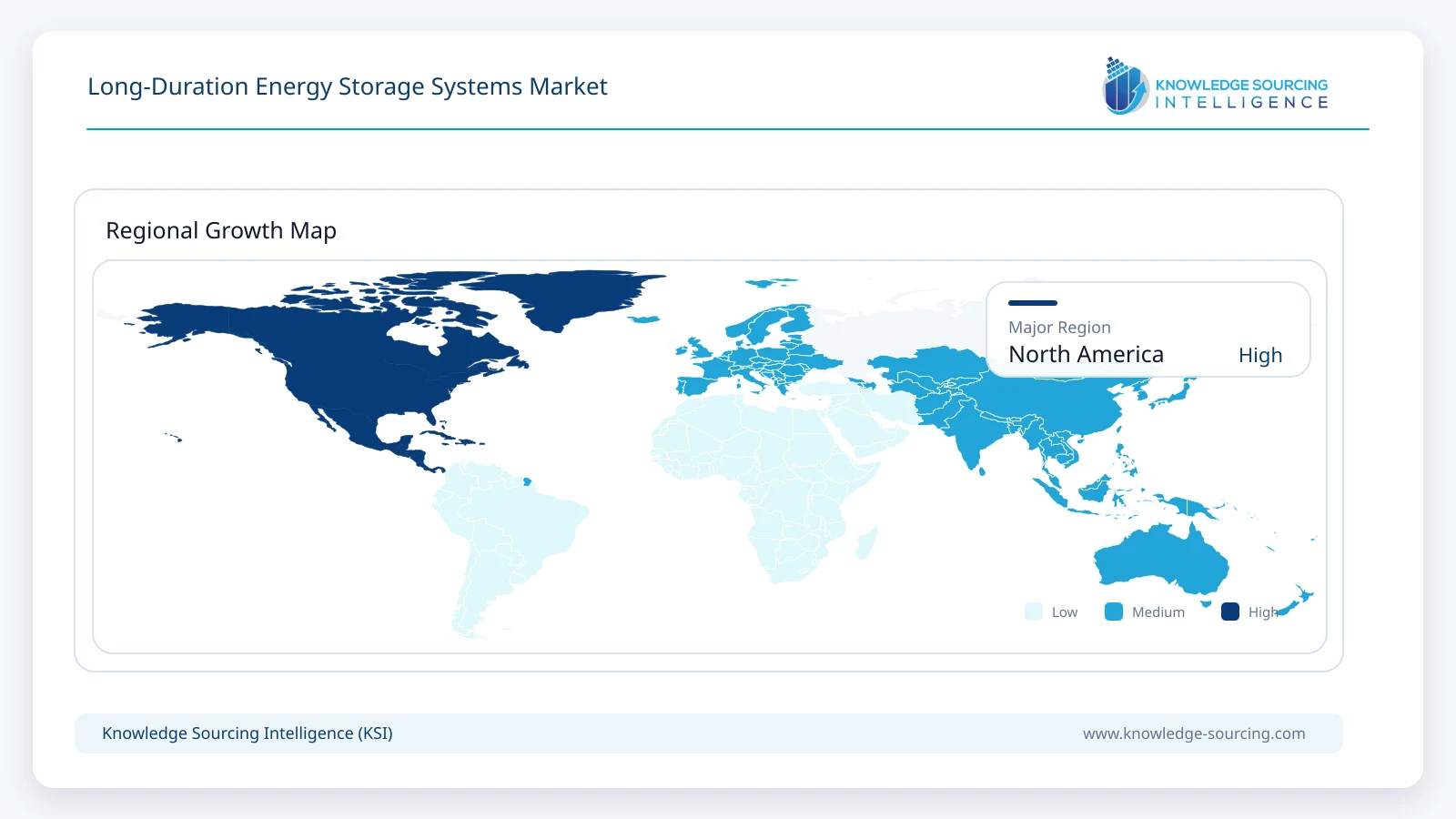
North America is the leading commercial region for emerging long-duration storage because policy support, utility procurement and private capital are moving several technologies into contracted projects. California is the center of this activity. The California Public Utilities Commission directed load-serving entities to procure 1,000 MW of long-duration storage, and the state completed its first eight-hour Integrated Resource Planning project in 2026. Separately, the California Energy Commission has allocated more than USD 247 million to non-lithium LDES projects covering vanadium flow, zinc, iron-air and hybrid systems. The resulting project portfolio creates a pathway from small demonstrations to larger resource-adequacy projects.
California is also supporting mechanical storage at much larger scale. Hydrostor's Willow Rock project is designed at 500 MW / 4,000 MWh and secured additional community-choice offtake during 2026. Arizona is developing a different technology mix through Salt River Project, which selected both ESS Tech's 5 MW / 50 MWh iron-flow system and Energy Dome's 19 MW ten-hour CO2 battery under programs that include collaboration with Google. The United States manufacturing base is expanding at the same time: Eos started commercial production at a second zinc-battery facility in 2026, while Form Energy raised USD 750 million to expand iron-air manufacturing and commercial deployment.
Competitive Environment
Competition remains fragmented because LDES is not a single technology market. Form Energy leads the emerging multi-day iron-air segment and is scaling manufacturing around 100-hour systems. Hydrostor is the most advanced developer in Advanced Compressed Air Energy Storage and is progressing large projects in California, Australia and Canada. Energy Dome is commercializing a thermodynamic carbon-dioxide battery under long-term tolling structures, while Highview Power is developing liquid-air storage. In electrochemical storage, Eos Energy Enterprises, ESS Tech and Invinity Energy Systems are building positions around zinc, iron-flow and vanadium-flow technologies respectively.
The competitive advantage is increasingly moving toward project execution, manufacturing scale and finance. Eos has paired manufacturing expansion with project-development and performance-insurance structures. Hydrostor has secured strategic project-execution partnerships and long-term offtake. Form Energy combines technology development with a large U.S. manufacturing base and multi-gigawatt-hour customer commitments. Energy Vault is pursuing gravity storage and announced a strategic agreement with Eskom in 2026 for deployment across Southern Africa. Smaller technology companies remain important, but they increasingly need partnerships with utilities, engineering firms, infrastructure investors and major energy users to reach commercial scale.
Recent Developments
September 2026: Hydrostor received grid connection approval for the 200 MW / 1,600 MWh Silver City A-CAES project in New South Wales.
September 2026: Eos announced a 10 MW / 100 MWh zinc-based storage project with MN8 Energy and Google in West Virginia alongside solar and lithium-ion storage.
August 2026: Form Energy secured USD 750 million in Series G financing to scale iron-air battery manufacturing and commercial deployments.
August 2026: Hydrostor secured USD 230 million to advance its Advanced Compressed Air Energy Storage project portfolio.
August 2026: Hydrostor signed an additional 60 MW offtake agreement for Willow Rock with Clean Energy Alliance in California.
June 2026: Energy Dome and Salt River Project announced a 19 MW ten-hour CO2 battery in Arizona under a 20-year tolling agreement.
June 2026: Eos launched commercial production at its second manufacturing facility and advanced plans toward 4 GWh of annualized production capacity.
June 2026: California celebrated completion of Tumbleweed, its first eight-hour battery project developed under the CPUC Integrated Resource Planning process.
May 2026: Invinity was selected to design a gigawatt-hour-scale vanadium flow battery system at the Technology Centre Laufenburg in Switzerland.
March 2026: Form Energy and FuturEnergy Ireland announced a 10 MW / 1,000 MWh iron-air project expected online in 2029.
March 2026: ESS Tech joined Salt River Project and Google to advance a 5 MW / 50 MWh iron-flow battery project in Arizona.
long-duration energy storage Systems Market Scope:
| Report Metric | Details |
|---|---|
| Total Market Size in 2026 | USD 1,048 million |
| Total Market Size in 2032 | USD 7,120 million |
| Forecast Unit | USD Million |
| Growth Rate | 37.6% |
| Study Period | 2021 to 2032 |
| Historical Data | 2021 to 2024 |
| Base Year | 2025 |
| Forecast Period | 2026 – 2032 |
| Segmentation | Technology, Duration, Application, Project Model, Geography |
| Companies |
|
Market Segmentation
By Technology
Electrochemical Storage
Vanadium and Other Flow Batteries
Zinc-Based Batteries
Iron-Air and Other Multi-Day Batteries
Mechanical Storage
Advanced Compressed Air
Gravity Storage
Thermodynamic and Thermal Storage
CO2 and Liquid-Air Storage
Thermal Storage
Other Emerging Technologies
By Duration
8–12 Hours
Above 12–24 Hours
Above 24–100 Hours
Above 100 Hours / Seasonal
By Application
Renewable Energy Shifting
Resource Adequacy and Capacity
Transmission and Congestion Support
Resilience and Backup Power
Data Center and Industrial Firming
Microgrid and Remote Power
By Project Model
Utility-Owned Projects
Independent Power Producer / Tolling Projects
Renewable + Storage Projects
Industrial and Large-Load Projects
Demonstration and Government-Supported Projects
By Geography
North America
Europe
Asia Pacific
China
Middle East and Rest of World
Table of Contents
1. EXECUTIVE SUMMARY
2. MARKET SNAPSHOT
2.1. Market Overview
2.2. Market Segmentation
2.3. Market Revenue, MW and MWh Forecast, 2026-2032
2.4. Installed and Contracted LDES Project Pipeline
3. BUSINESS LANDSCAPE
3.1. Market Drivers
3.1.1. Higher Renewable Penetration Increases the Need for Overnight and Multi-Day Flexibility
3.1.2. Capacity and Resource-Adequacy Requirements Support Contracted Revenue
3.1.3. Data-Center and Industrial Loads Broaden the Customer Base
3.2. Market Restraints
3.2.1. Bankability Remains Uneven Across Technologies
3.2.2. Low Utilization Can Make Capital Recovery Difficult
3.3. Market Opportunities
3.4. Industry Value Chain Analysis
3.5. Project Economics and Levelized Cost of Storage
3.6. Long-Term Offtake, Tolling and Capacity Contracts
4. TECHNOLOGICAL OUTLOOK
4.1. Flow Battery Systems
4.2. Zinc-Based Long-Duration Batteries
4.3. Iron-Air and Multi-Day Batteries
4.4. Advanced Compressed Air Energy Storage
4.5. Carbon-Dioxide and Liquid-Air Storage
4.6. Gravity Energy Storage
4.7. Thermal Energy Storage
4.8. Control Systems, Power Conversion and Grid Services
5. LONG-DURATION ENERGY STORAGE MARKET BY TECHNOLOGY
5.1. Introduction
5.2. Electrochemical Storage
5.2.1. Vanadium and Other Flow Batteries
5.2.2. Zinc-Based Batteries
5.2.3. Iron-Air and Other Multi-Day Batteries
5.3. Mechanical Storage
5.3.1. Advanced Compressed Air
5.3.2. Gravity Storage
5.4. Thermodynamic and Thermal Storage
5.4.1. CO2 and Liquid-Air Storage
5.4.2. Thermal Storage
5.5. Other Emerging Technologies
6. LONG-DURATION ENERGY STORAGE MARKET BY DURATION
6.1. Introduction
6.2. 8-12 Hours
6.3. Above 12-24 Hours
6.4. Above 24-100 Hours
6.5. Above 100 Hours / Seasonal
7. LONG-DURATION ENERGY STORAGE MARKET BY APPLICATION
7.1. Introduction
7.2. Renewable Energy Shifting
7.3. Resource Adequacy and Capacity
7.4. Transmission and Congestion Support
7.5. Resilience and Backup Power
7.6. Data Center and Industrial Firming
7.7. Microgrid and Remote Power
8. LONG-DURATION ENERGY STORAGE MARKET BY PROJECT MODEL
8.1. Utility-Owned Projects
8.2. Independent Power Producer / Tolling Projects
8.3. Renewable + Storage Projects
8.4. Industrial and Large-Load Projects
8.5. Demonstration and Government-Supported Projects
9. LONG-DURATION ENERGY STORAGE MARKET BY GEOGRAPHY
9.1. North America
9.2. Europe
9.3. Asia Pacific
9.4. China
9.5. Middle East and Rest of World
10. COMPETITIVE ENVIRONMENT AND ANALYSIS
10.1. Major Players and Strategy Analysis
10.2. Technology Positioning by Duration and Use Case
10.3. Manufacturing Capacity and Supply Chain
10.4. Project Finance, Insurance and Bankability
10.5. Competitive Dashboard
11. COMPANY PROFILES
11.1. Form Energy
11.2. Hydrostor
11.3. Energy Dome
11.4. Eos Energy Enterprises
11.5. ESS Tech
11.6. Invinity Energy Systems
11.7. Highview Power
11.8. Energy Vault
11.9. Rondo Energy
11.10. Antora Energy
11.11. Malta Inc.
11.12. Quidnet Energy
11.13. RheEnergise
11.14. Sumitomo Electric Industries
11.15. VRB Energy
11.16. Redox One
11.17. Corre Energy
11.18. Storworks Power
12. APPENDIX
Navigate
Trusted by the world's leading organizations