
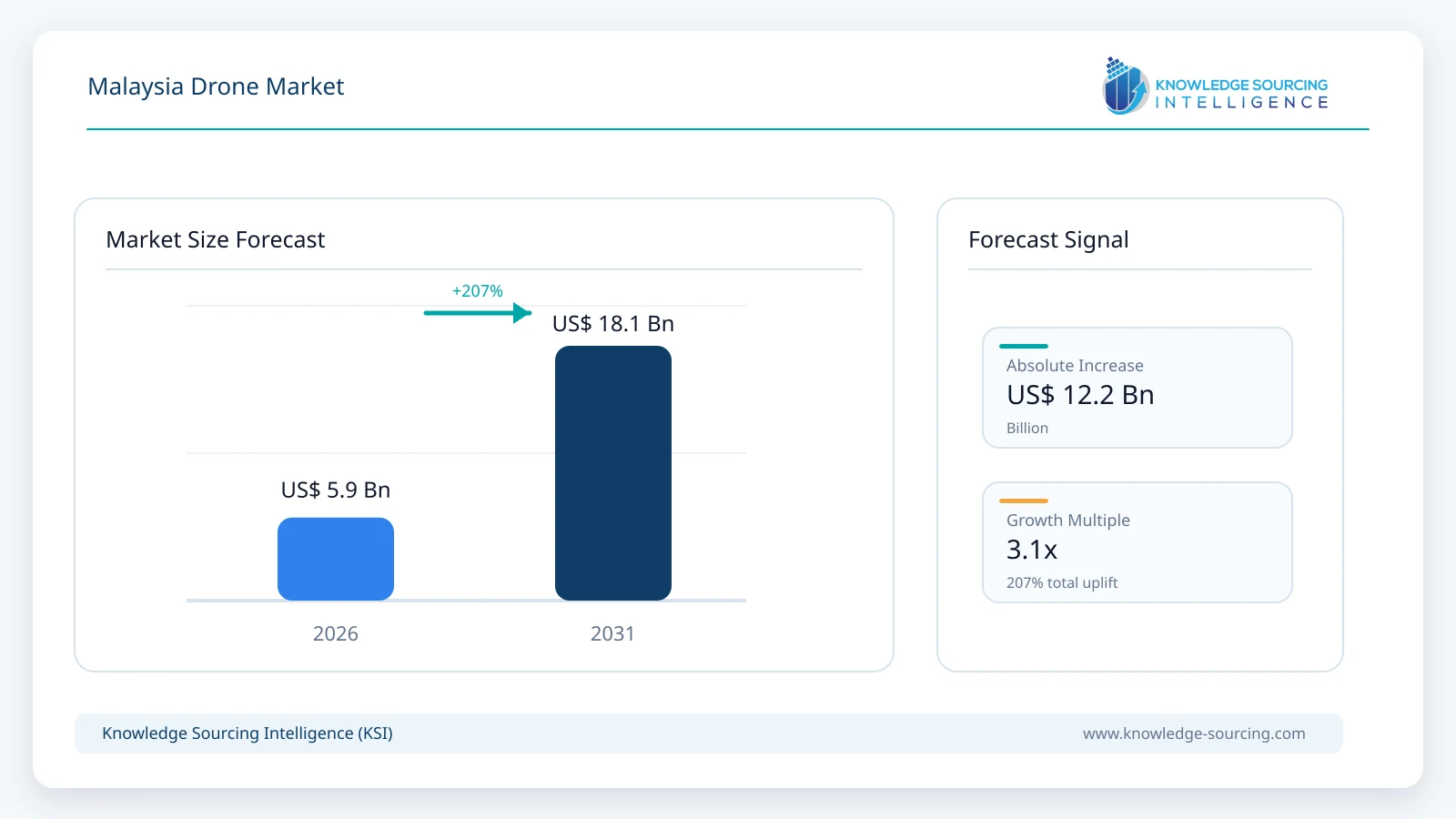
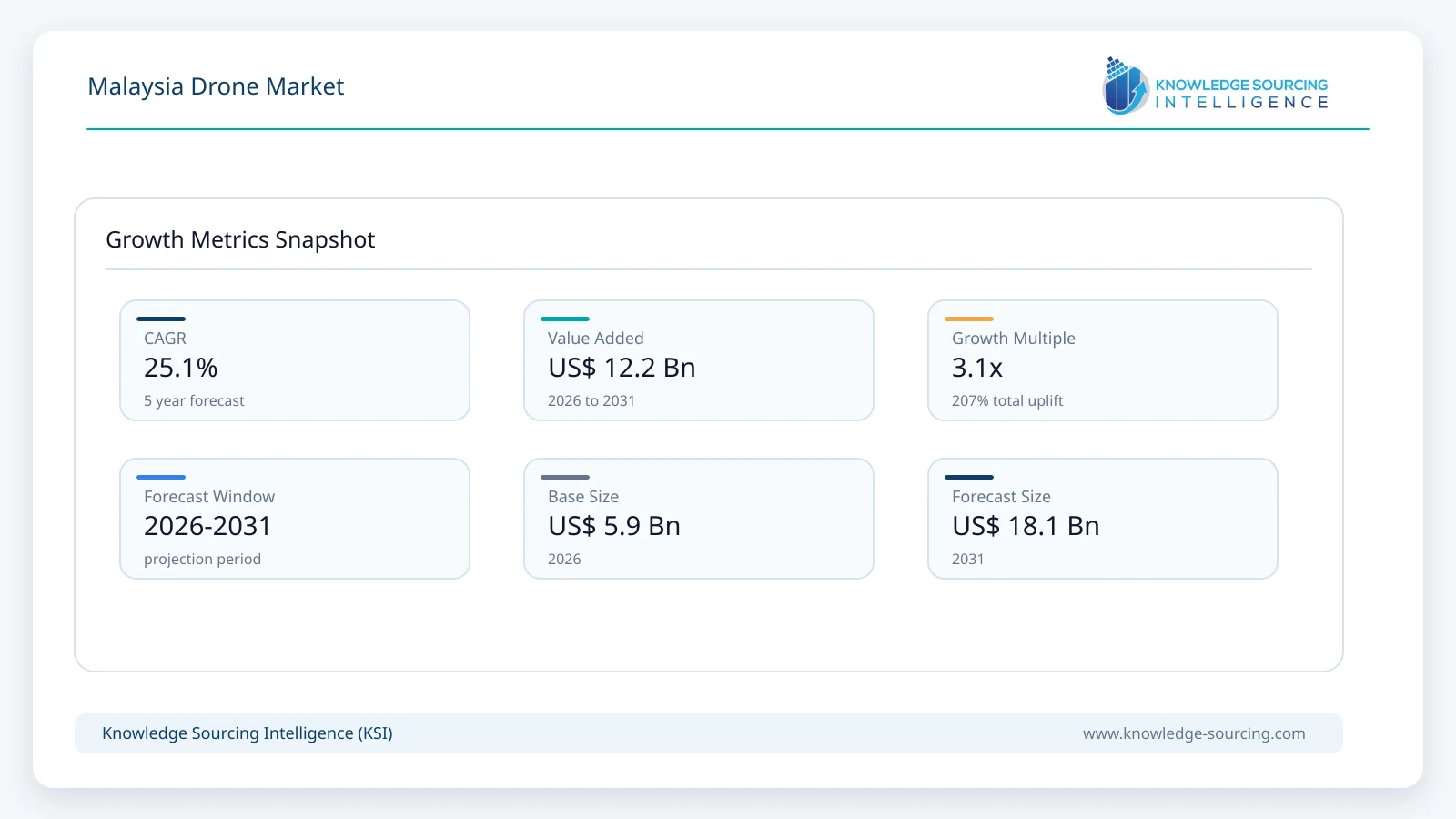
The Malaysia Drone market is forecast to grow at a CAGR of 25.1%, reaching USD 18.1 billion in 2031 from USD 5.9 billion in 2026.
Highlights:
- 1Largest End-User (Agriculture)The agriculture sector remains the primary consumer of drone technology due to the massive scale of plantation management in Malaysia. The transition toward autonomous spraying and multispectral imaging is a direct response to the need for optimized resource allocation and labor efficiency.
- 2Regulatory Impact (CAAM Directives)Strict adherence to Civil Aviation Directives (CAD) 6011 has institutionalized safety standards, which has the dual effect of increasing operational costs for small players while legitimizing the industry for large-scale enterprise adoption.
- 3Regional Leader (Selangor/Cyberjaya)Selangor, specifically the Cyberjaya tech hub, serves as the regional nucleus for drone innovation. The presence of specialized testbeds allows for rapid prototyping and accelerated commercialization of indigenous drone solutions.
- 4Technology Transition (AI and BVLOS)There is a definitive shift from manual pilot-operated flights to AI-driven autonomous systems. This transition is essential for expanding demand in the energy and telecommunications sectors, where long-range pipeline and tower inspections require BVLOS capabilities.
- 5Pricing Sensitivity (Component Sourcing)While enterprise demand is high, the market exhibits sensitivity to the pricing of imported flight controllers and specialized sensors. This has led to a strategic push for domestic assembly and the development of local intellectual property to hedge against global supply chain volatility.
Johor is expected to be the fastest-growing drone market in Malaysia, supported by large-scale industrial developments, logistics activities, smart city initiatives, and increasing adoption of drones in agriculture and infrastructure projects.
Malaysia's dedication to digital transformation and the embrace of smart technology have opened opportunities to develop drone innovations.
At the same time, funds directed to artificial intelligence, automation, and geospatial analytics are increasing the potential of different commercial uses of drones.
Also, the rising consumer need for aerial data services, especially in sectors where real-time monitoring and predictive maintenance are critical, is a major contributor to the market growth.
Drones are getting more attention on the defense and security side as they support border surveillance, maritime patrol, and rapid responses to disasters and emergencies.
STM has inked two memorandums of understanding (MoU) in Malaysia, one for naval projects and the other for tactical mini-UAV systems.
STM has also only recently signed a Memorandum of Understanding (MoU) with G7 Aerospace, the leading Malaysian defence aviation company, to explore the possibility of jointly producing Tactical Mini UAV Systems in Malaysia.
Malaysia gears its drone industry towards growth by introducing the Malaysia Drone Technology Action Plan (MDTAP) 2022-2030, a Plan that would focus on innovation, commercialization, and talent development.
The National 4IR Policy broadly advocates the use of drones in various industries, and the Civil Aviation Authority of Malaysia (CAAM) oversees issuing regulations for safe drone operations.
Other than that, there are organizations such as MDEC and MRANTI that provide support to drone startups, testing, and technology development.
Government support, the spread of industrial users, and the rise of drone service providers and technology developers have all contributed to Malaysia's market growth.
The software segment is expected to witness the fastest growth due to increasing demand for drone analytics, flight management systems, artificial intelligence integration, and cloud-based data processing solutions.
Hybrid drones are projected to be the fastest-growing product type as they combine the long-range capabilities of fixed-wing drones with the vertical takeoff and landing advantages of rotary-blade drones.
In 2025, above 20 kg was the largest segment by weight, followed by up to 20 kg.
The above 20 kg category is anticipated to grow rapidly owing to the rising adoption of heavy-payload drones for industrial inspections, defense operations, logistics, and large-scale agricultural applications.
The commercial drone segment is expected to register the highest growth, driven by expanding use cases across agriculture, construction, energy, government, security, surveillance, and infrastructure management sectors.
Market Dynamics
Drivers
Expansion of Infrastructure and Construction Activities
The drone market is mainly growing because of the fast development of infrastructure and construction projects nationwide in Malaysia. Increasingly, the government is allocating funds towards transportation networks, smart city developments, residential projects, industrial facilities, and public infrastructure, which, in turn, creates demand for efficient surveying, mapping, and inspection solutions using drones.
The Construction sector in Malaysia registered a strong growth of 12.5 per cent in 2025, achieving RM178.6 billion in the value of work done.
The sector continued to gain growth in the last quarter of 2025 with a 10.3 per cent rise.
The main contributors to the growth were the Special trade activities and non-residential buildings sub-sectors, which shot up by 21.1 per cent and 18.6 per cent, respectively.
During the last quarter of 2025, the total value of work done was measured at RM46.4 billion.
Out of this, RM16.2 billion or 34.9% came from the Civil engineering sub-sector, mainly to Construction of utility projects (RM8.8 billion) and roads and railways (RM5.8 billion).
On the other hand, the work done for the non-residential buildings and Residential buildings sub-sectors amounted to RM14.0 billion (30.1%) and RM10.5 billion (22.6%), respectively.
Through the use of drones, construction companies can take high-quality aerial pictures, create precise topographical maps, keep track of the ongoing work in real time, and do site inspections faster and more accurately than through traditional methods.
Precision Agriculture Integration: The structural demand for high-yield plantation management drives the adoption of drones for precise pesticide dispensation and crop health monitoring. This reduces chemical waste and addresses the critical shortage of manual labor in the agricultural commodity sector.
National Digitalization Policy: The Malaysian government’s commitment to the Digital Economy Blueprint provides the necessary funding and institutional support for drone startups. This policy environment encourages the adoption of 4IR technologies, directly fueling market growth through grants and tax incentives.
Advanced Air Mobility (AAM) Roadmap: The official development of the AAM Concept of Operations (ConOps) by CAAM and Futurise creates a forward-looking demand for heavy-lift drones and eVTOL (electric Vertical Take-off and Landing) aircraft, targeting the future of logistics and urban transport.
Restraints and Opportunities
Spectrum and Connectivity Constraints: The reliance on stable radio frequency and cellular connectivity for drone operations poses a risk in remote plantation areas. However, this creates a significant opportunity for 5G providers to develop dedicated low-altitude network solutions.
Regulatory Compliance Costs: High certification standards and the requirement for certified remote pilot training can be a barrier to entry for smaller enterprises. Conversely, this elevates the market's professional standards and opens opportunities for specialized training organizations.
Environmental Sensitivity and Sustainability: Concerns regarding the battery life and disposal of LiPo batteries present environmental challenges. This is driving innovation in hybrid-electric propulsion systems, such as petrol-electric generators, to extend flight endurance for heavy-duty applications.
Data Security and Sovereignty: As drones collect sensitive industrial and geographic data, there is an increasing demand for localized cloud storage and secure data transmission protocols. This offers an opportunity for Malaysian cybersecurity firms to integrate bespoke security layers into drone software.
Raw Material and Pricing Analysis
The hardware segment of the Malaysian drone market is fundamentally dependent on the supply of high-grade carbon fiber, specialized aluminum alloys, and electronic components, including lithium-polymer batteries and semiconductors. Pricing dynamics are currently influenced by the global volatility of raw material costs, particularly the rare earth elements required for high-torque brushless motors and precision sensors. In Malaysia, the supply chain is characterized by a high dependency on imported flight controllers and optical payloads, which subjects local assemblers to exchange rate fluctuations.
The pricing of finished drone systems varies significantly based on the level of autonomous integration and sensor sophistication. Enterprise-grade drones for the energy and agriculture sectors command premium pricing due to the inclusion of LiDAR or multispectral cameras. However, as domestic manufacturing capabilities increase through initiatives like the National Industrial Master Plan (NIMP 2030), there is an emerging trend of "vertical integration" where local companies are developing proprietary airframes. This strategy is intended to manage margins more effectively and reduce exposure to regional pricing variations of imported hardware.
Supply Chain Analysis
The supply chain for the Malaysian drone market is a multi-tier ecosystem involving raw material suppliers, component manufacturers, system integrators, and service providers. Production is currently concentrated in tech-centric zones like Cyberjaya and the Northern Corridor, where proximity to electronics manufacturing hubs facilitates easier access to circuitry and assembly expertise. Energy intensity is a critical factor in the manufacturing of composite materials like carbon fiber, which is primarily sourced from international suppliers, creating a regional risk exposure to trade disruptions.
Transportation constraints for high-capacity lithium batteries, classified as hazardous materials, influence the logistics and storage costs for drone distributors. To mitigate these risks, leading Malaysian drone firms are adopting integrated manufacturing strategies, where design and final assembly are conducted in-house. This model allows for better quality control and the ability to customize airframes for specific industrial applications. The supply chain is also becoming increasingly service-oriented, with a focus on data processing and cloud-based analytics, shifting the value proposition from the physical unit to the actionable intelligence provided by the system.
Government Regulations
Jurisdiction | Key Regulation / Agency | Market Impact Analysis |
Malaysia | Civil Aviation Authority of Malaysia (CAAM) - CAD 6011 | Establishes the legal framework for UAS operations, including Remote Pilot Certificate of Competency (RCoC) requirements, directly influencing professional service demand. |
Malaysia | MRANTI / MDTAP30 | Provides the strategic roadmap for the "DroneTech" ecosystem, facilitating testbeds and sandboxes that reduce the time-to-market for new drone technologies. |
International | ICAO (International Civil Aviation Organization) | Ensures Malaysia's drone regulations align with global safety and interoperability standards, facilitating the export of Malaysian drone services. |
Malaysia | JUPEM (Dept. of Survey and Mapping) | Regulates aerial photography and data collection for national security, impacting the workflow for mapping and surveillance companies. |
Key Developments
September 2025: CAAM & Futurise to Launch Advanced Air Mobility Concept of Operations. CAAM announced a joint initiative with Futurise to establish a Concept of Operations (ConOps) for Advanced Air Mobility (AAM) by Q1 2026, signalling regulatory evolution including drone services, low-altitude vehicles, and urban air mobility in Malaysia.
March 2025: Civil Aviation Authority of Malaysia (CAAM) Announces New UAS Regulation & Traffic Management System. CAAM stated it will publish a new Civil Aviation Regulation on unmanned aircraft operations and roll out a UAS-Traffic Management System (UAS-TMS) by Q4 2025 to regulate both recreational and commercial drone use across Malaysia.
Market Segmentation
By Application: Agriculture
Application-wise, the Malaysian drone market is segmented into commercial drones and consumer drones, with the former being further segmented into major industrial applications, including government, military & defense, construction, and energy.
Market growth for commercial drones is anticipated to show significant growth, fueled by the growing investment in smart mapping and monitoring. Improvements in living standards have further impacted consumer demand, with major players like DJI providing a portfolio with a diverse range. The agriculture segment is projected to grow at a steady rate owing to the ongoing investment in capital-intensive farming, which is driving the adoption of technological concepts like drones.
Efforts to bolster the adoption of unmanned aerial systems for field mapping and crop monitoring applications in Malaysia, with major domestic players, namely Alpha Swift Industries, offering an extensive range, including “A-22 Falco”, “Z Series”, “G Series, and “E Series”, have amplified the market expansion.
Regulatory programs and standards set under the “Unmanned Aerial Work Certificate” for agriculture UAS operations, including pest control and soil treatment, have further improved drone engagement in agriculture applications.
Ongoing transition towards scalable agriculture has improved the UAS landscape, with research studies like “Farming the Future: Harvesting Malaysia’s Agriculture Resilience through Digital Technologies” defining the adoption scope of DATs (Digital Agriculture Technologies).
Implementation of national initiatives like “Malaysia Digital (MD) AdTech” is further set to drive digital transformation in Malaysia, thereby supporting drone applicability.
Investment in innovations like “Mist Drone” by Aonic, followed by strategic efforts undertaken by players like Terra Drone to deploy advanced agriculture drones in Malaysia’s oil palm plantations under the company’s “Terra Agri” initiative, is set to expand the overall market trajectory.
By Product Type: Fixed Wing Drones
By Product Type, the Malaysian drone market is segmented into fixed-wing drones, rotary blade drones, and hybrid drones. The fixed-wing drone’s demand is set to show growth fueled by the growing UAS adoption in major sectors like agriculture and defense for large-scale mapping.
Strategic regulatory initiatives for bolstering drone technology have further outlined the framework to improve commercial and consumer applications. The fixed-wing segment is projected to grow at a steady rate, fueled by the growing high demand for UAS offering long endurance and coverage.
The growing emphasis on infrastructure inspection and surveillance for longer durations has positively impacted fixed-wing drone demand in Malaysia, with policies like “Malaysia Drone Technology Action Plan 2022-2030” further boosting the drone ecosystem.
Technological investment in sectors, followed by a strategy framework established by the standard ATF (Authorization to Fly), has further improved the overall adoption scope for fixed-wing drones, especially in agricultural applications.
Ongoing innovations and investment in drone development in Malaysia’s defence sector are propelling segment expansion; for instance, in April 2026, the “HDS-NSS” fixed-wing tactical drone showcased at DSA 2026 offers low-cost precision strike.
Strategic trade tie-ups with major drone-exporting nations, namely China, Turkey, and the United States, followed by improvements in fixed-wing drone accessories like motors showcased in “DroneTech Asia 2025,” have showcased Malaysia’s potential in exploring advanced technologies for fixed-wing drones.
By Component: Software (AI-Based Analytics)
Software components, specifically those focusing on AI-based analytics and automated flight planning, represent a high-value growth area. The operational advantage of modern drone systems lies in their ability to process vast amounts of aerial data in real-time. Malaysian firms are increasingly investing in proprietary software that integrates machine learning to automatically detect defects in telecommunication towers or cracks in civil engineering structures. This reduces the time between data capture and decision-making, providing a critical efficiency gain for enterprise clients.
Regional Analysis
Johor
Johor is a critical regional market for drone adoption due to its extensive agricultural land and its proximity to the Singaporean tech corridor. The state serves as a primary hub for large-scale palm oil plantations that have pioneered the use of autonomous spraying fleets. Furthermore, the development of the Ibrahim Technopolis (IBTEC) and other industrial parks in the Iskandar Malaysia region provides a fertile ground for the deployment of security and surveillance drones. The regional demand is also influenced by the logistics sector, with drones being explored for ship-to-shore deliveries at the Port of Tanjung Pelepas.
List of Companies
Alphaswift Industries Sdn. Bhd.
Aonic Sdn Bhd
DJI
Autel Robotics
Meraque Services Sdn Bhd
MATA AEROTECH SDN BHD
Eagle Brothers Company
XAG
DJI
DJI is the globally leading drone manufacturer and a Chinese-based company founded in 2006. The company is well-known for its products for consumers, commercial, and enterprise drone solutions, such as Mavic, Mini Air, Inspire, Agras, and Matrice. In addition to its core drone hardware, DJI creates aerial imaging systems, flight-control technologies, mapping software, and intelligent data solutions for uses from filmmaking and agriculture to infrastructure inspection and public safety.
DJI has been a significant presence in the Malaysian drone market through a wide range of options like authorized distributors, official online stores, and enterprise partners. The company serves both consumer and professional users in agriculture, construction, surveying, energy, infrastructure inspection, mapping, and public safety sectors in the country.
Meraque Services Sdn Bhd
Meraque Services has established itself as a dominant force in the Malaysian agricultural drone segment. The company’s strategy is centered on the development of specialized robotic solutions tailored for the challenging terrains of oil palm plantations. Its flagship product, the Autonomous Ground Vehicle (AGV) "RACE," complements its aerial drone fleet to provide a holistic "total plantation automation" solution.
Meraque’s competitive advantage is its deep integration with the Malaysian agricultural infrastructure, having developed a dedicated drone pilot training academy (MERIT) to ensure a steady supply of certified operators. This integration model, which combines hardware manufacturing, specialized software, and talent development, makes Meraque a critical partner for government-linked companies (GLCs) and private plantation owners seeking to future-proof their operations against labor shortages.
Alphaswift Industries Sdn Bhd
Alphaswift Industries specializes in the design and local manufacturing of high-performance UAVs, with a focus on hybrid-engine technology. The company’s strategy revolves around addressing the "endurance gap" in current drone operations. Their flagship A-22 Falco and A-24 Falco systems are engineered for long-range missions, particularly in cargo delivery and border surveillance, where battery-only systems are insufficient.
The company’s technology differentiation lies in its ability to customize modular payloads for varied industrial needs, from liquid spraying to heavy cargo transport. By maintaining a strong focus on local R&D and manufacturing in Cyberjaya, Alphaswift provides a secure, domestic alternative for sensitive government and military applications. Their integration model focuses on providing end-to-end hardware and flight control systems that are optimized for the specific tropical environmental conditions of the Southeast Asian region.
Analyst View
The Malaysian drone market is transitioning into a mature industrial ecosystem, driven by robust regulatory frameworks and high demand in the agriculture and infrastructure sectors. While component costs remain a challenge, the shift toward AI-integrated autonomous services ensures sustained long-term growth.
Malaysia Drone Market Scope:
| Report Metric | Details |
|---|---|
| Total Market Size in 2026 | USD 5.9 billion |
| Total Market Size in 2031 | USD 18.1 billion |
| Forecast Unit | Billion |
| Growth Rate | 25.1% |
| Study Period | 2021 to 2031 |
| Historical Data | 2021 to 2024 |
| Base Year | 2025 |
| Forecast Period | 2026 – 2031 |
| Segmentation | Component, Product Type, Weight, Application |
| Companies |
|
Market Segmentation
By Component
By Product Type
By Weight
By Application
By State
Table of Contents
1. EXECUTIVE SUMMARY
2. MARKET SNAPSHOT
2.1. Market Overview
2.2. Market Definition
2.3. Scope of the Study
2.4. Market Segmentation
3. BUSINESS LANDSCAPE
3.1. Market Drivers
3.2. Market Restraints
3.3. Market Opportunities
3.4. Porter’s Five Forces Analysis
3.5. Industry Value Chain Analysis
3.6. Policies and Regulations
3.7. Strategic Recommendations
4. TECHNOLOGICAL OUTLOOK
4.1. Artificial Intelligence (AI) and Machine Learning Integration
4.2. Autonomous Flight and Navigation Systems
4.3. Advanced Imaging and Sensor Technologies
4.4. LiDAR and 3D Mapping Solutions
5. MALAYSIA DRONE MARKET BY COMPONENT
5.1. Introduction
5.2. Hardware
5.3. Software
6. MALAYSIA DRONE MARKET BY PRODUCT TYPE
6.1. Introduction
6.2. Fixed Wing Drone
6.3. Rotary Blade Drone
6.4. Hybrid Drone
7. MALAYSIA DRONE MARKET BY WEIGHT
7.1. Introduction
7.2. Up to 20 kg
7.3. Above 20 kg
8. MALAYSIA DRONE MARKET BY APPLICATION
8.1. Introduction
8.2. Commercial Drone
8.2.1. Government
8.2.2. Energy
8.2.3. Military and Defense
8.2.4. Construction
8.2.5. Agriculture
8.2.6. Security and Surveillance
8.2.7. Others
8.3. Consumer Drone
8.3.1. Hobby and Gaming
8.3.2. Aerial Photography
9. MALAYSIA DRONE MARKET BY STATE
9.1. Introduction
9.2. Johor
9.3. Kedah
9.4. Selangor
9.5. Sabah
9.6. Others
10. COMPETITIVE ENVIRONMENT AND ANALYSIS
10.1. Major Players and Strategy Analysis
10.2. Market Share Analysis
10.3. Mergers, Acquisitions, Agreements, and Collaborations
10.4. Competitive Dashboard
11. COMPANY PROFILES
11.1. Alphaswift Industries Sdn. Bhd.
11.2. Aonic Sdn Bhd
11.3. DJI
11.4. Autel Robotics
11.5. Meraque Services Sdn Bhd
11.6. MATA AEROTECH SDN BHD
11.7. Eagle Brothers Company
11.8. XAG
12. RESEARCH METHODOLOGY
13. LIST OF FIGURES
14. LIST OF TABLES
Navigate
Trusted by the world's leading organizations











