
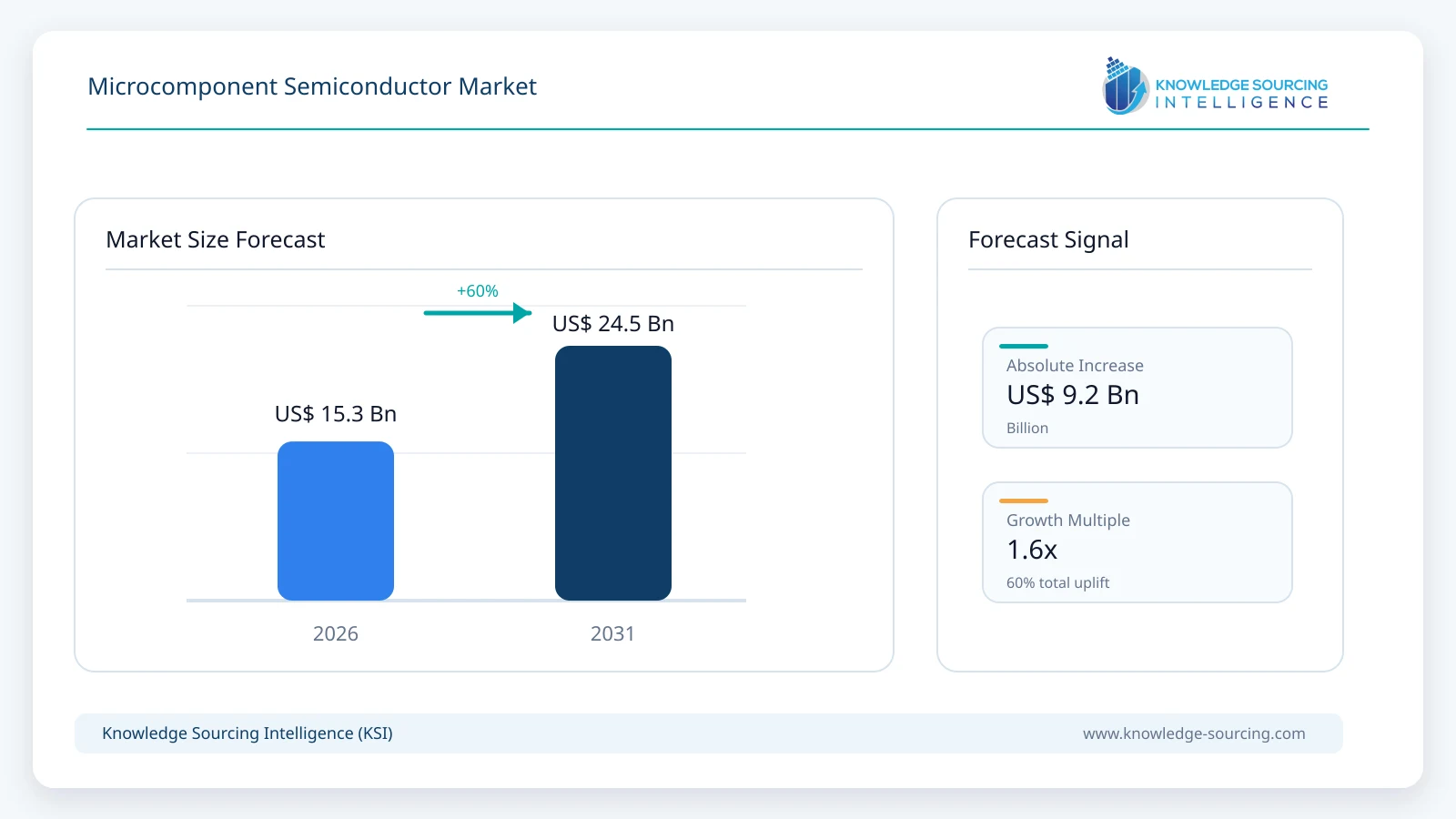
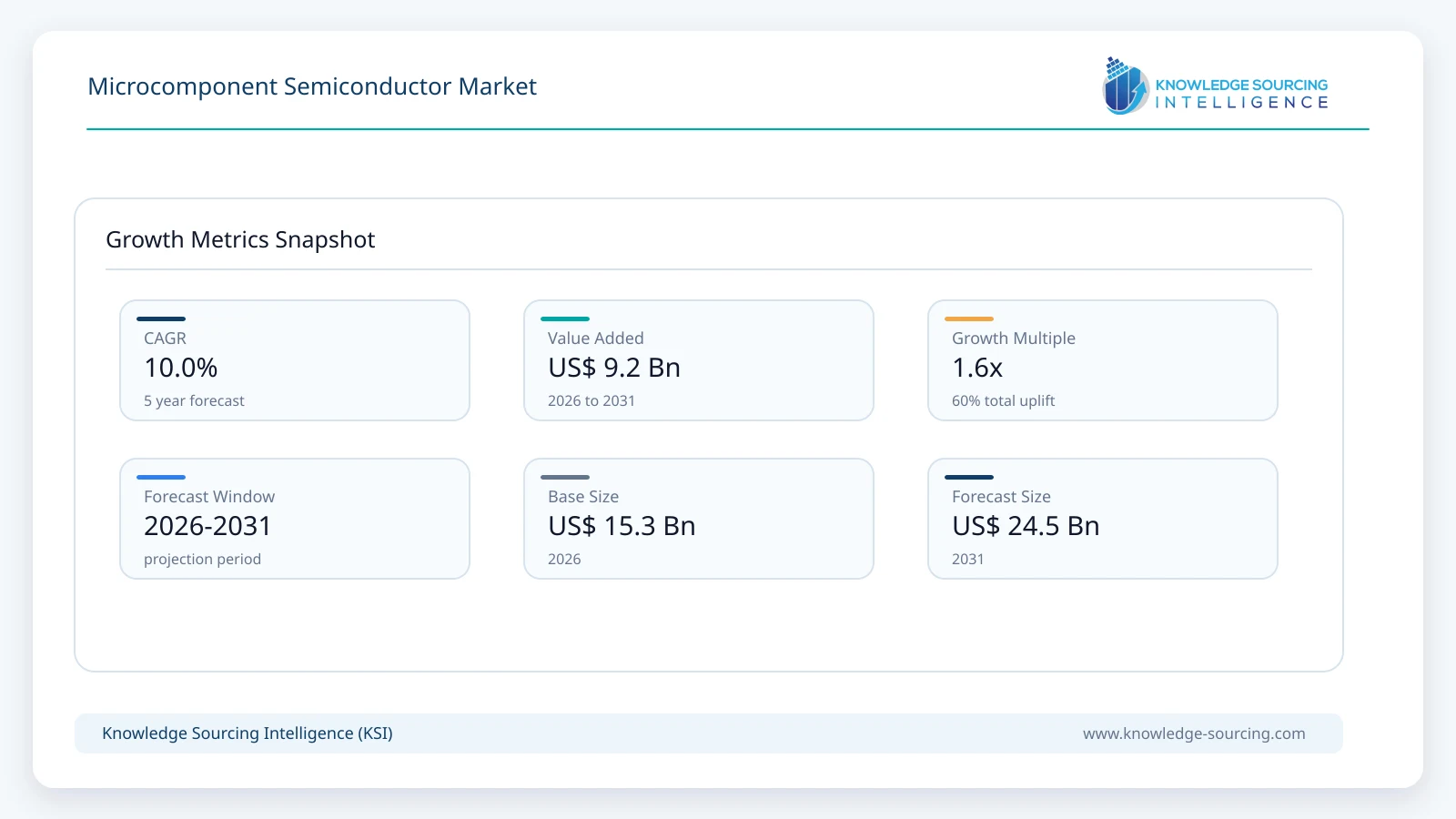
The Microcomponent Semiconductor Market for Automotive Industry is forecast to grow at a CAGR of 10.0%, reaching USD 24.5 billion in 2031 from USD 15.3 billion in 2026.
Highlights:
- 1Vehicle electrification and software-defined architectures are increasing semiconductor content per automobile.
- 2ADAS deployment is shifting procurement toward higher-performance automotive compute platforms.
- 3Supply-chain resilience and localized semiconductor manufacturing remain strategic purchasing priorities.
- 4Functional safety, cybersecurity, and long product qualification cycles continue to influence supplier selection.
- 5Automotive OEMs increasingly favor suppliers offering integrated hardware, software, and long-term lifecycle support.
Market Overview
Demand is no longer driven solely by vehicle production volumes. Instead, semiconductor content per vehicle continues to increase as manufacturers integrate software-defined architectures, electrified powertrains, centralized computing platforms, and connected vehicle services into new models. Buyers increasingly evaluate semiconductor suppliers on functional safety compliance, product longevity, cybersecurity capability, software support, and supply assurance rather than unit price alone.
Vehicle manufacturers are also changing procurement strategies following the semiconductor shortages experienced during recent years. Several automotive OEMs have strengthened direct engagement with semiconductor manufacturers, while chip suppliers continue expanding automotive-qualified production capacity and software ecosystems. According to the International Energy Agency (IEA), global electric car sales exceeded 17 million units in 2024, increasing the need for powertrain controllers, battery management processors, sensing devices, and high-performance computing platforms that require increasingly sophisticated semiconductor content.
Commercial value is distributed across a broad ecosystem that includes integrated device manufacturers, fabless semiconductor developers, foundries, packaging providers, electronic control unit suppliers, and automotive Tier 1 system integrators. Increasing adoption of centralized electronic architectures is gradually reducing the number of distributed control units while increasing processing capability within fewer, more powerful computing platforms. This transition is reshaping product specifications, research priorities, software investment, and supplier competition throughout the automotive semiconductor value chain.
Key Market Indicators
Indicator | Latest Evidence | Commercial Meaning |
Global electric vehicle sales | More than 17 million vehicles (2024) | Higher EV production increases demand for battery management, motor control, and powertrain semiconductors. |
Automotive functional safety standard | ISO 26262 widely adopted | Safety certification remains a critical purchasing requirement for automotive semiconductor suppliers. |
Vehicle cybersecurity regulation | UNECE R155 and R156 implementation | Cybersecurity and software update capability increasingly influence semiconductor architecture decisions. |
Advanced driver assistance adoption | Growing OEM integration across passenger vehicles | Higher sensor counts increase demand for processors, AI accelerators, and signal-processing devices. |
Key indicator: Global electric car sales exceeded 17 million vehicles in 2024 according to the International Energy Agency.
Commercial meaning: Electrification continues increasing semiconductor content per vehicle across multiple electronic domains.
Market Drivers
Expansion of software-defined vehicle architectures. Automotive manufacturers are replacing distributed electronic control architectures with centralized computing platforms that manage multiple vehicle functions through software. This transition increases demand for high-performance microprocessors, system-on-chip (SoC) devices, and automotive AI processors that consolidate computing workloads previously handled by numerous individual controllers. Companies including NXP Semiconductors, Qualcomm Technologies, Renesas Electronics, and Intel continue to expand automotive computing portfolios to support domain and zonal architectures, while OEM purchasing criteria increasingly emphasize software compatibility, over-the-air update capability, long product availability, and functional safety certification.
Accelerating deployment of ADAS technologies. Regulatory safety requirements, consumer demand for driver assistance, and insurance-related safety considerations continue to expand the installation of cameras, radar, ultrasonic sensors, and increasingly lidar systems. Each additional sensing function requires microcontrollers, digital signal processors, AI accelerators, and specialized ASICs capable of processing large volumes of real-time data with low latency. Semiconductor suppliers are responding through automotive-qualified processors supporting higher computational performance, lower power consumption, and compliance with ISO 26262 functional safety requirements, improving their competitiveness in higher-value vehicle platforms.
Growth in electric vehicle production and battery electronics. Electric vehicles require substantially more electronic control capability than conventional internal combustion vehicles because battery systems, inverters, charging functions, thermal management, and electric drive units depend on sophisticated semiconductor control. The International Energy Agency reported continued expansion in global electric vehicle deployment during 2024, while multiple automakers announced investments in dedicated EV manufacturing platforms. Semiconductor suppliers are expanding automotive-qualified product portfolios covering battery management systems, motor control, powertrain processors, and integrated computing platforms designed for high-voltage vehicle architectures.
Government safety, cybersecurity, and emissions requirements. Regulatory requirements increasingly influence semiconductor procurement decisions. UNECE cybersecurity regulations require manufacturers to manage vehicle cyber risks throughout the product lifecycle, while software update regulations require secure update mechanisms for connected vehicles. Emissions regulations and vehicle efficiency targets also encourage wider adoption of electronic control systems that optimize energy consumption and powertrain operation. Semiconductor vendors therefore compete not only through hardware performance but also through secure software platforms, long-term software maintenance, and compliance support that reduce certification complexity for automotive manufacturers.
Market Restraints and Challenges
Long automotive qualification and product validation cycles. Automotive semiconductor suppliers operate under qualification processes that are considerably longer than those serving consumer electronics. Devices must satisfy automotive reliability standards, extended operating temperature requirements, functional safety validation, and multi-year product lifecycle commitments before entering production vehicles. These lengthy approval cycles increase development costs and delay revenue realization, particularly for smaller suppliers attempting to commercialize new processor architectures or specialized AI accelerators.
Manufacturing concentration and supply-chain exposure. The automotive industry continues addressing lessons from recent semiconductor supply disruptions. Advanced semiconductor manufacturing remains concentrated among a limited number of foundries, while packaging and testing capacity also exhibits regional concentration. Several semiconductor companies have identified geopolitical uncertainty, logistics disruption, and manufacturing concentration as continuing operational risks within their annual reports. Automotive manufacturers increasingly diversify sourcing strategies, yet achieving dual-source capability remains difficult for highly specialized automotive-qualified devices.
Rising software complexity and cybersecurity compliance costs. Semiconductor differentiation increasingly depends on software ecosystems rather than hardware performance alone. Suppliers must invest continuously in software development kits, cybersecurity capabilities, AI optimization tools, functional safety documentation, and long-term maintenance support throughout vehicle production lifecycles. These investments raise development costs while increasing barriers for smaller competitors lacking extensive automotive software engineering resources or global technical support networks.
Pricing pressure from vehicle manufacturers. Automotive OEMs continue demanding lower system costs while simultaneously requiring higher computing performance, greater functional integration, and extended product support. Semiconductor manufacturers therefore face pressure to improve manufacturing efficiency, optimize chip architectures, and reduce lifecycle costs without compromising quality or safety certification. This pricing environment is particularly challenging in high-volume vehicle platforms where procurement decisions increasingly balance technical capability with long-term total ownership cost rather than component price alone.
Major Segment Analysis
Advanced Driver Assistance Systems (ADAS)
Advanced Driver Assistance Systems (ADAS) represent one of the most commercially important application segments because they combine multiple semiconductor-intensive functions within a single vehicle platform. Radar, cameras, ultrasonic sensors, driver monitoring systems, and increasingly lidar generate continuous data streams that require high-performance microprocessors, digital signal processors, AI processors, and application-specific integrated circuits capable of real-time decision making while meeting strict automotive safety requirements. As OEMs expand Level 2 and Level 2+ driving capabilities across mid-range vehicle portfolios, semiconductor content per vehicle continues to rise.
Purchasing decisions within the ADAS segment extend beyond processing performance. Vehicle manufacturers increasingly evaluate long-term software support, compliance with ISO 26262 functional safety standards, cybersecurity capability, power efficiency, and guaranteed product availability throughout vehicle production cycles that often exceed ten years. Suppliers including NXP Semiconductors, Qualcomm Technologies, Renesas Electronics, Intel Corporation, Infineon Technologies, and onsemi are strengthening integrated hardware and software platforms to simplify sensor fusion, artificial intelligence inference, and over-the-air software updates. Competition increasingly centers on complete compute platforms rather than standalone semiconductor components, making software ecosystems and development tools important factors in supplier differentiation.
Regional Analysis
Region | Main Demand Signal | Principal Constraint |
Americas | EV manufacturing expansion, ADAS deployment, semiconductor reshoring | High capital investment and workforce shortages |
Europe, Middle East and Africa | Vehicle safety regulations, electrification, software-defined vehicle adoption | High compliance costs and energy price volatility |
Asia-Pacific | Large-scale vehicle manufacturing, semiconductor production capacity, EV adoption | Geopolitical risks and foundry capacity concentration |
Americas
The Americas remain an important market because of strong automotive manufacturing activity, increasing investment in domestic semiconductor production, and growing deployment of electric and connected vehicles. The United States continues to support semiconductor manufacturing through incentives under the CHIPS and Science Act, encouraging expansion of automotive-grade semiconductor production and supply-chain resilience. Mexico strengthens regional demand through its role as an automotive manufacturing hub integrated with North American vehicle production, while Canada supports semiconductor demand through electric vehicle investments and battery supply-chain development. Brazil remains an important market for conventional automotive electronics and gradually expanding vehicle electrification, although adoption rates differ from those in North America. Across the region, OEMs increasingly prioritize long-term supply agreements and supplier diversification to reduce procurement risks.
Europe, Middle East and Africa
Demand across Europe, the Middle East and Africa is primarily supported by stringent vehicle safety rules, emissions regulations, and widespread adoption of advanced driver assistance technologies. Germany remains the region's largest automotive manufacturing center and hosts extensive semiconductor design and automotive research activities. France, Italy, and the United Kingdom continue expanding electrified vehicle production while strengthening software-defined vehicle capabilities. The European Chips Act supports investment in semiconductor manufacturing and research intended to improve regional supply resilience. Automotive manufacturers across the region increasingly require semiconductors that comply with cybersecurity regulations, functional safety standards, and long-term software maintenance commitments, raising qualification requirements for suppliers entering European automotive programs.
Asia-Pacific
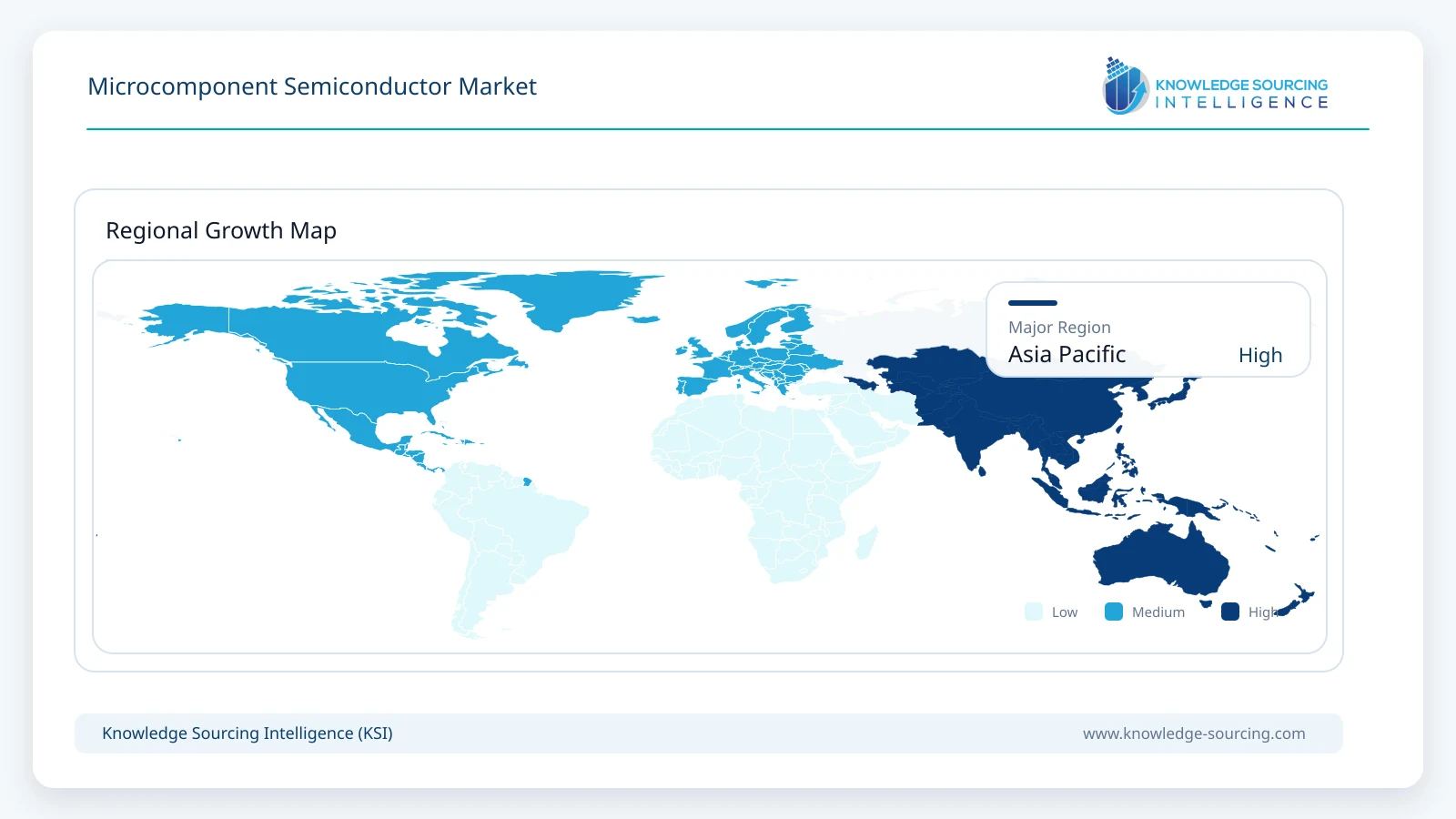
Asia-Pacific combines the world's largest vehicle manufacturing base with the most comprehensive semiconductor production ecosystem, making it central to both demand and supply. China continues expanding electric vehicle production, connected vehicle deployment, and domestic semiconductor development through industrial policy and manufacturing investment. Japan remains a critical center for automotive semiconductor design and vehicle manufacturing, while South Korea strengthens regional competitiveness through memory, logic, and automotive electronics capabilities. Taiwan plays a strategic role through advanced semiconductor foundry capacity that supports numerous global automotive chip suppliers. India continues increasing vehicle production and electronics manufacturing under domestic manufacturing initiatives, creating additional opportunities for automotive semiconductor suppliers serving both local assembly and export-oriented production. Regional growth is supported by manufacturing scale, but concentrated foundry capacity and geopolitical uncertainty remain operational considerations for the global automotive supply chain.
Competitive Landscape
The Microcomponent Semiconductor Market for the Automotive Industry exhibits characteristics of both technology concentration and application-specific competition. Product qualification requirements, long automotive design cycles, functional safety certification, and software integration create substantial barriers for new entrants, while established suppliers benefit from longstanding relationships with automotive OEMs and Tier 1 system integrators. Competition increasingly extends beyond semiconductor performance to include software development environments, cybersecurity capabilities, long-term product availability, and global technical support.
Intel Corporation, NXP Semiconductors, Renesas Electronics, Infineon Technologies, STMicroelectronics, Texas Instruments, Microchip Technology, onsemi, Analog Devices, Inc., and Qualcomm Technologies continue to expand automotive portfolios through processor development, AI-enabled computing platforms, power management solutions, and software ecosystems. Several companies are increasing investment in automotive-grade manufacturing capacity, strengthening relationships with foundry partners, and supporting software-defined vehicle development through integrated hardware and software platforms. Suppliers are also diversifying manufacturing footprints and enhancing product lifecycle support to address OEM concerns regarding supply continuity and extended vehicle production cycles.
Recent Developments
June 2026 – Infineon launched cloud-based automotive MCU evaluation platform: Infineon introduced an AWS-powered virtual platform enabling faster automotive microcontroller testing, supporting software-defined vehicle development and reducing hardware dependency during early design cycles.
July 2025 – Renesas Electronics launched the RA8P1 MCU Group for automotive edge AI: Renesas expanded its microcontroller portfolio with the RA8P1 family, integrating AI acceleration, Arm Cortex-M85 processing, and advanced security to enable intelligent automotive edge sensing, predictive maintenance, and cockpit applications.
June 2025 – Qualcomm acquired Autotalks: Qualcomm completed the acquisition of Autotalks, strengthening its automotive semiconductor portfolio with dedicated vehicle-to-everything (V2X) communication chips that improve road safety, automated driving, and connected vehicle infrastructure compatibility.
March 2025 – NXP Semiconductors launched the S32K5 automotive microcontroller family: NXP introduced the 16 nm FinFET-based S32K5 MCU family with embedded MRAM, targeting software-defined vehicles through higher performance, functional safety, real-time processing, and zonal automotive architecture support.
Regulatory and Policy Environment
Automotive semiconductor development is increasingly influenced by regulations governing vehicle safety, cybersecurity, emissions, and semiconductor manufacturing resilience. ISO 26262 remains the principal functional safety standard guiding semiconductor design for safety-critical vehicle systems, requiring suppliers to demonstrate rigorous development, verification, and validation processes before components enter commercial vehicle production. Compliance has become a fundamental procurement requirement across global automotive programs.
Cybersecurity requirements are also reshaping semiconductor design priorities. UNECE Regulations R155 and R156 require vehicle manufacturers to implement cybersecurity management systems and secure software update mechanisms throughout the vehicle lifecycle. As a result, semiconductor suppliers are incorporating hardware-based security features, secure boot functionality, encryption capability, and trusted execution environments into automotive processors and microcontrollers.
Government industrial policy is strengthening regional semiconductor capacity. The United States continues supporting domestic manufacturing through the CHIPS and Science Act, while the European Chips Act seeks to expand semiconductor production and reduce dependence on external manufacturing. Several Asia-Pacific governments are also supporting semiconductor investment through manufacturing incentives, research funding, and workforce development programs. These initiatives are expected to improve long-term supply resilience, although new fabrication capacity requires substantial investment and several years before reaching full commercial output.
Outlook and Strategic Implications
Automotive semiconductor demand during the 2026–2031 forecast period will increasingly depend on computing intensity rather than vehicle production volumes alone. Software-defined vehicle architectures, higher levels of driver assistance, connected services, and electrified powertrains will continue increasing semiconductor content across passenger and commercial vehicles. Suppliers capable of combining automotive-qualified hardware with scalable software platforms, cybersecurity features, and long-term lifecycle support are expected to strengthen their position within OEM procurement programs.
Future competition is likely to emphasize platform integration rather than individual semiconductor components. Automotive manufacturers increasingly prefer suppliers that can provide processors, AI acceleration, connectivity, power management, development tools, and software support within a unified ecosystem. This approach reduces integration complexity, shortens development timelines, and supports continuous software updates throughout vehicle lifecycles.
Strategic priorities across the value chain include:
Automotive OEMs: Increase direct engagement with semiconductor suppliers to improve supply visibility, secure long-term sourcing agreements, and accelerate software-defined vehicle development.
Semiconductor manufacturers: Expand automotive-grade production capacity, strengthen software ecosystems, and invest in functional safety, cybersecurity, and AI-enabled computing platforms.
Tier 1 suppliers and system integrators: Develop standardized electronic architectures that simplify integration while reducing validation effort and lifecycle costs.
Governments and policymakers: Continue supporting semiconductor manufacturing, advanced packaging, workforce development, and supply-chain resilience to reduce dependence on geographically concentrated production.
Although qualification timelines, manufacturing concentration, and rising software complexity will remain structural challenges, the market is expected to benefit from sustained investment in vehicle intelligence, electrification, and connected mobility. Suppliers that combine reliable manufacturing, automotive-grade quality systems, secure computing capability, and long-term engineering support will be better positioned to capture opportunities as vehicle electronics continue evolving toward centralized, software-centric computing platforms.
Market Scope:
| Report Metric | Details |
|---|---|
| Total Market Size in 2026 | USD 15.3 billion |
| Total Market Size in 2031 | USD 24.5 billion |
| Forecast Unit | USD Billion |
| Growth Rate | 10.0% |
| Study Period | 2021 to 2031 |
| Historical Data | 2021 to 2024 |
| Base Year | 2025 |
| Forecast Period | 2026 – 2031 |
| Segmentation | Type, Application, Technology, Geography |
| Companies |
|
Market Segmentation
By Type
Microprocessors (MPUs)
Microcontrollers (MCUs)
Digital Signal Processors (DSPs)
System-on-Chip (SoC)
Automotive AI Processors / Neural Processing Units (NPUs)
Application-Specific Integrated Circuits (ASICs)
By Application
Advanced Driver Assistance Systems (ADAS)
Powertrain
Body Electronics
Infotainment
Chassis and Safety
Telematics
Battery Management Systems (BMS)
By Technology
Conventional Automotive Electronics
Connected Vehicles
Autonomous Driving
Software-Defined Vehicles (SDVs)
By Geography
Americas
United States
Canada
Mexico
Brazil
Others
Europe, Middle East, and Africa (EMEA)
Germany
France
United Kingdom
Italy
Others
Asia-Pacific
China
Japan
South Korea
Taiwan
India
Others
Table of Contents
1. INTRODUCTION
1.1. Market Overview
1.2. Market Definition
1.3. Scope of the Study
1.4. Currency
1.5. Assumptions
1.6. Base and Forecast Years Timeline
2. RESEARCH METHODOLOGY
2.1. Research Design
2.2. Secondary Sources
3. EXECUTIVE SUMMARY
4. MARKET DYNAMICS
4.1. Market Segmentation
4.2. Market Drivers
4.3. Market Restraints
4.4. Market Opportunities
4.5. Porter’s Five Force Analysis
4.5.1. Bargaining Power of Suppliers
4.5.2. Bargaining Power of Buyers
4.5.3. Threat of New Entrants
4.5.4. Threat of Substitutes
4.5.5. Competitive Rivalry in the Industry
4.6. Life Cycle Analysis - Regional Snapshot
4.7. Market Attractiveness
5. MICROCOMPONENT SEMICONDUCTOR MARKET FOR AUTOMOTIVE INDUSTRY BY TYPE
5.1. Microprocessors
5.2. Microcontrollers
5.3. Digital Signal Processors
5.4. System-on-Chip (SoC)
5.5. Automotive AI Processors / Neural Processing Units (NPUs)
5.6. Application-Specific Integrated Circuits (ASICs)
6. MICROCOMPONENT SEMICONDUCTOR MARKET FOR AUTOMOTIVE INDUSTRY BY APPLICATION
6.1. Advanced Driver Assistance Systems (ADAS)
6.2. Powertrain
6.3. Body Electronics
6.4. Infotainment
6.5. Chassis and Safety
6.6. Telematics
6.7. Battery Management Systems (BMS)
7. MICROCOMPONENT SEMICONDUCTOR MARKET FOR AUTOMOTIVE INDUSTRY BY TECHNOLOGY
7.1. Conventional Automotive Electronics
7.2. Connected Vehicles
7.3. Autonomous Driving
7.4. Software-Defined Vehicles
8. MICROCOMPONENT SEMICONDUCTOR MARKET FOR AUTOMOTIVE INDUSTRY BY GEOGRAPHY
8.1. Americas
8.1.1. US
8.1.2. Canada
8.1.3. Mexico
8.1.4. Brazil
8.1.5. Others
8.2. Europe Middle East and Africa
8.2.1. Germany
8.2.2. France
8.2.3. United Kingdom
8.2.4. Italy
8.2.5. Others
8.3. Asia-Pacific
8.3.1. China
8.3.2. Japan
8.3.3. South Korea
8.3.4. Taiwan
8.3.5. India
8.3.6. Others
9. COMPETITIVE INTELLIGENCE
9.1. Competitive Benchmarking and Analysis
9.2. Recent Investment and Deals
9.3. Strategies of Key Players
10. COMPANY PROFILES
10.1. Intel Corporation
10.2. Infineon Technologies
10.3. onsemi
10.4. Microchip Technology
10.5. NXP Semiconductors
10.6. Renesas Electronics
10.7. STMicroelectronics
10.8. Analog Devices, Inc.
10.9. Texas Instruments
10.10. Qualcomm Technologies
LIST OF FIGURES
LIST OF TABLES
DISCLAIMER
Navigate
Trusted by the world's leading organizations











