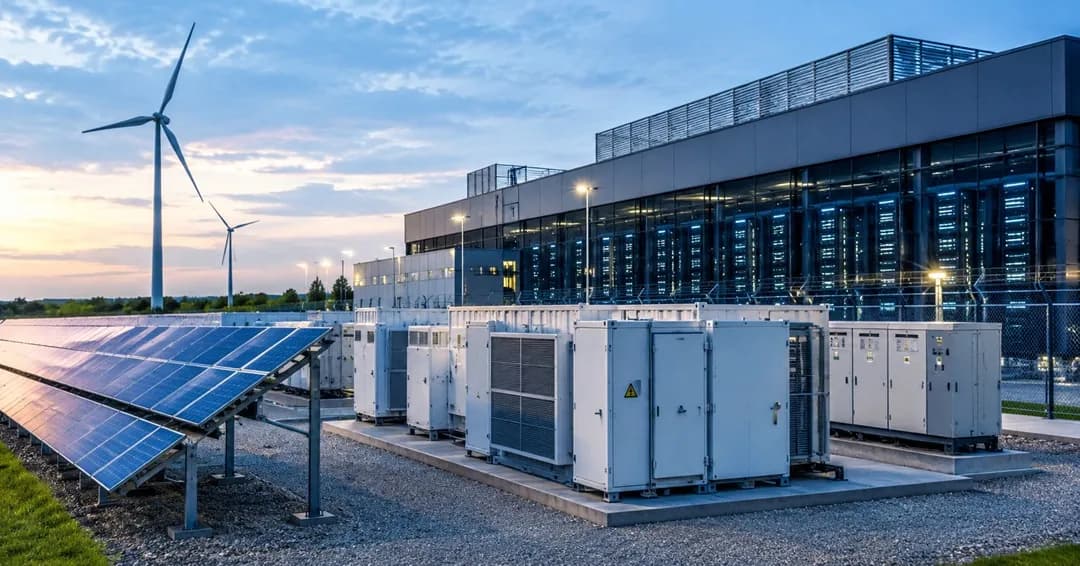
The AI data center microgrids market is expanding as grid constraints, interconnection delays, and rising AI computing power requirements increase demand for reliable on-site electricity. Hybrid generation, battery storage, advanced energy management, and islandable power systems are creating opportunities for suppliers supporting resilient, flexible, and efficient data center energy infrastructure.
Knowledge Sourcing Intelligence has published its latest analysis of the global AI Data Center Microgrids Market, projecting growth from USD 0.78 billion in 2026 to USD 3.38 billion by 2032, at a compound annual growth rate (CAGR) of 27.7%. Grid capacity constraints, utility interconnection delays, and rising electricity requirements associated with AI infrastructure expansion are supporting demand.
As data centers deploy power-intensive computing systems, operators are evaluating on-site generation combining fuel cells, natural gas generators, battery storage, and utility electricity. Microgrid technologies coordinate these resources, manage power flows, and support grid-connected and islanded operation.
The market covers microgrid control, protection, energy management, and integration technologies rather than the full value of power-generation equipment. Investment in dedicated electricity infrastructure creates opportunities for suppliers of these systems.
Request a free sample copy or view the report summary: AI Data Center Microgrids Market Report
Key Growth Drivers
Grid Interconnection Delays and On-Site Generation
Limited transmission capacity and lengthy utility connection processes are encouraging developers to explore dedicated generation. On-site systems can support phased deployment without waiting for full grid expansion, subject to permitting, fuel availability, and technical requirements. Microgrid controllers coordinate generation, storage, and utility connections to maintain power balance and operational reliability.
Increasing AI Computing Power Requirements
High-density GPU clusters require substantial electricity and can introduce rapid load fluctuations. Microgrid systems coordinate fast-response batteries and uninterruptible power supply (UPS) equipment with sustained generation from engines, turbines, or fuel cells. This integration supports voltage and frequency stability, reserve management, and reliable electricity delivery during changing workloads.
Expansion of Hybrid Power Architectures
Operators are evaluating combinations of distributed generation, battery storage, renewable electricity, and grid supply. These configurations require coordinated dispatch, synchronization, islanding, and protection systems. Energy management platforms optimize resource utilization while maintaining power quality, operating limits, and critical-load requirements.
Growing Focus on Energy Resilience
Islandable microgrids can sustain designated loads during utility disturbances when supported by sufficient generation, storage, and protection systems. Adoption depends on engineering reliability, cybersecurity, capital expenditure, fuel security, and regulatory compliance. These requirements create opportunities for suppliers offering validated control and integration capabilities.
Latest Industry Developments
September 2026 – Delta Electronics: Delta unveiled integrated AI modular data centers and microgrid solutions combining onsite generation, energy storage, and advanced power conversion.
September 2026 – Vertiv acquisition: Vertiv agreed to acquire UtilityInnovation Group, adding microgrid controls, onsite-generation orchestration, and behind-the-meter power architecture for AI data centers.
August 2026 – Bloom Energy and MiTAC: Bloom Energy announced plans to deploy an islanded fuel-cell microgrid at MiTAC's AI server manufacturing campus in Fremont, California. Although outside data center operations, the project demonstrates wider adoption of independently controlled on-site power across the AI infrastructure supply chain.
Market Segmentation and Regional Outlook
The market is segmented by component, operating mode, controlled resource, control function, data center type, and geography.
Components include microgrid controllers and energy management systems; protection, islanding, and synchronization controls; integrated switchboards; HMI, SCADA, and communications; engineering and commissioning services; and lifecycle software and cybersecurity support. Operating modes include grid-connected hybrid, islandable, fully off-grid, and bridge-to-grid architectures.
North America leads early deployment through hyperscale investment, grid constraints, and behind-the-meter generation projects. Europe presents opportunities through renewable integration and energy resilience initiatives. Asia Pacific benefits from expanding data center infrastructure, while the Middle East offers potential for integrated energy campuses combining dedicated generation and storage.
Competitive Landscape
Key companies identified in KSI's market coverage include Schneider Electric, Eaton, Siemens, ABB, GE Vernova, Honeywell, Caterpillar, and Cummins.
Competition centers on interoperability, cybersecurity, protection coordination, and integration expertise. Automation providers supply control platforms, while generation equipment manufacturers contribute to integrated power solutions. Suppliers offering scalable architectures and reliable islanding capabilities may benefit from increasingly complex AI power requirements.
Analyst Perspective
“The expansion of AI infrastructure is making electricity availability a critical consideration in data center development. Microgrids can coordinate on-site generation, storage, and grid supply, but commercial adoption depends on reliable integration, effective power management, and competitive operating costs.”
What The Study Covers
The report provides market estimates and forecasts through 2032, growth drivers and restraints, component and operating-mode segmentation, controlled-resource and control-function analysis, regional assessments, competitive intelligence, company profiles, and technology developments.
Have questions?
More Press Releases
EV Traction Motor Market to Reach USD 20.6 Billion by 2031 as Integrated E-Axles Gain Momentum
The global EV traction motor market is expanding as automakers adopt integrated e-axles, compact drivetrain architectures, and advanced propulsion technologies. Rising electric vehicle production, improved motor efficiency, power electronics innovation, and manufacturing optimization are creating opportunities for suppliers developing scalable, reliable, and space-efficient electric drive systems across passenger and commercial vehicle segments.
Semiconductor Test Socket Market Projected to Reach USD 3.55 Billion by 2032, Driven by AI and HPC Demand
The semiconductor test socket market is expanding as AI processors, high-performance computing, advanced packaging, and high-speed memory increase testing requirements. Growing semiconductor complexity is driving demand for reliable electrical contacts, improved signal integrity, and thermal management. Automotive electronics and power semiconductors are further creating opportunities for specialized test socket technologies.
Hydrogen Energy Storage Market to Reach USD 25.40 Billion by 2032 as Demand for Long-Duration Storage Grows
The hydrogen energy storage market is expanding as renewable energy integration, industrial hydrogen demand, and infrastructure investment drive adoption. Advancements in compressed gas, liquid hydrogen, underground geological, and solid-state storage technologies are creating opportunities across utilities, industrial applications, and grid-scale energy systems, while cost efficiency and infrastructure readiness remain critical challenges.