
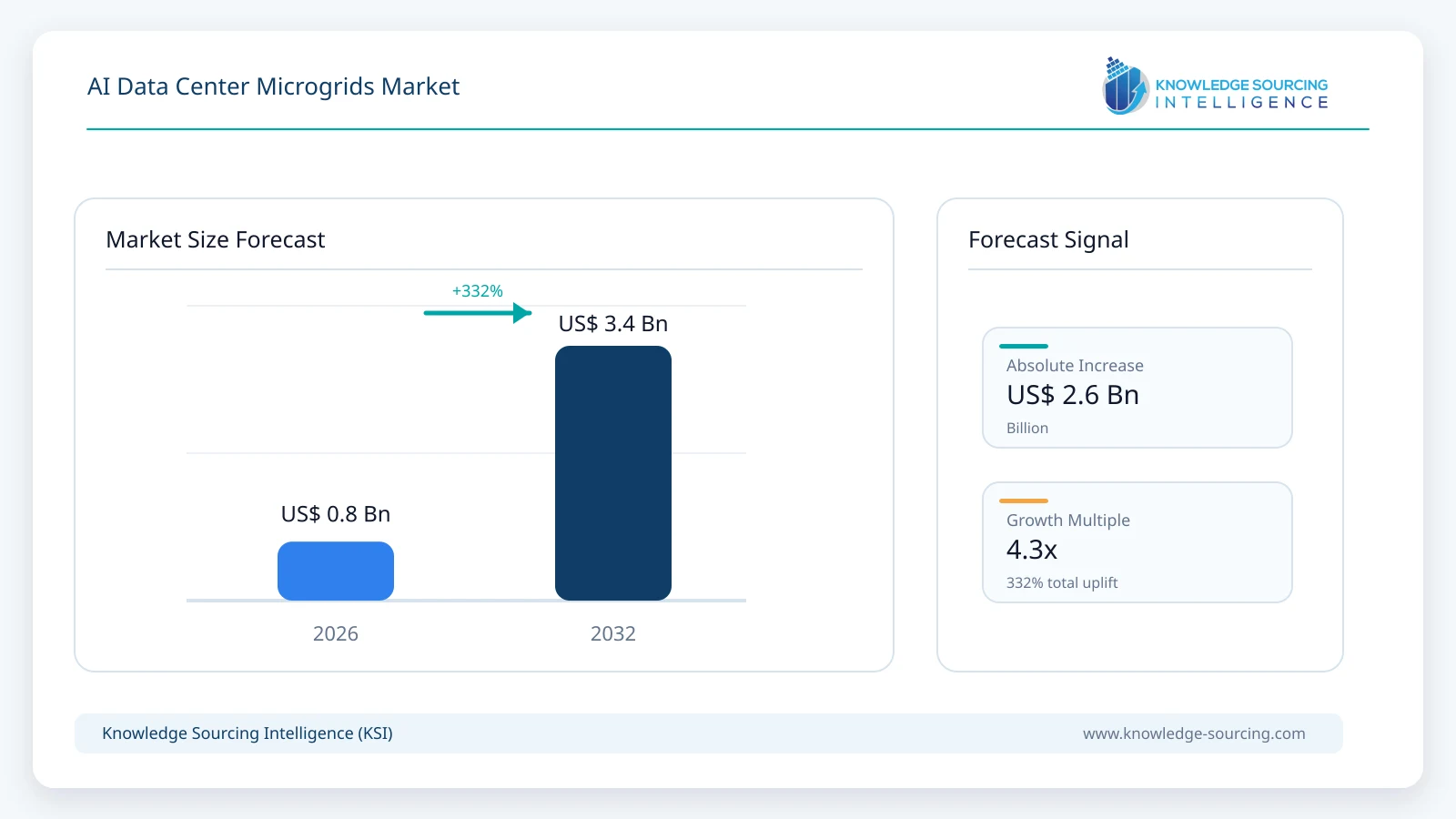
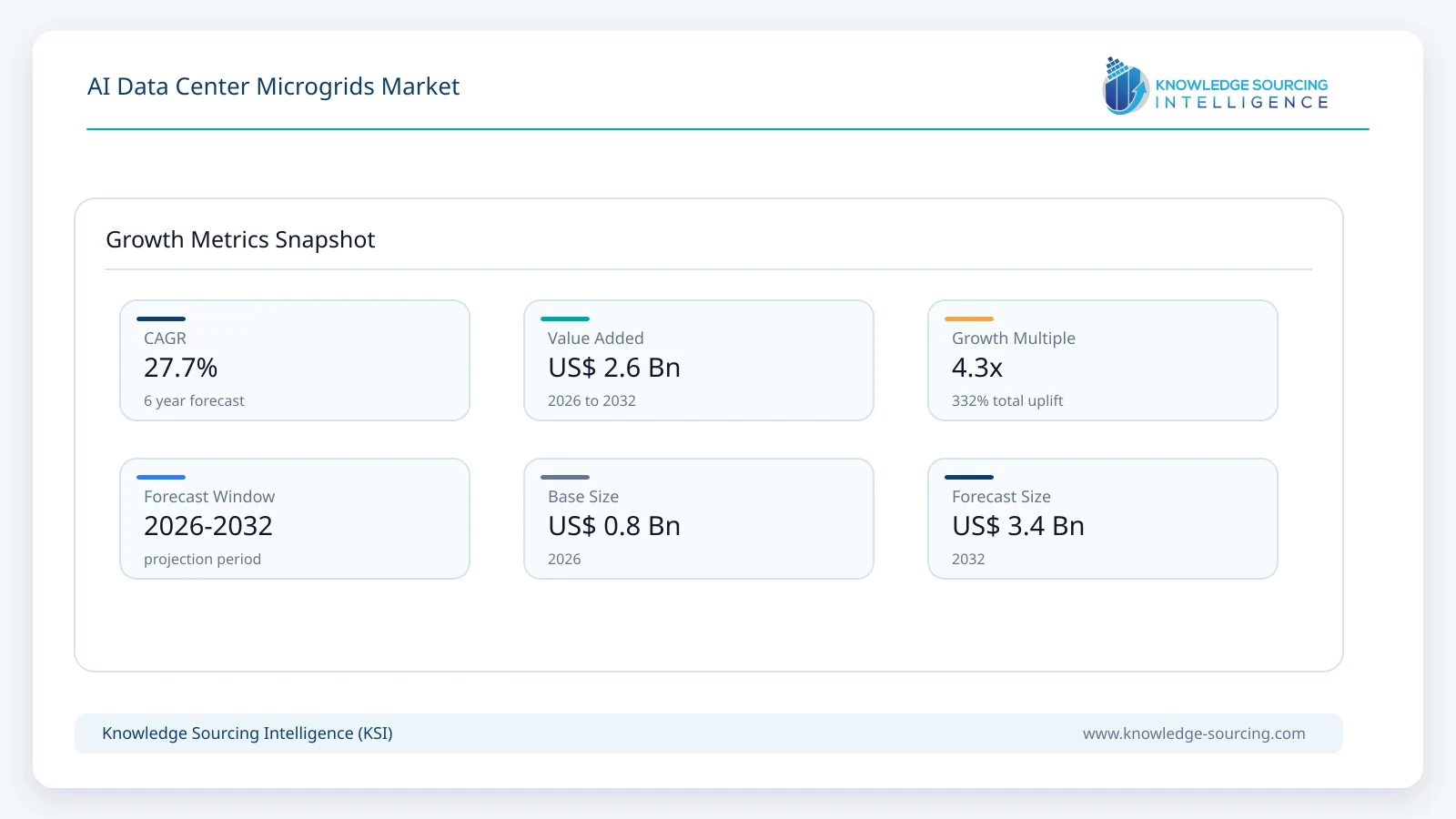
The AI Data Center Microgrids Market is estimated at USD 0.78 billion in 2026 and is projected to reach USD 3.38 billion by 2032, representing a CAGR of 27.7% during 2026–2032.
Highlights:
- 1North America leads early deployment through large behind-the-meter AI power projects and constrained grids.
- 2Engineering and integration remain significant because large AI microgrids combine multiple vendors and control domains.
- 3Software optimization grows rapidly as operators coordinate dispatch, reserves, energy costs and grid-support obligations.
- 4Controller standardization moderates revenue growth after 2030 even as microgrid-enabled capacity continues expanding.
Market Overview
AI data centers are changing the role of on-site power. Traditional data centers typically treated generators and UPS systems as independent resilience assets that remained idle during normal grid operation. New AI campuses increasingly combine utility service with prime generation, battery energy storage, renewable resources, and grid-interactive power electronics. Once multiple sources are expected to operate together, a dedicated microgrid layer is required to coordinate them. The controller must maintain generation-load balance, manage state of charge, enforce operating limits, sequence breakers, protect equipment, and determine how the site behaves during grid disturbances or loss of utility supply.
The scale and speed of AI load changes increase the control challenge. The International Energy Agency (IEA) reported that electricity use from AI-focused data centers increased by 50% in 2025 and is expected to triple between 2025 and 2030, while overall data-center electricity use rises from approximately 485 terawatt-hours to about 950 terawatt-hours. The same analysis notes that rapid AI power swings increase the importance of energy storage. For microgrids, these changes mean that dispatch logic must coordinate resources across several time scales. Batteries and UPS systems can absorb fast transients, while engines, turbines, or fuel cells provide sustained power and the microgrid controller maintains system stability and reserve margins.
Recent multi-hundred-megawatt and gigawatt-scale projects demonstrate why the control layer is becoming a distinct commercial market. Caterpillar announced a 2 GW dedicated power deployment for a hyperscale AI campus, Wärtsilä secured a 790 MW off-grid data-center power order in Texas, INNIO announced a 1.1 GW engine order for a major campus, and Bloom Energy expanded its Oracle agreement to support up to 2.8 GW of fuel-cell capacity. These generation assets are outside the market value quantified here, but each increases the requirement for plant-level energy management, protection, synchronization, black-start capability, load sharing and operating software.
Market Drivers
Grid interconnection delays are increasing demand for independently controllable power systems
AI campuses can often be designed and constructed faster than new transmission capacity, utility substations and firm grid connections can be delivered. This creates a commercial incentive to use on-site generation as bridge power or as a long-term primary source. Once a facility operates with meaningful non-utility generation, the value of microgrid controls rises because the site must manage power-source priorities, reserve margins, transitions, dispatch and protection without relying on the grid to absorb every disturbance. Microgrid control therefore becomes part of speed-to-power rather than an optional energy-management feature.
AI load volatility raises the value of coordinated fast-response control
Large accelerator clusters can change power draw quickly as workloads start, stop, checkpoint or shift between operating states. Generation assets optimized for sustained output cannot always respond at the same speed. A microgrid can assign short-duration events to batteries or grid-interactive UPS systems while maintaining efficient loading of engines, turbines or fuel cells. Controller logic that coordinates these resources reduces oversizing, stabilizes voltage and frequency, and prevents rapid AI load changes from propagating through the entire private power system.
Hybrid energy architectures require islanding, synchronization and protection coordination
Microgrid operation is more complex than ordinary parallel generation because the system may need to separate from the utility, form its own voltage and frequency reference, shed non-critical load, black-start selected resources and later resynchronize safely. Schneider Electric's EcoStruxure Microgrid documentation explicitly includes grid-outage detection, island transition, load management and reconnection sequences. Siemens similarly positions its Microgrid Integrated Switchboard around real-time monitoring, automated control and islanding. These functions create a distinct purchasing layer above individual generation and storage assets.
Restraints and Adoption Challenges
Microgrid controls are not required at every AI data center. Facilities with strong utility connections and conventional standby-only generation can continue using established transfer and backup schemes without a full microgrid controller. Projects also remain highly site-specific because utility interconnection rules, protection philosophy, generation technology, fuel availability, grid-forming capability and resilience targets vary materially by location. Cybersecurity becomes more critical as controllers gain authority over generation, storage, breakers and critical loads. A further restraint is standardization: as vendors develop validated reference designs and pre-engineered control centers, engineering hours and control hardware cost per megawatt can decline even while total microgrid-enabled capacity expands.
Segment Analysis
By Component
Engineering, integration and commissioning represent the largest 2026 revenue pool because large AI data-center microgrids must be modeled, protection-coordinated, programmed and validated across equipment from several suppliers. Power-flow studies, dynamic studies, controller configuration, sequence-of-operations development, factory acceptance testing and site commissioning are particularly important for islandable systems. Microgrid controller and EMS software is expected to grow faster through 2032 as more operators standardize hybrid energy architectures and manage multiple campuses using reusable control platforms. Hardware content increasingly shifts toward standardized industrial controllers, redundant servers, protection relays and communication gateways, while differentiation moves into software logic, cybersecurity and fleet-level optimization.
By Operating Mode
Grid-connected hybrid microgrids represent the largest deployment category because many AI campuses retain utility service while adding on-site generation and storage to accelerate energization or reduce grid dependence. Fully islanded and off-grid AI campuses form a smaller but faster-growing segment in locations where grid capacity is unavailable or development schedules cannot wait for permanent interconnection. Bridge-to-grid architectures sit between these models: on-site generation initially carries a large share of load, then transitions into a hybrid or resilience role once utility capacity becomes available.
Microgrid Layer | Revenue Contribution | Application | Technologies |
Engineering, integration and commissioning | Largest value pool | System studies, control logic, protection coordination and acceptance | Power-flow studies, dynamic models, FAT/SAT, commissioning |
Microgrid controller and EMS | Fastest-growing layer | Real-time dispatch, optimization, reserves and operating-state management | Controller, EMS, HMI/SCADA, forecasting |
Protection and islanding controls | Mission-critical layer | Grid separation, resynchronization, load shedding and fault coordination | Relays, synch-check, breaker logic, adaptive protection |
Microgrid control centers / switchboards | Standardizing hardware layer | Integrates control, metering, communications and DER interfaces | Control panels, integrated switchboards, gateways |
Lifecycle software and services | Recurring layer | Performance monitoring, cybersecurity, tuning and multi-site operations | Remote monitoring, analytics, software support |
Market and Adoption Indicators
Indicator | Latest Development | Market Impact |
AI-focused electricity growth | IEA expects AI-focused data-center electricity use to triple between 2025 and 2030. | Expands the power base requiring resilient, coordinated energy architectures. |
VoltaGrid AI power platform | ABB and VoltaGrid expanded their collaboration in March 2026 with 35 additional synchronous condensers and eHouses. | Shows multi-site AI power platforms moving toward integrated private-grid operation. |
Microgrid-ready medium-voltage UPS | ABB launched HiPerGuard 34.5kV in April 2026 with integration for BESS, gas generation and renewables. | Links critical-power equipment directly with microgrid operation and grid support. |
Dedicated hyperscale power | Caterpillar announced 2 GW of dedicated power for a hyperscale AI campus in January 2026. | Large private power systems require plant-level dispatch, protection and reserve coordination. |
Off-grid data-center power | Wärtsilä secured a 790 MW off-grid data-center power order in Texas in April 2026. | Confirms commercial demand for data centers capable of operating without utility supply. |
Hybrid-energy orchestration | Eaton positions a microgrid controller between grid, generation, BESS and grid-interactive UPS. | Supports controller demand as multiple power assets converge at AI campuses. |
Regional Opportunity
North America
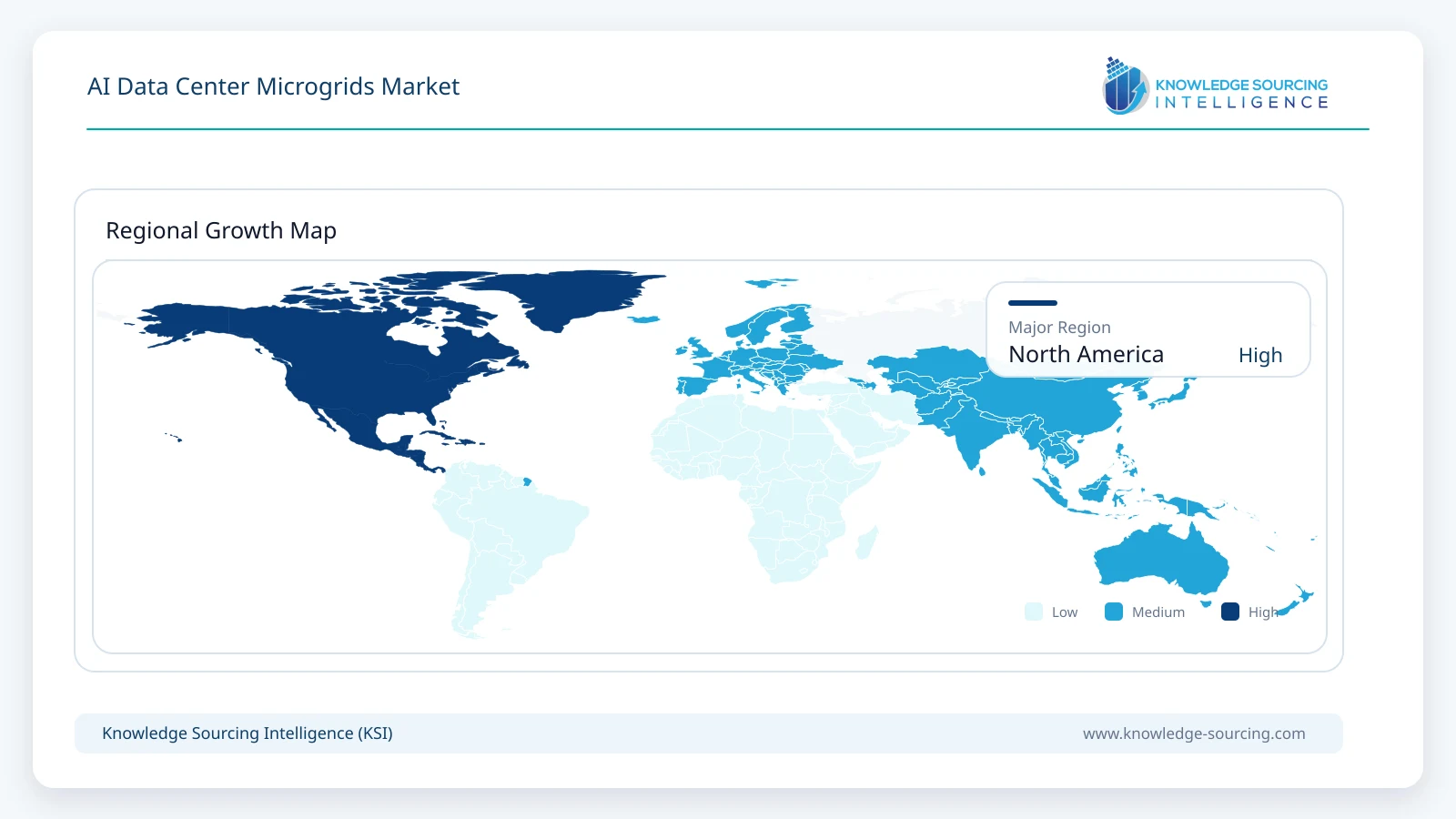
North America is the largest early market for AI data-center microgrids because the United States combines the world's largest concentration of new hyperscale AI projects with severe interconnection pressure in several data-center corridors. Large campuses are increasingly evaluating on-site generation not simply as backup but as bridge-to-grid or permanent primary power. The scale of 2026 projects illustrates this transition: Caterpillar's announced 2 GW dedicated-power program, Wärtsilä's 790 MW off-grid Texas order, Bloom Energy's expanded Oracle agreement supporting up to 2.8 GW, and INNIO's 1.1 GW engine order all create operating environments where plant-level control, protection and dispatch become central.
The regional supplier ecosystem is also unusually deep. Eaton is explicitly positioning microgrid controllers as the coordinating layer among on-site generation, battery storage, utility supply and grid-interactive UPS systems. ABB is supplying VoltaGrid with stabilization equipment, eHouses, and automation for AI data-center power platforms and has introduced a microgrid-ready 34.5-kV UPS architecture. Schneider Electric combines EcoStruxure Microgrid Operation, Microgrid Advisor and standardized control centers, while Siemens integrates its SICAM controller with protection and distribution in a pre-engineered Microgrid Integrated Switchboard. Caterpillar, GE Vernova, Honeywell and Cummins provide additional controller and integration options.
Demand is expected to remain concentrated in power-constrained markets where private generation can materially accelerate data-center energization. Texas is important because abundant gas supply and rapid AI campus development support very large behind-the-meter systems. Other U.S. markets may favor hybrid architectures in which batteries, utility capacity and on-site generation operate together rather than full off-grid designs. Through 2032, the strongest revenue opportunity is therefore not simply the number of microgrids installed, but the increasing control complexity per site as operators coordinate more assets, tighter grid requirements, dynamic AI loads and multi-campus energy strategies.
Europe, Asia Pacific and Middle East
Europe is developing microgrid demand around grid constraints, resilience, renewable integration and increasingly complex energy-management requirements, although gas-based on-site generation faces tighter permitting and emissions constraints than in parts of North America. Asia Pacific combines rapid data-center growth with highly diverse utility structures. Singapore, Malaysia, Japan, South Korea and Australia are relevant markets for hybrid architectures, while China has a large domestic power and control ecosystem. Middle Eastern AI campuses are well suited to large integrated energy parks that combine utility supply, dedicated generation, storage and renewables, creating an attractive environment for microgrid controls even where formal demand-response markets are less mature.
Competitive Landscape
Competition spans industrial automation companies, power-management vendors, generation original equipment manufacturers, microgrid specialists and engineering integrators. Schneider Electric, Eaton, Siemens, ABB, GE Vernova and Honeywell bring broad control portfolios that combine industrial controllers, protection, energy management, HMI/SCADA and lifecycle services. Caterpillar, Cummins and Rolls-Royce Power Systems compete from the generation side but increasingly attach microgrid controllers, storage interfaces and system-integration services to their power platforms.
Project developers and specialized energy providers also influence the market. VoltaGrid is building rapidly deployable behind-the-meter power platforms for AI data centers and works with ABB on stabilization and electrical infrastructure. Enchanted Rock develops microgrid-based resilience systems, while Wärtsilä combines generation, storage and control software across large power plants. Hitachi Energy participates through grid automation and power-system integration, and Aggreko competes in temporary and bridge-power applications where microgrid controls can coordinate staged capacity before permanent infrastructure is complete.
Competitive differentiation is shifting toward validated interoperability, cybersecurity, response speed and the ability to coordinate mixed assets under both grid-connected and islanded conditions. Vendors that can standardize control architectures without losing site-level flexibility should gain share because hyperscale customers increasingly want repeatable designs across multiple campuses. The ability to support black start, grid forming, load shedding, protection coordination and future grid-service participation within one control framework is becoming more valuable than a standalone energy-optimization dashboard.
Major companies and ecosystem participants covered: Schneider Electric, Eaton, Siemens, ABB, GE Vernova, Honeywell, Caterpillar, Cummins, Wärtsilä, Rolls-Royce Power Systems, Hitachi Energy, VoltaGrid, Enchanted Rock, Aggreko and Bloom Energy.
Recent Developments
September 2026: Cummins highlighted millisecond-response requirements for AI data-center loads and the growing role of integrated microgrid and battery controls.
July 2026: INNIO announced a 1.1 GW gas-engine order for a major data-center campus, expanding the installed base requiring coordinated behind-the-meter control.
June 2026: Schneider Electric detailed a standardized microgrid deployment approach using pre-tested architectures, repeatable control logic and validation.
April 2026: ABB launched the 34.5-kV HiPerGuard UPS with a microgrid-ready architecture integrating storage, gas generation and renewables.
April 2026: Wärtsilä secured a 790 MW off-grid power order for a new Texas data-center facility.
April 2026: Bloom Energy expanded its Oracle partnership to support procurement of up to 2.8 GW of fuel-cell capacity for AI and cloud infrastructure.
March 2026: ABB and VoltaGrid expanded their collaboration with 35 additional synchronous condensers and eHouses for global AI data-center power projects.
January 2026: Caterpillar and partners announced a 2 GW dedicated-power program for a hyperscale AI campus, with delivery beginning during 2026.
AI Data Center Microgrids Market Scope:
| Report Metric | Details |
|---|---|
| Total Market Size in 2026 | USD 0.78 billion |
| Total Market Size in 2032 | USD 3.37 billion |
| Forecast Unit | USD Billion |
| Growth Rate | 27.7% |
| Study Period | 2021 to 2032 |
| Historical Data | 2021 to 2024 |
| Base Year | 2025 |
| Forecast Period | 2026 – 2032 |
| Segmentation | Component, Operating Mode, Controlled Resource, Control Function |
| Companies |
|
Market Segmentation
By Component
Microgrid Controllers and Energy Management Systems
Protection, Islanding and Synchronization Controls
Microgrid Control Centers and Integrated Switchboards
HMI, SCADA and Communications
Engineering, Integration and Commissioning Services
Lifecycle Software, Cybersecurity and Support
By Operating Mode
Grid-Connected Hybrid Microgrids
Islandable Microgrids
Fully Off-Grid AI Data Centers
Bridge-to-Grid Architectures
By Controlled Resource
Gas Engines and Turbines
Fuel Cells
Battery Energy Storage Systems
Grid-Interactive UPS
Solar and Other Renewable Resources
Mixed Distributed Energy Resource Portfolios
By Control Function
Real-Time Power Balancing and Dispatch
Islanding and Resynchronization
Load Sharing and Reserve Management
Black Start and Restoration
Protection Coordination and Fast Load Shedding
Grid Import/Export and Power-Limit Control
Energy Cost and Emissions Optimization
By Data Center Type
Hyperscale AI Factories
Neocloud and GPU Cloud Facilities
Colocation Data Centers
Sovereign and Enterprise AI Facilities
By Region
North America
United States
Canada
Europe
Asia Pacific
Middle East and Rest of World
Table of Contents
1. Executive Summary
1.1. Market Opportunity and Key Findings
1.2. AI Data Center Microgrid Adoption Timeline
1.3. Principal Revenue Pools
2. Market Overview
2.1. Evolution from Backup Power to Integrated Microgrids
2.2. AI Workload Power Characteristics
2.3. Microgrid Architecture for AI Data Centers
2.4. Grid-Connected, Islanded and Bridge-to-Grid Operation
2.5. Interaction with UPS, BESS and On-Site Generation
20323.1. Global Market Revenue
3.2. Annual Growth Analysis
3.3. Microgrid Control and Integration Revenue per MW
3.4. New Build versus Retrofit Demand
4. Market by Component
4.1. Microgrid Controllers and Energy Management Systems
4.2. Protection, Islanding and Synchronization Controls
4.3. Microgrid Control Centers and Integrated Switchboards
4.4. HMI, SCADA and Communications
4.5. Engineering, Integration and Commissioning Services
4.6. Lifecycle Software, Cybersecurity and Support
5. Market by Operating Mode
5.1. Grid-Connected Hybrid Microgrids
5.2. Islandable Microgrids
5.3. Fully Off-Grid AI Data Centers
5.4. Bridge-to-Grid Architectures
6. Market by Controlled Resource
6.1. Gas Engines and Turbines
6.2. Fuel Cells
6.3. Battery Energy Storage Systems
6.4. Grid-Interactive UPS
6.5. Solar and Other Renewable Resources
6.6. Mixed Distributed Energy Resource Portfolios
7. Market by Control Function
7.1. Real-Time Power Balancing and Dispatch
7.2. Islanding and Resynchronization
7.3. Load Sharing and Reserve Management
7.4. Black Start and Restoration
7.5. Protection Coordination and Fast Load Shedding
7.6. Grid Import/Export and Power-Limit Control
7.7. Energy Cost and Emissions Optimization
8. Market by Data Center Type
8.1. Hyperscale AI Factories
8.2. Neocloud and GPU Cloud Facilities
8.3. Colocation Data Centers
8.4. Sovereign and Enterprise AI Facilities
9. Regional Market
9.1. North America
9.1.1. United States
9.1.2. Canada
9.2. Europe
9.3. Asia Pacific
9.4. Middle East and Rest of World
10. Market Dynamics
10.1. Drivers
10.1.1. Grid Interconnection Delays
10.1.2. Expansion of Behind-the-Meter AI Power
10.1.3. AI Load Volatility and Power Quality Requirements
10.1.4. Growth of Hybrid Energy Architectures
10.2. Restraints
10.2.1. Site-Specific Engineering Complexity
10.2.2. Cybersecurity and Control Authority
10.2.3. Utility Interconnection and Protection Requirements
10.2.4. Declining Control Cost from Standardization
11. Technology and Commercialization Outlook
11.1. Grid-Forming BESS and UPS Integration
11.2. AI-Based Dispatch and Forecasting
11.3. Adaptive Protection and Fast Load Shedding
11.4. Standardized Microgrid Control Centers
11.5. Fleet-Level Multi-Site Energy Management
11.6. Cybersecure IT/OT Integration
12. Competitive Landscape
12.1. Value Chain
12.2. Industrial Automation and Microgrid Control Vendors
12.3. Power-Management and Critical-Power Suppliers
12.4. Generation OEM Microgrid Platforms
12.5. Specialized Microgrid Developers and Integrators
12.6. Partnerships and Reference Architectures
13. Company Profiles
13.1. Schneider Electric
13.2. Eaton
13.3. Siemens
13.4. ABB
13.5. GE Vernova
13.6. Honeywell
13.7. Caterpillar
13.8. Cummins
13.9. Wärtsilä
13.10. Rolls-Royce Power Systems
13.11. Hitachi Energy
13.12. VoltaGrid
13.13. Enchanted Rock
13.14. Aggreko
13.15. Bloom Energy
14. Recent Developments
15. Appendix
Navigate
Trusted by the world's leading organizations











