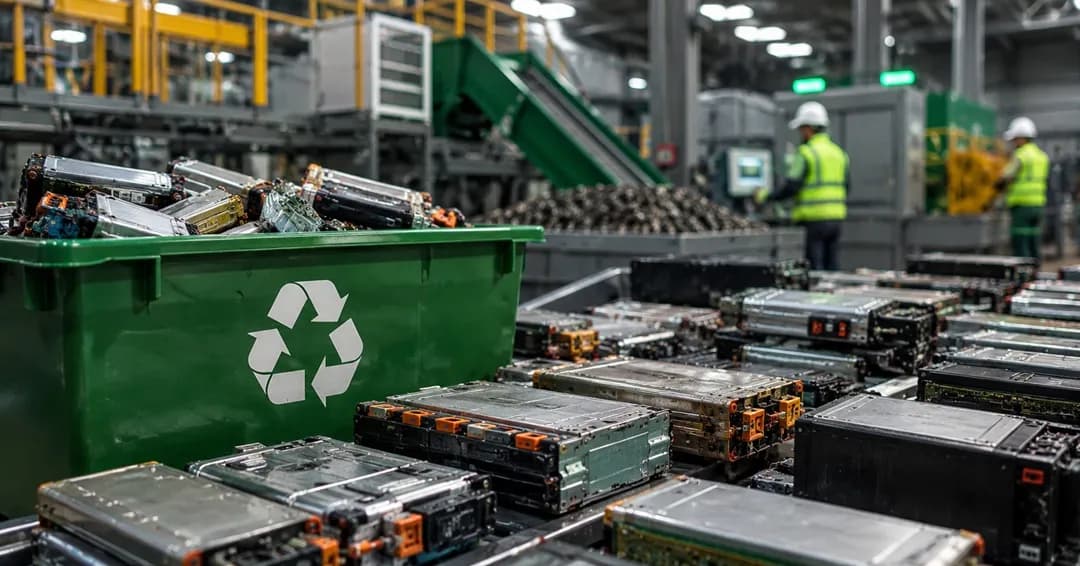
India’s EV battery recycling ecosystem is moving from waste management toward critical-mineral security. Battery Waste Management Rules, EPR obligations, recycled-content requirements, recycling incentives and EU-India cooperation are strengthening the framework. However, limited near-term feedstock, fragmented collection, underused capacity, chemistry differences and domestic refining gaps remain key challenges to scale sustainably.
India’s electric-vehicle transition is often measured from the front end of the market. The number of vehicles sold, the expansion of charging infrastructure, new battery plants and government incentives provide the most visible indicators of progress. Yet the sustainability of this transition will increasingly depend on what happens at the other end of the battery lifecycle. As more electric vehicles enter the road fleet, India will eventually have to manage a growing volume of batteries that are no longer suitable for their original application.
That issue is still developing, but the policy response has already moved ahead of the waste stream. India introduced the Battery Waste Management Rules in 2022, placing producers and importers under an Extended Producer Responsibility framework and requiring them to meet collection, recycling and refurbishment obligations. The framework has since been amended in 2023, 2024 and 2025, including changes to EPR compliance, environmental-compensation price bands and digital labelling. The rules also require producers to incorporate a minimum share of domestically recycled material into new batteries from financial year 2027-28 onward.
At the same time, the country is trying to build a domestic battery manufacturing industry. The Advanced Chemistry Cell Production Linked Incentive programme carries an outlay of Rs. 18,100 crore and targets 50 GWh of domestic cell manufacturing capacity. As of March 2026, 40 GWh had been awarded to four beneficiaries, although only 1 GWh had been installed. By 31 May 2026, beneficiary firms reported cumulative investment of Rs. 5,180 crore and direct employment of 1,277 under the scheme. The government continues to acknowledge that domestic demand for advanced chemistry cells is still being met largely through imports.
These two developments are closely connected. India wants to manufacture more batteries domestically, but it remains exposed to international supply chains for many of the minerals and processed materials required to make those batteries. Recycling cannot remove that dependence, because new mineral supply will remain necessary as EV production expands. It can, however, create a secondary source of materials from batteries and other products that are already circulating within the Indian economy.
That makes battery recycling more than an environmental obligation. It has the potential to become part of India's industrial strategy for critical minerals, domestic manufacturing and resource security. The more difficult question is whether the economics will support that ambition.
The Sustainability Question Begins Before the Battery Reaches a Recycler
A battery does not become a useful recycling feedstock simply because it has reached the end of its automotive life. Before it can be recycled, somebody has to identify it, collect it, transport it safely, determine its condition and chemistry, and decide whether it should be reused, refurbished or processed for material recovery.
This is particularly important in India because the country's EV market is not developing around a single vehicle category. Electric two-wheelers and three-wheelers have become important parts of adoption, while passenger cars, buses and commercial vehicles are developing through different market and policy channels. The resulting battery waste stream will therefore be fragmented by pack size, chemistry, ownership model and location.
A large electric bus fleet may return batteries through a relatively organised operator. An electric two-wheeler battery could take a very different route, moving through a dealer, independent workshop, fleet operator or local scrap network. These differences have direct consequences for recycling economics.
Collection is consequently likely to become one of the most important competitive factors in India's recycling industry.
NITI Aayog's January 2026 assessment of lithium-ion battery and e-waste circularity makes this point clearly. It identifies collection inefficiencies, informal-sector dominance, weak monitoring and inadequate financing as barriers to building a robust formal recycling ecosystem. The report also highlights the need for stronger traceability and better integration between collection systems and formal recyclers.
This suggests that the recycling challenge is not simply a question of building more processing plants. India could have technically sophisticated recycling facilities and still achieve disappointing environmental outcomes if a substantial share of batteries never reaches those facilities.
India May Have More Recycling Capacity Than It Needs in the Short Term
One of the more interesting features of India's battery-recycling market is the potential mismatch between processing capacity and actual end-of-life battery availability.
NITI Aayog estimates that India had more than 80 kilotonnes of announced lithium-ion battery recycling capacity against approximately 15 kilotonnes of end-of-life lithium-ion battery supply requiring recycling in 2025. The gap is expected to remain even as the market develops. By 2030, announced processing capacity is projected to reach around 115 kilotonnes, compared with estimated end-of-life battery availability of approximately 60 kilotonnes.
The figures should not be interpreted as evidence that India is building unnecessary infrastructure. Recycling capacity needs to be established before the largest wave of retired EV batteries arrives, and companies also need time to develop collection networks and establish relationships with vehicle manufacturers and battery producers. Nevertheless, the difference highlights a commercial risk.
A recycling facility is a capital-intensive asset. If it operates well below capacity for several years, its economics can become difficult even if the long-term market opportunity is attractive. This is why the distinction between announced capacity and operational utilisation matters when assessing the Indian recycling industry. The sector may need a transitional feedstock strategy.
Battery manufacturing scrap is one possible source. Cell manufacturing generates defective cells, production scrap and other material streams that can be processed before large volumes of post-consumer EV batteries reach end-of-life. As India's domestic battery manufacturing industry develops, recycling companies that can process both manufacturing waste and retired batteries may have a more stable feedstock base.
This could become an important differentiator between recycling companies. The strongest operators may not be those with the largest theoretical capacity, but those with long-term access to multiple sources of battery material.
The Real Strategic Value Lies in Critical Minerals
The environmental argument for battery recycling is compelling, but India's economic case may be even stronger.
Electric vehicles increase demand for lithium-ion batteries, while battery manufacturing increases demand for lithium, nickel, cobalt, manganese, graphite, copper and other materials. India does not have sufficient domestic production of all these inputs to support a rapidly expanding battery industry without substantial international sourcing. That creates a strategic vulnerability.
The country can respond by developing domestic mining, diversifying imports, establishing overseas mineral partnerships and improving processing capabilities. Recycling provides another layer of supply security because it allows materials already imported into India to be recovered and used again.
This is where the concept of "urban mining" becomes commercially relevant. A retired battery is effectively a concentrated stock of materials that have already passed through mining, refining, manufacturing and transportation stages. Recovering those materials does not eliminate the need for primary resources, but it can reduce the amount of new material required at the margin.
The government is increasingly treating that opportunity as a strategic issue. The Ministry of Mines' Incentive Scheme for Promotion of Critical Mineral Recycling carries a total outlay of Rs. 1,500 crore and supports recovery of critical minerals from lithium-ion batteries, e-waste and industrial scrap. By April 2026, 58 companies had been assessed as eligible, representing pledged capacity of around 850 kilotonnes per annum and pledged investment of approximately Rs. 5,000 crore.
The scale of the proposed capacity is notable, but it also reinforces the earlier point about utilisation. Pledged capacity is not the same as actual operating capacity, and the industry will need sufficient feedstock and downstream demand for these projects to become commercially productive.
The policy direction, however, is significant. India is no longer treating battery recycling solely as a waste-management issue. It is increasingly being positioned as part of the country's critical-mineral strategy.
Where Battery Recycling Can Strengthen India's EV Ecosystem
Value-chain stage | Potential contribution | Principal challenge |
Collection | Creates a reliable domestic source of used batteries | Fragmented ownership and informal collection |
Battery testing | Separates batteries suitable for reuse from those requiring recycling | Lack of standardised health and diagnostic data |
Second-life deployment | Extends the useful life of batteries before material recovery | Safety, residual-value and performance uncertainty |
Dismantling | Separates packs, modules and components for further processing | Different pack architectures and safety requirements |
Material recovery | Produces secondary lithium, nickel, cobalt, manganese and other materials | Chemistry-dependent economics and process complexity |
Refining | Converts recovered material into higher-value inputs | Purity, process efficiency and technology requirements |
Battery manufacturing | Creates a closed or partially closed material loop | Domestic cell manufacturing is still developing |
EPR compliance | Creates a regulatory demand for formal recycling | Monitoring, verification and enforcement |
EPR Has Changed the Commercial Logic of Recycling
The Battery Waste Management Rules introduced a significant change because they made producers responsible for the post-use management of batteries placed on the market.
Under the framework, producers and importers are required to meet specified EPR obligations, while registered recyclers generate EPR certificates linked to eligible recycling activity. These certificates provide a mechanism through which producers can meet their obligations and recyclers can receive an additional revenue stream alongside the sale of recovered materials.
This matters because the value of recovered materials alone may not always be sufficient to cover collection and processing costs.
Commodity prices fluctuate. Battery chemistries change. Transportation costs vary. Some battery packs are more expensive to dismantle than others. A recycling business therefore needs several revenue sources if it is expected to remain stable through different market conditions.
EPR can provide part of that support. The system is already generating substantial activity across India's broader battery-waste sector. As of 5 March 2026, 520 registered battery-waste recyclers had recycled 69.37 lakh tonnes of battery waste under the EPR framework, with 16.14 lakh tonnes associated with EPR certificate generation.
Those figures cover battery waste broadly and should not be interpreted as retired EV lithium-ion batteries. India's established lead-acid battery recycling ecosystem accounts for a significant portion of the broader battery-waste market. Nevertheless, the numbers demonstrate that EPR has created a functioning institutional framework for formal battery recycling.
The next challenge is ensuring that the framework produces genuine material recovery rather than simply compliance transactions.
Compliance Numbers Will Matter Less Than Material Quality
There is an important distinction between recycling a battery for regulatory purposes and recovering materials that can return to battery manufacturing. A recycler can dismantle a battery and recover a portion of its materials. The next question is what happens to those materials.
Black mass is valuable because it concentrates several battery materials, but it is not the end of the recycling process. Further processing is required to separate and refine individual materials. If India remains dependent on overseas facilities for significant portions of this refining stage, some of the strategic value of domestic collection and recycling will be lost. This is why India's next phase of recycling development should focus on refining capability and material quality.
The Technology Development Board, for example, supported MiniMines Cleantech Solutions in 2026 for commercialisation of an indigenous process intended to recover battery-grade lithium, cobalt, nickel and manganese salts from end-of-life lithium-ion batteries. The project is designed around multiple lithium-ion chemistries and includes mechanical processing followed by advanced extraction and separation.
Government-backed technology development by itself does not guarantee commercial success, but it demonstrates where the policy emphasis is moving. Higher-value recovery is becoming more important than simply increasing the volume of material passing through recycling facilities.
The same principle can be seen in earlier government-supported technology transfer. MeitY reported that an indigenous lithium-ion recycling technology transferred to several recyclers was capable of recovering more than 95% of lithium, cobalt, manganese and nickel content in the form of oxides and carbonates at about 98% purity.
The strategic objective should therefore be clear: move progressively from collection and dismantling toward high-quality material recovery and domestic refining.
Battery Chemistry Could Change the Recycling Business
The recycling economics of a lithium-ion battery depend heavily on its chemistry.
This is an area where simplistic assumptions can create poor investment decisions. A battery containing relatively high-value nickel and cobalt may offer a different recovery opportunity from a battery based on lithium iron phosphate. The composition affects the value of recovered material and, therefore, the economics of processing.
India's battery market is likely to contain multiple chemistries for years rather than converging quickly on a single technology. That creates both risk and opportunity.
Recyclers with processes that work across different chemistries may have greater flexibility as the market changes. Companies tied too closely to a single material stream could find that their economics deteriorate if manufacturers shift toward another chemistry. Technology flexibility is therefore likely to become an increasingly important part of the competitive landscape.
It also strengthens the case for chemistry-level information to accompany batteries through their lifecycle. NITI Aayog has recommended that India establish clearer chemistry-wise metal-composition information and strengthen standards around recycled lithium-ion batteries. It has also called for stronger EPR enforcement, purity standards, third-party audits and better guidance covering collection, storage, transportation, refurbishment and recycling.
Those recommendations are commercially relevant because better information reduces uncertainty for both recyclers and battery manufacturers.
Collection Is Where India's Informal Sector Becomes Important
India's informal recycling sector is often presented as a weakness in the circular-economy system, but that description is incomplete.
Informal collectors already have extensive networks for gathering scrap from dispersed sources. They understand local markets and often operate at collection points that formal recycling companies would find expensive to replicate.
The problem is not necessarily that informal operators exist. The problem is that batteries containing hazardous materials and valuable critical minerals may move through channels where safety procedures, documentation and material recovery are difficult to verify.
NITI Aayog has noted that informal-sector dominance remains significant in lithium-ion battery and e-waste collection and has recommended mechanisms for integrating informal workers and clusters into formal systems. That approach is more realistic than attempting to replace the informal network entirely.
Formal recyclers can potentially work with local aggregators that follow defined collection and safety requirements. Common facility centres can provide safer processing capabilities. Digital records and producer take-back programmes can improve traceability without eliminating the local collection infrastructure that makes the system economically viable.
The transition will require training and financing, but it could produce a larger formal collection network at lower cost than building an entirely new system from scratch.
Second-Life Use Can Improve Battery Economics, but It Also Delays Recycling
A battery that no longer meets the performance requirements of an electric vehicle may still have useful capacity. That creates a second-life opportunity for stationary energy storage and other applications where energy density, weight and rapid power delivery may be less demanding than in a vehicle.
NITI Aayog's earlier analysis estimated that batteries reaching the end of their automotive life can still retain significant residual value and identified reuse as a potential source of stationary storage capacity. It also estimated that recycled EV lithium-ion batteries could potentially supply a meaningful share of the minerals required for domestic battery manufacturing by 2030 if effective recycling policies are established.
Second-life deployment should therefore be seen as complementary to recycling. The economics, however, need careful evaluation. A battery may retain capacity but still require testing, repackaging, transportation and battery-management modifications before it can be used safely in another application. Those costs can erase much of the residual value.
Battery-health assessment will become particularly important. If manufacturers, fleet operators, insurers and storage companies cannot reliably determine remaining capacity and safety, second-life markets will remain fragmented.
There is also an important distinction between extending battery life and delaying material recovery. A second-life battery eventually becomes a recycling feedstock, so the two markets should be designed as sequential stages rather than competing systems.
Recycling Capacity Alone Does Not Make the EV Industry Sustainable
There is a temptation to judge India's recycling progress by the number of facilities announced or the tonnes of batteries that facilities claim they can process. That would be the wrong metric.
A sustainable recycling industry needs to achieve several things simultaneously. It must collect batteries efficiently, process them safely, recover valuable materials at high yields, minimise environmental impacts during processing and produce outputs that can be sold into industrial supply chains.
A facility that has high nominal capacity but low utilisation does not solve the industry's feedstock problem. A plant that produces black mass but depends on overseas refining does not capture the full strategic value of recycling. A process with high recovery rates but poor waste and energy management may also provide less environmental benefit than headline figures suggest.
India therefore needs to develop a broader set of performance indicators. Collection rate, plant utilisation, material recovery, purity of recovered products, domestic use of recycled material and environmental performance should all become part of the assessment. That would encourage the industry to optimise the entire value chain rather than simply maximise throughput.
Domestic Battery Manufacturing Could Create the Demand for Recycling Needs
India's recycling industry will ultimately need customers for recovered materials.
The development of domestic cell manufacturing could provide those customers.
The Ministry of Heavy Industries says the PLI ACC scheme has also raised demand for cathode active materials, anode active materials, foils and other battery components, with manufacturers announcing component manufacturing and recycling units. This creates a potential upstream and downstream link between domestic cell production and recycling.
As domestic production expands, demand for cathode and anode materials, foils and other battery components should increase. This creates a potential market for recovered materials from recycling.
The Battery Waste Management framework strengthens this link by requiring producers to use a minimum percentage of domestically recycled materials in new batteries from FY2027-28.
This requirement could become one of the most important drivers of India's circular battery economy.
Recycling needs feedstock, but it also needs demand. If domestic battery manufacturers are required and commercially encouraged to use qualifying recycled materials, recyclers gain a clearer downstream market.
The result could be a reinforcing cycle in which battery manufacturing creates future recycling feedstock, while recycling provides part of the raw-material supply for subsequent battery production.
What Will Determine Whether India's Recycling Industry Scales Successfully?
Factor | Positive development | Remaining concern |
Policy | EPR framework and critical-mineral incentives are established | Enforcement and verification need to remain strong |
Recycling investment | 58 companies are eligible under the critical-mineral recycling scheme | Pledged capacity must translate into operating plants |
Feedstock | EV adoption and domestic battery manufacturing will increase future volumes | End-of-life EV battery supply remains limited in the near term |
Collection | Formal producer and recycler networks are expanding | Informal channels still capture significant material flows |
Technology | Indigenous hydrometallurgical and other recovery technologies are advancing | Commercial-scale performance must be demonstrated consistently |
Material demand | Domestic cell manufacturing creates future customers | Domestic cell production is still at an early stage |
Second life | Extends useful battery life and can improve asset value | Testing, safety and residual-value standards remain underdeveloped |
Sustainability | Higher recovery can reduce demand for virgin materials | Recycling itself consumes energy, chemicals and other resources |
India's Policy Is Moving from Waste Management Toward Resource Security
The most significant development in India's recycling policy may be the gradual change in how the problem is framed. The Battery Waste Management Rules were initially important because they established producer responsibility and formal recycling obligations. The critical-mineral recycling incentive goes further by recognising that the material recovered from waste has strategic value. That is an important evolution.
India is not simply trying to prevent batteries from entering landfills or informal processing streams. It is increasingly trying to recover the minerals contained in those batteries and retain them within the domestic economy.
The international dimension is also expanding. In May 2026, India and the European Union launched a €15.2 million joint initiative under the Trade and Technology Council focused on EV battery recycling and critical raw materials. The initiative is intended to support technologies and collaboration around circularity and resource security.
For Indian companies, international technology partnerships could be useful because recycling technologies are evolving quickly and the domestic market is still developing. Access to process expertise, testing capabilities and international material standards could help domestic recyclers move more quickly toward battery-grade outputs.
At the same time, India has a strong reason to build domestic capabilities rather than relying permanently on imported recycling technology. The value of recycling lies partly in reducing supply-chain dependence, so excessive dependence on imported processing equipment or overseas refining would weaken part of the strategic rationale.
The Environmental Case Depends on What Happens After Recovery
Recycling is often presented as inherently sustainable, but the environmental outcome depends on the entire process.
Battery recycling consumes energy and, depending on the technology, chemicals and water. It can also generate residues that require controlled treatment. This means that India's recycling policy should eventually look beyond recovery percentages.
A process that recovers lithium, nickel and cobalt at high rates but generates significant untreated waste is not equivalent to a process that achieves similar recovery with better resource efficiency and controlled residues.
The emergence of domestic technologies focused on high recovery and lower environmental impact is therefore encouraging. Government support for zero-discharge and battery-grade recovery processes, such as the MiniMines project, indicates that technology development is beginning to address both material recovery and process sustainability. Over time, this could become a differentiator in the market.
Recyclers will not only be competing over how much battery material they can process. They may also have to demonstrate how efficiently they can recover it and what environmental footprint is associated with the recovery process.
The Industry Should Avoid Building a Recycling Business Around One Battery Chemistry
India's EV market is likely to remain technologically diverse. Battery chemistry will evolve according to vehicle requirements, cost targets, mineral availability, safety considerations and manufacturing capability. A chemistry that becomes dominant in one segment may not dominate another. That uncertainty has implications for recycling infrastructure.
A plant designed around a single chemistry may achieve high recovery rates when feedstock is predictable, but its economics could become less attractive if the market moves toward another chemistry. Flexible processes capable of handling multiple battery types may therefore offer greater long-term resilience.
This is particularly relevant because India's recycling capacity is being built at a time when the country's cell-manufacturing ecosystem is still taking shape.
The battery technologies manufactured domestically over the next decade will influence the composition of the waste stream that recyclers eventually receive.
Policy should therefore avoid locking the industry into assumptions about one chemistry. Standards for safety, traceability, material disclosure and recycling performance are likely to be more durable than technology-specific mandates.
The Bigger Opportunity Is to Close the Material Loop
The strongest version of India's EV circular economy would not end with a recycling facility producing recovered material. It would end with that material returning to manufacturing.
The sequence would begin with battery production and continue through vehicle use, collection, testing, second-life deployment where appropriate, dismantling, material recovery, refining and the production of new battery materials.
Each stage creates value, but the value becomes more strategically significant as the material moves closer to battery-grade quality.
This is why India's domestic refining capability matters so much.
If batteries are collected in India and processed into intermediate products that are then exported for final refining, India captures only part of the economic and strategic benefit. If the country develops the capability to refine those materials domestically and supply them to battery manufacturers, recycling becomes a more meaningful component of the country's industrial ecosystem.
The policy architecture is beginning to support this direction. The Ministry of Mines' critical-mineral recycling scheme is focused on extraction and recovery, while the ACC manufacturing programme is designed to create domestic cell production. EPR rules create obligations around battery collection and recycling, and minimum recycled-content requirements can create downstream demand.
The challenge is now to make these policies work together.
What India Needs to Get Right Before 2030
The next few years will be less about recycling enormous volumes of retired EV batteries and more about establishing the infrastructure that will handle those volumes later.
Collection systems need to become more organised without unnecessarily excluding informal operators. Battery manufacturers and vehicle companies need to provide recyclers with better information about chemistry and pack design. Transport and storage standards need to reflect the safety risks associated with damaged lithium-ion batteries. Recyclers need access to financing and technology that allows them to move beyond basic dismantling.
Most importantly, India needs stronger links between recycling and manufacturing.
If recyclers can secure long-term feedstock agreements with vehicle manufacturers and fleet operators, their utilisation should become more predictable. If battery manufacturers sign long-term purchase agreements for qualifying recycled materials, recyclers gain downstream certainty. If both relationships develop together, the business case becomes substantially stronger.
This is where the industry is likely to move next.
The recycler of the future may not operate as an isolated waste processor. It could have relationships with automakers, battery manufacturers, fleet operators, material refiners and energy-storage companies, creating a more integrated commercial model around the battery lifecycle.
Can Recycling Make India's EV Growth More Sustainable?
It can, but the impact should be understood realistically.
Recycling will not eliminate the environmental impacts associated with mining battery minerals. It will not remove India's need for imported lithium, nickel, graphite or other materials. It will not make every EV battery economically recyclable, and it will not automatically reduce the price of electric vehicles.
What it can do is reduce the amount of material that has to be sourced from virgin resources over time while creating a domestic source of secondary materials. That has environmental and economic value.
The opportunity is particularly strong because India is simultaneously expanding EV adoption and attempting to build a domestic battery manufacturing ecosystem. A large EV fleet creates future recycling feedstock. Domestic battery production creates demand for battery materials. EPR creates a regulatory mechanism for collection and recycling. Critical-mineral incentives provide support for building recovery capacity.
The pieces are beginning to fit. The difficult part is making them operate as one system.
India's current position also warrants some caution. NITI Aayog's assessment indicates that announced lithium-ion recycling capacity may remain well above actual end-of-life battery availability through 2030, which means the industry will need efficient collection systems and alternative feedstock sources to avoid prolonged underutilisation. The domestic cell-manufacturing programme is also still in its early implementation phase, with only 1 GWh installed against 40 GWh awarded under the PLI scheme as of March 2026.
These gaps are not reasons to dismiss the recycling opportunity. They are reasons to judge it on execution rather than announcements. The ultimate measure of success will not be the number of recycling plants India has built or the tonnes of battery waste that have passed through registered facilities. It will be the proportion of valuable material that can be collected safely, recovered efficiently, refined to the quality required by manufacturers and returned to productive use within the economy.
If India can achieve that, battery recycling will provide more than an answer to the waste created by electric mobility. It will create a secondary raw-material stream that supports the next generation of batteries and reduces some of the country's exposure to volatile international mineral markets.
That makes recycling an important part of India's EV sustainability equation, but its significance goes further than sustainability alone. A well-developed circular battery industry could become a component of India's industrial competitiveness, critical-mineral security and domestic manufacturing strategy.
The most sustainable EV ecosystem, therefore, will not be one in which batteries are simply replaced when they lose their automotive usefulness. It will be one in which the battery is treated as an asset throughout its entire lifecycle, with its performance extended where practical and its materials recovered when further use is no longer economical.
India has already started building the policy framework for that model. The next challenge is to make the economics work. If collection becomes efficient, recycling technologies continue to improve, domestic refining expands and battery manufacturers create genuine demand for recovered materials, recycling could turn a future waste problem into a strategic resource advantage. That would make India's EV growth not only cleaner at the point of use, but more resilient across the full battery value chain.
Have questions?
More Thought Articles
How EV Charger Manufacturers Can Capitalize on India’s Home Charging Revolution
India’s residential EV charging opportunity is expanding as policy support, EV adoption, and private parking infrastructure develop. Manufacturers can capture value beyond AC chargers through installation, smart charging, load management, solar integration, software, and after-sales services. Housing societies, automakers, and property developers offer scalable routes to residential charging customers.
Second-Life EV Battery Market in India: What Is Driving Demand from Manufacturers?
India’s second-life EV battery market is gaining relevance as electric vehicle adoption expands and batteries retain useful capacity after automotive service. Growing stationary-storage demand, battery data, refurbishment capabilities, EPR obligations, and critical-mineral policies are encouraging manufacturers to extend battery value through reuse before eventual recycling within India’s emerging circular battery ecosystem.
The Rise of Locally Manufactured Battery Separators in India’s EV Ecosystem
India’s battery industry is progressing from pack assembly toward domestic cell and material manufacturing, creating opportunities for lithium-ion battery separators. Policy support, ACC capacity expansion and R&D initiatives are strengthening the ecosystem. However, technical complexity, manufacturing yields, qualification requirements and economics mean localisation will likely advance gradually through coatings, testing and finishing.