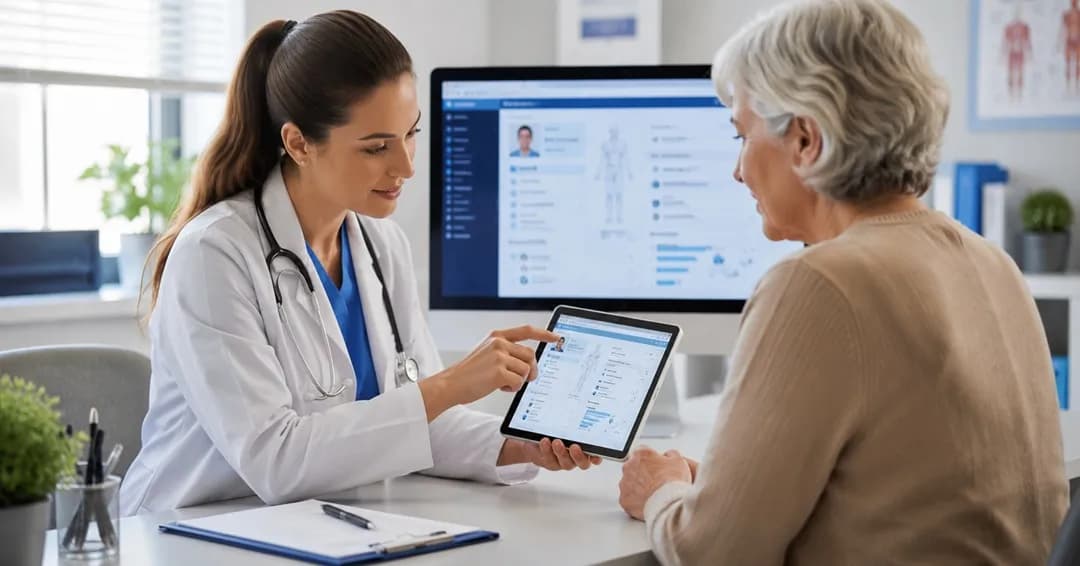
Digital health records are transforming U.S. healthcare by improving patient information accessibility, clinical decision-making, care coordination, and emergency response. Integrated with AI, telehealth, and remote monitoring, electronic health records enhance patient engagement, reduce medical errors, support value-based care, and enable healthcare providers to deliver more efficient, data-driven, and personalized treatment.
Over the years, healthcare systems all around the world have committed extensive resources in various ways to enhance the accessibility, accuracy, and usefulness of patient information to a high degree. The digitization of patient records is among the most remarkable changes to medicine in recent history. Initially, the main goal of electronic documentation was simply to digitize the paper-based files, but nowadays, these digital health records are essential clinical tools that assist in diagnosis, treatment planning, care coordination, and population health management. The benefits of these systems go beyond administrative aspects as well. Not only are they changing the way care is delivered and physicians make decisions, but also how patients engage with the healthcare system.
The U.S. is among the most developed countries in terms of the use of digital health records. Besides federal incentives, the ongoing digitization of healthcare and the increasing pressure to achieve better outcomes at lower costs pushed digital health record adoption forward. Initially, technology adoption driven only by regulatory compliance is now turning into a real operational requirement for various stakeholders, from hospitals, physician groups, specialty clinics, insurers, and public health agencies.
Nowadays, digital health records differ vastly from electronic copies of paper charts. In fact, they operate as interlinked healthcare intelligence platforms that bring together clinical histories, lab data, medication records, imaging results, and, to a greater extent, patient-generated health information. Besides, their role is no longer limited to the documentation side only, but they touch almost every aspect of the patient path.
Why Patient Information Accessibility Matters More Than Ever
The American health care system is one of the most fragmented in the world. People get healthcare from different providers in different places. One person may have a face-to-face with a doctor in Dallas, a cardiologist visit in Houston, get the pictures done in the lab in Austin, and receive emergency care while traveling in a different state. In most cases, doctors don't have the full patient's records and hence do their job based on partial information. In such cases, it not only slows down the treatment but could also lead to harmful medical situations.
Electronic health records help in bridging the information gaps. Healthcare professionals can view detailed patient records instantly, which greatly diminishes the chances of depending on patient explanations or paper records. Such a feature becomes even more indispensable when dealing with senior citizens, chronic disease patients, or those who need care from multiple specialties. Many U.S. health care providers have a few years' worth of patient information on their systems. Being able to see all of this at once can lead to a better diagnosis and a more precise treatment plan.
Approximately two-thirds (65%) of the U.S. population in 2025 will be composed of persons of working age (15-64 years); children aged 0-14 years will account for about (17%) of the total population; older persons aged 65 years and older will account for approximately 18% of the population, which demonstrates that the U.S. population is becoming aged. A very moderate amount of youth exists with youth (10-19) at 13% and youth (10-24) at around 19%. The remaining portion of the population consists of both a significant number of senior citizens (65+) as well as younger individuals (the majority being between 10-19 years).
Samsung has collaborated with b.well Connected Health, a platform aggregating the largest electronic medical record (EMR) systems in the United States. Athenahealth, Cerner Health, Epic Systems, and Veradigm are included in it. Started from the U.S., its Medications tracking feature enables users to easily track medications within the application and get tips related to their medication's general description, side effects, etc., plus warnings about drug interactions or even reactions related to food. This happens to be one of the most used features inside the Samsung Health app for users within the United States. Close to two-thirds return to manage their medications at least three times a week.
Improving Clinical Decision-Making
One major benefit of electronic health records is that they facilitate more informed and accurate clinical decision-making. Today's systems come equipped with clinical decision support (CDS) functionalities that evaluate patient data and issue evidence-based suggestions. These CDS tools can notify doctors of a patient's allergy, drug interaction, double prescription, abnormal lab value, or even a preventive care opportunity.
For instance, in case a doctor orders a medication that could potentially have a dangerous reaction with another drug presently being taken by the patient, the system is able to produce a prompt warning. Besides, digital records also enable doctors to spot a patient's health progression over an extended period of time. Tracking blood pressure, cholesterol, glucose levels, and kidney function, amongst others, becomes simpler with time.
Rather than depending on separate visits, practitioners accessing a patient's history through digital platforms get to make decisions that are well-supported and more accurate in terms of treatment progress.
In June 2025, by implementing Epic, an Electronic Health Record (EHR) system, Campbell County Health (CCH) announced a major advancement in improving patient care, communication, and operational efficiency.
Enhancing Care Coordination Across Healthcare Networks
Care coordination is often highlighted as one of the main aspects of healthcare reform in the U.S. It is not rare for a patient with chronic conditions to be attended by different doctors, nurses, therapists, pharmacists, and a primary care doctor. If they do not share the right information effectively, the treatment plans may end up being inconsistent or even duplicated. A method to accomplish this is through electronic medical records that create a common information space where healthcare workers with the proper authorization can access the most relevant patient details. This common visibility not only reduces communication failures but also ensures that care is not interrupted.
Besides the patient, the doctors, rehabilitation workers, cardiologists, nursing staff, and general practitioners are all involved in the recovery process of the patient. With unified electronic records, each healthcare professional has access to the patient's treatment history, updated medications, laboratory test results, and discharge information.
Supporting Value-Based Healthcare Models
The U.S. healthcare sector is still actively migrating away from a fee-for-service model towards value-based care systems, which focus on outcomes and efficiency. Central to this change are electronic health records.
Hospitals and other health organizations are making larger expenditures on quality measures as their performance indicators, such as the rates of preventive screening, the effectiveness of chronic disease management, the rates of readmission, and the patient satisfaction levels. Gathering such data and performing analysis would be very challenging, if not impossible, using conventional paper-based systems.
The providers of healthcare through digital platforms can track their patient populations, recognize gaps in care, and even intervene in a timely manner before the patient's condition deteriorates. In the same vein, a healthcare institution can use a digital platform to quickly get to know who amongst their diabetic patients have not gone through the HbA1c testing or the hypertensive patients who have not kept their follow-up appointments. To enhance patients' compliance and outcomes, automated reminder messages and outreach programs can be put in place. Such a preventive method is very well in line with the goals of value-based care and strategies for population health.
Reducing Medical Errors
Medical errors continue to be a major issue in healthcare systems around the world. In the past, paper records have been one of the main reasons for problems such as illegible handwriting, incomplete records, lost files, and communication failures. Electronic health records greatly minimize these errors.
Electronic prescribing systems not only do away with the problems of deciphering handwriting but also keep thorough and accurate medication records. Automated allergy checks can prevent patients from being prescribed harmful medications. Structured clinical documentation raises reliability and decreases the chance for misunderstandings.
Technology may not be able to eradicate medicine-related errors completely, but it offers several layers of defense that assist healthcare professionals in recognizing possible hazards before they get to the patients. Implementation of comprehensive electronic health record platforms has led many hospital systems to report quantifiable decreases in medication-related incidents.
Accelerating Emergency Care Delivery
Emergency departments operate under intense time pressure. Physicians often have only minutes to make critical decisions. Access to digital health records can significantly improve emergency care efficiency.
The HF Stats 2025 Heart Failure Epidemiology and Outcomes Statistics estimated that nearly 6.7 million Americans aged 20 and above are living with HF, with the number of cases projected to increase to 8.7 million by the year 2030.
When patients arrive unconscious, confused, or unable to communicate effectively, clinicians can rapidly review allergies, chronic conditions, medication histories, prior surgeries, and recent test results. This immediate access can influence treatment decisions during stroke interventions, cardiac emergencies, trauma cases, and severe allergic reactions.
As interoperability improves across the United States, emergency providers increasingly gain access to patient information from external healthcare organizations, creating a more complete clinical picture during urgent situations.
The Rise of Patient-Centered Healthcare
Digital health records are changing not only how providers deliver care but also how patients participate in their healthcare journeys. Patient portals have become increasingly common across U.S. healthcare systems. These platforms allow individuals to access laboratory results, schedule appointments, request prescription refills, review visit summaries, and communicate directly with healthcare providers.
This increased transparency promotes patient engagement and encourages individuals to take a more active role in managing their health. Research consistently suggests that engaged patients tend to demonstrate better medication adherence, improved chronic disease management, and higher satisfaction levels. Digital access to personal health information supports these outcomes by reducing informational barriers between patients and providers.
Nabla is one of the most popular AI assistants helping doctors in the clinical setting. Now Nabla introduces Nabla Connect, a plug-and-play module that allows EHR vendors to directly embed top-tier ambient AI capabilities into their products. Through Nabla Connect, EHR vendors will be able to generate more value, improve customer retention, and respond to the soaring provider requests for ambient AI without going through the complicated engineering efforts, long development cycles, and compliance issues of building the solutions internally. Usually, it takes only a few days for the completion of this simple and quick integration.
Integration with Telehealth and Remote Monitoring
The expansion of telehealth services in the United States has further increased the importance of digital health records. Virtual consultations depend heavily on immediate access to accurate patient information. During remote visits, clinicians rely on digital records to review histories, assess treatment plans, and document encounters. At the same time, remote patient monitoring technologies continue gaining traction.
Connected devices can transmit blood pressure readings, glucose measurements, heart rhythms, oxygen saturation levels, and other health indicators directly into digital record systems. Physicians can monitor patients between visits and identify potential problems before they escalate. This integration supports a more continuous model of care, particularly for patients with chronic diseases such as diabetes, hypertension, heart failure, and chronic obstructive pulmonary disease.
In the U.S., CVS Health uses integrated EHR solutions that allow pharmacists to view patient medication histories, check prescription drugs for potential interactions, and collaborate with physicians throughout the patient care continuum.
Key U.S. Companies Driving Innovation
Epic Systems Corporation
Epic Systems started in Wisconsin, and it is now among the top electronic health record vendors that have a big influence in the United States. It is the EHR vendor for many of the biggest US academic medical centers and integrated delivery networks. Epic's platform focuses on interoperability, patient engagement, population health management, and data integration. The Epic MyChart patient portal is a healthcare application, which is one of the most widely used in America. Millions of patients can access their medical information and communicate with the provider via MyChart.
Oracle Health
Located in Austin, Texas, Oracle Health is the result of Oracle's acquisition of Cerner, a key player in electronic health records in the US. Oracle has been working on updating healthcare data systems using cloud technologies, sophisticated analytics, and AI-supported clinical operations. The goal is to lessen paperwork and make data sharing easier in healthcare. Their increasing focus on integrated health data systems is in line with wider sector moves to enhance interoperability and simplify patient journeys.
The company Oracle Health launched an innovative EHR platform, a platform that will launch for U.S.-based ambulatory care providers in 2025. Built for the AI-based use, it runs on Oracle Cloud Infrastructure (OCI) and has voice-first navigation, deep AI agents for documentation, coding proposals, and clinical insights, all with the goal of reducing clinician burden and improving patient care. It is anticipated that the acute care function will be available in 2026.
Athenahealth
Athenahealth, which has its main office in Boston, Massachusetts, has successfully reached many ambulatory care providers and physician practices. The company's healthcare technology platform, based on the cloud, integrates electronic health records, practice management software, and financial solutions related to healthcare. Athenahealth is famous for assisting small healthcare organizations that need high-level functions of a big company but do not have huge internal IT resources. Its network-based method enables doctors to gain from collective clinical insights and the best practice developments.
Athenahealth, a top provider of network-enabled software and services for healthcare practices and systems across the U.S., revealed enhancements to its electronic health record (EHR) that aim to make the clinical workflow simpler from start to finish, automating the everyday tasks and providing personalized insights for a patient-centered approach to healthcare.
Veradigm
Located in Chicago, Illinois, Veradigm focuses on healthcare data, analytics, and technology solutions that connect providers, payers, researchers, and life sciences organizations. The company leverages clinical information derived from electronic health records to support real-world evidence generation, population health initiatives, and healthcare research. As healthcare increasingly becomes data-driven, Veradigm's emphasis on extracting actionable insights from clinical records has gained strategic importance.
Major Digital Health Record Platforms and Innovations in the United States
Company | Product/Platform | Development Focus | U.S. City |
Epic Systems Corporation | Epic EHR & MyChart | Integrated health records, patient engagement, interoperability, and AI-enabled workflows | Verona, Wisconsin |
Oracle Health | Oracle Health EHR | Cloud-based healthcare infrastructure, AI-assisted clinical documentation | Austin, Texas |
Athenahealth | athenaOne | Ambulatory care management, cloud EHR, revenue cycle integration | Boston, Massachusetts |
Veradigm | Veradigm Network EHR Solutions | Healthcare analytics, real-world evidence generation, population health management | Chicago, Illinois |
Challenges That Still Need Attention
Despite substantial progress, digital health records are not without limitations. Interoperability remains inconsistent across healthcare organizations. Although federal initiatives have improved data exchange standards, many providers continue facing challenges when sharing information across different platforms.
Cybersecurity concerns also continue to intensify. Healthcare data represents one of the most valuable targets for cybercriminals. Hospitals and healthcare networks must invest heavily in security infrastructure to protect sensitive patient information.
Provider burnout represents another challenge. Many clinicians report spending significant time on documentation requirements. Technology vendors increasingly focus on AI-powered clinical documentation tools designed to reduce administrative workloads and improve user experience. Addressing these issues will be critical to maximizing the long-term value of digital health record investments.
Looking Ahead
The future of digital health records in the US is probably not going to be limited to just documentation. This technology is slowly transforming into a clinical intelligence infrastructure that enables predictive medicine, personalized care, and ongoing patient involvement. As interoperability standards develop, healthcare providers will be better able to share information effortlessly. Artificial intelligence, remote monitoring devices, and sophisticated data processing will enlarge the usefulness of medical records beyond their traditional role as a recordkeeping function.
Those healthcare providers that will thrive are most probably those that consider digital records not only as compliance documents but as a powerful tool to improve patient outcomes, minimize costs, and facilitate better clinical decisions.
The real advantage of digital health records is not only in their ability to hold information but also in how they can use information to generate insightful knowledge. In fact, this is the major factor visualizing the future of healthcare in the United States, where the availability of data, expert clinical interpretations, and patient-focused care are becoming the three inseparable aspects of excellent medicine.
Have questions?
More Thought Articles
How EV Charger Manufacturers Can Capitalize on India’s Home Charging Revolution
India’s residential EV charging opportunity is expanding as policy support, EV adoption, and private parking infrastructure develop. Manufacturers can capture value beyond AC chargers through installation, smart charging, load management, solar integration, software, and after-sales services. Housing societies, automakers, and property developers offer scalable routes to residential charging customers.
Second-Life EV Battery Market in India: What Is Driving Demand from Manufacturers?
India’s second-life EV battery market is gaining relevance as electric vehicle adoption expands and batteries retain useful capacity after automotive service. Growing stationary-storage demand, battery data, refurbishment capabilities, EPR obligations, and critical-mineral policies are encouraging manufacturers to extend battery value through reuse before eventual recycling within India’s emerging circular battery ecosystem.
The Rise of Locally Manufactured Battery Separators in India’s EV Ecosystem
India’s battery industry is progressing from pack assembly toward domestic cell and material manufacturing, creating opportunities for lithium-ion battery separators. Policy support, ACC capacity expansion and R&D initiatives are strengthening the ecosystem. However, technical complexity, manufacturing yields, qualification requirements and economics mean localisation will likely advance gradually through coatings, testing and finishing.