
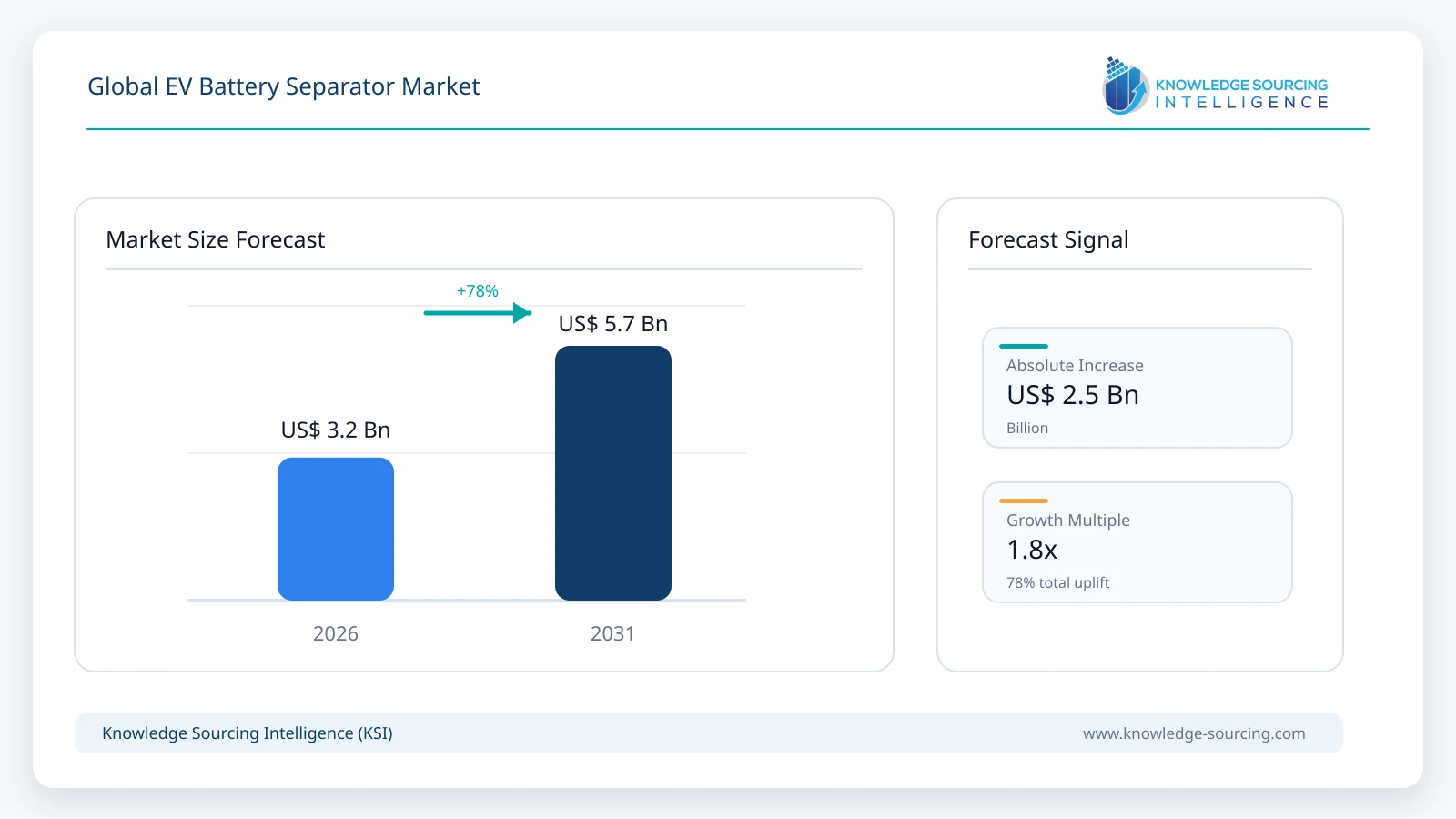
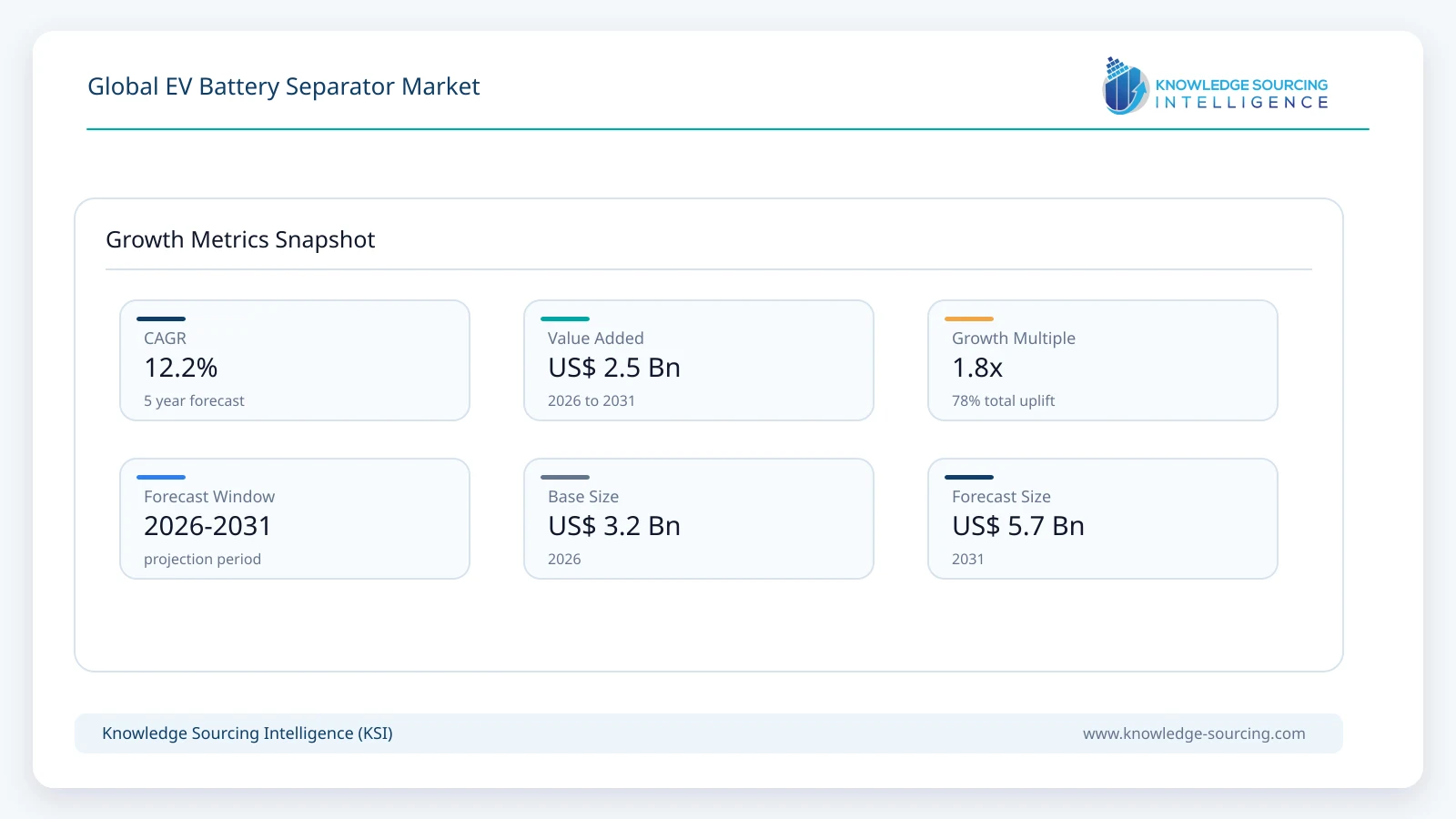
The Global EV Battery Separator market is forecast to grow at a CAGR of 12.2%, reaching USD 5.7 billion in 2031 from USD 3.2 billion in 2026.
Highlights:
- 132% of market value in 2026Polyethylene remains the largest material segment, accounting for approximately .
- 216.8% annually through 2031Ceramic-Coated Separators are projected to grow at approximately , making them the fastest-growing major material category.
- 386% of separator market value in 2026Battery Electric Vehicles represent approximately , reflecting their substantially larger battery packs.
- 474% of global market value in 2026Asia Pacific accounts for approximately , supported by China’s scale and established Japanese and South Korean separator suppliers.
- 5North America records one of the strongest regional growth rates as Asahi Kasei, ENTEK and Microporous develop localized production.
- 61.2 TWh in 2025EV battery deployment reached approximately and is projected by the IEA to approach 3 TWh by 2030.
Battery separators are thin microporous membranes positioned between the positive and negative electrodes of lithium-ion cells. They prevent direct electrical contact between the electrodes while allowing ionic movement through the electrolyte, making separator performance central to battery safety, charging behaviour, cycle life, and manufacturing yield.
Demand is directly linked to the expansion of battery-cell production rather than vehicle sales alone. Global EV battery deployment reached approximately 1.2 TWh in 2025, almost 30% above 2024 and more than seven times the 2020 level. The IEA expects deployment to approach 3 TWh by 2030 under its main policy scenarios, indicating a substantial increase in the quantity of separator film required by automotive battery production.
Polyethylene remains the largest individual material platform and accounts for approximately 32% of market value in 2026. Wet-process PE separators are widely used in automotive lithium-ion batteries because manufacturers can achieve thin films, controlled pore structures, and high mechanical performance at scale. At the same time, Ceramic-Coated Separators represent the strongest value-growth opportunity as cell manufacturers seek improved thermal stability, puncture resistance and interface performance for increasingly demanding battery designs.
The market is also becoming more geographically diversified. Asia Pacific remains the dominant manufacturing centre, but North America and Europe are developing regional separator capacity as automotive companies seek more resilient battery supply chains. Asahi Kasei’s Canadian project is designed for approximately 700 million square metres of annual coated separator capacity, while ENTEK’s Terre Haute project is supported by a USD 1.3 billion U.S. Department of Energy loan.
Growth Drivers and Trends
EV Battery Deployment Is Expanding the Separator Demand Base
The fundamental demand mechanism is the continued expansion of rechargeable battery manufacturing for electric vehicles. Every conventional lithium-ion cell requires an electronically insulating but ionically permeable separator, meaning additional battery production translates directly into greater separator requirements.
The IEA reports that EV battery deployment reached around 1.2 TWh in 2025, up almost 30% year on year. Light-duty vehicles accounted for more than 85% of deployment, while battery demand from electric trucks expanded even faster. By 2030, EV battery deployment is expected to approach 3 TWh under the IEA’s Current Policies and Stated Policies scenarios.
Global electric-car sales exceeded 20 million units in 2025, representing around one-quarter of new cars sold worldwide. The IEA expects sales to reach roughly 23 million in 2026. This provides a strong physical-volume foundation for separator demand even before accounting for greater technical complexity or regional manufacturing expansion.
Ceramic and Functional Coatings Are Increasing Separator Value
Separator suppliers are increasingly competing on functional performance rather than base-film volume alone. Ceramic and polymer coatings can improve heat resistance, electrolyte wettability, mechanical strength and adhesion between the separator and electrode stack.
Asahi Kasei continues to expand Hipore coating capability, while SEMCORP is developing ultra-thin separator products combined with ceramic, polymer and hybrid coating technologies. SEMCORP’s 5-micron separator is designed to increase the space available for active material while maintaining mechanical performance.
This trend is particularly important as battery manufacturers increase energy density and charging performance. Higher-performance cells generate greater thermal and mechanical demands, making advanced coatings more commercially important even when the underlying polyolefin base film remains similar.
Battery Supply-Chain Localization Is Reshaping Capacity Investment
Battery-cell production remains concentrated in Asia, but automotive manufacturers and policymakers in North America and Europe increasingly seek regional component supply. Separators are strategically important because qualification cycles are lengthy and a supply disruption can stop an entire cell-production line.
ENTEK’s Indiana project is designed to establish large-scale U.S. wet-process lithium-ion separator capacity and is supported by a USD 1.3 billion Department of Energy loan. Asahi Kasei is developing an integrated separator facility in Ontario with Honda participation and opened a new Hipore coating line in North Carolina in August 2026.
Microporous is also expanding U.S. capacity. In May 2026, the company reported annual offtake agreements exceeding half a billion square metres, supporting more than 50 GWh of battery capacity and underpinning its Virginia expansion.
Ultra-Thin Films Increase the Importance of Process Control
Reducing separator thickness can create more room for active electrode material inside a battery cell, potentially improving energy density. However, thinner films increase requirements for puncture resistance, pore uniformity, dimensional stability and defect detection.
SEMCORP’s current 5-micron separator demonstrates this trade-off. The company reports substantially reduced thickness while maintaining high puncture strength, illustrating why future separator development depends increasingly on materials science and manufacturing precision rather than simply increasing film output.
This creates a strong competitive advantage for manufacturers that can produce ultra-thin membranes at high yield. A technically advanced separator has limited commercial value if defect rates or production variability prevent large-scale automotive qualification.
AI Inspection and Digital Manufacturing Are Improving Yield Economics
Battery separators are highly sensitive to pinholes, contamination, coating variation and thickness defects. Inspection therefore becomes more difficult as films become thinner and manufacturing lines operate at higher speeds.
In June 2026, SEMCORP entered a strategic cooperation agreement with LUSTER LightTech to deploy AI-based visual inspection, process analytics and closed-loop quality control across domestic and overseas separator facilities. The stated objective is to move from passive defect detection toward predictive warning and real-time process optimisation.
Manufacturing technology therefore becomes a source of competitive differentiation alongside membrane chemistry. Suppliers capable of maintaining higher usable yield can improve margins even during periods of aggressive price competition.
Market Restraints
Customer Qualification Cycles Are Lengthy
Separators are safety-critical battery components. Cell manufacturers therefore need to validate mechanical strength, porosity, electrolyte interaction, thermal behaviour, coating performance and compatibility with their manufacturing processes before approving a supplier.
Once qualified, battery manufacturers generally avoid changing separator specifications without extensive testing. This favours established suppliers but can delay revenue generation from newly commissioned capacity.
Capacity Expansion Can Create Pricing Pressure
Separator production capacity has expanded rapidly, particularly in China. Large-scale investment improves availability but can create temporary overcapacity when battery-cell projects are delayed or vehicle demand grows more slowly than expected.
Price pressure is strongest in standardized base films. Manufacturers consequently seek to differentiate through thinner products, advanced coatings, higher safety performance and stronger customer qualification.
Manufacturing Yield Strongly Influences Economics
Separator manufacturing requires tight control over resin quality, stretching, pore formation, solvent removal, coating, drying and inspection. Small defects can render significant sections of membrane unusable.
Ultra-thin products make this issue more important because production tolerances become narrower. Plant economics therefore depend on qualified usable output rather than nameplate square-metre capacity alone.
Technology Evolution Creates Long-Term Product Risk
Lithium-ion battery architecture continues to evolve across LFP, high-nickel chemistries, silicon-rich anodes, sodium-ion technologies and solid-state systems. Each can impose different separator requirements.
Conventional liquid-electrolyte lithium-ion cells continue to dominate EV production through the forecast period, so separators remain essential. However, manufacturers need to invest in new membrane and coating technologies to remain relevant as battery architecture evolves.
Localization Increases Capital Requirements
Regional production reduces logistics exposure and can improve access to government-supported automotive programmes, but separator factories require substantial capital and need sufficient customer commitments to achieve efficient utilisation.
Asahi Kasei’s Canadian project involves approximately ¥180 billion of investment, while ENTEK’s U.S. expansion similarly requires large-scale public and private financing.
Localization therefore provides strategic value but can pressure returns if battery-cell projects are delayed or plants operate below planned utilisation.
Segment Analysis
By Material Type
Polyethylene Remains the Largest Material Segment
Polyethylene accounts for approximately 32% of market value in 2026, making it the largest individual material platform. Wet-process PE separators have become widely established in automotive lithium-ion batteries because they can combine thin gauge, uniform microporous structures and strong mechanical properties at large production volumes.
The material benefits from mature manufacturing processes and extensive qualification across major battery platforms. As cell manufacturers pursue higher energy density, PE films are becoming thinner and more technically sophisticated rather than simply being displaced by alternative materials.
PE therefore remains central to the separator market through 2031 even as its share moderates gradually. The commercial focus increasingly shifts toward thinner films, improved uniformity and functional coatings applied to the PE substrate.
Ceramic-Coated Separators Record the Strongest Growth
Ceramic-Coated Separators are projected to grow at approximately 16.8% annually through 2031, materially faster than the total market. Their growth reflects the need for greater thermal stability and mechanical protection as manufacturers increase cell energy density and charging performance.
Ceramic particles can improve dimensional stability at elevated temperatures and reduce the risk of separator shrinkage under thermal stress. Coatings can also improve electrolyte interaction and mechanical resistance depending on the formulation.
Asahi Kasei, SEMCORP, SK IE Technology and other major suppliers continue to expand coated-product capacity, demonstrating that coating technology is moving from an optional premium feature toward an increasingly important part of high-performance automotive separator design.
By Vehicle Type
Battery Electric Vehicles Dominate Separator Demand
Battery Electric Vehicles account for approximately 86% of separator-market value in 2026, making BEVs overwhelmingly the largest vehicle segment. The principal reason is battery size rather than vehicle-unit share. A BEV commonly carries tens of kilowatt-hours of battery capacity, while conventional hybrids use much smaller packs.
Growth in battery-electric car sales therefore has a disproportionate effect on separator demand. The IEA reports that global electric-car sales exceeded 20 million units in 2025 and expects continued expansion in 2026 and beyond.
The segment remains the primary volume engine through 2031 as battery capacity deployed in passenger cars, commercial vehicles and trucks increases.
Battery Electric Vehicles Also Remain the Fastest-Growing Major Vehicle Segment
Unlike some markets where the largest segment is mature, BEVs are also projected to record the strongest separator-demand growth among the principal vehicle categories, at approximately 12.8% annually through 2031.
The growth is driven by both higher EV sales and the substantially greater amount of separator material required per vehicle. Increasing adoption of electric SUVs, commercial vehicles and trucks can further raise average battery capacity.
PHEVs and HEVs remain part of the market structure and are fully modelled internally, but their smaller battery packs make them less important to separator value creation than BEVs during the forecast period.
Geographical Outlook
Asia Pacific Remains the Largest Regional Market
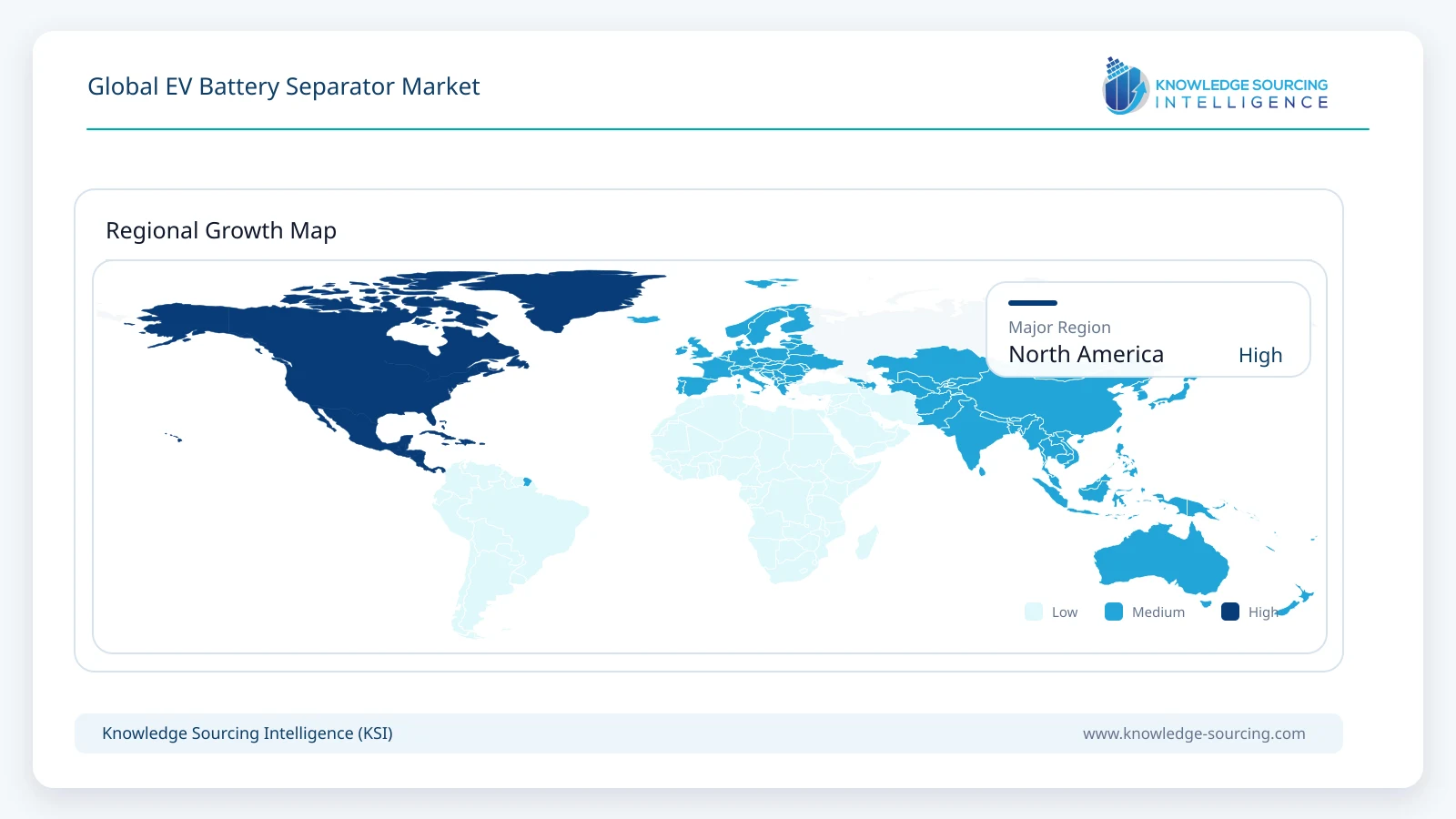
Asia Pacific accounts for approximately 74% of global market value in 2026, reflecting its dominant position in lithium-ion battery manufacturing. China combines the world’s largest EV market with extensive domestic battery-cell and separator capacity, while Japan and South Korea retain strong materials and separator technology positions.
The regional supplier base includes SEMCORP, SK IE Technology, Asahi Kasei, Toray, W-SCOPE, Sumitomo Chemical, Shenzhen Senior Technology Material, Sinoma Lithium Battery Separator, Putailai, Gellec, Cangzhou Mingzhu and ZIMT.
This manufacturing depth provides economies of scale but also creates intense pricing competition. Asia Pacific nevertheless remains the principal production and consumption centre through 2031.
North America Records the Strongest Regional Growth
North America is projected to record a mid-teens CAGR through 2031, making it one of the fastest-growing regional separator markets despite starting from a much smaller base than Asia Pacific.
The growth is driven by supply-chain localization rather than EV adoption alone. ENTEK is developing substantial U.S. separator capacity, Asahi Kasei is expanding in Canada and North Carolina, and Microporous is increasing U.S. production backed by long-term offtake agreements.
The region therefore increases its share of global separator value through 2031, even though Asia Pacific continues to dominate global manufacturing.
Recent Developments
In August 2026, Asahi Kasei inaugurated a new Hipore wet-process separator coating line in Charlotte, North Carolina. Commercial production is scheduled to begin during the second half of fiscal 2026.
In August 2026, SEMCORP commissioned the first production line of Phase II at its Yuxi separator project, beginning the next stage of capacity expansion after Phase I production lines reached operation.
In June 2026, SEMCORP signed a global cooperation agreement with LUSTER LightTech to deploy AI visual inspection and intelligent quality management across its separator manufacturing network.
In May 2026, Microporous announced annual separator offtake agreements totalling more than half a billion square metres, supporting more than 50 GWh of battery production.
In April 2026, Microporous secured final financing for its Danville, Virginia separator plant. At full capacity, the facility is expected to support approximately 65 GWh of annual battery production.
Competitive Environment
The EV battery separator market is concentrated around Asian manufacturers but is becoming geographically more diversified. SEMCORP holds one of the strongest positions in wet-process separator production and continues to increase both capacity and coating sophistication. SK IE Technology remains a major Korean separator specialist, while Asahi Kasei combines Hipore wet-process technology with Celgard dry-process capabilities.
Toray, W-SCOPE, Sumitomo Chemical and UBE provide additional Japanese and Korean technology depth. China has developed a broad second tier of large-scale suppliers including Shenzhen Senior Technology Material, Sinoma Lithium Battery Separator, Shanghai Putailai, Hebei Gellec, Cangzhou Mingzhu and ZIMT.
North American suppliers are becoming strategically more important. ENTEK is building large-scale wet-process capacity, while Microporous is expanding coated separator production. Local supply does not immediately replace Asian production, but it provides battery manufacturers with additional sourcing options and reduces geographic concentration.
Competition through 2031 is expected to depend increasingly on manufacturing yield, film thickness, coating performance, regional capacity and qualification history. Suppliers that combine these capabilities with disciplined capacity utilization are better positioned than companies competing primarily on headline production capacity.
Analyst View
The Global EV Battery Separator Market is supported by the continued expansion of electric vehicle battery manufacturing and rising demand for lithium-ion battery technologies. The demand case remains structurally strong because separators are essential components of conventional lithium-ion cells, while increasing EV adoption and battery deployment continue to strengthen requirements for advanced separator technologies.
The larger commercial opportunity is increasingly concentrated in performance improvement rather than basic membrane volume. Polyethylene remains the largest material platform, but Ceramic-Coated Separators grow faster as cell manufacturers place greater emphasis on thermal stability, mechanical performance, and higher-energy-density battery architectures.
Battery Electric Vehicles remain both the largest and fastest-growing vehicle application because their battery packs are substantially larger than those used in hybrid vehicles. Geographically, Asia Pacific retains overwhelming manufacturing leadership, while North America gains share as regional separator projects enter production.
The strongest suppliers through 2031 should therefore be those that combine high-throughput manufacturing, strong customer qualification, thinner films, advanced coatings and geographically diversified production while avoiding excessive capacity expansion.
EV Battery Separator Market Scope
| Report Metric | Details |
|---|---|
| Total Market Size in 2026 | USD 3.2 billion |
| Total Market Size in 2031 | USD 5.7 billion |
| Forecast Unit | Billion |
| Growth Rate | 12.2% |
| Study Period | 2021 to 2031 |
| Historical Data | 2021 to 2024 |
| Base Year | 2025 |
| Forecast Period | 2026 – 2031 |
| Segmentation | Material Type, Vehicle Type, Geography |
| Companies |
|
Market Segmentation
By Material Type
· Polyethylene (PE)
· Polypropylene (PP)
· Multilayer Polyolefin Separators
· Ceramic-Coated Separators
· Composite and Non-Woven Separators
· Others
By Vehicle Type
· Battery Electric Vehicles (BEVs)
· Hybrid Electric Vehicles (HEVs)
· Plug-in Hybrid Electric Vehicles (PHEVs)
By Geography
· North America
o United States
o Canada
o Mexico
· South America
o Brazil
o Argentina
o Others
· Europe
o United Kingdom
o Germany
o France
o Spain
o Italy
o Others
· Middle East and Africa
o Saudi Arabia
o United Arab Emirates
o Israel
o South Africa
o Others
· Asia Pacific
o China
o Japan
o South Korea
o India
o Indonesia
o Thailand
Others
Table of Contents
1. INTRODUCTION
1.1. Market Overview
1.2. Market Definition
1.3. Scope of the Study
1.4. Market Segmentation
1.5. Currency
1.6. Assumptions
1.7. Base and Forecast Years Timeline
1.8. Key Benefits for Stakeholders
2. RESEARCH METHODOLOGY
2.1. Research Design
2.2. Research Process
3. EXECUTIVE SUMMARY
3.1. Key Findings
4. MARKET DYNAMICS
4.1. Market Drivers
4.2. Market Restraints
4.3. Market Opportunities
4.4. Porter’s Five Forces Analysis
4.5. Industry Value Chain Analysis
4.6. Regulatory and Policy Environment
4.7. Analyst View
5. GLOBAL EV BATTERY SEPARATOR MARKET BY MATERIAL TYPE
5.1. Introduction
5.2. Polyethylene (PE)
5.3. Polypropylene (PP)
5.4. Multilayer Polyolefin Separators
5.5. Ceramic-Coated Separators
5.6. Composite and Non-Woven Separators
5.7. Others
6. GLOBAL EV BATTERY SEPARATOR MARKET BY VEHICLE TYPE
6.1. Introduction
6.2. Battery Electric Vehicles (BEVs)
6.3. Hybrid Electric Vehicles (HEVs)
6.4. Plug-in Hybrid Electric Vehicles (PHEVs)
7. GLOBAL EV BATTERY SEPARATOR MARKET BY GEOGRAPHY
7.1. Introduction
7.2. North America
7.2.1. United States
7.2.2. Canada
7.2.3. Mexico
7.3. South America
7.3.1. Brazil
7.3.2. Argentina
7.3.3. Others
7.4. Europe
7.4.1. United Kingdom
7.4.2. Germany
7.4.3. France
7.4.4. Spain
7.4.5. Italy
7.4.6. Others
7.5. Middle East and Africa
7.5.1. Saudi Arabia
7.5.2. United Arab Emirates
7.5.3. Israel
7.5.4. South Africa
7.5.5. Others
7.6. Asia Pacific
7.6.1. China
7.6.2. Japan
7.6.3. South Korea
7.6.4. India
7.6.5. Indonesia
7.6.6. Thailand
7.6.7. Others
8. COMPETITIVE ENVIRONMENT AND ANALYSIS
8.1. Major Players and Strategy Analysis
8.2. Market Share Analysis
8.3. Mergers, Acquisitions, Agreements and Collaborations
8.4. Competitive Dashboard
9. COMPANY PROFILES
9.1. SEMCORP Group
9.2. SK IE Technology Co., Ltd.
9.3. Asahi Kasei Battery Separator Corporation
9.4. Toray Industries, Inc.
9.5. ENTEK International LLC
9.6. W-SCOPE Corporation
9.7. Sumitomo Chemical Co., Ltd.
9.8. UBE Corporation
9.9. Shenzhen Senior Technology Material Co., Ltd.
9.10. Sinoma Lithium Battery Separator Co., Ltd.
9.11. Shanghai Putailai New Energy Technology Co., Ltd.
9.12. Teijin Limited
9.13. Microporous, LLC
9.14. Hebei Gellec New Energy Science & Technology Co., Ltd.
9.15. Cangzhou Mingzhu Plastic Co., Ltd.
9.16. Zhongxing Innovative Material Technologies Co., Ltd. (ZIMT)
9.17. Foshan Jinhui Hi-Tech Optoelectronic Material Co., Ltd.
10. APPENDIX
10.1. Currency
10.2. Assumptions
10.3. Base and Forecast Years Timeline
10.4. Key Benefits for Stakeholders
10.5. Research Methodology
10.6. Abbreviations
Navigate
Trusted by the world's leading organizations











