
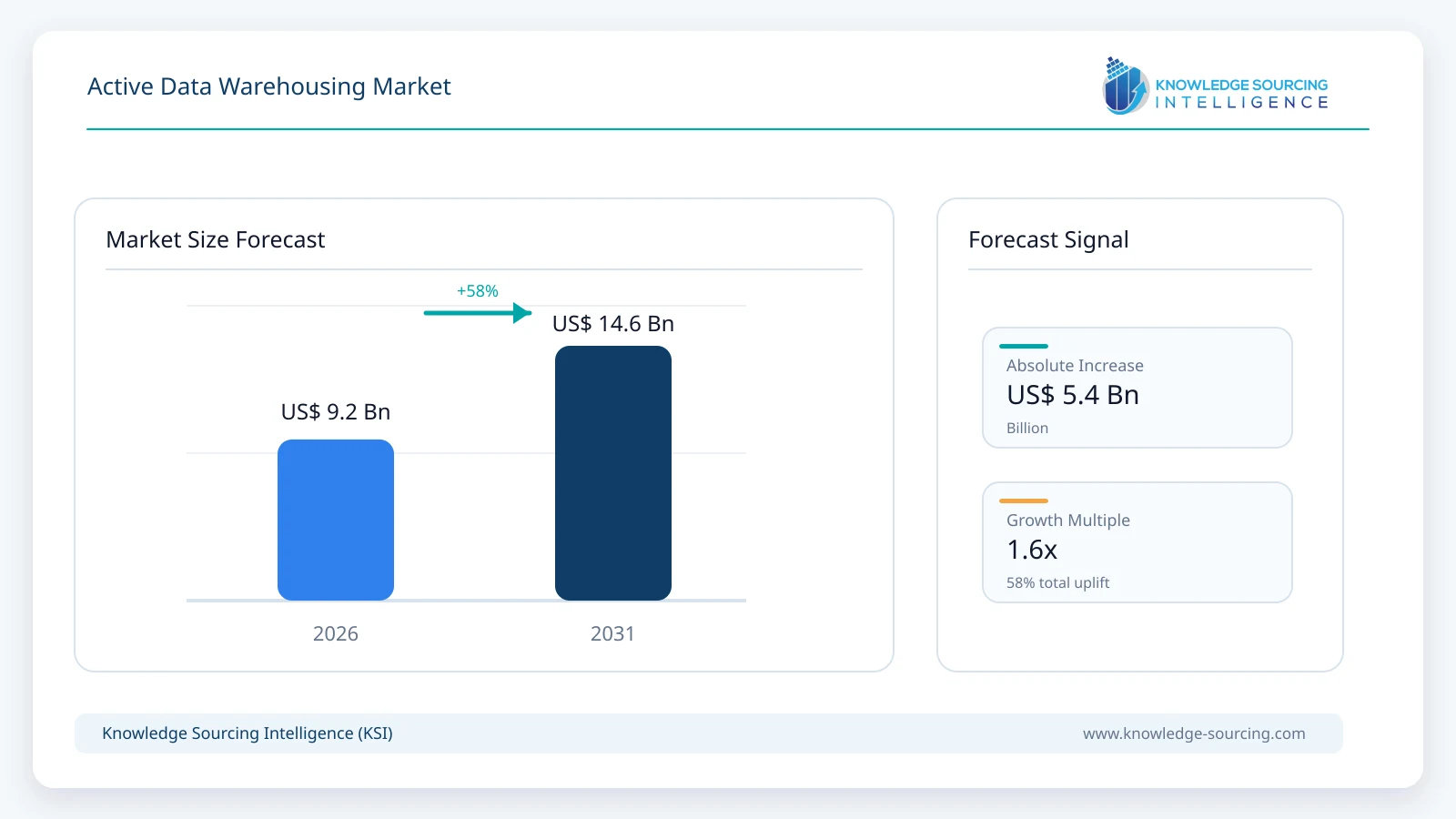
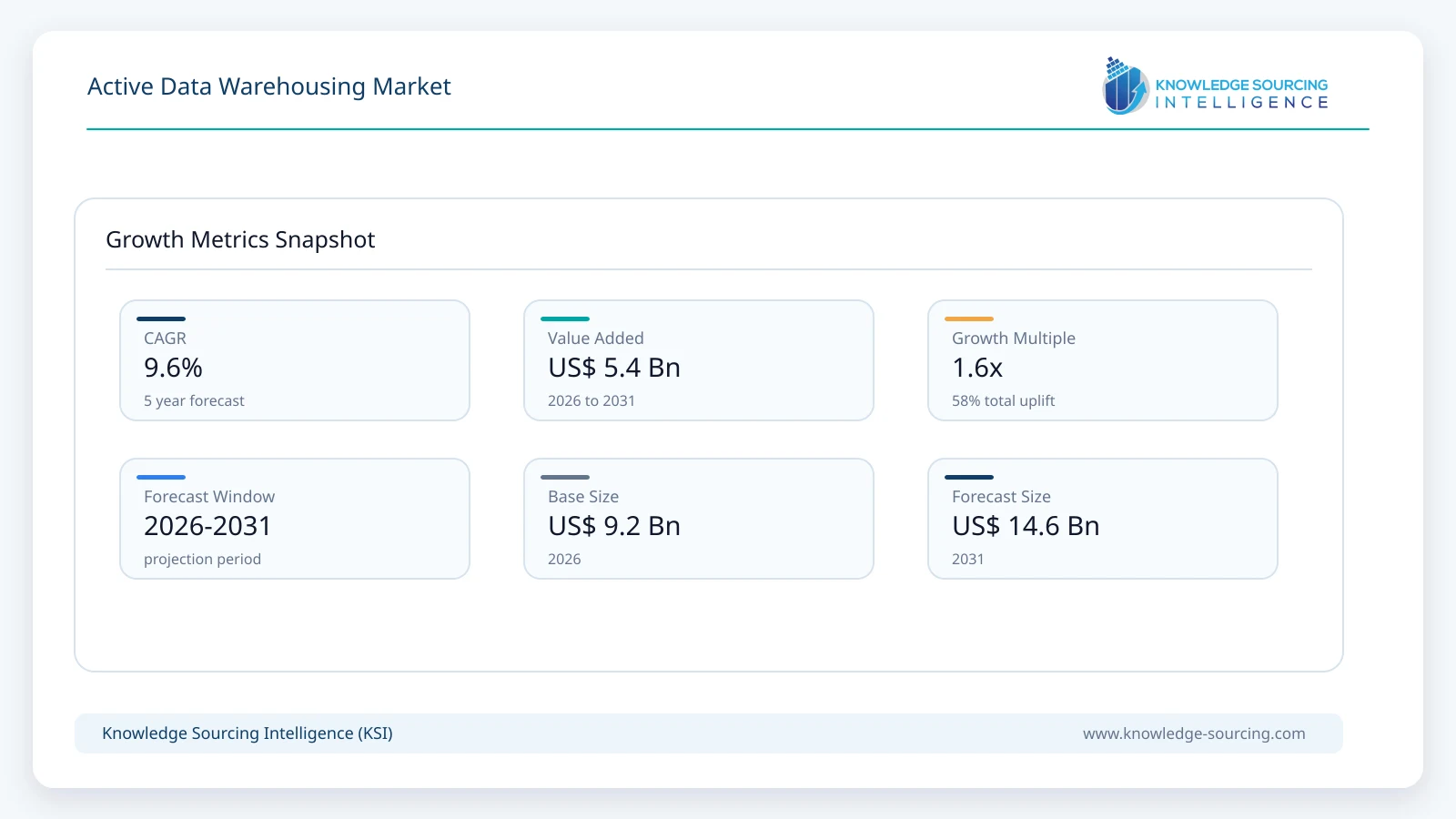
The Active Data Warehousing Market is forecast to grow at a CAGR of 9.60%, reaching USD 14.61 billion in 2031 from USD 9.24 billion in 2026.
Highlights:
- 1Continuous operational analytics and AI-driven decision support remain the primary demand catalyst across data-intensive industries.
- 2Cloud deployment represents the strongest investment area as enterprises modernize legacy analytical infrastructure.
- 3Large enterprises account for substantial spending owing to complex multi-source data integration requirements.
- 4BFSI remains the leading commercial application because of real-time fraud detection, compliance reporting, and risk analytics.
- 5North America maintains a strong market position due to mature cloud adoption, enterprise IT investment, and advanced analytics deployment.
- 6Competition increasingly centers on hybrid cloud interoperability, automation, and integrated AI capabilities.
The active data warehousing market comprises software platforms and associated services that enable enterprises to capture, integrate, process, and analyze operational and historical data with minimal latency for business-critical decision-making. Unlike conventional data warehouses designed primarily for periodic reporting, active data warehousing environments continuously refresh information from multiple transactional systems, cloud applications, streaming platforms, and connected devices. This capability allows organizations to support real-time dashboards, fraud monitoring, inventory optimization, predictive maintenance, customer analytics, and operational intelligence.
Enterprise demand for active data warehousing continues to expand as organizations generate larger volumes of structured and semi-structured information across distributed environments. Financial institutions require immediate visibility into transactions to reduce fraud exposure and manage regulatory reporting. Retailers depend on continuously updated customer and inventory data to optimize pricing and fulfilment. Manufacturing companies use operational data to improve equipment utilization and production scheduling, while healthcare organizations increasingly require near real-time clinical and administrative insights to improve resource allocation and patient outcomes.
Buyer priorities have shifted beyond storage capacity toward analytical responsiveness, scalability, workload management, and interoperability across hybrid IT environments. Procurement teams increasingly evaluate platforms based on integration with cloud-native analytics, artificial intelligence (AI), machine learning (ML), governance capabilities, metadata management, security architecture, and support for open data formats. Enterprises also seek predictable operating costs and reduced administrative complexity, particularly as data estates become more geographically distributed.
The industry structure includes global enterprise software vendors, cloud platform providers, specialized analytics companies, and data management solution providers. Competition extends beyond database performance to encompass ecosystem integration, workload automation, AI-assisted optimization, and support for multi-cloud deployments. Managed services, consulting, migration assistance, and lifecycle support have become important revenue contributors as organizations modernize legacy data warehouse environments.
Commercial demand is also influenced by enterprise investment in cloud infrastructure and data modernization initiatives. Many organizations operate hybrid architectures where sensitive workloads remain on-premises while analytical processing expands into public cloud environments. Consequently, active data warehousing platforms increasingly support workload portability, elastic computing resources, and unified governance across multiple deployment models.
Industry adoption reflects both technological advancement and changing business economics. Organizations seek to shorten reporting cycles, improve forecasting accuracy, reduce manual intervention, and enable business users to access trusted information with minimal delay. These objectives continue to position active data warehousing as a foundational component of enterprise data architecture rather than simply a repository for historical information.
Market Drivers
Expansion of Real-Time Enterprise Decision-Making
Organizations increasingly depend on operational intelligence rather than retrospective reporting. Executives require continuously refreshed performance indicators to respond to supply chain disruptions, financial risks, customer demand fluctuations, and operational incidents. Active data warehousing enables rapid data consolidation across enterprise applications, reducing analytical latency. Vendors respond by enhancing streaming data ingestion, automated workload optimization, and intelligent query acceleration, creating measurable productivity improvements for enterprise buyers.
Growth of Cloud-Based Enterprise Infrastructure
Migration toward public and hybrid cloud environments has fundamentally altered enterprise data management strategies. Businesses seek analytical platforms capable of supporting distributed workloads without compromising governance or performance. Procurement decisions increasingly favor solutions that simplify migration, scale computational resources efficiently, and reduce capital expenditure. Cloud-native active data warehouses benefit from consumption-based pricing models that align infrastructure costs with business activity.
Rising Adoption of Artificial Intelligence and Advanced Analytics
Machine learning applications depend on timely, high-quality enterprise data. Active data warehouses provide centralized, continuously updated datasets required for predictive analytics, recommendation engines, forecasting models, and intelligent automation. Organizations increasingly prioritize platforms capable of integrating analytical workloads directly with AI development environments. Software providers continue expanding embedded AI features, automated optimization, and natural language query capabilities to improve accessibility for business users.
Increasing Regulatory Reporting Requirements
Industries such as banking, healthcare, telecommunications, and utilities face stringent reporting obligations that require accurate, auditable, and timely information. Active data warehousing supports regulatory compliance by improving data consistency, lineage tracking, and reporting automation. Vendors strengthen governance capabilities, metadata management, encryption, and access controls to satisfy procurement requirements from highly regulated industries.
Market Restraints and Challenges
Complex Legacy System Integration
Many enterprises continue operating decades-old transactional systems that were not designed for continuous analytical synchronization. Integrating these environments with modern cloud-based active data warehouses requires specialized expertise, extended implementation timelines, and substantial investment. Organizations often adopt phased modernization strategies to reduce operational disruption while preserving critical business processes.
Escalating Data Governance Requirements
Growing data volumes increase complexity surrounding quality management, master data consistency, access control, and regulatory compliance. Organizations must establish comprehensive governance frameworks before fully realizing the value of active analytics. Weak governance can reduce confidence in analytical outputs and delay enterprise-wide adoption.
Cost Management Across Hybrid Architectures
Although cloud platforms improve scalability, organizations frequently encounter rising operational expenditure associated with storage, data movement, compute-intensive analytics, and multi-cloud management. Procurement teams increasingly emphasize workload optimization, resource monitoring, and lifecycle cost transparency when evaluating vendors.
Shortage of Advanced Data Engineering Skills
Implementing active data warehousing requires expertise in cloud architecture, database optimization, integration engineering, cybersecurity, and advanced analytics. Many organizations experience delays due to limited availability of experienced professionals. Vendors increasingly address this constraint through automation, low-code administration tools, and managed service offerings.
Major Segment Analysis
Banking, Financial Services, and Insurance (BFSI)
The BFSI industry represents the most commercially important end-user segment because financial institutions process exceptionally high transaction volumes while operating under rigorous regulatory oversight. Active data warehousing enables banks, insurers, payment providers, and investment firms to consolidate transactional, customer, operational, and risk information into continuously updated analytical environments.
Demand is driven by fraud detection, anti-money laundering monitoring, customer behavior analytics, credit risk assessment, regulatory reporting, and personalized financial services. Financial institutions increasingly require analytical systems capable of processing streaming transaction data alongside historical customer information to identify anomalies before financial losses occur.
Procurement decisions prioritize security architecture, regulatory compliance, system availability, disaster recovery capabilities, and seamless integration with core banking applications. Buyers also evaluate scalability to accommodate growing digital payment volumes and expanding customer interaction channels.
Competition within this segment increasingly focuses on AI integration, automated governance, advanced encryption, workload isolation, and cloud interoperability. Vendors capable of reducing implementation complexity while maintaining strict compliance standards achieve stronger commercial positioning. Continued investment in digital banking, open banking ecosystems, and real-time payment infrastructure supports sustained demand for active data warehousing across global financial markets.
Regional Analysis
North America remains the largest revenue-generating region due to extensive enterprise cloud adoption, mature analytics capabilities, and substantial investment in AI-enabled business intelligence. Large financial institutions, technology companies, healthcare providers, and retailers continue investing in advanced data architectures. Regulatory expectations surrounding cybersecurity and data governance further encourage modernization of enterprise data infrastructure.
Europe demonstrates steady demand supported by industrial digitalization, manufacturing modernization, financial services innovation, and expanding cloud adoption. Compliance requirements associated with data protection regulations encourage organizations to strengthen governance, metadata management, and secure data integration practices. Hybrid deployment remains particularly important for organizations balancing regulatory obligations with cloud scalability.
Asia Pacific represents the fastest-expanding regional opportunity as enterprises accelerate digital investment across banking, telecommunications, manufacturing, healthcare, and e-commerce. Governments continue supporting cloud infrastructure, smart manufacturing, digital public services, and AI development. Rapid growth in enterprise data volumes creates favorable conditions for active data warehousing adoption despite varying levels of digital maturity across countries.
Middle East and Africa continues progressing through government-led digital infrastructure investment, financial sector modernization, and smart city initiatives. Demand is strongest among public sector organizations, financial institutions, telecommunications providers, and energy companies. Adoption remains constrained in certain markets by infrastructure disparities and limited availability of advanced technical expertise.
South America demonstrates gradual market expansion driven by banking modernization, retail digitalization, telecommunications investment, and broader enterprise cloud adoption. Economic volatility influences capital expenditure decisions; however, organizations increasingly recognize operational analytics as an important productivity investment. Managed cloud services are expected to gain wider acceptance as enterprises seek cost-efficient modernization strategies.
Competitive Landscape
The competitive environment is characterized by global cloud providers, enterprise software companies, and specialized data platform vendors competing across performance, scalability, interoperability, automation, and governance capabilities. Suppliers increasingly differentiate offerings through unified analytics platforms that combine active data warehousing with AI, machine learning, data lakes, streaming analytics, and metadata management.
Competition increasingly extends beyond database performance toward ecosystem compatibility. Enterprises prefer vendors capable of integrating with existing ERP systems, cloud platforms, business intelligence applications, cybersecurity frameworks, and developer environments. Strategic partnerships with cloud infrastructure providers, systems integrators, and enterprise software vendors continue expanding deployment opportunities.
Hybrid cloud capabilities have become a major competitive factor as customers seek flexibility across public cloud, private cloud, and on-premises environments. Vendors also compete by simplifying migration from legacy systems through automated conversion tools, consulting services, and managed operations. Geographic expansion, localized support services, and investment in AI-enabled workload optimization further strengthen competitive positioning among Oracle Corporation, Microsoft Corporation, Amazon Web Services, Inc., Google LLC (Google Cloud), International Business Machines Corporation, SAP SE, Snowflake Inc., Teradata Corporation, Databricks, Inc., and Cloudera, Inc.
Recent Developments
June 2026: Snowflake made Adaptive Compute generally available, automatically optimizing compute resources for changing workloads to improve query performance, scalability, and efficiency across enterprise cloud data warehouse environments.
May 2026: Databricks announced the general availability of Query-based Connectors for Lakeflow Connect, enabling direct database ingestion from Oracle, Teradata, SQL Server, MySQL, MariaDB, and PostgreSQL without requiring CDC configuration or ingestion gateways.
April 2026: Databricks introduced Query-based Connectors for Lakeflow Connect in Public Preview, allowing organizations to simplify continuous operational data ingestion from major enterprise databases for active analytics and warehousing workloads.
Regulatory and Policy Environment
Regulatory compliance continues to influence enterprise investment in active data warehousing. Data protection regulations require organizations to maintain appropriate governance, access controls, auditability, and lifecycle management for sensitive information. Financial institutions must satisfy supervisory reporting obligations, while healthcare organizations manage stringent privacy requirements for patient records.
International standards relating to information security management, cybersecurity controls, cloud security assurance, and business continuity increasingly shape procurement decisions. Public sector cloud modernization programs across multiple countries further encourage adoption of secure analytical platforms capable of meeting government security requirements.
Organizations also face growing expectations regarding data sovereignty, cross-border data transfers, and responsible AI governance. Consequently, vendors continue strengthening encryption, identity management, metadata tracking, policy automation, and compliance reporting features.
Outlook and Strategic Implications
The commercial outlook for the active data warehousing market remains favorable as enterprises prioritize continuous operational intelligence, AI integration, and cloud-based analytical infrastructure. Investment will increasingly concentrate on hybrid architectures capable of balancing regulatory compliance with scalable computing resources. Organizations are expected to favor platforms supporting unified governance across distributed environments while reducing operational complexity through automation.
Procurement strategies will increasingly emphasize interoperability rather than isolated database performance. Buyers will seek suppliers capable of integrating transactional systems, streaming data, AI applications, and business intelligence tools within a common analytical framework. Managed services and migration expertise are expected to become more influential purchasing considerations as organizations replace aging warehouse environments.
Technology development will continue emphasizing AI-assisted query optimization, automated data engineering, metadata intelligence, and cost-efficient workload orchestration. Competitive differentiation will depend on ecosystem integration, cloud flexibility, governance maturity, and operational simplicity rather than storage capacity alone.
Challenges associated with cybersecurity, governance complexity, and skilled workforce availability will continue affecting implementation timelines. Nevertheless, enterprises that establish scalable, governed active data warehousing environments are likely to achieve faster analytical decision-making, improved operational visibility, stronger regulatory compliance, and greater adaptability to future business requirements. These commercial priorities are expected to sustain investment across multiple industries throughout the forecast period.
Active Data Warehousing Market Scope
| Report Metric | Details |
|---|---|
| Total Market Size in 2026 | USD 9.24 billion |
| Total Market Size in 2031 | USD 14.61 billion |
| Forecast Unit | Billion |
| Growth Rate | 9.60% |
| Study Period | 2021 to 2031 |
| Historical Data | 2021 to 2024 |
| Base Year | 2025 |
| Forecast Period | 2026 – 2031 |
| Segmentation | Component, Deployment, Organization Size, End-User Industry, Geography |
| Companies |
|
Market Segmentation
By Component
By Deployment
By Organization Size
By End-user Industry
By Geography
Table of Contents
1. EXECUTIVE SUMMARY
2. MARKET SNAPSHOT
2.1. Market Overview
2.2. Market Definition
2.3. Scope of the Study
2.4. Market Segmentation
3. BUSINESS LANDSCAPE
3.1. Market Drivers
3.2. Market Restraints
3.3. Market Opportunities
3.4. Porter’s Five Forces Analysis
3.5. Industry Value Chain Analysis
3.6. Policies and Regulations
3.7. Strategic Recommendations
4. TECHNOLOGICAL OUTLOOK
5. ACTIVE DATA WAREHOUSING MARKET BY COMPONENT
5.1. Introduction
5.2. Software
5.3. Services
6. ACTIVE DATA WAREHOUSING MARKET BY DEPLOYMENT
6.1. Introduction
6.2. On-Premises
6.3. Cloud
6.4. Hybrid
7. ACTIVE DATA WAREHOUSING MARKET BY ORGANIZATION SIZE
7.1. Introduction
7.2. Small and Medium Enterprises (SMEs)
7.3. Large Enterprises
8. ACTIVE DATA WAREHOUSING MARKET BY END-USER INDUSTRY
8.1. Introduction
8.2. Banking, Financial Services, and Insurance (BFSI)
8.3. Retail and E-Commerce
8.4. IT and Telecommunications
8.5. Healthcare and Life Sciences
8.6. Manufacturing
8.7. Government and Public Sector
8.8. Energy and Utilities
8.9. Others
9. ACTIVE DATA WAREHOUSING MARKET BY GEOGRAPHY
9.1. Introduction
9.2. North America
9.2.1. United States
9.2.2. Canada
9.2.3. Mexico
9.3. South America
9.3.1. Brazil
9.3.2. Argentina
9.3.3. Others
9.4. Europe
9.4.1. Germany
9.4.2. United Kingdom
9.4.3. France
9.4.4. Italy
9.4.5. Spain
9.4.6. Others
9.5. Middle East and Africa
9.5.1. Saudi Arabia
9.5.2. UAE
9.5.3. South Africa
9.5.4. Others
9.6. Asia Pacific
9.6.1. China
9.6.2. Japan
9.6.3. India
9.6.4. South Korea
9.6.5. Australia
9.6.6. Indonesia
9.6.7. Thailand
9.6.8. Others
10. COMPETITIVE ENVIRONMENT AND ANALYSIS
10.1. Major Players and Strategy Analysis
10.2. Market Share Analysis
10.3. Mergers, Acquisitions, Agreements, and Collaborations
10.4. Competitive Dashboard
11. COMPANY PROFILES
11.1. Oracle Corporation
11.2. Microsoft Corporation
11.3. Amazon Web Services, Inc.
11.4. Google LLC (Google Cloud)
11.5. International Business Machines Corporation
11.6. SAP SE
11.7. Snowflake Inc.
11.8. Teradata Corporation
11.9. Databricks, Inc.
11.10. Cloudera, Inc.
12. APPENDIX
12.1. Currency
12.2. Assumptions
12.3. Base and Forecast Years Timeline
12.4. Key Benefits for Stakeholders
12.5. Research Methodology
12.6. Abbreviations
LIST OF FIGURES
LIST OF TABLES
Navigate
Trusted by the world's leading organizations











