Report Overview
The AI and IP rights market is expected to witness robust growth over the forecast period.
Highlights:
- 1Growing enterprise adoption of generative AI has increased demand for AI-supported patent, copyright, and licensing management.
- 2AI-powered patent search and prior art solutions represent one of the most commercially important solution categories because they shorten research timelines and improve patent quality.
- 3North America maintains strong demand due to high patent activity, established technology companies, and mature intellectual property enforcement systems.
- 4Large language models and semantic search technologies are improving patent discovery, infringement detection, and portfolio analytics.
- 5Regulatory discussions surrounding AI-generated inventions and copyright ownership are encouraging organizations to strengthen governance frameworks.
- 6Competition increasingly centers on integrated software ecosystems combining AI analytics, workflow automation, legal expertise, and global intellectual property databases.
The AI and IP Rights Market comprises software platforms, analytics tools, advisory services, and compliance solutions that help organizations create, protect, manage, license, and enforce intellectual property in an environment where artificial intelligence plays a growing role in innovation and content generation. The market covers technologies supporting patent discovery, prior art searches, trademark monitoring, copyright management, licensing administration, infringement detection, and governance of AI-generated assets across multiple industries.
Commercial demand has expanded as enterprises deploy generative AI, machine learning, and autonomous systems throughout research, software engineering, industrial design, healthcare, and digital media. These technologies generate large volumes of inventions, software code, technical documentation, creative works, and data-driven outputs that raise new questions regarding ownership, inventorship, licensing rights, and regulatory compliance. Consequently, organizations are investing in AI-enabled intellectual property management to reduce legal uncertainty, accelerate innovation cycles, and strengthen commercialization strategies.
Buyer priorities have shifted beyond traditional patent administration toward platforms capable of integrating AI-assisted patent analytics, automated prior art identification, portfolio valuation, infringement monitoring, and regulatory reporting. Corporate legal departments, research organizations, technology developers, and innovation teams increasingly seek unified systems that improve operational efficiency while maintaining legal defensibility across multiple jurisdictions.
The industry structure combines established intellectual property management providers with specialized AI software developers offering analytics, semantic search, litigation intelligence, and licensing automation. Vendors compete through proprietary AI models, extensive patent databases, workflow automation capabilities, cloud deployment options, cybersecurity standards, and integration with enterprise research and legal management systems.
Revenue generation is supported by subscription-based software, enterprise licensing agreements, consulting engagements, compliance services, managed intellectual property operations, and data analytics. Larger organizations frequently procure integrated solutions covering patent lifecycle management, trademark administration, licensing workflows, and AI governance rather than purchasing standalone applications.
Adoption patterns differ by industry. Technology companies utilize AI to manage large patent portfolios and software assets. Pharmaceutical companies apply AI-powered prior art and patent landscaping during drug discovery. Media organizations require copyright monitoring for AI-generated content, while automotive manufacturers focus on protecting AI-driven mobility technologies, connected vehicle software, and autonomous driving innovations. Governments and research institutions are also modernizing intellectual property administration to improve examination efficiency and support innovation ecosystems.
Market Drivers
Expansion of Generative AI Across Commercial Industries
Generative AI has become an important contributor to software development, engineering design, pharmaceutical research, marketing content, and industrial innovation. Organizations producing AI-assisted outputs require structured approaches to determine ownership rights, licensing obligations, and commercialization strategies.
Corporate legal departments are investing in AI-enabled intellectual property platforms that document innovation processes, manage evidence supporting patent applications, and establish audit trails. Vendors have responded by incorporating generative AI capabilities into drafting assistance, invention disclosure workflows, and legal document analysis, creating additional software demand across enterprise customers.
Rising Patent Filing Activity in Emerging Technology Fields
Artificial intelligence, semiconductor technologies, robotics, biotechnology, telecommunications, and autonomous mobility continue generating large patent portfolios. As filing volumes increase, organizations face greater complexity when evaluating novelty, competitive positioning, and freedom-to-operate assessments.
AI-powered patent search platforms reduce manual review requirements through semantic analysis and machine learning models capable of identifying technically relevant prior art. Faster patent intelligence improves research productivity while supporting strategic investment decisions in research and development.
Greater Focus on Intellectual Property Commercialization
Companies increasingly regard intellectual property as a financial asset supporting licensing revenue, mergers and acquisitions, technology partnerships, and investment valuation. This commercial perspective has expanded demand for analytics platforms capable of measuring patent strength, technology relevance, licensing opportunities, and portfolio performance.
Institutional investors, corporate strategy teams, and licensing specialists are using AI-generated insights to prioritize high-value assets while identifying underutilized intellectual property suitable for commercialization.
Growing Regulatory Attention Toward AI Governance
Governments are developing policies governing AI transparency, copyright, data usage, and accountability. Although legal approaches differ internationally, organizations recognize the importance of maintaining documented governance practices and traceable innovation records.
Compliance requirements encourage enterprises to adopt integrated platforms capable of managing legal documentation, monitoring policy updates, and supporting internal governance procedures across multiple jurisdictions.
Market Restraints and Challenges
Legal Uncertainty Regarding AI-Generated Intellectual Property
Many jurisdictions continue evaluating whether AI-generated inventions, creative works, or software outputs qualify for existing intellectual property protections. Differences in national legal interpretations create uncertainty for multinational organizations.
This uncertainty affects investment planning, patent filing strategies, and licensing negotiations. Companies mitigate these risks by combining AI tools with expert legal review rather than relying exclusively on automated decision-making.
Data Quality and Patent Database Integration Challenges
AI systems depend upon comprehensive, current, and standardized intellectual property datasets. Organizations operating across multiple countries often encounter fragmented patent databases, inconsistent document formats, and language barriers.
Incomplete data reduces analytical accuracy and increases verification requirements. Vendors continue expanding multilingual databases and improving data normalization capabilities to strengthen platform reliability.
Confidentiality and Cybersecurity Requirements
Intellectual property assets frequently include commercially sensitive research, product designs, pharmaceutical discoveries, and proprietary algorithms. Organizations therefore apply rigorous cybersecurity requirements during procurement.
Software providers must demonstrate encryption, access controls, regulatory compliance, and secure cloud infrastructure before enterprise deployment, increasing implementation complexity and operational costs.
Limited Acceptance of Fully Automated Legal Decisions
Although AI improves efficiency, intellectual property law remains dependent on legal interpretation, jurisdiction-specific precedent, and professional judgment. Most organizations are unwilling to delegate critical filing or litigation decisions entirely to automated systems.
Consequently, software suppliers position AI as decision support rather than replacement for legal professionals, combining automation with expert review services.
Major Segment Analysis
AI-Powered Patent Search and Prior Art Solutions
AI-powered patent search and prior art solutions represent one of the most commercially valuable segments because they directly influence research productivity, patent quality, and litigation risk. Patent-intensive industries increasingly require rapid identification of existing technologies before investing in research programs or filing applications.
Large enterprises seek platforms capable of searching millions of patent documents using semantic understanding rather than simple keyword matching. Engineering organizations, pharmaceutical developers, semiconductor manufacturers, and software companies value solutions that identify technically similar inventions across multiple languages and jurisdictions.
Competition within this segment depends upon database coverage, search accuracy, natural language processing performance, workflow integration, and analytical visualization. Providers capable of combining patent search with competitive intelligence, citation analysis, technology mapping, and licensing recommendations offer broader commercial value.
The segment also benefits from recurring subscription revenue because customers continuously monitor competitor filings, emerging technology areas, and potential infringement risks throughout product development cycles.
Regional Analysis
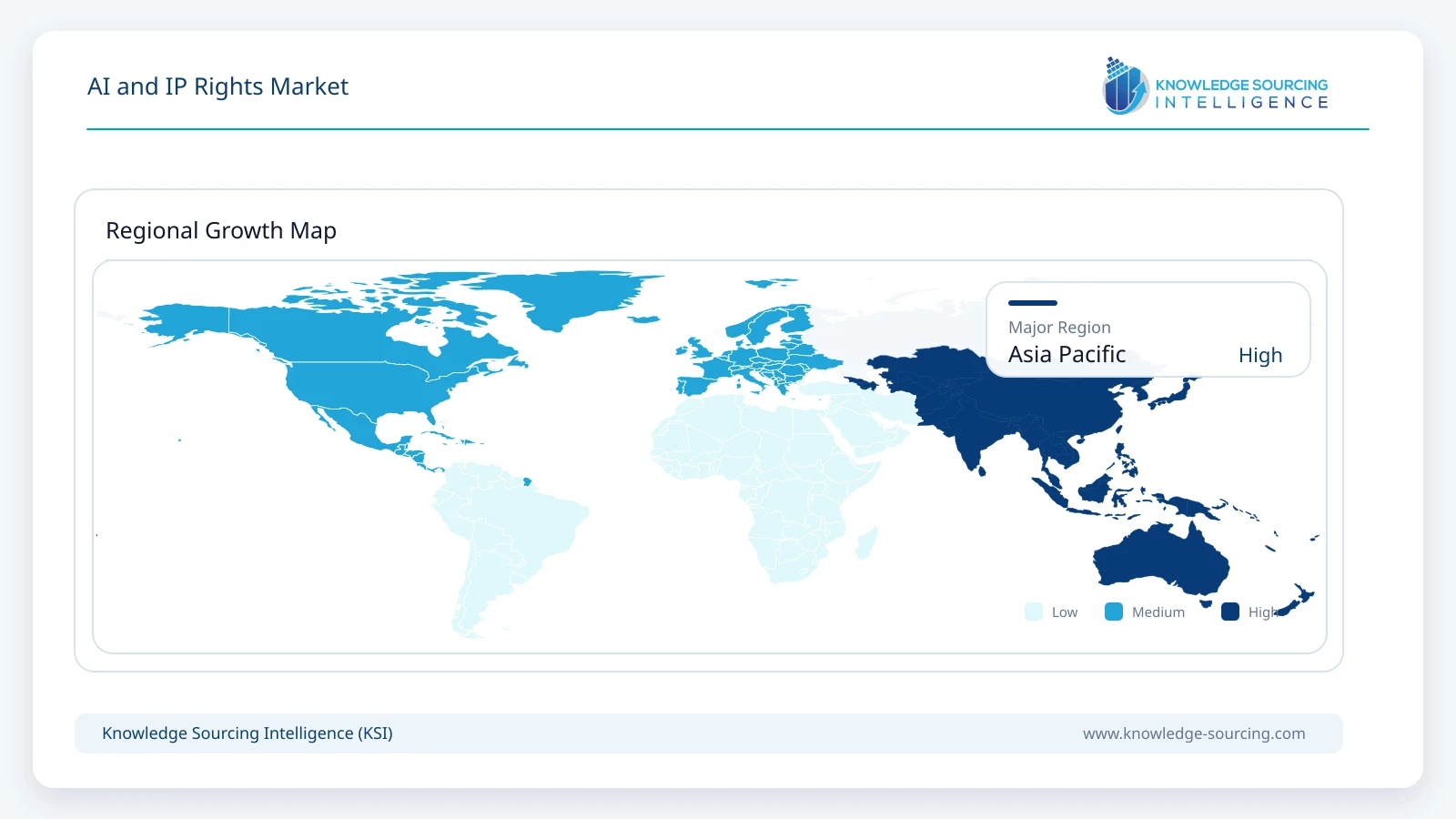
North America
North America represents a mature market supported by extensive research spending, high patent filing activity, advanced software development, and established intellectual property enforcement. Technology companies, pharmaceutical manufacturers, universities, and legal firms continue investing in AI-enabled intellectual property management to improve operational efficiency and innovation protection. Procurement decisions emphasize cybersecurity, cloud deployment, regulatory compliance, and integration with enterprise software.
Europe
European demand is influenced by strong industrial research capabilities, cross-border intellectual property management requirements, and evolving AI governance policies. Manufacturing, automotive engineering, pharmaceuticals, and industrial automation contribute substantial patent activity. Organizations prioritize solutions capable of supporting multilingual documentation and compliance across multiple European jurisdictions.
Asia Pacific
Asia Pacific represents the fastest-expanding adoption environment due to increasing research investment, expanding technology manufacturing, semiconductor development, and government support for innovation. China, Japan, South Korea, India, Taiwan, and Australia continue strengthening intellectual property ecosystems. Buyers seek scalable platforms supporting growing patent portfolios while improving research efficiency and licensing management.
Middle East & Africa
Demand remains comparatively smaller but continues expanding through government-led innovation programs, digital economy initiatives, university research commercialization, and technology investment. Procurement is concentrated among public institutions, multinational corporations, and regional legal advisory organizations.
South America
Brazil and Argentina account for most commercial activity within the region. Intellectual property modernization, technology entrepreneurship, pharmaceutical manufacturing, and digital business expansion contribute to increasing adoption. Budget limitations and varying regulatory maturity continue influencing purchasing decisions.
Competitive Landscape
Competition is characterized by a combination of established intellectual property management vendors and specialized AI technology providers. Suppliers differentiate through proprietary analytics engines, comprehensive global patent databases, workflow automation, cloud-native deployment, cybersecurity capabilities, API integration, multilingual search functionality, and regulatory expertise.
Strategic partnerships between software vendors, legal service providers, research organizations, and enterprise technology companies are expanding solution capabilities. Investment continues toward generative AI integration, predictive patent analytics, automated licensing administration, and enterprise knowledge management. Geographic expansion remains important as multinational customers seek standardized intellectual property management across international operations while maintaining compliance with regional legal requirements.
Major participants include Clarivate Plc, Anaqua, Inc., Questel SAS, PatSnap Pte. Ltd., Dolcera Corporation, AppColl, Inc., Dennemeyer Group, and LexisNexis Intellectual Property Solutions.
Recent Developments
July 2026: Apple filed a trade-secret lawsuit against OpenAI, alleging misappropriation of confidential manufacturing knowledge and proprietary information through former employees, highlighting the growing importance of AI-related trade secret and intellectual property protection.
March 2026: Encyclopaedia Britannica filed a copyright lawsuit against OpenAI, alleging unauthorized use of copyrighted encyclopedia content for AI training and outputs, marking another significant legal development in AI-related intellectual property enforcement.
March 2026: Murgitroyd launched its Responsible AI Framework and accompanying AI Usage Policy, establishing governance principles covering client confidentiality, ethical AI deployment, intellectual property protection, and responsible use of AI across IP services.
Regulatory and Policy Environment
The regulatory environment continues evolving as governments clarify intellectual property protection for AI-assisted innovation and creative outputs. Patent offices are evaluating guidance concerning AI-assisted inventions, inventorship requirements, and examination procedures. Copyright authorities are addressing ownership of AI-generated content while balancing creator rights and technological innovation.
Organizations must also comply with privacy regulations, cybersecurity requirements, contractual licensing obligations, export controls, and industry-specific compliance standards. Procurement decisions increasingly include assessments of auditability, explainability, data governance, and secure handling of confidential research information.
International policy differences encourage multinational organizations to adopt centralized governance platforms capable of tracking regulatory developments, maintaining documentation, and supporting jurisdiction-specific compliance workflows.
Outlook and Strategic Implications
Over the forecast period, investment will continue shifting toward integrated platforms that combine patent analytics, legal workflow automation, AI governance, portfolio management, and licensing intelligence within unified enterprise environments. Buyers are expected to prioritize scalable cloud architectures, explainable AI capabilities, strong cybersecurity controls, and seamless integration with research, engineering, and legal systems.
Technology providers will compete through analytical accuracy, database quality, workflow automation, multilingual capabilities, and industry specialization rather than standalone search functionality. Demand from software development, pharmaceuticals, advanced manufacturing, media, and autonomous systems will remain important as organizations seek stronger protection for AI-assisted innovation.
Procurement strategies are likely to emphasize long-term platform partnerships instead of isolated software deployments. Vendors capable of combining legal expertise, artificial intelligence, regulatory compliance, and enterprise-grade intellectual property management will be better positioned to address increasingly complex customer requirements. While regulatory uncertainty surrounding AI-generated intellectual property will remain a commercial risk, organizations investing in governance, documentation, and compliant innovation management are expected to strengthen both operational resilience and long-term intellectual asset value.
AI and IP Rights Market Scope
| Report Metric | Details |
|---|---|
| Forecast Unit | Billion |
| Study Period | 2021 to 2031 |
| Historical Data | 2021 to 2024 |
| Base Year | 2025 |
| Forecast Period | 2026 – 2031 |
| Segmentation | Solution, Application, End-User, Geography |
| Geographical Segmentation | North America, South America, Europe, Middle East and Africa, Asia Pacific |
| Companies |
|
Market Segmentation
By Solution
By Application
By End-user
By Geography
Table of Contents
1. EXECUTIVE SUMMARY
2. MARKET SNAPSHOT
2.1. Market Overview
2.2. Market Definition
2.3. Scope of the Study
2.4. Market Segmentation
3. BUSINESS LANDSCAPE
3.1. Market Drivers
3.2. Market Restraints
3.3. Market Opportunities
3.4. Porter’s Five Forces Analysis
3.5. Industry Value Chain Analysis
3.6. Policies and Regulations
3.7. Strategic Recommendations
4. TECHNOLOGICAL OUTLOOK
5. AI AND IP RIGHTS MARKET BY SOLUTION
5.1. Introduction
5.2. IP Management Software
5.3. AI-Powered Patent Search and Prior Art Solutions
5.4. IP Analytics and Monitoring Platforms
5.5. Legal Advisory and Consultancy Services
5.6. AI Licensing and Compliance Solutions
6. AI AND IP RIGHTS MARKET BY APPLICATION
6.1. Introduction
6.2. AI in Content Creation
6.3. AI in Software Development
6.4. AI in Drug Discovery and Healthcare
6.5. AI in Industrial Design and Manufacturing
6.6. AI in Autonomous Systems
6.7. AI in Legal Technology
6.8. Others
7. AI AND IP RIGHTS MARKET BY END-USER
7.1. Introduction
7.2. Technology Companies
7.3. Pharmaceutical and Biotech Companies
7.4. Automotive and Aerospace Companies
7.5. Media and Entertainment Companies
7.6. Legal and IP Service Providers
7.7. Government and Research Institutions
7.8. Others
8. AI AND IP RIGHTS MARKET BY GEOGRAPHY
8.1. Introduction
8.2. North America
8.2.1. By Solution
8.2.2. By Application
8.2.3. By End-User
8.2.4. By Country
8.2.4.1. United States
8.2.4.2. Canada
8.2.4.3. Mexico
8.3. South America
8.3.1. By Solution
8.3.2. By Application
8.3.3. By End-User
8.3.4. By Country
8.3.4.1. Brazil
8.3.4.2. Argentina
8.3.4.3. Others
8.4. Europe
8.4.1. By Solution
8.4.2. By Application
8.4.3. By End-User
8.4.4. By Country
8.4.4.1. United Kingdom
8.4.4.2. Germany
8.4.4.3. France
8.4.4.4. Italy
8.4.4.5. Spain
8.4.4.6. Others
8.5. Middle East & Africa
8.5.1. By Solution
8.5.2. By Application
8.5.3. By End-User
8.5.4. By Country
8.5.4.1. Saudi Arabia
8.5.4.2. UAE
8.5.4.3. South Africa
8.5.4.4. Others
8.6. Asia Pacific
8.6.1. By Solution
8.6.2. By Application
8.6.3. By End-User
8.6.4. By Country
8.6.4.1. China
8.6.4.2. Japan
8.6.4.3. India
8.6.4.4. South Korea
8.6.4.5. Taiwan
8.6.4.6. Australia
8.6.4.7. Others
9. COMPETITIVE ENVIRONMENT AND ANALYSIS
9.1. Major Players and Strategy Analysis
9.2. Market Share Analysis
9.3. Mergers, Acquisitions, Agreements, and Collaborations
9.4. Competitive Dashboard
10. COMPANY PROFILES
10.1. Clarivate Plc
10.2. Anaqua, Inc.
10.3. Questel SAS
10.4. PatSnap Pte. Ltd.
10.5. Dolcera Corporation
10.6. AppColl, Inc.
10.7. Dennemeyer Group
10.8. LexisNexis Intellectual Property Solutions
11. APPENDIX
11.1. Currency
11.2. Assumptions
11.3. Base and Forecast Years Timeline
11.4. Key Benefits for Stakeholders
11.5. Research Methodology
11.6. Abbreviations
Navigate
Trusted by the world's leading organizations











