
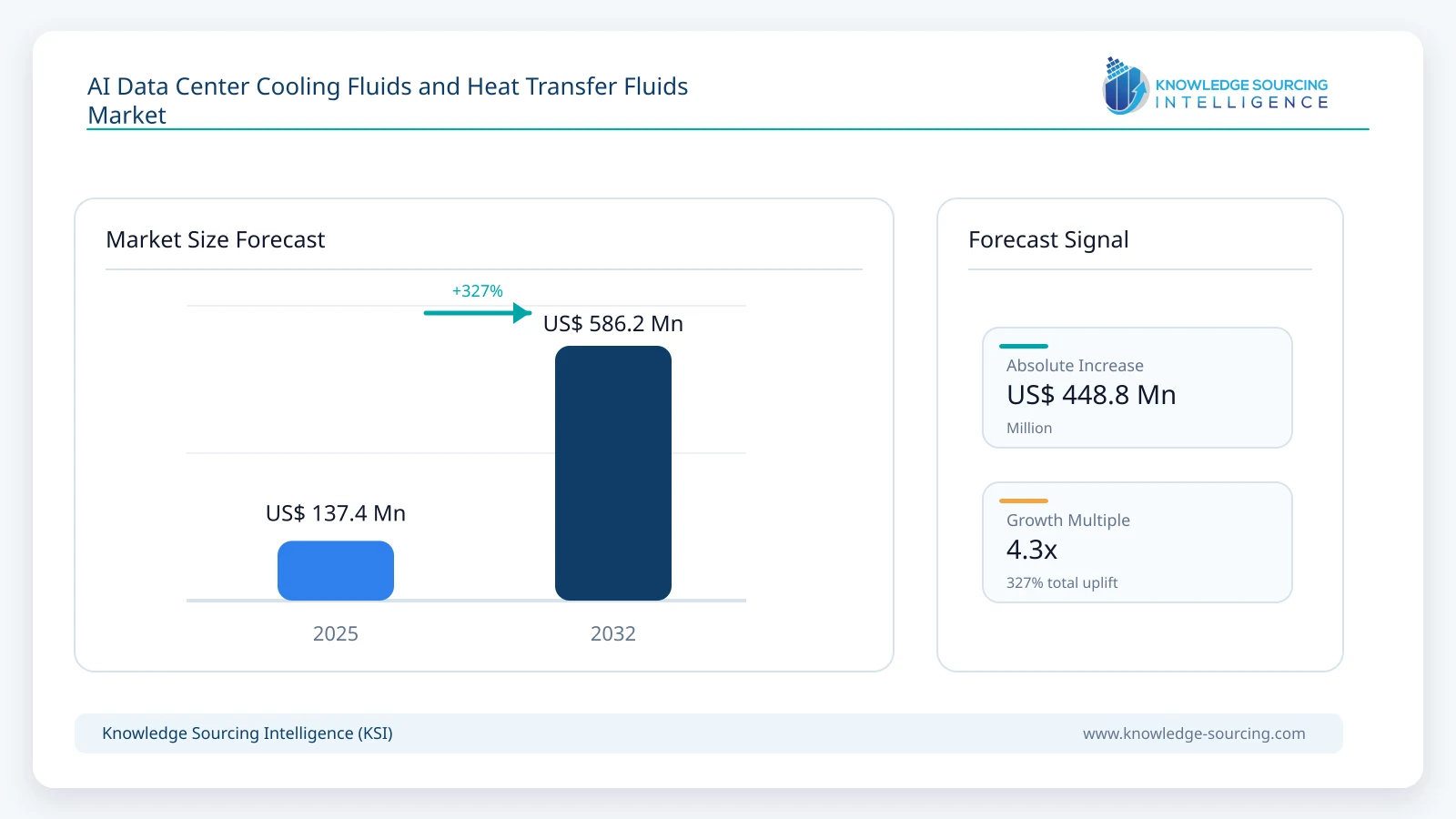
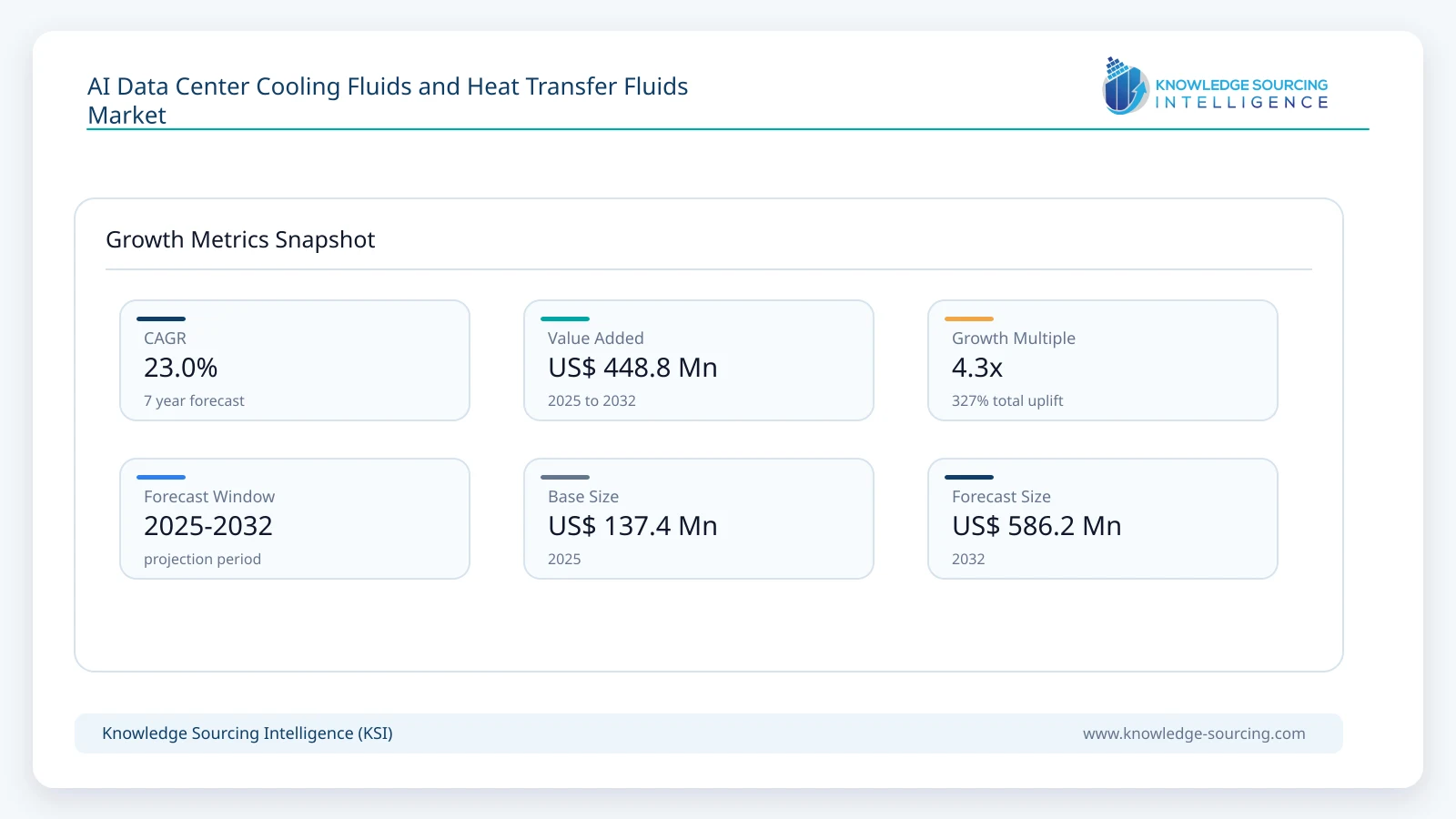
The AI Data Center Cooling Fluids and Heat Transfer Fluids Market is forecast to grow at a CAGR of 23.0%, reaching USD 586.2 million in 2032 from USD 137.4 million in 2025, with revenue estimated at USD 171.8 million in 2026.
Highlights:
- 1Propylene glycol-based fluids represented approximately 61.5% of global coolant-fluid revenue in 2025, supported by demand for inhibited fluids in qualified cold-plate and freeze-protected facility circuits.
- 2Facility cooling and external heat-rejection circuits accounted for approximately 54.6% of 2025 market revenue, reflecting fluid demand from chilled-water distribution, exposed piping and outdoor thermal management.
- 3Direct-to-chip coolant loops generated approximately USD 45.5 million in 2025 and are projected to reach USD 235.7 million in 2032 as high-density accelerator deployments expand.
- 4The Americas, comprising North and South America, represented approximately 54.6% of global revenue in 2025, supported by substantial AI infrastructure investment and established cooling-fluid supply networks.
- 5Asia Pacific coolant-fluid revenue is projected to reach approximately USD 114.4 million by 2032, supported by growing AI and colocation infrastructure across China, Japan, India, Singapore, and other regional hubs.
The market includes formulated glycol fluids, specialty aqueous coolants, and dielectric liquids sold for AI data centers. It covers both technology-side cooling and the associated facility and outdoor heat-rejection circuits, but not cooling equipment or ordinary circulating water without a purchased formulated-fluid component.
Cold plates and coolant distribution units require fluids validated for narrow passages, copper components, and seals. Dow supplies DOWFROST LC 25 for technology cooling and DOWFROST HD for facility systems, while Shell introduced its DLC Fluid S3 for direct liquid cooling in June 2025. The Open Compute Project and equipment-vendor qualification requirements are encouraging repeatable specifications and separating premium IT-side formulations from conventional facility-loop fluids.
Market Overview
High-density GPU servers use liquid cooling to move heat through cold plates, manifolds, and coolant distribution units, with separate facility loops transporting that heat toward chillers, dry coolers, or cooling towers. The distinction between the technology and facility circuits matters commercially because the fluid requirements, operating temperatures, corrosion inhibitors, and qualified suppliers may differ. A single AI facility can purchase both classes of heat-transfer fluid without the same volume being counted twice.
Inhibited propylene glycol blends serve both technology-side applications and external cooling circuits, although the correct formulation depends on the operating temperature, metals, elastomers and conductivity requirements of each loop. Dow, Clariant, BASF, Shell and Dynalene market purpose-developed fluids for liquid-cooled data centers. Specialty aqueous formulations can be appropriate where freeze protection is unnecessary, while ethylene glycol remains commercially relevant in controlled facility applications where handling requirements and system design support its use.
Single-phase immersion systems use electrically non-conductive liquids in direct contact with electronic components, creating a separate market from cold-plate coolants and conventional plant-water circuits. Engineered Fluids, Lubrizol, Shell and Castrol offer differentiated dielectric products, while Chemours has been involved in two-phase fluid qualification. Fluid cost, environmental compliance, service procedures and equipment compatibility determine where immersion becomes competitive with established direct-to-chip architectures.
Market Trends
Ready-to-Use Coolants Are Moving Into Standardized Rack Designs
AI rack integrators increasingly specify cold-plate coolant formulations during hardware qualification, rather than leaving chemical selection to site-level commissioning teams. Dow, Castrol and Dynalene supply ready-to-use PG25 formulations. Controlled formulations reduce contamination and compatibility risks, while approved-fluid lists reward multi-site supply capability.
BASF's October 2026 GLYTHERMIN launch, including GLYTHERMIN DC PG25, reflects the stronger connection between coolant supply and AI-server ecosystem validation. As equipment qualification becomes more detailed, product documentation, fluid testing and regional availability are becoming as important to procurement decisions as headline heat-transfer properties.
Coolant Health and Material Compatibility Are Gaining Procurement Weight
Copper-intensive cold plates and densely packaged liquid distribution assemblies place greater demands on coolant cleanliness, corrosion control, and long-term chemical stability. Inadequate inhibitor performance or particulate control can impair small flow passages and increase maintenance risk. Dow's coolant care initiatives and Ecolab's 3D TRASAR technology illustrate the industry's growing attention to fluid monitoring, rather than relying solely on coolant selection at commissioning.
Data center operators increasingly specify conductivity, reserve alkalinity, filtration and wetted-material compatibility across the full technology cooling loop. Those requirements can support specialized formulations and recurring condition checks, but they do not imply annual replacement of the entire coolant inventory. Suppliers therefore compete through demonstrated lifetime performance, testing support, and clear maintenance procedures alongside initial fluid pricing.
Immersion Cooling Is Broadening the Dielectric Fluid Portfolio
Selected high-density server deployments use single-phase immersion cooling, in which dielectric fluid contacts electronic components and transfers heat to an external exchanger. Engineered Fluids' ElectroCool products, Lubrizol's CompuZol portfolio and immersion offerings from Shell and Castrol demonstrate multiple commercial fluid options. Material compatibility, flash point, viscosity, and replenishment economics influence both system design and the cost of operating large immersion inventories.
Two-phase dielectric technology provides a separate route to heat transfer through vaporization and condensation, but commercial deployment remains constrained by specialized enclosures, fluid economics, maintenance and evolving environmental requirements. Chemours' work with equipment partners demonstrates qualification activity without establishing broad adoption across AI data centers.
Facility-Side Cooling Is Increasingly Planned With IT-Side Liquid Loops
AI liquid-cooling installations typically couple server-side coolant circuits to facility distribution through a coolant distribution unit or intermediate heat exchanger. Dry coolers, chilled-water systems, cooling towers, and adiabatic equipment then reject the heat using configurations influenced by climate and site constraints. Outdoor exposure may justify inhibited glycol, whereas indoor water-only loops can reduce chemical demand when the equipment design and water-treatment regime permit.
The International Energy Agency's 2026 assessment placed projected global data center electricity use at approximately 950 TWh in 2030, indicating the scale of the broader infrastructure expansion. Cooling-fluid purchases, however, depend on the proportion of AI installations using liquid circuits, first-fill inventories, replenishment cycles, and the formulated-fluid content of each circuit, not simply on electricity consumption or construction spending.
Segment Analysis
By Fluid Type: Propylene Glycol-Based Fluids
Propylene glycol-based fluids represent the leading chemistry group because appropriately inhibited formulations can combine corrosion protection, material compatibility and freeze protection across qualifying technology and facility cooling systems. Ready-to-use products such as PG25 reduce site-mixing variability in specified cold-plate installations. Different inhibitor systems remain necessary for outdoor loops, where temperature exposure and the thermal efficiency penalty associated with glycol concentration affect fluid choice.
Propylene glycol-based fluid revenue is estimated at USD 84.6 million in 2025 and projected to reach USD 371.4 million by 2032, reflecting growing adoption of formulated liquids in AI infrastructure. Dow's DOWFROST LC 25, Clariant's Antifrogen PG 25, Shell's DLC Fluid S3 and BASF's GLYTHERMIN DC PG25 illustrate how leading suppliers compete on coolant qualification, stability, wetted-material compatibility and dependable supply.
By Cooling Circuit: Technology Cooling Systems (IT-Side)
Technology Cooling Systems (IT-Side) circulate liquid in equipment close to AI processors, including direct-to-chip cold-plate systems, immersion tanks and rear-door heat-exchanger loops. Their tighter requirements for cleanliness, electrical properties, corrosion performance and material compatibility distinguish them from many facility cooling circuits. By contrast, facility and external heat-rejection loops typically prioritize appropriate freeze protection, corrosion control, pump efficiency and long-term operation across a wider range of outdoor conditions.
Facility-water and external heat-rejection circuits accounted for USD 75.0 million of coolant-fluid revenue in 2025, compared with USD 45.5 million from direct-to-chip loops and USD 16.9 million from other technology-side circuits. By 2032, facility-loop fluid sales are projected at USD 259.6 million, while direct-to-chip loops reach USD 235.7 million. Immersion and rear-door systems contribute additional demand. The circuit breakdown below distinguishes each separately purchased fluid inventory while retaining the global market total.
Physical cooling circuit | 2025 (USD million) | 2032 (USD million) |
Facility-water / external loops | 75.0 | 259.6 |
Direct-to-chip technology loops | 45.5 | 235.7 |
Single-phase immersion | 15.0 | 83.4 |
Two-phase dielectric systems | 0.7 | 4.6 |
Rear-door heat exchanger loops | 1.2 | 3.0 |
Global market | 137.4 | 586.2 |
Note: Individual circuit values are rounded; the 2032 components sum to USD 586.3 million, compared with the published global total of USD 586.2 million.
By Cooling Technology: Direct-to-Chip Liquid Cooling
Direct-to-chip liquid cooling has the clearest near-term route to higher fluid demand because cold plates remove heat from high-power processors without requiring full server immersion. Accelerator rack deployments drive purchases of qualified aqueous coolants for first fills, capacity additions and maintenance top-ups. The same installation may require a different inhibited glycol or treated-water fluid in the downstream facility loop, making circuit boundaries important for understanding supplier opportunities.
Direct-to-chip coolant revenue is projected to rise from USD 45.5 million in 2025 to USD 235.7 million in 2032. Single-phase immersion fluids increase from USD 15.0 million to USD 83.4 million, while two-phase dielectric systems reach USD 4.6 million in 2032. Cooling technologies such as chillers, dry coolers, hybrid heat rejection and rear-door exchangers generate fluid demand through their associated circuits; their equipment revenue is not part of these estimates.
Market Drivers
Rapid Expansion of AI Accelerator Infrastructure
AI training and inference campuses are commissioning more liquid-cooled accelerator racks, creating demand for initial coolant fills in technology-side and facility-side loops. Greenfield projects can standardize formulations across large installations, while retrofits often require dedicated coolant distribution and new heat-rejection connections. The revenue opportunity depends on actual commissioned liquid-cooling capacity and fluid inventory, rather than announced data center investment alone.
Increasing Rack Power Density
Higher power densities in GPUs and AI accelerators concentrate heat at processor surfaces, increasing the use of cold plates and specialized coolant passages. These components require carefully controlled liquid chemistry to maintain flow performance and avoid deposits. As rack configurations change, suppliers able to qualify formulations against new component materials can gain opportunities from first fills, equipment upgrades and repeat deployments.
Growing Focus on Cooling Reliability
The cost of downtime in liquid-cooled AI clusters increases the commercial value of stable coolant chemistry, corrosion protection and fluid-quality assurance. In narrow cold-plate channels, deposits or contaminated fluid can raise service requirements and threaten equipment performance. Customers therefore consider product qualification, testing support and ongoing fluid health alongside the upfront price of glycol or dielectric liquid.
Standardization of Cold-Plate Coolant Specifications
Open Compute Project guidance and hardware-vendor specifications are helping standardize coolant grades for defined cold-plate environments. Repeatable requirements for inhibitors, dilution-water purity and material compatibility make multi-site purchasing more predictable. Suppliers whose products receive technical approval can benefit from broader deployment across server platforms, while unqualified alternatives face additional testing and customer acceptance barriers.
Expansion of Global AI Data Center Capacity
Expansion of AI infrastructure in the United States, China, Japan, India and other regional hubs creates new requirements for coolant blending, packaging, transport and on-site technical support. Large operators increasingly seek consistent formulations across facilities even when external heat-rejection systems differ by climate. Local stocking, qualification laboratories and reliable replenishment services can therefore influence competitive position beyond the chemical formulation itself.
Market Restraints
Compatibility and Warranty Qualification
Liquid-cooled servers and facility systems use combinations of copper, stainless steel, seals and other wetted materials that must remain compatible with coolant inhibitors and base fluids. Extensive qualification and OEM warranty requirements can lengthen supplier approval cycles, particularly for formulations introduced into existing equipment designs. Substituting a lower-priced fluid without supporting test evidence can create reliability and maintenance risks.
Higher Specialty Fluid Cost
Specialty inhibitor packages and dielectric immersion liquids carry higher purchase costs than treated water or conventional bulk glycol mixtures. Large initial fills can make immersion equipment especially capital intensive, while premium cold-plate fluids must demonstrate reliability benefits that justify their cost. The economics can limit adoption where operators can meet thermal requirements using lower-cost, qualified aqueous solutions.
Uncertainty Around Coolant Replacement Intervals
Properly maintained coolant can remain in a closed circuit for an extended period, limiting replacement volumes even as installed liquid-cooling capacity expands. Actual purchases arise from commissioning, planned service, partial drain-and-refill activity and leakage or maintenance losses. Assuming that the entire installed inventory is purchased again each year would therefore overstate recurring demand.
Regulatory and Environmental Scrutiny
Environmental rules governing selected fluorinated dielectric substances create uncertainty for emerging two-phase cooling liquids. Data center operators also assess spill control, recovery, disposal and worker handling when specifying immersion products. Qualification costs can slow adoption of chemistries without a clear regulatory pathway.
Infrastructure and Deployment Constraints
AI facility commissioning can be delayed by grid connections, equipment availability, cooling-plant integration and construction schedules, deferring the initial coolant purchases attached to those projects. Fluid orders depend on operational system deployment rather than announced campus capacity. In addition, outdoor designs that use water-only circulation where technically appropriate can reduce formulated glycol demand per installed cooling megawatt.
Regional Outlook
North America
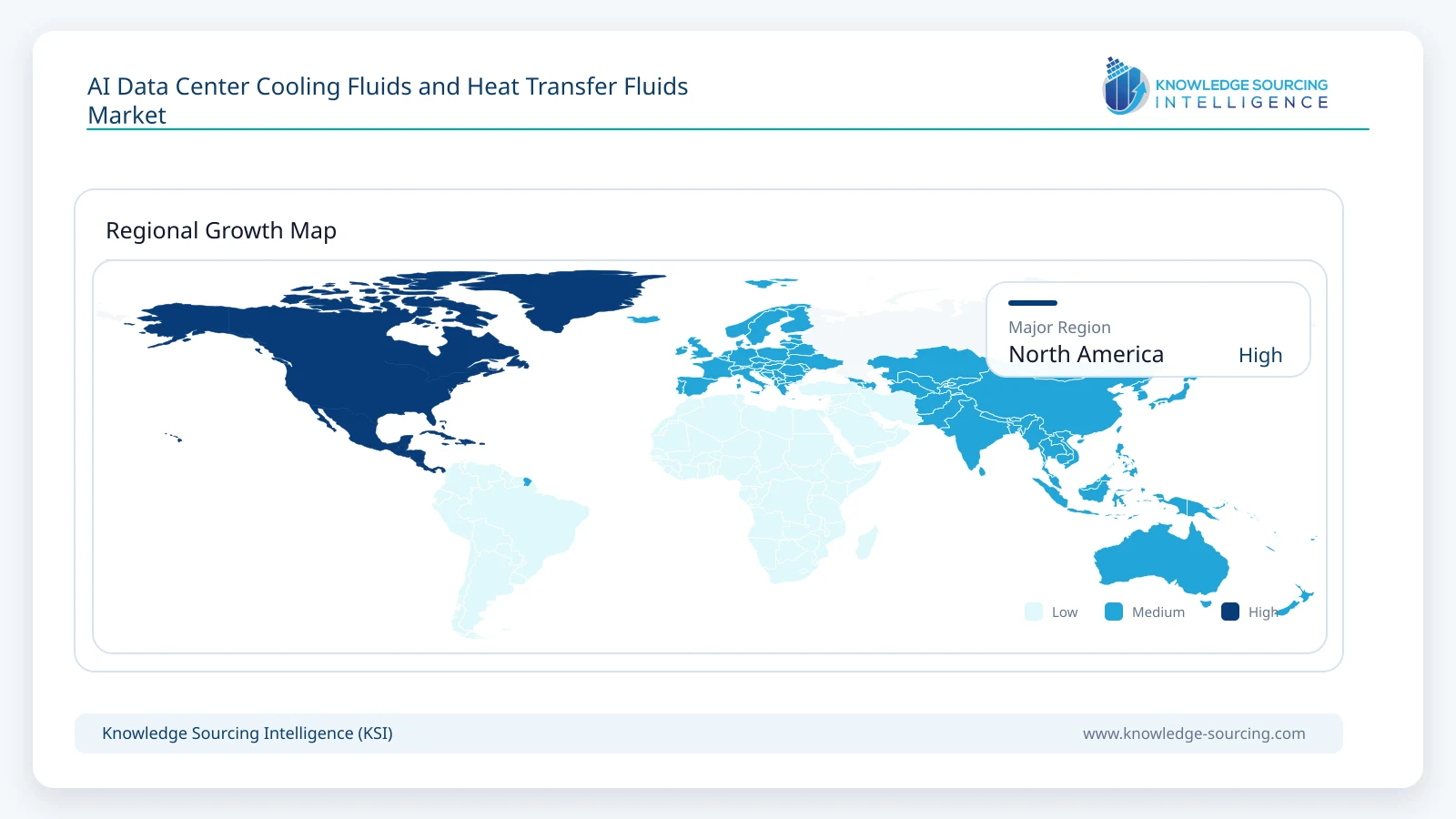
North American AI data centers account for the principal share of demand within the Americas, where combined cooling-fluid revenue is estimated at USD 75.0 million in 2025. The United States supports large hyperscale, GPU-cloud and colocation deployments, creating demand for cold-plate coolant qualification and a broad range of facility-loop fluids. Canada and Mexico contribute through additional data center projects, regional distribution and external heat-rejection requirements.
Across North and South America combined, coolant-fluid revenue is projected to reach USD 378.8 million by 2032. The region benefits from increasing liquid-cooled AI capacity, established chemical manufacturing and qualified delivery channels. The distinction between cold-climate glycol needs and hot-weather heat-rejection design remains important, particularly where water use, dry cooling and intermediate heat exchangers alter the volume and formulation of purchased fluids.
Asia Pacific
Asia Pacific's AI data center cooling-fluid market is projected to expand from USD 30.8 million in 2025 to USD 114.4 million by 2032, supported by investments in high-performance computing and cloud infrastructure. China and Japan have established electronics and data center ecosystems, while India, Singapore, South Korea and Australia are expanding relevant capacity. The resulting demand covers both qualified direct-to-chip fluids and formulated liquids for facility cooling systems.
Regional climate, water availability and local manufacturing influence which fluid categories gain the most traction. Hot climates require different rejection architectures from locations with extended free-cooling windows. Suppliers with consistent product quality, equipment compatibility documentation and regional availability will be better positioned to serve multi-country AI infrastructure programs.
Competitive Landscape
Global chemical and lubricant suppliers compete with specialist coolant developers across distinct technology-side, facility-side and immersion markets. Dow, Clariant, BASF and Dynalene market formulated aqueous and glycol fluids; Shell and Castrol offer products for direct liquid and immersion applications; and Engineered Fluids and Lubrizol focus on differentiated dielectric liquids. Arteco adds direct liquid-cooling formulations through its ZITREC product family.
Ecolab contributes coolant monitoring and water-chemistry support, while Chemours remains relevant to two-phase engineered-fluid development and equipment qualification. TotalEnergies has developed advanced immersion-related fluids, although suppliers' product coverage does not by itself establish their share of revenue in AI data centers. Competitive strength depends on approved applications, actual delivery capability and technical service as much as on portfolio breadth.
Supplier selection is increasingly driven by component warranties, inhibitor performance, chemical stability, logistics and lifecycle cost. Large integrated producers can support regional blending and distribution, whereas specialized providers may compete through dielectric performance or application-specific compatibility testing. Fluid makers able to demonstrate consistent results over prolonged operating periods can strengthen their position in standardized AI rack and data center cooling designs.
Recent Developments
October 2026: BASF launched GLYTHERMIN data center heat-transfer fluids and stated that GLYTHERMIN DC PG25 had qualified as an NVIDIA DSX Ready Coolant, supporting liquid-cooled AI infrastructure.
May 2026: Dow presented its expanded AI thermal-management portfolio at COMPUTEX, including DOWFROST LC 25, DOWFROST HD and DOWSIL ICL-1100 single-phase immersion fluid.
May 2026: Castrol ON announced OCP Inspired recognition for its PG 25 direct liquid cooling fluid and described planned marketplace inclusion for additional immersion products.
February 2026: Chemours and 2CRSi announced a joint development agreement after qualification of Opteon two-phase immersion cooling fluid in current-generation servers.
June 2025: Shell launched DLC Fluid S3, a propylene glycol-based direct liquid cooling fluid for high-performance computing and AI data centers.
May 2025: Ecolab launched 3D TRASAR Technology for Direct-to-Chip Liquid Cooling to support real-time coolant health monitoring and reliability management.
Market Outlook
Growing deployment of cold-plate-cooled AI racks will support sales of qualified glycol and specialty aqueous fluids, while the expansion of campus heat-rejection systems will sustain demand for facility-side formulations. Propylene glycol-based products are projected to remain the largest fluid category, reflecting their use across multiple qualified circuits and their importance in applications requiring corrosion or freeze protection.
Single-phase immersion fluids should gain demand in applications that justify higher initial liquid inventories and specialized maintenance practices. Two-phase dielectric systems remain a smaller opportunity given their qualification, cost and regulatory requirements. Cooling designs that isolate outdoor glycol loops from indoor treated-water circuits will continue to influence purchased fluid volumes, so expansion in computing capacity will not translate proportionately into every coolant category.
The Americas are projected to retain the largest combined regional revenue pool through 2032, supported by liquid-cooled AI capacity and chemical supply networks. Asia Pacific will also grow as more facilities adopt qualified liquid-cooling architectures. Across the industry, competition will increasingly turn on hardware compatibility, stable fluid quality, supply reliability and documented operating performance rather than purchase price alone.
AI Data Center Cooling Fluids and Heat Transfer Fluids Market Scope:
| Report Metric | Details |
|---|---|
| Total Market Size in 2025 | USD 137.4 million |
| Total Market Size in 2032 | USD 586.2 million |
| Forecast Unit | USD Million |
| Growth Rate | 23.0% |
| Study Period | 2020 to 2032 |
| Historical Data | 2020 to 2023 |
| Base Year | 2024 |
| Forecast Period | 2025 – 2032 |
| Segmentation | Fluid Type, Cooling Circuit, Cooling Technology, Geography |
| Companies |
|
Market Segmentation
By Fluid Type
Propylene Glycol-Based Fluids
Ethylene Glycol-Based Fluids
Specialty Water-Based Coolants
Single-Phase Dielectric Fluids
Two-Phase Dielectric Fluids
By Cooling Circuit
Technology Cooling Systems (IT-Side)
Facility Cooling and External Heat-Rejection Circuits
By Cooling Technology
Direct-to-Chip Liquid Cooling
Immersion Cooling
Chiller-Based Cooling
Dry Cooling and Free Cooling
Evaporative, Adiabatic and Hybrid Cooling
Rear-Door Heat Exchanger Cooling
By Geography
North America
United States
Canada
Mexico
South America
Brazil
Rest of South America
Europe
Germany
United Kingdom
France
Netherlands
Rest of Europe
Middle East and Africa
UAE
Saudi Arabia
Rest of Middle East and Africa
Asia Pacific
China
India
Japan
South Korea
Singapore
Australia
Rest of Asia Pacific
Table of Contents
1. INTRODUCTION
1.1. Market Overview
1.2. Market Definition and Scope
1.3. Currency and Assumptions
2. RESEARCH METHODOLOGY
2.1. Research Data
2.2. Assumptions
2.3. Market Estimation Methodology
3. EXECUTIVE SUMMARY
3.1. Research Highlights
3.2. Market Size and Forecast, 2025–2032
3.3. Market Outlook
4. MARKET DYNAMICS
4.1. Market Drivers
4.2. Market Restraints
4.3. Market Opportunities
4.4. Industry Value Chain Analysis
4.5. Regulatory and Technology Overview
5. AI DATA CENTER COOLING FLUIDS AND HEAT TRANSFER FLUIDS MARKET BY FLUID TYPE
5.1. Propylene Glycol-Based Fluids
5.2. Ethylene Glycol-Based Fluids
5.3. Specialty Water-Based Coolants
5.4. Single-Phase Dielectric Fluids
5.5. Two-Phase Dielectric Fluids
6. AI DATA CENTER COOLING FLUIDS AND HEAT TRANSFER FLUIDS MARKET BY COOLING CIRCUIT
6.1. Technology Cooling Systems (IT-Side)
6.2. Facility Cooling and External Heat-Rejection Circuits
7. AI DATA CENTER COOLING FLUIDS AND HEAT TRANSFER FLUIDS MARKET BY COOLING TECHNOLOGY
7.1. Direct-to-Chip Liquid Cooling
7.2. Immersion Cooling
7.3. Chiller-Based Cooling
7.4. Dry Cooling and Free Cooling
7.5. Evaporative, Adiabatic and Hybrid Cooling
7.6. Rear-Door Heat Exchanger Cooling
8. AI DATA CENTER COOLING FLUIDS AND HEAT TRANSFER FLUIDS MARKET BY GEOGRAPHY
8.1. North America
8.1.1. United States
8.1.2. Canada
8.1.3. Mexico
8.2. South America
8.2.1. Brazil
8.2.2. Rest of South America
8.3. Europe
8.3.1. Germany
8.3.2. United Kingdom
8.3.3. France
8.3.4. Netherlands
8.3.5. Rest of Europe
8.4. Middle East and Africa
8.4.1. UAE
8.4.2. Saudi Arabia
8.4.3. Rest of Middle East and Africa
8.5. Asia Pacific
8.5.1. China
8.5.2. India
8.5.3. Japan
8.5.4. South Korea
8.5.5. Singapore
8.5.6. Australia
8.5.7. Rest of Asia Pacific
9. COMPETITIVE ENVIRONMENT AND ANALYSIS
9.1. Major Players and Strategy Analysis
9.2. Market Share Analysis
9.3. Mergers, Acquisitions, Agreements and Collaborations
9.4. Competitive Dashboard
10. COMPANY PROFILES
10.1. Dow
10.2. Clariant
10.3. BASF
10.4. Shell
10.5. Castrol (BP)
10.6. Dynalene
10.7. Arteco
10.8. Ecolab
10.9. Lubrizol
10.10. Engineered Fluids
10.11. Chemours
10.12. TotalEnergies
Navigate
Trusted by the world's leading organizations











