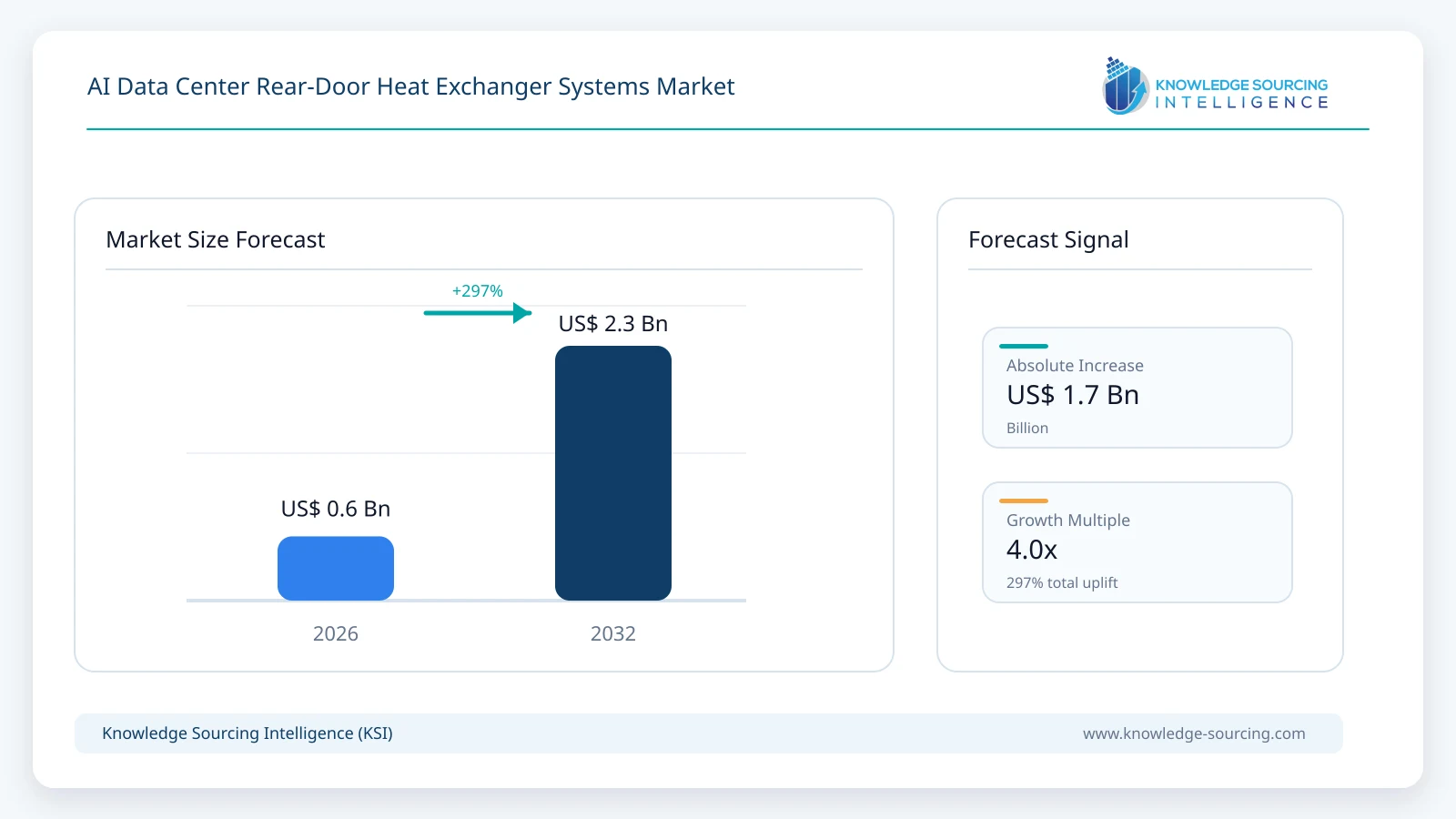
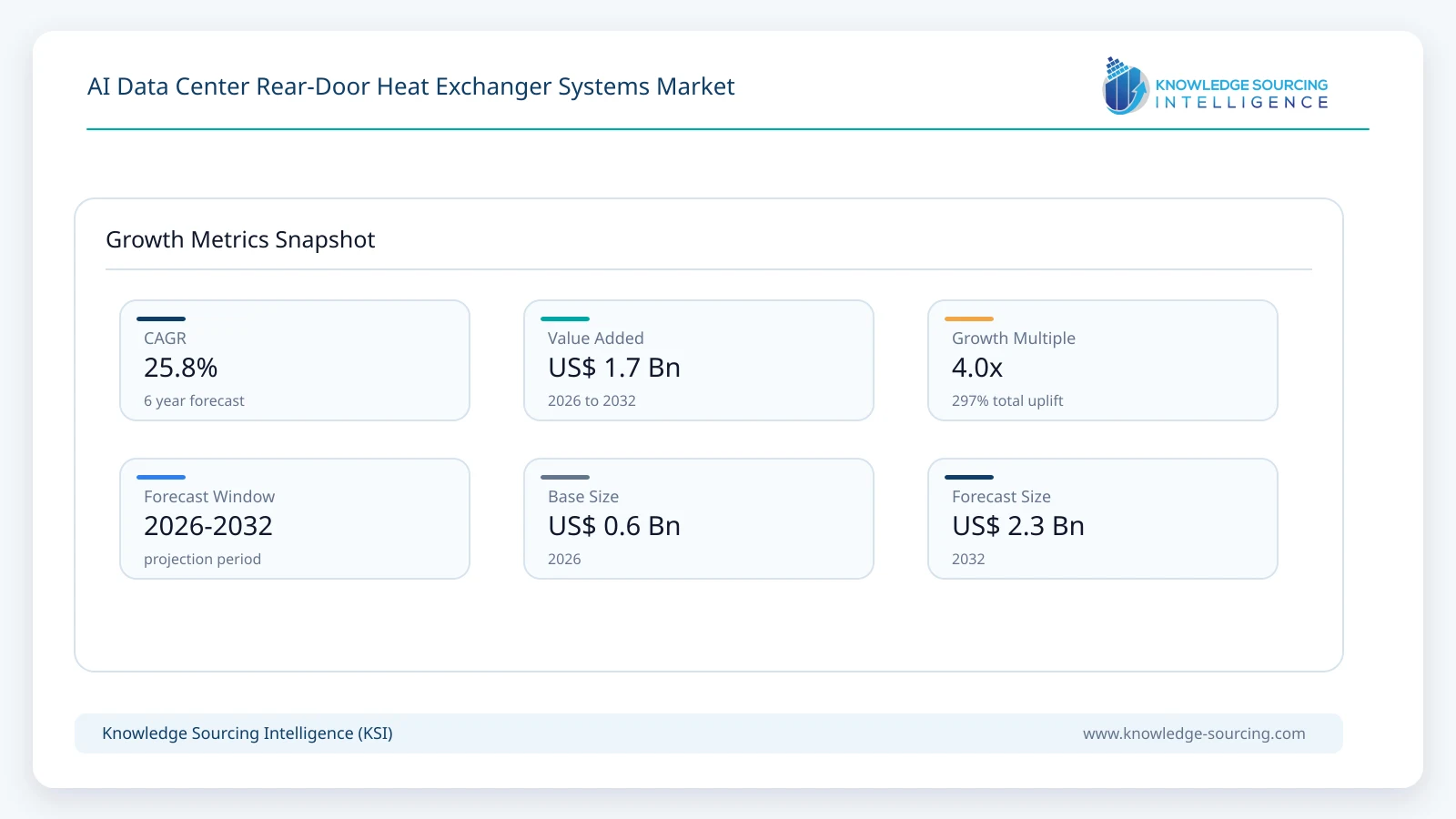
The AI Data Center Rear-Door Heat Exchanger Systems Market is estimated at USD 0.58 billion in 2026 and is projected to reach USD 2.30 billion by 2032, representing a CAGR of 25.8% during 2026-2032.
Highlights:
- 1Passive RDHx remains attractive where server fans provide sufficient airflow through the coil.
- 2Active RDHx grows faster as rack heat loads and air-side pressure drops increase.
- 3Brownfield data centers are a major adoption base because RDHx can retrofit existing racks.
- 4AI reference designs now combine CDUs, cold plates and rear-door heat exchangers as one thermal stack.
- 5North America leads commercial demand through hyperscale retrofits and GPU-cloud deployments.
- 6Rack-level controls and leak monitoring are becoming more important as active RDHx adoption expands.
Market Overview
Rear-door heat exchangers remove heat at the last air-side point before server exhaust enters the room. IT fans pull air through the server, and the hot exhaust passes across a liquid-filled coil mounted directly behind the rack. The coil transfers heat to a water or water-glycol circuit and returns air to the room at or near ambient temperature. Passive systems rely primarily on server fan pressure, while active systems add electronically commutated fans to overcome heat-exchanger pressure drop and support higher heat loads.
The architecture is particularly useful in brownfield AI deployments. Existing facilities may have sufficient electrical power and chilled-water capacity but insufficient room-air cooling for new GPU racks. Replacing a standard rack door with an RDHx can raise supported rack density without rebuilding the full data-hall air system. Schneider Electric specifically positions ChilledDoor for brownfield AI modernization, while STULZ, nVent, Rittal and Coolcentric all emphasize retrofit compatibility. This creates a different demand profile from greenfield direct-to-chip cooling because the commercial value comes from reusing existing servers, racks and facility infrastructure.
RDHx is also becoming a complementary technology rather than merely an alternative to cold plates. Schneider Electric's 2026 AMD Helios design uses direct liquid cooling for 84% of rack heat and rear-door heat exchangers for the remaining air-cooled load. Vertiv similarly positions RDHx as a hybrid layer alongside direct-to-chip systems. As accelerators become liquid cooled while memory, networking, power supplies and other components retain air cooling, hybrid architectures can sustain RDHx demand even as cold-plate penetration rises.
Market Drivers
Brownfield AI retrofits favor rack-level heat removal
Grid connections and existing data-center shells have become valuable assets, encouraging operators to place AI infrastructure into facilities originally designed for much lower rack densities. Rear-door heat exchangers allow cooling capacity to be added rack by rack while preserving existing server airflow and room layouts. Schneider Electric's 2026 brownfield guidance explicitly identifies ChilledDoor as an option for H100- and H200-class GPU environments, while nVent and Rittal position their rear-door systems as retrofit solutions for standard racks. This makes RDHx particularly attractive where the building cannot support a large new fan-wall or room-cooling system.
Residual air heat remains after direct-to-chip adoption
Cold plates usually prioritize processors and other highest-heat components. Power supplies, memory, storage, network interfaces and additional electronics can still reject heat to air. Schneider Electric's AMD Helios reference design indicates that direct liquid cooling removes 84% of rack heat, leaving a meaningful residual load for air-side cooling. Rear-door heat exchangers can capture that remaining load without forcing operators to maintain oversized room-level cooling infrastructure, supporting hybrid liquid-air designs through multiple AI hardware generations.
Rising rack density increases the value of active rear doors
Passive rear doors are efficient because they consume little or no direct fan power, but higher air-side resistance becomes more difficult as rack density increases. Active designs add electronically commutated fans and controls that maintain airflow across the heat exchanger as server load changes. STULZ's 2026 CyberRack update includes integrated temperature sensing and load-adaptive fan control, while Delta, nVent and Legrand offer active platforms designed for higher-density racks. The result is an expanding equipment-value layer around fans, controls, redundancy and monitoring rather than only the heat-exchanger coil.
Standardized AI reference designs reduce deployment risk
Rack-scale AI systems increasingly deploy through validated reference architectures that specify power, coolant flow, rack layout and residual heat removal together. Motivair rear doors now appear inside Schneider Electric's AMD Helios design, while Vertiv includes RDHx within its 360AI portfolio. This turns rear-door cooling from a project-specific retrofit into a repeatable subsystem that can be procured and commissioned with the wider AI rack. Standardization supports higher adoption among colocation and neocloud operators that need predictable designs across multiple sites.
Restraints and Adoption Challenges
Rear-door heat exchangers are not suitable for every AI architecture. Very high rack densities can exceed the practical air-moving capability of standard server fans, increasing the need for active doors or direct-to-chip cooling. RDHx also requires a liquid loop close to the rack, which introduces hose routing, leak management, water-quality requirements and service procedures into facilities that may have been designed as air-only environments. Opening the rear door for maintenance can temporarily release rack heat into the room, so operators still need contingency cooling. As AI platforms move toward higher percentages of direct liquid heat capture, the residual air load per rack may decline, limiting RDHx equipment content even as the number of liquid-cooled racks expands.
Segment Analysis
By Operating Architecture
Passive rear-door heat exchangers represent the larger installed architecture in 2026 because they offer very low direct power consumption and can be retrofitted onto standard server racks where existing IT fans provide sufficient airflow. Rittal, Lenovo, Coolcentric and other suppliers have established passive products that transfer rack heat into a chilled-water loop without adding fan energy at the door.
Active rear-door heat exchangers are expected to grow faster through 2032. Integrated fans reduce dependence on server fan pressure and allow the system to handle higher heat loads and changing operating conditions. STULZ, Delta, nVent, Motivair and Legrand offer active or intelligent configurations with sensors, controls and variable-speed fans. Active systems carry higher equipment value per rack, supporting market revenue as AI densities rise.
RDHx Category | Revenue Contribution | Growth Direction | Primary AI Data Center Application |
Passive rear-door heat exchangers | Largest installed architecture | Strong | Efficient retrofit cooling where server fan airflow is sufficient |
Active rear-door heat exchangers | Growing high-density segment | Fastest | Higher heat loads, pressure-drop management and variable AI workloads |
Hybrid RDHx + direct-to-chip systems | Emerging mainstream architecture | Very strong | Capture residual air heat after processor cold-plate cooling |
RDHx hose, valve and manifold kits | Core supporting category | Strong | Connect rack doors safely to secondary coolant loops |
Controls, sensors and leak monitoring | Smaller 2026 base | Fast | Adaptive airflow, thermal control and rack-level reliability |
Integration and lifecycle services | Recurring service layer | Strong | Retrofit engineering, commissioning and fluid-system maintenance |
Market and Technology Indicators
Indicator | Latest Development | Market Impact |
Hybrid AI rack cooling | AMD Helios design uses direct liquid cooling for 84% of rack heat and RDHx for residual air load. | Supports RDHx as a complementary layer rather than a temporary technology. |
High-density RDHx capability | Legrand USystems ColdLogik portfolio supports up to 200 kW per rack. | Extends rack-door cooling into very high-density AI environments. |
Commercial AI portfolio | Vertiv CoolLoop RDHx supports configurations up to 80 kW per rack. | Shows RDHx incorporated into mainstream AI infrastructure portfolios. |
2026 product refresh | STULZ updated CyberRack Active Rear Door with higher capacity and adaptive fan controls. | Demonstrates active RDHx product investment specifically for AI/HPC. |
Brownfield deployment | Schneider Electric positions ChilledDoor for existing data centers adding GPU infrastructure. | Expands demand beyond new-build AI factories. |
Retrofit-ready architecture | nVent, Rittal and Coolcentric provide rack-compatible rear-door systems. | Creates a broad installed-base opportunity without replacing server hardware. |
Regional Opportunity
North America
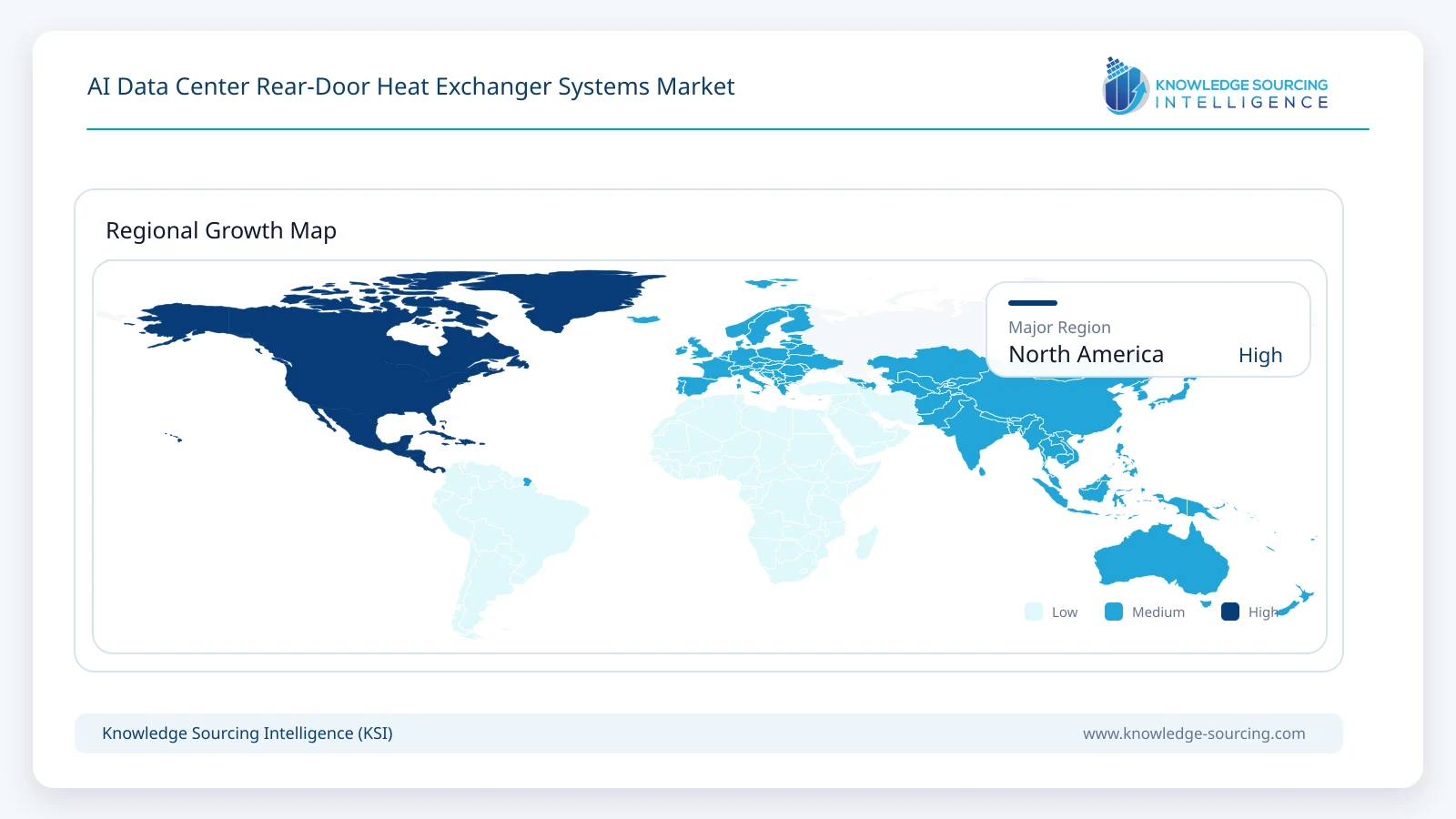
North America is the largest commercial market for AI data-center rear-door heat exchangers because the United States has a large installed base of enterprise, hyperscale and colocation facilities that are being upgraded for accelerated computing. Many of these sites cannot economically replace the complete room-cooling system each time rack density increases. RDHx allows operators to add higher-density GPU racks within existing halls by intercepting heat before it reaches the room, making it particularly useful for phased AI expansion.
The supplier ecosystem is also strong. Motivair by Schneider Electric manufactures ChilledDoor systems in the United States and is integrating them into validated NVIDIA- and AMD-oriented AI reference designs. Vertiv offers CoolLoop and Liebert DCD rear-door systems as part of its 360AI portfolio. nVent and Coolcentric supply retrofit-oriented door systems, while Legrand's USystems ColdLogik platform spans passive and active configurations at very high rack densities. Lenovo continues to support water-cooled rear-door systems within its rack ecosystem, providing an IT-vendor route to adoption.
Colocation facilities are an important buyer group because they need to support mixed tenants and multiple cooling architectures within the same building. RDHx allows a high-density customer rack to be cooled locally while surrounding lower-density racks remain on existing room systems. The same feature makes RDHx useful during staged migration toward direct-to-chip cooling. Through 2032, North American demand is expected to come from brownfield GPU upgrades, hybrid liquid-cooled AI racks and new facilities designed around room-neutral rack blocks.
Europe has a long history of water-assisted rack cooling and benefits from mature suppliers including STULZ, Rittal, Legrand USystems and nVent. Asia Pacific combines rapid AI deployment with major rack and thermal-equipment manufacturing, supporting both retrofit and greenfield demand. The Middle East remains a smaller but fast-growing greenfield opportunity where hybrid rack-level cooling can reduce the mechanical footprint required for large AI campuses.
Competitive Landscape
The competitive landscape combines diversified critical-infrastructure suppliers, specialist rack-cooling companies and server or enclosure vendors. Schneider Electric / Motivair, Vertiv, STULZ and Legrand / USystems have particularly visible AI-oriented RDHx portfolios. nVent, Rittal and Coolcentric compete strongly in rack-compatible retrofit systems. Delta Electronics supports RDHx through both CoolDoor products and high-capacity coolant distribution platforms, while Munters is positioning rear-door cooling within its broader liquid-cooling portfolio.
Adjacent ecosystem participants influence adoption through coolant distribution, rack integration and server compatibility. Airedale by Modine supplies CDUs for hybrid and RDHx applications, Lenovo maintains rack-integrated rear-door options, and IBM has a long operating history with rear-door heat-exchanger deployments. Boyd, Alfa Laval and Kelvion participate in broader liquid heat-exchange and cooling infrastructure that can support customized rack-level solutions. Competitive differentiation centers on cooling capacity per rack, pressure drop, fan energy, rack compatibility, ability to retrofit, water temperature range, leak management, controls, serviceability and integration with direct-to-chip systems.
Major companies and ecosystem participants covered: Schneider Electric / Motivair, Vertiv, STULZ, Legrand / USystems, nVent, Rittal, Coolcentric, Delta Electronics, Munters, Airedale by Modine, Lenovo, IBM, Boyd, Alfa Laval and Kelvion.
Recent Developments
August 2026: Schneider Electric published updated AI thermal-management guidance describing rear-door heat exchangers as capable of capturing the remaining 20% of total rack heat load in direct-to-chip liquid-cooled AI architectures.
July 2026: Schneider Electric and AMD released a validated Helios reference design using Motivair rear-door heat exchangers alongside direct liquid cooling for racks up to 246 kW.
February 2026: Schneider Electric highlighted ChilledDoor as a brownfield AI modernization option for H100- and H200-class GPU environments.
February 2026: Legrand published updated guidance on RDHx adoption as high rack densities and AI workloads increase pressure on room-level cooling.
January 2026: STULZ introduced an updated CyberRack Active Rear Door with increased cooling output, integrated temperature sensing and load-adaptive fan controls.
2026: Vertiv continued global deployment of CoolLoop RDHx as part of its 360AI hybrid liquid-cooling architecture.
2026: Munters expanded its liquid-cooling portfolio positioning rear-door heat exchangers as a retrofit and transition path toward higher-density liquid cooling.
AI Data Center Rear-Door Heat Exchanger Systems Market Scope:
| Report Metric | Details |
|---|---|
| Total Market Size in 2026 | USD 0.58 billion |
| Total Market Size in 2032 | USD 2.30 billion |
| Forecast Unit | USD Billion |
| Growth Rate | 25.8% |
| Study Period | 2021 to 2032 |
| Historical Data | 2021 to 2024 |
| Base Year | 2025 |
| Forecast Period | 2026 – 2032 |
| Segmentation | Operating Architecture, Component, Rack Heat Load, Deployment Type |
| Companies |
|
Market Segmentation
By Operating Architecture
Passive Rear-Door Heat Exchangers
Active Rear-Door Heat Exchangers
Hybrid RDHx and Direct-to-Chip Systems
By Component
Heat-Exchanger Door Assemblies
EC Fans and Airflow Modules
Hose, Valve and Manifold Kits
Controls, Sensors and Leak Monitoring
Installation, Commissioning and Lifecycle Services
By Rack Heat Load
Below 50 kW
50-100 kW
100-200 kW
Above 200 kW
By Deployment Type
Brownfield AI Retrofits
Greenfield AI Data Centers
Hybrid Air-Liquid Data Halls
Colocation High-Density Zones
By Customer Type
Hyperscale Cloud Providers
Neocloud and GPU-Cloud Operators
Colocation Providers
Sovereign AI Infrastructure
Enterprise and High-Performance Computing
By Region
North America
United States
Canada
Europe
Asia Pacific
Middle East and Rest of World
Table of Contents
1. EXECUTIVE SUMMARY
1.1. Market Opportunity and Key Findings
1.2. RDHx Adoption Timeline
1.3. Principal Revenue Pools
2. MARKET OVERVIEW
2.1. Rear-Door Heat Exchanger Operating Principle
2.2. Passive versus Active RDHx
2.3. Brownfield AI Retrofit Architecture
2.4. Hybrid RDHx and Direct-to-Chip Cooling
2.5. Room-Neutral Rack Cooling
3. MARKET SIZE AND FORECAST, 2026-2032
3.1. Global Market Revenue
3.2. Annual Growth Analysis
3.3. RDHx-Cooled Rack Shipments
3.4. Revenue per Rack and Cooling Capacity
4. MARKET BY OPERATING ARCHITECTURE
4.1. Passive Rear-Door Heat Exchangers
4.2. Active Rear-Door Heat Exchangers
4.3. Hybrid RDHx and Direct-to-Chip Systems
5. MARKET BY COMPONENT
5.1. Heat-Exchanger Door Assemblies
5.2. EC Fans and Airflow Modules
5.3. Hose, Valve and Manifold Kits
5.4. Controls, Sensors and Leak Monitoring
5.5. Installation, Commissioning and Lifecycle Services
6. MARKET BY RACK HEAT LOAD
6.1. Below 50 kW
6.2. 50-100 kW
6.3. 100-200 kW
6.4. Above 200 kW
7. MARKET BY DEPLOYMENT TYPE
7.1. Brownfield AI Retrofits
7.2. Greenfield AI Data Centers
7.3. Hybrid Air-Liquid Data Halls
7.4. Colocation High-Density Zones
8. MARKET BY CUSTOMER TYPE
8.1. Hyperscale Cloud Providers
8.2. Neocloud and GPU-Cloud Operators
8.3. Colocation Providers
8.4. Sovereign AI Infrastructure
8.5. Enterprise and High-Performance Computing
9. REGIONAL MARKET
9.1. North America
9.1.1. United States
9.1.2. Canada
9.2. Europe
9.3. Asia Pacific
9.4. Middle East and Rest of World
10. MARKET DYNAMICS
10.1. Drivers
10.1.1. Brownfield AI Retrofit Demand
10.1.2. Residual Air Heat after Direct-to-Chip Cooling
10.1.3. Rising Rack Density
10.1.4. Validated Hybrid AI Reference Designs
10.2. Restraints
10.2.1. Practical Airflow Limits at Extreme Rack Density
10.2.2. Liquid Infrastructure and Leak Management Requirements
10.2.3. Maintenance-Door Opening and Contingency Cooling
10.2.4. Increasing Direct-Liquid Heat Capture
11. COMPETITIVE LANDSCAPE
11.1. Value Chain
11.2. Active RDHx Suppliers
11.3. Passive RDHx Suppliers
11.4. Rack and Enclosure Integration
11.5. CDU and Secondary-Loop Ecosystem
11.6. AI Reference-Design Partnerships
12. COMPANY PROFILES
12.1. Schneider Electric
12.2. Vertiv
12.3. STULZ
12.4. Legrand
12.5. nVent
12.6. Rittal
12.7. Coolcentric
12.8. Delta Electronics
12.9. Munters
12.10. Airedale by Modine
12.11. Lenovo
12.12. IBM
12.13. Boyd
12.14. Alfa Laval
12.15. Kelvion
13. RECENT DEVELOPMENTS
14. APPENDIX
14.1. Definitions and Abbreviations
14.2. RDHx Architecture Classification
14.3. Rack Heat-Load and Hybrid-Cooling Framework
14.4. Source and Data Notes
Navigate
Trusted by the world's leading organizations