
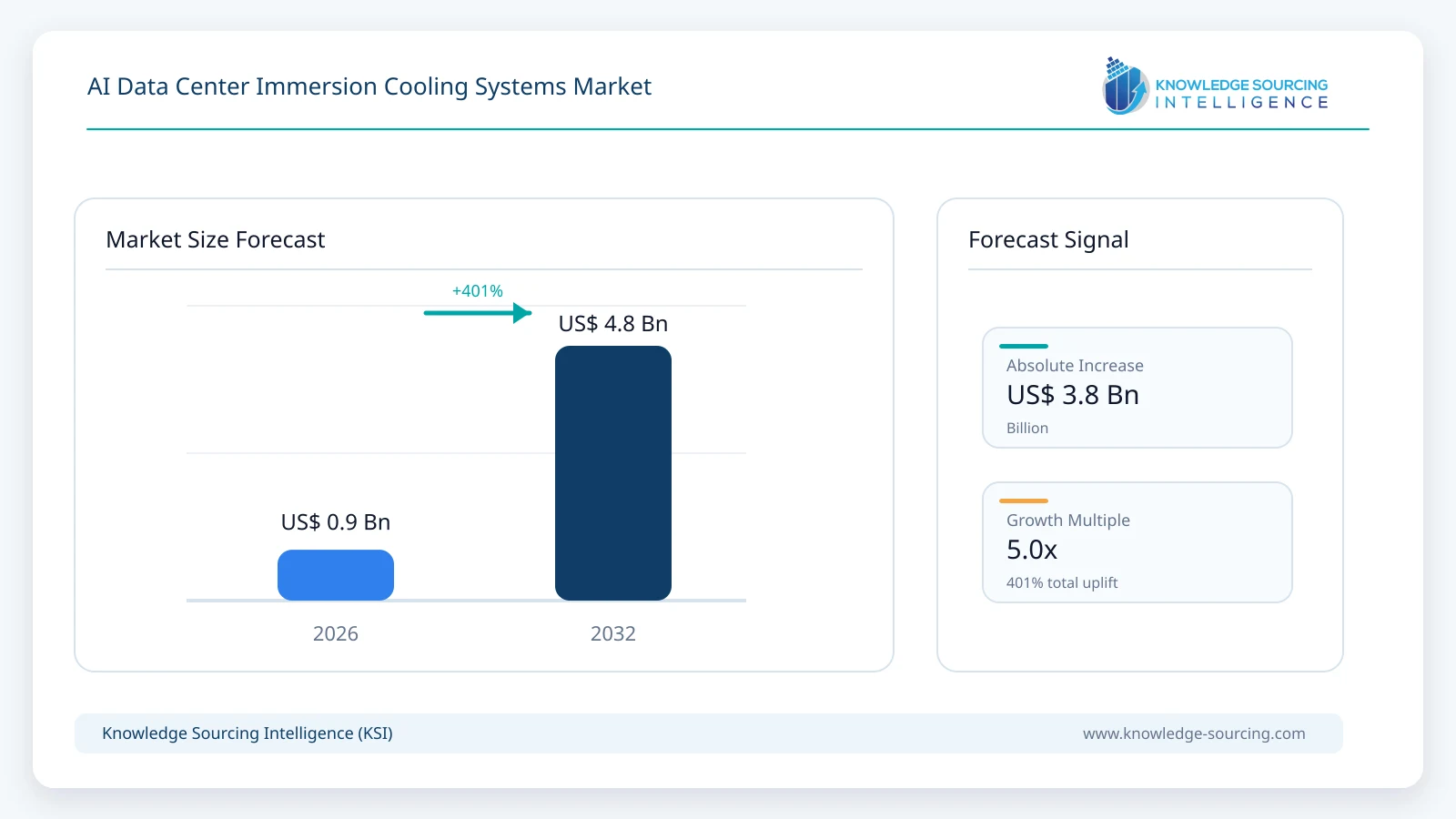
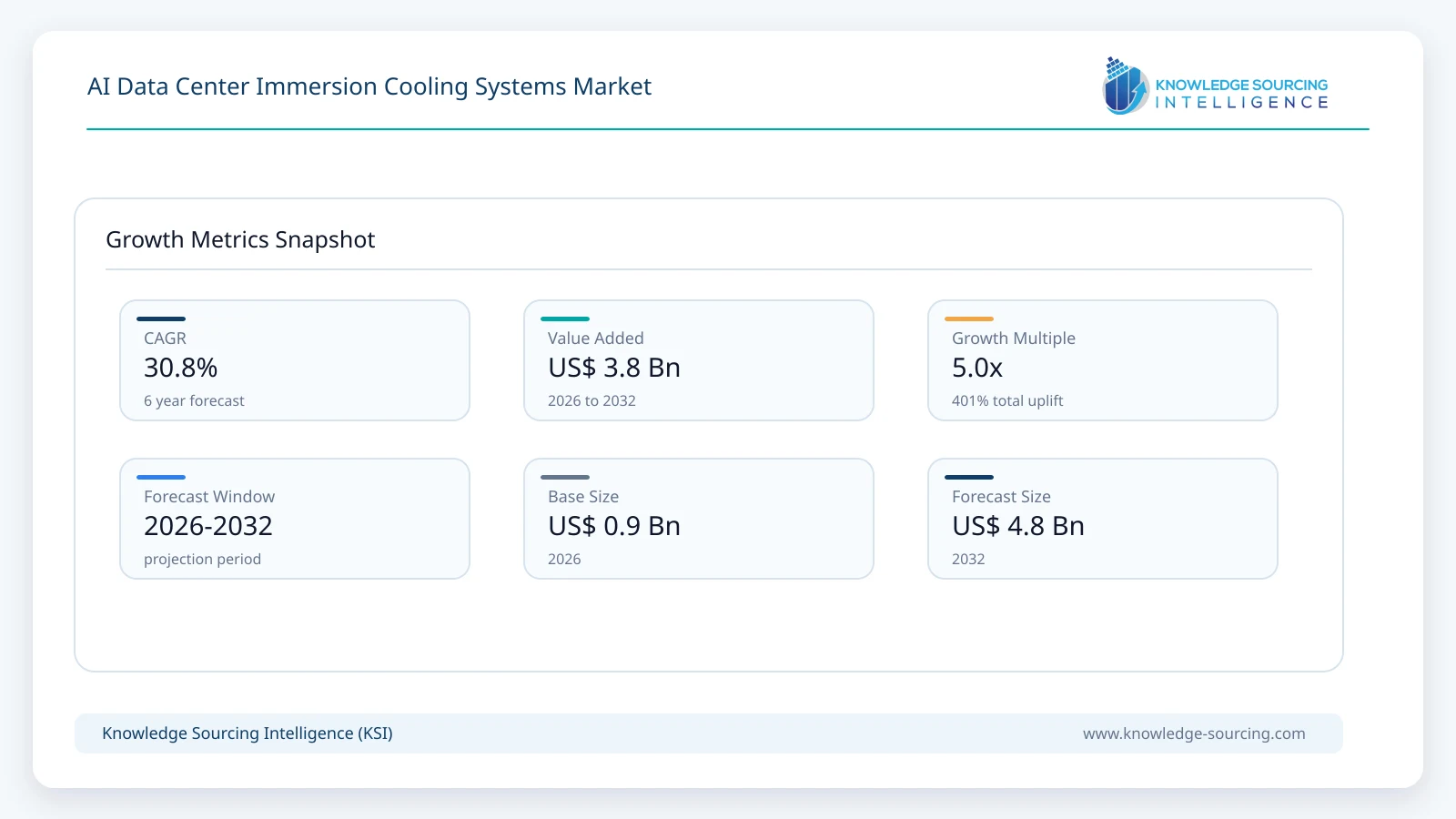
The AI Data Center Immersion Cooling Systems Market is estimated at USD 0.95 billion in 2026 and is projected to reach USD 4.76 billion by 2032, representing a CAGR of 30.8% during 2026–2032.
Highlights:
- 1Single-phase immersion cooling represents the largest commercial architecture in 2026.
- 2AI density growth increases demand for cooling architectures that remove nearly all server heat.
- 3Dielectric-fluid qualification is becoming a central procurement and reliability requirement.
- 4North America leads early commercialization through AI, HPC and industrial compute deployments.
- 5Asia Pacific is expanding through server manufacturing, refining, fluids and cooling-equipment ecosystems.
- 6Service procedures and component warranties remain major barriers to broad hyperscale adoption.
- 7Fluid monitoring and lifecycle management create recurring revenue beyond initial system installation.
Market Overview
Immersion cooling changes the thermal architecture by eliminating the air gap between heat-generating electronics and the primary cooling medium. In single-phase systems, servers are submerged in a dielectric liquid that remains in liquid form while circulating through a heat exchanger. Two-phase systems use a dielectric fluid that boils at the component surface and condenses elsewhere in the enclosure, allowing heat to be transferred through phase change. Both architectures can remove heat from processors and surrounding components, reducing dependence on high-speed fans and allowing much higher compute density in a smaller physical footprint.
The strongest commercial case is emerging where density, deployment speed, or environmental conditions make conventional cooling difficult. AI inference and training clusters are increasingly installed in modular facilities, industrial buildings, edge locations, and retrofitted data centers that may not have the floor area or air-handling infrastructure required for very high rack densities. GRC is working with ENDOR Development on immersion-cooled AI factories, while Infinium is positioning waterless modular immersion infrastructure for deployment in powered commercial and industrial buildings. These models expand the opportunity beyond traditional hyperscale campuses.
The market remains less standardized than direct-to-chip liquid cooling. Server vendors must validate materials, connectors, drives, power supplies, cables, and service procedures for continuous fluid exposure. Operators must establish processes for lifting, draining and servicing immersed hardware, while fluid suppliers must prove dielectric performance, oxidation stability, flash point, material compatibility and long-term cleanliness. The result is a market in which hardware, fluid, and compute-platform qualification are tightly connected, creating higher integration content but also longer adoption cycles.
Market Drivers
AI density increases the value of whole-server heat capture
Direct-to-chip cooling primarily targets processors and other selected high-heat components, leaving residual heat from memory, power supplies, storage, and networking equipment to be removed by air unless the liquid loop is extended. Immersion captures heat from most or all server components within the same fluid environment. As AI systems move toward higher total rack power and more components require active thermal management, the value of whole-server heat capture rises. This is particularly relevant for dense inference clusters, specialized accelerators and high-performance computing platforms where operators prioritize maximum compute per square metre.
Waterless and climate-resilient deployments broaden the addressable site base
Immersion systems can operate with dry coolers or other closed-loop heat-rejection equipment and do not require evaporative cooling at the rack level. This is attractive in water-constrained regions and at sites where traditional computer-room air conditioning would require major building modifications. Submer positions immersion cooling around climate resilience and dense AI deployment, while Infinium is explicitly targeting existing powered commercial and industrial facilities with waterless modular infrastructure. These use cases create demand outside the conventional hyperscale data-center footprint.
Integrated hardware qualification is improving commercial readiness
The market is moving from independent tank demonstrations toward integrated solutions involving server manufacturers, fluid suppliers and cooling vendors. ExxonMobil and Supermicro are validating NVIDIA B300-based servers with immersion fluids, while UNICOM Engineering and GRC are supplying turnkey AI and HPC platforms. S-OIL demonstrations in South Korea combine GPU servers, cooling tanks, fluid and operational monitoring. Each validated reference reduces the integration burden for buyers and supports repeatable deployment rather than one-off engineering.
Strategic investment is expanding the supplier ecosystem
Large thermal-management and materials companies are entering or expanding immersion portfolios. Trane Technologies agreed to acquire LiquidStack in 2026, adding immersion cooling to a broader chiller, heat-rejection and liquid-distribution platform. Dow is commercializing dedicated single-phase immersion fluids, while energy and lubricant companies including ExxonMobil, Shell, SK Enmove and S-OIL are developing or testing dielectric products. This enlarges manufacturing capacity, service coverage and long-term fluid support, which are necessary for immersion cooling to move beyond specialist deployments.
Restraints and Adoption Challenges
Immersion cooling faces several structural barriers that prevent it from replacing direct-to-chip cooling across most AI data centers. Server warranties and field-service procedures are not universally designed around submerged equipment, and replacing components can require draining, lifting, and cleaning steps unfamiliar to conventional operators. Dielectric fluids add procurement, compatibility and lifecycle-management requirements, and some two-phase fluids face additional environmental or regulatory scrutiny. Rack standards, cable management, storage-device choices and optical connectivity may also require redesign. Direct-to-chip cooling benefits from closer alignment with mainstream server platforms, so immersion adoption is expected to concentrate where its density, water, noise, footprint or deployment-speed advantages justify the additional operational change.
Segment Analysis
By Cooling Architecture
Single-phase immersion cooling represents the largest 2026 revenue pool because it uses fluids that remain liquid during operation and has a broader commercial supplier base across tanks, fluids, pumps and heat exchangers. GRC, Submer, LiquidStack and multiple Asian suppliers offer single-phase systems, while Dow, ExxonMobil, Shell and other materials companies are expanding compatible fluid portfolios. The architecture is easier to understand operationally than two-phase systems and can be paired with conventional facility heat-rejection loops.
Two-phase immersion cooling is expected to grow faster from a smaller base. Phase change can provide strong thermal performance with reduced pumping, making it attractive for extreme heat-flux environments. Adoption depends on working-fluid availability, environmental profile, materials compatibility, containment, fluid-loss management, and server qualification. Fluid technology therefore plays a larger role in the commercial structure than in single-phase systems. Integrated modular immersion systems and factory-built deployment services are also expanding quickly because they reduce the need for site-specific tank, piping and controls engineering.
Segment | Revenue Contribution | Growth Direction | Primary AI Data Center Application |
Single-phase immersion systems | Largest architecture | Very strong | Dense AI/HPC clusters, modular facilities and waterless deployments |
Two-phase immersion systems | Smaller commercial base | Fastest architecture | Extreme heat flux and highly compact compute |
Dielectric immersion fluids | Core recurring category | Very strong | Heat transfer, electrical insulation and lifecycle reliability |
Immersion tanks / enclosures | Largest hardware pool | Strong | Contain servers, fluid and internal circulation hardware |
Pumps, heat exchangers and controls | Core supporting layer | Strong | Move heat from immersion bath to facility loop |
Integration and lifecycle services | Growing service layer | Very strong | Server qualification, commissioning, fluid care and maintenance |
Market and Technology Indicators
Indicator | Latest Development | Market Impact |
Thermal-platform consolidation | Trane Technologies announced acquisition of LiquidStack in February 2026. | Moves immersion cooling into a larger global thermal-management platform. |
Integrated AI platforms | UNICOM Engineering and GRC launched turnkey immersion-cooled AI solutions in March 2026. | Reduces qualification and multi-vendor integration burden for buyers. |
AI server validation | ExxonMobil and Supermicro are validating immersion cooling with NVIDIA B300-class servers. | Connects immersion fluids with mainstream next-generation AI hardware. |
Dedicated fluid innovation | Dow highlighted DOWSIL ICL-1100 single-phase immersion fluid at COMPUTEX 2026. | Expands materials options and supplier support for long-life immersion operation. |
Live AI data-center trials | S-OIL, GST and partners are testing immersion cooling in operating AI/GPU environments in 2026. | Builds commercial evidence beyond laboratory demonstrations. |
Factory-built deployment model | Infinium Edge launched modular immersion infrastructure for dense AI/HPC workloads. | Supports deployment outside conventional purpose-built data centers. |
Regional Opportunity
North America
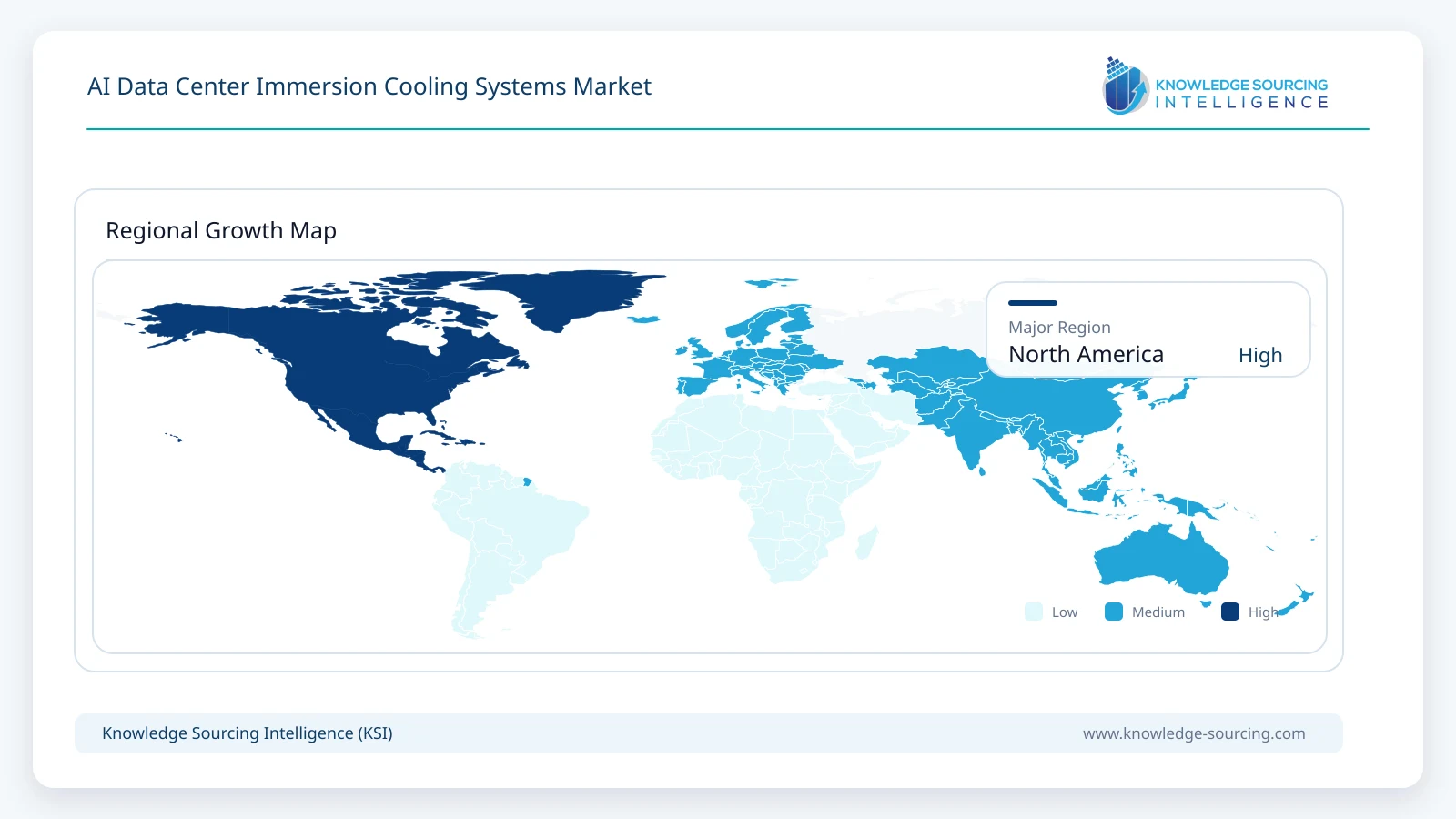
North America is the largest early commercial market for AI data-center immersion cooling because the United States combines a large AI infrastructure buildout with strong specialist-cooling, server, and materials ecosystems. GRC has deployed immersion technology across AI, HPC and enterprise environments and is expanding through integrated AI-factory partnerships. LiquidStack is headquartered in Texas and is being acquired by Trane Technologies, strengthening its ability to combine immersion tanks with chillers, heat rejection and service coverage. ExxonMobil and Supermicro are validating immersion-ready AI server configurations, while Infinium is commercializing modular waterless infrastructure aimed at distributed AI deployments.
The region is particularly attractive for use cases where power is available before purpose-built data-center space. Industrial sites, warehouses, former manufacturing facilities, and modular AI campuses can use immersion cooling to increase compute density without installing large room-air systems. This aligns with a broader trend toward repurposing powered real estate for AI inference and specialized compute. Immersion also creates an option in regions where water use or mechanical-yard space constrains conventional cooling. These advantages support growth in neocloud, industrial AI and sovereign or enterprise compute alongside hyperscale experimentation.
Adoption will remain selective. Major hyperscale platforms are standardizing direct-to-chip liquid cooling around mainstream GPU rack architectures, so immersion must compete on total cost, density, deployment speed and operational simplicity rather than thermal performance alone. North American buyers are therefore expected to use immersion disproportionately in specialized high-density clusters, factory-built modular systems, edge or industrial facilities, and AI deployments where water or floor-space constraints are acute. This still creates a substantial market because the absolute volume of AI infrastructure is increasing rapidly.
Asia Pacific is a major supply and commercialization region because it combines server manufacturing, electronics integration, specialty fluids, and cooling-equipment production. South Korea is particularly active through S-OIL, SK Enmove, GST, and other participants testing immersion with AI servers. Europe contributes through Submer, advanced cooling engineering and sustainability-driven data-center design. The Middle East provides a greenfield opportunity where water constraints and large new AI campuses can support high-density closed-loop thermal architectures.
Competitive Landscape
The competitive landscape combines specialist immersion-cooling vendors, diversified thermal-equipment companies, server integrators, and dielectric-fluid suppliers. GRC, Submer, and LiquidStack are among the best-established immersion-system specialists. Trane Technologies is expanding into immersion through LiquidStack, while Supermicro and UNICOM Engineering provide server and platform integration. Vertiv and Schneider Electric participate in adjacent liquid-cooling ecosystems and can influence broader facility integration even where immersion is not their principal architecture.
Fluid competition is expanding quickly. Dow offers dedicated silicone-based immersion fluid, while ExxonMobil, Shell, SK Enmove, S-OIL and other energy or lubricant suppliers are developing or validating dielectric fluids for AI data centers. Castrol and TotalEnergies bring adjacent thermal-fluid portfolios and materials expertise. Asian system vendors, including Global Standard Technology, are also important because tank hardware, server adaptation, and fluid qualification frequently occur within one regional ecosystem. Competitive advantage depends on server validation, fluid stability, materials compatibility, thermal performance, service procedures, modular scalability, and the ability to support long operating lifetimes without contamination or fluid degradation.
Major companies and ecosystem participants covered: GRC, Submer, LiquidStack / Trane Technologies, Supermicro, UNICOM Engineering, Dow, ExxonMobil, Shell, SK Enmove, S-OIL, Global Standard Technology, Castrol, TotalEnergies, Boyd, Iceotope, Asperitas, Gigabyte Technology and Wiwynn.
Recent Developments
September 2026: South Korean refiners expanded immersion-cooling demonstrations for AI data centers, with S-OIL, SK Enmove and other suppliers moving from fluid development into live system validation.
July 2026: Infinium Edge expanded its modular immersion-cooling model for deploying AI compute at powered commercial and industrial sites.
June 2026: Dow showcased DOWSIL ICL-1100 single-phase immersion fluid and broader AI thermal-management materials at COMPUTEX 2026.
June 2026: S-OIL expanded immersion-cooling validation with university and industry partners using GPU and supercomputing environments.
May 2026: S-OIL, GST, ONION Software and server partners launched an AI data-center immersion-cooling proof of concept in South Korea.
March 2026: UNICOM Engineering and GRC launched integrated immersion-cooled AI, HPC and GPU-as-a-Service platforms.
February 2026: Trane Technologies announced a definitive agreement to acquire LiquidStack and expand end-to-end data-center thermal management.
January 2026: Infinium launched the Infinium Edge immersion-cooling platform for high-density AI and HPC workloads.
AI Data Center Immersion Cooling Systems Market Scope:
| Report Metric | Details |
|---|---|
| Total Market Size in 2026 | USD 0.95 billion |
| Total Market Size in 2032 | USD 4.76 billion |
| Forecast Unit | USD Billion |
| Growth Rate | 30.8% |
| Study Period | 2021 to 2032 |
| Historical Data | 2021 to 2024 |
| Base Year | 2025 |
| Forecast Period | 2026 – 2032 |
| Segmentation | Cooling Architecture, Component, Deployment Model, Customer Type |
| Companies |
|
Market Segmentation
By Cooling Architecture
Single-Phase Immersion Cooling
Two-Phase Immersion Cooling
Hybrid Immersion and Direct-Liquid Architectures
By Component
Immersion Tanks and Enclosures
Dielectric Cooling Fluids
Pumps and Circulation Systems
Heat Exchangers
Filtration, Sensors and Fluid Monitoring
Controls and Management Systems
Server Adaptation and Immersion-Ready Hardware
By Deployment Model
In-Data-Center Immersion Pods
Modular / Containerized Immersion Systems
Industrial and Repurposed Powered Sites
Edge and Distributed AI
High-Performance Computing Facilities
By Customer Type
Hyperscale Cloud Providers
Neocloud and GPU-Cloud Operators
Colocation Providers
Sovereign AI Infrastructure
Enterprise, Industrial and HPC Users
By Service
System Design and Integration
Installation and Commissioning
Fluid Management and Testing
Maintenance and Lifecycle Services
Server Qualification and Warranty Support
North America
United States
Canada
Europe
Asia Pacific
Middle East and Rest of World
Table of Contents
Table of Contents
1. EXECUTIVE SUMMARY
1.1. Market Opportunity and Key Findings
1.2. Immersion Cooling Commercialization Timeline
1.3. Principal Revenue Pools
2. MARKET OVERVIEW
2.1. AI Heat Density and Whole-Server Cooling
2.2. Single-Phase and Two-Phase Architectures
2.3. Dielectric Fluids and Material Compatibility
2.4. Server Qualification and Serviceability
2.5. Facility Integration and Heat Rejection
3. MARKET SIZE AND FORECAST, 2026-2032
3.1. Global Market Revenue
3.2. Annual Growth Analysis
3.3. Installed Immersion-Cooled IT Capacity
3.4. Revenue per MW and System Content
4. MARKET BY COOLING ARCHITECTURE
4.1. Single-Phase Immersion Cooling
4.2. Two-Phase Immersion Cooling
4.3. Hybrid Immersion and Direct-Liquid Architectures
5. MARKET BY COMPONENT
5.1. Immersion Tanks and Enclosures
5.2. Dielectric Cooling Fluids
5.3. Pumps and Circulation Systems
5.4. Heat Exchangers
5.5. Filtration, Sensors and Fluid Monitoring
5.6. Controls and Management Systems
5.7. Server Adaptation and Immersion-Ready Hardware
6. MARKET BY DEPLOYMENT MODEL
6.1. In-Data-Center Immersion Pods
6.2. Modular / Containerized Immersion Systems
6.3. Industrial and Repurposed Powered Sites
6.4. Edge and Distributed AI
6.5. High-Performance Computing Facilities
7. MARKET BY CUSTOMER TYPE
7.1. Hyperscale Cloud Providers
7.2. Neocloud and GPU-Cloud Operators
7.3. Colocation Providers
7.4. Sovereign AI Infrastructure
7.5. Enterprise, Industrial and HPC Users
8. MARKET BY SERVICE
8.1. System Design and Integration
8.2. Installation and Commissioning
8.3. Fluid Management and Testing
8.4. Maintenance and Lifecycle Services
8.5. Server Qualification and Warranty Support
9. REGIONAL MARKET
9.1. North America
9.1.1. United States
9.1.2. Canada
9.2. Europe
9.3. Asia Pacific
9.4. Middle East and Rest of World
10. MARKET DYNAMICS
10.1. Drivers
10.1.1. Growth in Whole-Server Heat Density
10.1.2. Waterless and Climate-Resilient Deployment
10.1.3. Integrated AI Server Qualification
10.1.4. Expansion of Fluids and Thermal Supplier Ecosystem
10.2. Restraints
10.2.1. Server Warranty and Serviceability Constraints
10.2.2. Fluid Compatibility and Lifecycle Management
10.2.3. Two-Phase Fluid and Regulatory Complexity
10.2.4. Competition from Direct-to-Chip Cooling
11. COMPETITIVE LANDSCAPE
11.1. Value Chain
11.2. Immersion System Vendors
11.3. Server and Platform Integrators
11.4. Dielectric Fluid Suppliers
11.5. Facility Thermal Integration Providers
11.6. Partnerships, Validation and Commercial Deployment
12. COMPANY PROFILES
12.1. GRC
12.2. Submer
12.3. Trane Technologies
12.4. Supermicro
12.5. UNICOM Engineering
12.6. Dow
12.7. ExxonMobil
12.8. Shell
12.9. SK Enmove
12.10. S-OIL
12.11. Global Standard Technology
12.12. Castrol
12.13. TotalEnergies
12.14. Boyd
12.15. Iceotope
12.16. Asperitas
12.17. Gigabyte Technology
12.18. Wiwynn
13. APPENDIX
Navigate
Trusted by the world's leading organizations











