
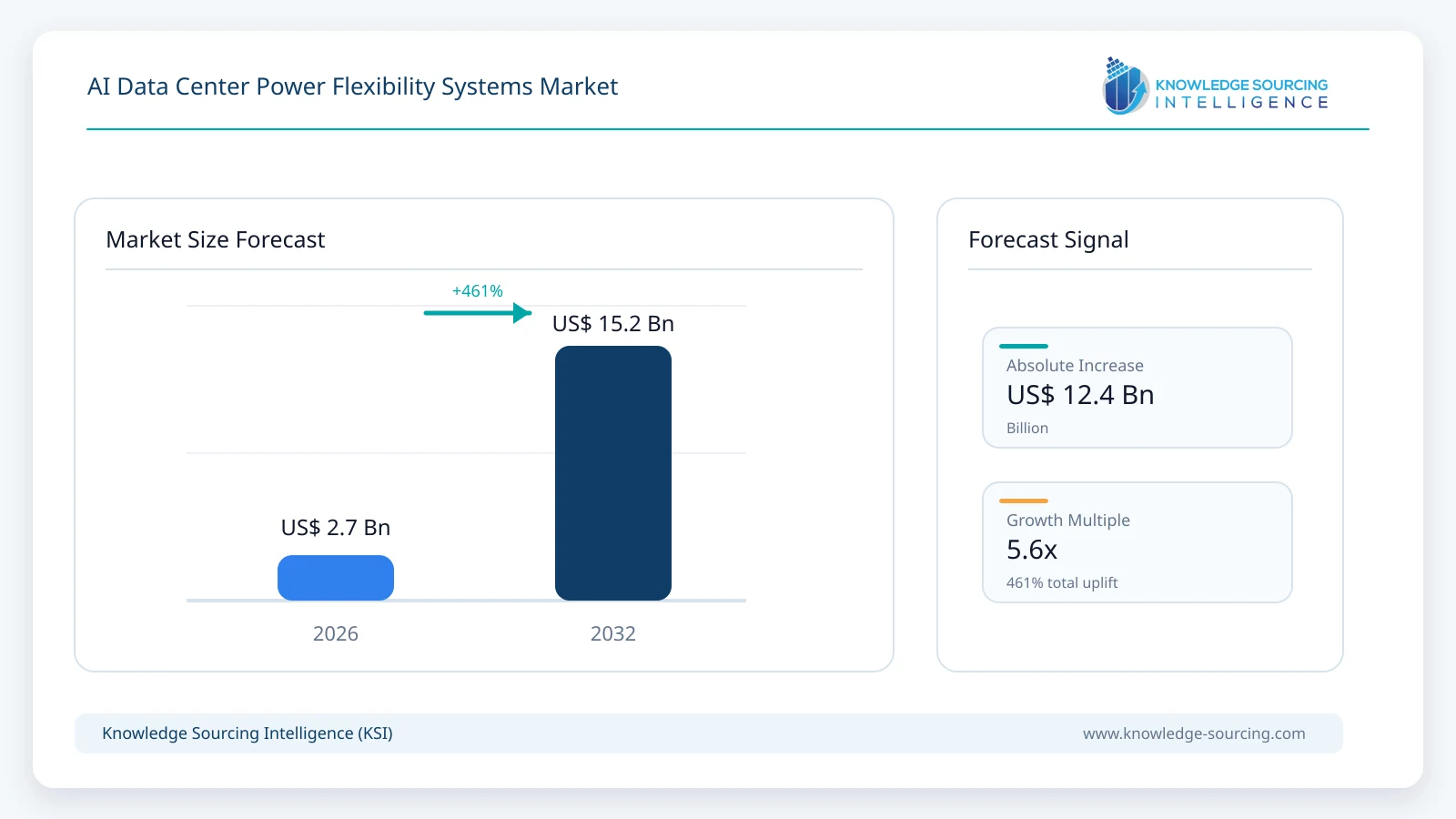
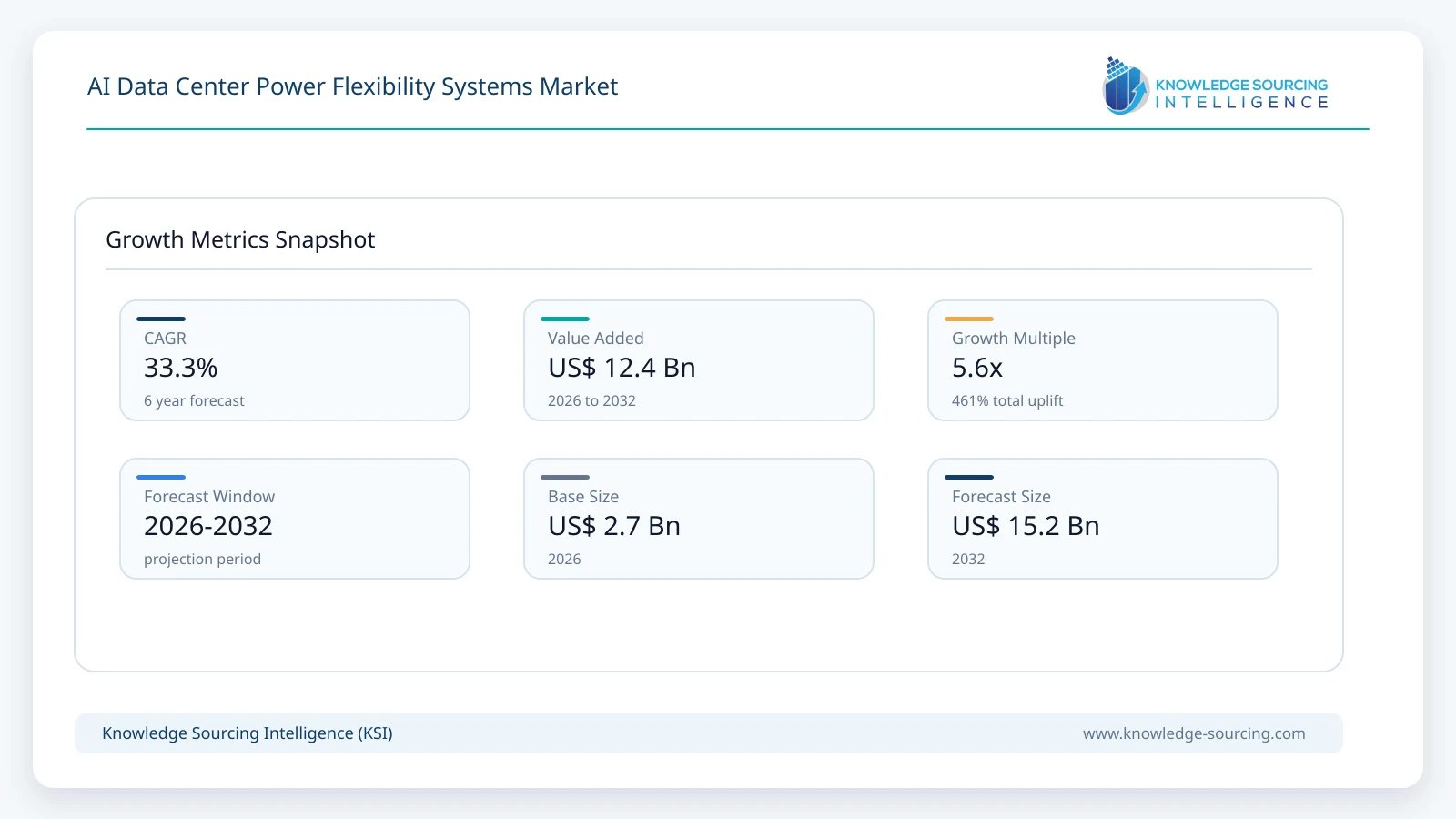
The AI Data Center Power Flexibility Systems Market is estimated at USD 2.70 billion in 2026 and is projected to reach USD 15.15 billion by 2032, expanding at a CAGR of 33.3% during 2026–2032.
Highlights:
- 1Grid constraints are turning controllable AI demand into a commercially valuable infrastructure capability.
- 2Google has contracted one gigawatt of data-center demand response with U.S. utilities.
- 3EPRI DCFlex is validating flexible data-center operation across nine active demonstration sites.
- 4AI workload orchestration is emerging as the fastest-growing software layer within power flexibility.
- 5Battery-backed UPS systems increasingly provide load smoothing alongside their traditional resilience function.
- 6Flexible interconnection models can connect large loads before all network upgrades are completed.
- 7North America leads early deployments because AI growth and grid congestion are converging rapidly.
- 8Power flexibility combines compute scheduling, facility controls, storage and utility communication in real time.
- 9Training and batch inference workloads provide greater curtailment potential than latency-critical AI services.
- 10Virtual power plant integration creates additional value from batteries already installed for resilience.
- 11Common telemetry and utility-control standards remain a key requirement for scaled multi-vendor deployment.
- 12Power-flexible architectures complement, rather than replace, new generation, transmission and data-center power equipment.
Electricity availability has become a primary constraint on AI infrastructure deployment. The International Energy Agency (IEA) projects global data-center electricity consumption to rise from about 485 TWh in 2025 to around 950 TWh in 2030, with electricity use from AI-focused data centers increasing considerably faster than the overall category. In the United States, Lawrence Berkeley National Laboratory's 2025 update estimates that data centers could account for 11.8% of national electricity consumption by 2030 in its central case, with a scenario range of 9.5% to 15.3%. This growth is concentrating new demand in regions where transmission additions and generation projects can require substantially longer lead times than an AI facility.
Power flexibility addresses part of this timing mismatch by allowing operators and utilities to distinguish between firm and controllable load. A facility can respond by shifting non-urgent training jobs, reducing accelerator power limits, scheduling batch inference differently, discharging batteries during grid stress, smoothing short-duration GPU power ramps, operating onsite energy resources, or participating in formal demand-response programs. These mechanisms operate on different time scales, from millisecond power smoothing to multi-hour workload shifting, and therefore require coordination between data-center software and electrical infrastructure.
The commercial opportunity is becoming broader than demand-response software alone. AI clusters can create rapid changes in facility power draw, increasing the value of battery-supported UPS architectures and high-speed power controls. At the same time, utilities and grid operators are developing interconnection structures where large loads can accept limited curtailment in exchange for earlier connection. PJM's 2026 connect-and-manage work explicitly considers customer flexibility solutions for large loads before completion of required transmission upgrades. This directly links power-flexibility capability with data-center development schedules and creates a stronger purchasing case for integrated controls, storage and grid-service interfaces.
Table 1. AI Data Center Power Flexibility Systems Market Forecast, 2026-2032
Year | Market Size (USD billion) | Year-on-Year Growth |
2026 | 2.70 | - |
2027 | 3.46 | 28.0% |
2028 | 4.53 | 31.0% |
2029 | 6.07 | 34.0% |
2030 | 8.31 | 37.0% |
2031 | 11.30 | 36.0% |
2032 | 15.15 | 34.0% |
Market Drivers
Grid interconnection constraints increase the value of controllable load
New AI campuses frequently request hundreds of megawatts of firm capacity, while transmission and generation additions can take several years. Flexibility gives utilities another option between immediate full-firm service and outright delay. Google has already incorporated machine-learning workload flexibility into utility agreements, and PJM is evaluating frameworks in which large loads can connect under defined curtailment conditions. As these arrangements become formalized, flexibility systems move from experimental energy optimization to infrastructure that can influence speed-to-power and site economics.
AI workloads provide software-controllable demand at meaningful scale
Unlike many industrial processes, portions of AI computing can be scheduled, slowed or geographically shifted while preserving higher-priority workloads. Google has demonstrated workload-based demand response, while Emerald AI and NVIDIA have shown fast AI-cluster power adjustments against external grid targets. The value is highest where operators can classify jobs by urgency and service-level requirements, allowing training, checkpointing, synthetic-data generation and selected batch inference to absorb more of the flexibility requirement than real-time production services.
Storage and UPS assets are gaining an additional operating role
AI power profiles are increasing interest in batteries that can support more than outage ride-through. Grid-interactive BESS can perform peak shaving, load shifting, rapid ramp-rate control and demand-response participation, while suitably designed UPS systems can smooth short-duration fluctuations between IT demand and grid draw. This creates incremental value from electrical assets that are already justified by resilience requirements and supports collaboration between critical-power suppliers, virtual-power-plant operators and energy-management software companies.
Market Restraints
The principal constraint is workload criticality. Data centers are designed around high availability, and not all computing can be curtailed without affecting customers, model-training deadlines or inference latency. Operators therefore need precise classification of flexible and non-flexible workloads, conservative control limits and fallbacks that prevent grid-service participation from compromising service-level agreements.
Commercial models also vary by utility territory. Demand-response compensation, interconnection rules, wholesale-market access, battery dispatch permissions and backup-generation restrictions differ widely across regions. A technically flexible facility may therefore have limited economic incentive to expose that flexibility unless utilities create tariffs or connection structures that value the capability.
Integration complexity remains material. Power flexibility crosses IT schedulers, building and electrical controls, UPS and storage systems, microgrid controllers, utility signals and cybersecurity boundaries. Proprietary interfaces can slow deployment, while insufficient telemetry or command latency can reduce the reliability of flexibility commitments.
Technology and Solution Landscape
Table 2. Core Power-Flexibility Solution Categories
Solution Category | 2026 Position | Primary Function | Representative Participants |
Grid-interactive BESS and UPS | Largest 2026 value pool | Peak shaving, load smoothing, ride-through, grid services | Vertiv, Schneider Electric, Eaton, Fluence, Tesla Energy |
Workload and power orchestration | Fastest-growing category | Compute shifting, power caps, grid-signal response | NVIDIA, Emerald AI, Google internal platforms, Phaidra |
Microgrid and DER controls | Established enabling layer | Coordinates utility, onsite generation, storage and loads | Schneider Electric, Siemens, ABB, Honeywell, GE Vernova |
Demand response and VPP integration | Expanding market interface | Aggregates flexible load and behind-the-meter assets | CPower, Voltus, Kraken Technologies |
Telemetry and grid interface | Foundational control layer | Real-time IT/OT measurement, forecasting and command exchange | Multiple power, automation and data-center control vendors |
Grid-interactive BESS and UPS
Grid-interactive battery systems and flexibility-enabled UPS platforms represent the largest solution segment in 2026 because they combine a physical power resource with established data-center resilience spending. Their role is expanding from emergency backup toward controlled charge-discharge operation, peak management and rapid smoothing of AI load changes. Vertiv's integration of EnergyCore Grid BESS with CPower's virtual-power-plant platform illustrates the shift toward monetizing behind-the-meter assets while maintaining facility resilience. Schneider Electric is similarly emphasizing battery-backed UPS operation for grid-friendly AI loads and rapid power fluctuations.
Workload and power orchestration
Workload and power orchestration is expected to grow faster than the hardware categories because it can unlock flexibility from computing capacity that is already installed. NVIDIA DSX Flex is designed to receive load-shedding, demand-response and pricing signals and adapt AI workloads while coordinating utility power, onsite renewables and storage. Emerald AI's Conductor platform provides a separate orchestration layer that has been demonstrated against utility and system-operator targets. As AI operators standardize workload priority classes and expose power controls at GPU, rack and cluster level, software can increase available flexibility without requiring a proportional increase in energy hardware.
Table 3. Power-Flexibility Mechanisms by Response Time and Operational Role
Flexibility Mechanism | Typical Response Window | Commercial / Grid Role | Enabling Systems |
Power smoothing / ramp control | Milliseconds to seconds | Absorb rapid AI load swings | Battery-backed UPS, fast BESS controls |
Emergency curtailment | Seconds to minutes | Reduce facility demand during grid stress | Workload caps, schedulers, BESS, onsite resources |
Demand response | Minutes to hours | Meet utility or market reduction events | Compute shifting, BESS, VPP integration |
Peak shaving / load shifting | Hours | Reduce peak import and capacity exposure | BESS, scheduling, microgrid controls |
Flexible interconnection | Event-based / seasonal | Enable earlier connection under constrained service | Contracted curtailment, automation, utility telemetry |
Energy-market optimization | Continuous | Respond to price, renewable and grid conditions | EMS, DERMS, workload orchestration |
By Customer Type
The market is segmented into hyperscale cloud providers, neocloud and GPU-cloud operators, colocation providers, sovereign AI infrastructure and large enterprise or high-performance-computing operators. Hyperscalers are important early adopters because they can coordinate workloads across large fleets and negotiate directly with utilities. Neocloud and AI-factory operators have a different incentive: flexible interconnection can shorten the period between facility completion and usable grid capacity. Colocation providers increasingly need to expose power-flexibility features without interfering with customer workload control, creating demand for contractual, metering and control mechanisms that separate facility-level assets from tenant IT decisions.
Regional Opportunity
North America
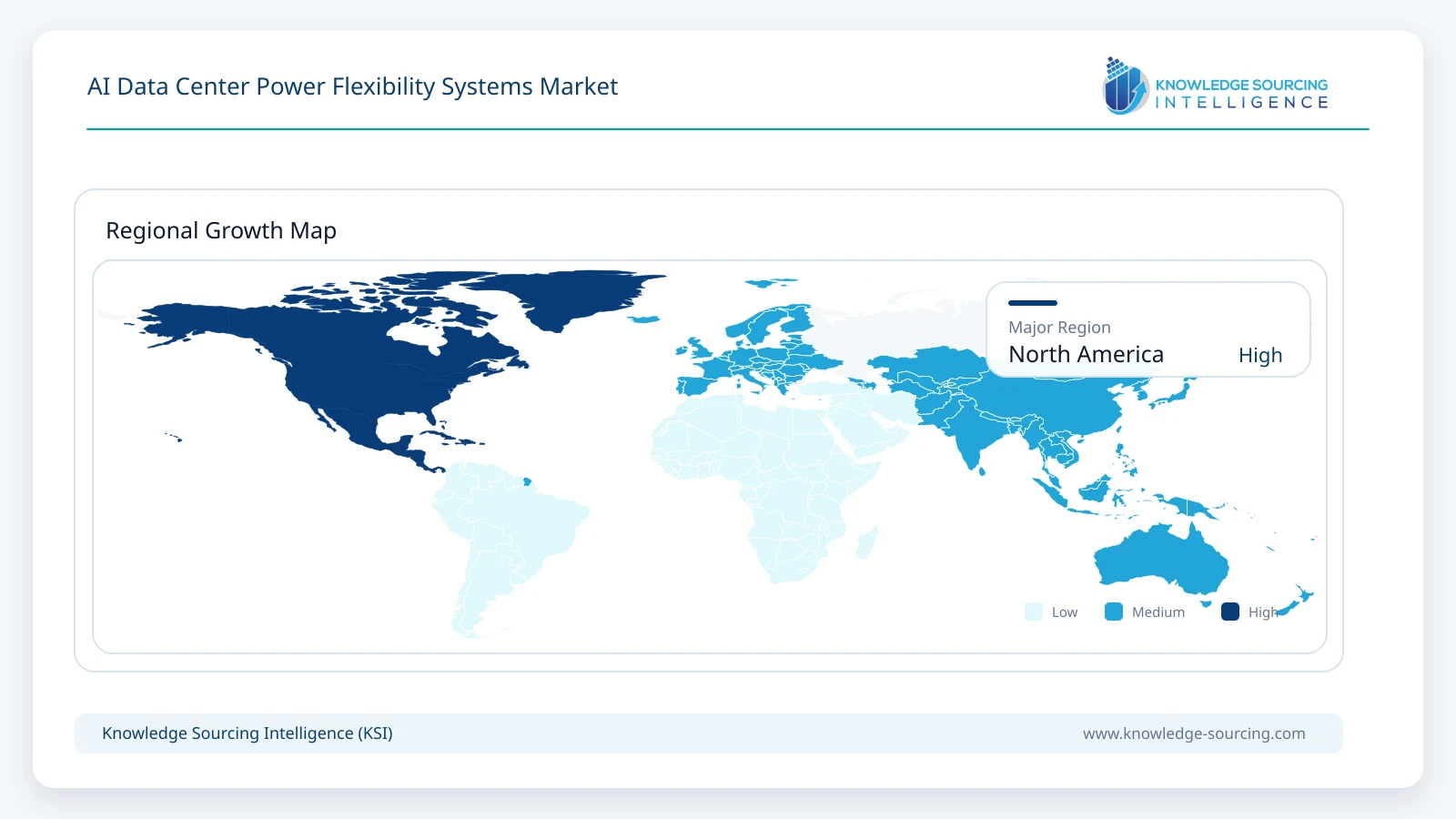
North America is the principal early market for AI data-center power flexibility. The United States combines the world's largest concentration of hyperscale and AI infrastructure investment with rapidly rising utility load forecasts and increasingly visible interconnection constraints.
Lawrence Berkeley National Laboratory's 2025 update indicates that data centers could account for 11.8% of U.S. electricity consumption by 2030 in its central estimate, while regional systems such as PJM are explicitly developing mechanisms for large flexible loads. These conditions create a direct commercial link between flexibility capability and new-site energization.
The region also contains the most mature demonstration ecosystem. Google has integrated 1 GW of demand response into utility agreements and has used machine-learning workload flexibility with partners including Indiana Michigan Power and Tennessee Valley Authority. EPRI's DCFlex initiative is coordinating utilities, data-center operators and technology suppliers across active demonstrations. Emerald AI, NVIDIA, utilities and infrastructure operators have tested rapid, automated reductions in AI-cluster consumption. Vertiv and CPower are commercializing grid-interactive BESS and virtual-power-plant integration specifically for data centers. The result is a market with buyers, grid programs, software suppliers and critical-power vendors all developing in parallel.
The U.S. market is not uniform. Value is highest in constrained data-center regions where interconnection lead times, transmission capacity or peak-demand exposure create an economic reason to make load flexible. Regulatory treatment of backup generation, wholesale-market access and utility tariffs can materially change the preferred architecture. The addressable market therefore expands first through utility-specific programs and bilateral agreements rather than through a single national operating model.
Europe is developing around grid-responsive operation, renewable integration and constrained connection capacity, with the United Kingdom and parts of continental Europe providing relevant demonstration environments. Asia Pacific combines very large data-center expansion with different utility structures; Taiwan, Japan, South Korea, Singapore and selected Chinese markets have strong incentives around reliability and energy optimization. Middle Eastern AI campuses are more likely to combine grid supply with dedicated generation, storage and energy-park architectures, making hybrid-energy orchestration an important pathway even where formal demand-response markets are less mature.
Competitive Landscape
Competition spans four overlapping groups. AI-compute suppliers are moving downward into power-aware scheduling and cluster control. Critical-power companies are adding grid-interactive features to UPS, BESS and power-management platforms. Energy-management and automation vendors provide microgrid, distributed-energy-resource and facility orchestration. Demand-response and virtual-power-plant companies provide the commercial interface between flexible data-center assets and utilities or electricity markets.
NVIDIA and Emerald AI have prominent positions in compute-aware flexibility, while hyperscalers such as Google are demonstrating proprietary workload controls at fleet scale. Schneider Electric, Vertiv, Eaton, Siemens, ABB, GE Vernova and Honeywell participate through critical power, microgrid, controls and energy-management portfolios. CPower, Voltus and Kraken Technologies provide aggregation or grid-flexibility capabilities, while Fluence and Tesla Energy are relevant to the storage layer. The competitive boundary is expected to remain fluid because the highest-value deployments require coordination across software and physical energy assets rather than a single standalone product.
Interoperability is likely to become an important differentiator. Operators need a common control path from utility signal to facility energy system and ultimately to the AI workload. Vendors that can integrate IT telemetry, power-system constraints, batteries, onsite generation and service-level priorities without locking operators into a single hardware stack are positioned to capture a larger share of enterprise deployments.
Major companies and ecosystem participants covered: NVIDIA, Emerald AI, Schneider Electric, Vertiv, Eaton, Siemens, ABB, GE Vernova, Honeywell, CPower Energy, Voltus, Kraken Technologies, Phaidra, Fluence, Tesla Energy, Bloom Energy, Enchanted Rock and Hitachi Energy.
Recent Developments
September 2026: Emerald AI, Google and NVIDIA launched the AI Energy Management Alliance to advance flexible, grid-responsive data centers across the AI and power value chain.
June 2026: Google and Voltus announced a three-year arrangement intended to unlock up to 100 MW of flexible distributed capacity in the PJM region.
April 2026: Vertiv and CPower announced integration of Vertiv EnergyCore Grid BESS with CPower virtual-power-plant capabilities for data-center grid participation.
March 2026: Google reported 1 GW of data-center demand-response capacity integrated into long-term utility agreements across the United States.
March 2026: Emerald AI, NVIDIA, EPRI, National Grid and Nebius demonstrated automated AI-factory load reductions while preserving priority workload performance.
January 2026: PJM outlined a connect-and-manage pathway that includes curtailment and customer-flexibility options for new large-load interconnections.
AI Data Center Power Flexibility Systems Market Scope:
| Report Metric | Details |
|---|---|
| Total Market Size in 2026 | USD 2.70 billion |
| Total Market Size in 2032 | USD 15.15 billion |
| Forecast Unit | USD Billion |
| Growth Rate | 33.3% |
| Study Period | 2021 to 2032 |
| Historical Data | 2021 to 2024 |
| Base Year | 2025 |
| Forecast Period | 2026 – 2032 |
| Segmentation | Solution, Flexibility Mechanism, Deployment Architecture, Customer Type, Geography |
| Companies |
|
Market Segmentation
By Solution
Grid-Interactive Battery Energy Storage Systems and UPS
Workload and Power Orchestration Software
Microgrid and Distributed Energy Resource Controls
Demand Response and Virtual Power Plant Integration
Telemetry, Forecasting and Grid Interface
By Flexibility Mechanism
Power Smoothing and Ramp-Rate Control
Workload Shifting and Compute Curtailment
Peak Shaving and Temporal Load Shifting
Emergency Curtailment
Flexible Interconnection
Grid Services and Energy-Market Optimization
By Deployment Architecture
Grid-Connected AI Data Centers
Grid plus Onsite Energy Resources
Microgrids and Behind-the-Meter Energy Parks
Colocation and Multi-Tenant Architectures
By Customer Type
Hyperscale Cloud Providers
Neocloud and GPU-Cloud Operators
Colocation Providers
Sovereign AI Infrastructure
Enterprise and High-Performance Computing
By Geography
North America
United States
Canada
Europe
Asia Pacific
Middle East and Rest of World
Table of Contents
1. EXECUTIVE SUMMARY
1.1. Market Opportunity and Key Findings
1.2. Power-Flexibility Adoption Timeline
1.3. Principal Revenue Pools
1.4. Grid and Interconnection Context
2. MARKET OVERVIEW
2.1. AI Data-Center Electricity Demand
2.2. Grid Interconnection Constraints
2.3. Data-Center Load Flexibility
2.4. IT and OT Coordination
2.5. Utility and Market Participation Models
3. MARKET SIZE AND FORECAST, 2026-2032
3.1. Global Market Revenue
3.2. Annual Growth Analysis
3.3. Installed Flexible AI Load
3.4. Flexibility Revenue per MW
4. MARKET BY SOLUTION
4.1. Grid-Interactive Battery Energy Storage Systems and UPS
4.2. Workload and Power Orchestration Software
4.3. Microgrid and Distributed Energy Resource Controls
4.4. Demand Response and Virtual Power Plant Integration
4.5. Telemetry, Forecasting and Grid Interface
5. MARKET BY FLEXIBILITY MECHANISM
5.1. Power Smoothing and Ramp-Rate Control
5.2. Workload Shifting and Compute Curtailment
5.3. Peak Shaving and Temporal Load Shifting
5.4. Emergency Curtailment
5.5. Flexible Interconnection
5.6. Grid Services and Energy-Market Optimization
6. MARKET BY DEPLOYMENT ARCHITECTURE
6.1. Grid-Connected AI Data Centers
6.2. Grid plus Onsite Energy Resources
6.3. Microgrids and Behind-the-Meter Energy Parks
6.4. Colocation and Multi-Tenant Architectures
7. MARKET BY CUSTOMER TYPE
7.1. Hyperscale Cloud Providers
7.2. Neocloud and GPU-Cloud Operators
7.3. Colocation Providers
7.4. Sovereign AI Infrastructure
7.5. Enterprise and High-Performance Computing
8. REGIONAL MARKET
8.1. North America
8.1.1. United States
8.1.2. Canada
8.2. Europe
8.3. Asia Pacific
8.4. Middle East and Rest of World
9. TECHNOLOGY AND COMMERCIALIZATION OUTLOOK
9.1. Workload Priority and Service-Level Controls
9.2. GPU, Rack and Cluster Power Capping
9.3. Grid-Interactive UPS and BESS
9.4. Microgrid and Hybrid Energy Orchestration
9.5. IT/OT Telemetry and Control Standards
9.6. Cybersecurity and Fail-Safe Operation
9.7. Utility Tariffs and Flexible Interconnection Models
10. COMPETITIVE LANDSCAPE
10.1. Value Chain
10.2. AI Workload and Power-Orchestration Vendors
10.3. Critical-Power and Energy-Management Vendors
10.4. Demand-Response and Virtual-Power-Plant Providers
10.5. Energy Storage and Onsite Power Providers
10.6. Partnerships, Demonstrations and Commercial Deployments
11. COMPANY PROFILES
11.1. NVIDIA
11.2. Emerald AI
11.3. Schneider Electric
11.4. Vertiv
11.5. Eaton
11.6. Siemens
11.7. ABB
11.8. GE Vernova
11.9. Honeywell
11.10. CPower Energy
11.11. Voltus
11.12. Kraken Technologies
11.13. Phaidra
11.14. Fluence
11.15. Tesla Energy
11.16. Bloom Energy
11.17. Enchanted Rock
11.18. Hitachi Energy
12. APPENDIX
12.1. Definitions and Abbreviations
12.2. Flexibility Mechanism Classification
12.3. Regional Utility and Market Frameworks
12.4. Source and Data Notes
Navigate
Trusted by the world's leading organizations











