
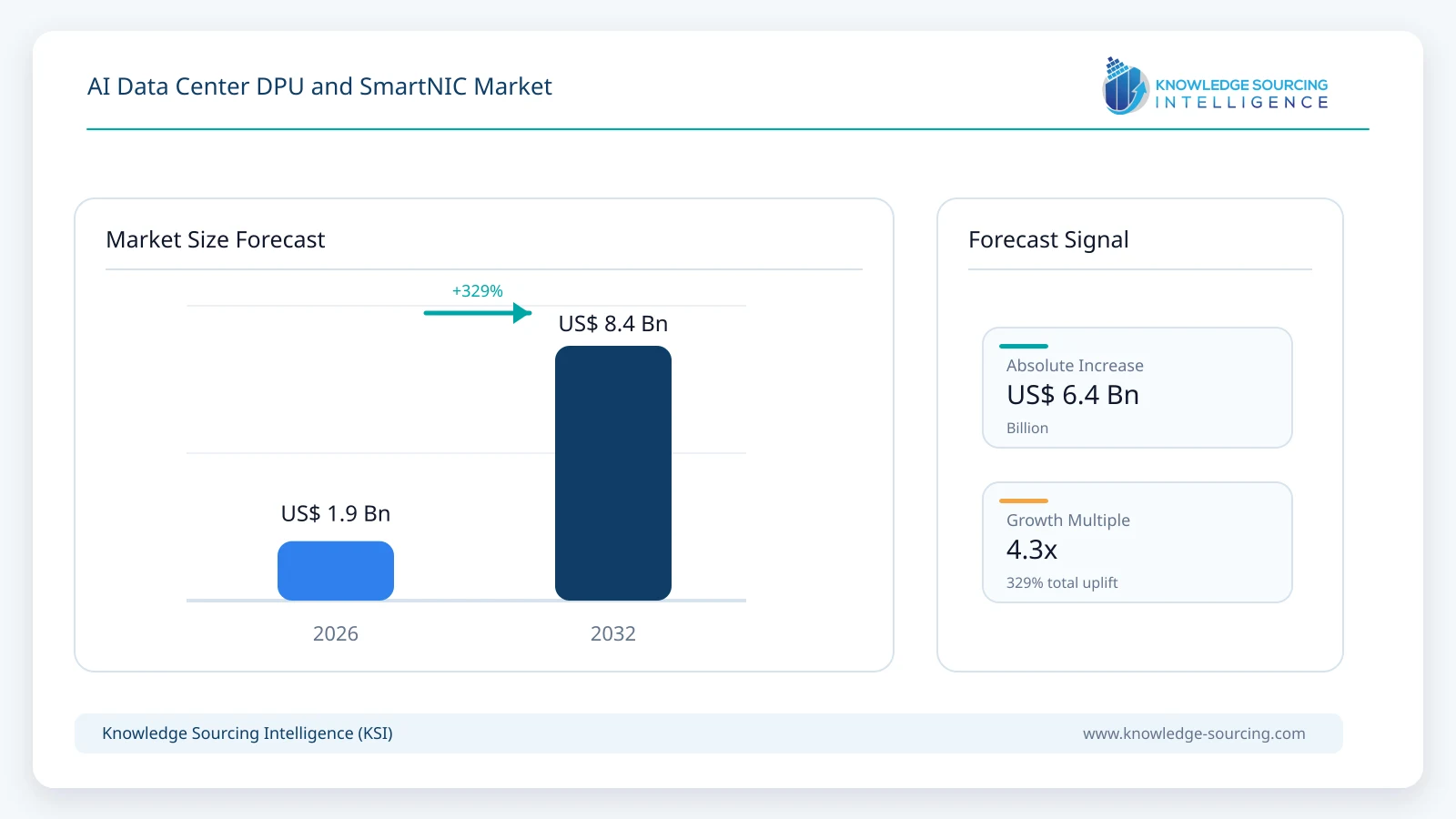
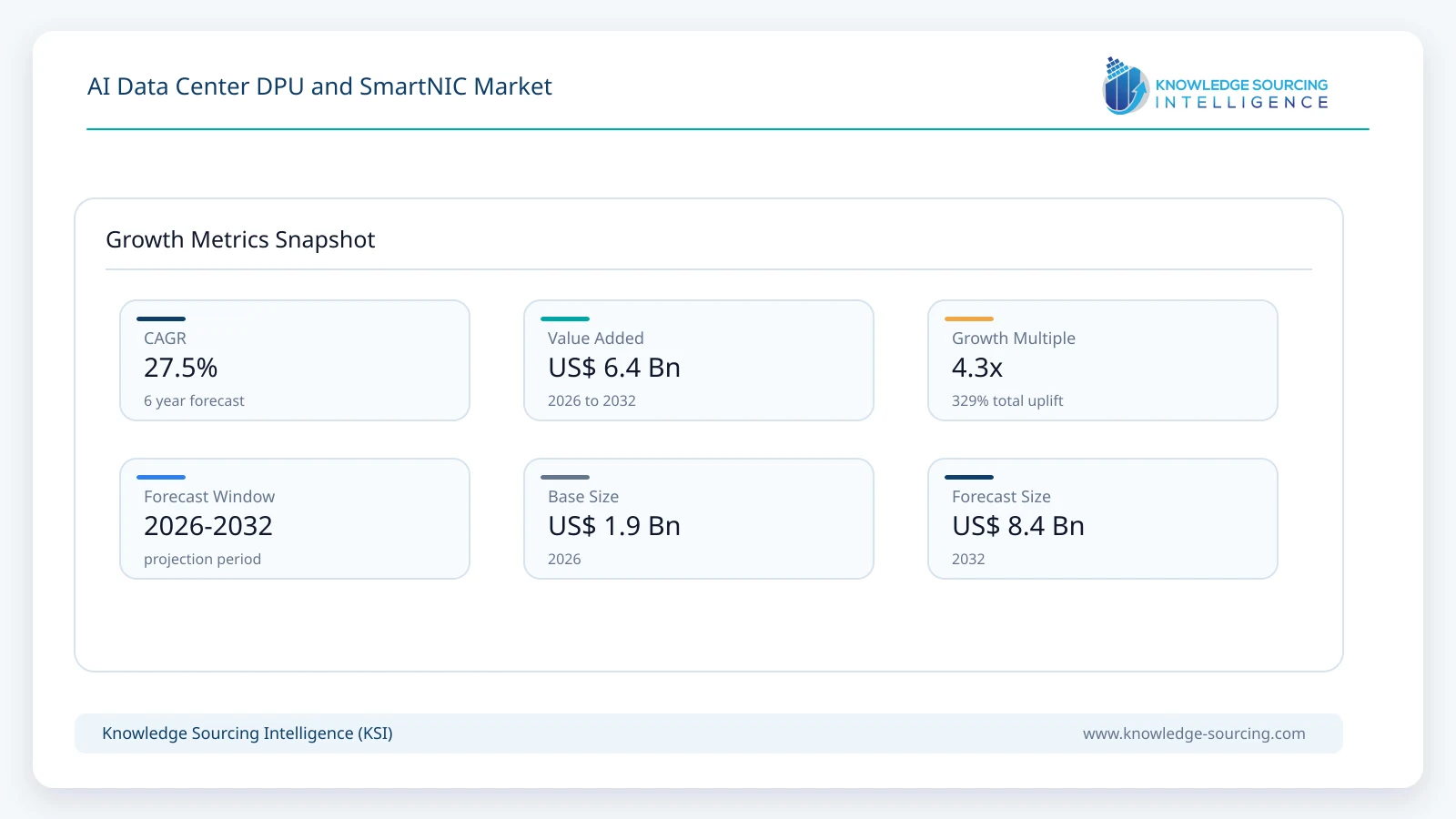
The AI Data Center DPU and SmartNIC Market is estimated at USD 1.95 billion in 2026 and is projected to reach USD 8.36 billion by 2032, representing a CAGR of 27.5% during 2026-2032.
Highlights:
- 1Programmable DPUs are becoming a dedicated infrastructure-compute layer inside large AI factories.
- 2BlueField-4 raises DPU throughput to 800 Gb/s for next-generation AI infrastructure.
- 3AMD Salina targets front-end AI networking, security, storage and observability offload.
- 4Microsoft is deploying AMD Pensando DPUs in Azure AI backend networking infrastructure.
- 5Google and Intel are co-developing custom IPUs for next-generation cloud and AI systems.
- 6AI storage is creating a new DPU use case around KV-cache and remote NVMe access.
- 7Security isolation becomes more valuable as AI clusters support multiple tenants and services.
- 8DPUs return host CPU cores to workload coordination instead of infrastructure packet processing.
- 9North America leads adoption through hyperscaler, neocloud and AI-platform concentration.
- 10Storage-centric DPU deployments are the fastest-growing use case through 2032.
- 11Programmability differentiates DPUs from fixed-function high-speed Ethernet network interface cards.
- 12Open software stacks and orchestration integration increasingly determine commercial platform adoption.
Market Overview
DPUs and SmartNICs sit between the host server and the network, storage, and security infrastructure. Their role is to execute infrastructure services that would otherwise consume CPU cores or depend on software forwarding in the host operating system. Common functions include virtual switching, overlay networking, packet steering, encryption, firewalling, telemetry, storage protocol processing, and remote direct memory access. Because these functions operate independently from the workload CPU, cloud operators can maintain stronger isolation between tenant applications and infrastructure control while preserving more host compute for AI data preparation, orchestration and inference services.
AI workloads expand the value of this offload layer. Training clusters require efficient front-end networking for data ingestion, orchestration, and storage even when accelerator-to-accelerator traffic uses a separate scale-out or scale-up fabric. Agentic inference increases the importance of persistent context, remote storage, and fast retrieval of Key-Value (KV) cache data. NVIDIA's BlueField-4 Storage Processing Unit and AMD's Salina DPU both extend infrastructure offload deeper into AI-native storage, while Marvell is positioning OCTEON DPUs as brokers between Ethernet networks and flash storage for distributed inference.
The market contains both merchant and vertically integrated deployments. NVIDIA and AMD sell programmable DPU platforms to server and cloud ecosystems. Marvell and Broadcom provide merchant SmartNIC and infrastructure-processing silicon and cards. Microsoft Azure Boost, Google's custom IPU architecture, and Amazon Web Services' Nitro system demonstrate a parallel model in which hyperscalers design their own offload silicon and hardware around internal cloud requirements. These internal platforms are included only where the underlying DPU/IPU hardware value is identifiable, while the cloud service revenue itself is excluded.
Market Drivers
Infrastructure offload preserves CPU capacity for AI workloads
Cloud networking, security and storage functions can consume a material share of host CPU resources when executed in software. DPUs separate this work from the host and provide dedicated programmable engines for packet processing, encryption, storage and telemetry. AMD states that Pensando Salina can return up to 22 CPU cores per server to AI work in selected configurations, while Microsoft Azure Boost moves network and storage virtualization onto dedicated hardware. As AI servers become more expensive, the economic value of preserving host CPU capacity and reducing jitter rises alongside accelerator utilization.
AI-native storage is creating a new DPU acceleration layer
Long-context and agentic inference workloads create much larger Key-Value cache and persistent-memory requirements than conventional inference. NVIDIA's BlueField-4 STX architecture uses dedicated storage processing to move context data between clusters and storage, while Marvell is extending OCTEON DPUs into network-storage architectures for AI inference. AMD's Salina similarly accelerates storage access and can manage NVMe capacity used to extend GPU-memory workflows. This expands DPU value beyond conventional network virtualization into a storage-and-memory infrastructure layer tied directly to tokens per second and GPU utilization.
Multi-tenant AI infrastructure increases security and isolation requirements
Neocloud, public-cloud, and colocation AI platforms increasingly host several customers, models, and services on shared infrastructure. DPUs can enforce networking and security policy outside the host operating system, creating a stronger trust boundary between customer workloads and provider infrastructure. NVIDIA, AMD and Microsoft all emphasize hardware-accelerated security and isolation in their current offload platforms. The requirement becomes more important as high-value accelerator clusters are shared across tenants and as agentic systems access large amounts of distributed data.
800G networking raises the performance ceiling for programmable offload
Network interfaces are moving from 200G and 400G toward 800G in current AI platforms. BlueField-4 supports 800 Gb/s infrastructure processing, while AMD Salina provides dual 400 Gigabit Ethernet ports and nearly 800 Gb/s software-defined networking bandwidth in published performance data. Higher bandwidth makes software-only packet processing increasingly expensive in CPU terms and raises the performance requirement for encryption, telemetry, and storage offload. This strengthens the case for purpose-built DPU hardware as AI front-end and storage networks scale.
Restraints and Adoption Challenges
The principal restraint is the high degree of vertical integration among the largest hyperscalers. Microsoft, Google, and Amazon can design custom offload platforms rather than purchase merchant DPUs in every server, limiting the addressable market for independent vendors. DPUs also add cost, power consumption, and software complexity and are not necessary in every enterprise AI deployment. Offloaded services must integrate with cloud orchestration, virtual networking, storage, and security software; hardware without a mature software stack can be difficult to adopt. Conventional high-performance NICs increasingly incorporate fixed-function offloads that can address some requirements at lower cost, while host CPUs continue to improve packet-processing and encryption performance.
Segment Analysis
By Product Architecture
Programmable DPUs with onboard Arm-class compute cores and hardware accelerators represent the largest 2026 revenue pool. NVIDIA BlueField, AMD Pensando and Marvell OCTEON combine programmable processing with high-speed Ethernet, cryptography and storage functions, allowing infrastructure services to execute independently from the host CPU. These platforms carry higher average selling prices than conventional NICs because they integrate processors, memory, accelerators and complex software stacks.
SmartNIC and IPU architectures optimized around programmable packet processing and cloud-specific offload are expected to expand rapidly through 2032. Microsoft Azure Boost and Google/Intel IPUs illustrate how large cloud providers can customize the balance between ASIC acceleration, embedded compute and software programmability. Storage-focused DPU configurations are expected to record the fastest use-case growth as agentic AI and distributed inference create new requirements around KV-cache, NVMe-over-Fabrics and secure data movement.
Product / Use Case | 2026 Position | Growth Direction | Primary AI Data Center Role |
Programmable DPUs | Largest revenue pool | Very strong | Networking, storage, security and infrastructure offload |
Cloud-specific IPUs | Large hyperscale internal segment | Strong | Custom virtual networking, storage and isolation services |
Programmable SmartNICs | Established merchant category | Strong | Packet processing, telemetry, encryption and virtual switching |
AI-storage DPU acceleration | Smaller 2026 base | Fastest | KV-cache movement, remote NVMe access and context-memory storage |
Security and isolation offload | Core recurring use case | Very strong | Multi-tenant segmentation, encryption and trusted infrastructure |
Software, SDK and support layer | Supporting platform category | Strong | Programmability, orchestration and lifecycle integration |
Market and Technology Indicators
Indicator | 2026 Evidence | Market Relevance |
800 Gb/s DPU generation | NVIDIA BlueField-4 supports 800 Gb/s infrastructure processing. | Raises programmable offload bandwidth for next-generation AI factories. |
Production AI platform integration | NVIDIA Vera Rubin production systems include BlueField-4 DPU and BlueField-4 STX storage platforms. | Moves DPU adoption into complete rack-scale AI reference architectures. |
AMD front-end AI networking | AMD Pensando Salina provides networking, security, observability and storage offload for AI infrastructure. | Expands merchant competition in front-end DPU deployment. |
Azure deployment | Microsoft announced deployment of AMD Pensando DPUs in AI backend networking and selected Azure services. | Confirms hyperscale production adoption beyond one silicon vendor. |
Custom IPU development | Intel and Google expanded co-development of ASIC-based IPUs for cloud and AI infrastructure. | Shows continuing demand for dedicated infrastructure processors. |
AI-native storage offload | Marvell is positioning OCTEON DPUs for network storage and KV-cache-related AI data movement. | Extends DPU value from networking into inference storage infrastructure. |
Regional Opportunity
North America
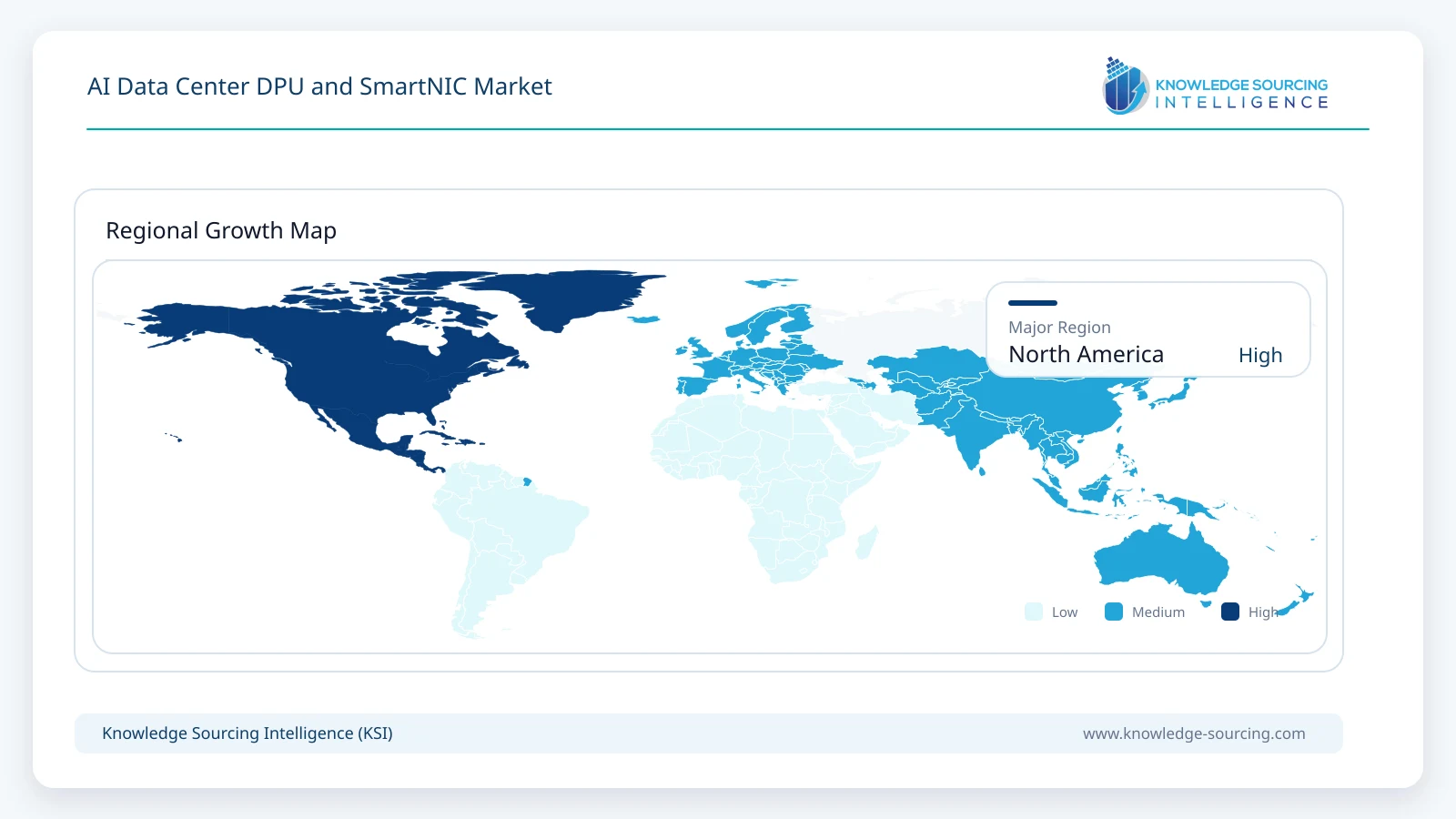
North America is the largest market for AI data-center DPUs and SmartNICs because the region contains the leading hyperscale cloud providers, AI-platform companies and merchant DPU suppliers. NVIDIA, AMD, Intel, Marvell and Broadcom are headquartered in the United States, while Microsoft, Google and Amazon Web Services operate some of the world's largest internal SmartNIC and infrastructure-processing fleets. This concentration creates both merchant demand and substantial custom-silicon activity.
The 2026 product cycle strengthens that position. NVIDIA's Vera Rubin platform integrates BlueField-4 as an AI-factory infrastructure processor, while BlueField-4 STX extends DPU functionality into context-memory storage. AMD's Pensando Salina is being deployed with Microsoft Azure and positioned for AI front-end networking and storage acceleration. Intel and Google are co-developing another generation of custom IPUs, while Microsoft has moved the next generation of Azure Boost into general availability with custom offload hardware for networking, storage and security.
Neocloud operators provide an additional merchant opportunity because they generally lack the scale to design custom infrastructure processors but still require cloud-grade isolation, storage performance and observability. AI storage suppliers are also adopting DPU architectures to reduce CPU overhead and move data efficiently between GPUs and flash. Through 2032, North American growth is expected to be led by BlueField and Pensando deployments, AI-native storage offload, custom hyperscale IPUs and higher attach rates in shared GPU infrastructure.
Asia Pacific plays a major manufacturing role and is also expanding AI-cloud deployment across China, Japan, South Korea, Taiwan, India and Southeast Asia. Europe contributes through sovereign AI, cloud infrastructure and SmartNIC software ecosystems. The Middle East is emerging as a large AI-capacity market where merchant DPU platforms can be integrated into imported rack-scale systems and neocloud infrastructure without requiring locally designed offload silicon.
Competitive Landscape
The competitive landscape combines merchant semiconductor vendors, vertically integrated hyperscalers and server-platform companies. NVIDIA has the broadest commercially integrated DPU position through BlueField hardware, DOCA software and tight linkage with Spectrum-X, storage and Vera Rubin systems. AMD competes through the Pensando portfolio and is integrating Salina into Helios and Microsoft Azure. Marvell offers OCTEON DPUs across cloud, networking and AI-storage applications, while Broadcom maintains a SmartNIC and high-performance Ethernet offload portfolio.
Hyperscalers remain strategically important competitors and customers. Microsoft uses both its own Azure Boost DPU architecture and external AMD Pensando technology. Google works with Intel on custom IPUs, and Amazon Web Services has long used its internally developed Nitro architecture to offload networking, storage and management functions. These companies influence merchant roadmap requirements even where they do not purchase standard cards in every deployment.
Server and system vendors determine how quickly DPUs become part of standardized AI infrastructure. Dell Technologies, HPE, Lenovo and Supermicro integrate or qualify BlueField, Pensando, Intel and other offload technologies across data-center platforms. Achronix, Napatech and Silicom participate in programmable acceleration and SmartNIC implementations for specialized networking and cloud environments. Competitive differentiation centers on throughput, CPU offload efficiency, programmable software, encryption and security, storage acceleration, power consumption, orchestration integration and ecosystem support.
Major companies and ecosystem participants covered: NVIDIA, AMD, Intel, Marvell Technology, Broadcom, Microsoft, Google, Amazon Web Services, Dell Technologies, HPE, Lenovo, Supermicro, Achronix, Napatech and Silicom.
Recent Developments
September 2026: Marvell detailed DPU-powered network-storage architectures for AI inference, using OCTEON DPUs to offload networking, security, and storage processing from host CPUs.
August 2026: Marvell showcased OCTEON DPU technology for AI-native network storage and advanced inference infrastructure at FMS 2026.
July 2026: Microsoft and AMD announced that Azure is deploying AMD Pensando DPUs in AI backend networking infrastructure and selected Azure services.
May 2026: Microsoft made the next generation of Azure Boost generally available with custom ASIC-hardened networking and storage offload infrastructure.
April 2026: Intel and Google announced expanded multiyear co-development of custom ASIC-based IPUs for cloud and AI infrastructure.
March 2026: NVIDIA announced Vera Rubin production systems including BlueField-4 DPU and BlueField-4 STX storage infrastructure.
January 2026: NVIDIA introduced BlueField-4-powered AI-native context-memory storage infrastructure for long-context and agentic inference.
AI Data Center DPU and SmartNIC Market Scope:
| Report Metric | Details |
|---|---|
| Total Market Size in 2026 | USD 1.95 billion |
| Total Market Size in 2032 | USD 8.36 billion |
| Forecast Unit | USD Billion |
| Growth Rate | 27.5% |
| Study Period | 2021 to 2032 |
| Historical Data | 2021 to 2024 |
| Base Year | 2025 |
| Forecast Period | 2026 – 2032 |
| Segmentation | Product Architecture, Use Case, Network Interface, Deployment Layer |
| Companies |
|
Market Segmentation
By Product Architecture
Programmable DPUs
Infrastructure Processing Units
Programmable SmartNICs
Cloud-Specific Custom Offload ASICs
Software, SDK and Support Layer
By Use Case
Software-Defined Networking and Virtual Switching
Storage and NVMe-over-Fabrics Acceleration
AI Storage and KV-Cache Data Movement
Security, Encryption and Tenant Isolation
Telemetry and Observability
Front-End AI Networking
By Network Interface
Up to 200G
400G
800G
Above 800G Roadmap
By Deployment Layer
AI Compute Servers
Front-End Network Servers
AI Storage Nodes
Cloud Infrastructure Services
Multi-Tenant GPU Platforms
By Customer Type
Hyperscale Cloud Providers
Neocloud and GPU-Cloud Operators
AI Storage Providers
Colocation and Managed Infrastructure Providers
Enterprise and High-Performance Computing
By Region
North America
United States
Canada
Europe
Asia Pacific
Middle East and Rest of World
Table of Contents
1. EXECUTIVE SUMMARY
1.1. Market Opportunity and Key Findings
1.2. DPU and SmartNIC Adoption Outlook
1.3. Principal Revenue Pools
2. MARKET OVERVIEW
2.1. Infrastructure Offload Architecture
2.2. DPU, IPU and SmartNIC Functional Differences
2.3. AI Front-End Networking Requirements
2.4. AI Storage and KV-Cache Acceleration
2.5. Security, Isolation and Observability
3. MARKET SIZE AND FORECAST, 2026-2032
3.1. Global Market Revenue
3.2. Annual Growth Analysis
3.3. DPU and SmartNIC Units Shipped
3.4. Revenue per AI Server and Storage Node
4. MARKET BY PRODUCT ARCHITECTURE
4.1. Programmable DPUs
4.2. Infrastructure Processing Units
4.3. Programmable SmartNICs
4.4. Cloud-Specific Custom Offload ASICs
4.5. Software, SDK and Support Layer
5. MARKET BY USE CASE
5.1. Software-Defined Networking and Virtual Switching
5.2. Storage and NVMe-over-Fabrics Acceleration
5.3. AI Storage and KV-Cache Data Movement
5.4. Security, Encryption and Tenant Isolation
5.5. Telemetry and Observability
5.6. Front-End AI Networking
6. MARKET BY NETWORK INTERFACE
6.1. Up to 200G
6.2. 400G
6.3. 800G
6.4. Above 800G Roadmap
7. MARKET BY DEPLOYMENT LAYER
7.1. AI Compute Servers
7.2. Front-End Network Servers
7.3. AI Storage Nodes
7.4. Cloud Infrastructure Services
7.5. Multi-Tenant GPU Platforms
8. MARKET BY CUSTOMER TYPE
8.1. Hyperscale Cloud Providers
8.2. Neocloud and GPU-Cloud Operators
8.3. AI Storage Providers
8.4. Colocation and Managed Infrastructure Providers
8.5. Enterprise and High-Performance Computing
9. REGIONAL MARKET
9.1. North America
9.1.1. United States
9.1.2. Canada
9.2. Europe
9.3. Asia Pacific
9.4. Middle East and Rest of World
10. MARKET DYNAMICS
10.1. Drivers
10.1.1. CPU Offload and Infrastructure Efficiency
10.1.2. AI-Native Storage and KV-Cache Growth
10.1.3. Multi-Tenant Security and Isolation
10.1.4. 800G Infrastructure Networking
10.2. Restraints
10.2.1. Hyperscale Custom-Silicon Competition
10.2.2. Software and Orchestration Complexity
10.2.3. Additional Power and Hardware Cost
10.2.4. Overlap with Fixed-Function NIC Offloads
11. COMPETITIVE LANDSCAPE
11.1. Market Structure and Competitive Intensity
11.2. Programmable DPU and SmartNIC Platform Positioning
11.3. Merchant Silicon versus Hyperscale Custom Architecture
11.4. Networking, Storage and Security Software Integration
11.5. Cloud, Server OEM and AI-Storage Partnerships
11.6. Competitive Differentiation: Throughput, Offload Efficiency, Programmability and Ecosystem
12. COMPANY PROFILES
12.1. NVIDIA
12.2. AMD
12.3. Intel
12.4. Marvell Technology
12.5. Broadcom
12.6. Microsoft
12.7. Google
12.8. Amazon Web Services
12.9. Dell Technologies
12.10. HPE
12.11. Lenovo
12.12. Supermicro
12.13. Achronix
12.14. Napatech
12.15. Silicom
13. RECENT DEVELOPMENTS
14. APPENDIX
14.1. Definitions and Abbreviations
14.2. DPU, IPU and SmartNIC Architecture Classification
14.3. Networking, Storage and Security Offload Framework
14.4. Source and Data Notes
Navigate
Trusted by the world's leading organizations











