
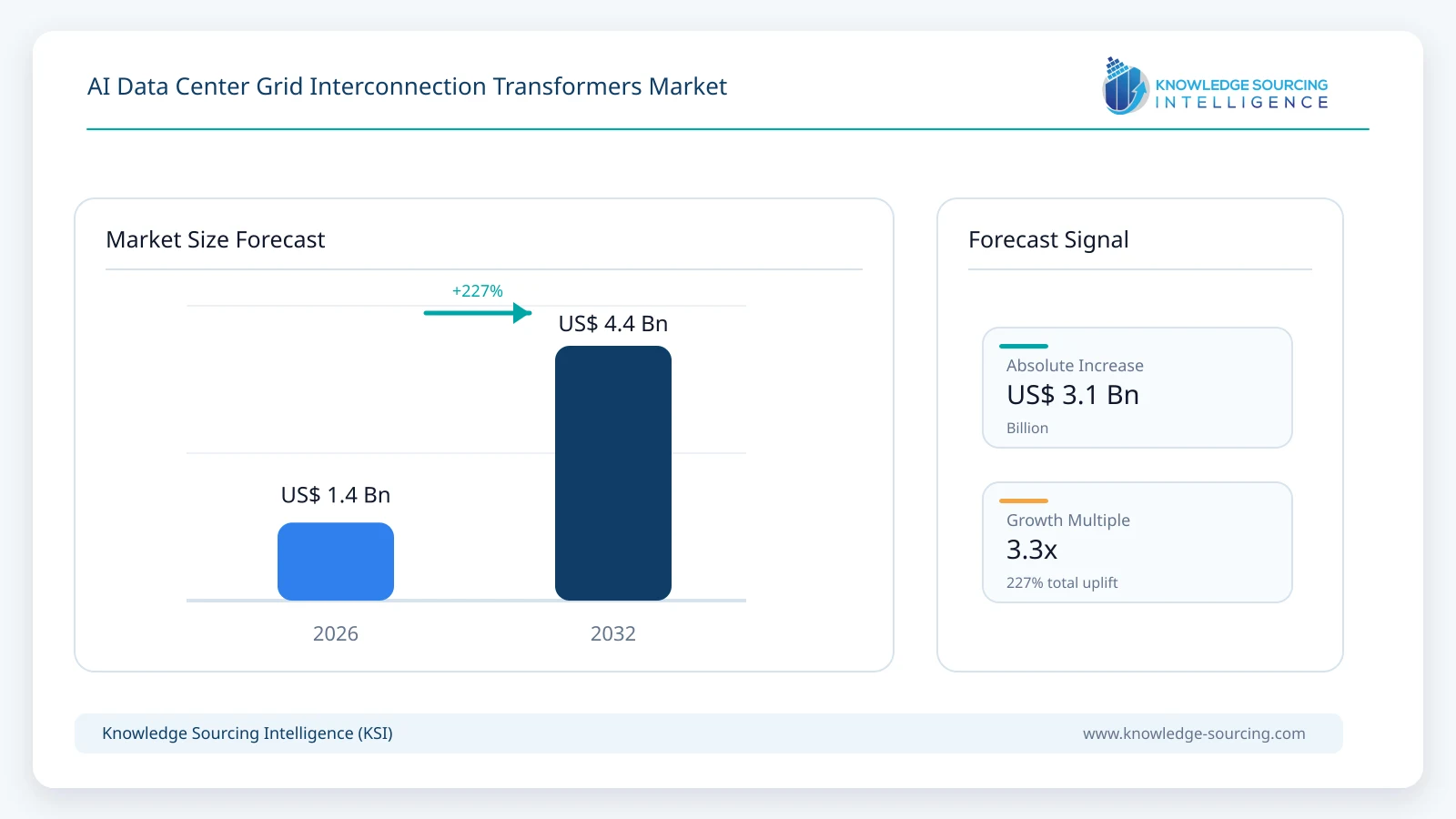
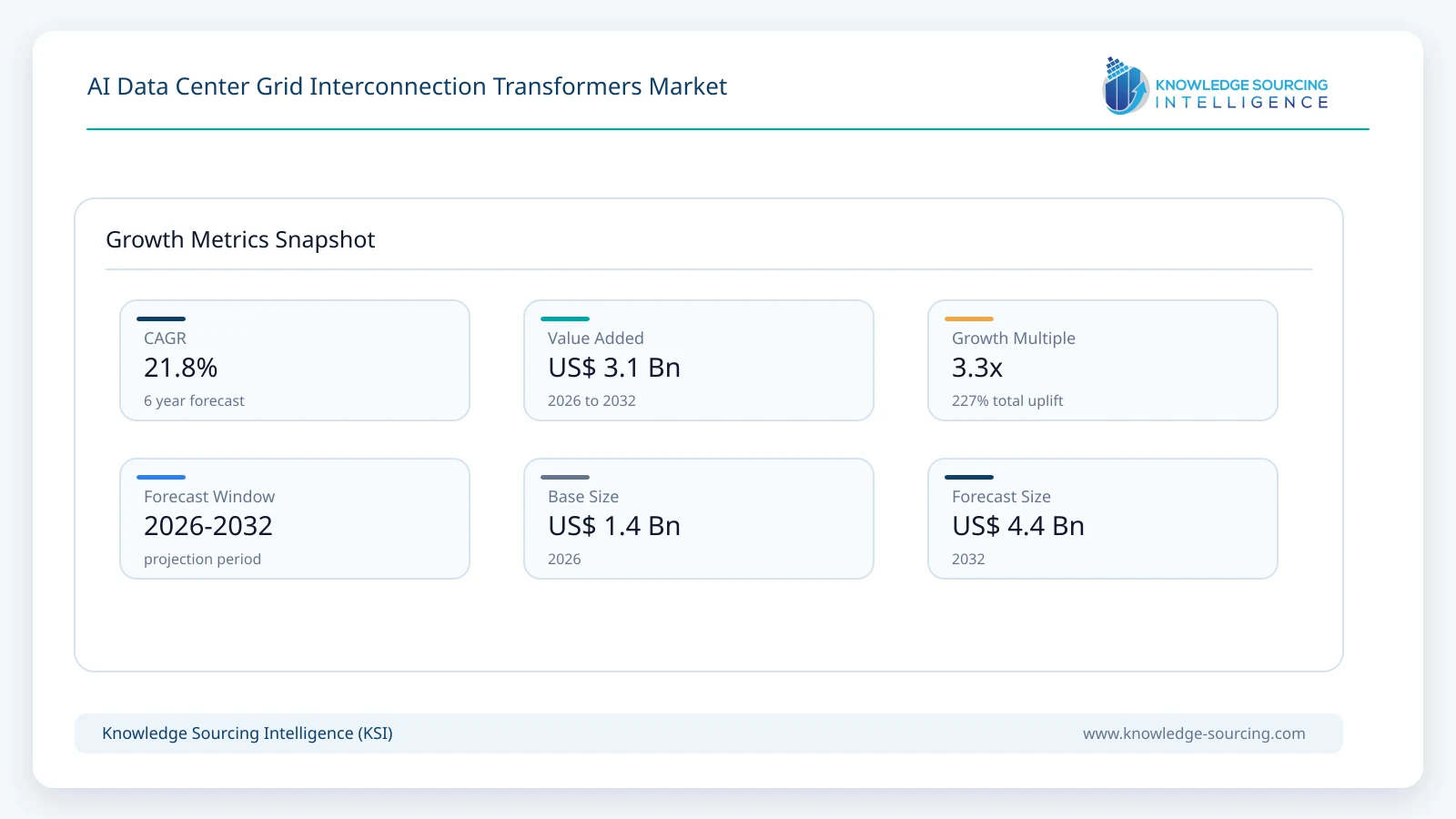
The AI Data Center Grid Interconnection Transformers Market is estimated at USD 1.35 billion in 2026 and is projected to reach USD 4.41 billion by 2032, representing a CAGR of 21.8% during 2026-2032.
Highlights:
- 1Large power transformers form the largest 2026 revenue pool for AI campus grid connections.
- 2Transformer availability is becoming a critical-path issue for energizing new AI data-center capacity.
- 3North America leads demand through hyperscale AI development and constrained grid-equipment supply.
- 4Behind-the-meter generation creates additional demand for generator step-up and interconnection transformers.
- 5Solid-state transformers remain an emerging option but do not displace conventional grid transformers by 2032.
Market Overview
AI campuses increasingly require grid connections that resemble industrial or utility-scale loads rather than conventional commercial buildings. A large campus can connect through 115 kV, 138 kV, 230 kV, or other regional transmission and sub-transmission voltages before stepping power down to medium-voltage campus distribution. The transformer configuration depends on utility topology, redundancy, project phasing, and whether the site includes on-site generation or energy storage. Large projects can therefore require several main transformers plus spare or reserve capacity rather than one transformer sized exactly to the information-technology load.
Transformer procurement is unusually schedule-sensitive because manufacturing remains engineering-intensive and requires specialized steel, copper, insulation, bushings, tap changers and test capacity. Hitachi Energy's June 2026 shipment of two transformers weighing more than 80 tonnes each to a hyperscale U.S. data-center project by Antonov aircraft illustrates the value developers place on meeting energization milestones. The equipment was manufactured in Europe and transported by air because conventional logistics could not meet the required schedule. Similar urgency is encouraging multi-year reservations, global sourcing and framework agreements.
AI also raises operational requirements. High load factors and rapid campus expansion increase the value of low-loss transformer designs, online dissolved-gas analysis, bushing monitoring, temperature monitoring and digital asset-health systems. At sites using gas generation, fuel cells, or other behind-the-meter resources, additional generator step-up or interconnection transformers connect on-site sources to the campus electrical system. Emerging solid-state transformer architectures could eventually combine medium-voltage conversion with direct-current output, but conventional magnetic transformers remain the principal grid-interface technology through the forecast period.
Market Drivers
AI data-center electricity demand is increasing transformer requirements
The International Energy Agency (IEA) expects global data-center electricity consumption to rise from about 485 terawatt-hours in 2025 to approximately 950 terawatt-hours in 2030, with electricity use from AI-focused data centers tripling over the same period. New electrical capacity must pass through grid substations and transformer banks before it reaches campus distribution. The relationship is not one transformer per megawatt because project voltage, redundancy and phasing differ, but the rapid increase in connected load materially expands annual transformer MVA purchased for data centers.
Transformer supply constraints are forcing earlier procurement
Lead times have become a project risk rather than a purchasing inconvenience. Reuters reported in July 2026 that some high-voltage transformer lead times had reached about 160 weeks, up from approximately 143 weeks in 2024. Utilities and data-center developers are placing orders years ahead, sourcing globally and using long-term supplier agreements to secure capacity. This supports higher order visibility for manufacturers and raises the value of suppliers able to reserve production slots, provide engineering support early, and coordinate transport for unusually large equipment.
Larger campuses are increasing transformer ratings and redundancy
AI projects are moving from tens of megawatts toward multi-hundred-megawatt campuses and, in selected cases, gigawatt-scale plans. Larger connections increase average transformer MVA and can require several parallel units to satisfy N+1 or other reliability strategies. Prolec GE has noted a continuing trend toward higher MVA ratings in data-center transformer demand, which places additional pressure on large-power-transformer manufacturing capacity. Higher unit size also raises transport complexity, test requirements and replacement risk, increasing revenue per transformer bank.
Manufacturing expansion is increasing addressable supply
Major suppliers are committing capital specifically to relieve transformer bottlenecks. Hitachi Energy is expanding large-power-transformer manufacturing in Virginia, Mississippi, India, and China. Siemens Energy India approved a 30,000 MVA large-transformer capacity expansion, while GE Vernova is investing in Prolec GE and additional global transformer manufacturing. These projects do not remove near-term constraints, but they support higher annual shipments after 2027 and allow transformer revenue to grow alongside the AI campus pipeline rather than being capped indefinitely by manufacturing shortages.
Restraints and Adoption Challenges
The principal restraint is physical manufacturing capacity. Large transformers require long production cycles, specialized labor, and test facilities that cannot be expanded quickly. Project cancellations or delayed grid approvals can also leave developers with expensive reserved equipment, encouraging phased procurement rather than unrestricted ordering. Transformer design remains utility- and site-specific, limiting standardization across voltage classes and grid codes. Transportation can be another constraint because large units may require heavy-haul routes, rail access, or specialized cranes. Finally, emerging solid-state conversion and higher-voltage direct-current architectures could reduce the number of conventional transformation stages inside future campuses, although they are unlikely to replace the utility-interface transformer requirement at scale during the forecast period.
Segment Analysis
By Transformer Type
Large grid-interface power transformers represent the largest 2026 revenue pool because they carry the highest unit values and are required for transmission- or sub-transmission-connected campuses. These systems step utility voltage down to the campus medium-voltage network and frequently include on-load tap changers, digital monitoring, cooling systems and specialized protection interfaces. Their long production cycles make them the principal equipment bottleneck for many large projects.
High-voltage campus step-down and modular transformer packages are expected to grow fastest through 2032. Data-center developers increasingly build substations in repeatable phases so each additional campus block can be energized without waiting for one very large final configuration. Generator step-up and interconnection transformers also expand as behind-the-meter generation becomes more common. Spare and mobile transformer strategies remain smaller in revenue terms but gain importance because multi-year replacement lead times make unplanned transformer failure increasingly difficult to tolerate.
Transformer Category | Revenue Contributioin | Growth Direction | Primary AI Data Center Application |
Large grid-interface power transformers | Largest revenue pool | Strong | Step utility transmission/sub-transmission voltage into campus networks |
High-voltage campus step-down transformers | Large and expanding | Fastest | Serve phased multi-building AI campus electrical blocks |
Autotransformers | Selective high-value category | Strong | Voltage transformation where grid configuration favors autotransformer design |
Generator step-up/interconnection transformers | Growing | Very strong | Connect behind-the-meter generation to campus distribution |
Spare/mobile transformer capacity | Smaller base | Above average | Reduce outage exposure when replacement lead times are long |
Monitoring, commissioning and lifecycle services | Recurring layer | Strong | Condition monitoring, testing, maintenance and life extension |
Market and Technology Indicators
Indicator | Revenue Contribution | Market Impact |
Transformer lead times | Reuters reported some high-voltage transformer lead times near 160 weeks in 2026. | Makes transformer procurement a critical-path scheduling issue. |
U.S. large-transformer expansion | Hitachi Energy broke ground on a USD 457 million Virginia large-power-transformer facility. | Adds domestic capacity for grid, generation and data-center demand. |
Additional U.S. capacity | Hitachi Energy announced a USD 528 million Mississippi transformer facility in September 2026. | Shows continuing investment despite already-large manufacturing expansion. |
India manufacturing expansion | Hitachi Energy announced approximately INR 2,000 crore for a new large-power-transformer factory in Gujarat. | Expands global supply serving AI data centers and transmission projects. |
Siemens Energy capacity | Siemens Energy India approved approximately INR 2,060 crore for 30,000 MVA of additional large-transformer capacity. | Confirms sustained global transformer bottleneck and demand outlook. |
GE Vernova / Prolec GE | GE Vernova completed the USD 5.275 billion Prolec GE acquisition and reported strong data-center electrification orders. | Strengthens North American transformer supply and commercial reach. |
Regional Opportunity
North America
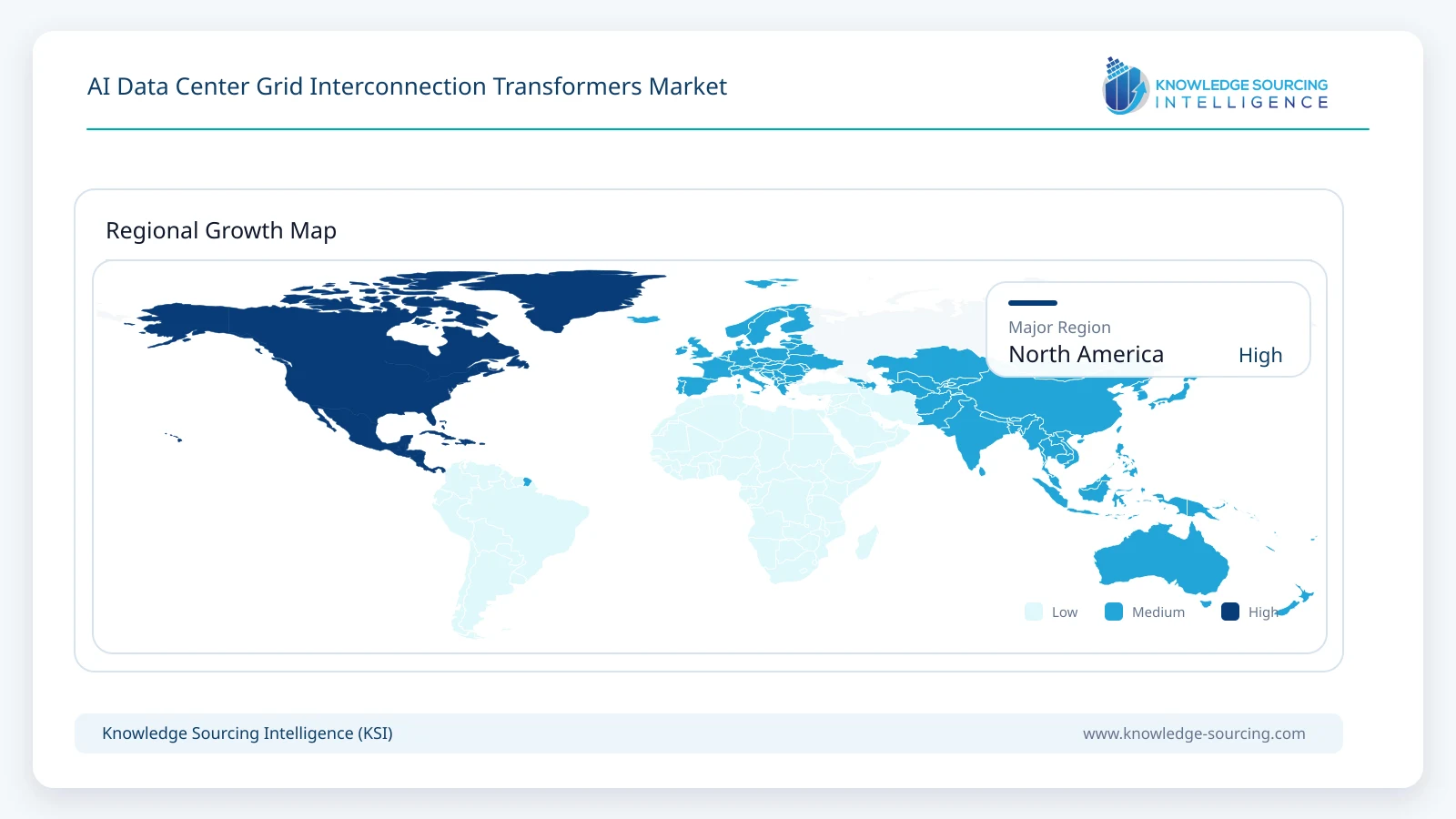
North America is the largest market for AI data-center grid interconnection transformers because the United States contains the largest pipeline of hyperscale and neocloud campuses and is simultaneously experiencing acute grid-equipment constraints. Utilities are processing very large load requests, while developers increasingly seek transmission-level connections that require dedicated substations and large transformer banks. The combination of high project scale, long equipment lead times, and strict energization schedules gives transformer availability unusually high strategic value.
Supply expansion is substantial but remains behind demand. Hitachi Energy is investing more than USD 1 billion across U.S. grid-equipment manufacturing, including large transformer projects in Virginia and Mississippi. GE Vernova completed its acquisition of Prolec GE in February 2026, bringing five U.S. manufacturing sites within the combined North American transformer footprint. GE Vernova reported USD 2.4 billion of data-center electrification equipment orders in the first quarter of 2026 alone, more than its full-year 2025 data-center equipment orders, illustrating how quickly large-load infrastructure demand is expanding.
Urgency is changing procurement behavior. Hitachi Energy's 2026 airlift of two more-than-80-tonne transformers from Europe to a U.S. hyperscale project demonstrates that developers may accept extraordinary logistics costs to avoid missing commissioning schedules. At the same time, Reuters reported that utilities are extending procurement horizons and placing orders several years ahead. Data-center developers are likely to use similar strategies, including framework agreements, standardized substation blocks, spare transformers and global sourcing.
Through 2032, North American demand is expected to remain concentrated in large grid-interface transformers and phased campus step-down systems. Behind-the-meter generation adds a second revenue layer through generator step-up and interconnection transformers. Manufacturing expansion should improve availability after 2028, but higher annual AI capacity additions and growing transformer ratings are likely to keep factories highly utilized through the forecast period.
Europe contributes through both local AI infrastructure development and transformer exports to global projects. Asia Pacific combines rapid data-center deployment with major manufacturing bases in China, India, South Korea and Japan. The Middle East is emerging as a greenfield AI infrastructure region where large campuses can require new high-voltage substations and transformer banks from the outset.
Competitive Landscape
The competitive landscape is led by a limited number of global manufacturers with large-power-transformer engineering, manufacturing and high-voltage test capability. Hitachi Energy, GE Vernova / Prolec GE and Siemens Energy hold particularly strong positions because they combine broad voltage ranges, global factories, utility relationships and lifecycle services. Mitsubishi Electric, Toshiba Energy Systems & Solutions, Hyosung Heavy Industries and HD Hyundai Electric are important Asian suppliers with international large-transformer capabilities.
Regional manufacturers are strategically important because transportation costs, local standards, and constrained global supply can favor nearby factories. Virginia Transformer is a major North American independent supplier, while WEG and SGB-SMIT serve multiple regional markets. Wilson Transformer Company is significant in Australia and export markets, and CG Power, TBEA, Fuji Electric and Elsewedy Electric contribute additional manufacturing capacity across Asia, the Middle East and international projects.
Competitive differentiation centers on manufacturing-slot availability, maximum MVA and voltage capability, low-loss design, digital monitoring, transport engineering, service coverage and the ability to standardize transformer designs across phased data-center campuses. In the current market, delivery certainty can be as important as purchase price. Suppliers able to commit early production slots and provide global factory flexibility are better positioned for hyperscale customers whose data-center construction schedules can move faster than traditional utility procurement cycles.
Major companies and ecosystem participants covered: Hitachi Energy, GE Vernova / Prolec GE, Siemens Energy, Mitsubishi Electric, Toshiba Energy Systems & Solutions, Hyosung Heavy Industries, HD Hyundai Electric, WEG, SGB-SMIT Group, Virginia Transformer, Wilson Transformer Company, TBEA, CG Power and Industrial Solutions, Fuji Electric and Elsewedy Electric.
Recent Developments
September 2026: Hitachi Energy announced a USD 528 million transformer manufacturing facility in Mississippi, more than doubling local production capacity.
August 2026: Hitachi Energy announced a USD 300 million investment in China to expand power-transformer and component manufacturing capacity.
August 2026: Siemens and Reinhausen announced development of a modular solid-state transformer connecting up to 36 kV grid voltage directly to 800 VDC AI data-center systems.
June 2026: Hitachi Energy broke ground on a USD 457 million large-power-transformer facility in South Boston, Virginia.
June 2026: Hitachi Energy announced approximately INR 2,000 crore for a new large-power-transformer factory in Vadodara, India, supporting applications including AI data centers.
June 2026: Hitachi Energy reported emergency air transport of two more-than-80-tonne transformers from Europe to a U.S. hyperscale data-center project.
March 2026: GE Vernova announced approximately USD 200 million for a new transformer manufacturing facility in Hai Phong, Vietnam.
February 2026: Siemens Energy India approved approximately INR 2,060 crore to add around 30,000 MVA of large-power-transformer capacity.
February 2026: GE Vernova completed the USD 5.275 billion acquisition of the remaining 50% of Prolec GE, materially expanding its North American transformer platform.
AI Data Center Grid Interconnection Transformers Market Scope:
| Report Metric | Details |
|---|---|
| Total Market Size in 2026 | USD 1.35 billion |
| Total Market Size in 2032 | USD 4.41 billion |
| Forecast Unit | USD Billion |
| Growth Rate | 21.8% |
| Study Period | 2021 to 2032 |
| Historical Data | 2021 to 2024 |
| Base Year | 2025 |
| Forecast Period | 2026 – 2032 |
| Segmentation | Transformer Type, Voltage Class, Campus Architecture, Deployment Requirement |
| Companies |
|
Market Segmentation
By Transformer Type
Large Grid-Interface Power Transformers
High-Voltage Campus Step-Down Transformers
Autotransformers
Generator Step-Up and Interconnection Transformers
Spare and Mobile Transformer Capacity
Monitoring, Commissioning and Lifecycle Services
By Voltage Class
Below 69 kV
69-138 kV
Above 138 kV
By Campus Architecture
Utility-Fed Hyperscale Campuses
Grid plus Behind-the-Meter Generation
Phased Modular AI Campuses
Colocation High-Density Expansions
By Deployment Requirement
Greenfield Grid Interconnections
Existing Substation Expansion
Transformer Replacement and Life Extension
Emergency, Spare and Mobile Capacity
By Customer Type
Hyperscale Cloud Providers
Neocloud and GPU-Cloud Operators
Colocation Providers
Utilities Serving Data Center Campuses
Sovereign and Enterprise AI Infrastructure
By Region
North America
United States
Canada
Europe
Asia Pacific
Middle East and Rest of World
Table of Contents
1. EXECUTIVE SUMMARY
1.1. Market Opportunity and Key Findings
1.2. AI Campus Grid-Connection Outlook
1.3. Principal Revenue Pools
2. MARKET OVERVIEW
2.1. Utility-to-Campus Transformer Architecture
2.2. AI Data Center Load Growth and Grid Connection
2.3. Transformer Lead Times and Manufacturing Constraints
2.4. Redundancy, Phasing and Spare-Transformer Strategy
2.5. Digital Monitoring and Transformer Asset Health
3. MARKET SIZE AND FORECAST, 2026-2032
3.1. Global Market Revenue
3.2. Annual Growth Analysis
3.3. Transformer MVA Shipped for AI Data Centers
3.4. Revenue by New Build, Expansion and Replacement
4. MARKET BY TRANSFORMER TYPE
4.1. Large Grid-Interface Power Transformers
4.2. High-Voltage Campus Step-Down Transformers
4.3. Autotransformers
4.4. Generator Step-Up and Interconnection Transformers
4.5. Spare and Mobile Transformer Capacity
4.6. Monitoring, Commissioning and Lifecycle Services
5. MARKET BY VOLTAGE CLASS
5.1. Below 69 kV
5.2. 69-138 kV
5.3. Above 138 kV
6. MARKET BY CAMPUS ARCHITECTURE
6.1. Utility-Fed Hyperscale Campuses
6.2. Grid plus Behind-the-Meter Generation
6.3. Phased Modular AI Campuses
6.4. Colocation High-Density Expansions
7. MARKET BY DEPLOYMENT REQUIREMENT
7.1. Greenfield Grid Interconnections
7.2. Existing Substation Expansion
7.3. Transformer Replacement and Life Extension
7.4. Emergency, Spare and Mobile Capacity
8. MARKET BY CUSTOMER TYPE
8.1. Hyperscale Cloud Providers
8.2. Neocloud and GPU-Cloud Operators
8.3. Colocation Providers
8.4. Utilities Serving Data Center Campuses
8.5. Sovereign and Enterprise AI Infrastructure
9. REGIONAL MARKET
9.1. North America
9.1.1. United States
9.1.2. Canada
9.2. Europe
9.3. Asia Pacific
9.4. Middle East and Rest of World
10. MARKET DYNAMICS
10.1. Drivers
10.1.1. Growth in AI Data Center Electricity Demand
10.1.2. Transformer Supply Constraints and Early Procurement
10.1.3. Higher Campus MVA and Redundancy Requirements
10.1.4. Global Manufacturing Capacity Expansion
10.2. Restraints
10.2.1. Long Manufacturing Cycles
10.2.2. Utility and Grid-Approval Uncertainty
10.2.3. Heavy-Haul Logistics and Site Constraints
10.2.4. Emerging Solid-State and Direct-Current Architectures
11. COMPETITIVE LANDSCAPE
11.1. Market Structure and Competitive Intensity
11.2. Manufacturing Capacity and Geographic Positioning
11.3. Large-MVA and High-Voltage Technology Positioning
11.4. Hyperscale Procurement and Standardized Campus Designs
11.5. Service, Spare and Lifecycle Strategies
12. COMPANY PROFILES
12.1. Hitachi Energy
12.2. GE Vernova / Prolec GE
12.3. Siemens Energy
12.4. Mitsubishi Electric
12.5. Toshiba Energy Systems & Solutions
12.6. Hyosung Heavy Industries
12.7. HD Hyundai Electric
12.8. WEG
12.9. SGB-SMIT Group
12.10. Virginia Transformer
12.11. Wilson Transformer Company
12.12. TBEA
12.13. CG Power and Industrial Solutions
12.14. Fuji Electric
12.15. Elsewedy Electric
13. RECENT DEVELOPMENTS
14. APPENDIX
Navigate
Trusted by the world's leading organizations











