
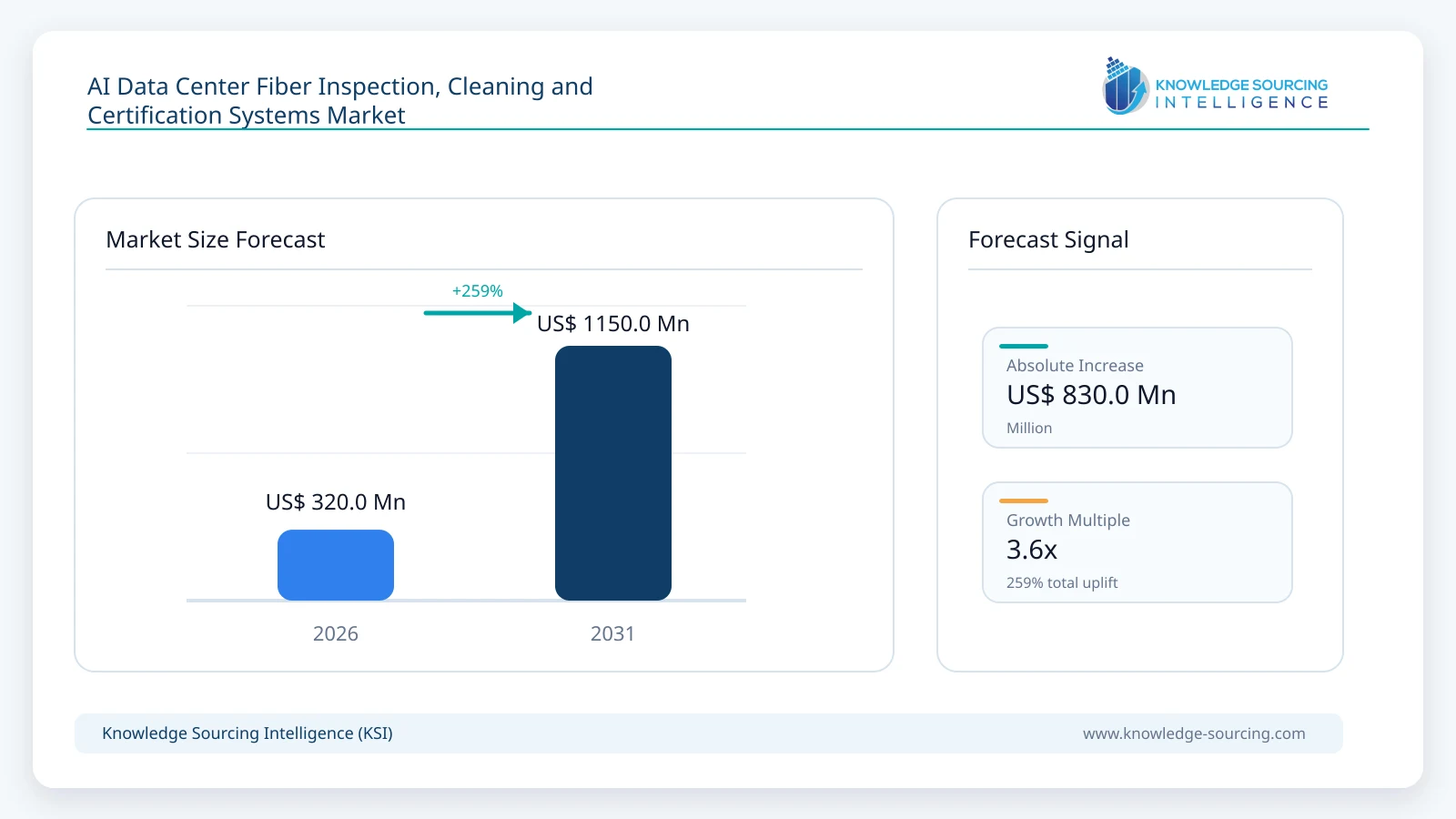
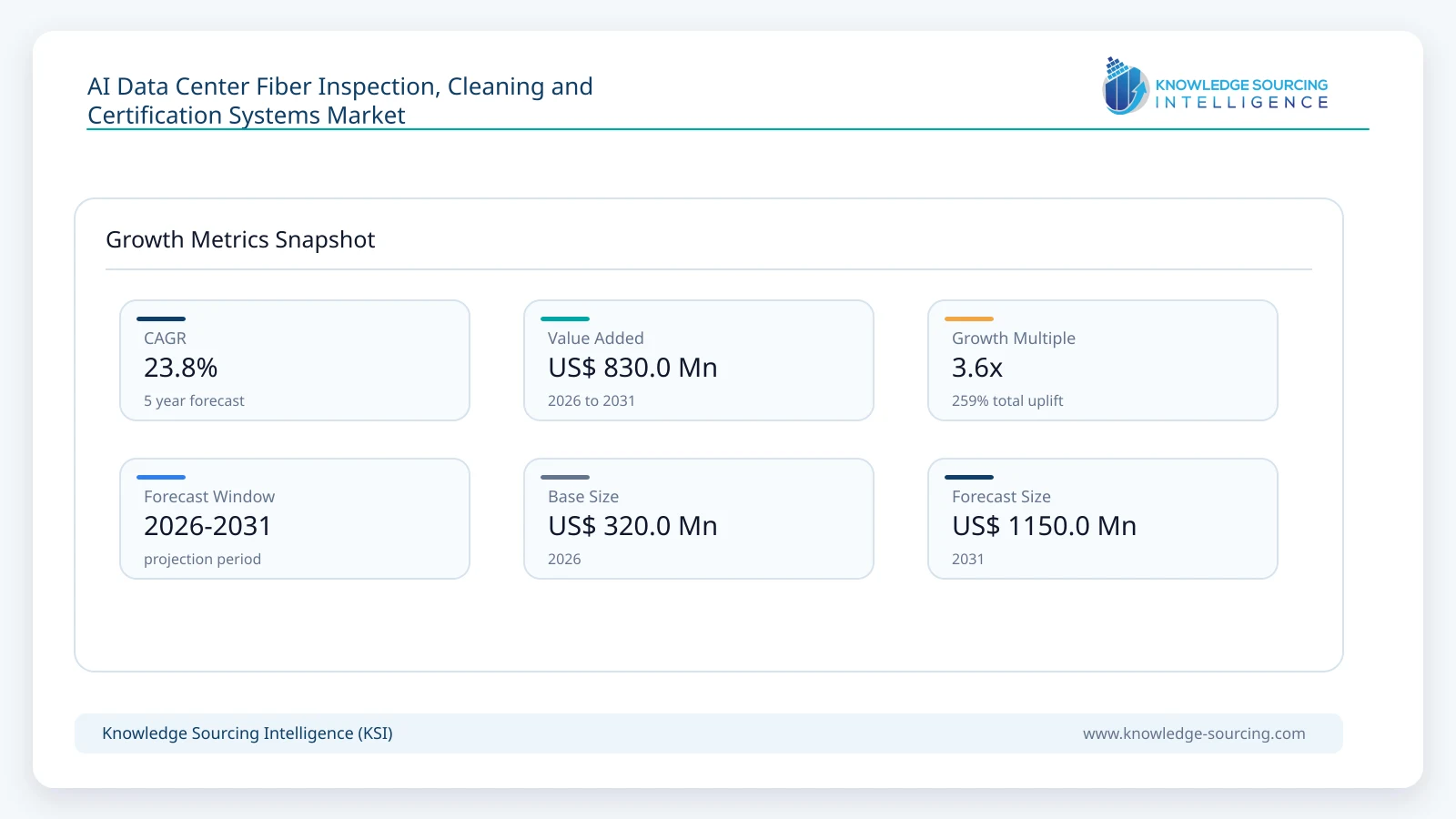
The AI Data Center Fiber Inspection, Cleaning and Certification Systems Market is estimated at USD 320.0 million in 2026 and is projected to reach USD 1,150.0 million by 2032, representing a CAGR of 23.8% during 2026–2032.
Highlights:
- 1Multi-fiber certification equipment represents the largest 2026 dedicated revenue pool worldwide.
- 2Automated inspection and cleaning are the fastest-growing workflow as connector density increases.
- 3North America leads demand through hyperscale AI construction and dense optical network deployment.
- 4Skilled-labor shortages increase demand for guided workflows and automated pass/fail analysis.
Market Overview
Fiber inspection and certification become more difficult as connector density and lane count rise. A traditional duplex link can be inspected and tested one pair at a time, but AI data centers increasingly use 12-, 16-, 24-, and 32-fiber multi-fiber push-on (MPO) interfaces alongside newer Very Small Form Factor (VSFF) connector families. Fluke Networks notes that current high-density environments contain a mix of connector types, pin configurations, and polarity schemes that legacy multi-fiber testers were not designed to handle efficiently. The result is a shift toward native multi-fiber instruments that test many fibers in parallel while automatically recording loss, length, and polarity.
Connector inspection is equally important because contamination on one end face can transfer during mating and affect multiple fibers in the same array. Automated microscopes inspect the full ferrule, analyze individual fiber zones, and grade end faces against IEC 61300-3-35 criteria. VIAVI, Fluke Networks and EXFO all provide automated inspection systems designed for single- and multi-fiber connectors. At higher link speeds, reflectance and insertion loss become more important, increasing the value of OTDR, return-loss, and advanced Tier 1 or Tier 2 certification workflows.
Cleaning is developing from a simple consumable category into an engineered workflow. Conventional one-click cleaners, swabs, solvents, and dry-cleaning systems remain widely used, but connector density creates pressure to reduce repeated manual cleaning. CommScope's 2026 FastSelfClean architecture actively cleans fiber end faces during connector insertion and is designed for initial 144-fiber implementations. While such designs may reduce external cleaning-tool demand on selected future platforms, they validate the commercial importance of contamination control and are likely to coexist with conventional cleaning and inspection across the much larger installed base.
Market Drivers
Fiber count per AI rack is increasing sharply
Corning expects AI rack fiber density to move beyond 1,000 fibers and potentially approach 5,000 in future designs. Even when factory-built racks reduce on-site installation, each connector and link still needs validated cleanliness, polarity, and optical performance before the system is accepted. Higher fiber counts therefore increase the number of test events per rack and encourage buyers to replace sequential tools with equipment that can inspect or certify complete multi-fiber arrays in a single workflow.
800G and 1.6T links require tighter control of optical loss
AI scale-out fabrics are migrating rapidly toward 800G and 1.6T connectivity. Faster applications operate with smaller optical-loss margins and make previously tolerable connector contamination or excessive reflectance more consequential. Fluke Networks explicitly links third-generation multi-fiber certification to AI and 1.6T data-center requirements, while VIAVI positions the DCX 700 for high-density AI data centers. This raises demand for precise insertion-loss testing, connector certification, and fault localization rather than basic continuity checks.
Multi-fiber and VSFF connectors require new test interfaces
Data centers are no longer standardized around one MPO format. Modern installations can include pinned and unpinned 12-, 16-, and 24-fiber MPOs, 32-fiber variants, and VSFF connectors such as MMC. Fluke CertiFiber Max and VIAVI DCX 700 both emphasize native support for multiple fiber-count formats, while inspection systems require matching tips and automated ferrule analysis. Connector diversification expands the value of modular adapters, software-defined workflows and future-ready test platforms.
Labor productivity is becoming part of the investment case
AI deployments often require thousands of fiber certifications in compressed installation windows. Repeated manual referencing, connector changes and individual-fiber tests consume skilled technician time and increase the chance of handling errors. VIAVI's one-cord referencing and Fluke's one-second multi-fiber test cycle are commercial responses to this constraint. Cloud workflow tools such as StrataSync and LinkWare Live add remote project setup, result consolidation, and calibration tracking, allowing operators and integrators to manage large distributed crews with more consistent processes.
Restraints and Adoption Challenges
The principal restraint is that test equipment is reusable and can serve multiple projects, so revenue does not rise directly with fiber count. Large contractors and hyperscalers can improve instrument utilization and limit the number of additional testers purchased per site. Factory-integrated rack construction can also shift testing upstream into centralized manufacturing facilities, reducing some field-tool demand. Emerging self-cleaning connector designs may reduce routine cleaning requirements on selected new platforms. In addition, multi-function test systems increasingly combine inspection, loss testing, OTDR, and reporting within common hardware ecosystems, which can consolidate spending that previously went to separate instruments.
Segment Analysis
By Solution Type
Multi-fiber certification and optical-loss testing systems represent the largest dedicated revenue pool in 2026 because high-end OLTS and associated modules carry significant instrument value and are required for formal acceptance of new links. Their role becomes more important as MPO and MMC links replace simpler duplex architectures across scale-out fabrics. OTDR and advanced troubleshooting systems form a second high-value equipment layer for fault localization, reflectance analysis, and Tier 2 certification.
Automated inspection and cleaning are expected to grow faster through 2032. Inspection systems increasingly use algorithmic end-face grading and multi-camera ferrule views to remove technician subjectivity, while cleaning products expand alongside every connector interface deployed. The fastest growth comes from automated or semi-automated workflows that combine inspection, pass/fail analysis, cleaning guidance, and cloud documentation. Test-process software also grows quickly because hyperscale projects require standardized results across large technician teams and multiple sites.
Solution Category | Revenue Contribution | Growth Direction | Primary AI Data Center Application |
Multi-fiber OLTS certification systems | Largest dedicated category | Strong | Insertion loss, length and polarity certification across MPO/MMC links |
OTDR and advanced fiber troubleshooting | High-value equipment category | Strong | Fault location, reflectance analysis and Tier 2 certification |
Automated fiber inspection systems | Established category | Fast | End-face grading, contamination detection and IEC-based pass/fail |
Cleaning tools and consumables | Broad recurring category | Strong | Remove connector contamination before mating and certification |
Test workflow and reporting software | Smaller 2026 base | Very fast | Project setup, result consolidation, reporting and fleet management |
Specialist certification services | Recurring service layer | Strong | Commissioning, acceptance testing and troubleshooting at scale |
Market and Technology Indicators
Indicator | Revenue Contribution | Market Impact |
AI rack fiber density | Corning expects more than 1,000 fibers per AI rack, with future designs potentially approaching 5,000. | Increases inspection, certification and cleaning events per rack. |
24-fiber simultaneous certification | VIAVI launched DCX 700 in February 2026 for testing up to 24 fibers simultaneously. | Reduces test time and technician variability in hyperscale deployment. |
Third-generation multi-fiber testing | Fluke launched CertiFiber Max with native MPO/MMC support and one-second test cycles. | Shows test equipment evolving specifically for AI-era connector density. |
AI-specific inspection workflow | VIAVI INX 700 inspection microscopes target hyperscale data centers and automated multi-fiber inspection. | Expands automation beyond loss testing into connector-quality validation. |
Self-cleaning 144-fiber connectors | CommScope introduced FastSelfClean technology for future ultra-dense AI racks. | Shows contamination control moving into connector architecture itself. |
1.6T deployment | VIAVI's September 2026 ECOC portfolio targets scale-up, scale-out and scale-across networks at 1.6T and beyond. | Raises optical-test complexity across every AI network layer. |
Regional Opportunity
North America
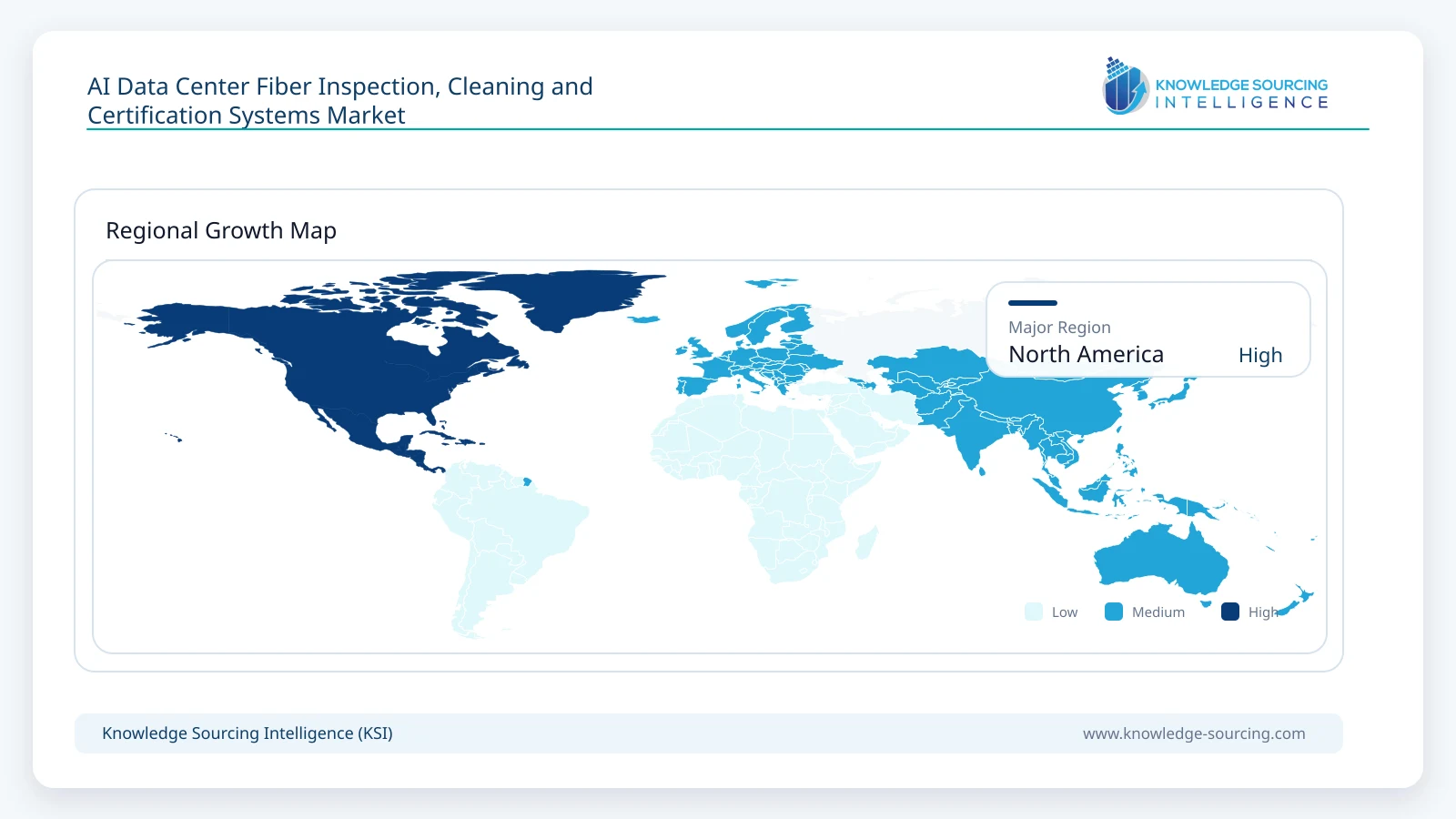
North America is the largest market for AI data-center fiber inspection, cleaning and certification systems because the United States combines the highest concentration of hyperscale and neocloud construction with extensive use of pre-terminated high-density optical cabling. Large AI campuses can require thousands of multi-fiber links across rack, row, data-hall, and campus layers, creating significant acceptance-testing and documentation requirements before production traffic is enabled.
The region also contains a strong test-and-measurement ecosystem. VIAVI is headquartered in the United States and is explicitly developing hyperscale data-center tools such as DCX 700 and INX 700. Fluke Networks has a large installed base among cabling contractors and certification technicians through the Versiv and LinkWare ecosystem. AFL, Panduit, CommScope and Corning connect the test workflow with structured cabling, connector and installation ecosystems, while specialist cleaning suppliers provide recurring consumables and maintenance tools.
Factory integration changes where testing occurs rather than eliminating it. Corning expects hyperscalers to move more rack cabling, labeling, testing and documentation into controlled manufacturing environments as fiber counts rise. This supports additional test-equipment demand at rack integrators and cable-assembly factories while reducing some repetitive site work. Field teams still need inspection, acceptance certification and troubleshooting after transport and final connection. Through 2032, North American growth is expected to be led by multi-fiber certification, automated inspection and centralized test-data management.
Asia Pacific is a major manufacturing and deployment region because large volumes of optical cable assemblies, connectors and server systems are produced in China, Taiwan, Japan, South Korea and Southeast Asia. Europe combines hyperscale expansion with mature cabling-certification practices and strong adoption of standards-based testing. The Middle East is emerging as a greenfield AI infrastructure region where large new campuses can adopt multi-fiber certification workflows from initial construction rather than retrofit them into an older test process.
Competitive Landscape
The competitive landscape is led by established fiber test-and-measurement suppliers with broad portfolios spanning inspection, certification and troubleshooting. VIAVI and Fluke Networks are particularly strong in data-center multi-fiber certification and technician workflow automation. EXFO has a broad fiber-inspection and MPO test portfolio, while Anritsu and AFL participate across optical measurement, loss testing and field verification. These companies compete on measurement accuracy, native connector support, test speed, software integration and installed technician ecosystems.
Connector and cleaning specialists influence the market because inspection and cleaning workflows depend on the physical interfaces used in AI networks. SENKO Advanced Components and US Conec help define high-density connector formats and supporting cleaning or inspection requirements. NTT Advanced Technology and MicroCare / Sticklers compete in connector-cleaning systems and consumables. Panduit, CommScope and Corning participate through structured cabling and connector ecosystems that increasingly bundle installation, inspection and certification guidance. The competitive boundary therefore extends beyond instrument manufacturers into the connector and deployment workflow.
Competitive differentiation is moving toward automation rather than basic optical measurement. Buyers increasingly value one-cord or one-jumper referencing, simultaneous testing of many fibers, automated polarity detection, IEC-compliant inspection grading, guided workflows, cloud project management and the ability to support new connector formats without replacing the full platform. As AI installations become larger, the economic value of reducing technician minutes per link can exceed the incremental cost of the test equipment itself.
Major companies and ecosystem participants covered: VIAVI Solutions, Fluke Networks, EXFO, Anritsu, AFL, Kingfisher International, SENKO Advanced Components, US Conec, NTT Advanced Technology, MicroCare / Sticklers, Fujikura, Sumitomo Electric, Panduit, CommScope and Corning.
Recent Developments
September 2026: VIAVI expanded its end-to-end data-center test portfolio for 1.6T scale-up, scale-out and scale-across networks, including fiber inspection, cleaning and monitoring workflows.
July 2026: Fluke Networks published updated guidance on PAM4, 800G and higher-speed data-center links, emphasizing tighter inspection and test requirements.
May 2026: CommScope announced FastSelfClean™ technology for high-density AI data-center connectors (with initial 144-fiber FSC144 designs) featuring active gel-cleaning.
February 2026: VIAVI launched the DCX 700 Tier 1 multi-fiber Optical Loss Test Set for simultaneous testing of up to 24 fibers.
2026: VIAVI introduced INX 700 probe microscopes for automated single- and multi-fiber inspection in hyperscale data centers.
2026: Fluke Networks launched CertiFiber Max, a third-generation multi-fiber certification platform supporting MPO and MMC interfaces and one-second test cycles.
2026: Fluke expanded FiberInspector workflows for high-density MPO and VSFF connector inspection with automated end-face certification.
2026: AI connector ecosystems expanded around MMC and other high-density formats, increasing demand for compatible inspection, cleaning and certification adapters.
AI Data Center Fiber Inspection, Cleaning and Certification Systems Market Scope:
| Report Metric | Details |
|---|---|
| Total Market Size in 2026 | USD 320.0 million |
| Total Market Size in 2031 | USD 1,150.0 million |
| Forecast Unit | Million |
| Growth Rate | 23.8% |
| Study Period | 2021 to 2031 |
| Historical Data | 2021 to 2024 |
| Base Year | 2025 |
| Forecast Period | 2026 – 2031 |
| Segmentation | Product Architecture, Use Case, Network Interface, Deployment Layer |
| Companies |
|
Market Segmentation
By Product Architecture
Programmable DPUs
Infrastructure Processing Units
Programmable SmartNICs
Cloud-Specific Custom Offload ASICs
Software, SDK and Support Layer
By Use Case
Software-Defined Networking and Virtual Switching
Storage and NVMe-over-Fabrics Acceleration
AI Storage and KV-Cache Data Movement
Security, Encryption and Tenant Isolation
Telemetry and Observability
Front-End AI Networking
By Network Interface
Up to 200G
400G
800G
Above 800G Roadmap
By Deployment Layer
AI Compute Servers
Front-End Network Servers
AI Storage Nodes
Cloud Infrastructure Services
Multi-Tenant GPU Platforms
By Customer Type
Hyperscale Cloud Providers
Neocloud and GPU-Cloud Operators
AI Storage Providers
Colocation and Managed Infrastructure Providers
Enterprise and High-Performance Computing
By Region
North America
United States
Canada
Europe
Asia Pacific
Middle East and Rest of World
Table of Contents
1. Executive Summary
1.1. Market Opportunity and Key Findings
1.2. AI Fiber-Test Workflow Evolution
1.3. Principal Revenue Pools
2. Market Overview
2.1. AI Fiber Density and Optical-Loss Requirements
2.2. Connector Contamination and Inspection Requirements
2.3. Multi-Fiber Certification and Polarity Management
2.4. OTDR and Advanced Troubleshooting
2.5. Factory versus Field Test Workflows
20323.1. Global Market Revenue
3.2. Annual Growth Analysis
3.3. Test Equipment versus Consumables and Services
3.4. Revenue by New Build and Retrofit
4. Market by Solution Type
4.1. Multi-Fiber Optical Loss Test Sets
4.2. OTDR and Advanced Fiber Troubleshooting
4.3. Automated Fiber Inspection Systems
4.4. Fiber Cleaning Tools and Consumables
4.5. Optical Power Meters, Light Sources and VFLs
4.6. Test Workflow and Reporting Software
4.7. Certification and Troubleshooting Services
5. Market by Connector Type
5.1. MPO / MTP
5.2. MMC and Other VSFF Multi-Fiber Connectors
5.3. LC and Duplex VSFF Connectors
5.4. Emerging High-Fiber-Count Connector Systems
6. Market by Test Requirement
6.1. End-Face Inspection and Grading
6.2. Cleaning and Contamination Control
6.3. Insertion Loss and Length Certification
6.4. Polarity and Continuity Validation
6.5. OTDR and Reflectance Testing
6.6. Troubleshooting and Fault Isolation
7. Market by Deployment Stage
7.1. Cable and Rack Manufacturing
7.2. Data Center Installation and Commissioning
7.3. Acceptance Certification
7.4. Operations, Maintenance and Moves/Adds/Changes
8. Market by Customer Type
8.1. Hyperscale Cloud Providers
8.2. Neocloud and GPU-Cloud Operators
8.3. Colocation Providers
8.4. Cabling Contractors and System Integrators
8.5. Rack and Cable-Assembly Manufacturers
9. Regional Market
9.1. North America
9.1.1. United States
9.1.2. Canada
9.2. Europe
9.3. Asia Pacific
9.4. Middle East and Rest of World
10. Market Dynamics
10.1. Drivers
10.1.1. Rising Fiber Count per AI Rack
10.1.3. Multi-Fiber and VSFF Connector Adoption
10.1.4. Technician Productivity and Workflow Automation
10.2. Restraints
10.2.1. Reusable Equipment and Higher Fleet Utilization
10.2.2. Factory Integration Reducing Selected Field-Test Activity
10.2.3. Multi-Function Test Platform Consolidation
10.2.4. Self-Cleaning and Lower-Maintenance Connector Architectures
11. Competitive Landscape
11.1. Market Structure and Competitive Intensity
11.2. Portfolio Breadth Across Inspection, Certification and Cleaning
11.3. Multi-Fiber and VSFF Technology Positioning
11.4. Hyperscale Workflow Automation and Test Data Management
11.5. OEM, Cabling and Connector Ecosystem Partnerships
12. Company Profiles
12.1. VIAVI Solutions
12.2. Fluke Networks
12.3. EXFO
12.4. Anritsu
12.5. AFL
12.6. Kingfisher International
12.7. SENKO Advanced Components
12.8. US Conec
12.9. NTT Advanced Technology
12.10. MicroCare
12.11. Fujikura
12.12. Sumitomo Electric
12.13. Panduit
12.14. CommScope
12.15. Corning
13. Recent Developments
14. Appendix
Navigate
Trusted by the world's leading organizations











