
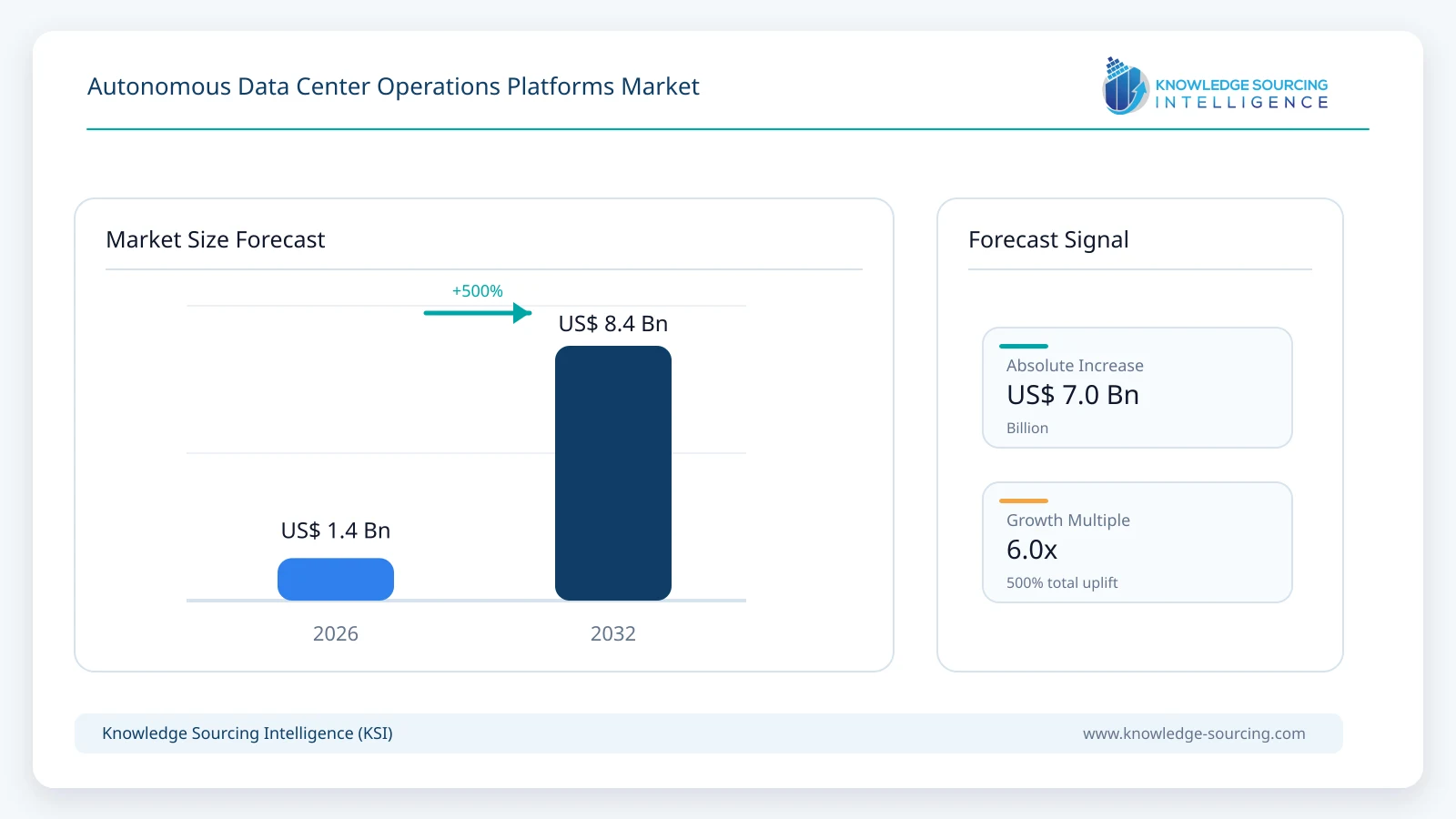
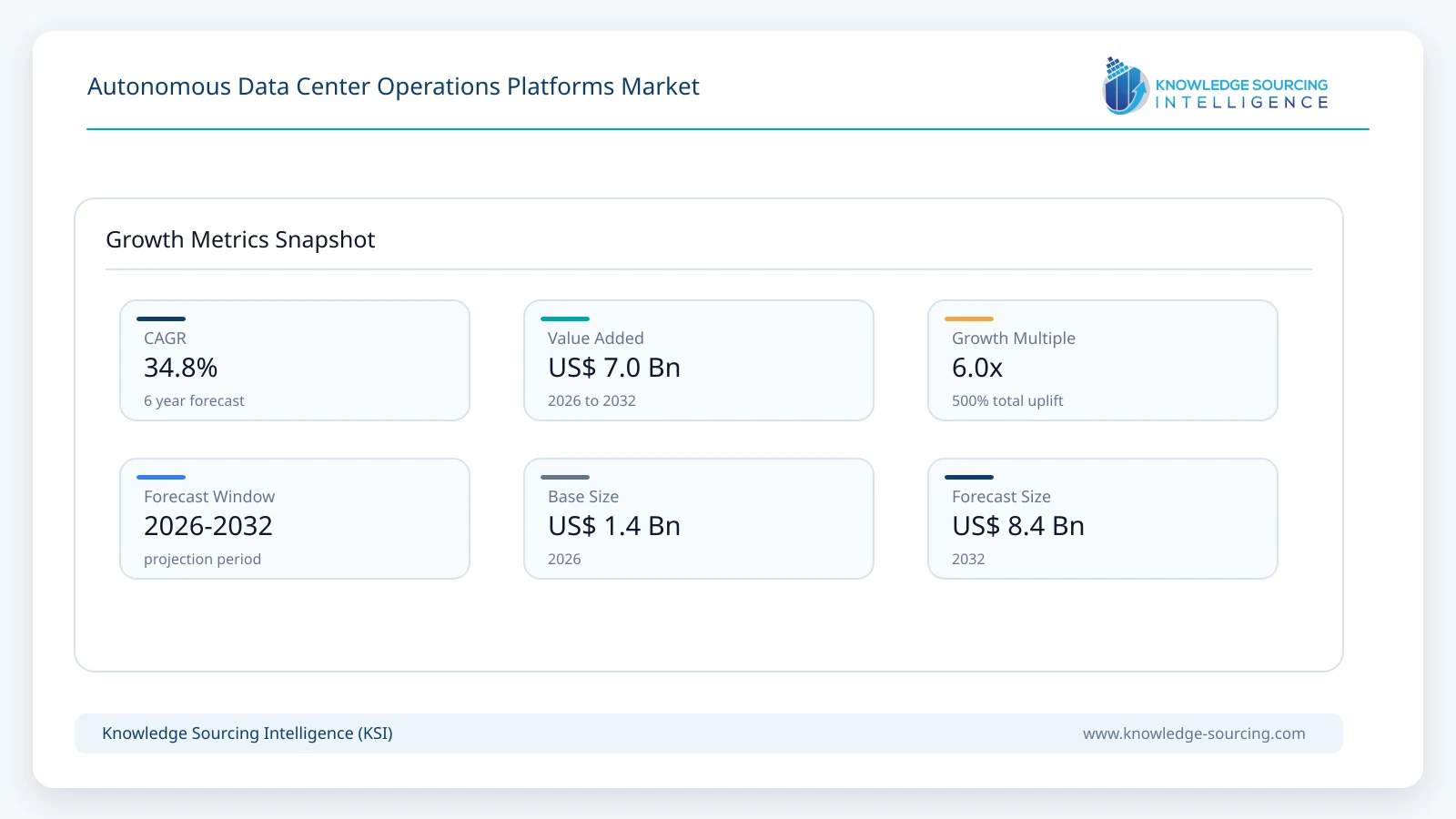
The Autonomous Data Center Operations Platforms Market is projected to grow from USD 1.40 billion in 2026 to USD 8.40 billion by 2032, registering a CAGR of 34.8% between 2026 and 2032.
Highlights:
- 1Autonomous operations are progressing from advisory analytics toward closed-loop control and remediation.
- 2NVIDIA Mission Control extends automation from workload orchestration into infrastructure resiliency and facility coordination.
- 3Phaidra is commercializing agentic cooling and cross-domain operational intelligence for high-density AI factories.
- 4AI-powered predictive maintenance is expanding across critical power and cooling assets.
- 5Cooling control is an early closed-loop use case because AI workloads create rapid thermal transients.
- 6Autonomous recovery reduces the time between fault detection, isolation and workload restart.
- 7Staffing shortages strengthen the business case for systems that scale operations without proportional headcount growth.
- 8North America leads early adoption through hyperscale AI deployment and a dense software ecosystem.
- 9Human approval remains important for high-risk switching, safety and maintenance actions.
- 10Cross-domain coordination between IT and OT provides greater value than isolated equipment analytics.
- 11Brownfield adoption usually begins with predictive maintenance, cooling optimization or alarm intelligence before wider automation.
- 12Agentic operations are expected to become a recurring software layer alongside DCIM, BMS and cluster-management platforms.
Conventional data center operations rely on multiple management layers. DCIM tracks capacity and assets, BMS and Electrical Power Monitoring Systems (EPMS) supervise facility equipment, cluster managers schedule compute, and service teams diagnose equipment faults. Each tool can generate large volumes of telemetry and alarms, but operating decisions often remain fragmented across specialist teams. Autonomous operations platforms sit above or alongside these systems, combining telemetry, context, models and control interfaces to reduce the number of events that require manual interpretation and to automate repeatable responses.
AI factories make this coordination problem materially harder. The International Energy Agency (IEA) expects global data center electricity consumption to rise from about 485 terawatt-hours (TWh) in 2025 to around 950 TWh in 2030, with electricity use from AI-focused facilities growing much faster than the overall category. High-density accelerator systems also introduce highly synchronized workload patterns that can change power and thermal conditions within seconds. Operators therefore need software that can interpret infrastructure conditions at machine speed rather than rely only on fixed alarm thresholds and manually tuned setpoints.
The 2026 operating stack illustrates how the category is forming. NVIDIA Mission Control provides an integrated control plane for AI factories and includes continuous health checks, autonomous job and hardware recovery, workload orchestration, power optimization and building-management integration. Phaidra uses a facility-specific operational model to coordinate compute, power and cooling telemetry, while its liquid-cooling agent predicts thermal spikes and changes cooling setpoints before the full thermal response reaches the fluid loop. Schneider Electric is embedding AI into EcoStruxure IT for predictive and prescriptive operations, and Vertiv is applying machine learning to asset-health monitoring and predictive maintenance. The common direction is clear: software is moving from visibility toward decision support, then into controlled execution.
Market Drivers
Operational complexity is increasing faster than staffing capacity
AI data centers combine dense compute, liquid cooling, high-current electrical systems and rapidly changing workload profiles. At the same time, Uptime Institute's 2026 survey reports that more than half of operators are having difficulty finding qualified candidates for open positions. This creates a structural incentive to automate repetitive diagnosis, alarm triage, health checks and routine response workflows. The value is not simply lower labor cost. Autonomous systems can preserve scarce engineering attention for high-risk decisions while software handles high-frequency events that would otherwise create alert fatigue and slower response times.
AI factories require faster incident detection and recovery
The cost of infrastructure faults rises as more accelerator capacity is concentrated in rack-scale systems. A cooling excursion, fabric fault or hardware failure can interrupt expensive training and inference workloads across many GPUs. NVIDIA positions its autonomous recovery engine around automated anomaly detection, fault isolation and workload restart, reporting materially faster recovery than manual workflows. The commercial case therefore links autonomous operations directly to GPU availability, training continuity and token output rather than treating operations software as a back-office efficiency tool.
Closed-loop cooling and power optimization create measurable economic value
Cooling is becoming one of the first infrastructure domains where autonomous control can deliver direct financial and reliability benefits. Phaidra's 2026 production work with CoreWeave and Applied Digital uses rack power as a leading indicator for liquid-cooling demand and automatically adjusts coolant distribution unit settings before the heat fully propagates through the loop. Similar control principles can be applied to chiller staging, cooling-water temperatures, fan operation, battery dispatch and workload power policies. When operators can verify outcomes against safety limits, these use cases move from recommendations into controlled autonomous actions.
Restraints and Adoption Challenges
Full autonomy is constrained by risk, data quality and integration complexity. Mission-critical facilities are designed around deterministic controls, change-management procedures and clear operator accountability. Autonomous platforms must therefore prove that recommendations and actions remain within equipment limits, redundancy policies and service-level requirements. Brownfield sites may also have incomplete telemetry, inconsistent naming conventions or proprietary controls that limit system-level visibility. Cybersecurity is another concern because an autonomous platform can potentially influence power, cooling or workload behavior. Adoption is therefore expected to progress in stages, with low-risk analytics and predictive maintenance preceding broader closed-loop control and multi-domain agentic operation.
Autonomous Data Center Operations Platforms Market Segment Analysis
By Component
Software platforms represent the largest revenue pool because the core value resides in the intelligence, orchestration and automation layer. Subscription and enterprise-license models cover observability, anomaly detection, predictive analytics, autonomous agents, policy engines and workflow automation. Integration and implementation services remain important because data center operators must connect heterogeneous BMS, EPMS, DCIM, cluster-management, cooling and asset systems before autonomous functions can operate safely. Managed predictive and optimization services form a smaller but material segment, particularly where vendors combine analytics with 24/7 engineering support.
By Operational Function
Predictive maintenance and anomaly detection form the largest operational function in 2026 because they can be deployed without granting the software direct control of critical equipment. Autonomous thermal optimization is expected to expand quickly as liquid-cooled AI systems become more common and workload-driven temperature changes become faster. Automated remediation and recovery is another high-growth segment, particularly for AI clusters where software can isolate failed components, restart jobs and validate system health. Cross-domain orchestration, which coordinates compute, cooling, power and maintenance decisions, remains an earlier-stage category but carries the highest strategic value because it can optimize the entire AI factory rather than a single subsystem.
By Level of Autonomy
The market can be viewed across four practical levels. Advisory systems detect and explain conditions but leave action to the operator. Prescriptive systems recommend specific actions based on live context. Closed-loop systems execute approved control actions automatically within defined limits. Multi-domain autonomous platforms coordinate several subsystems and can select actions based on facility-wide objectives such as uptime, compute availability, power limits or energy efficiency. Most commercial deployments in 2026 remain between the advisory and closed-loop stages, while the fastest innovation is occurring in tightly bounded autonomous agents with clear safety guardrails.
Table 1. Autonomous Operations Capability Ladder
Autonomy Level | Typical Capability | Representative Data Center Use |
Advisory intelligence | Detects anomalies and explains likely causes | Alarm triage, root-cause analysis and operator guidance |
Prescriptive operations | Recommends prioritized corrective actions | Maintenance prioritization, capacity and setpoint recommendations |
Closed-loop control | Executes approved actions automatically | Cooling setpoints, power policies and automated recovery |
Cross-domain autonomy | Coordinates multiple operational domains | Compute, power, cooling and facility optimization |
Market and Adoption Indicators
Table 2. Indicators Supporting Autonomous Data Center Operations Adoption
Indicator | Recent Evidence | Market Relevance |
Data center electricity growth | IEA projects global data center electricity use to rise from about 485 TWh in 2025 to around 950 TWh in 2030. | A larger and more power-intensive installed base increases the value of automated operations. |
Staffing pressure | Uptime Institute reports that more than half of surveyed operators have difficulty finding qualified candidates in 2026. | Automation can scale monitoring and diagnosis without proportional headcount growth. |
Autonomous recovery | NVIDIA Mission Control includes autonomous job and hardware recovery across AI factory infrastructure. | Moves operations software from observability into automated remediation. |
Agentic cooling | Phaidra reported 75-80% lower thermal overshoot versus tuned PID baselines in production validation with liquid-cooled AI systems. | Provides a measurable closed-loop control use case for high-density facilities. |
AI-enabled DCIM | Schneider Electric introduced AI functionality in EcoStruxure IT in July 2026 for predictive and active optimization. | Shows incumbent DCIM platforms moving toward prescriptive operations. |
Predictive maintenance | Vertiv launched Next Predict in January 2026 as an AI-powered managed service for critical infrastructure. | Expands recurring AI operations revenue beyond software-only platforms. |
Regional Opportunity
North America
North America is the largest early market because it combines hyperscale cloud infrastructure, rapid AI-factory deployment, high labor costs and a concentrated operations-software ecosystem. NVIDIA, Phaidra, Schneider Electric, Vertiv, Honeywell, Eaton, Sunbird Software and several infrastructure-software specialists have substantial commercial activity in the United States. The region is also home to many of the first large deployments where hundreds or thousands of GPUs operate behind shared liquid-cooling and power systems, creating a strong economic case for automated fault handling and cross-domain coordination.
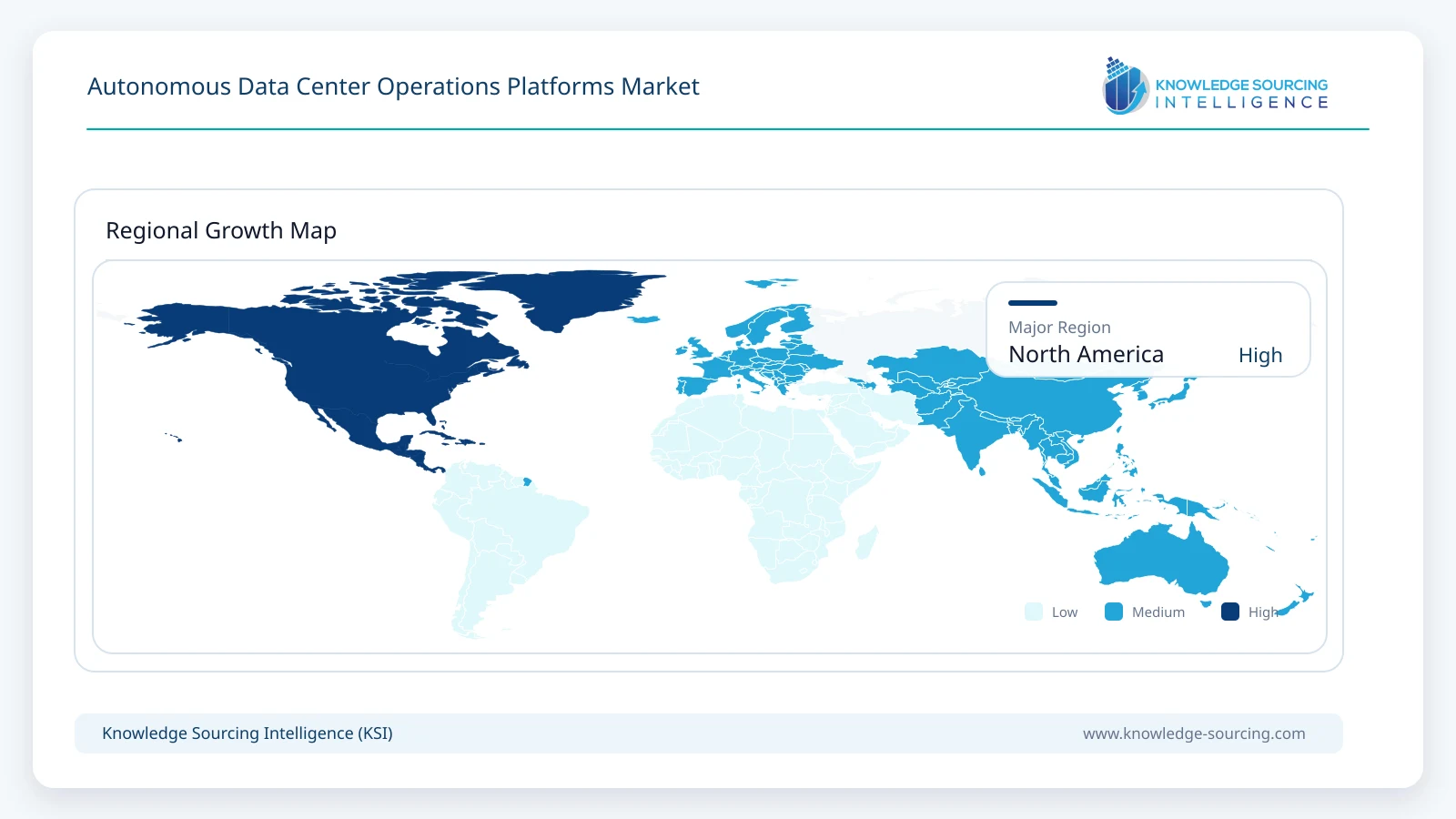
Adoption is strongest in hyperscale, neocloud and large colocation environments where the value of uptime and usable compute capacity is high enough to justify advanced control software. AI infrastructure operators can monetize improvements in GPU availability and power utilization directly, making autonomous operations easier to justify than in smaller enterprise facilities. The region also has a large installed base of conventional data centers where predictive maintenance, alarm intelligence and AI-enhanced DCIM provide an incremental migration path without requiring immediate closed-loop control.
Through 2032, North American demand is expected to broaden from specialist AI-factory platforms into a more integrated operational software stack. DCIM vendors are adding AI recommendations, equipment suppliers are attaching predictive services to critical assets, and compute-platform vendors are extending orchestration into power, cooling and recovery. The result is likely to be a federated architecture rather than one universal control system: specialized agents and analytics products will exchange data through APIs while safety-critical actions remain governed by equipment controls, policy engines and human approval rules.
Europe
European adoption is supported by large colocation markets, energy-efficiency requirements and a strong industrial automation base. Operators are likely to prioritize energy optimization, predictive maintenance and controlled cooling automation, particularly where electricity costs and grid constraints materially affect operating economics. Schneider Electric, Siemens, ABB and other regional infrastructure suppliers provide an installed channel for adding AI-driven operations capabilities to existing facilities.
Asia Pacific
Asia Pacific combines hyperscale and sovereign AI growth with a large installed base of data centers in China, Japan, Singapore, Australia, India and South Korea. The region offers strong demand for remote and multi-site automation as operators scale facilities across markets with different labor, power and climate conditions. Adoption is expected to be particularly strong in new high-density campuses where telemetry and control interfaces can be designed for automation from the start.
Middle East and Rest of World
Large greenfield AI campuses in the Middle East can incorporate autonomous operations at the design stage, avoiding some of the integration problems found in brownfield facilities. Sovereign AI programs and large-scale data center investment also increase the value of platforms that allow centralized teams to supervise complex facilities with limited local specialist staffing. Other regions are expected to adopt the technology more selectively, starting with predictive maintenance and remote operations.
Competitive Landscape
Competition spans AI-factory orchestration vendors, autonomous-control specialists, DCIM suppliers, critical-infrastructure companies and industrial automation providers. NVIDIA has a differentiated position in AI factories because Mission Control connects compute orchestration, infrastructure health, autonomous recovery, power policies and building-management integration. Phaidra is one of the clearest specialists in agentic data center operations, combining operational intelligence with closed-loop cooling and power-related agents. Schneider Electric, Vertiv, Siemens, Honeywell, ABB and Eaton can extend autonomous capabilities through their installed power, cooling and automation footprints.
The competitive boundary is moving beyond traditional software categories. A DCIM platform can add AI recommendations, a critical-power supplier can sell predictive maintenance as a managed service, and a GPU-platform vendor can automate workload recovery and facility coordination. This creates overlap, but it also creates partnership opportunities because no single vendor controls every layer of a data center. Operators are likely to maintain specialist platforms for compute, power, cooling and asset management while using cross-domain orchestration to connect the highest-value workflows.
Trust, explainability and safe execution will be critical differentiators. Operators need to understand why a system recommends or performs an action, verify that it respects redundancy and equipment constraints, and preserve an auditable history of changes. Platforms that can begin in read-only mode, prove value through recommendations, and then progress toward bounded automation are positioned more favorably than products that require immediate control authority. Integration breadth and the ability to work with heterogeneous equipment will also be important because most large data centers contain multiple generations and vendors of infrastructure.
Major companies and ecosystem participants covered: NVIDIA, Phaidra, Schneider Electric, Vertiv, Siemens, Honeywell, ABB, Eaton, Sunbird Software, FNT Software, Nlyte Software, Johnson Controls, Coolgradient, Vigilent and IBM.
Recent Developments
August 2026: InfraPartners and Phaidra announced a partnership to integrate AI agents with prefabricated AI factories, combining cooling control and real-time facility intelligence across design, build and operations.
March 2026: Phaidra, CoreWeave and Applied Digital reported production validation of agentic liquid-cooling control using rack power as a leading indicator for thermal response.
March 2026: Phaidra launched Phaidra Prism, an AI operations platform designed to unify infrastructure intelligence and accelerate troubleshooting in AI factories.
January 2026: Vertiv launched Next Predict, an AI-powered managed service that uses machine-learning analytics to anticipate critical infrastructure issues before they cause disruption.
2026: NVIDIA Mission Control 2.3 expanded autonomous resiliency capabilities for Blackwell infrastructure, including autonomous job and hardware recovery, power optimization and enhanced facility integration.
Autonomous Data Center Operations Platforms Market Scope:
| Report Metric | Details |
|---|---|
| Total Market Size in 2026 | USD 1.40 billion |
| Total Market Size in 2032 | USD 8.40 billion |
| Forecast Unit | USD Billion |
| Growth Rate | 34.8% |
| Study Period | 2021 to 2032 |
| Historical Data | 2021 to 2024 |
| Base Year | 2025 |
| Forecast Period | 2026 – 2032 |
| Segmentation | Component, Operational Function, Level of Autonomy, Control Domain, Data Center Type, Geography |
| Companies |
|
Market Segmentation
By Component
Autonomous Operations Software Platforms
Integration and Implementation Services
Managed Predictive and Optimization Services
By Operational Function
Observability, Anomaly Detection and Root-Cause Analysis
Predictive Maintenance
Autonomous Thermal Optimization
Automated Incident Remediation and Recovery
Power and Energy Optimization
Cross-Domain AI Factory Orchestration
By Level of Autonomy
Advisory Intelligence
Prescriptive Operations
Closed-Loop Autonomous Control
Multi-Domain Agentic Operations
By Control Domain
Compute and IT Infrastructure
Power Infrastructure
Cooling and Thermal Systems
Facility and Asset Operations
Cross-Domain Operations
By Data Center Type
Hyperscale and AI Factories
Colocation Data Centers
Enterprise Data Centers
Edge and Distributed Facilities
By Geography
North America
United States
Canada
Europe
Asia Pacific
Middle East and Rest of World
Table of Contents
Table of Contents
1. EXECUTIVE SUMMARY
1.1. Market Opportunity and Key Findings
1.2. Adoption Timeline
1.3. Principal Revenue Pools
2. MARKET OVERVIEW
2.1. Evolution from Monitoring to Autonomous Operations
2.2. AI Factory Operations Complexity
2.3. IT and OT Coordination
2.4. Operational Data, Telemetry and Control Interfaces
3. MARKET SIZE AND FORECAST, 2026-2032
3.1. Global Market Revenue
3.2. Annual Growth Analysis
3.3. Software versus Services Revenue
3.4. Adoption by Data Center Installed Capacity
4. MARKET BY COMPONENT
4.1. Autonomous Operations Software Platforms
4.2. Integration and Implementation Services
4.3. Managed Predictive and Optimization Services
5. MARKET BY OPERATIONAL FUNCTION
5.1. Observability, Anomaly Detection and Root-Cause Analysis
5.2. Predictive Maintenance
5.3. Autonomous Thermal Optimization
5.4. Automated Incident Remediation and Recovery
5.5. Power and Energy Optimization
5.6. Cross-Domain AI Factory Orchestration
6. MARKET BY LEVEL OF AUTONOMY
6.1. Advisory Intelligence
6.2. Prescriptive Operations
6.3. Closed-Loop Autonomous Control
6.4. Multi-Domain Agentic Operations
7. MARKET BY CONTROL DOMAIN
7.1. Compute and IT Infrastructure
7.2. Power Infrastructure
7.3. Cooling and Thermal Systems
7.4. Facility and Asset Operations
7.5. Cross-Domain Operations
8. MARKET BY DATA CENTER TYPE
8.1. Hyperscale and AI Factories
8.2. Colocation Data Centers
8.3. Enterprise Data Centers
8.4. Edge and Distributed Facilities
9. REGIONAL MARKET
9.1. North America
9.1.1. United States
9.1.2. Canada
9.2. Europe
9.3. Asia Pacific
9.4. Middle East and Rest of World
10. TECHNOLOGY AND COMMERCIALIZATION OUTLOOK
10.1. AI Agents for Data Center Operations
10.2. Autonomous Recovery and Remediation
10.3. Closed-Loop Cooling Control
10.4. Predictive Asset Health and Maintenance
10.5. Integration with DCIM, BMS and Cluster Management
10.6. Human-in-the-Loop Governance and Safety
10.7. Cybersecurity and Operational Trust
11. COMPETITIVE LANDSCAPE
11.1. Value Chain
11.2. AI Factory Orchestration Platforms
11.3. Autonomous Control Specialists
11.4. DCIM and Infrastructure Software Vendors
11.5. Critical Infrastructure and Industrial Automation Vendors
11.6. Partnerships and Ecosystem Development
12. COMPANY PROFILES
12.1. NVIDIA
12.2. Phaidra
12.3. Schneider Electric
12.4. Vertiv
12.5. Siemens
12.6. Honeywell
12.7. ABB
12.8. Eaton
12.9. Sunbird Software
12.10. FNT Software
12.11. Nlyte Software
12.12. Johnson Controls
12.13. Coolgradient
12.14. Vigilent
12.15. IBM
13. APPENDIX
13.1. Definitions and Abbreviations
13.2. Autonomous Operations Capability Classification
13.3. Application and Deployment Framework
13.4. Source and Data Notes
Navigate
Trusted by the world's leading organizations











