
Artichokes Market Size:
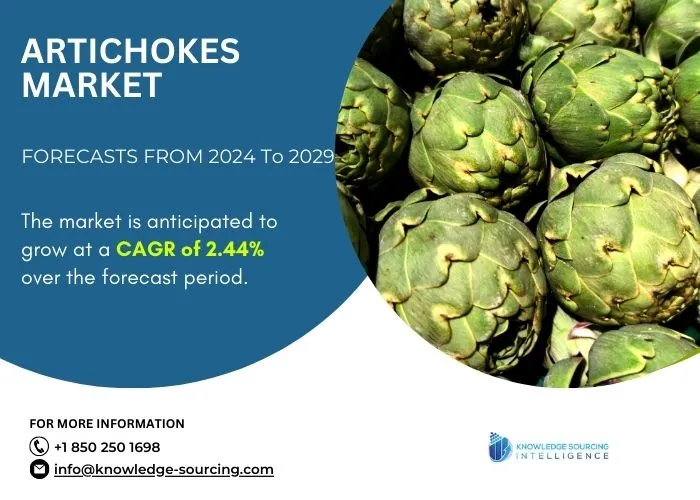
The Global Artichokes market is forecast to grow at a CAGR of 2.7%, reaching USD 3.2 billion in 2031 from USD 2.8 billion in 2026.
The artichoke market is projected to progress steadily during the period under consideration. The Mediterranean food culture involves the cultivation of the artichoke plant, which has many health advances, such as antimicrobial, antifungal, antibacterial, antioxidant, and anticancer components, alongside a good flavor. Artichokes contain chemicals that help lessen nausea, vomiting, spasms, and gas, so they are often eaten in food. An artichoke leaf extract may aid digestion, cholesterol reduction, and liver protection, owing to an increased artichoke market share globally.
Artichokes Production:
According to the FAO report, during the last ten years, the world's artichoke production has gradually increased. The growing demand is due to the rising interest in plant-based meals and the popularity of plant-based diets. The growing sale of plant-based products leads to the artichoke market share. Additionally, the artichoke is a sought-after vegetable by vegans and vegetarians due to its nutritional benefits, and as a result, the artichoke market is on a continuous uptrend.
Artichoke Market Growth Drivers:
Awareness of the health benefits of artichokes among people
The vegetable's nutritious content significantly impacts the artichoke market's growth. Advances in food science are mostly responsible for the global demand for artichokes. People concerned about their health are aware that artichokes are thought to assist individuals in controlling their blood pressure.
Furthermore, consuming processed artichokes has been demonstrated to enhance digestion, which has fueled the artichoke market's expansion. The number of people making an effort to live better lifestyles has increased total spending on natural supplements, directly impacting the global artichoke market expansion.
The availability of artichokes is regarded to drive the market growth.
The availability of artichokes is expected to affect the pricing. While demand for artichokes is highest in the winter, supplies are at their most in March when prices are at their lowest. The most popular artichoke type globally is the green globe kind. Using the proper packing and preservation techniques, the artichokes are kept fresh, allowing for longer shelf life and worldwide exporting over greater distances. The canned and frozen varieties of the vegetable have significantly impacted the artichokes market.
Artichokes have multiple nutritious properties, increasing their consumption among humans.
Artichokes contain a notable amount of fiber, which can eliminate constipation and increase the motility of the bowel, thus promoting digestive health. They also contain substances that develop good bacteria in the stomach, consequently escalating gut health. Potassium, which helps lower blood pressure and associated heart disease risk, is abundantly present in artichokes.
This group of nutrients also contains anti-inflammatory and antioxidant substances that can help reduce the chances of having heart disease. One way in which these artichoke chemicals function is by stimulating the formation of bile compounds that the liver requires to digest and absorb fats. People with liver problems and those with a higher-fat diet could benefit from this.
Technological advancement plays a major role in the growth of artichokes.
Along with crop monitoring and management, yield optimization and supply chain management are also those branches where artificial intelligence (AI) opportunities appear. Employed to track crop health and signal early disease or pest indices, AI-based tech can scrutinize data from sensors, drones, and satellite photography. AI algorithms could be fed into it to choose the most optimal dates for planting and harvesting artichokes. The data analysis system may consider soil composition, weather patterns, and other environmental factors. Utilizing AI, new artichoke products that adhere to certain nutritional profiles may be created by analyzing consumer preferences, propelling artichoke market size.
Rising sales of fresh artichokes might impact the market.
The fresh artichoke market is anticipated to rise significantly due to its high consumption, intriguing flavor, and tenderness. The primary determinants of its demand are its flavor, freshness, and nutritional value. Customers find the product more appealing due to its natural look and the growing popularity of healthy, minimally processed foods, which supports the expansion of this market.
The canned food category is predicted to grow significantly due to its year-round availability and increased demand from the American, French, and Spanish processing industries. Canned artichokes may be included in every meal, making them a popular option and contributing to the canned artichokes market.
Artichoke Market Geographical Outlook:
Europe is anticipated to be the largest market shareholder.
As the primary producing nations are situated in the European region, there is a rise in the consumption of organic foods. Owing to this, Europe is predicted to have the greatest artichokes market share globally. Only Murcia province produced more artichokes than 6,335 hectares in 2021 (13% more than the previous years) annually in Spain, according to the International Society for Horticultural Science.
Artichokes are selling well in the area due to the huge rise in demand in Italy, France, Spain, and the U.K. Additionally, producers are funding R&D initiatives to investigate and expand the applications for this vegetable, which is projected to increase local sales.
South America is expected to hold a significant market share.
South America is projected to present considerable development potential due to rising production in Argentina and Peru and the widespread use of Cynara in many culinary products. The highly adaptable item is frequently prepared into a paste or baked into a tart. Peruvian artichokes are appreciated because of their sour, green flavor. It is added to appetizers as a nutritious ingredient. Additionally, it is anticipated that the Peruvian Exporters' Association's (ADEX) investment in research and development (R&D) for this industry to increase output would help the artichokes market in the area flourish.
Artichoke Market Key Developments:
In April 2023, Ocean Mist Farms, North America's premier producer and marketer of fresh artichokes, announced the commencement of its annual spring promotion. The promotion highlights the health and nutrition advantages and acclaim of its famed Gold Standard artichokes.
In January 2022, World Finer Foods introduced Cutting Vedge, a brand of artichoke-based, protein-rich frozen foods.
Artichokes Market Segmentation:
By Origin
Organic
Conventional
By Product Type
Globe Artichokes
Elongated Artichokes
By End-Use
Food Processing
Direct Consumption
Beverages Processing
Others
By Geography
North America
USA
Canada
Mexico
South America
Brazil
Argentina
Others
Europe
United Kingdom
Germany
France
Spain
Others
Middle East and Africa
Saudi Arabia
UAE
Israel
Others
Asia Pacific
China
Japan
India
South Korea
Taiwan
Thailand
Indonesia
Others
Table of Contents
1. INTRODUCTION
1.1. Market Overview
1.2. Market Definition
1.3. Scope of the Study
1.4. Market Segmentation
1.5. Currency
1.6. Assumptions
1.7. Base, and Forecast Years Timeline
1.8. Key Benefits for the stakeholder
2. RESEARCH METHODOLOGY
2.1. Research Design
2.2. Research Processes
3. EXECUTIVE SUMMARY
3.1. Key Findings
4. MARKET DYNAMICS
4.1. Market Drivers
4.2. Market Restraints
4.3. Porter’s Five Forces Analysis
4.3.1. Bargaining Power of Suppliers
4.3.2. Bargaining Power of Buyers
4.3.3. Threat of New Entrants
4.3.4. Threat of Substitutes
4.3.5. Competitive Rivalry in the Industry
4.4. Industry Value Chain Analysis
4.5. Analyst View
5. ARTICHOKES MARKET, BY ORIGIN
5.1. Introduction
5.2. Organic
5.2.1. Market Trends and Opportunities
5.2.2. Growth Prospects
5.2.3. Geographic Lucrativeness
5.3. Conventional
5.3.1. Market Trends and Opportunities
5.3.2. Growth Prospects
5.3.3. Geographic Lucrativeness
6. ARTICHOKES MARKET, BY PRODUCT TYPE
6.1. Introduction
6.2. Globe Artichokes
6.2.1. Market Trends and Opportunities
6.2.2. Growth Prospects
6.2.3. Geographic Lucrativeness
6.3. Elongated Artichokes
6.3.1. Market Trends and Opportunities
6.3.2. Growth Prospects
6.3.3. Geographic Lucrativeness
7. ARTICHOKES MARKET, BY END-USE
7.1. Introduction
7.2. Food Processing
7.2.1. Market Trends and Opportunities
7.2.2. Growth Prospects
7.2.3. Geographic Lucrativeness
7.3. Direct Consumption
7.3.1. Market Trends and Opportunities
7.3.2. Growth Prospects
7.3.3. Geographic Lucrativeness
7.4. Beverages Processing
7.4.1. Market Trends and Opportunities
7.4.2. Growth Prospects
7.4.3. Geographic Lucrativeness
7.5. Others
7.5.1. Market Trends and Opportunities
7.5.2. Growth Prospects
7.5.3. Geographic Lucrativeness
8. ARTICHOKES MARKET, BY GEOGRAPHY
8.1. Introduction
8.2. North America
8.2.1. By Origin
8.2.2. By Product Type
8.2.3. By End-Use
8.2.4. By Country
8.2.4.1. USA
8.2.4.1.1. Market Trends and Opportunities
8.2.4.1.2. Growth Prospects
8.2.4.2. Canada
8.2.4.2.1. Market Trends and Opportunities
8.2.4.2.2. Growth Prospects
8.2.4.3. Mexico
8.2.4.3.1. Market Trends and Opportunities
8.2.4.3.2. Growth Prospects
8.3. South America
8.3.1. By Origin
8.3.2. By Product Type
8.3.3. By End-Use
8.3.4. By Country
8.3.4.1. Brazil
8.3.4.1.1. Market Trends and Opportunities
8.3.4.1.2. Growth Prospects
8.3.4.2. Argentina
8.3.4.2.1. Market Trends and Opportunities
8.3.4.2.2. Growth Prospects
8.3.4.3. Others
8.3.4.3.1. Market Trends and Opportunities
8.3.4.3.2. Growth Prospects
8.4. Europe
8.4.1. By Origin
8.4.2. By Product Type
8.4.3. By End-Use
8.4.4. By Country
8.4.4.1. United Kingdom
8.4.4.1.1. Market Trends and Opportunities
8.4.4.1.2. Growth Prospects
8.4.4.2. Germany
8.4.4.2.1. Market Trends and Opportunities
8.4.4.2.2. Growth Prospects
8.4.4.3. France
8.4.4.3.1. Market Trends and Opportunities
8.4.4.3.2. Growth Prospects
8.4.4.4. Spain
8.4.4.4.1. Market Trends and Opportunities
8.4.4.4.2. Growth Prospects
8.4.4.5. Others
8.4.4.5.1. Market Trends and Opportunities
8.4.4.5.2. Growth Prospects
8.5. Middle East and Africa
8.5.1. By Origin
8.5.2. By Product Type
8.5.3. By End-Use
8.5.4. By Country
8.5.4.1. Saudi Arabia
8.5.4.1.1. Market Trends and Opportunities
8.5.4.1.2. Growth Prospects
8.5.4.2. UAE
8.5.4.2.1. Market Trends and Opportunities
8.5.4.2.2. Growth Prospects
8.5.4.3. Israel
8.5.4.3.1. Market Trends and Opportunities
8.5.4.3.2. Growth Prospects
8.5.4.4. Others
8.5.4.4.1. Market Trends and Opportunities
8.5.4.4.2. Growth Prospects
8.6. Asia Pacific
8.6.1. By Origin
8.6.2. By Product Type
8.6.3. By End-Use
8.6.4. By Country
8.6.4.1. China
8.6.4.1.1. Market Trends and Opportunities
8.6.4.1.2. Growth Prospects
8.6.4.2. Japan
8.6.4.2.1. Market Trends and Opportunities
8.6.4.2.2. Growth Prospects
8.6.4.3. India
8.6.4.3.1. Market Trends and Opportunities
8.6.4.3.2. Growth Prospects
8.6.4.4. South Korea
8.6.4.4.1. Market Trends and Opportunities
8.6.4.4.2. Growth Prospects
8.6.4.5. Taiwan
8.6.4.5.1. Market Trends and Opportunities
8.6.4.5.2. Growth Prospects
8.6.4.6. Thailand
8.6.4.6.1. Market Trends and Opportunities
8.6.4.6.2. Growth Prospects
8.6.4.7. Indonesia
8.6.4.7.1. Market Trends and Opportunities
8.6.4.7.2. Growth Prospects
8.6.4.8. Others
8.6.4.8.1. Market Trends and Opportunities
8.6.4.8.2. Growth Prospects
9. COMPETITIVE ENVIRONMENT AND ANALYSIS
9.1. Major Players and Strategy Analysis
9.2. Market Share Analysis
9.3. Mergers, Acquisitions, Agreements, and Collaborations
9.4. Competitive Dashboard
10. COMPANY PROFILES
10.1. Caprichos del Paladar
10.2. The ultimate artichoke
10.3. Roland Foods (Vestar Capital Partners)
10.4. Ocean Mist Farms
10.5. Cento Fine Foods
10.6. San Diego Seed Company
10.7. The Artisan Food Company
Navigate
Trusted by the world's leading organizations











