
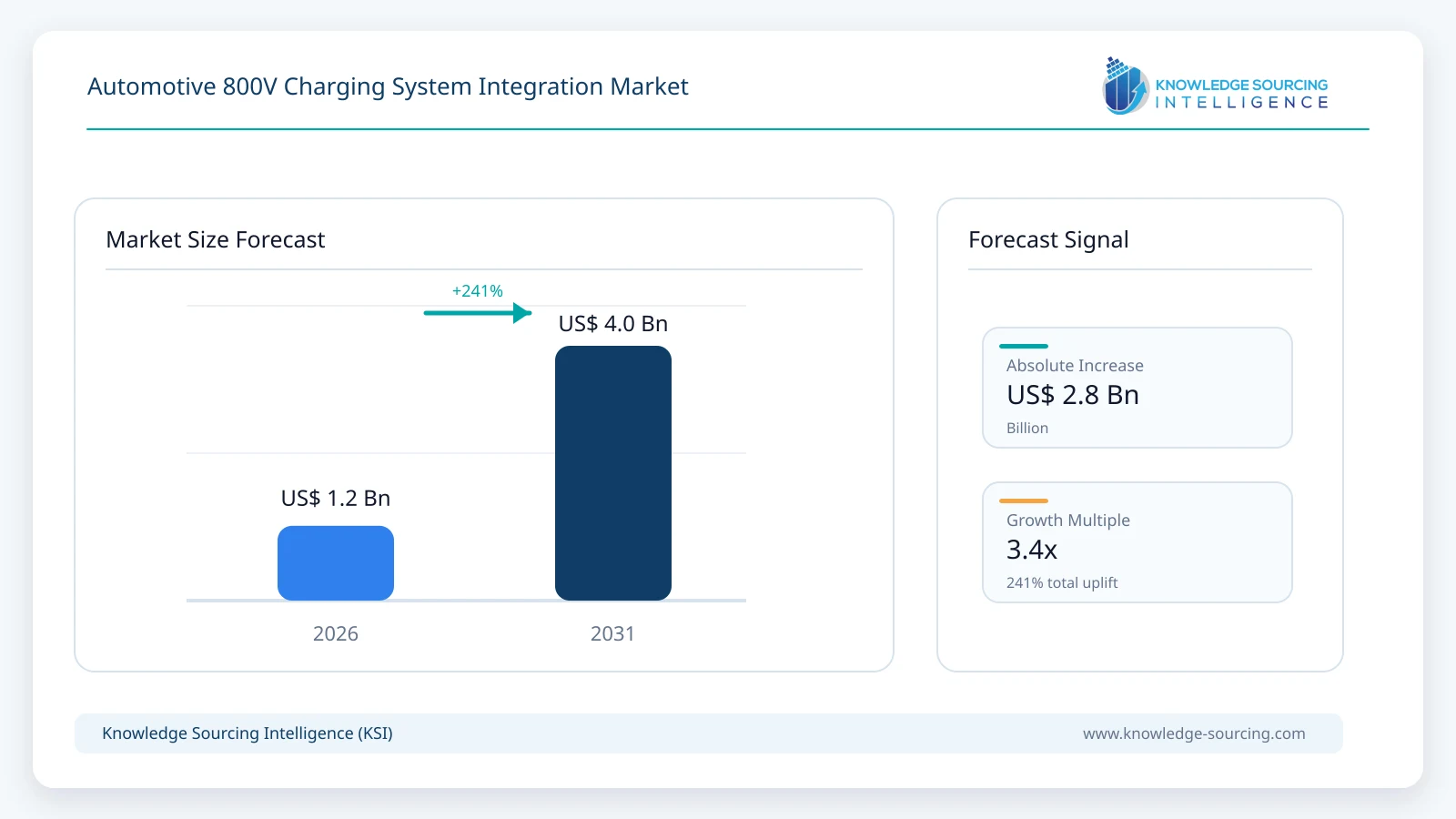
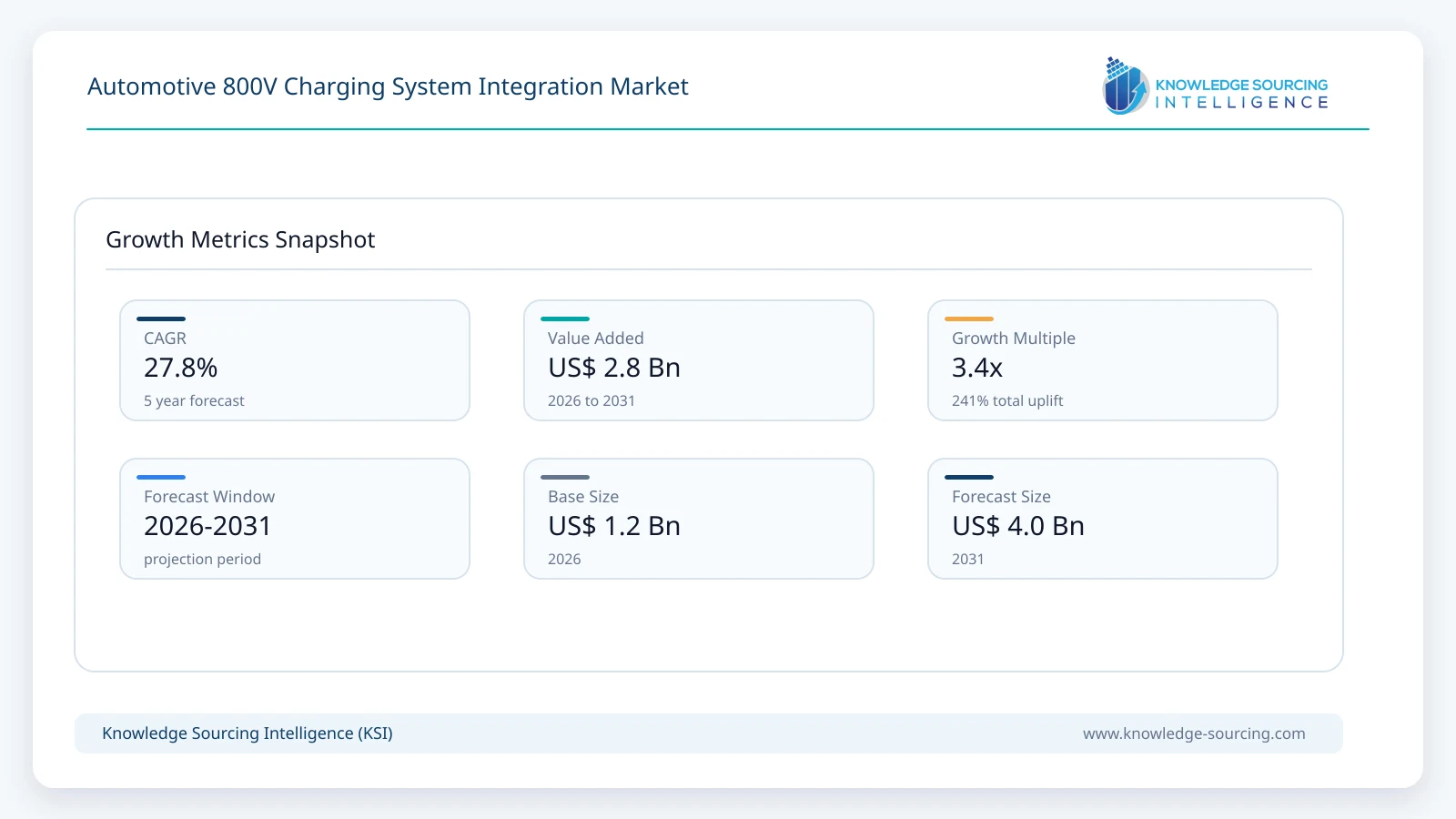
The Automotive 800V Charging System Integration Market is projected to expand at a CAGR of 27.8%, increasing from USD 1.18 billion in 2026 to USD 4.02 billion by 2031.
Highlights:
- 1Integrated AC charging and conversion modules account for an estimated 34% of 2026 market value.
- 2Combined charging boxes lead the charging-system architecture mix, with further integration expected through 2031.
- 3Asia Pacific is the leading regional market in 2026, supported by Chinese EV manufacturing and higher-voltage platforms.
- 4Cross-voltage charging compatibility is a core requirement because 800V vehicles still use many 400V DC charging stations.
- 5SiC-intensive charging designs gain share as higher charging power places more emphasis on converter efficiency.
- 6Battery bank switching and inverter-assisted charging create alternative designs for using 400V charging stations.
Revenue comes from integrated onboard charging and conversion modules, equipment that adapts 400V fast chargers to higher-voltage batteries, dedicated charging-path switching and protection, control electronics, and closely related system engineering. Automakers purchase these functions either as a complete high-voltage charging box or as components designed into the battery and drive system.
Hyundai’s E-GMP uses its drive motor and inverter to boost voltage when connected to 400V chargers, while Porsche’s Cayenne Electric uses high-voltage battery switching to create two 400V banks. ZF offers a modular converter design combining onboard charging and DC boost functions, and Schaeffler’s High Voltage Box supports both 400V and 800V battery applications. Different approaches alter hardware cost, component integration and the qualifications needed before a system can be launched on more than one vehicle platform.
Market Overview
An 800V traction battery cannot always accept the same DC voltage offered by an existing public charger, so vehicle charging systems must match the station output to the pack while managing current, contactors, insulation monitoring and temperature limits. At 800V stations, the vehicle can make use of high charging power with lower current than a similar 400V design. At lower-voltage stations, manufacturers must use electrical conversion or change how battery sections are connected. Onboard AC charging needs a separate conversion stage and should not be confused with external DC fast-charger hardware.
Porsche’s Taycan Combined Booster Charger combines DC charging conversion with high-voltage distribution, while its Cayenne Electric shifts to battery-bank switching for compatible 400V charging. BMW’s new iX3 similarly connects battery management and an internal switching matrix to support both voltage classes. Hyundai retains a different solution on E-GMP, where existing inverter and motor hardware performs the boost function. The competing designs show why charging integration requires agreement between battery engineers, power-electronics teams, safety specialists and charging software developers.
Suppliers including Schaeffler, ZF, Valeo and BorgWarner compete by reducing the size of high-voltage electronics and avoiding duplicate conversion stages. A combined module can share a housing, cooling circuit, electrical protection and software interfaces, but it also brings more functions into one qualification program. Vehicle manufacturers therefore compare the cost of individual electronic parts with the system-level savings from packaging, wiring and serviceability. The value of integration depends on both charging performance and how easily one design can serve several regional charging standards.
Market Trends
400V Compatibility Is Shaping 800V Charging Design
Hyundai’s E-GMP uses the traction motor and inverter to raise charging voltage from a 400V station, allowing its higher-voltage battery to use infrastructure designed for older electric vehicles. Porsche’s Cayenne Electric instead divides the battery into two nominal 400V banks through a high-voltage switch. BMW’s iX3 uses an internally developed switching matrix for similar cross-voltage charging access. These choices affect module demand because a battery-switching design does not require the same dedicated booster content as an external DC conversion approach.
Charging performance also depends on battery condition, station voltage and available current rather than voltage rating alone. Charging-system suppliers must protect contactors during switching, control voltage changes and coordinate with the pack’s charging limits. Automakers that plan to sell one platform across Europe, China and North America gain commercial value from these compatibility functions because fast-charging infrastructure remains mixed by power level and interface.
Combined High-Voltage Modules Are Reducing Separate Components
Schaeffler’s High Voltage Box 3.0 combines onboard charging with a high-to-low-voltage converter, while ZF’s SELECT platform places charging, boost and vehicle power-conversion functions within a common housing. Such designs reduce separate enclosures and high-voltage cable runs, but more shared hardware also makes cooling and service replacement more dependent on the whole module. Tier 1 suppliers can benefit when automakers purchase an assembled charging subsystem rather than a collection of standalone parts.
Schaeffler presented its SuperBox in September 2026, bringing together an inverter, onboard charger, high-voltage boost circuit and auxiliary power functions. Its use of a shared transformer and motor windings illustrates how suppliers can remove repeated power stages instead of simply placing separate products inside one enclosure. OEM adoption will depend on efficiency across real charging cycles, service access and the ability to configure the same design for different battery packs.
Higher Charging Power Is Raising Thermal and Safety Requirements
BMW demonstrated charging power up to 460 kW on its 800V iX5 program in October 2026, while Porsche reports up to 400 kW for the Cayenne Electric. Higher charging power increases the importance of keeping electrical contacts, busbars, charging control components and battery interfaces within qualified temperature limits. It also requires stable communication and reliable reductions in requested power if the vehicle or charger approaches its operating limits.
Automotive 800V charging components must work safely through repeated high-power sessions, wet conditions and vehicle vibration. Suppliers are investing in semiconductor switching, insulation design and thermal validation, while automakers are more closely integrating the charging pathway with the battery and vehicle software. The resulting demand favors suppliers able to validate complete charging paths rather than only the rated power of one converter.
Charging Communication and Safety Controls Are Becoming More Integrated
Vehicle-to-station communication has become a central part of 800V charging-path design as batteries accept wider voltage ranges and higher current at compatible DC stations. ISO 15118-20 and IEC 61851-23 provide technical frameworks for communication and DC charging equipment, while the July 2026 amendment to ISO 15118-20 updates services and security provisions. Vehicle integration teams must align station requests with battery current limits, contactor states and protective shutdown behavior before validating a charging system across regions.
A combined charging module can place power conversion and charge-path control closer to the vehicle’s electrical safety logic, reducing duplicated interfaces while increasing software-testing work. Regional connector arrangements, the station’s voltage capability, and the state of the battery still determine the achievable charge rate. Suppliers therefore compete on the consistency of charging sessions and verified fault handling, not only on the headline power rating of their converters.
Segment Analysis
By Charging Integration Function: Integrated AC Charging and Conversion Modules
Integrated AC charging and power-conversion modules account for an estimated 34% of market revenue in 2026, making them the largest function group. Schaeffler’s high-voltage box and ZF’s converter platform show how vehicle manufacturers can source onboard charging alongside other charge-path functions. Sharing electronics and a compact housing can reduce installation work and weight, although it raises design requirements for cooling, electromagnetic compatibility and service access.
Demand for DC charging above 350 kW increases the value of voltage adaptation, switching and interface controls even when the onboard AC charger continues to serve an 11 kW or 22 kW supply. These changes direct more vehicle-side charging spend toward the high-voltage charging path through 2031. OEMs will decide how much to combine into one module based on battery layout, station compatibility, and the cost of validating a common unit for several vehicles.
By Charging System Architecture: Combined Charging Boxes
Combined OBC, DC/DC and high-voltage charging boxes are estimated to represent 39% of the market in 2026 and gain share as suppliers reduce separate enclosures. ZF and Schaeffler offer modular solutions that bundle conversion functions, while Porsche’s Combined Booster Charger illustrates a vehicle-level charging architecture that puts distribution and conversion close together. A common enclosure simplifies vehicle packaging but can make replacement more expensive when only one internal section fails.
Automakers developing high-volume 800V platforms can justify the engineering costs of deeply integrated designs across multiple variants. Lower-volume programs may prefer separate units because components can be changed or sourced independently. The balance should continue to shift toward integrated boxes as platform volumes increase and suppliers prove reliable cooling, switching, and software performance.
By Charger Compatibility: Dedicated Voltage Boosting
Dedicated DC booster solutions represent a meaningful share of the 2026 market because not every 800V battery can be reconfigured for 400V charging. A separate booster can handle voltage adaptation without changing the pack’s cell connections, but it adds electronic hardware and creates another thermal load. ZF’s SELECT converter illustrates a commercial approach to incorporating the function alongside other vehicle power-conversion tasks.
Porsche’s battery-bank switching and Hyundai’s inverter-assisted boost show why this segment faces competing design choices. Dedicated boosters are expected to lose relative share where manufacturers can reuse battery switching or traction components, although their absolute demand can still rise as 800V EV sales expand. Suppliers need to demonstrate that their design offers reliable charging access at a reasonable total installed cost.
By Geography: Asia Pacific
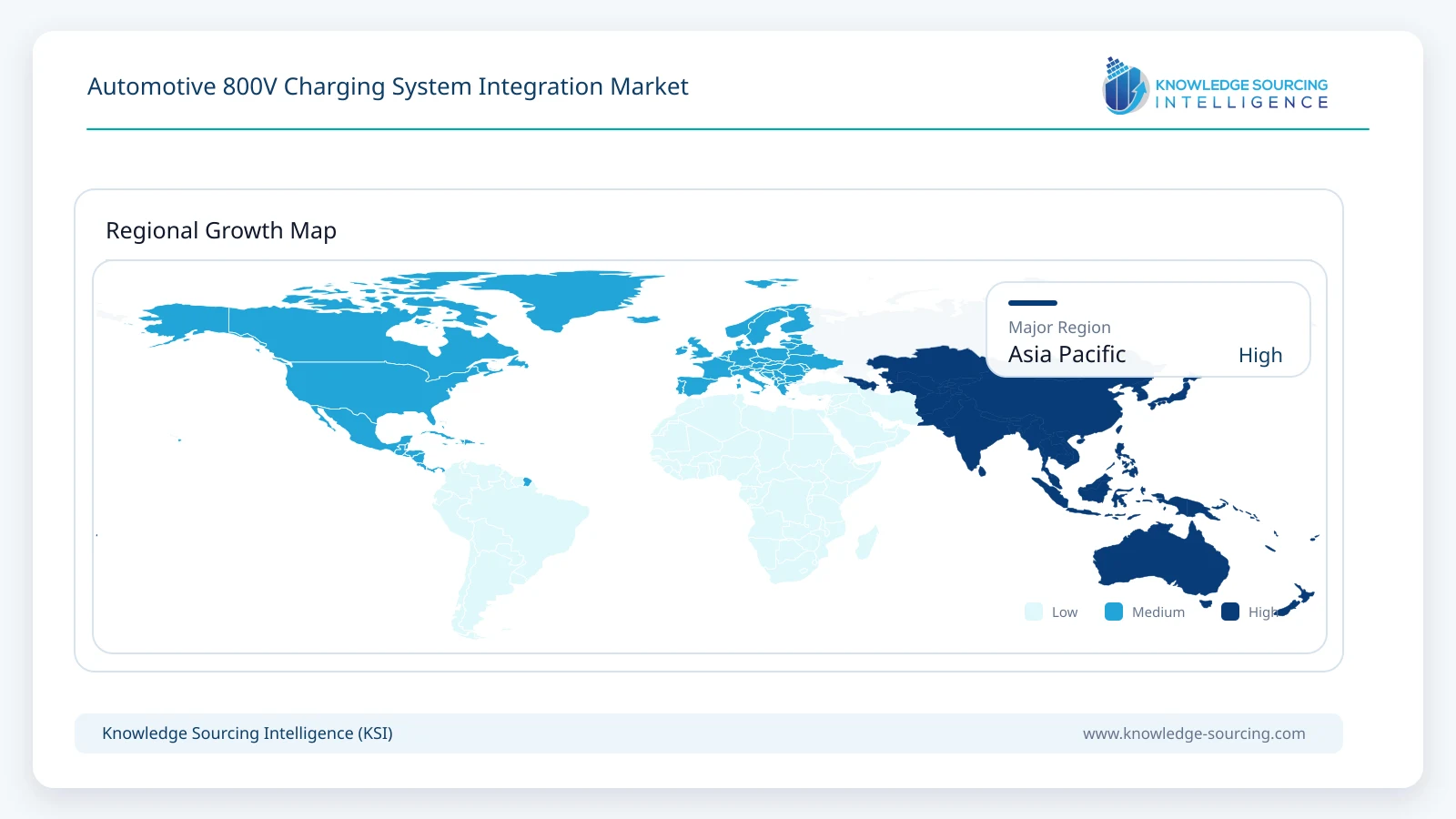
Asia Pacific accounts for an estimated 58% of global revenue in 2026, supported by China’s electric-vehicle manufacturing base and its rapid introduction of higher-voltage platforms. BYD’s 2025 Super e-Platform demonstrates the region’s move toward high-power charging, while Hyundai and other Asian automakers continue to develop 800V vehicles for international markets. Production scale supports local sourcing of integrated charging electronics and faster feedback between battery and vehicle design teams.
China’s charging-system suppliers face heavy price pressure, which encourages compact designs and shared components even as the power requirements rise. Japan, South Korea and India provide additional manufacturing, engineering and vehicle-demand opportunities. Asia Pacific is forecast to retain the largest market position through 2031 because 800V implementation is spreading beyond premium models into higher-volume electric vehicles.
Market Drivers
Faster DC Charging Across New Vehicle Platforms
BMW’s Neue Klasse and Porsche’s Cayenne Electric show how automakers are using high-voltage charging capability to make long-distance EV travel more practical. Charging power above 300 kW requires a reliable path between the public charger, high-voltage battery and vehicle controller. As new 800V models enter production, each qualified platform creates demand for charging switching, conversion and interface electronics.
Automakers generally validate charging functions for a complete vehicle architecture rather than buy them as independent accessories. Higher production volumes allow the same charging design to be reused across multiple models, creating longer supply programs for integrated module manufacturers.
Need to Support Existing 400V Charging Stations
An 800V vehicle that cannot use a 400V DC charging station would face limits in parts of the public charging network. Hyundai uses inverter-assisted boost, Porsche uses battery-bank switching and BMW integrates voltage adaptation within the battery system. Each method needs coordinated hardware and control logic to maintain charging access safely.
Cross-voltage compatibility has a direct commercial value for global EV platforms because charger voltage ranges differ by region and station generation. Manufacturers that can reuse one vehicle platform across these environments reduce regional engineering and certification work.
High-Voltage Module Integration and Packaging Savings
Combined high-voltage boxes reduce the number of separate power-electronics housings that vehicle manufacturers must install and connect. Schaeffler and ZF offer designs that group onboard charging, DC conversion and related control functions. Fewer external connections can help simplify assembly and reduce packaging demand in a crowded underbody or front compartment.
Integrated charging hardware also gives Tier 1 suppliers a larger share of a platform’s design work, including cooling and control software. Vehicle manufacturers may accept a higher-value module when its total installed cost and test requirements are lower than those of several independent units.
New Electric Platforms from Chinese and European Automakers
BYD’s 1000V Super e-Platform and BMW’s Gen6 800V architecture demonstrate the move toward higher charging voltage in both China and Europe. These platforms require charging electronics designed for their operating voltage and compatible battery layouts, creating procurement opportunities as model families expand.
Global suppliers must adapt their designs to different charging connectors, station voltages and customer battery systems. Common 800V modules that can be configured across several vehicle programs offer more attractive production scale and lower engineering cost per vehicle.
Demand for Reliable High-Power Charging and Controls
Charging sessions at 350 kW and above place heavy demands on high-voltage switching, electrical interfaces and thermal protection. BMW’s October 2026 iX5 charging demonstration illustrates the power levels that system designers are targeting. Coordinated charge limits and fault responses are essential for stable operation rather than just achieving a peak power figure.
Vehicle manufacturers validating high-power 800V charging systems increasingly test repeated charging sessions in extreme temperatures and with different public DC stations. Suppliers that can validate the complete charging path, rather than only one power stage, are better placed to secure programs that demand both high peak power and repeatable performance.
Market Restraints
Cost of High-Voltage Electronics and Qualification
800V charging modules require power semiconductors, insulation materials and switching components that operate safely under high voltage and repeated fast-charging cycles. Silicon carbide designs can improve efficiency, but the component and qualification costs remain material. Vehicle manufacturers must weigh these costs against the limited charging benefit for smaller batteries and lower-price models.
Charging hardware must also pass electromagnetic, electrical safety and thermal tests at a full-system level. Programs can face added expense when one module combines several functions because a design change may require a broader round of validation.
Differences Between Public Charging Networks
Public DC charging stations vary in voltage range, connector type, available current and software behavior. An 800V battery may need extra voltage conversion or internal switching to charge effectively at a lower-voltage station. Compatibility can therefore require additional parts even when the vehicle is designed around a simpler high-voltage powertrain.
Automakers launching 800V electric vehicles across international markets must verify charging behavior across regional station voltages, connector types and control standards. The engineering effort and potential field issues can delay launches or reduce the expected cost savings from a common charging platform.
Thermal Limits During Repeated High-Power Sessions
High charging current and fast voltage changes produce heat in connectors, semiconductor devices and electrical conductors. Porsche’s and BMW’s high-power vehicles must manage these limits alongside battery temperatures to sustain charging without damage. Components rated for high peak power still need cooling and derating strategies for repeated sessions.
Shared cooling systems can make integrated charging modules compact, but failure of one section may affect several vehicle functions. OEMs consequently require careful fault isolation, thermal testing and replacement strategies before adopting the most tightly integrated designs.
Electrical Safety and Complex Switching Sequences
Battery reconfiguration and motor-assisted charging require precise control of high-voltage contactors and power-electronic states. A switching error could expose components to incorrect voltage or interrupt charging, so the vehicle must verify electrical isolation and safe conditions at each step. Architecture choices that reduce hardware still add control and safety work.
Vehicle charging software must exchange voltage and current limits with DC stations while enforcing battery-management safety requirements throughout the charging sequence. Unexpected station behavior, communication loss or a protective shutdown must leave the vehicle in a safe state, increasing validation time across vehicle programs.
Pressure to Reduce Cost in Mass-Market Electric Vehicles
Chinese automakers are introducing higher-voltage platforms into increasingly competitive price segments, creating pressure on charging-module suppliers to lower installed system cost. Integrated electronics can help, but vehicle manufacturers may bring switching and control functions in-house or reuse existing inverter hardware rather than purchase a complete external booster.
Tier 1 suppliers face the risk of losing content per vehicle even as 800V production grows. Winning programs depend on lower manufacturing cost, flexible software and designs that reduce wiring, assembly or service costs enough to justify the supplier module.
Regional Outlook
Asia Pacific
China’s EV manufacturing scale and fast expansion of high-power charging platforms support the largest regional demand for 800V charging integration. BYD’s Super e-Platform advances charging-voltage requirements, while Hyundai’s E-GMP demonstrates cross-voltage compatibility on exported electric vehicles. Charging-module procurement is therefore closely linked to battery and vehicle-platform decisions made within large local automotive groups.
Japan, South Korea and India offer additional engineering and manufacturing activity, although new 800V production is not evenly distributed across these markets. Asia Pacific is expected to remain the largest region through 2031 as higher-voltage architectures move into more vehicle classes and suppliers build lower-cost integrated charging solutions.
Europe
European 800V vehicle programs led by Porsche and BMW support demand for advanced charging conversion, battery switching and high-voltage control modules. Porsche’s Combined Booster Charger and BMW’s Neue Klasse illustrate how brands use charging performance to differentiate their electric vehicles while keeping access to older charging infrastructure. European suppliers including Schaeffler and ZF support this demand with configurable high-voltage charging products.
European automakers also place strong emphasis on safety verification, repair access and compatibility with varied public charging stations. These requirements favor suppliers with validated complete systems and a clear path to production across several models. Europe should remain an important high-value engineering market even as Asia Pacific accounts for a larger share of units.
Competitive Landscape
800V charging integration is supplied through several business models: automakers developing proprietary charging architectures, Tier 1 companies delivering complete charging boxes, and specialists supplying conversion or switching subsystems. Hyundai’s patented multi-charging design and BMW’s in-house battery switching show how OEMs can keep important design work internally. Schaeffler, ZF and BorgWarner instead compete for externally sourced charging modules that fit multiple battery and vehicle arrangements.
Schaeffler and ZF compete through integrated power-electronic housings, while BorgWarner offers an 800V bidirectional charger for a future OEM program and Valeo applies inverter technology to voltage-boosting options. Competitiveness depends on qualification at the full-vehicle level, dependable operation at 400V and 800V stations, and the ability to meet packaging and warranty targets across multiple models. Production nominations and recurring supply agreements are stronger indicators of commercial position than the announcement of a standalone prototype.
Recent Developments
20 October 2026: BMW Group, IONNA and Alpitronic demonstrated up to 460 kW charging with the new electric BMW iX5. BMW described the event as a technology demonstration, not a commercially available U.S. charging service.
September 2026: Schaeffler presented its SuperBox integrated power-electronics design combining onboard charging, DC boosting and auxiliary power functions.
22 July 2026: Porsche introduced the Cayenne Electric range in Singapore, describing an 800V battery capable of two-bank 400V charging on suitable infrastructure.
January 2026: BMW Group detailed 800V fast charging on the iX3 and an in-house switching matrix supporting 400V charging stations.
19 November 2025: Porsche launched the Cayenne Electric with up to 400 kW DC charging, supported by battery cooling and high-voltage charging architecture.
17 March 2025: BYD announced its 1000V Super e-Platform and megawatt flash-charging technology, expanding competition beyond conventional 800V charging designs.
Market Outlook
800V charging integration through 2031 should move toward smaller combined high-voltage units as vehicle manufacturers seek to reduce separate conversion, protection and switching components. Higher charging power and wider access to 400V stations will keep voltage adaptation central to engineering decisions. The balance among dedicated boosters, inverter-assisted charging and battery switching will differ by automaker, limiting the scope for one universal design.
China is expected to provide the largest production base, while European electric platforms should continue to support higher-value system design and validation work. Integration suppliers will benefit where they can reduce overall vehicle cost and maintain safe charging across several markets. Hardware content per vehicle may decline with scale and reuse, but a larger population of qualifying 800V vehicles supports strong overall market growth.
Automotive 800V Charging System Integration Market Scope:
| Report Metric | Details |
|---|---|
| Total Market Size in 2026 | USD 1.18 billion |
| Total Market Size in 2031 | USD 4.02 billion |
| Forecast Unit | USD Billion |
| Growth Rate | 27.8% |
| Study Period | 2021 to 2031 |
| Historical Data | 2021 to 2024 |
| Base Year | 2025 |
| Forecast Period | 2026 – 2031 |
| Segmentation | Charging Integration Function, System Architecture, 400V Charger Compatibility, Peak DC Charging Power |
| Companies |
|
Market Segmentation
By Charging Integration Function
Integrated AC Charging and Conversion Modules
400 V / 800 V Charging Voltage Adaptation
DC Charging Path Switching and Protection
Charging Control and Communication Interfaces
System Engineering and Lifecycle Support
By System Architecture
Combined OBC, DC/DC and High-Voltage Box
Separate Charging and Conversion Modules
Motor-Inverter-Assisted Charging Integration
Battery-Reconfiguration Charging Architecture
By 400V Charger Compatibility
Dedicated DC Voltage-Booster Path
Inverter and Motor-Winding Boost Path
Battery Bank Reconfiguration
Native 800 V Path with Limited 400 V Adaptation
By Peak DC Charging Power
Below 250 kW
250-349 kW
350-499 kW
500 kW and Above
By Semiconductor Architecture
SiC-Intensive Charging Power Stages
Mixed Silicon and SiC Designs
Primarily Silicon Power Stages
By Vehicle Type
Passenger Battery Electric Vehicles
Light Commercial Battery Electric Vehicles
Electric Trucks and Buses
Other Eligible Road EVs
By Supplier Integration Model
Tier 1 Integrated Charging Modules
OEM-Integrated Power Electronics
Tier 1 Charging Subsystems and Interfaces
Standalone Engineering and Validation Services
By Propulsion Type
Battery Electric Vehicles
Plug-in Hybrid Electric Vehicles
Fuel Cell and Other Electric Road Vehicles
By Revenue Component
Integrated Charging Modules
Charging Conversion / Boost Content
Charge-Path Switching and Protection
Control and Interface Electronics
Integration, Calibration and Support
By Geography
Asia Pacific
China
Japan
South Korea
India
Thailand
Indonesia
Taiwan
Others
Europe
Germany
France
United Kingdom
Spain
Italy
Others
North America
United States
Canada
Mexico
South America
Brazil
Argentina
Others
Middle East and Africa
Saudi Arabia
United Arab Emirates
South Africa
Others
Table of Contents
1. EXECUTIVE SUMMARY
2. MARKET SNAPSHOT
2.1. Market Overview
2.2. Definition and Scope
2.3. Market Segmentation
3. BUSINESS LANDSCAPE
3.1. Market Drivers
3.2. Market Restraints
3.3. Market Opportunities
3.4. Porter’s Five Forces
3.5. Industry Value Chain
3.6. Policies and Regulations
3.7. Strategic Recommendations
4. TECHNOLOGICAL OUTLOOK
4.1. 800V Charging System Design
4.2. 400V-to-800V Compatibility
4.3. Switching, Protection and Communication
5. AUTOMOTIVE 800V CHARGING SYSTEM INTEGRATION MARKET BY CHARGING INTEGRATION FUNCTION
5.1. Integrated AC Charging and Conversion Modules
5.2. 400 V / 800 V Charging Voltage Adaptation
5.3. DC Charging Path Switching and Protection
5.4. Charging Control and Communication Interfaces
5.5. System Engineering and Lifecycle Support
6. AUTOMOTIVE 800V CHARGING SYSTEM INTEGRATION MARKET BY SYSTEM ARCHITECTURE
6.1. Combined OBC, DC/DC and High-Voltage Box
6.2. Separate Charging and Conversion Modules
6.3. Motor-Inverter-Assisted Charging Integration
6.4. Battery-Reconfiguration Charging Architecture
7. AUTOMOTIVE 800V CHARGING SYSTEM INTEGRATION MARKET BY 400V CHARGER COMPATIBILITY
7.1. Dedicated DC Voltage-Booster Path
7.2. Inverter and Motor-Winding Boost Path
7.3. Battery Bank Reconfiguration
7.4. Native 800 V Path with Limited 400 V Adaptation
8. AUTOMOTIVE 800V CHARGING SYSTEM INTEGRATION MARKET BY PEAK DC CHARGING POWER
8.1. Below 250 kW
8.2. 250-349 kW
8.3. 350-499 kW
8.4. 500 kW and Above
9. AUTOMOTIVE 800V CHARGING SYSTEM INTEGRATION MARKET BY SEMICONDUCTOR ARCHITECTURE
9.1. SiC-Intensive Charging Power Stages
9.2. Mixed Silicon and SiC Designs
9.3. Primarily Silicon Power Stages
10. AUTOMOTIVE 800V CHARGING SYSTEM INTEGRATION MARKET BY VEHICLE TYPE
10.1. Passenger Battery Electric Vehicles
10.2. Light Commercial Battery Electric Vehicles
10.3. Electric Trucks and Buses
10.4. Other Eligible Road EVs
11. AUTOMOTIVE 800V CHARGING SYSTEM INTEGRATION MARKET BY SUPPLIER INTEGRATION MODEL
11.1. Tier 1 Integrated Charging Modules
11.2. OEM-Integrated Power Electronics
11.3. Tier 1 Charging Subsystems and Interfaces
11.4. Standalone Engineering and Validation Services
12. AUTOMOTIVE 800V CHARGING SYSTEM INTEGRATION MARKET BY PROPULSION TYPE
12.1. Battery Electric Vehicles
12.2. Plug-in Hybrid Electric Vehicles
12.3. Fuel Cell and Other Electric Road Vehicles
13. AUTOMOTIVE 800V CHARGING SYSTEM INTEGRATION MARKET BY REVENUE COMPONENT
13.1. Integrated Charging Modules
13.2. Charging Conversion / Boost Content
13.3. Charge-Path Switching and Protection
13.4. Control and Interface Electronics
13.5. Integration, Calibration and Support
14. AUTOMOTIVE 800V CHARGING SYSTEM INTEGRATION MARKET BY GEOGRAPHY
14.1. Asia Pacific
14.1.1. China
14.1.2. Japan
14.1.3. South Korea
14.1.4. India
14.1.5. Thailand
14.1.6. Indonesia
14.1.7. Taiwan
14.1.8. Others
14.2. Europe
14.2.1. Germany
14.2.2. France
14.2.3. United Kingdom
14.2.4. Spain
14.2.5. Italy
14.2.6. Others
14.3. North America
14.3.1. United States
14.3.2. Canada
14.3.3. Mexico
14.4. South America
14.4.1. Brazil
14.4.2. Argentina
14.4.3. Others
14.5. Middle East and Africa
14.5.1. Saudi Arabia
14.5.2. United Arab Emirates
14.5.3. South Africa
14.5.4. Others
15. COMPETITIVE ENVIRONMENT AND ANALYSIS
15.1. Major Players and Strategy Analysis
15.2. Market Share Analysis
15.3. Recent Collaborations and Platform Awards
15.4. Competitive Dashboard
16. COMPANY PROFILES
16.1. Schaeffler AG
16.2. ZF Friedrichshafen AG
16.3. Valeo SE
16.4. BorgWarner Inc.
16.5. Hyundai Motor Group
16.6. Porsche AG
16.7. BMW Group
16.8. BYD Company Limited
16.9. MAHLE GmbH
16.10. Hyundai Mobis Co., Ltd.
17. APPENDIX
17.1. Currency
17.2. Assumptions
17.3. Base and Forecast Years
17.4. Stakeholder Benefits
17.5. Methodology
17.6. Abbreviations
Navigate
Trusted by the world's leading organizations











