
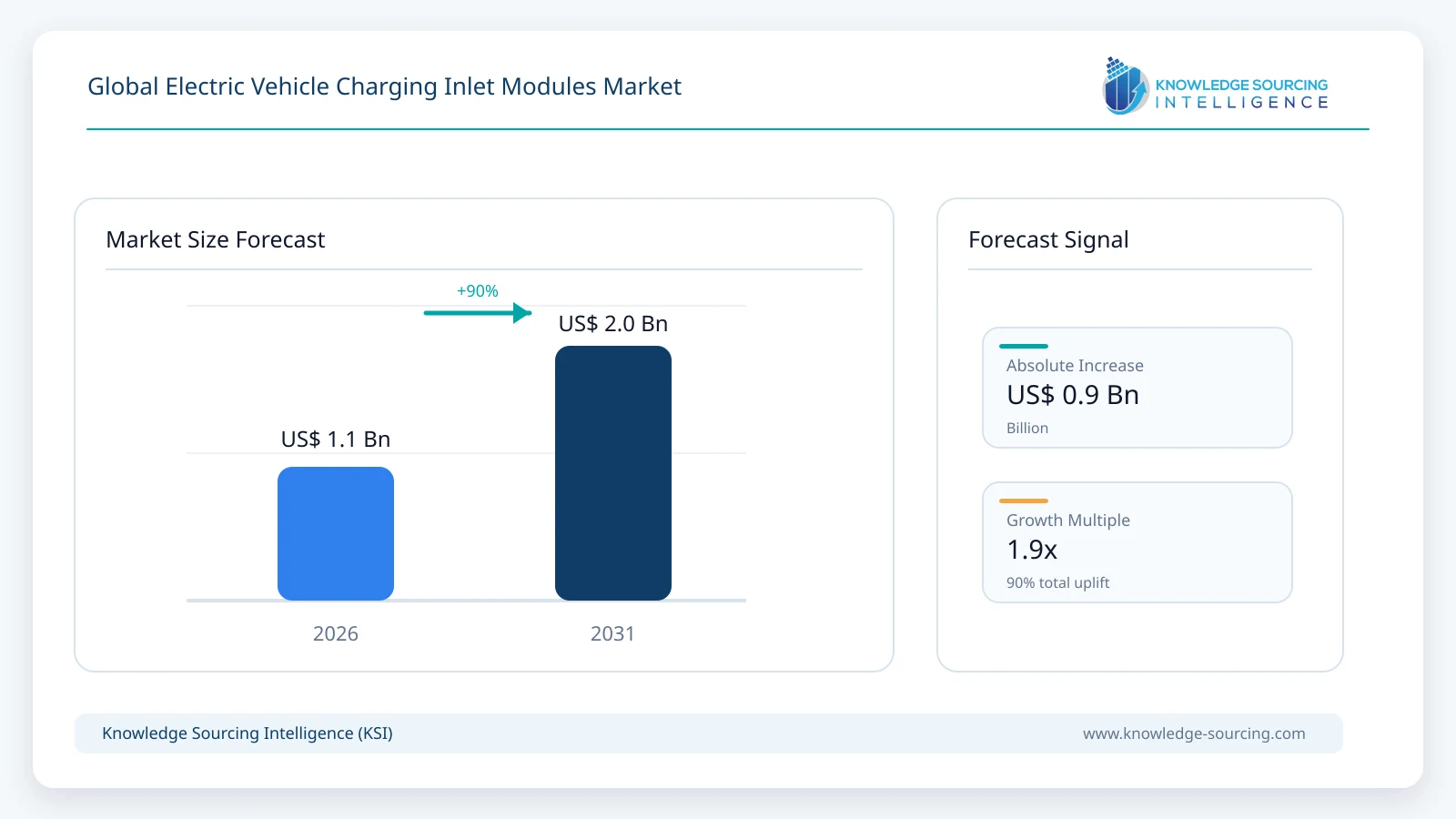
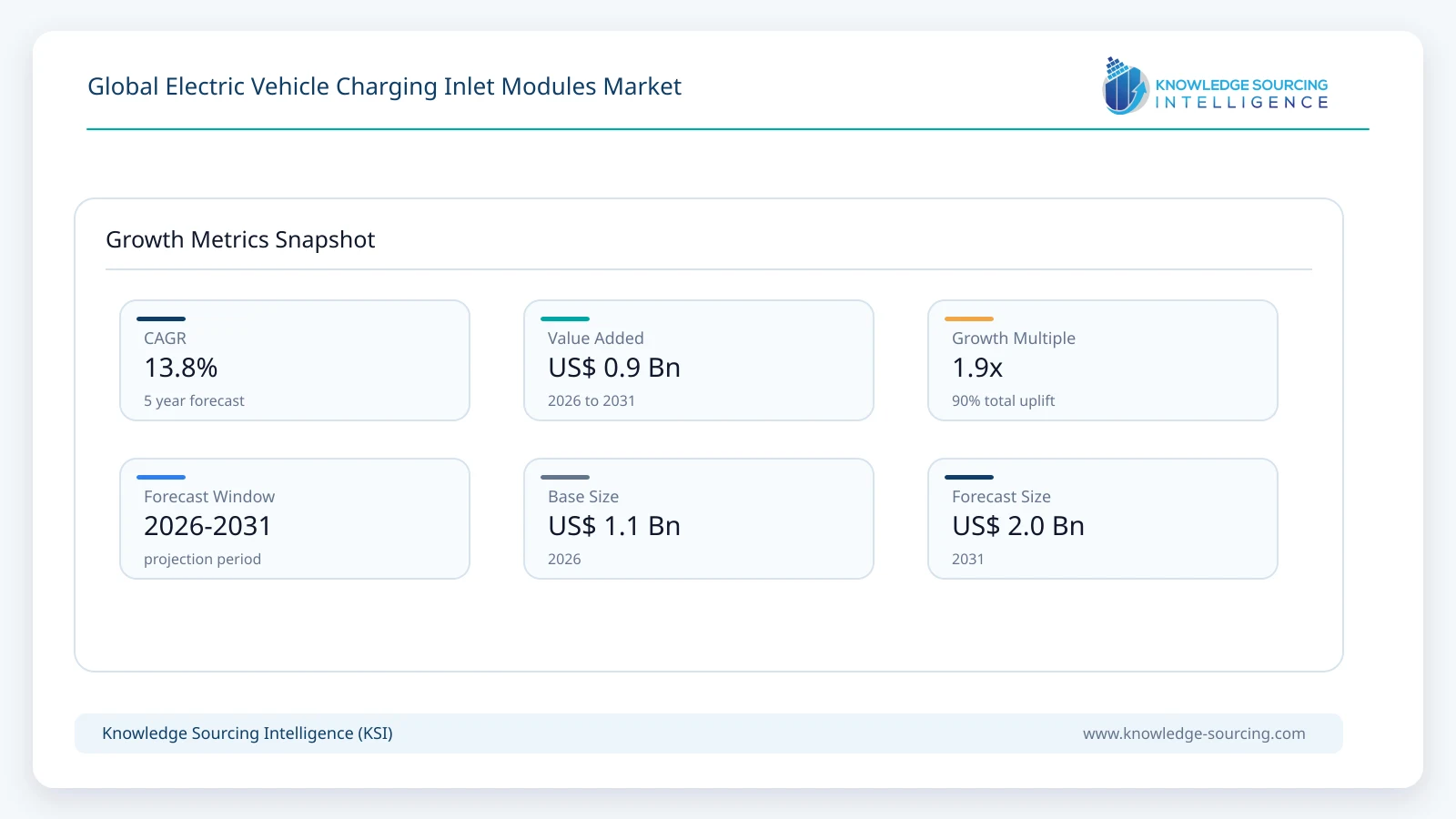
The global electric vehicle charging inlet modules market is projected to grow from USD 1.05 billion in 2026 to USD 2 billion by 2031, representing 13.8%.CAGR over this period.
Highlights:
- 1Global electric-car sales are expected to reach approximately 23 million units in 2026, expanding the installed base for vehicle-side charging inlets.
- 2Combined AC/DC inlet modules are becoming the mainstream architecture for passenger battery-electric vehicles that support both home charging and public DC fast charging.
- 3SAE J3400 standardization is reshaping inlet sourcing and vehicle packaging across North America.
- 4High-power inlet designs increasingly incorporate temperature sensors, locking actuators and serviceable high-voltage cable assemblies.
- 5Integrated inlet-control architectures are emerging for commercial vehicles as OEMs seek fewer external control units and simpler cabling.
- 6Asia Pacific remains the largest production base because China accounts for the majority of global electric-vehicle manufacturing.
- 7Commercial electric trucks and buses create a higher-value inlet opportunity because of higher current ratings and more demanding durability requirements.
The charging inlet is the physical vehicle-side entry point for conductive charging. It must provide a secure electrical interface while also supporting mechanical locking, ingress protection, communication signals and thermal monitoring. In combined charging systems, the same vehicle inlet can support lower-power AC charging and high-power DC charging, reducing the need for separate external charge ports. The design is therefore closely linked to regional charging standards, vehicle voltage architecture and packaging constraints.
Product complexity is increasing. TE Connectivity's current charging-inlet portfolio supports AC, CCS and high-power DC designs, with the CI 500 family rated up to 500 A and 1,000 VDC. Phoenix Contact's CHARX connect family extends vehicle-side charging toward commercial and utility vehicles, including inlet assemblies that integrate locking, temperature sensing and high-voltage cables. In February 2026, Phoenix Contact introduced a production-ready CCS inlet with the charging controller integrated directly into the inlet module, showing how the component is evolving beyond a passive socket.
The market excludes charger-side plugs, charging cables, wallboxes, public charging dispensers and complete charging-station hardware. These products form the external charging infrastructure. This report focuses only on the vehicle-side inlet module and directly integrated functions, keeping the market distinct from EV charging connector and charging infrastructure markets.
Charging Inlet Technology Comparison
Interface / Architecture | Typical Charging Capability | Primary Markets | Vehicle-Side Design Implication |
Type 2 / CCS2 | AC plus high-power DC | Europe and many international markets | Combined inlet supports one vehicle opening for AC and DC charging. |
CCS1 | AC plus high-power DC | Legacy and transitional North American platforms | Larger combined interface with separate DC contacts below the AC section. |
SAE J3400 / NACS | AC and DC through common power contacts | North America | Compact inlet geometry supports both AC and DC through a common interface. |
GB/T | AC and DC, often through separate inlet architectures | China | Vehicle integration varies by platform and can require separate AC and DC interfaces. |
High-Power Commercial Inlet | High-current DC with heavy-duty mechanical design | Buses, trucks, off-highway vehicles | Higher current, larger cable cross-sections, temperature monitoring and serviceability become critical. |
Market Dynamics
Electric Vehicle Production Expands the Addressable Inlet Base
Every plug-in vehicle requires a vehicle-side charging interface, making electric-vehicle production the principal volume driver for the market. The International Energy Agency expects global electric-car sales to reach approximately 23 million units in 2026, equal to about 28% of total car sales. Electric truck sales also exceeded 400,000 units in 2025. Rising EV production therefore expands both the high-volume passenger inlet market and the higher-value commercial-vehicle segment.
Regional Standard Transitions Create a New Product-Cycle Opportunity
Charging-standard transitions require automakers and suppliers to redesign vehicle-side interfaces. SAE International's J3400/2 standard, revised in May 2025, defines the physical connector and inlet geometry for the North American Charging System. Suppliers are responding with new NACS inlet families while maintaining CCS1 support for transition-period platforms. In Europe, the Alternative Fuels Infrastructure Regulation continues to reinforce Type 2 and Combo 2 interoperability for public charging, helping preserve CCS2 as the principal vehicle interface.
Higher Charging Power Raises Thermal and Safety Requirements
Faster charging increases current density and heat generation at the inlet contacts. Modern assemblies therefore use temperature sensors, high-voltage interlock functions, more robust sealing and precisely controlled contact resistance. TE's CI 500 supports up to 500 A and 1,000 VDC, while Phoenix Contact commercial-vehicle products offer boost currents up to 800 A. Higher-voltage 800 V vehicle architectures also increase insulation and creepage requirements without eliminating the need for high-current capability.
Platform Qualification and Long Vehicle Cycles Limit Rapid Supplier Switching
Vehicle charging inlets are homologated as part of a safety-critical charging path. Once an inlet is integrated into the body structure, wiring harness and charge controller, substitution can require mechanical redesign and validation. This creates relatively long supplier relationships after platform nomination. At the same time, standard transitions such as J3400 create windows in which automakers can reconsider sourcing, making new vehicle platforms especially important competitive battlegrounds.
Technological Outlook
Integrated Locking and Temperature Sensing
Electronic locking ensures that the charging connector remains secured during energy transfer, while temperature sensing helps protect the inlet during high-current DC charging. TE's charging-inlet actuators are available across Type 1/CCS1, Type 2/CCS2, GB/T and NACS variants and are designed for high cycle life. Sensor and actuator integration is becoming a standard requirement rather than an optional accessory on higher-power platforms.
Smart Charging Inlets with Integrated Control
Charging-control electronics have historically been mounted separately from the inlet. Phoenix Contact's CHARX connect advanced, introduced in February 2026, integrates the charging controller directly into a CCS inlet for heavy-duty vehicles. The architecture reduces external cabling and control devices while supporting ISO 15118 communication, functional safety and high-power charging. Similar integration can increase the value content of the inlet module even if unit growth remains tied to vehicle production.
High-Power and Serviceable Commercial-Vehicle Inlets
Commercial vehicles require charging interfaces that tolerate frequent use, harsh environments and high current. Modular inlets with replaceable high-voltage cables can reduce maintenance downtime. Phoenix Contact's commercial-vehicle systems support detachable cable assemblies and high-power charging, while TE offers commercial-vehicle CCS inlet kits and pigtails designed around serviceable architectures.
SAE J3400 and Multi-Standard Platform Engineering
North American vehicle programs are increasingly moving to SAE J3400. The standard uses the same primary contacts for AC and DC power transfer, allowing a more compact inlet than CCS1. During the transition, global suppliers need product families that support J3400, CCS1, CCS2 and GB/T while minimizing changes to vehicle packaging, harness routing and locking systems.
Global Electric Vehicle Charging Inlet Modules Market Segment Analysis
By Inlet Architecture
Combined AC/DC inlet modules are the central architecture for mainstream passenger battery-electric vehicles in regions using CCS or SAE J3400. AC-only inlets remain relevant for lower-power plug-in vehicles and selected applications, while DC-focused designs are important in commercial and specialist vehicles. The commercial direction is toward modular families that allow different current ratings and cable exits while retaining common vehicle mounting geometry.
By Charging Standard
CCS2 remains the principal standard across Europe and many international vehicle platforms. SAE J3400 is becoming strategically important in North America as automakers redesign upcoming vehicles around the standardized NACS geometry. China continues to represent a distinct GB/T ecosystem, while CHAdeMO remains more relevant to the installed Japanese vehicle base than to new global platform development.
By Integration Level
Basic inlet assemblies contain the power and signal contacts, housing and sealing elements. Higher-value modules add locking actuators, temperature sensors, LEDs, integrated cable tails and serviceable connectors. Smart inlet architectures can further integrate charging-control electronics, reducing external control boxes and wiring. The move toward higher integration raises module value even when the number of inlets per vehicle remains broadly stable.
By Vehicle Type
Passenger electric cars provide the largest unit volume because they account for the majority of global plug-in vehicle sales. Commercial vehicles generate greater value per inlet because buses, trucks and off-highway equipment require higher continuous current, larger conductors, more rugged housings and more frequent mating-cycle durability. Plug-in hybrid vehicles generally use lower charging power than long-range battery-electric vehicles.
By Power Class
Lower-current AC and moderate-power DC inlets continue to serve cost-sensitive and plug-in hybrid platforms. High-power passenger EVs increasingly require 250 A to 500 A DC capability, while commercial-vehicle designs can exceed these levels in boost operation. The growth of 800 V vehicles and megawatt-class heavy-duty charging will continue to raise thermal-management and sensing requirements at the vehicle inlet.
Market and Demand Indicators
Indicator | Latest Development | Market Impact |
Global electric-car demand | IEA expects approximately 23 million electric-car sales in 2026. | Provides the principal annual vehicle-production base for charging-inlet demand. |
Electric trucks | Global electric truck sales exceeded 400,000 units in 2025. | Creates a higher-value inlet segment with heavier-duty current and durability requirements. |
Supplier consolidation | TE Connectivity acquired major Phoenix Contact vehicle charging-inlet assets in February 2026. | Demonstrates strategic value of established OEM inlet programs and technology. |
Smart inlet integration | Phoenix Contact introduced a CCS inlet with integrated charging controller in February 2026. | Raises potential module value through electronics and control integration. |
North American standardization | SAE J3400/2 formally defines NACS connector and inlet dimensions. | Accelerates vehicle-side NACS design and multi-standard supplier investment. |
Asia Pacific Market Analysis
Asia Pacific is the largest manufacturing region for vehicle charging inlets because China accounts for the majority of global electric-vehicle production. Chinese passenger vehicles use a large domestic ecosystem of GB/T inlet suppliers, while global automakers manufacturing in the region also source CCS and other interface variants for export vehicles. Japan and South Korea contribute connector engineering, wiring-harness capability and regional vehicle platforms, while India is increasing local demand as passenger and commercial EV production expands.
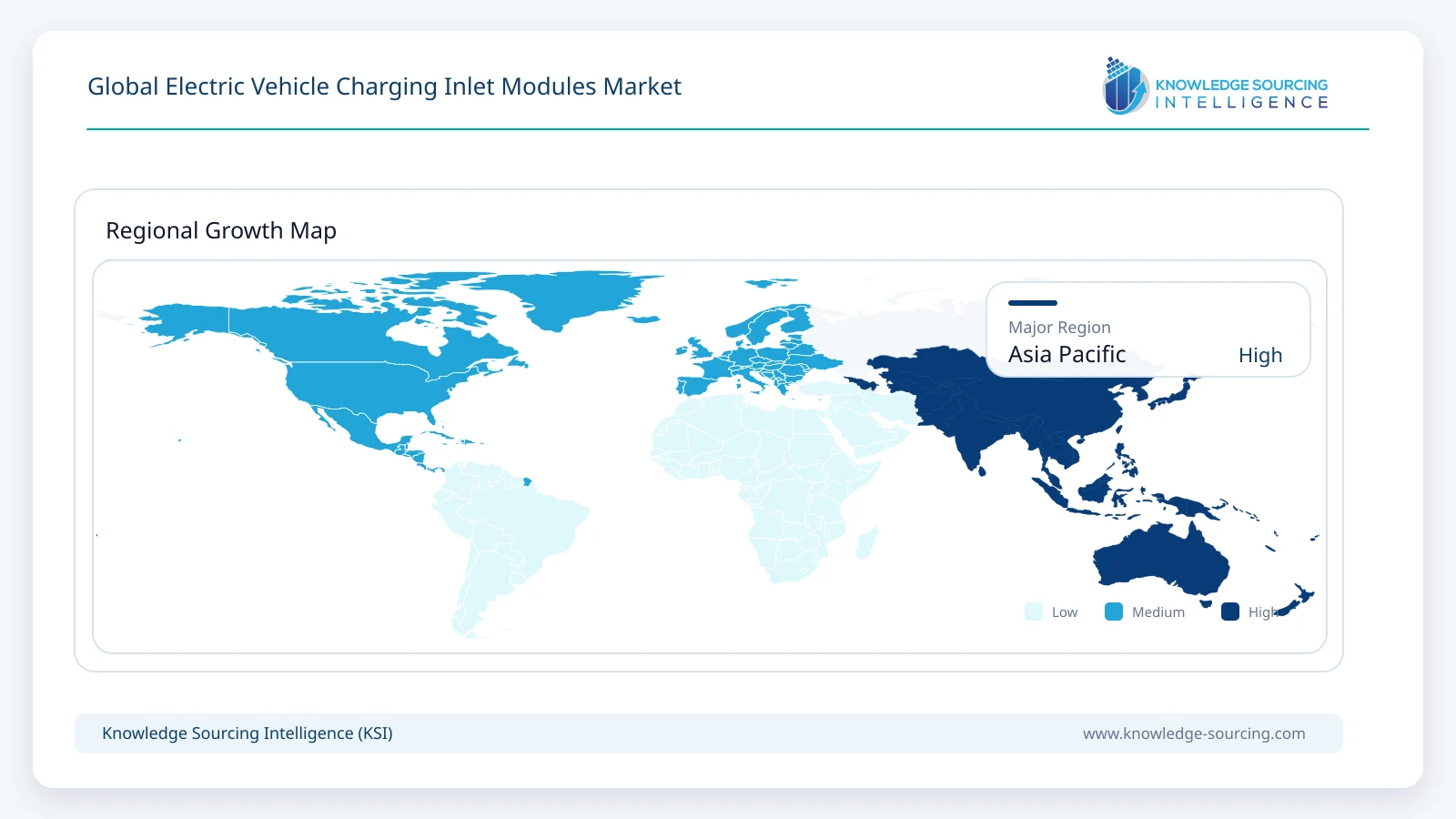
The regional supply chain includes JONHON, Yonggui Electric, Nanjing Kangni, Saichuan Electronics, Yazaki, Sumitomo and other automotive connectivity suppliers. High local EV volumes favor automated production and lower unit costs, while export programs require suppliers to support CCS2, CCS1 and increasingly SAE J3400 alongside China-specific interfaces. This multi-standard requirement makes modular inlet engineering and global automotive qualification important competitive capabilities.
Competitive Landscape
The market includes global automotive connector groups, vehicle-harness suppliers and specialist charging-interface manufacturers. TE Connectivity has strengthened its position through the 2026 acquisition of major Phoenix Contact charging-inlet assets. Phoenix Contact remains technologically relevant in utility and commercial-vehicle charging, including integrated-control and high-power inlet designs. Yazaki, Sumitomo, Aptiv, Amphenol, MENNEKES Automotive, REMA-EV, JONHON, Yonggui Electric, Nanjing Kangni and other suppliers compete across regional standards and vehicle programs.
Competitive positioning depends on automaker qualification, regional-standard coverage, high-current capability, thermal sensing, locking reliability, sealing, packaging flexibility and serviceability. As charging interfaces become more integrated, suppliers that combine the inlet with actuators, cable assemblies and charging-control electronics can capture more value per vehicle than vendors supplying only the molded socket.
Recent Developments
July 2026: TE Connectivity highlighted its next-generation AMP+ charging-inlet portfolio for faster and higher-power hybrid and electric vehicle charging.
February 2026: TE Connectivity acquired major vehicle charging-inlet assets from Phoenix Contact E-Mobility to strengthen its automotive charging-interface portfolio.
February 2026: Phoenix Contact introduced CHARX connect advanced, a production-ready CCS charging inlet with the vehicle charging controller integrated directly into the inlet.
Q3 2026: Phoenix Contact planned series availability of its integrated-controller CCS inlet and new high-power NACS vehicle inlets for utility and commercial vehicles.
May 2025: SAE International revised J3400/2, defining connector and inlet dimensions for the North American Charging System.
Global Electric Vehicle Charging Inlet Modules Market Scope:
| Report Metric | Details |
|---|---|
| Total Market Size in 2026 | USD 1.05 billion |
| Total Market Size in 2031 | USD 2.00 billion |
| Forecast Unit | USD Billion |
| Growth Rate | 13.8% |
| Study Period | 2021 to 2031 |
| Historical Data | 2021 to 2024 |
| Base Year | 2025 |
| Forecast Period | 2026 – 2031 |
| Segmentation | Inlet Architecture, Charging Standard, Integration Level, Vehicle Type, Power Class , Geography |
| Companies |
|
Market Segmentation
By Inlet Architecture
AC-Only Inlets
Combined AC/DC Inlets
DC-Focused High-Power Inlets
By Charging Standard
CCS1
CCS2
SAE J3400 / NACS
GB/T
CHAdeMO / Other Standards
By Integration Level
Basic Inlet Assemblies
Inlets with Actuator and Sensing
Inlets with Integrated Cable / Busbar Interface
Smart Inlets with Integrated Charging Control
By Vehicle Type
Passenger Battery Electric Vehicles
Plug-in Hybrid Electric Vehicles
Commercial Electric Vehicles
Electric Buses and Off-Highway Vehicles
By Power Class
Low and Moderate Power
High-Power Passenger EV
Ultra-High-Power Commercial EV
By Geography
North America
United States
Canada
Mexico
South America
Brazil
Argentina
Rest of South America
Europe
Germany
United Kingdom
France
Italy
Rest of Europe
Middle East and Africa
Saudi Arabia
United Arab Emirates
South Africa
Rest of Middle East and Africa
Asia Pacific
China
Japan
India
South Korea
Rest of Asia Pacific
Table of Contents
1. EXECUTIVE SUMMARY
2. MARKET SNAPSHOT
2.1. Market Overview
2.2. Market Segmentation
3. BUSINESS LANDSCAPE
3.1. Market Drivers
3.1.1. Electric Vehicle Production Expands the Addressable Inlet Base
3.1.2. Regional Standard Transitions Create a New Product-Cycle Opportunity
3.1.3. Higher Charging Power Raises Thermal and Safety Requirements
3.2. Market Restraints
3.2.1. Platform Qualification and Long Vehicle Cycles Limit Rapid Supplier Switching
3.3. Market Opportunities
3.4. Porter's Five Forces Analysis
3.5. Industry Value Chain Analysis
3.6. Charging Standards and Automotive Safety Requirements
4. TECHNOLOGICAL OUTLOOK
4.1. Integrated Locking and Temperature Sensing
4.2. Smart Charging Inlets with Integrated Control
4.3. High-Power and Serviceable Commercial-Vehicle Inlets
4.4. SAE J3400 and Multi-Standard Platform Engineering
5. GLOBAL ELECTRIC VEHICLE CHARGING INLET MODULES MARKET BY INLET ARCHITECTURE
5.1. AC-Only Inlets
5.2. Combined AC/DC Inlets
5.3. DC-Focused High-Power Inlets
6. GLOBAL ELECTRIC VEHICLE CHARGING INLET MODULES MARKET BY CHARGING STANDARD
6.1. CCS1
6.2. CCS2
6.3. SAE J3400 / NACS
6.4. GB/T
6.5. CHAdeMO / Other Standards
7. GLOBAL ELECTRIC VEHICLE CHARGING INLET MODULES MARKET BY INTEGRATION LEVEL
7.1. Basic Inlet Assemblies
7.2. Inlets with Actuator and Sensing
7.3. Inlets with Integrated Cable / Busbar Interface
7.4. Smart Inlets with Integrated Charging Control
8. GLOBAL ELECTRIC VEHICLE CHARGING INLET MODULES MARKET BY VEHICLE TYPE
8.1. Passenger Battery Electric Vehicles
8.2. Plug-in Hybrid Electric Vehicles
8.3. Commercial Electric Vehicles
8.4. Electric Buses and Off-Highway Vehicles
9. GLOBAL ELECTRIC VEHICLE CHARGING INLET MODULES MARKET BY POWER CLASS
9.1. Low and Moderate Power
9.2. High-Power Passenger EV
9.3. Ultra-High-Power Commercial EV
10. GLOBAL ELECTRIC VEHICLE CHARGING INLET MODULES MARKET BY GEOGRAPHY
10.1. North America
10.1.1. United States
10.1.2. Canada
10.1.3. Mexico
10.2. South America
10.2.1. Brazil
10.2.2. Argentina
10.2.3. Rest of South America
10.3. Europe
10.3.1. Germany
10.3.2. United Kingdom
10.3.3. France
10.3.4. Italy
10.3.5. Rest of Europe
10.4. Middle East and Africa
10.4.1. Saudi Arabia
10.4.2. United Arab Emirates
10.4.3. South Africa
10.4.4. Rest of Middle East and Africa
10.5. Asia Pacific
10.5.1. China
10.5.2. Japan
10.5.3. India
10.5.4. South Korea
10.5.5. Rest of Asia Pacific
11. COMPETITIVE ENVIRONMENT AND ANALYSIS
11.1. Major Players and Strategy Analysis
11.2. Market Share Analysis
11.3. Product Development, Acquisitions and Platform Awards
11.4. Competitive Dashboard
12. COMPANY PROFILES
12.1. TE Connectivity Ltd.
12.2. Phoenix Contact E-Mobility GmbH
12.3. Yazaki Corporation
12.4. Sumitomo Wiring Systems, Ltd.
12.5. Aptiv PLC
12.6. Amphenol Corporation
12.7. MENNEKES Elektrotechnik GmbH & Co. KG
12.8. REMA-EV
12.9. AVIC JONHON Optronic Technology Co., Ltd.
12.10. Zhejiang Yonggui Electric Equipment Co., Ltd.
12.11. Nanjing Kangni Mechanical & Electrical Co., Ltd.
12.12. Saichuan Electronics
12.13. Ebusbar
12.14. Japan Aviation Electronics Industry, Ltd.
12.15. Luxshare Precision Industry Co., Ltd.
13. RECENT DEVELOPMENTS
14. APPENDIX
14.1. Currency
14.2. Assumptions
14.3. Base and Forecast Years Timeline
14.4. Abbreviations
Navigate
Trusted by the world's leading organizations











