
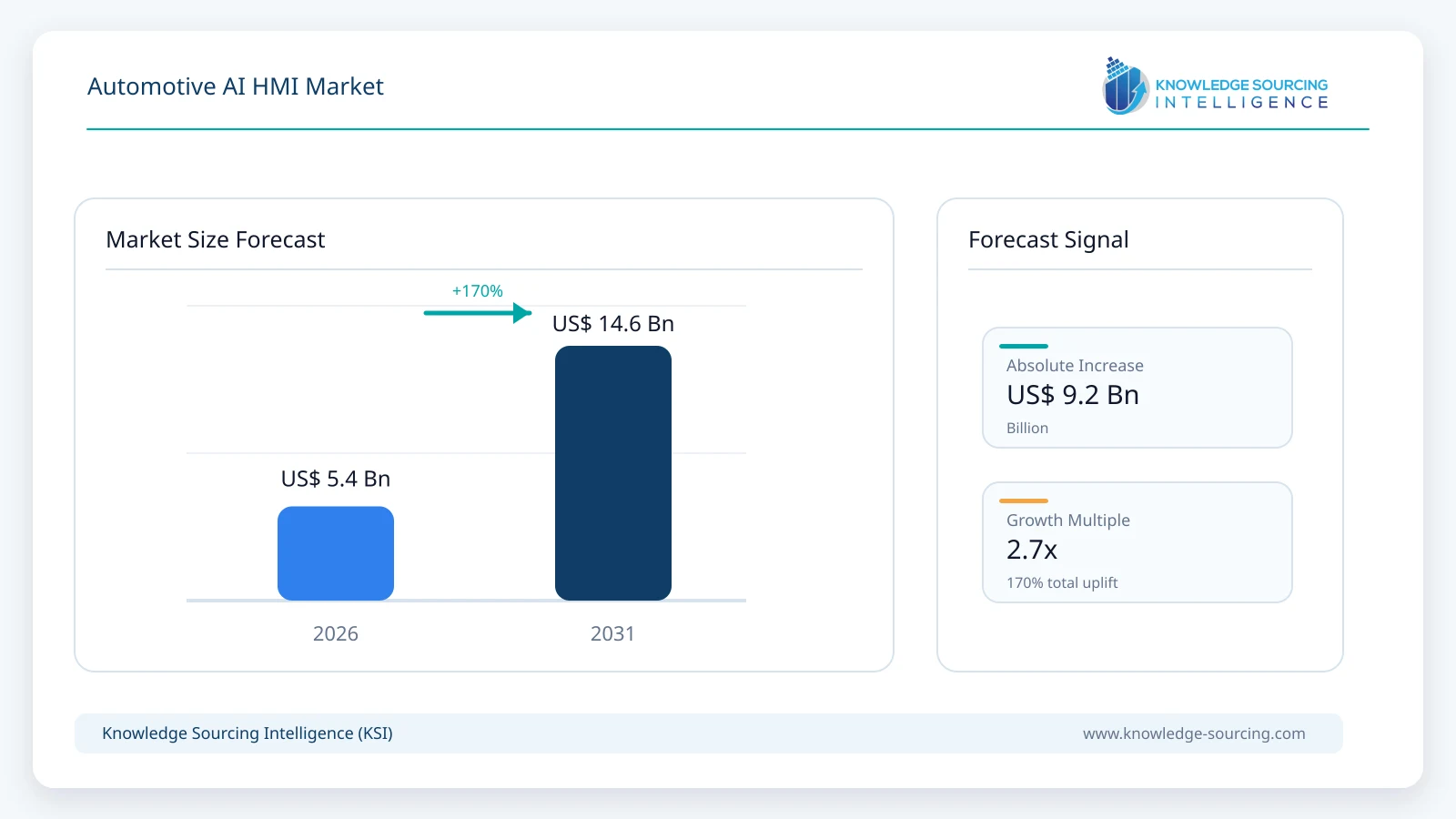
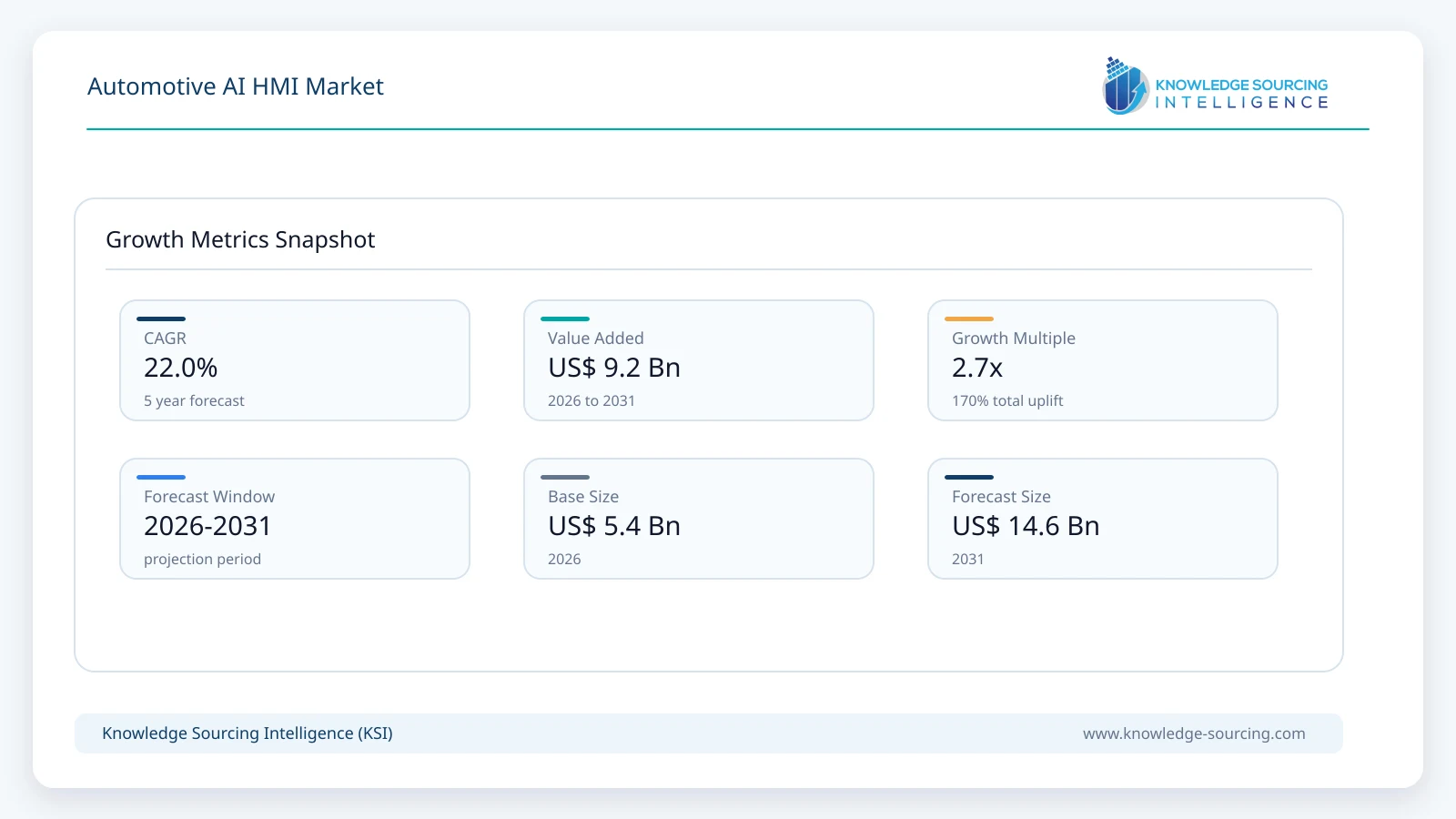
The Automotive AI HMI Market is estimated at approximately USD 5.40 billion in 2026 and is projected to reach about USD 14.60 billion by 2031, representing a CAGR of 22.0% during the forecast period.
Highlights:
- 1Conversational and generative-AI interfaces account for approximately 44% of global market value in 2026 because voice remains the most scalable hands-free entry point for AI-enabled vehicle interaction.
- 2Multimodal AI HMI, combining voice with touch, gaze, gesture, camera and contextual data, represents approximately 31% of 2026 market value and is the fastest-growing interaction class as cockpit compute and interior sensing converge.
- 3Hybrid edge-cloud AI architectures account for approximately 52% of market value in 2026 because OEMs increasingly combine low-latency on-device inference with cloud-based knowledge, model updates and complex generative services.
- 4Navigation, infotainment and general vehicle assistance represent approximately 47% of 2026 AI HMI value, while comfort, personalization and proactive vehicle-control functions are gaining share as systems become more agentic.
- 5Passenger vehicles represent approximately 96% of global market value in 2026, with premium and upper-midrange vehicles carrying the highest AI HMI content and fastest production adoption.
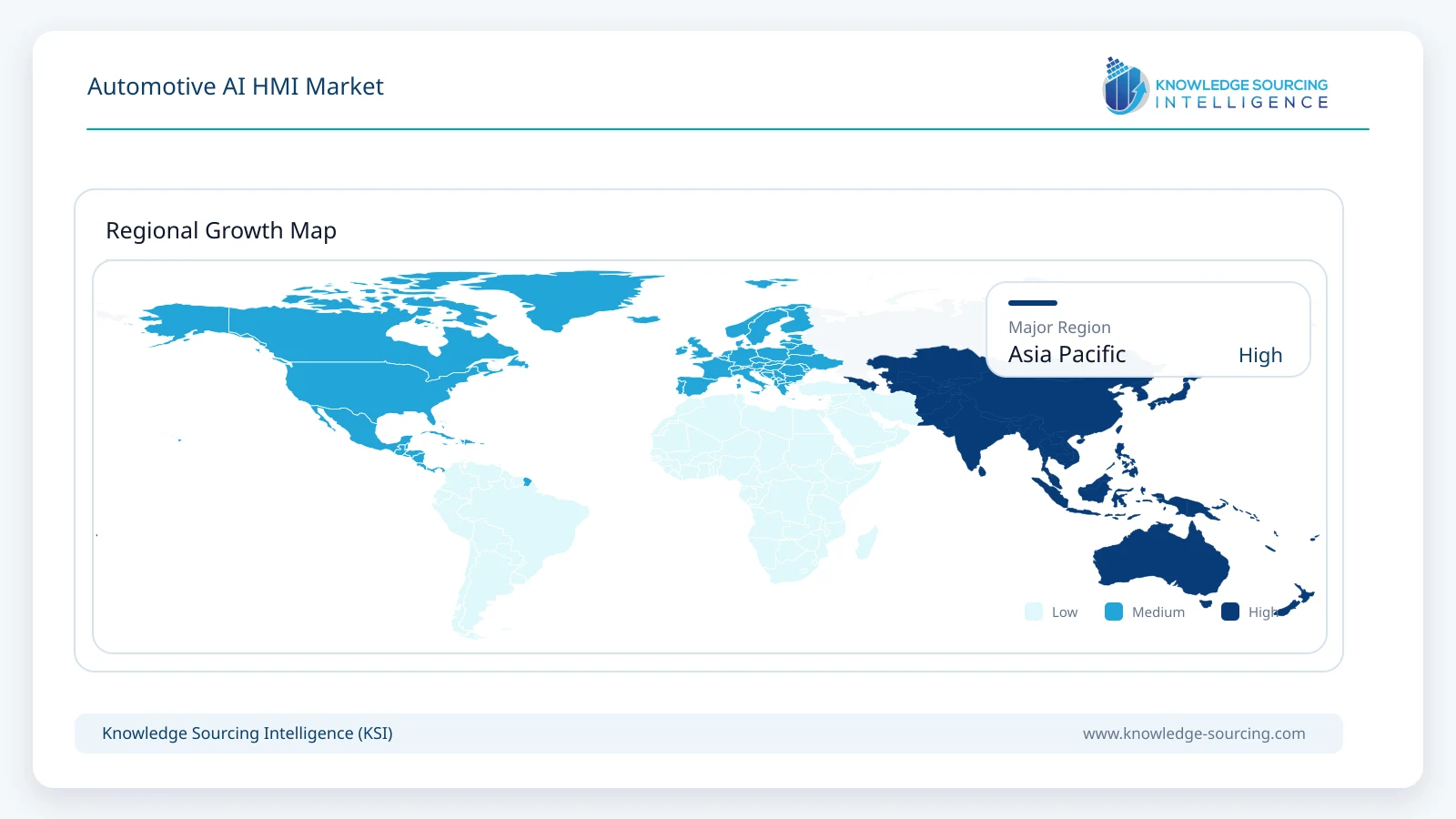
- 6Asia Pacific represents approximately 40% of global market value in 2026, supported by rapid smart-cockpit deployment in China, while Europe remains a major high-value region due to production programs from BMW, Mercedes-Benz and other premium OEMs.
Adoption is shifting the in-vehicle interface away from deterministic voice commands and fixed graphical menus toward systems that can interpret natural language, retain dialogue context and connect occupant intent more directly with vehicle functions.
Production programs from BMW, Mercedes-Benz and Cerence illustrate how quickly conversational AI is moving into the vehicle. BMW is rolling out an AI-enhanced Intelligent Personal Assistant based on Amazon Alexa+ technology, Mercedes-Benz is deploying a multi-agent MBUX Virtual Assistant that combines ChatGPT4o, Microsoft Bing and Google Gemini, and Cerence xUI provides OEMs with a hybrid edge-cloud platform built around automotive-grade large language models. Together, these programs are moving natural-language interaction beyond demonstration projects and into series-production HMI.
Beyond the assistant itself, AI HMI is becoming more closely tied to centralized cockpit and vehicle compute. Qualcomm, Visteon, Panasonic Automotive Systems and HARMAN are developing platforms that combine AI inference, multi-display rendering, personalization and vehicle-domain orchestration on high-performance cockpit or central computers. This architecture supports a broader role for the interface, including coordinated adjustment of climate, seating, navigation, media and other functions using occupant identity, context and vehicle state.
Market Overview
Conventional in-vehicle HMI depends on predefined commands, menu structures and fixed mappings between an input and an action. AI-enabled systems broaden that interaction by interpreting intent, conversational history and incomplete or follow-up requests, allowing the interface to select the relevant vehicle function, information source or digital service without requiring the occupant to navigate a rigid menu hierarchy.
Generative AI extends this capability through stronger language understanding and the ability to synthesize responses from several sources. In production automotive use, however, the most credible implementations remain tightly orchestrated rather than operating as unrestricted general-purpose chatbots. Vehicle-domain knowledge, permission layers and safety controls determine which functions can be accessed and how far an AI-generated interpretation is allowed to influence an actual vehicle action.
The interaction becomes more context-aware when voice is combined with interior sensing. Cameras can identify who is speaking, gaze can indicate which object or display an occupant is referring to, gestures can confirm or modify an action, and driver-monitoring data can influence whether information should be simplified or delayed. HARMAN Ready Engage combines voice, gestures and contextual data, while BMW and Mercedes-Benz are integrating AI assistants into broader graphical and visual interfaces rather than treating voice as an isolated channel.
How much of this functionality can be delivered locally depends increasingly on the vehicle's compute architecture. Hybrid systems can keep wake-word processing, basic vehicle control and selected small language models on-device while using cloud models for broader knowledge and more computationally intensive reasoning. As centralized cockpit and vehicle computers gain AI capability, more inference can move into the vehicle, reducing latency and enabling tighter coordination across displays, audio, climate and safety-related domains.
Market Trends
Generative AI Is Replacing Command-and-Control Voice Interaction
BMW, Mercedes-Benz and Cerence are already moving production voice interfaces away from fixed command grammars toward natural multi-turn dialogue. BMW integrates Amazon Alexa+ technology into its Intelligent Personal Assistant, Mercedes-Benz uses a multi-agent architecture combining several AI services within the fourth generation of MBUX, and Cerence xUI applies automotive-grade LLMs to vague or ambiguous commands while preserving conversational context.
As this capability matures, competitive performance is being judged less by speech-recognition accuracy alone and more by reasoning quality, domain orchestration, response continuity and the ability to connect language with actual vehicle functions. AI assistant platforms are therefore becoming long-lived software layers that can continue improving after vehicle launch through model, service and feature updates.
Agentic AI Is Moving HMI from Response to Proactive Orchestration
Qualcomm and HARMAN are pushing the interface toward coordinated action across several vehicle domains rather than isolated question-and-answer behavior. Qualcomm positions agentic AI around experiences that anticipate driver needs, while HARMAN Ready Engage combines voice, gesture and contextual signals to coordinate media, comfort, navigation and safety-related responses.
Delivering that level of orchestration requires deeper access to vehicle data and permissions than a traditional infotainment assistant would normally receive. The system has to distinguish between actions that can be executed directly, those that require confirmation and those that must remain outside AI control, making policy engines, safety boundaries and domain-specific execution logic increasingly important parts of the HMI stack.
Hybrid Edge-Cloud AI Is Becoming the Preferred Deployment Model
Cerence xUI combines edge and cloud AI, Qualcomm cockpit platforms support local inference, and Visteon is adding AI-capable compute that can run assistants and personalization functions inside the vehicle. These implementations reflect the practical limits of relying exclusively on cloud models for automotive use, where connectivity, response time and functional reliability vary by location and use case.
Keeping time-critical and privacy-sensitive functions local while escalating broader knowledge or complex generative requests to the cloud gives OEMs a more balanced deployment model. As automotive NPUs become more capable, a larger share of intent recognition, personalization and selected generative functions can migrate on-device without eliminating the cloud's role in model updates, external knowledge and higher-compute reasoning.
Multimodal HMI Is Linking Voice with Gaze, Gesture and Interior Sensing
Interior cameras and occupant-monitoring systems give AI HMI access to context that voice alone cannot provide. Voice can express an intention, gaze can identify the object or display being referenced, and gestures can confirm an action without another verbal command. Information about who is speaking, where occupants are seated and what is happening inside the cabin can therefore become part of the interaction model.
Using those inputs together allows the interface to adapt not only what information is presented but also where, when and to whom it is shown. Seat position, driver state, passenger presence and environmental context can influence display behavior and interaction priority, increasing the value of sensor fusion and shared cockpit compute across the wider smart-cabin architecture.
OEM-Specific AI Personas and Avatars Are Becoming Brand Assets
Mercedes-Benz already uses animated MBUX Virtual Assistant avatars, while HARMAN Ready Engage includes expressive avatars and a Persona Builder that allows automakers to define interaction style and personality. These systems show how the assistant is becoming part of the vehicle's branded digital environment rather than a generic layer supplied by an external technology provider.
That creates a new differentiation layer around tone, visual identity and interaction behavior, particularly as the underlying foundation models become more interchangeable. OEMs can continue updating the assistant throughout the vehicle lifecycle while retaining control over persona design and the customer-facing experience, even when language models or knowledge services are provided by third parties.
Segment Analysis
By Interaction Modality: Conversational and Voice AI
Conversational and voice AI is the largest modality because it provides hands-free access to navigation, media, climate, communications and general information without requiring the driver to look away from the road. The technology is also easier to deploy across existing cockpit layouts than new gesture or gaze hardware because microphones and voice-assistant infrastructure are already common in connected vehicles.
Conversational and voice AI represents approximately USD 2.38 billion of market value in 2026 and could approach USD 5.7 billion by 2031. Growth will come from generative dialogue, better context retention, multilingual support and deeper vehicle-control integration rather than from basic speech recognition alone.
By AI Capability: Contextual and Generative AI Assistants
Contextual and generative assistants form the highest-growth capability segment because they can interpret free-form requests, maintain dialogue context and combine external knowledge with vehicle-specific information. BMW, Mercedes-Benz, BYD and other OEM programs demonstrate that LLM-based assistants are moving rapidly into series production.
This segment accounts for approximately USD 2.65 billion in 2026 and is expected to exceed USD 7.5 billion by 2031. The strongest value will accrue to platforms that combine broad language capability with automotive-domain safety, low latency and control over proprietary vehicle functions.
By Deployment Architecture: Hybrid Edge-Cloud AI
Hybrid edge-cloud deployment is the largest architecture because it balances local reliability with cloud-scale intelligence. Wake word, vehicle commands and selected SLM functions can run locally, while knowledge-intensive or highly generative queries are escalated to cloud models when connectivity is available.
Hybrid architectures represent approximately USD 2.81 billion in 2026. Their share should remain high through 2031 even as on-device compute improves, because OEMs are likely to continue using cloud services for large-model updates, broader information retrieval and continuous AI improvement.
By Vehicle Function: Navigation, Infotainment and General Assistance
Navigation, infotainment and general assistance remains the largest function because these are the least safety-critical domains and provide immediate consumer value. Natural-language destination planning, media search, general questions, route modification and app control are therefore among the first AI functions to reach broad production deployment.
The function group represents approximately USD 2.54 billion in 2026. Its share will gradually decline as proactive comfort, vehicle-control and safety-support functions grow faster, but absolute value will continue to rise with richer knowledge and app ecosystems.
By Component Layer: Software Platforms and AI Middleware
Software platforms and AI middleware account for the largest component layer because the value of AI HMI increasingly lies in intent understanding, dialogue management, model orchestration, domain routing, personalization and safety logic rather than in microphones or displays alone. Cerence xUI, HARMAN Ready Engage and OEM-developed assistant stacks are examples of this software-centric shift.
Software platforms and middleware represent approximately 51% of 2026 market value. Their share is expected to rise as compute hardware becomes more standardized and OEMs differentiate through branded assistant behavior, services and continuous software updates.
Market Drivers
Rapid Production Adoption of Generative AI Assistants
The move from demonstrations to series vehicles is the strongest near-term driver. BMW is rolling out Alexa+-based AI interaction, Mercedes-Benz is deploying a multi-agent MBUX assistant, and Cerence xUI is entering BYD vehicles and programs with other global automakers. These launches validate commercial demand for LLM-powered HMI.
Once AI assistant infrastructure is installed, OEMs can add new skills and services through software rather than redesigning physical controls. This creates a recurring innovation cycle and supports higher software value per vehicle.
Software-Defined Vehicle and Centralized Compute Architectures
Centralized cockpit and vehicle compute provides the processing, memory and high-speed connectivity required for advanced AI HMI. Qualcomm Cockpit Elite, Visteon SmartCore HPC and Panasonic cockpit-domain controllers support multiple displays, AI inference and software updates from a common platform.
This reduces hardware fragmentation and makes it easier to share vehicle context across functions. AI assistants can therefore coordinate climate, seating, navigation, media and other domains more effectively than systems built on isolated ECUs.
OEM Demand for Brand Differentiation through Digital Experience
As vehicle hardware becomes more standardized, digital interaction is increasingly used to differentiate brands. A responsive assistant, branded avatar, personalized recommendations and proactive controls can create a distinct user experience even when underlying displays and processors are similar.
AI HMI therefore becomes a strategic brand layer. Automakers are likely to invest in proprietary persona design, domain knowledge and service integration while using third-party foundation models selectively underneath the experience.
Growing Availability of Automotive-Grade Edge AI Compute
New automotive processors integrate high-performance NPUs capable of running speech, vision and language models locally. Qualcomm, NVIDIA and Visteon are expanding AI-capable cockpit and central-compute platforms, reducing the cost and latency of in-vehicle inference.
More capable edge compute improves privacy, supports offline functionality and allows multimodal sensor fusion. It also gives OEMs more flexibility to decide which AI tasks should remain local and which should use cloud resources.
Convergence of HMI with Interior Sensing and Personalization
Driver monitoring, occupant monitoring and biometric or profile data give the HMI more context about who is in the vehicle and how they are interacting. This allows interfaces to change language, display layout, seat settings, climate preferences or notification behavior automatically.
The result is a broader addressable market that extends beyond voice assistants into adaptive displays, intelligent comfort and proactive cabin orchestration. AI HMI increasingly becomes the user-facing layer for the entire smart-cabin stack.
Market Restraints
Functional Safety and Incorrect AI Output Risk
Generative AI can produce uncertain or incorrect outputs, which is unacceptable when the interface controls safety-relevant vehicle functions. Automotive systems therefore need strict domain boundaries, deterministic execution layers and confirmation logic before AI-generated intent can trigger an action.
This requirement limits the degree of autonomy that can be given to general-purpose models and increases validation cost. OEMs must design architectures in which probabilistic language understanding is separated from safety-critical control execution.
Privacy, Data Governance and Cybersecurity Requirements
AI HMI can process voice recordings, location, contacts, preferences, cabin images and behavioral data. These inputs are valuable for personalization but create privacy and cybersecurity exposure, particularly when information is transmitted to external cloud services.
OEMs therefore need consent management, data minimization, secure model interfaces and regional compliance strategies. Privacy requirements can slow global rollout when the same assistant must operate under different data-protection rules.
Cloud Dependence, Latency and Connectivity Variability
Large cloud models provide powerful reasoning but can suffer from network latency, coverage gaps and service interruptions. A slow or unavailable assistant directly damages perceived quality because occupants expect immediate response to basic vehicle requests.
Hybrid architectures reduce this risk but require duplicate capabilities and sophisticated routing between edge and cloud models. Maintaining consistent behavior across both execution environments increases software complexity and cost.
Long Vehicle Lifecycles versus Rapid AI Model Evolution
Vehicles remain in service for more than a decade, while AI models and cloud APIs can change within months. OEMs need long-term support, model compatibility and hardware headroom to prevent the HMI from becoming obsolete early in the vehicle lifecycle.
This creates uncertainty around compute sizing and software-maintenance cost. Hardware selected years before production must still support future AI models and security updates long after launch.
Fragmented Language, Cultural and Regional Requirements
Natural-language HMI must handle accents, dialects, code-switching, local place names and cultural expectations. Performance that is strong in English may not transfer directly to Asian, Middle Eastern or multilingual markets.
Global deployment therefore requires significant localization and testing. Automotive-specific vocabulary, vehicle terminology and regional services add further complexity beyond general-purpose language-model performance.
Regional Outlook
Asia Pacific
Asia Pacific is the largest automotive AI HMI market, driven by rapid smart-cockpit adoption in China and strong electronics capability across Japan and South Korea. Chinese OEMs compete heavily on in-vehicle software, voice assistants, personalization and digital services, creating a large production base for AI-enabled interfaces across both premium and mainstream EVs.
The regional ecosystem includes BYD, which selected Cerence xUI for LLM-powered in-car experiences in 2026, as well as technology suppliers including Qualcomm, Panasonic Automotive Systems and Visteon. Visteon has reported multiple AI-capable smart-cockpit customer wins in China, while Panasonic is deploying centralized cockpit controllers with voice and driver-personalization functions in Japanese OEM programs.
Growth through 2031 will be supported by local language-model development, high EV penetration and fast vehicle refresh cycles. China is likely to remain the fastest commercialization market for multimodal and agentic HMI, while Japan and South Korea contribute advanced hardware and automotive-grade integration.
Europe
Europe is a major high-value market because premium OEMs are among the earliest adopters of production generative AI HMI. BMW introduced Alexa+-based natural-language interaction in the iX3, while Mercedes-Benz is deploying the fourth generation of MBUX with multi-agent AI, multi-turn dialogue, short-term memory and animated assistant avatars.
European deployment also places strong emphasis on privacy, safety and brand-controlled interaction. This favors hybrid architectures, controlled vehicle-domain execution and supplier platforms that can be customized deeply rather than generic consumer assistants transplanted directly into the car.
Regional growth will be content-driven rather than dependent on vehicle volume. Premium AI assistants, multimodal interfaces and software-updatable cockpit platforms are expected to migrate gradually into higher-volume models as compute and cloud-service costs decline.
Competitive Landscape
The automotive AI HMI market is fragmented across OEM-developed assistant stacks, automotive AI specialists, cockpit Tier 1 suppliers, semiconductor companies and cloud/AI platform providers. Cerence AI has a strong position in automotive conversational AI through xUI and CaLLM, while HARMAN combines AI orchestration, avatars and cockpit platforms through Ready Engage and Ready Upgrade. Qualcomm provides the compute and AI foundation through Snapdragon Cockpit and Digital Chassis platforms.
BMW and Mercedes-Benz demonstrate the OEM-led model, where consumer AI technologies are integrated into a proprietary vehicle assistant and graphical experience. Amazon Alexa+, Google Gemini, OpenAI-related services and Microsoft Bing can therefore act as model or knowledge providers while the automaker retains control over the vehicle-facing HMI and execution layer.
Visteon and Panasonic Automotive Systems compete through centralized cockpit compute and integration, enabling OEM-specific AI experiences across displays, voice and vehicle personalization. NVIDIA contributes accelerated AI infrastructure and in-vehicle generative-AI tooling, while other cockpit suppliers are adding AI middleware and domain-control capability as part of software-defined vehicle programs.
Competitive advantage increasingly depends on four capabilities: automotive-domain reliability, model flexibility, edge-cloud orchestration and deep access to vehicle functions. Platforms that can work across multiple underlying LLMs while preserving OEM brand identity and safety boundaries are likely to gain share as the market moves beyond first-generation assistants.
Recent Developments
29 July 2026: Qualcomm announced that BMW Group selected it as a leading compute-silicon provider for next-generation digital cockpit and automated-driving systems through the next decade, including Snapdragon Elite platforms and dedicated AI accelerators for future AI-powered vehicle experiences.
7 July 2026: Panasonic Automotive Systems announced that its cockpit domain controller was adopted for the all-new Mazda CX-5, combining centralized multi-display control, voice interaction, driver-profile personalization and OTA-capable software architecture.
8 April 2026: Cerence AI expanded its partnership with BYD to deploy Cerence xUI as an LLM-powered conversational in-car assistant across new BYD vehicles for global customers, using a hybrid automotive-grade generative-AI platform.
19 March 2026: Qualcomm detailed expanded automotive agentic-AI work across Snapdragon Digital Chassis, including collaboration with Google to combine in-vehicle compute with Automotive AI Agent technology for personalized and proactive HMI.
13 January 2026: HARMAN announced road-ready upgrades across its in-cabin experience portfolio, emphasizing integrated AI, personalization and software-defined vehicle execution, with Ready Engage positioned as an emotionally intelligent AI interaction layer.
6 January 2026: Visteon launched a flexible AI-ADAS Compute Module powered by NVIDIA that can be configured to run AI-driven cockpit functions such as voice assistants and personalized in-vehicle experiences without a full vehicle-architecture redesign.
5 January 2026: BMW announced integration of Amazon Alexa+ technology into the BMW Intelligent Personal Assistant, enabling natural multi-turn interaction and context-aware vehicle control beginning with the BMW iX3.
Market Outlook
The automotive AI HMI market is expected to expand from approximately USD 5.400 billion in 2026 to about USD 14.595 billion by 2031. Conversational AI will remain the largest entry point, but value will shift toward multimodal and agentic systems that combine natural language with vehicle context, interior sensing and proactive orchestration.
Hybrid edge-cloud deployment will remain the dominant architecture because automotive use requires both low-latency local control and access to rapidly improving cloud models. Increasing NPU performance will move more intent recognition, personalization and selected generative functions into the vehicle while cloud services continue to support broad knowledge and model evolution.
Asia Pacific will remain the largest regional market, while Europe continues to generate high value per vehicle through premium branded assistants and tightly integrated digital cockpits. Supplier success will depend on automotive safety, privacy, multimodal reasoning, model flexibility and the ability to connect AI intent reliably to vehicle functions throughout a long product lifecycle.
Automotive AI HMI Market Scope
| Report Metric | Details |
|---|---|
| Total Market Size in 2026 | USD 5.40 billion |
| Total Market Size in 2031 | USD 14.60 billion |
| Forecast Unit | Billion |
| Growth Rate | 22.0% |
| Study Period | 2021 to 2031 |
| Historical Data | 2021 to 2024 |
| Base Year | 2025 |
| Forecast Period | 2026 – 2031 |
| Segmentation | Interaction Modality, AI Capability, Deployment Architecture, Vehicle Function, Component Layer, Vehicle Type, Geography |
| Companies |
|
Market Segmentation
By Interaction Modality
Conversational and Voice AI
Touch and Graphical AI HMI
Gaze and Vision-Based Interaction
Gesture and Proximity Interaction
Multimodal AI HMI
By AI Capability
Rule-Assisted and Predictive AI
Contextual and Generative AI Assistants
Agentic and Proactive AI HMI
Personalized and Adaptive AI Interfaces
By Deployment Architecture
Cloud-Centric AI HMI
Edge / On-Device AI HMI
Hybrid Edge-Cloud AI HMI
By Vehicle Function
Navigation, Infotainment and General Assistance
Climate, Seating and Comfort Control
Vehicle Information, Diagnostics and Settings
Safety, Driver Support and Contextual Alerts
Productivity, Communication and Connected Services
By Component Layer
Software Platforms and AI Middleware
Automotive Compute and AI Accelerators
Cloud AI and Data Services
Sensors, Microphones and Multimodal Input Hardware
Display, Audio and HMI Output Hardware
By Vehicle Type
Passenger Vehicles
Light Commercial Vehicles
Medium and Heavy Commercial Vehicles
Buses and Specialty Vehicles
By Geography
North America
United States
Canada
Mexico
South America
Brazil
Argentina
Others
Europe
Germany
United Kingdom
France
Italy
Spain
Others
Middle East and Africa
Saudi Arabia
UAE
South Africa
Others
Asia Pacific
China
Japan
South Korea
India
Indonesia
Thailand
Others
Table of Contents
1. INTRODUCTION
1.1. Market Overview
1.2. Market Definition
1.3. Scope of the Study
1.4. Market Segmentation
1.5. Currency
1.6. Assumptions
1.7. Base and Forecast Years
1.8. Key Benefits to Stakeholders
2. RESEARCH METHODOLOGY
2.1. Research Design
2.2. Secondary Research
2.3. Primary Research
2.4. Market Estimation
2.5. Segment Modelling
2.6. Data Triangulation and Validation
3. EXECUTIVE SUMMARY
3.1. Key Findings
3.2. Automotive AI HMI Market Size, 2026-2031
3.3. Interaction Modality Outlook
3.4. AI Capability Outlook
3.5. Deployment Architecture Outlook
3.6. Vehicle Function Outlook
3.7. Component Layer Outlook
3.8. Vehicle Type Outlook
3.9. Regional Opportunity Summary
4. MARKET DYNAMICS
4.1. Market Drivers
4.1.1. Rapid Production Adoption of Generative AI Assistants
4.1.2. Software-Defined Vehicle and Centralized Compute Architectures
4.1.3. OEM Demand for Brand Differentiation through Digital Experience
4.1.4. Growing Availability of Automotive-Grade Edge AI Compute
4.1.5. Convergence of HMI with Interior Sensing and Personalization
4.2. Market Restraints
4.2.1. Functional Safety and Incorrect AI Output Risk
4.2.2. Privacy, Data Governance and Cybersecurity Requirements
4.2.3. Cloud Dependence, Latency and Connectivity Variability
4.2.4. Long Vehicle Lifecycles versus Rapid AI Model Evolution
4.2.5. Fragmented Language, Cultural and Regional Requirements
4.3. Market Opportunities
4.4. Porter's Five Forces Analysis
4.5. Industry Value Chain Analysis
4.6. AI HMI Software, Compute and Cloud Economics
4.7. Functional Safety, Privacy and AI Governance Requirements
5. TECHNOLOGY OUTLOOK
5.1. Automatic Speech Recognition and Natural Language Understanding
5.2. Large and Small Language Models for Automotive
5.3. Multimodal Voice, Touch, Gaze and Gesture Fusion
5.4. Context, Intent and Vehicle-Domain Orchestration
5.5. Agentic AI and Proactive In-Vehicle Assistance
5.6. Edge AI and Automotive NPUs
5.7. Hybrid Edge-Cloud AI Architecture
5.8. Digital Avatars and Brand-Specific Personas
5.9. Driver and Occupant Context Integration
5.10. AI-Driven Displays, HUDs and Adaptive Graphics
5.11. Safety Guardrails, Permissions and Deterministic Execution
5.12. OTA Model Updates and AI Lifecycle Management
6. AUTOMOTIVE AI HMI MARKET BY INTERACTION MODALITY
6.1. Introduction
6.2. Conversational and Voice AI
6.3. Touch and Graphical AI HMI
6.4. Gaze and Vision-Based Interaction
6.5. Gesture and Proximity Interaction
6.6. Multimodal AI HMI
7. AUTOMOTIVE AI HMI MARKET BY AI CAPABILITY
7.1. Introduction
7.2. Rule-Assisted and Predictive AI
7.3. Contextual and Generative AI Assistants
7.4. Agentic and Proactive AI HMI
7.5. Personalized and Adaptive AI Interfaces
8. AUTOMOTIVE AI HMI MARKET BY DEPLOYMENT ARCHITECTURE
8.1. Introduction
8.2. Cloud-Centric AI HMI
8.3. Edge / On-Device AI HMI
8.4. Hybrid Edge-Cloud AI HMI
9. AUTOMOTIVE AI HMI MARKET BY VEHICLE FUNCTION
9.1. Introduction
9.2. Navigation, Infotainment and General Assistance
9.3. Climate, Seating and Comfort Control
9.4. Vehicle Information, Diagnostics and Settings
9.5. Safety, Driver Support and Contextual Alerts
9.6. Productivity, Communication and Connected Services
10. AUTOMOTIVE AI HMI MARKET BY COMPONENT LAYER
10.1. Introduction
10.2. Software Platforms and AI Middleware
10.3. Automotive Compute and AI Accelerators
10.4. Cloud AI and Data Services
10.5. Sensors, Microphones and Multimodal Input Hardware
10.6. Display, Audio and HMI Output Hardware
11. AUTOMOTIVE AI HMI MARKET BY VEHICLE TYPE
11.1. Introduction
11.2. Passenger Vehicles
11.3. Light Commercial Vehicles
11.4. Medium and Heavy Commercial Vehicles
11.5. Buses and Specialty Vehicles
12. AUTOMOTIVE AI HMI MARKET BY GEOGRAPHY
12.1. North America
12.1.1. United States
12.1.2. Canada
12.1.3. Mexico
12.2. South America
12.2.1. Brazil
12.2.2. Argentina
12.2.3. Others
12.3. Europe
12.3.1. Germany
12.3.2. United Kingdom
12.3.3. France
12.3.4. Italy
12.3.5. Spain
12.3.6. Others
12.4. Middle East and Africa
12.4.1. Saudi Arabia
12.4.2. UAE
12.4.3. South Africa
12.4.4. Others
12.5. Asia Pacific
12.5.1. China
12.5.2. Japan
12.5.3. South Korea
12.5.4. India
12.5.5. Indonesia
12.5.6. Thailand
12.5.7. Others
13. COMPETITIVE ENVIRONMENT AND ANALYSIS
13.1. Major Players and Strategy Analysis
13.2. Market Share Analysis
13.3. Conversational and Generative AI Benchmarking
13.4. Edge versus Cloud AI Capability Benchmarking
13.5. Multimodal and Contextual HMI Benchmarking
13.6. Automotive Compute and AI Accelerator Benchmarking
13.7. OEM Programs, Model Partnerships and Production Readiness
13.8. Competitive Dashboard
14. COMPANY PROFILES
14.1. Cerence AI
14.2. HARMAN International
14.3. Qualcomm Technologies, Inc.
14.4. Visteon Corporation
14.5. Panasonic Automotive Systems Co., Ltd.
14.6. Mercedes-Benz Group AG
14.7. BMW Group
14.8. NVIDIA Corporation
14.9. Amazon / Alexa Automotive
14.10. Google
14.11. Microsoft
14.12. Continental AG
15. APPENDIX
15.1. Currency
15.2. Assumptions
15.3. Base and Forecast Years Timeline
15.4. Key Benefits for Stakeholders
15.5. Research Methodology
15.6. Abbreviations
15.7. Data Sources
Navigate
Trusted by the world's leading organizations











