
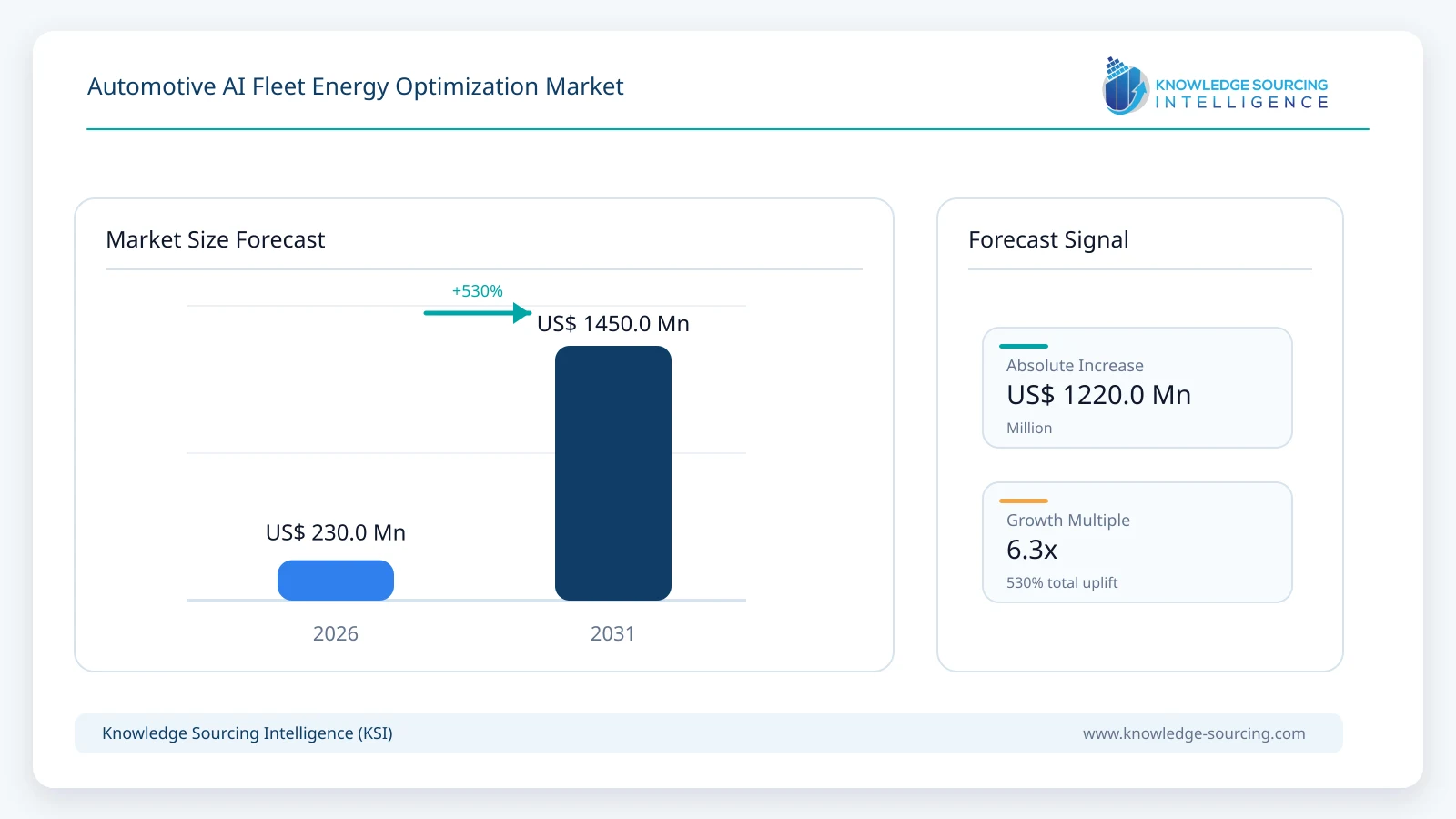
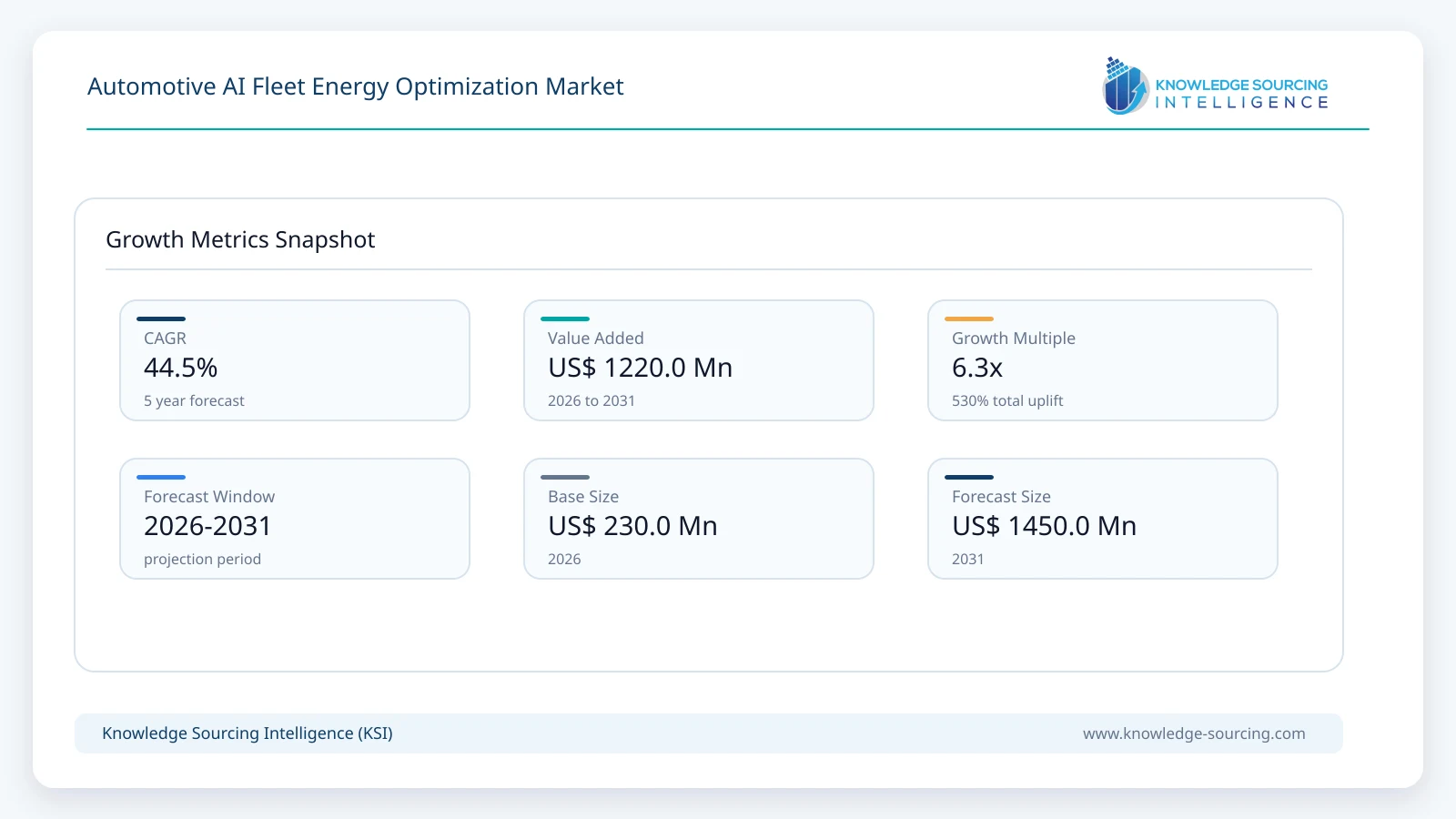
The Automotive AI Fleet Energy Optimization Market is estimated at USD 230 million in 2026 and is projected to reach USD 1,450 million by 2031, representing a 44.5% CAGR during the forecast period.
Highlights:
- 1Fuel and idling optimization leads 2026 function revenue as conventional-powertrain commercial fleets remain the largest installed customer pool.
- 2Battery-electric fleet energy optimization is expected to grow faster as depot capacity, charging windows and usable range become operational constraints.
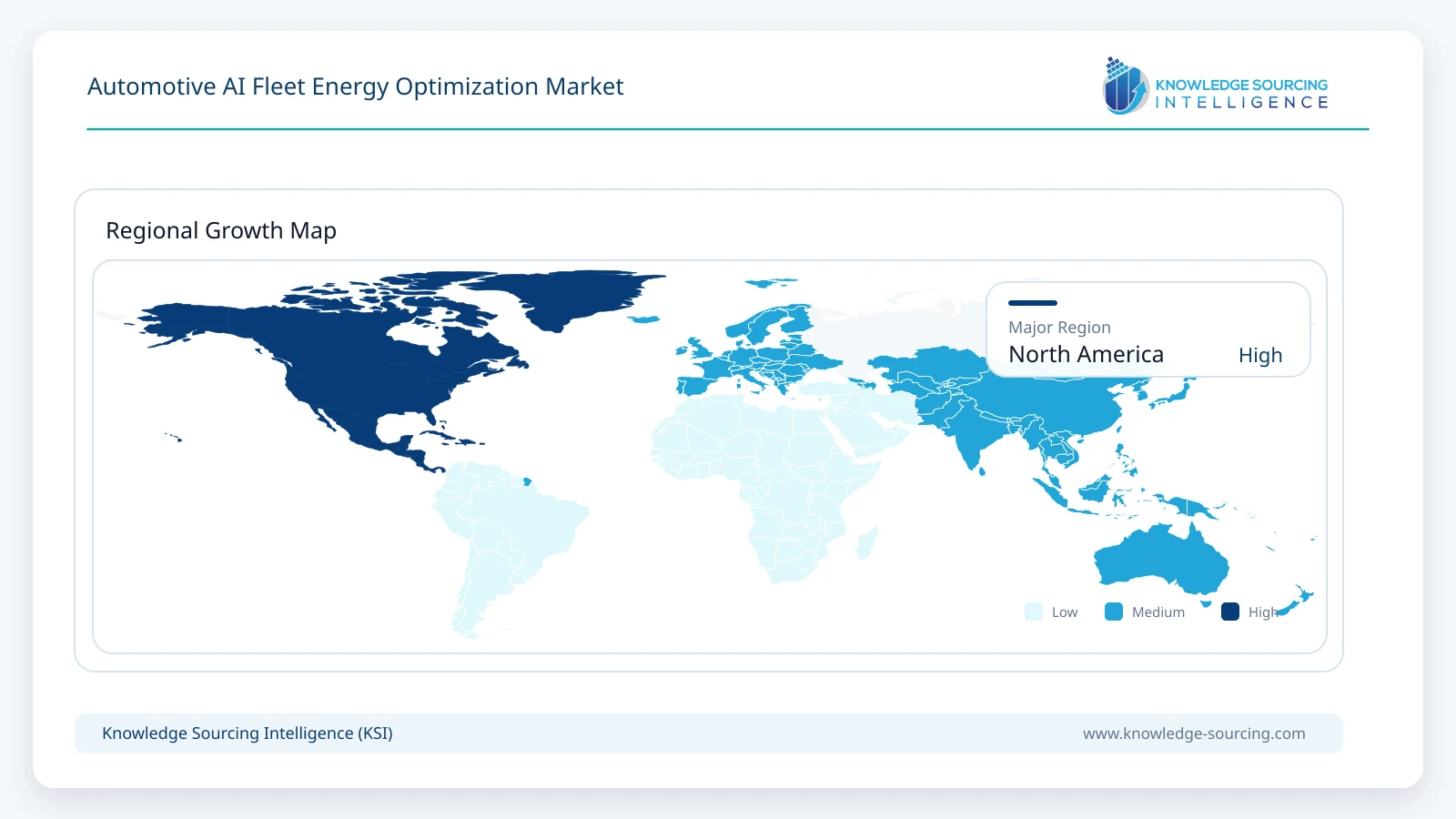
- 3North America and Asia Pacific each represent approximately 31% of 2026 revenue; Asia Pacific is projected to become the largest region by 2031.
- 4Geotab reports nearly six million connected-vehicle subscriptions in 2026, providing an established data ecosystem for advanced paid optimization features.
- 5Einride introduced Flip AI in August 2026, extending automated electric-fleet and charging workflows beyond its existing transport operations.
Vehicle operators increasingly treat energy as a scheduling variable rather than a cost reported after a journey. AI-supported software combines fuel and electricity consumption, state of charge, route gradients, traffic patterns, charging windows and tariff information to propose operating decisions for individual vehicles and multi-depot fleets. Logistics, public transit, parcel delivery and service vehicles use different configurations, but each requires energy recommendations that respect work assignments and departure deadlines.
Geotab and Samsara support broad connected-fleet energy analysis and action-oriented fuel management. Einride Saga links electric trucks, charging locations and transportation schedules, while Ampcontrol, Synop and BetterFleet concentrate on electric fleet depots where energy demand and daily vehicle readiness must be managed together. Fleet purchasers increasingly evaluate the quality of these recommendations, ease of integration and measurable operating savings when selecting a solution.
Market Overview
Fuel and electricity constitute major controllable variable costs in commercial transport, but the optimization methods differ with the powertrain and operating cycle. A diesel distribution truck can reduce consumption through route selection, idle-time control and improved fueling choices. An electric delivery fleet must also manage state of charge, charger availability, grid demand and the timing of dispatch. AI-enabled control becomes valuable when these factors change during the working day and fixed rules cannot efficiently accommodate every exception.
The underlying connected-vehicle infrastructure has already reached meaningful scale. Geotab reported a dataset based on nearly six million subscriptions in February 2026, while its European reporting showed stronger EV penetration among connected fleets than in the United States. The IEA reported more than 400,000 electric truck sales worldwide in 2025 and rapid growth in electric light commercial vehicles. Those figures demonstrate the expanding base of vehicles for energy-aware software, although advanced optimization remains a paid capability rather than an automatic feature of every connected asset.
Platform competition combines multi-brand telematics suppliers, depot-charging specialists and vehicle manufacturers. Samsara offers fuel-management decisions within its connected operations environment; Einride links freight planning and electric energy use in Saga; and Volvo Connect provides charging status and range-and-route tools for electric trucks. Dedicated vendors such as Synop, BetterFleet and Ampcontrol connect chargers, operational schedules and utility tariffs for customers that require more involved depot control.
Market Trends
Depot Energy Scheduling Is Becoming Part of Vehicle Dispatch
Electric bus and truck operators increasingly schedule charging around the next assigned duty rather than charging each vehicle to the same target state. Charge-management systems need reliable departure times, state-of-charge readings, expected route energy and the maximum electrical capacity available at each depot. Synop and OptiGrid announced an integrated offering in April 2026 that links vehicle readiness, charger operation and energy costs, highlighting this change in purchasing requirements.
Operating benefits depend on the quality of fleet and charger integration rather than optimization algorithms alone. Electricity tariffs, demand charges, delays from charger outages and last-minute route reassignment can rapidly undermine static charging schedules. Vendors capable of updating power allocations while protecting departure deadlines are positioned to earn recurring software fees, especially as medium- and heavy-duty electric vehicles enter larger depots.
Fuel Decision Platforms Are Moving Beyond Retrospective Dashboards
Diesel and hybrid fleets continue to represent a substantial addressable base for AI-supported energy optimization because fuel prices vary by location and driving conditions. Samsara launched its Fuel Command Center in August 2026, combining spend visibility, driver behaviour and preferred fuel stops with practical workflow controls. The offering illustrates how energy analytics is becoming integrated with the decisions made by dispatchers, managers and drivers.
Fleets are more likely to pay for software that identifies a recoverable cost and then supports the corrective action. Preferred fuel-stop guidance, idling alerts and vehicle-specific driving feedback can shorten the period between detecting waste and changing operations. These tools compete with ordinary fuel reporting, so suppliers must demonstrate incremental savings and avoid forcing customers to purchase duplicate dashboards.
Energy-Aware Routing Is Linking Traffic Conditions with Battery Use
Electric freight movements are sensitive to payload, weather, road gradient and the amount of energy that must remain in the battery before a truck reaches its next charging opportunity. Einride Saga AI integrates shipment plans, vehicle information and charging operations, allowing the fleet to evaluate energy demand alongside route and delivery schedules. The capability becomes more valuable as electric trucks undertake longer or less predictable duties.
Navigation and charging decisions are increasingly made at fleet level rather than only inside individual vehicles. A dispatch system can reassign a vehicle or charger when actual consumption deviates from a forecast, reducing the risk of missed delivery windows. Providers must integrate accurate vehicle energy data and charger status to deliver these outcomes, which creates demand for robust multi-brand interfaces and ongoing model maintenance.
AI Agents Are Beginning to Automate Energy Operations
Einride introduced Flip AI in August 2026 after acquiring the energy-software company Flipturn, extending automated workflows to electric fleets, shippers and charging operators. The announced platform can read information across fleet and charger systems, restart stalled equipment and raise service tickets. These functions represent a shift from displaying recommendations to carrying out narrowly defined operational actions.
Automated actions are commercially useful when vehicle schedules and energy systems produce frequent exceptions, but permissions and safety limits must be clear. Fleet managers generally require approval controls for changes that affect driving assignments, charger capacity or significant energy expenditure. The adoption path therefore favours supervised automation, auditable recommendations and integrations that work with existing depot control systems.
Grid Limits and Dynamic Tariffs Are Shaping Fleet Software Contracts
Large depots can incur substantial electricity charges when many heavy vehicles charge during the same billing interval. Blink introduced its EnergyConnect energy-management system in August 2026 to allocate power across charging sites, while dedicated providers model tariffs and vehicle readiness together. Charging management is increasingly assessed against the capacity of electrical connections and the cost of expanding them.
Grid-aware optimization can avoid some upgrade costs by spreading demand across a broader charging window, although savings depend on the local tariff and vehicle operating pattern. Fleet platforms that predict next-shift energy needs, react to charger failures and coordinate load at multiple sites can capture a larger portion of the energy-management software budget. Providers must distinguish these decisions from routine charger monitoring and basic static load limits.
Segment Analysis
By Optimization Function: Fleet Fuel and Idling Management
AI fleet fuel and idling optimization represents an estimated 37% of 2026 revenue because conventional engines still account for a large installed commercial fleet. The function uses trip consumption, engine idling, fuel purchase patterns and driver behaviour to identify practical reductions in fuel cost. Samsara has moved from separate fuel reports toward consolidated spend and routing recommendations, while Geotab connects energy-usage records with operational fleet analysis.
Growth in this function remains supported by large diesel truck and van fleets, particularly where operators can change idle policies, driver practices or fuel-stop selection without replacing vehicles. Its share is expected to decline as electric fleet charging software expands faster. Vendors must demonstrate energy-specific value rather than claim the full price of a multipurpose telematics subscription.
By Propulsion Type: Battery Electric Vehicle Fleets
Battery-electric vehicle fleets represent approximately 33% of 2026 value and are forecast to become the largest propulsion category by 2031. Electric buses, delivery vans and heavy trucks create demand for software that can forecast route consumption and allocate limited depot charging capacity. Synop, Ampcontrol and BetterFleet demonstrate how vehicle readiness, charger availability and electricity pricing can be managed in a common workflow.
As electric vehicle penetration rises, large fleets are expected to shift from isolated pilot depots to standardized software across multiple operating sites. The IEA documented rapid electric truck sales growth in 2025, led by China, while European electric light-commercial vehicle sales also increased. Adoption will vary by local tariffs, grid capacity and the availability of vehicle energy data, so software penetration is not expected to mirror vehicle sales one-for-one.
By Fleet End User: Freight and Logistics Operators
Freight and logistics operators account for an estimated 30% of the 2026 market because route lengths, vehicle utilization and fuel expenditure make energy management commercially material. Electric freight operators must coordinate charge planning with loading cycles and driver schedules, while conventional long-haul fleets focus on fuel stops, idle reduction and route efficiency. Einride Saga and Samsara represent distinct platform approaches serving these requirements.
The purchasing model in freight increasingly favours fleet-wide results over isolated vehicle dashboards. Larger logistics groups need consistent cost reporting across depots and brands, yet they must account for different diesel and electric operating patterns. Vendors that combine practical recommendations with dispatch workflows can strengthen customer retention, especially when the platform supports both current fleets and future electrification.
By Deployment Architecture: Cloud-Based SaaS
Cloud-based software represents an estimated 58% of the 2026 market as fleet operators favour centrally updated optimization models, multi-site reporting and subscription-based deployment. Geotab, Samsara and charging-software specialists can integrate data from vehicles, work orders, chargers and energy tariffs without each customer building a new platform. Cloud services also help keep route and energy models current when tariffs or operations change.
Hybrid cloud and edge architectures are expected to gain share where depots require charging decisions during temporary network outages. A local controller can preserve electrical limits and execute charging schedules while cloud software handles forecasting and optimization across sites. This combination is especially important for electric transit and high-utilization truck depots where loss of communication cannot delay the next service.
Market Drivers
Increasing Electricity and Fuel Cost Exposure
Commercial fleet operators are exposed to variations in fuel prices, electricity tariffs and the amount of energy consumed per shipment or vehicle-hour. Samsara introduced consolidated fuel-spend decision tools in August 2026, demonstrating customer demand for identifying operating waste while work is in progress. AI-supported applications can compare driving patterns, fuel stops and schedules to highlight costs that managers can directly influence.
The value case is most compelling when energy optimization can be linked to measurable reductions in a fleet’s operating bill. Vehicle-linked subscriptions can be justified against recurring fuel or electricity savings rather than a one-time technology benefit. Operators still need validated baseline consumption to distinguish real savings from seasonal, weather-related or route-mix changes.
Expanding Electric Commercial Vehicle Fleet
The IEA recorded electric truck sales exceeding 400,000 in 2025 and electric light-commercial vehicle sales above 430,000, enlarging the group of operators that must manage charging at scale. Electric fleets create software needs around charge acceptance, planned duty cycles and the difference between theoretical and actual usable range. Operators increasingly require coordinated scheduling rather than individual vehicle charge-status displays.
Larger electric depots create recurring demand for algorithms that balance departure readiness against the site’s electricity limits. This supports subscription uptake among transit agencies, parcel fleets and regional freight operators. The growth rate will depend on fleet purchasing cycles and whether new vehicles expose sufficiently reliable real-time energy signals.
Constrained Depot Power Connections
Commercial vehicle depots frequently have fixed electrical connections that cannot support unrestricted simultaneous charging as fleets add vehicles. Synop’s April 2026 partnership with OptiGrid and Blink’s August 2026 EnergyConnect launch demonstrate growing supplier attention to charge scheduling and dynamic load allocation. The software can prioritize vehicles according to next-shift requirements and distribute energy over available charging windows.
Electricity demand peaks, charger downtime and delays to utility upgrades create an economic incentive to improve depot capacity utilization. Automated scheduling can reduce avoidable congestion and delay some infrastructure expenditure. The size of the benefit varies by depot utilization, charger configuration and tariff structure, making site-level testing important before large procurement commitments.
Fleet Software and Telematics Integration
Large connected-fleet ecosystems already provide the vehicle location, fuel consumption and battery information needed by energy-optimization applications. Geotab described nearly six million connected vehicle subscriptions in its February 2026 report, while providers such as Samsara link fleet operations with fuel-management tools. Existing connectivity reduces the need for new onboard instrumentation when software can access trustworthy vehicle signals.
Fleet operators can adopt incremental energy applications through existing platforms and partner integrations, limiting training and onboarding disruption. Supplier ecosystems that support multiple vehicle brands and depot chargers can reach mixed fleets more effectively. Platform dependence remains important because authorization rules and differences in sensor quality affect which decisions are actually possible.
Energy-Aware Route and Dispatch Economics
Transport operations increasingly require dispatch decisions that account for vehicle energy state, delivery windows and the availability of chargers or lower-cost refueling points. Einride Saga integrates planned freight movements with charging predictions, while Samsara supports preferred fuel-stop navigation. These product capabilities connect energy decisions to the revenue-generating work a vehicle must complete.
Avoiding an unplanned charging stop or excessive idle period can preserve delivery punctuality as well as energy. Software suppliers can therefore create value through reliability and vehicle utilization in addition to direct consumption savings. This wider benefit supports adoption in higher-utilization fleets, provided recommendations are transparent to dispatchers and can be overridden during service disruptions.
Market Restraints
Inconsistent Vehicle Energy Data Access
Commercial vehicles from different manufacturers report fuel use, battery state and charging status through different data interfaces. Even where basic location and mileage are available, high-quality energy signals may be missing, delayed or subject to OEM permissions. AI models that receive inconsistent battery or consumption information can recommend charging plans or routes that appear economical but are operationally unsuitable.
Suppliers must invest in data validation, brand coverage and fallback logic rather than assuming all connected vehicles produce equivalent records. This adds integration costs and slows rollout to mixed fleets. Purchasers are likely to prioritize vendors with documented coverage and clear handling of missing information.
Uncertain Savings and Contract Economics
Fleet energy savings vary with utilization, local fuel prices, tariffs, weather and the proportion of operational changes a dispatcher can implement. Vendor case studies report strong outcomes at selected customers, but the same savings cannot automatically be applied across other depots or routes. Large fleets also need to distinguish energy savings from gains due to vehicle replacement, driver policy or new infrastructure.
Procurement teams may resist separate AI fees if similar recommendations appear within an existing telematics contract. Pilot testing and agreed measurement periods can reduce uncertainty, although they extend the sales cycle. Vendors that clearly price only their additional energy-optimization function are better positioned to defend renewals.
Depot Charging Reliability and Grid Availability
Even accurate AI dispatch planning cannot overcome a failed charger, insufficient electrical capacity or a delayed network connection. Heavy vehicle charging can be particularly challenging when many vehicles return during a short overnight interval. A schedule that assumes every vehicle will receive a full charge may fail if power is curtailed or equipment is unavailable.
Fleet operators must purchase maintenance, resilient control and sometimes battery storage alongside software. These additional investments can delay the economics of AI energy optimization, particularly for smaller depots. Cloud-only recommendations are insufficient when local power limits have to remain enforced during communications outages.
Operational Safety and Dispatcher Accountability
Fleet energy optimization systems can recommend rerouting, lower charging targets or changes in departure order, but transport operators remain accountable for safety, service coverage and labor constraints. A recommendation that minimizes electricity charges is unacceptable if it leaves a vehicle below the required reserve for its assigned route. Automated controls must observe driver hours, passenger obligations and emergency-response priorities.
Operators commonly require human approval or predefined restrictions before automation changes work assignments or charging priorities. Building these governance controls takes additional engineering and testing. Adoption can therefore progress more slowly than the introduction of a basic analytics dashboard.
Fragmented Technology and Procurement Responsibilities
Energy-management software often connects vehicle telematics, charger management, utility billing and transport management supplied by different companies. Separate data contracts and security permissions can prevent one vendor from controlling the full optimization loop. Electric fleet managers may also need to coordinate procurement among transport, facilities and finance departments.
Complex ownership of software licenses and data can raise implementation costs and make benefits harder to allocate among participants. Contract terms must distinguish ordinary charger software from vehicle-level scheduling and fleet energy prediction. Without this clarity, companies risk paying for overlapping functions and slowing the move from a successful pilot to broad deployment.
Regional Outlook
North America
North American fleet demand is supported by large connected vehicle installations, fuel-sensitive commercial transport and growing electric truck and transit deployments. Samsara and Geotab have significant regional platform ecosystems, while Ampcontrol, Synop and BetterFleet address depot charging operations and fleet electrification. Fleet purchasing places considerable weight on immediate operating savings, platform integration and the ability to manage varied vehicle types.
The United States is estimated to account for the majority of North American market revenue in 2026 because of its commercial truck fleet, software purchasing capacity and energy management supplier concentration. Canada contributes through connected logistics and transit electrification, while Mexico presents opportunities in cross-border and distribution fleets. Electric fleet growth and network infrastructure constraints will determine the mix of fuel and charging optimization over the forecast period.
Asia Pacific
Asia Pacific represents a substantial 2026 market base and is projected to become the largest region by 2031, reflecting China’s scale in electric commercial vehicles and expanding connected transport operations. The IEA reported that China accounted for most of the rapid increase in electric truck sales in 2025. Fleet energy software requirements are shaped by high-utilization delivery operations, depot power management and the need to reduce the cost of serving dense urban networks.
China is expected to remain the region’s largest national market, while India gains share as commercial fleet digitization and electric buses, vans and trucks expand. Japan, South Korea and Australia provide demand for advanced logistics planning and controlled charging operations. Differences in power tariffs, technology standards and vehicle data access are expected to favor local integrations alongside the larger global platform suppliers.
Competitive Landscape
Competitive activity divides between broad connected-fleet platforms and specialists that control electric vehicle energy workflows. Geotab and Samsara offer access to large vehicle populations and established dispatch or fleet operations software. Einride links electric freight service delivery with charging and scheduling decisions, while Ampcontrol, Synop and BetterFleet offer dedicated depot energy-management capabilities. This mix creates partnerships as well as competition because broad telematics vendors may lack detailed charger-control functions.
Technology differentiation increasingly depends on how reliably a platform joins route demand, vehicle state, utility tariffs and charger capacity. Volvo’s fleet services show the opportunity for OEM-integrated planning, whereas ChargePoint, Blink and specialist charging providers illustrate the importance of infrastructure integration. Providers with multi-brand vehicle coverage, strong charging interfaces and practical audit trails are positioned to support fleet customers beyond a single vehicle or depot program.
Commercial agreements are expected to combine vehicle-linked subscription charges, enterprise software licensing and separately invoiced rollout projects. Bundled services can accelerate customer adoption but also make comparisons difficult when operators already own fleet-management or charge-point subscriptions. Suppliers able to establish an attributable energy saving, protect departure readiness and maintain reliable support are more likely to secure multi-site contracts.
Recent Developments
27 August 2026 | Einride launched Flip AI, a platform designed to automate selected electric-fleet and charging workflows following its acquisition of Flipturn. The release extends AI-based operating decisions beyond Einride’s own freight services.
19 August 2026 | Samsara introduced Fuel Command Center, integrating fuel usage, routing guidance and card controls to help commercial fleets identify and address avoidable fuel expenditure.
18 August 2026 | Blink Charging announced EnergyConnect, an AI-driven energy-management system that allocates available power across charging sites and supports dynamic load control.
30 April 2026 | Synop and OptiGrid announced a commercial fleet offering that combines battery-integrated charging with AI-based energy-cost and departure-ready charge scheduling.
11 February 2026 | Blink Charging and BetterFleet announced a collaboration connecting charging systems with AI-based fleet energy planning and operational digital-twin software.
27 January 2026 | Monta launched an AI intelligence layer for charging-network operations, providing energy and site-performance insights that may support fleet operators using its broader platform.
Market Outlook
AI fleet energy optimization is expected to develop from standalone dashboards into operating software that connects route assignment, refueling or charging and live vehicle status. Conventional commercial fleets will continue to purchase fuel-efficiency decisions during the forecast period, while the faster-growing battery-electric segment increases demand for coordinated depot power allocation and energy-aware routing. Software suppliers that can support both environments without duplicating underlying telematics charges will have a more flexible customer offering.
The projected market is expected to depend on growth in paid optimization subscriptions and enterprise deployments rather than the full value of charging infrastructure or transport services. Greater electric truck and bus penetration, dynamic electricity tariffs and more capable fleet data platforms provide a favorable setting, but grid limitations, software integration costs and the need for verifiable savings will shape adoption. Reliable decision quality and operator trust should remain the main differentiators.
Automotive AI Fleet Energy Optimization Market Scope
| Report Metric | Details |
|---|---|
| Total Market Size in 2026 | USD 230 million |
| Total Market Size in 2031 | USD 1,450 million |
| Forecast Unit | Million |
| Growth Rate | 44.5% |
| Study Period | 2021 to 2031 |
| Historical Data | 2021 to 2024 |
| Base Year | 2025 |
| Forecast Period | 2026 – 2031 |
| Segmentation | Optimization Function, Propulsion Type, Commercial Vehicle Type, Deployment Architecture, Fleet Size, Fleet End User, Revenue Model, Geography |
| Companies |
|
Market Segmentation
By Optimization Function
AI Fleet Fuel and Idling Optimization
EV Depot and Charging Energy Scheduling
Energy-Aware Routing and Dispatch
Cross-Fleet Energy Orchestration
Electricity Tariff and Flexibility Optimization
By Propulsion Type
Internal Combustion Engine Fleets
Battery Electric Vehicle Fleets
Hybrid and Plug-in Hybrid Fleets
By Commercial Vehicle Type
Light Commercial Vehicles
Medium-Duty Trucks
Heavy-Duty Trucks
Buses and Coaches
Passenger Mobility Fleet Vehicles
By Deployment Architecture
Cloud-Based SaaS
Hybrid Cloud and Edge
OEM-Integrated Fleet Applications
By Fleet Size
Small Fleets, Under 50 Vehicles
Medium Fleets, 50–499 Vehicles
Large Fleets, 500 or More Vehicles
By Fleet End User
Freight and Logistics Operators
Public Transit Operators
Parcel and Last-Mile Delivery
Field Service and Utility Fleets
Passenger Mobility Operators
Municipal and Government Fleets
By Revenue Model
Vehicle-Linked Optimization Subscriptions
Enterprise and OEM Software Licenses
Engineering, Onboarding and Integration
By Geography
North America
United States
Canada
Mexico
South America
Brazil
Argentina
Colombia
Chile
Other South America
Europe
Germany
United Kingdom
France
Italy
Spain
Netherlands
Sweden
Poland
Other Europe
Middle East and Africa
Saudi Arabia
United Arab Emirates
South Africa
Israel
Other Middle East and Africa
Asia Pacific
China
Japan
India
South Korea
Australia
Other Asia Pacific
Table of Contents
1. EXECUTIVE SUMMARY
1.1. Market Opportunity and Key Findings
1.2. Outlook for Fleet Energy Intelligence
2. MARKET SNAPSHOT
2.1. Market Overview
2.2. Market Definition
2.3. Market Scope
2.4. Market Segmentation
3. BUSINESS LANDSCAPE
3.1. Market Drivers
3.1.1. Increasing Electricity and Fuel Cost Exposure
3.1.2. Expanding Electric Commercial Vehicle Fleet
3.1.3. Constrained Depot Power Connections
3.1.4. Fleet Software and Telematics Integration
3.1.5. Energy-Aware Route and Dispatch Economics
3.2. Market Restraints
3.2.1. Inconsistent Vehicle Energy Data Access
3.2.2. Uncertain Savings and Contract Economics
3.2.3. Depot Charging Reliability and Grid Availability
3.2.4. Operational Safety and Dispatcher Accountability
3.2.5. Fragmented Technology and Procurement Responsibilities
3.3. Market Opportunities
3.4. Porter’s Five Forces Analysis
3.5. Industry Value Chain Analysis
3.6. Policies and Regulations
3.7. Strategic Recommendations
4. TECHNOLOGICAL OUTLOOK
4.1. AI Energy Prediction and Fleet Optimization
4.2. Charging, Fuel and Energy Data Integration
4.3. Cross-Depot Dispatch and Control
5. AUTOMOTIVE AI FLEET ENERGY OPTIMIZATION MARKET BY OPTIMIZATION FUNCTION
5.1. AI Fleet Fuel and Idling Optimization
5.2. EV Depot and Charging Energy Scheduling
5.3. Energy-Aware Routing and Dispatch
5.4. Cross-Fleet Energy Orchestration
5.5. Electricity Tariff and Flexibility Optimization
6. AUTOMOTIVE AI FLEET ENERGY OPTIMIZATION MARKET BY PROPULSION TYPE
6.1. Internal Combustion Engine Fleets
6.2. Battery Electric Vehicle Fleets
6.3. Hybrid and Plug-in Hybrid Fleets
7. AUTOMOTIVE AI FLEET ENERGY OPTIMIZATION MARKET BY COMMERCIAL VEHICLE TYPE
7.1. Light Commercial Vehicles
7.2. Medium-Duty Trucks
7.3. Heavy-Duty Trucks
7.4. Buses and Coaches
7.5. Passenger Mobility Fleet Vehicles
8. AUTOMOTIVE AI FLEET ENERGY OPTIMIZATION MARKET BY DEPLOYMENT ARCHITECTURE
8.1. Cloud-Based SaaS
8.2. Hybrid Cloud and Edge
8.3. OEM-Integrated Fleet Applications
9. AUTOMOTIVE AI FLEET ENERGY OPTIMIZATION MARKET BY FLEET SIZE
9.1. Small Fleets, Under 50 Vehicles
9.2. Medium Fleets, 50–499 Vehicles
9.3. Large Fleets, 500 or More Vehicles
10. AUTOMOTIVE AI FLEET ENERGY OPTIMIZATION MARKET BY FLEET END USER
10.1. Freight and Logistics Operators
10.2. Public Transit Operators
10.3. Parcel and Last-Mile Delivery
10.4. Field Service and Utility Fleets
10.5. Passenger Mobility Operators
10.6. Municipal and Government Fleets
11. AUTOMOTIVE AI FLEET ENERGY OPTIMIZATION MARKET BY REVENUE MODEL
11.1. Vehicle-Linked Optimization Subscriptions
11.2. Enterprise and OEM Software Licenses
11.3. Engineering, Onboarding and Integration
12. GEOGRAPHICAL SEGMENTATION
12.1. North America
12.1.1. United States
12.1.2. Canada
12.1.3. Mexico
12.2. South America
12.2.1. Brazil
12.2.2. Argentina
12.2.3. Colombia
12.2.4. Chile
12.2.5. Other South America
12.3. Europe
12.3.1. Germany
12.3.2. United Kingdom
12.3.3. France
12.3.4. Italy
12.3.5. Spain
12.3.6. Netherlands
12.3.7. Sweden
12.3.8. Poland
12.3.9. Other Europe
12.4. Middle East and Africa
12.4.1. Saudi Arabia
12.4.2. United Arab Emirates
12.4.3. South Africa
12.4.4. Israel
12.4.5. Other Middle East and Africa
12.5. Asia Pacific
12.5.1. China
12.5.2. Japan
12.5.3. India
12.5.4. South Korea
12.5.5. Australia
12.5.6. Other Asia Pacific
13. COMPETITIVE ENVIRONMENT
13.1. Market Share Analysis
13.2. Strategic Developments
13.3. Competitive Benchmarking
14. COMPANY PROFILES
14.1. Geotab Inc.
14.2. Samsara Inc.
14.3. Einride AB
14.4. Ampcontrol Inc.
14.5. Synop, Inc.
14.6. BetterFleet
14.7. ChargePoint Holdings, Inc.
14.8. Blink Charging Co.
14.9. Volvo Trucks (Volvo Group)
14.10. Monta ApS
14.11. Nuvve Holding Corp.
15. APPENDIX
15.1. Research Methodology
15.2. Data Sources
15.3. Assumptions
15.4. Abbreviations
Navigate
Trusted by the world's leading organizations











