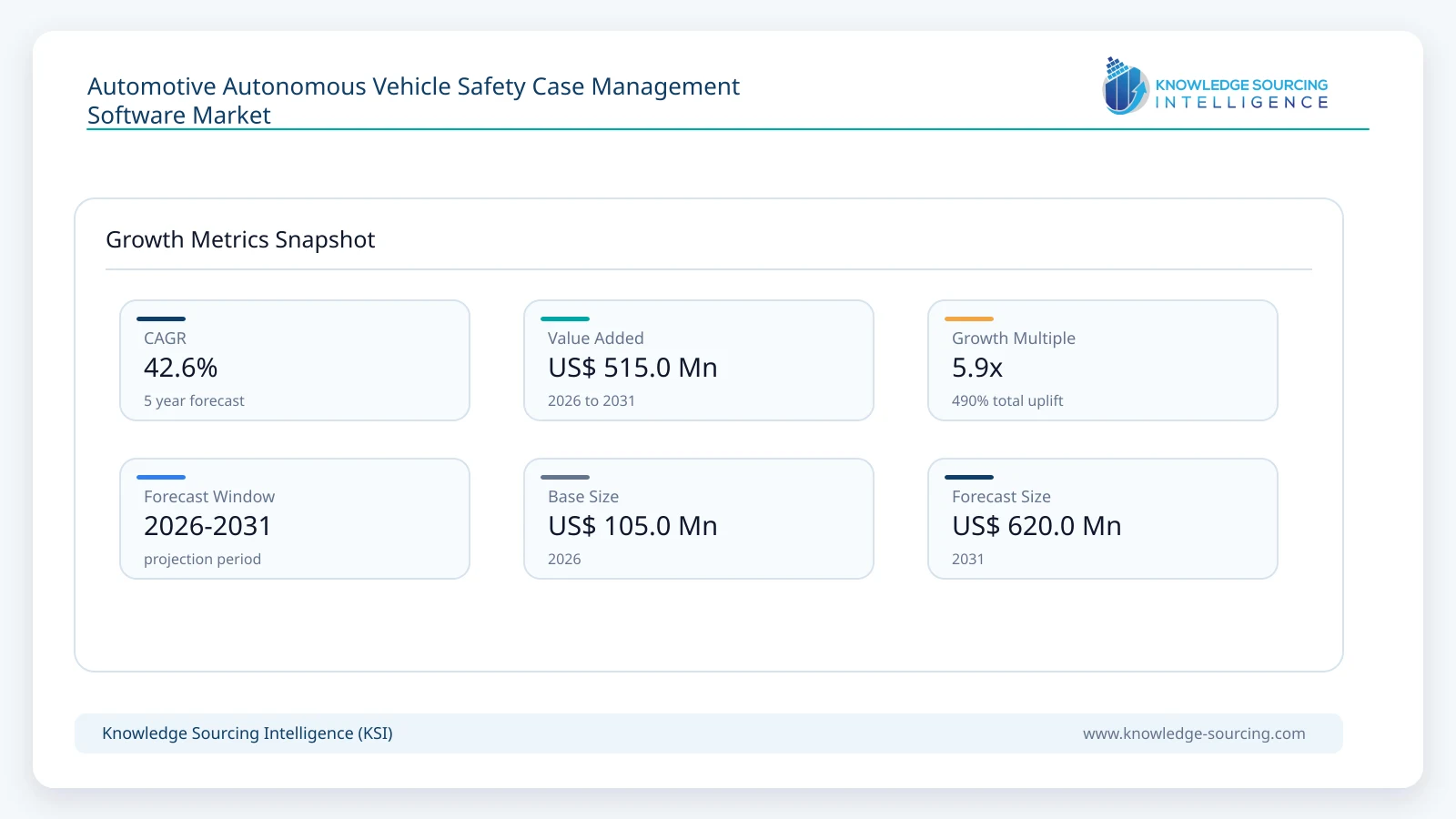
The automotive autonomous vehicle safety case management software market is estimated at USD 105 million in 2026 and is projected to reach USD 620 million by 2031, representing a five-year CAGR of 42.6% during the forecast period.
Highlights:
- 1Level 4 automated-driving programs represent about 61.0% of the modeled 2026 market as driverless deployment requires detailed claims and operational boundaries.
- 2Evidence and requirements traceability is projected to reach USD 230 million in 2031 as software releases generate more linked test results and change records.
- 3Integrated safety-engineering and ALM platforms account for approximately 50.5% of the 2026 software architecture market.
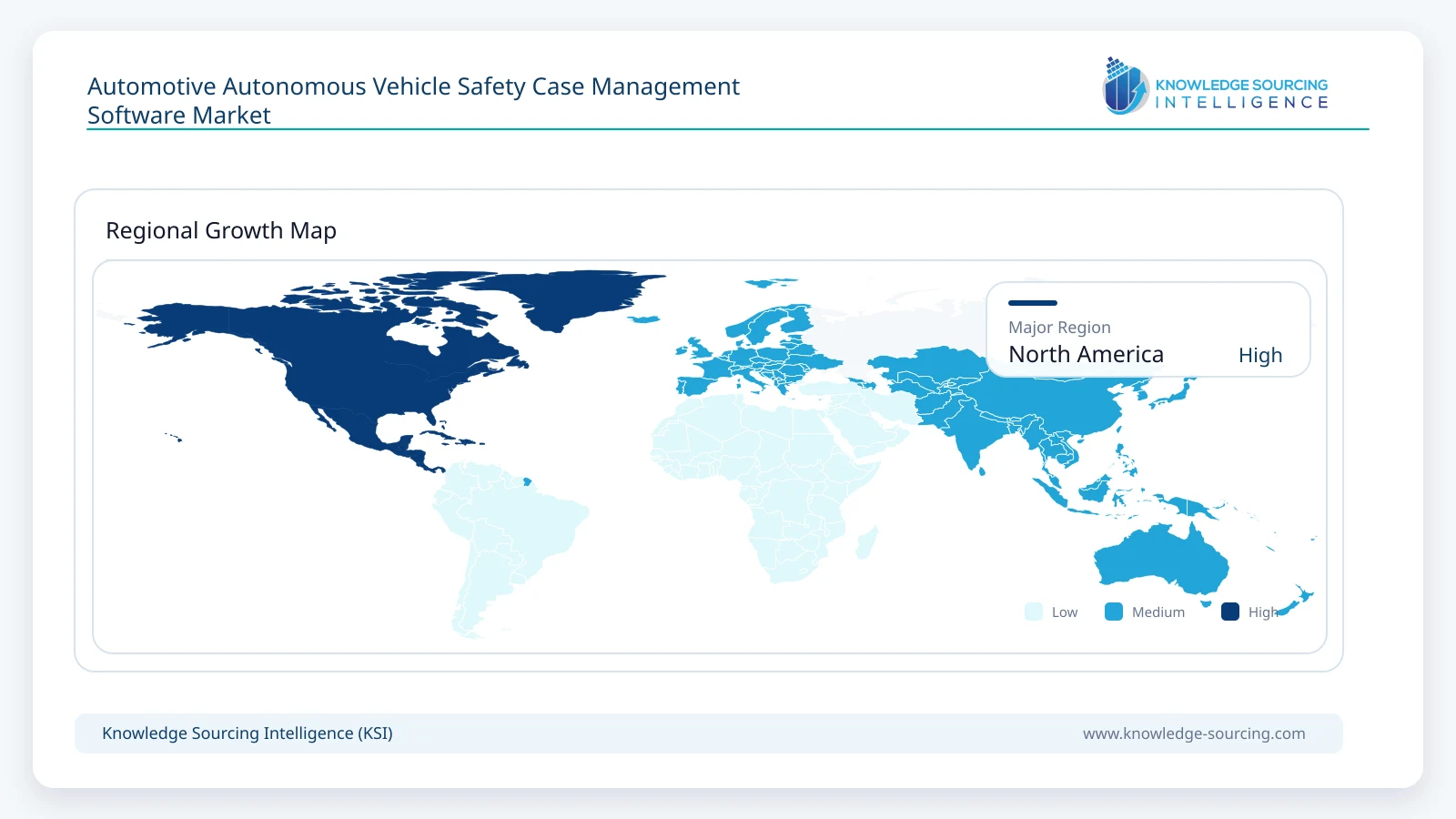
- 4North America leads the 2026 regional market, while Asia Pacific is forecast to expand to USD 205 million by 2031.
- 5UNECE’s June 2026 ADS framework, Waymo’s independent case audit and AVSC assessment guidance support a stronger market for review-ready assurance records.
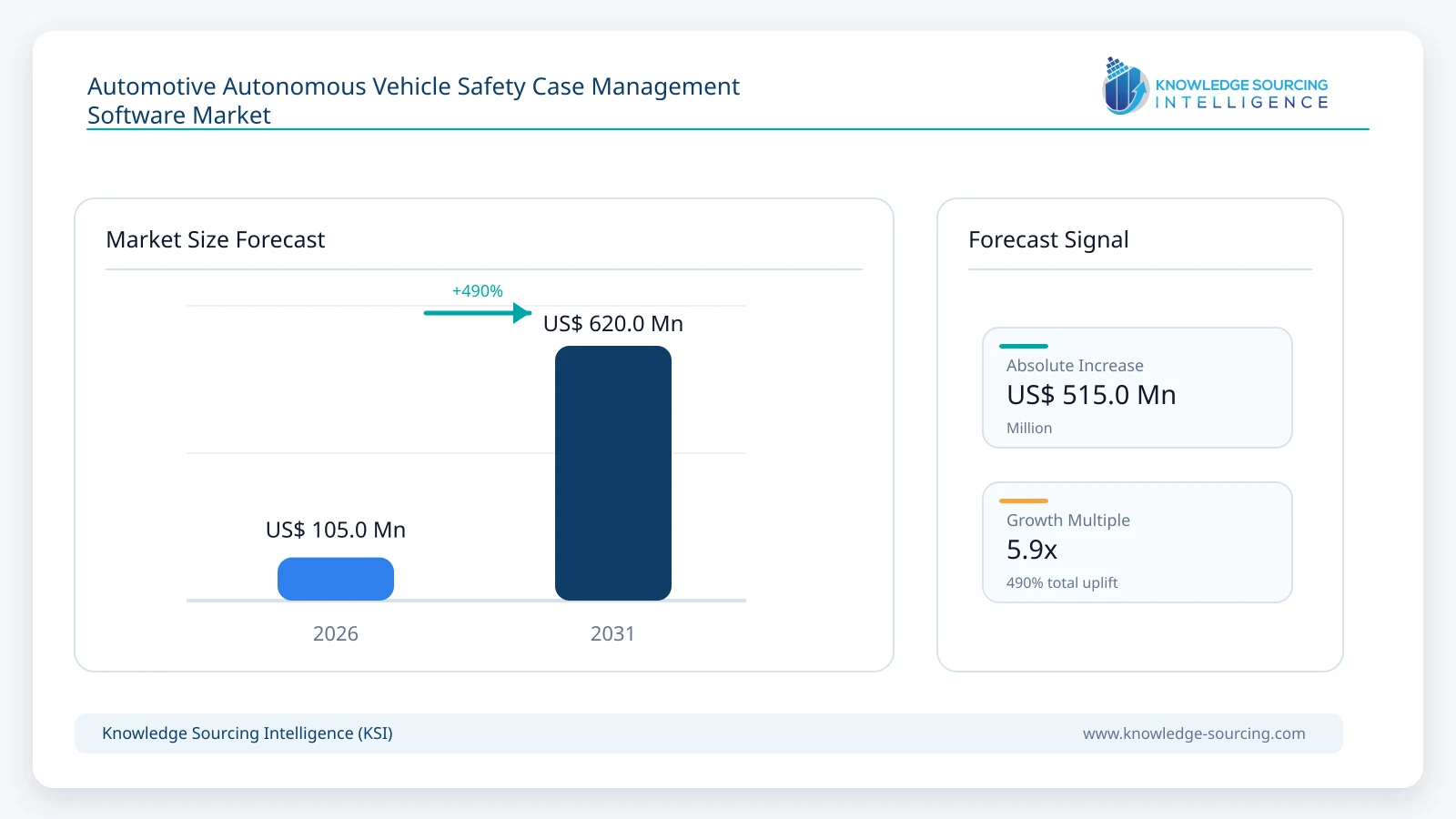
The approval of UNECE’s global automated-driving framework in June 2026 marked an important change in how vehicle developers communicate safety readiness. Rather than treating a collection of passed tests as sufficient proof, developers must organize a structured position on hazards, acceptable risk, validation performance and the operating situations for which the automated driving system is intended. Software used to capture claims, connect supporting evidence and manage assessment findings becomes more important as these programs grow.
Waymo’s November 2025 independent review by TÜV SÜD illustrates the practical depth of safety-case governance. The review addressed how safety claims are created, supporting evidence is identified, and policies are applied, rather than checking a single crash metric. Digital case-management workspaces help make these processes repeatable when an automated driver is revised, extended to a new city or released on a different vehicle platform.
Adelard’s ASCE is an example of purpose-built claims-and-evidence tooling, while Ansys safety software, PTC Codebeamer and Siemens Polarion connect assurance work to broader engineering records. Buyers increasingly favor systems that link the safety case to requirements, software test results, scenario libraries and controlled approvals without duplicating the full underlying simulation, testing or application-lifecycle budget.
Market Overview
Safety cases translate a developer’s safety approach into an assessable chain of claims, reasoning and evidence. An automated-driving program may need to demonstrate that its perception, motion planning, fallback and human-interaction strategies remain acceptably safe under specified road, weather and operational conditions. A structured case allows reviewers to examine not only evidence that supports a claim but also assumptions, limitations and unresolved challenges.
The evidence stream spans functional safety under ISO 26262, unintended-behavior concerns under ISO 21448, scenario-based evaluations under ISO 34502 and the broader argument-oriented approach of UL 4600. The software market comprises case editors, evidence-link management, review workflows, change-impact tracking and the assurance portions of integrated engineering platforms. Simulation engines, sensor test systems, entire ALM systems and consulting hours outside platform deployment serve related needs but are commercially separate.
Enterprise purchases are typically organized around autonomous-driving programs, safety engineering departments or development-tool ecosystems. Specialized teams may adopt dedicated GSN or CAE tools; larger automakers increasingly seek integration with safety analysis and requirements platforms so claims can be maintained when software, sensors or operating domains change. The ability to preserve evidence lineage across vehicle generations is a central basis for renewal and integration spending.
Market Trends
Safety Cases Become Living Release Records
Autonomous-driving programs change operating-domain boundaries, software models and performance thresholds more often than conventional type-approval documentation was designed to handle. A release-ready assurance case must therefore show what changed, which hazards and claims were affected, and why prior verification remains valid or requires another test.
Waymo’s publicly described safety-case process and the 2026 UNECE framework both place attention on continuing assurance, rather than a one-time report. Vendors offering version-controlled arguments and evidence status tracking can become a routine part of the vehicle release workflow.
Linking Simulation and Real-World Evidence to Claims
Confidence in an autonomous vehicle depends on evidence generated through simulation, track testing, operational data, software verification and analysis of rare driving scenarios. Without explicit relationships between these results and the corresponding safety claims, very large data libraries may be difficult for an assessor to interpret.
Ansys model-based safety tools, software-testing evidence providers and requirements platforms create integration opportunities for claim-level traceability. Customers are likely to value automatically refreshed evidence references, especially when a new software build changes only a limited part of a validated system.
Structured Argument Notations Gain Wider Use
UL 4600 and ISO/IEC/IEEE 15026-2 provide a foundation for expressing assurance arguments as connected claims and evidence, although they do not require a single graphical notation. Specialist environments support Goal Structuring Notation and Claims-Arguments-Evidence views that can explain dependencies and expose missing support.
Adelard ASCE includes GSN and CAE modeling with consistency checks, while Ansys has demonstrated graphical safety-case functionality through its Digital Safety Manager. Visual argument management becomes commercially useful when reviewers must understand many interacting safety goals without navigating hundreds of uncontrolled document pages.
Independent Assessment and Evidence Quality Control
The Automated Vehicle Safety Consortium’s October 2025 guidance and Waymo’s independent audit show increasing emphasis on how safety claims are assessed, including whether evidence is current, relevant and sufficiently independent. A document with complete-looking links may still contain weak reasoning or inadequate operational evidence.
Case-management software is consequently expanding beyond document storage into reviewer roles, approval history, unresolved-issue handling and audit findings. Suppliers that make challenge and sign-off workflows clear can serve both developers and independent assessment organizations.
AI Safety Broadens the Assurance Boundary
Automated-driving functions increasingly combine deterministic control software with machine-learning perception and decision-making components. AI-based behavior introduces evidence questions about data quality, distribution shift, unusual scenarios and the adequacy of verification around model outputs.
ISO/PAS 8800 and Parasoft’s June 2026 AI safety material highlight the need to connect AI-specific testing with conventional software assurance. Over the forecast period, case platforms are expected to link model evaluation, scenario coverage and software regression outcomes into a single defensible release argument.
Segment Analysis
Software Function: Evidence and Requirements Traceability
Evidence and requirements traceability represents USD 34 million of the 2026 software-function market and is projected to reach USD 230 million by 2031. The segment grows as developers connect tests, scenarios, requirements and operational findings to many separate safety claims across vehicle versions.
IBM ELM, Codebeamer, Polarion and Ansys medini analyze provide different types of lifecycle integration, while specialist case tools retain responsibility for argument structure. Customers favor automated links that preserve the origin, version and status of test evidence rather than large manual evidence registers.
Automation Level: Level 4 High Automation
Level 4 programs are estimated to account for USD 64 million, or approximately 61.0% of 2026 revenue, reflecting driverless operations in bounded environments that require a detailed justification of release readiness. Robotaxi, freight and shuttle developers must link an operational design domain to fault handling, safety metrics and restrictions on operation.
Level 4 safety-case work is expected to reach USD 420 million in 2031, supported by more deployed software configurations and geographic extensions. The workload arises from the number of independently supported system configurations and their evidence updates, rather than simply the number of vehicles sold.
Platform Architecture: Integrated Safety Engineering and ALM
Integrated safety engineering and application-lifecycle platforms contribute an estimated USD 53 million in 2026, as automakers seek to connect hazards, requirements, tests and sign-offs in established engineering ecosystems. The software is generally purchased by central engineering teams and deployed across several related programs.
Its value is projected to rise to USD 345 million by 2031, while dedicated argument suites retain a role where independent assurance reviews require highly structured graphical cases. Differentiation increasingly depends on connector quality, managed baselines and the ability to export assessment-ready records.
Deployment Model: Cloud and Managed SaaS
On-premises and private installations remain the largest 2026 deployment class at an estimated USD 55 million because autonomous-driving evidence can contain sensitive vehicle architectures, proprietary datasets and controlled release decisions. Many engineering organizations prefer restricted repositories that already meet their information security requirements.
Cloud and managed SaaS platforms are projected to reach USD 275 million by 2031 as program teams, vehicle suppliers and assessment participants require access to shared, permissioned evidence. Strong access controls and data residency options will be necessary for cloud adoption to expand across countries.
Market Drivers
Safety-Case-Centered ADS Approval Frameworks
UNECE’s June 2026 automated-driving framework places a credible safety case and safety management within the international validation approach. Programs seeking approval across vehicle types or operating territories need a consistent way to show how their tests and analyses support stated safety claims.
This increases the value of case versioning, documented assessment decisions and controlled evidence packages, especially where different authorities ask for comparable justifications.
Software Release Cadence and ODD Expansion
Robotaxi and automated freight developers routinely introduce updates to perception, planning and fallback functions, while expanding operational design domains to new roads or conditions. Each change can affect assumptions embedded in the prior safety argument.
Software platforms that identify impacted claims and reconnect test evidence reduce the administrative burden of maintaining a living case across releases and vehicle configurations.
Third-Party Review and Liability Expectations
Waymo’s TÜV SÜD audit and the AVSC assessment best practice demonstrate a practical requirement to examine how claims are built, challenged and supported. Developers need records that can be reviewed independently of the engineers who created them.
Auditable workflows, reviewer permissions and decision records help buyers prepare consistent material for safety boards, insurers, commercial partners and authorities.
Growing Complexity of AI-Based Validation
Machine-learning perception introduces risks associated with rare conditions, imperfect training data and uncertain model behavior, while the rest of the vehicle remains subject to conventional functional safety controls. Multiple evidence types must contribute to one system-level assessment.
Traceable links between AI datasets, scenario outcomes and vehicle safety claims make specialized software more valuable than disconnected document repositories.
Shared Engineering Across OEM and Supplier Teams
Automakers rely on Tier 1s, autonomy developers, testing firms and independent assessors to supply different components of the safety argument. A single driving-system release may incorporate several teams and test facilities across regions.
Structured case tools allow controlled contribution and reuse without losing ownership of assumptions, mitigating evidence or approval status.
Market Restraints
Small and Uneven Paying Customer Base
High-automation programs remain concentrated among a relatively small group of manufacturers, autonomy developers and operators. Many developers maintain proprietary evidence systems or use general engineering platforms already licensed for wider work.
The number of autonomous vehicles in a fleet therefore does not translate directly into the number of paid safety-case subscriptions. This limits how rapidly a narrowly defined software market can expand.
Difficulty Attributing Broad ALM Contract Value
Requirements, test and engineering-management suites serve far more purposes than autonomous-driving safety cases. A customer purchasing an enterprise ALM deployment may spend only a portion of that contract on claims, evidence governance and assurance review.
Integrated vendors face pricing pressure when dedicated functionality appears to customers as an incremental module rather than a standalone purchase.
Restricted Data Sharing and Confidentiality
Safety-case evidence may include unreleased software logic, vehicle architecture, incident data and proprietary scenario libraries. Sharing these artifacts among external assessors and suppliers raises confidentiality, cybersecurity and data sovereignty concerns.
Requirements for private installations or controlled exports can delay deployment and raise support costs, particularly in programs operating across national borders.
Uncertain Evidence Sufficiency and Tool Acceptance
Standards give structure to an assurance case but cannot guarantee that the reasoning is sound or the evidence is sufficient. Regulators and independent auditors may reach different conclusions about residual risks and the validity of simulation results.
Customers remain responsible for engineering judgments and approval decisions, reducing the extent to which a purchased platform can automate or guarantee safety certification.
Integration Burden Across Fragmented Toolchains
Autonomous-driving organizations often combine simulation systems, software repositories, test benches, issue tracking, scenario libraries and proprietary incident analysis. Evidence definitions and access controls differ across these tools.
Connector maintenance, data cleaning and qualification add cost, particularly when a release changes the evidence model or a supplier modifies its engineering platform.
Regional Outlook
North America
North America is estimated to generate USD 36 million, or approximately 34.3% of global revenue, in 2026, supported by robotaxi and autonomous freight engineering in the United States and specialized software and safety-assurance suppliers. Waymo’s independently audited safety-case processes and US-based research into evidence credibility demonstrate how prominent operators are formalizing release governance.
The region is projected to reach USD 205 million in 2031, as more vehicle configurations and expanded operations increase the number of claims that must be maintained. US regulatory differences across jurisdictions and the use of proprietary internal software will continue to influence the addressable third-party software opportunity.
Asia Pacific
Asia Pacific accounts for an estimated USD 29 million in 2026, with China, Japan and South Korea supplying much of the addressable demand from driverless mobility, automotive R&D and systems engineering. The region’s market combines large manufacturer-led development programs with specialist work on scenarios, sensor validation and software process control.
Revenue is projected to reach USD 205 million by 2031, matching North America in this working forecast as more platforms progress toward commercial safety-case updates. Procurement is likely to favor local hosting, local regulatory compatibility and integration with established vehicle-software engineering systems.
Competitive Landscape
Adelard competes most directly in structured assurance-case authoring, with ASCE supporting graphical claims and evidence. Ansys combines hazard analysis, safety engineering and Digital Safety Manager capabilities. PTC, Siemens and IBM participate through traceable lifecycle environments, making these firms relevant in projects where a safety-case module is purchased alongside a wider engineering suite.
Jama Software, Parasoft, LDRA and related verification specialists contribute evidence management, requirements traceability and audit-ready records, but their entire software portfolios cannot be attributed to this market. Competitive advantage rests on how clearly a product links assertions to current evidence, supports independent challenge and survives software changes. General ALM license scale is not a reliable proxy for share in this narrow category.
Recent Developments
24 June 2026: UNECE WP.29 adopted the global framework for fully driverless ADS, adding a safety-case-centered validation path and in-service monitoring expectations. Its effect on software demand depends on national implementation.
11 June 2026: Parasoft published its automotive ISO/PAS 8800 AI safety workflow, emphasizing continuous test evidence and traceability that can be linked to a formal assurance argument.
7 April 2026: Waymo researchers described a structured approach to assessing the credibility of safety-case claims and their supporting evidence in an SAE technical paper.
7 April 2026: General Motors researchers presented a method for developing automated-driving safety cases following UL 4600 and ISO 5083, extending the practical reference base for case tooling.
5 November 2025: Waymo reported completion of independent TÜV SÜD audits of its safety-case and remote-assistance processes, demonstrating the importance of auditable argument records.
14 October 2025: The Automated Vehicle Safety Consortium released AVSC-D-04-2025, a best practice for systematic assessment of claims supported by evidence in ADS safety cases.
Market Outlook
Autonomous vehicle safety case management is expected to become an established part of the release process as developers face increasing expectations for structured evidence and lifecycle-wide assurance. Demand will arise primarily from paid development programs, controlled vehicle software configurations and independent assessment workflows, rather than from vehicle production volume alone.
From 2026 to 2031, the market is projected to grow as traceability becomes more automated and approval processes require clearer explanations of claims, uncertainty, evidence quality and residual risk. The strongest expansion is expected in Level 4 deployments and cloud-enabled collaborative evidence management, although highly sensitive programs will continue to use private installations.
Suppliers able to connect specialist safety arguments with simulation, requirements, verification and operating evidence should capture more complex programs. Adoption remains constrained by a limited customer population and the difficulty of isolating safety-case software from broader engineering platforms; buyer confidence will depend on reliability, transparency and assessor acceptance rather than on automated document creation alone.
Market Scope
| Report Metric | Details |
|---|---|
| Total Market Size in 2026 | USD 105 million |
| Total Market Size in 2031 | USD 620 million |
| Forecast Unit | Million |
| Growth Rate | 42.6% |
| Study Period | 2021 to 2031 |
| Historical Data | 2021 to 2024 |
| Base Year | 2025 |
| Forecast Period | 2026 – 2031 |
| Segmentation | Software Function, Deployment Model, Automation Level, Vehicle Application, Customer Type, Revenue Model, Platform Architecture, Geography |
| Companies |
|
Market Segmentation
By Software Function
Safety claims and argument modeling
Evidence and requirements traceability
Change-impact and continuous assurance
Review, approval and audit workflow
By Deployment Model
Cloud and managed SaaS
On-premises and private installations
Hybrid deployment
By Automation Level
Level 3 conditional automation
Level 4 high automation
Level 5 and general autonomy research
By Vehicle Application
Private passenger L3 programs
Robotaxis and automated shuttles
Autonomous commercial trucks
Industrial and other purpose-built road AVs
By Customer Type
Automakers and Tier 1 system suppliers
Autonomous-driving technology and fleet operators
Independent engineering and assurance firms
Public, test and research institutions
By Revenue Model
Program-linked software licenses
Enterprise platform licenses
Specialist implementation and integration
By Platform Architecture
Dedicated assurance-case suites
Integrated safety engineering and ALM platforms
Federated evidence and custom assurance workspaces
By Geography
North America
United States
Canada
Mexico
South America
Brazil
Argentina
Chile
Others
Europe
Germany
United Kingdom
France
Italy
Spain
Netherlands
Others
Middle East and Africa
Saudi Arabia
United Arab Emirates
Israel
South Africa
Others
Asia Pacific
China
India
Japan
South Korea
Australia
Indonesia
Thailand
Taiwan
Others
Table of Contents
1. EXECUTIVE SUMMARY
1.1. Market Opportunity and Key Findings
1.2. Future Safety Assurance Outlook
2. MARKET SNAPSHOT
2.1. Market Overview
2.2. Market Definition
2.3. Scope of the Study
2.4. Market Segmentation
3. BUSINESS LANDSCAPE
3.1. Market Drivers
3.1.1. Safety-Case-Centered ADS Approval Frameworks
3.1.2. Software Release Cadence and ODD Expansion
3.1.3. Third-Party Review and Liability Expectations
3.1.4. Growing Complexity of AI-Based Validation
3.1.5. Shared Engineering Across OEM and Supplier Teams
3.2. Market Restraints
3.2.1. Small and Uneven Paying Customer Base
3.2.2. Difficulty Attributing Broad ALM Contract Value
3.2.3. Restricted Data Sharing and Confidentiality
3.2.4. Uncertain Evidence Sufficiency and Tool Acceptance
3.2.5. Integration Burden Across Fragmented Toolchains
3.3. Market Opportunities
3.4. Porter’s Five Forces Analysis
3.5. Industry Value Chain Analysis
3.6. Policies and Regulations
3.7. Strategic Recommendations
4. TECHNOLOGICAL OUTLOOK
4.1. Claims-Arguments-Evidence and Goal Structuring Notation
4.2. Automated Evidence Traceability and Change Impact
4.3. Continuous Safety Assurance and Audit Governance
4.4. AI and Scenario-Based Validation Interfaces
5. AUTOMOTIVE AUTONOMOUS VEHICLE SAFETY CASE MANAGEMENT SOFTWARE MARKET BY SOFTWARE FUNCTION
5.1. Overview
5.2. Safety claims and argument modeling
5.3. Evidence and requirements traceability
5.4. Change-impact and continuous assurance
5.5. Review, approval and audit workflow
6. AUTOMOTIVE AUTONOMOUS VEHICLE SAFETY CASE MANAGEMENT SOFTWARE MARKET BY DEPLOYMENT MODEL
6.1. Overview
6.2. Cloud and managed SaaS
6.3. On-premises and private installations
6.4. Hybrid deployment
7. AUTOMOTIVE AUTONOMOUS VEHICLE SAFETY CASE MANAGEMENT SOFTWARE MARKET BY AUTOMATION LEVEL
7.1. Overview
7.2. Level 3 conditional automation
7.3. Level 4 high automation
7.4. Level 5 and general autonomy research
8. AUTOMOTIVE AUTONOMOUS VEHICLE SAFETY CASE MANAGEMENT SOFTWARE MARKET BY VEHICLE APPLICATION
8.1. Overview
8.2. Private passenger L3 programs
8.3. Robotaxis and automated shuttles
8.4. Autonomous commercial trucks
8.5. Industrial and other purpose-built road AVs
9. AUTOMOTIVE AUTONOMOUS VEHICLE SAFETY CASE MANAGEMENT SOFTWARE MARKET BY CUSTOMER TYPE
9.1. Overview
9.2. Automakers and Tier 1 system suppliers
9.3. Autonomous-driving technology and fleet operators
9.4. Independent engineering and assurance firms
9.5. Public, test and research institutions
10. AUTOMOTIVE AUTONOMOUS VEHICLE SAFETY CASE MANAGEMENT SOFTWARE MARKET BY REVENUE MODEL
10.1. Overview
10.2. Program-linked software licenses
10.3. Enterprise platform licenses
10.4. Specialist implementation and integration
11. AUTOMOTIVE AUTONOMOUS VEHICLE SAFETY CASE MANAGEMENT SOFTWARE MARKET BY PLATFORM ARCHITECTURE
11.1. Overview
11.2. Dedicated assurance-case suites
11.3. Integrated safety engineering and ALM platforms
11.4. Federated evidence and custom assurance workspaces
12. GEOGRAPHICAL SEGMENTATION
12.1. Regional Overview
12.2. North America
12.2.1. United States
12.2.2. Canada
12.2.3. Mexico
12.3. South America
12.3.1. Brazil
12.3.2. Argentina
12.3.3. Chile
12.3.4. Others
12.4. Europe
12.4.1. Germany
12.4.2. United Kingdom
12.4.3. France
12.4.4. Italy
12.4.5. Spain
12.4.6. Netherlands
12.4.7. Others
12.5. Middle East & Africa
12.5.1. Saudi Arabia
12.5.2. United Arab Emirates
12.5.3. Israel
12.5.4. South Africa
12.5.5. Others
12.6. Asia Pacific
12.6.1. China
12.6.2. India
12.6.3. Japan
12.6.4. South Korea
12.6.5. Australia
12.6.6. Indonesia
12.6.7. Thailand
12.6.8. Taiwan
12.6.9. Others
13. COMPETITIVE ENVIRONMENT AND ANALYSIS
13.1. Major Players and Strategy Analysis
13.2. Market Share Analysis
13.3. Agreements and Collaborations
13.4. Competitive Dashboard
14. COMPANY PROFILES
14.1. Adelard LLP
14.2. Ansys
14.3. PTC Inc.
14.4. Siemens Digital Industries Software
14.5. IBM
14.6. Jama Software
14.7. Parasoft
14.8. LDRA
14.9. Rapita Systems
14.10. Vector Informatik GmbH
15. APPENDIX
15.1. Currency
15.2. Assumptions
15.3. Base and Forecast Years Timeline
15.4. Key Benefits for Stakeholders
15.5. Research Methodology
15.6. Abbreviations
Navigate
Trusted by the world's leading organizations