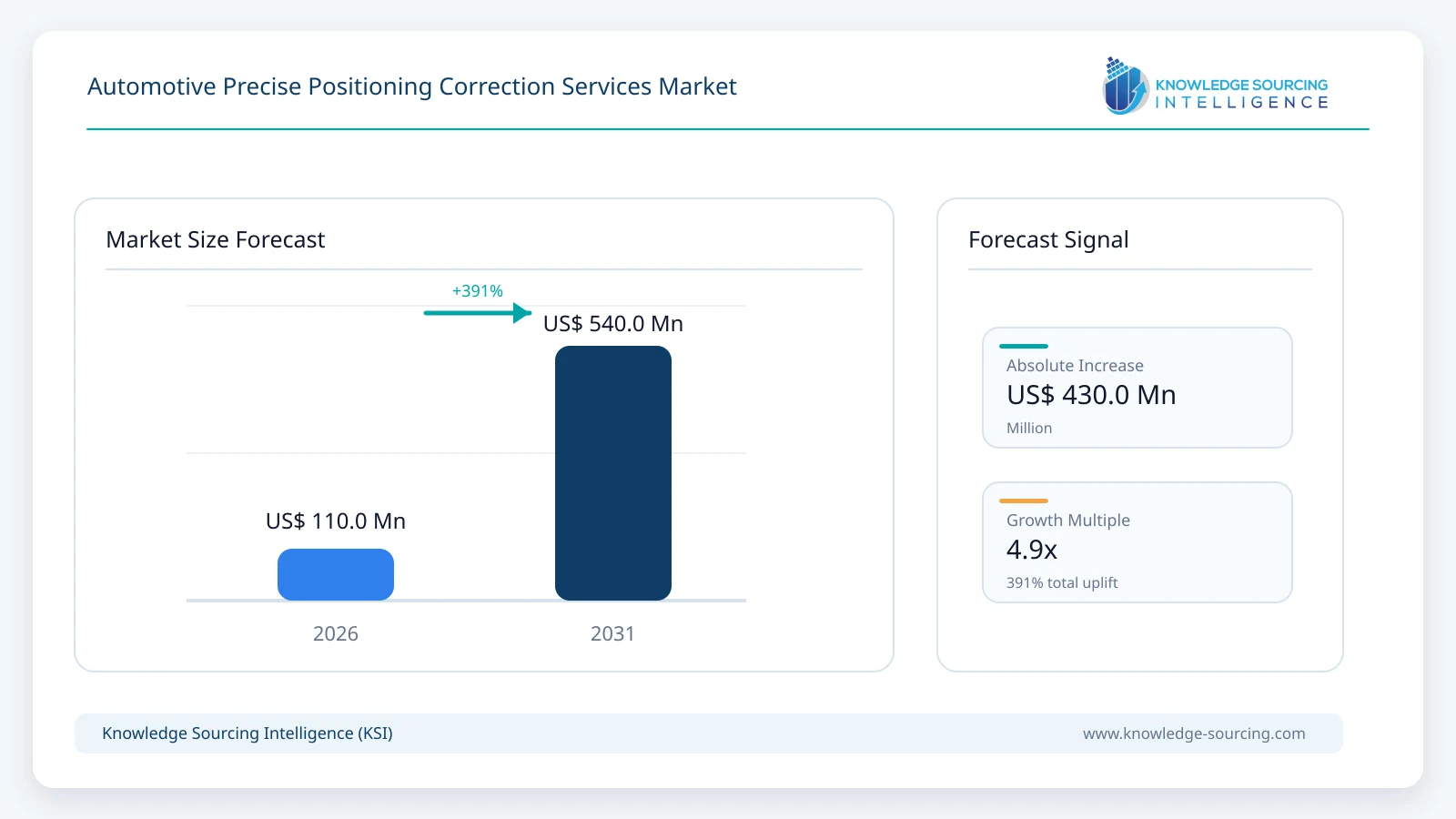
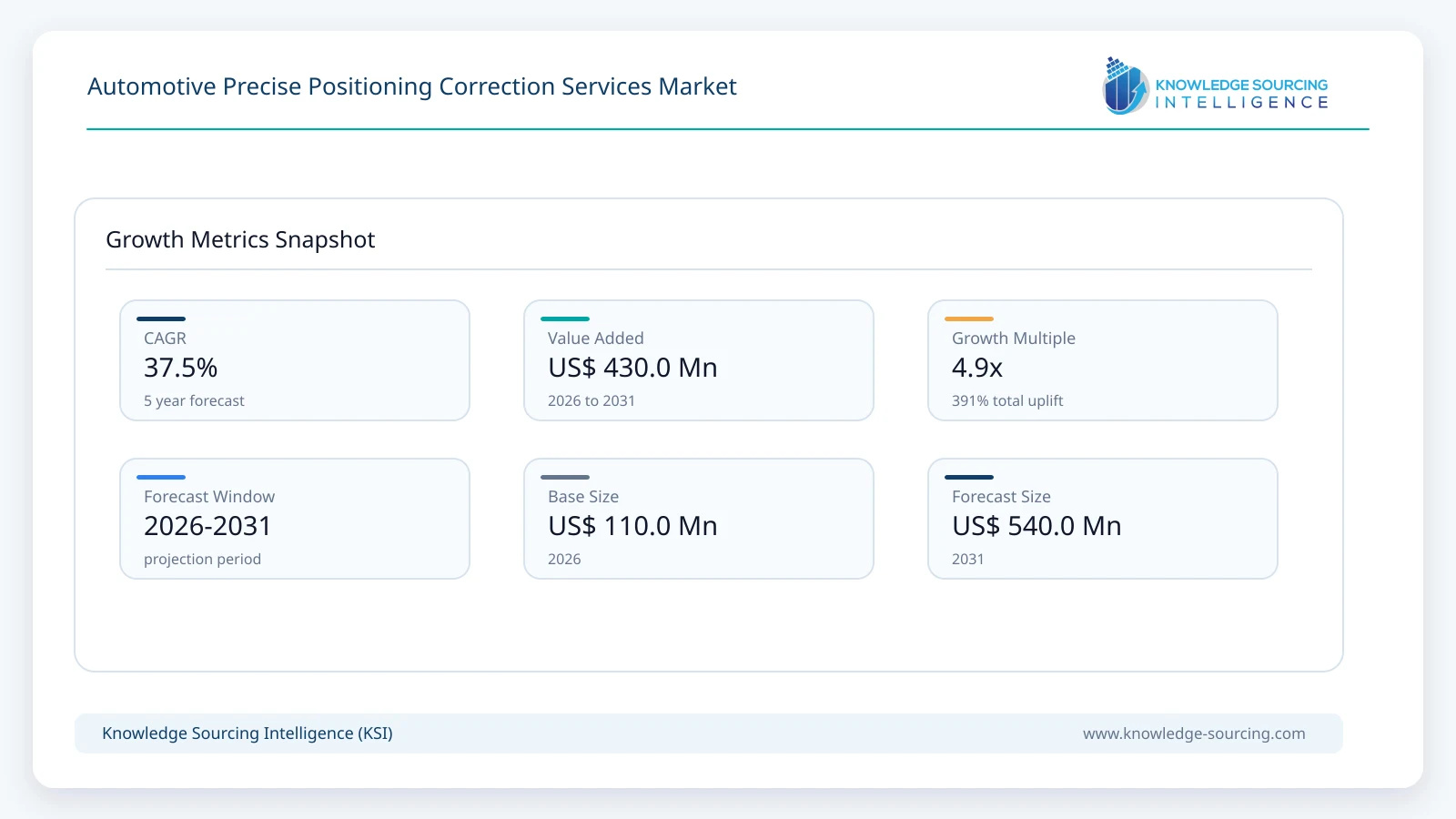
The Automotive Precise Positioning Correction Services Market is projected to expand at a CAGR of 37.5%, increasing from USD 110.0 million in 2026 to USD 540.0 million by 2031.
Highlights:
- 1Global correction-service revenue is estimated at USD 110 million in 2026 and forecast at USD 540 million in 2031.
- 2PPP-RTK and SSR correction services represent 52.7% of estimated 2026 revenue and remain the largest technology segment.
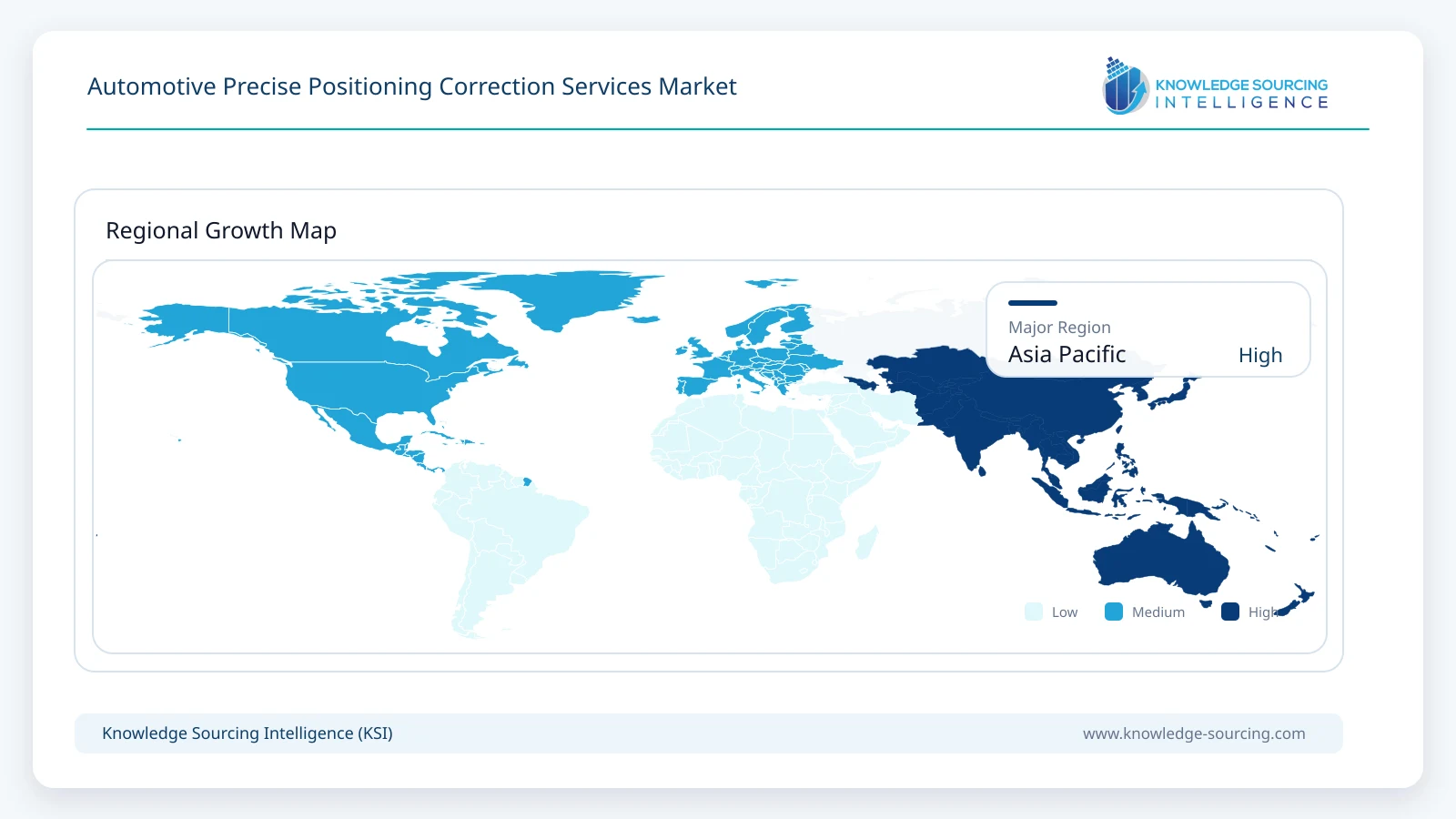
- 3Asia Pacific leads the regional model in 2026, supported by China, Japan and South Korea.
- 4Factory-integrated production vehicle services are projected to become the leading deployment pathway by 2031.
- 5GMV has documented production GNSS correction services for BMW, while Swift, Trimble and Hexagon provide automotive-oriented alternatives.
- 6Public free-of-charge Galileo HAS corrections increase pressure on commercial services to offer integrity and dependable availability.
GNSS correction infrastructure connects surveyed reference-station networks, atmospheric error models, secure service delivery, and in-vehicle positioning engines. TerraStar-X Enterprise, Skylark Cx, Trimble RTX and GMV GSharp illustrate distinct approaches to providing wide-area corrections for safety-relevant automotive localization. The data can travel over cellular networks, and some services support additional satellite delivery. Automotive buyers assess the cost and integrity of that continuous data feed alongside the hardware and onboard fusion algorithms used to compute a final vehicle position.
Automotive procurement increasingly treats correction service availability as a multiyear platform obligation rather than a short test subscription. Vehicle manufacturers and Tier 1 integrators must verify regional coverage, response time, receiver compatibility, security provisions, and loss-of-service behavior. GMV has documented safe correction services in production BMW applications, while Trimble and Swift Navigation have expanded chipset and computing-platform partnerships. Their developments indicate a path from engineering deployments toward repeatable vehicle-program licensing, although each supplier offers a different combination of software and correction data.
Market Overview
Correction streams that resolve GNSS clock, orbit, and atmospheric errors support lane-level positioning when standard satellite navigation alone is insufficient for the vehicle application. Automotive location systems then combine corrected GNSS with inertial measurements, wheel speed and other sensors to maintain continuity through tunnels or dense urban corridors. The value of commercial corrections is strongest where OEMs need consistent cross-border performance, reliable service-level commitments, and positioning-integrity information for automated functions.
Automotive correction providers operate reference-station networks, model atmospheric effects, and distribute data in formats including RTCM and SSR to vehicle receivers. Swift Navigation offers automotive-focused Skylark corrections, Hexagon provides TerraStar-X Enterprise, and Point One Navigation supplies network RTK to customers developing autonomous vehicles. The competitive market is shaped by geographic coverage, the ability to support varied GNSS chipsets, and the economics of maintaining a correction stream across a vehicle fleet for several years.
Market Trends
Safety-Qualified Integrity and Protection Information
Automotive correction suppliers are adding integrity monitoring to the familiar accuracy metric because safety-relevant driving functions must judge when a satellite-based position can be trusted. Hexagon presents end-to-end correction integrity within TerraStar-X Enterprise, while GMV combines correction data with automotive safety engineering in GSharp. Such services support a more demanding purchasing specification than a conventional surveying subscription.
Protection levels and trustworthy continuity can strengthen supplier differentiation in Level 2+ and Level 3 programs. Safety qualification also raises product-validation and network-operations costs, making long-term OEM contracts more commercially important. The 2031 forecast accordingly places growing value in factory-connected subscriptions rather than relying mainly on short-lived development trials.
Receiver-Agnostic Correction Streaming
Automotive OEMs increasingly choose GNSS processors and domain-computing platforms independently of the company operating correction stations. Swift Navigation pairs Skylark with STMicroelectronics receivers and NVIDIA development software, and Hexagon describes hardware-agnostic service integration. Open transport and message interfaces improve sourcing flexibility by allowing multiple compatible receiver architectures to use one subscribed correction feed.
Correction service vendors benefit when a program can retain its data provider despite later GNSS module redesigns. Automotive buyers, however, still require end-to-end qualification across receiver firmware, positioning engine, and update procedures. Providers with repeatable interoperability tools should reduce qualification lead time and gain access to higher-volume vehicle platforms.
Regional Expansion of Network Coverage
Trimble expanded its VRS service presence in Japan through the September 2026 Terasat acquisition, extending a reference-station distribution model already used in several professional positioning markets. The earlier KT agreement in South Korea demonstrates how mobile network operators can distribute high-accuracy corrections with connectivity services. Such arrangements are commercially relevant in densely connected automotive regions where high network availability is achievable.
Automotive manufacturers source global platforms but activate positioning features only where mapped driving capabilities, local network coverage, and service contracts permit. Broad geographic availability improves an OEMs ability to deploy similar features in multiple countries, while regional atmospheric models remain critical to rapid convergence. Expansion therefore tends to increase the addressable subscriber base before producing uniform revenue across all markets.
Hybrid Delivery and Resilience Architecture
Automotive correction delivery is increasingly designed around low-bandwidth cellular streams supported by fallback mechanisms for poor coverage. Trimble supplies satellite and IP paths for its RTX family, while point-to-point and network-based RTK remain useful in high-density corridors. The purchased correction layer must be integrated with in-vehicle dead reckoning so temporary losses do not translate directly into unstable driver assistance behavior.
Hybrid delivery is not a replacement for assessing local multipath, satellite obstruction or deliberately corrupted GNSS signals. Automotive customers must test the complete positioning stack, including message age, latency and reacquisition behavior. Distinct hybrid subscription products can command a premium when the resulting continuity has been demonstrated against an OEM operating-domain requirement.
Public Accuracy Infrastructure and Private Differentiation
The European Galileo High Accuracy Service delivers free PPP correction information, providing a useful alternative to commercial offerings for compatible equipment. Private providers therefore cannot assume that all improvements in GNSS accuracy will generate subscription revenue. Paid services instead compete through convergence speed, regional atmospheric modeling, integrity guarantees, integration support and contractual reliability.
Automotive demand for certified and monitored correction streams is likely to remain concentrated in use cases where a free global correction feed does not satisfy feature-availability or safety requirements. Open public corrections can also expand the population of compatible receiver devices. That combination encourages commercial suppliers to improve their value-added service layer rather than rely solely on raw positioning accuracy.
Segment Analysis
By Correction Technology: PPP-RTK and SSR Services
PPP-RTK and state-space representation services hold the largest modeled correction-technology share, at 52.7% of 2026 revenue, because they support regional atmospheric corrections with scalable transmission to many vehicles. GMV GSharp and TerraStar-X Enterprise both illustrate approaches that combine precision with automotive integrity needs, while standard data interfaces help connect correction processing to a wider set of receivers.
The forecast allocates USD 333 million to this category in 2031 as production vehicle programs scale in regions with established reference-station networks. The revenue potential depends less on maximum laboratory accuracy than on consistent field performance and affordable per-vehicle service procurement.
By Delivery Architecture: Cellular and IP Streaming
Cellular and IP correction delivery accounts for an estimated 66.4% of global 2026 revenue, reflecting the prevalence of connected telematics and the relatively low data demand of GNSS correction messages. Automotive buyers can distribute one correction feed through their existing connectivity architecture while keeping positioning algorithms on the vehicle. HERE and Swift Navigation illustrate correction-data services accessible through software interfaces.
By 2031, the model assigns USD 409 million to cellular and IP correction streaming as factory-integrated subscriptions gain volume. Satellite continuity remains commercially useful in isolated corridors, but mainstream connected vehicle platforms favor low-cost IP distribution where networks are sufficiently reliable.
By Application: Automated Driving and ADAS Localization
Automated driving and ADAS localization accounts for an estimated USD 45 million in 2026 as vehicle manufacturers use high-accuracy absolute position to support feature availability and confidence in the road geometry. GMV production work with BMW provides a direct example of correction data used within an automotive safety architecture. Unlike general map navigation, the application requires measured availability and clear behavior when positioning confidence degrades.
The forecast increases this application to USD 288 million in 2031 as additional vehicle platforms adopt paid correction services. Fleet trials and robotaxi deployments remain valuable early customers, but OEM-scale factory integration provides the stronger long-term volume opportunity.
By Revenue Model: Recurring Vehicle and Fleet Subscriptions
Annual per-vehicle and fleet correction subscriptions represent USD 70 million in estimated 2026 revenue because correction stations, cloud processing and delivery infrastructure continue to operate after the initial hardware installation. Vehicle manufacturers may purchase service access centrally or incorporate it within connected-feature contracts. A purchased subscription can cover several driving features while still representing one correction-data revenue stream.
Recurring subscriptions are projected to contribute USD 400 million by 2031, above the share generated by standalone engineering. Growth depends on active paying vehicles, renewal assumptions, service tiers and procurement discounts rather than the total number of vehicles sold with GNSS hardware.
Market Drivers
Expansion of Hands-Off Driver Assistance Programs
Automakers adding higher-level highway assistance increasingly require a stable absolute-location reference for route matching and operating-domain checks. GMV supplies BMW with safe correction data and a complementary positioning engine, demonstrating that these functions can be delivered as a commercial service in production vehicles. High-accuracy correction data help reduce the positional uncertainty that standard GNSS would leave to onboard sensors alone.
OEM-scale licensing changes the revenue profile because one validated stream can be reused across many vehicles on the same platform. The automotive correction supplier must still prove availability and integrity across regions, creating longer qualification cycles but also stronger recurring service relationships.
Commercialization of Safety and Integrity Services
Automotive safety teams evaluate protection information, data age and failure monitoring alongside the nominal accuracy of positioning corrections. TerraStar-X Enterprise and GMV GSharp illustrate correction networks designed for safety-relevant ADAS requirements, while Swift offers an automotive-oriented integrity service. Suppliers able to document safety architecture can address higher-value contracts than generic mapping applications.
Customer qualification converts cloud operations and reference-station monitoring into differentiated service content. It also supports multiple years of contracted delivery after vehicle launch, provided the correction service maintains the agreed integrity and availability.
Better Integration with Automotive Chipsets and Compute
GNSS correction adoption becomes more practical when standard receiver platforms and vehicle computing stacks are prepared to consume the service. In 2025, STMicroelectronics worked separately with Trimble and Swift Navigation on Teseo VI integrations, and Swift extended its automotive positioning tools toward NVIDIA DRIVE in January 2026. These developments reduce the engineering effort needed to bring correction data into vehicle localization software.
The resulting ecosystem makes the correction provider less dependent on selling its own physical GNSS module. OEMs can retain familiar sourcing channels while procuring the correction stream as a managed service. This architecture supports growth in premium and mass-market ADAS programs.
High-Density Regional Network Expansion
Network RTK and PPP-RTK services benefit from surveyed reference stations and well-calibrated atmospheric corrections along major vehicle routes. Trimble strengthened its Japanese VRS network presence in 2026, and Point One added network RTK delivery to its existing license. More continuous coverage gives mobility customers a better basis for choosing a national or regional service agreement.
Regional network improvements can support automotive deployments beyond a few mapped test corridors, but network reach does not automatically equal paid production installations. The modeled growth uses service availability as an adoption enabler, together with separate assumptions about vehicle qualification and active subscriptions.
Autonomous and Commercial Fleet Demand
Commercial autonomous fleets need accurate location across depot operations, road junctions and route transitions, particularly when cameras or lane markings provide uncertain visual cues. Point One markets correction services for autonomous passenger vehicles and heavy trucking, while Swift documents correction products for fleet and mobility applications. Operators can purchase correction services against a manageable number of vehicles before large passenger-car rollout.
Fleet contracts provide early recurring revenue and operational evidence for correction providers. Their per-vehicle value can exceed consumer automotive procurement where service coverage and downtime penalties are more demanding, although eventual factory volumes may reduce average revenue per vehicle.
Market Restraints
Coverage Gaps and Urban GNSS Impairment
High-precision correction streams cannot fully eliminate errors caused by multipath, satellite obstruction or temporary loss of observation in tunnels and dense urban environments. Automotive localization therefore relies on inertial fusion and wheel odometry to maintain continuity. Buyers must validate the complete positioning system against their operating domain rather than purchasing a correction subscription solely on a stated accuracy figure.
Correction network coverage can also vary between countries, raising the cost of supporting one global vehicle program. OEMs may restrict feature activation where service performance cannot be demonstrated consistently, delaying subscription-scale revenue.
Safety Validation and Long-Term Service Obligations
Positioning corrections used within hands-off driving features require monitoring of integrity, continuity and failure conditions that is more demanding than ordinary navigation service procurement. A provider may need redundant processing sites, security controls, time synchronization and extensive validation with the vehicle positioning engine. These requirements can significantly increase the cost of converting a prototype into a series-qualified service.
Automotive suppliers must commit to supporting multiple model years and in-field software updates. Reference-network outages, changing receiver firmware and service migration can all trigger additional testing, so contract economics depend on the whole operational life of the vehicle.
Free Public Correction Services and Price Pressure
Galileo HAS makes high-accuracy PPP corrections available without a commercial subscription, introducing a genuine substitute for applications that can tolerate its documented service characteristics. Conventional satellite augmentation and network-based public positioning assets also place a ceiling on the price customers will pay for baseline improvements. A private correction vendor must therefore justify the premium through reliability, convergence and service-level support.
Vehicle manufacturers procuring very large fleets may further negotiate low per-vehicle rates because each extra correction stream can be distributed at comparatively low marginal data cost. Growth in subscribers therefore need not translate into equal growth in average service pricing.
Signal Security and Data-Integrity Exposure
GNSS correction data must be authenticated and delivered through secure channels when used for safety-relevant localization. Receiver spoofing, intentional interference and compromised correction transport can produce incorrect or untrustworthy position estimates. ESA demonstrated a Galileo signal-authentication test in September 2026, underscoring the broader industry effort to protect satellite positioning against deception.
Automotive OEMs may require suppliers to align service monitoring, incident response and software-update procedures with vehicle cybersecurity practices. These controls create integration cost and can slow new vendor approval even when the underlying accuracy performance is adequate.
Procurement Complexity and Split Supplier Responsibility
Automotive high-accuracy positioning is often assembled from a GNSS receiver, inertial sensors, onboard positioning software, map services and a separate correction provider. Trimble, STMicroelectronics, GMV and Swift offer different combinations of these elements, giving vehicle manufacturers sourcing flexibility but complicating responsibility for end-to-end performance. Contract allocation can become difficult when a localization failure involves several independently supplied components.
Tier 1 integrators may prefer bundled positioning packages where a single supplier accepts more responsibility for calibration and system validation. Independent correction operators consequently need interoperable interfaces, clear service obligations and commercial terms that fit OEM platform procurement.
Regional Outlook
Asia Pacific
China, Japan and South Korea account for much of the Asia Pacific positioning-correction opportunity because vehicle makers and network operators are actively developing connected driving functions and high-precision GNSS infrastructure. China has supplier-reported FindAUTO vehicle installations, while Trimble and KT announced a correction-service distribution partnership in South Korea. These activities support the region’s leading estimated 2026 revenue share of 34.5%.
Asia Pacific demand is forecast to increase as Japanese and Korean vehicle programs expand safety and localization services and Chinese manufacturers integrate high-accuracy positioning into more passenger-car platforms. Trimble’s 2026 acquisition of Terasat Japan strengthens the local reference-station network offering, but future automotive service revenue will depend on OEM procurement and active feature subscriptions rather than network coverage alone.
North America
The United States has an established automotive autonomy and ADAS development ecosystem in which correction services are bought both for production-positioning stacks and engineering fleets. Swift Navigation, Trimble and Point One offer automotive-appropriate correction products, and Swift’s January 2026 integration work with NVIDIA connects corrections more closely to automated-driving development workflows. North America is estimated to represent USD 35 million in 2026 revenue.
Growth through 2031 is expected to come from more factory-connected safety applications and commercial autonomous operations in the United States and Canada. North American suppliers have strong software and reference-network capabilities, yet buyers must verify operation across large rural corridors and GNSS-challenged urban areas. Vehicle-specific service agreements and integrity guarantees should influence competitive selection as deployment moves beyond test fleets.
Competitive Landscape
Automotive correction services are supplied by specialist cloud GNSS providers, industrial positioning companies and mobility data-platform operators. Swift Navigation focuses on automotive-integrity correction services and receiver-agnostic integrations; Trimble supplies RTX and VRS networks with automotive chipset partnerships; and Hexagon markets TerraStar-X Enterprise with end-to-end correction integrity. GMV combines production automotive correction services with certified positioning software, while Point One offers network RTK and sensor-fusion tools for autonomous and ADAS customers.
Regional providers and adjacent mapping services create meaningful competitive pressure. Qianxun Spatial Intelligence has reported production FindAUTO positioning deployments in China, and HERE provides separately licensed HD GNSS correction data through developer interfaces. Service owners compete on verified geographic coverage, convergence time, integrity monitoring, interoperability and multiyear support. Supplier revenue shares cannot be inferred from advertised vehicle compatibility or partner counts because a commercial positioning package may include hardware and onboard software in addition to corrections.
Recent Developments
8 September 2026: Trimble announced its acquisition of Terasat Japan, expanding VRS correction service coverage in Japan; broader local network reach improves the potential for automotive service contracts.
5 August 2026: Point One Navigation launched Network RTK delivery under its True RTK license, allowing a customer to select single-baseline or network correction delivery without buying a second product.
2 June 2026: Swift Navigation reported its Skylark positioning service had received the 2026 AutoTech ADAS and Safety Technology Award, highlighting interest in independent localization integrity; an award is not a vehicle-volume disclosure.
6 January 2026: Swift Navigation announced a Starling SAL plug-in for NVIDIA DRIVE AGX and DriveWorks, reducing engineering work required to integrate high-accuracy positioning into vehicle development platforms.
9 July 2025: Trimble and KT Corporation announced planned bundled telecom and RTX Fast correction services across South Korea for automotive and IoT customers.
3 March 2025: Swift Navigation and STMicroelectronics introduced an integrated offering combining Teseo VI GNSS chip technology with cloud-delivered Skylark corrections for automotive safety and autonomy.
Market Outlook
Automotive correction-service revenue is forecast to rise from USD 110 million in 2026 to USD 540 million in 2031 as more ADAS and automated-driving platforms maintain active high-accuracy localization contracts. The largest forecast shift is toward factory-integrated production vehicles, where service access can extend across a model line rather than being limited to engineering fleets. Connected distribution remains the leading architecture, with safety-qualified PPP-RTK and state-space corrections capturing a growing proportion of demand.
Positioning service competition will increasingly be decided by dependable coverage, integrity support and compatibility with OEM hardware choices, rather than a single laboratory accuracy claim. Public high-accuracy GNSS streams will continue to reduce the price of basic corrections, while vehicle manufacturers seek higher-assurance commercial alternatives for demanding functions. Providers that combine robust monitoring with efficient regional delivery and transparent service commitments are positioned to capture the strongest recurring contracts.
Automotive Precise Positioning Correction Services Market Scope:
| Report Metric | Details |
|---|---|
| Total Market Size in 2026 | USD 110.0 million |
| Total Market Size in 2031 | USD 540.0 million |
| Forecast Unit | USD Million |
| Growth Rate | 37.5% |
| Study Period | 2021 to 2031 |
| Historical Data | 2021 to 2024 |
| Base Year | 2025 |
| Forecast Period | 2026 – 2031 |
| Segmentation | Correction Technology, Delivery Architecture, Application, Customer Group |
| Companies |
|
Market Segmentation
By Correction Technology
PPP-RTK and SSR Services
Network RTK and VRS Services
Wide-Area PPP and RTX Services
Hybrid and Continuity Correction Services
By Delivery Architecture
Cellular and IP Correction Streaming
Integrated Cellular and Satellite Continuity
Satellite-Broadcast Correction Delivery
By Application
Automated Driving and ADAS Localization
Autonomous Test and Robotaxi Fleet Operations
HD Mapping and Localization Updates
Commercial Fleet and Logistics Precision
By Customer Group
Vehicle OEMs and Automotive Brands
Autonomy and Fleet Operators
Automotive Tier 1 and Computing Suppliers
Engineering and Mobility Integrators
By Revenue Model
Recurring Vehicle and Fleet Correction Subscriptions
Platform and Enterprise Correction Licenses
Integration, Qualification and Support Services
By Vehicle Type
Passenger Cars
Light Commercial Vehicles
Medium and Heavy Commercial Vehicles
Autonomous Shuttles and Specialty Road Vehicles
By Deployment Stage
Factory-Integrated Production Vehicle Services
Autonomous Trials and Preproduction Programs
Connected Fleet and Authorized Retrofit Services
By Geography
North America
United States
Canada
Mexico
South America
Brazil
Argentina
Others
Europe
Germany
United Kingdom
France
Italy
Spain
Netherlands
Nordic Countries
Others
Middle East and Africa
Saudi Arabia
United Arab Emirates
Israel
South Africa
Others
Asia Pacific
China
Japan
South Korea
India
Australia
Indonesia
Thailand
Taiwan
Others
Table of Contents
1. EXECUTIVE SUMMARY
1.1. Market Opportunity and Key Findings
1.2. Global Market Forecast, 2026–2031
1.3. Commercial and Technology Outlook
1.4. Regional Opportunity
2. MARKET SNAPSHOT
2.1. Market Overview
2.2. Market Definition
2.3. Scope of the Study
2.4. Market Segmentation
3. BUSINESS LANDSCAPE
3.1. Market Drivers
3.1.1. Expansion of Hands-Off Driver Assistance Programs
3.1.2. Commercialization of Safety and Integrity Services
3.1.3. Better Integration with Automotive Chipsets and Compute
3.1.4. High-Density Regional Network Expansion
3.1.5. Autonomous and Commercial Fleet Demand
3.2. Market Restraints
3.2.1. Coverage Gaps and Urban GNSS Impairment
3.2.2. Safety Validation and Long-Term Service Obligations
3.2.3. Free Public Correction Services and Price Pressure
3.2.4. Signal Security and Data-Integrity Exposure
3.2.5. Procurement Complexity and Split Supplier Responsibility
3.3. Market Opportunities
3.4. Porter's Five Forces Analysis
3.5. Industry Value Chain Analysis
3.6. Policies and Regulations
3.7. Strategic Recommendations
4. TECHNOLOGICAL OUTLOOK
4.1. PPP, PPP-RTK, SSR and Network RTK Corrections
4.2. Reference Station and Atmospheric Modeling Networks
4.3. Automotive Positioning Integrity and Safety Monitoring
4.4. IP, Cellular and Satellite Correction Transport
4.5. Receiver Interoperability and GNSS-Inertial Localization
4.6. GNSS Security, Spoofing Detection and Service Availability
5. AUTOMOTIVE PRECISE POSITIONING CORRECTION SERVICES MARKET BY CORRECTION TECHNOLOGY
5.1. Introduction
5.2. PPP-RTK and SSR Services
5.3. Network RTK and VRS Services
5.4. Wide-Area PPP and RTX Services
5.5. Hybrid and Continuity Correction Services
6. AUTOMOTIVE PRECISE POSITIONING CORRECTION SERVICES MARKET BY DELIVERY ARCHITECTURE
6.1. Introduction
6.2. Cellular and IP Correction Streaming
6.3. Integrated Cellular and Satellite Continuity
6.4. Satellite-Broadcast Correction Delivery
7. AUTOMOTIVE PRECISE POSITIONING CORRECTION SERVICES MARKET BY APPLICATION
7.1. Introduction
7.2. Automated Driving and ADAS Localization
7.3. Autonomous Test and Robotaxi Fleet Operations
7.4. HD Mapping and Localization Updates
7.5. Commercial Fleet and Logistics Precision
8. AUTOMOTIVE PRECISE POSITIONING CORRECTION SERVICES MARKET BY CUSTOMER GROUP
8.1. Introduction
8.2. Vehicle OEMs and Automotive Brands
8.3. Autonomy and Fleet Operators
8.4. Automotive Tier 1 and Computing Suppliers
8.5. Engineering and Mobility Integrators
9. AUTOMOTIVE PRECISE POSITIONING CORRECTION SERVICES MARKET BY REVENUE MODEL
9.1. Introduction
9.2. Recurring Vehicle and Fleet Correction Subscriptions
9.3. Platform and Enterprise Correction Licenses
9.4. Integration, Qualification and Support Services
10. AUTOMOTIVE PRECISE POSITIONING CORRECTION SERVICES MARKET BY VEHICLE TYPE
10.1. Introduction
10.2. Passenger Cars
10.3. Light Commercial Vehicles
10.4. Medium and Heavy Commercial Vehicles
10.5. Autonomous Shuttles and Specialty Road Vehicles
11. AUTOMOTIVE PRECISE POSITIONING CORRECTION SERVICES MARKET BY DEPLOYMENT STAGE
11.1. Introduction
11.2. Factory-Integrated Production Vehicle Services
11.3. Autonomous Trials and Preproduction Programs
11.4. Connected Fleet and Authorized Retrofit Services
12. AUTOMOTIVE PRECISE POSITIONING CORRECTION SERVICES MARKET BY GEOGRAPHY
12.1. North America
12.1.1. United States
12.1.2. Canada
12.1.3. Mexico
12.2. South America
12.2.1. Brazil
12.2.2. Argentina
12.2.3. Others
12.3. Europe
12.3.1. Germany
12.3.2. United Kingdom
12.3.3. France
12.3.4. Italy
12.3.5. Spain
12.3.6. Netherlands
12.3.7. Nordic Countries
12.3.8. Others
12.4. Middle East and Africa
12.4.1. Saudi Arabia
12.4.2. United Arab Emirates
12.4.3. Israel
12.4.4. South Africa
12.4.5. Others
12.5. Asia Pacific
12.5.1. China
12.5.2. Japan
12.5.3. South Korea
12.5.4. India
12.5.5. Australia
12.5.6. Indonesia
12.5.7. Thailand
12.5.8. Taiwan
12.5.9. Others
13. COMPETITIVE ENVIRONMENT AND ANALYSIS
13.1. Major Players and Strategy Analysis
13.2. Market Share Analysis
13.3. Agreements, Collaborations and Network Expansion
13.4. Competitive Dashboard
14. COMPANY PROFILES
14.1. Swift Navigation
14.2. Trimble Inc.
14.3. Hexagon AB (NovAtel)
14.4. GMV
14.5. u-blox AG
14.6. Point One Navigation
14.7. HERE Technologies
14.8. Qianxun Spatial Intelligence
15. APPENDIX
15.1. Currency
15.2. Assumptions
15.3. Base and Forecast Years Timeline
15.4. Key Benefits for Stakeholders
15.5. Research Methodology
15.6. Abbreviations
Navigate
Trusted by the world's leading organizations