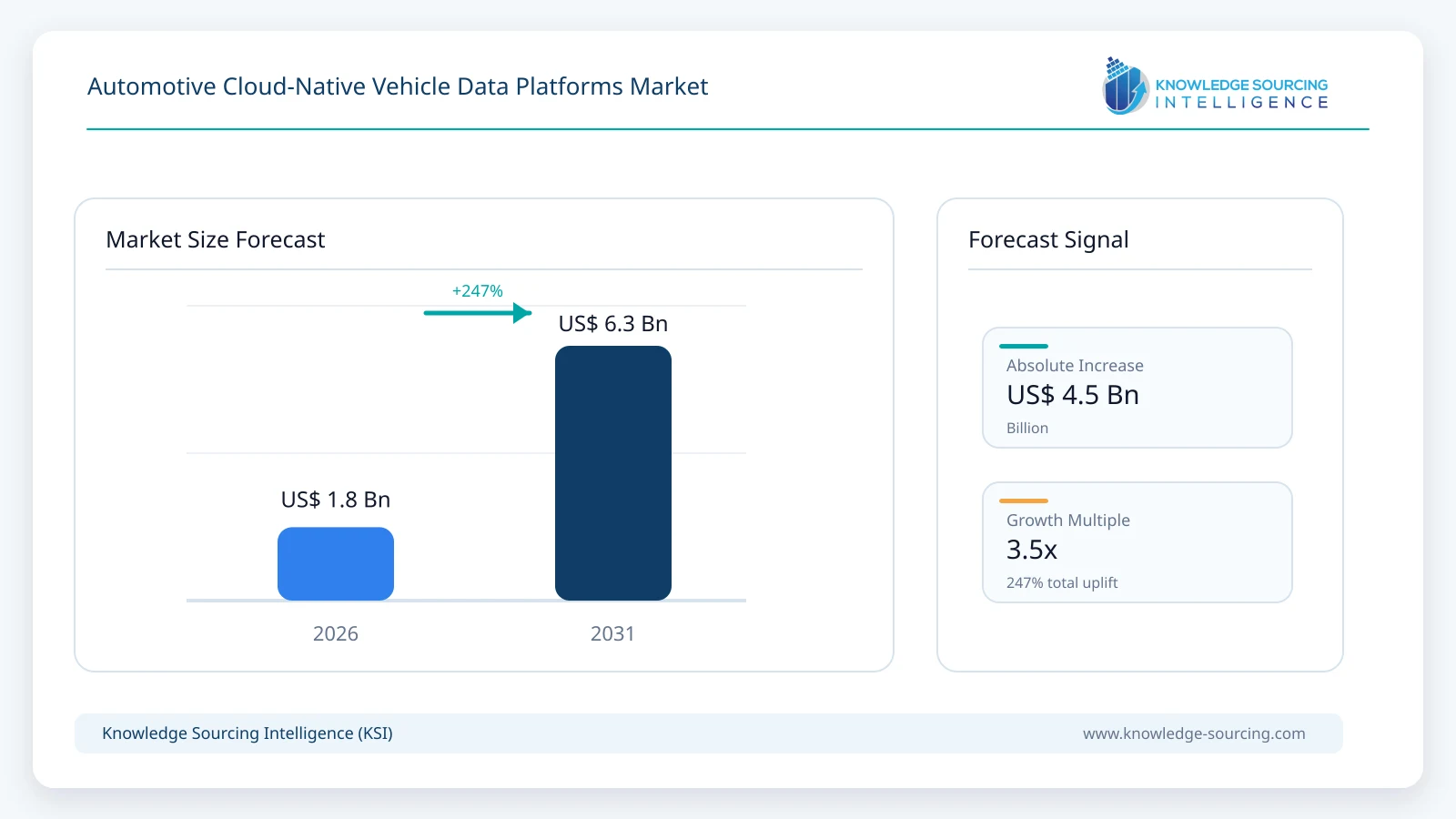
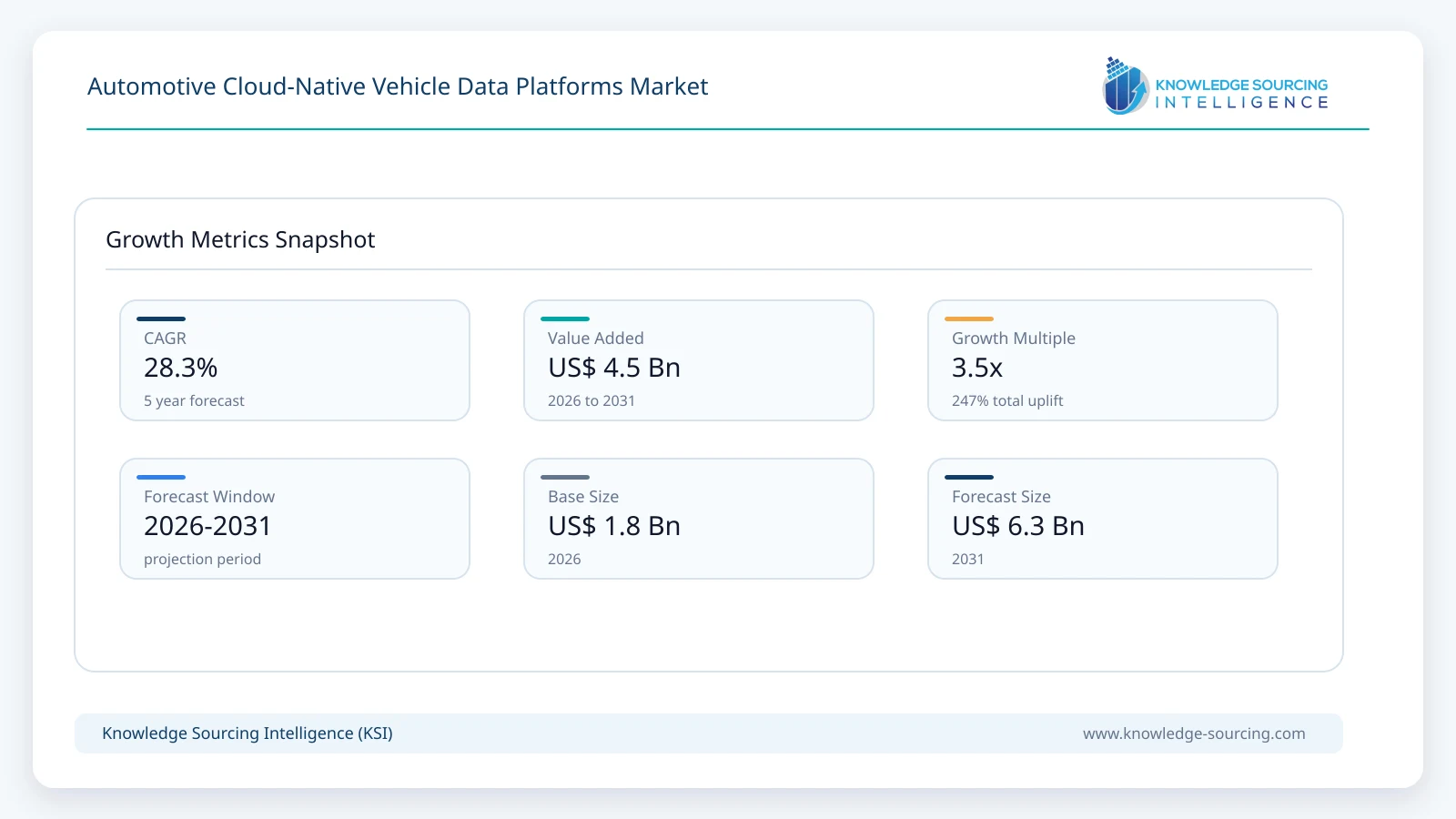
The Automotive Cloud-Native Vehicle Data Platforms Market is projected to expand at a CAGR of 28.3%, increasing from USD 1.80 billion in 2026 to USD 6.25 billion by 2031.
Highlights:
- 1Global platform revenue advances from USD 1.80 billion in 2026 to USD 6.25 billion in 2031 as recurring data pipelines expand across connected fleets.
- 2Vehicle-linked platform access represents about 56% of 2026 revenue and becomes a larger contributor as qualifying active vehicles rise.
- 3Cloud-native collection increasingly uses events and policies to reduce unnecessary uploads while retaining vehicle-quality evidence.
- 4Public-cloud services lead deployment, while hybrid designs gain share as data selection moves closer to vehicles.
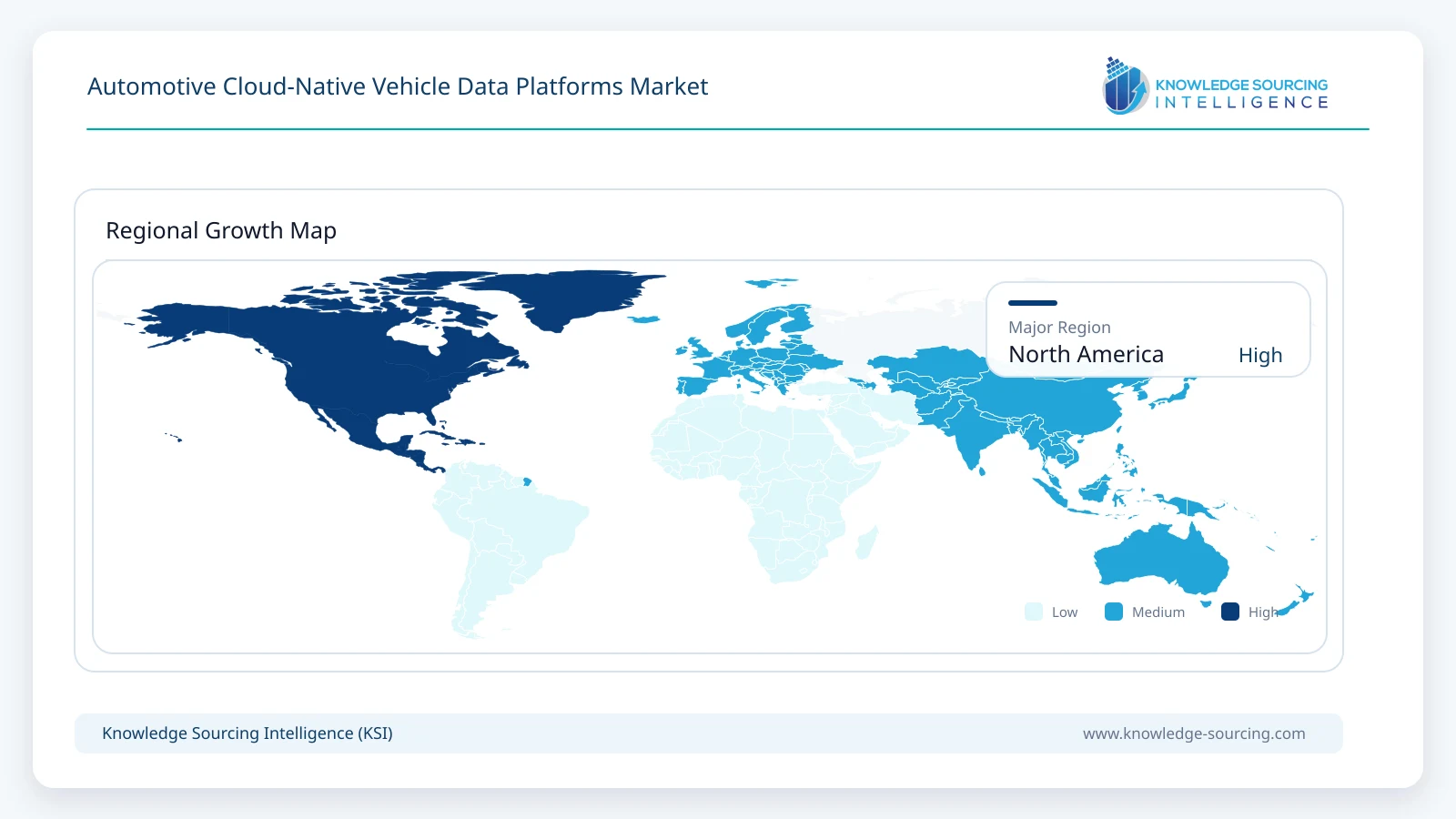
- 5North America has the largest estimated 2026 revenue base; Asia Pacific becomes the largest regional market by 2031.
- 6Automotive data standards and explicit consent management influence supplier selection alongside compute capacity and price.
Cloud-native vehicle-data services connect the vehicle’s electronic architecture to an enterprise information environment that can scale from a small test fleet to several million customer vehicles. Their commercial components include rule-based data acquisition, streaming ingest, signal normalization, storage governance, developer APIs, and platform observability. Modern deployments commonly combine an in-vehicle selection agent with streaming cloud infrastructure to avoid uploading data that has limited operational or engineering value.
Automakers purchase this capability through several contracting routes: per-vehicle platform access, enterprise-wide data foundation agreements, and project-specific integration and operations. The choice depends on fleet size, in-house software capability, regional privacy requirements, and whether the buyer needs continuous product engineering data or consumer-service operations. Automotive data can also be shared with selected suppliers, dealers, insurers or fleet operators through managed permission and API frameworks.
COVESA’s Vehicle Signal Specification offers a common description of vehicle signals, while its vehicle-data access standards help reduce the effort needed to use data across differently designed vehicles. Microsoft, AWS and Google Cloud provide scalable cloud services, with Sonatus, Aeris, WirelessCar, Geotab and other specialists adapting acquisition, permission handling and fleet interfaces to automotive requirements. Spending growth reflects broader deployment of those functions across vehicle lifecycles rather than increases in raw data volume alone.
Market Overview
Connected vehicles produce technical information that is valuable only when it can be collected in a consistent format, linked to a vehicle and analyzed within the time needed for an operating decision. Cloud-native platforms use elastic message processing and managed data stores to keep telemetry, diagnostics, battery signals and software-event histories accessible across engineering, fleet and customer-service organizations. BMW’s Azure-based development-data system illustrates how a cloud architecture can organize more than 10,000 vehicle signals without relying on repetitive manual transfer workflows.
Vehicle-data suppliers are increasingly competing on data selection and semantic consistency rather than raw ingest capacity. COVESA maintains a vehicle-signal vocabulary that helps reduce supplier-specific mapping work, while Sonatus Collector AI and Sibros support rule-based acquisition. Geotab’s factory-connected integrations with Hyundai and Polestar show how cloud-to-cloud access can also replace additional fleet hardware. These architectures reduce installation friction but make clear data-rights agreements and predictable API behavior more important.
Cloud platform operating costs depend on how often vehicles report, the proportion of signals transmitted, data retention, compute intensity, and the number of downstream consumers. Application development accelerates when the same governed data pipeline supports warranty diagnosis, charging insights, software validation and partner products. However, the same architecture needs region-specific security controls and a defined operating model for changes in vehicle software, connectivity availability, and service entitlements.
Market Trends
Selective Event-Driven Data Collection
Sonatus’s policy-driven collection tools and AWS’s vehicle telemetry architecture show how OEMs can request specific signals when a diagnostic or software condition occurs. Rather than transmit continuous streams from every sensor, event triggers capture useful evidence with the time, vehicle, and software context required for investigation. This shifts procurement toward the quality of collection rules, local filtering, and reliable synchronization between the vehicle and cloud.
Selective acquisition is particularly useful when vehicles have different hardware generations or when camera and radar events create large files. Engineering teams can narrow data campaigns to fault conditions, selected VIN groups, and defined service regions. Suppliers able to configure these policies without lengthy vehicle software changes can shorten validation cycles and reduce data-transfer costs, supporting growing platform budgets.
Unified Vehicle Signal Models and Governed APIs
COVESA’s VSS and VISS specifications address a longstanding problem in mixed-fleet data: the same technical measurement may arrive under different names, units, or access mechanisms. High Mobility packages OEM signals into one vehicle-data API, while WirelessCar focuses on the permissions and partner access needed to make the information useful outside the OEM. Standardized semantics are moving from optional integration aids toward core platform architecture.
OEMs and fleet operators benefit when new vehicle brands or software versions can be introduced without rebuilding every downstream application. Cloud-native schemas, catalogs, and entitlement services therefore earn budget alongside message transport and storage. The leading challenge is preserving signal accuracy and permissions when source systems or manufacturer agreements change.
Cloud Data Products Replace Isolated Data Lakes
AWS’s 2026 automotive data-platform guidance describes a governed foundation that publishes reusable data products from telemetry, charging, campaign, and service sources. BMW’s use of Azure illustrates a similar need for accessible engineering information, with application-level tools built on a shared data foundation. Enterprises are seeking defined ownership, access policy, and reliable quality for each dataset, rather than a central repository without accountable consumers.
Data products create a practical procurement distinction between general cloud capacity and automotive-specific schemas, workflows, and data services. A governed service can support multiple applications with less repetitive data preparation, although buyers must ensure that retention, cost allocation, and permissions remain auditable. This supports recurring platform management and catalog revenue.
OEM-Native Fleet Data Integrations
Geotab introduced factory-connected integrations with Hyundai and Polestar in 2026, allowing eligible commercial vehicles to contribute data without installing separate fleet devices. High Mobility expanded standardized access to Nissan and Hyundai data during the same year. Such arrangements make the vehicle-data API a commercially important layer between an automaker’s backend and its fleet or mobility partners.
Hardware-free integration can lower activation cost while increasing the number of vehicle brands visible in a fleet dashboard. Revenue increasingly follows active access to a supported vehicle or a contracted data package rather than a one-time device installation. Data availability, freshness and consent still vary by model and territory, giving suppliers with durable manufacturer relationships an advantage.
AI-Assisted Engineering and Data Access
Nissan Technical Centre Europe expanded its use of Sonatus Fastlane in October 2026 after work on event-driven fault analysis, using cloud-assisted tools to reduce investigation effort. Geotab launched an approved AI-compatible connector in June 2026, extending the ways organizations query live fleet information. These examples show AI being applied on top of established data pipelines rather than replacing the need for trustworthy acquisition and governance.
Engineering groups can use structured histories to identify recurring defects and evaluate software changes across fleets, while business users access approved data through conversational or workflow interfaces. Demand for these experiences increases the value of traceable source signals, authorization rules, and cost-controlled storage. Platform differentiation will depend partly on maintaining that foundation at automotive scale.
Segment Analysis
By Platform Function: Event Collection and Stream Orchestration
Event collection and stream orchestration represent the largest platform function in 2026, with an estimated 29% revenue share. OEMs need reliable acquisition across vehicle networks and connected gateways before downstream analytics can deliver value. Sonatus, Sibros and AWS address this workflow with policies, cloud pipelines and vehicle-event processing that make diagnostics and fleet histories consistently available.
As OEM data environments mature, governed lakehouses and quality services gain share because manufacturers want data that different divisions can trust and reuse. Ingestion remains essential, but platforms with superior normalization, lineage and permission controls may capture more value from each connected vehicle program than basic transport services.
By Deployment Architecture: Public Cloud Managed Services
Public cloud managed services lead 2026 deployments with an estimated 61% share because automakers can scale vehicle ingestion, stream processing, and storage without building every component internally. AWS, Azure and Google Cloud supply the core infrastructure, and automotive platform specialists make it suitable for vehicle-data security and data-model requirements.
Hybrid vehicle-cloud architectures gain share as more filtering, compression, and event recognition takes place inside the vehicle while cloud services maintain fleet-wide context. Sovereign and private platforms remain relevant for sensitive engineering data and regional requirements, but often require greater operational resources and careful interoperability planning.
By Application: Fleet and Connected Vehicle Operations
Fleet and connected vehicle operations account for an estimated 27% of 2026 spending as OEMs and operators combine real-time status, maintenance, charging, and vehicle availability information. Geotab, High Mobility, and WirelessCar demonstrate how cloud delivery lets operators use factory-connected data across different vehicle brands and operational systems.
Software engineering data and EV energy operations expand as more vehicle programs use field information to improve software releases and manage battery-related service performance. The business value is strongest where a single governed data foundation supports multiple teams without duplicating acquisition and contractual data-access costs.
By Customer Type: Vehicle OEMs
Automotive manufacturers are the principal customers for shared vehicle-data foundations, representing an estimated 58% of market revenue in 2026. Their purchases cover technical integration, long-lived data catalogs, fleet ingestion, and permissions for dealer or third-party services. Large OEM platforms can spread a common architecture across vehicle brands but require substantial migration and operating discipline.
Fleet and mobility operators represent a growing customer category because cloud-to-cloud OEM APIs can replace aftermarket installations for supported vehicles. These buyers favor clear per-vehicle pricing, consistent data availability, and easy integration with analytics applications, which shifts some platform spending toward service providers that specialize in multi-brand connectivity.
Market Drivers
Expansion of Connected OEM Fleet Operations
Aeris reported service reach across more than 45 million connected vehicles in October 2026, illustrating the scale at which cloud operating platforms can be deployed. Automotive OEMs require centralized management of vehicle status, diagnostics and service histories to support these fleets across model years and geographies.
Platform demand rises when manufacturers activate richer data features within already-connected vehicles and make the results available to operations and aftersales teams. Recurring service access and data-processing entitlements offer suppliers continuing revenue after the vehicle is sold.
Need for Faster Vehicle Quality Investigation
Nissan Technical Centre Europe’s 2026 expansion of Sonatus Fastlane provides a concrete example of the value of targeted data capture and cloud-assisted root-cause analysis. Vehicle engineering programs can use event data to recreate intermittent faults that are difficult to capture in repeated physical tests.
A common data pipeline allows engineering teams to compare fault conditions across vehicles and software releases. The ability to reduce investigation time supports platform buying decisions, especially for OEMs managing frequent software changes and complex electrical architectures.
OEM-Native API Integrations Reduce Deployment Friction
Geotab’s 2026 Hyundai and Polestar integrations connect factory-installed vehicle data directly to fleet software, while High Mobility added more manufacturer APIs. These integrations reduce the need for separate fleet hardware on eligible vehicles and shorten the activation process for vehicle-data services.
Lower activation costs expand the group of fleets that can justify a recurring data subscription. Their purchases create demand for data normalization, permissions and reliability monitoring, even when telematics hardware was included in the original vehicle.
Standardized Signal Semantics and Data Governance
COVESA’s signal-model and data-interface standards establish a shared foundation for understanding measurements from different vehicle designs. Automotive platforms can use consistent signal meanings to reduce the custom integration work needed when data is shared between OEMs, cloud systems, and external service providers.
Standardization supports enterprise buying because engineering, warranty and fleet teams can reuse a dataset under defined permissions rather than commission separate pipelines. The resulting emphasis on cataloging, auditability and data quality widens the addressable spending beyond simple telemetry transport.
Growth in EV, Software and Partner Data Applications
Battery condition, charging events, software updates and vehicle fault histories increasingly need to be combined in cloud services used by several OEM departments. AWS’s 2026 automotive data foundation links such datasets into governed data products, supporting consistent analysis across connected-vehicle operations.
As vehicles gain more software-managed functions, the volume and variety of useful events rises. Purchasers seek scalable platforms that can serve both present operational requirements and additional customer services without rebuilding the core data infrastructure for each application.
Market Restraints
Cloud Processing and Data-Transfer Expense
High-frequency telemetry can create substantial ingestion, transfer, and retention charges when OEMs scale across millions of vehicles. Companies must set collection policies that preserve diagnostic value without storing excessive raw data.
Excessive reporting increases operating cost per active vehicle and can erode the economics of recurring platform services. Supplier proposals therefore face scrutiny over compression, event filtering and lifecycle storage policy.
Privacy, Consent and Regional Data Requirements
Vehicle location, usage and individual driving data can be subject to contractual, privacy and cybersecurity restrictions across different territories. WirelessCar’s data-access services show why entitlement and permissions are operational requirements rather than optional features.
Automakers may need separate storage environments, regional processing, and more complex third-party agreements. These requirements add cost and delay to multi-market deployments, particularly when data crosses organizational boundaries.
Fragmented Vehicle Signals and Legacy Architectures
Vehicle fleets combine model years, network protocols, proprietary diagnostics, and different data reporting intervals. Even with common specifications, OEMs must validate mappings and maintain them as electronic architectures and software change.
Poor signal consistency can cause unreliable downstream dashboards or faulty engineering conclusions. Data governance and quality assurance consequently absorb budgets that some buyers would otherwise devote to application features.
Data Rights and Supplier Dependency
Cloud platforms often depend on contracts with OEMs, connectivity providers and specialist vendors for the information they deliver. High Mobility discloses that OEM data costs can form a substantial portion of the final per-vehicle charge.
Service providers have limited control over upstream access terms, regional eligibility and available signals. Contract revisions or loss of a manufacturer integration can interrupt the continuity that fleet and enterprise buyers expect.
Complex Migration and Organizational Adoption
Large manufacturers may operate independent development, warranty, connected-service, and commercial-fleet data systems. Combining them into a governed platform requires legacy interfaces, internal agreement on data ownership, and careful migration of operational services.
Migration schedules can slow new contracts even when the technical cloud design is available. Vendors able to phase deployments and keep existing workflows running are better placed to win long-duration platform projects.
Regional Outlook
North America
North America contributes an estimated 35% of global market revenue in 2026, supported by large cloud-service providers, software-platform developers and OEM connected-vehicle programs. AWS, Microsoft, Google Cloud, Sonatus, Sibros and Geotab serve different parts of the vehicle-data supply chain, from cloud operations to fleet API access. U.S. automotive engineering and commercial fleet demand also supports purchasing across diagnostics, software testing, and data management.
North American OEM and fleet customers typically emphasize scalable service agreements, integration with enterprise cloud systems and the reliability of connected-vehicle interfaces. Platform providers compete on a combination of recurring data costs, OEM program references and the ability to deploy regional security controls. Revenue continues to rise through 2031, although Asia Pacific expands more rapidly as major automotive markets increase connected-data deployment.
Asia Pacific
Asia Pacific is expected to be the fastest-growing region, increasing its modeled global share from 30% in 2026 to 37% in 2031. China, Japan, South Korea and India combine vehicle production, digital service development and large domestic connected-fleet ecosystems. Growth is driven by broader deployment of cloud data infrastructure, remote diagnostics and software engineering pipelines across established and emerging automotive manufacturers.
Regional deployment economics vary because manufacturers must balance local cloud ecosystems, data localization, vehicle cost targets and cross-border supplier relationships. Programs that combine vehicle-side filtering with locally managed cloud services are positioned to expand where infrastructure and privacy requirements differ. The leading opportunities are in platform standardization, battery and charging data services, and large-scale operational event processing.
Competitive Landscape
Hyperscale providers lead infrastructure supply, while automotive-focused vendors compete on interpreting vehicle signals, controlling data access and supporting production vehicle lifecycles. AWS and Microsoft offer cloud architecture and processing services; Google Cloud participates through data infrastructure and industry partnerships. Sonatus, Sibros and Aeris provide specialist vehicle-oriented acquisition and connected-platform capabilities. WirelessCar and High Mobility are stronger in data distribution, entitlement and normalized interfaces to OEM data.
OEM sourcing choices are influenced by whether the data platform can operate alongside existing telematics systems and vehicle software. Specialist companies often work with cloud hyperscalers rather than replace them, sharing contract value according to infrastructure, data-management and integration responsibilities. Suppliers with measured operating scale, approved vehicle interfaces and repeatable data models are better placed to compete for global programs than firms selling undifferentiated storage alone.
Recent Developments
20 October 2026: NTCE expanded use of the Sonatus Fastlane validation platform after event-driven data collection and fault-analysis work, illustrating a production-development application for cloud-connected vehicle data.
23 June 2026: Geotab and Toyota Connected announced a global alliance for connected fleet technologies, with rollout organized in phases rather than immediate worldwide deployment.
17 June 2026: Geotab launched an AI-compatible connector for approved access to MyGeotab data, extending the interfaces through which enterprise users can use vehicle data.
20 April 2026: High Mobility added Nissan as its 30th supported brand, expanding standardized access to charging, diagnostics, and vehicle-trip information.
16 April 2026: Sonatus made Collector AI and related offerings available through SDVerse, broadening the procurement route for its automotive vehicle-data technology.
30 March 2026: Geotab and Hyundai launched OEM-native telematics integration for supported Hyundai vehicles in Europe, enabling fleet data delivery without additional hardware.
Market Outlook
Automotive cloud-native data platforms will increasingly connect software-defined vehicle engineering with day-to-day vehicle operations. Suppliers will be required to handle complex signal histories, selective data capture, and secure access to shared data products as connected programs grow. Customers with several vehicle brands or electronic architectures will place particular value on standardization that reduces repeated integration work.
The greatest spending gains are expected in recurring active-vehicle access, supported by enterprise governance and integration services. OEMs can gain more value from existing cloud assets when diagnostic, energy, and service data is reused across applications, although buyers must manage the cost of ingest, privacy requirements, and the quality of OEM interfaces. Hybrid collection designs will help balance the need for timely information against bandwidth and retention expense.
Competitive differentiation will move toward reliable vehicle identity, signal provenance, permission controls, and developer access as basic cloud compute becomes more standardized. North American platform specialists retain substantial customer relationships, while Asia Pacific should contribute a growing share of demand. Cloud-native suppliers that demonstrate scalable automotive deployments and transparent operating costs will be positioned to win longer-term enterprise platform contracts.
Automotive Cloud-Native Vehicle Data Platforms Market Scope:
| Report Metric | Details |
|---|---|
| Total Market Size in 2026 | USD 1.80 billion |
| Total Market Size in 2031 | USD 6.25 billion |
| Forecast Unit | USD Billion |
| Growth Rate | 28.3% |
| Study Period | 2021 to 2031 |
| Historical Data | 2021 to 2024 |
| Base Year | 2025 |
| Forecast Period | 2026 – 2031 |
| Segmentation | Platform Function , Data Workload, Deployment Architecture, Application |
| Companies |
|
Market Segmentation
By Platform Function
Event Collection and Stream Orchestration
Vehicle Signal Normalization and Catalogs
Cloud Processing and Governed Lakehouses
Data APIs and Managed Exchange
Data Quality, Security and Observability
By Data Workload
Telemetry and Vehicle Diagnostics
Battery, Energy and Charging Data
ADAS and Sensor Event Metadata
Software, Feature and OTA Event Data
Fleet and Mobility Contextual Data
By Deployment Architecture
Public Cloud Managed Services
Hybrid Vehicle-Cloud Data Architecture
Private and Sovereign Cloud Deployments
By Application
Fleet and Connected Vehicle Operations
Vehicle Quality and Service Analytics
Software Engineering and Development Data
EV Energy and Charging Data Operations
Mobility Data Products and Partner APIs
By Customer Type
Vehicle OEMs
Tier 1 and Vehicle Software Suppliers
Fleet and Mobility Operators
Data and Service Ecosystem Integrators
By Revenue Component
Vehicle-Linked Data Platform Access
Enterprise Data Foundation Contracts
Engineering and Integration Services
By Vehicle Class
Passenger Vehicles
Commercial Vehicles
By Geography
North America
United States
Canada
Mexico
South America
Brazil
Argentina
Chile
Others
Europe
Germany
United Kingdom
France
Italy
Spain
Others
Middle East and Africa
Saudi Arabia
United Arab Emirates
South Africa
Israel
Turkey
Others
Asia Pacific
China
Japan
India
South Korea
Australia
Indonesia
Thailand
Taiwan
Others
Table of Contents
1. EXECUTIVE SUMMARY
1.1 Market Opportunity and Key Findings
1.2 Global Market Forecast and Segment Direction
1.3 Regional Market Outlook
2. MARKET SNAPSHOT
2.1 Market Overview
2.2 Market Definition
2.3 Scope of the Study
2.4 Market Segmentation
3. BUSINESS LANDSCAPE
3.1 Market Drivers
3.1.1 Expansion of Connected OEM Fleet Operations
3.1.2 Need for Faster Vehicle Quality Investigation
3.1.3 OEM-Native API Integrations Reduce Deployment Friction
3.1.4 Standardized Signal Semantics and Data Governance
3.1.5 Growth in EV, Software and Partner Data Applications
3.2 Market Restraints
3.2.1 Cloud Processing and Data-Transfer Expense
3.2.2 Privacy, Consent and Regional Data Requirements
3.2.3 Fragmented Vehicle Signals and Legacy Architectures
3.2.4 Data Rights and Supplier Dependency
3.2.5 Complex Migration and Organizational Adoption
3.3 Market Opportunities
3.4 Porter’s Five Forces Analysis
3.5 Industry Value Chain Analysis
3.6 Policies and Regulations
3.7 Strategic Recommendations
4. TECHNOLOGICAL OUTLOOK
4.1 Event-Driven Vehicle Data Collection
4.2 Cloud Streaming and Data Lakehouse Architecture
4.3 Vehicle Signal Normalization and VSS/VISS
4.4 Access Governance and Secure Data APIs
4.5 Hybrid Cloud and Edge Data Orchestration
5. AUTOMOTIVE CLOUD-NATIVE VEHICLE DATA PLATFORMS MARKET BY PLATFORM FUNCTION
5.1 Event Collection and Stream Orchestration
5.2 Vehicle Signal Normalization and Catalogs
5.3 Cloud Processing and Governed Lakehouses
5.4 Data APIs and Managed Exchange
5.5 Data Quality, Security and Observability
6. AUTOMOTIVE CLOUD-NATIVE VEHICLE DATA PLATFORMS MARKET BY DATA WORKLOAD
6.1 Telemetry and Vehicle Diagnostics
6.2 Battery, Energy and Charging Data
6.3 ADAS and Sensor Event Metadata
6.4 Software, Feature and OTA Event Data
6.5 Fleet and Mobility Contextual Data
7. AUTOMOTIVE CLOUD-NATIVE VEHICLE DATA PLATFORMS MARKET BY DEPLOYMENT ARCHITECTURE
7.1 Public Cloud Managed Services
7.2 Hybrid Vehicle-Cloud Data Architecture
7.3 Private and Sovereign Cloud Deployments
8. AUTOMOTIVE CLOUD-NATIVE VEHICLE DATA PLATFORMS MARKET BY APPLICATION
8.1 Fleet and Connected Vehicle Operations
8.2 Vehicle Quality and Service Analytics
8.3 Software Engineering and Development Data
8.4 EV Energy and Charging Data Operations
8.5 Mobility Data Products and Partner APIs
9. AUTOMOTIVE CLOUD-NATIVE VEHICLE DATA PLATFORMS MARKET BY CUSTOMER TYPE
9.1 Vehicle OEMs
9.2 Tier 1 and Vehicle Software Suppliers
9.3 Fleet and Mobility Operators
9.4 Data and Service Ecosystem Integrators
10. AUTOMOTIVE CLOUD-NATIVE VEHICLE DATA PLATFORMS MARKET BY REVENUE COMPONENT
10.1 Vehicle-Linked Data Platform Access
10.2 Enterprise Data Foundation Contracts
10.3 Engineering and Integration Services
11. AUTOMOTIVE CLOUD-NATIVE VEHICLE DATA PLATFORMS MARKET BY VEHICLE CLASS
11.1 Passenger Vehicles
11.2 Commercial Vehicles
12. AUTOMOTIVE CLOUD-NATIVE VEHICLE DATA PLATFORMS MARKET BY GEOGRAPHY
12.1 North America
12.1.1 United States
12.1.2 Canada
12.1.3 Mexico
12.2 South America
12.2.1 Brazil
12.2.2 Argentina
12.2.3 Chile
12.2.4 Others
12.3 Europe
12.3.1 Germany
12.3.2 United Kingdom
12.3.3 France
12.3.4 Italy
12.3.5 Spain
12.3.6 Others
12.4 Middle East and Africa
12.4.1 Saudi Arabia
12.4.2 United Arab Emirates
12.4.3 South Africa
12.4.4 Israel
12.4.5 Turkey
12.4.6 Others
12.5 Asia Pacific
12.5.1 China
12.5.2 Japan
12.5.3 India
12.5.4 South Korea
12.5.5 Australia
12.5.6 Indonesia
12.5.7 Thailand
12.5.8 Taiwan
12.5.9 Others
13. COMPETITIVE ENVIRONMENT AND ANALYSIS
13.1 Major Players and Strategy Analysis
13.2 Market Share Analysis
13.3 Mergers, Acquisitions, Agreements and Collaborations
13.4 Competitive Dashboard
14. COMPANY PROFILES
14.1 Amazon Web Services
14.2 Microsoft
14.3 Google Cloud
14.4 Sonatus
14.5 Sibros
14.6 Aeris
14.7 WirelessCar
14.8 Geotab
14.9 High Mobility
14.10 Upstream Security
15. APPENDIX
15.1 Currency
15.2 Assumptions
15.3 Base and Forecast Years Timeline
15.4 Key Benefits for Stakeholders
15.5 Research Methodology
15.6 Abbreviations
Navigate
Trusted by the world's leading organizations