
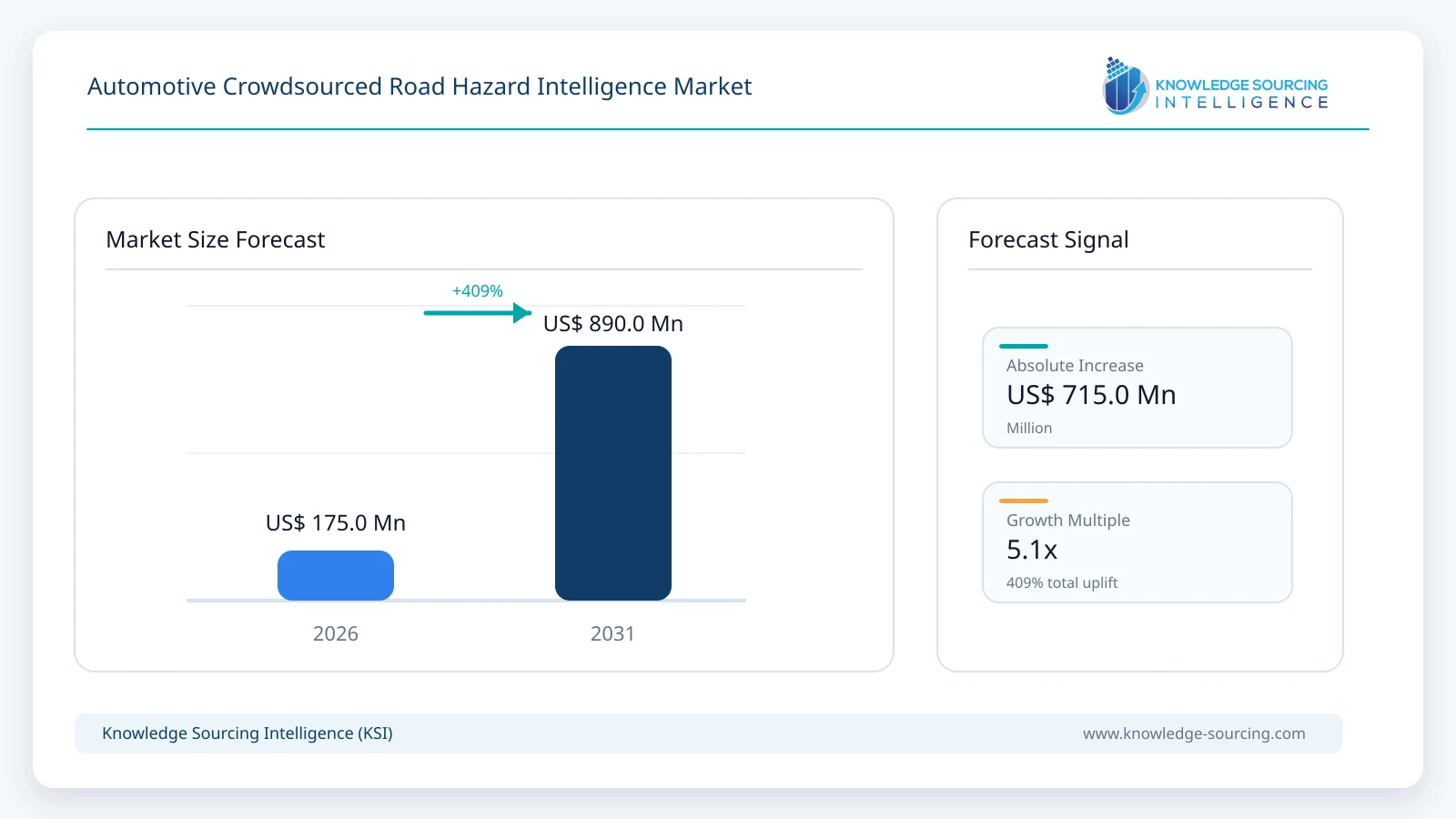
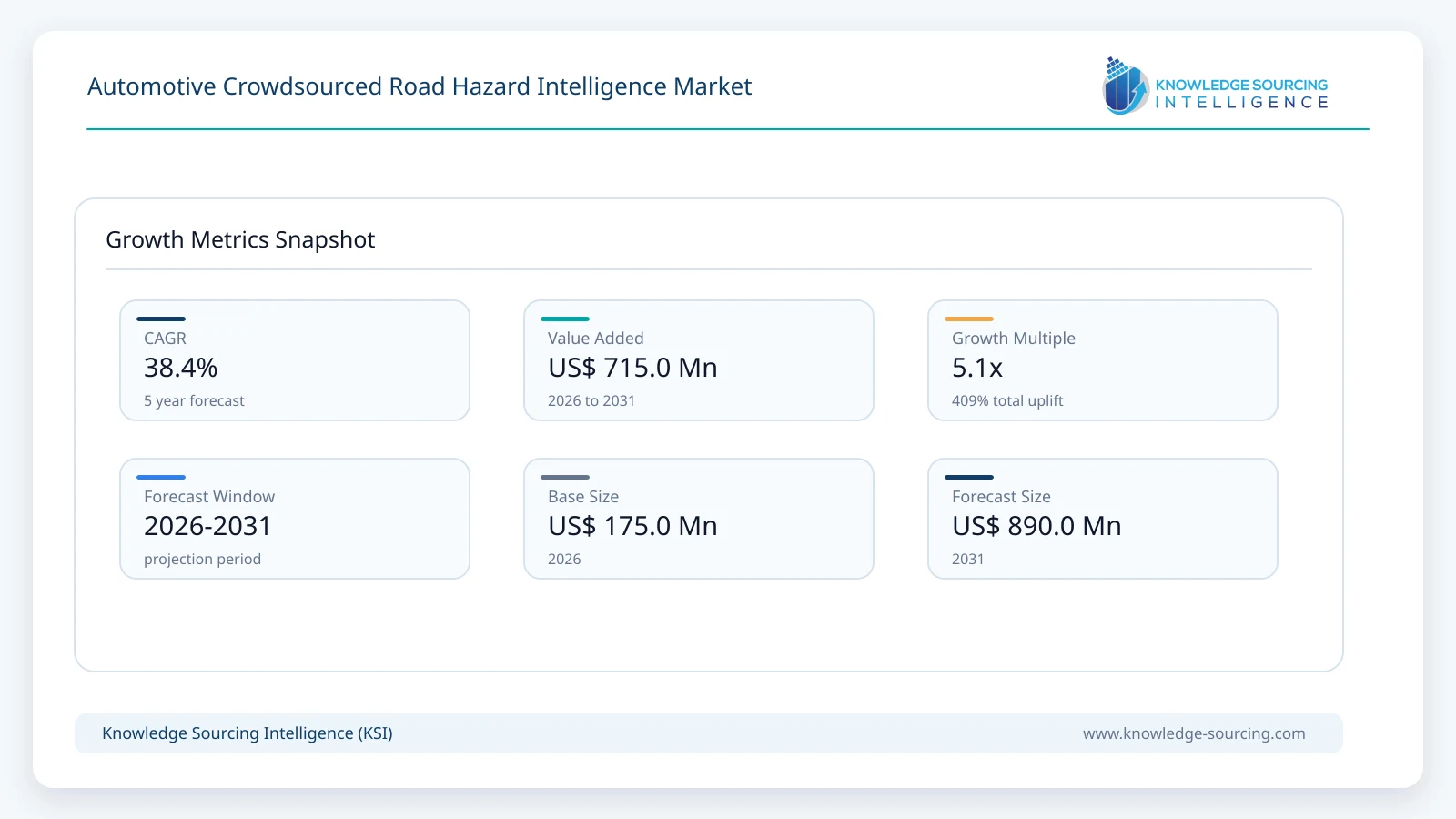
The Automotive Crowdsourced Road Hazard Intelligence Market is forecast to grow at a CAGR of 38.4%, reaching USD 890.0 million in 2031 from USD 175.0 million in 2026.
Highlights:
- 1The market is estimated at USD 175 million in 2026 and forecast to reach USD 890 million by 2031.
- 2OEM hazard-intelligence licenses account for approximately 53% of modeled 2026 market revenue.
- 3Automated vehicle telemetry is the leading intelligence input, supported by community and verified responder reports.
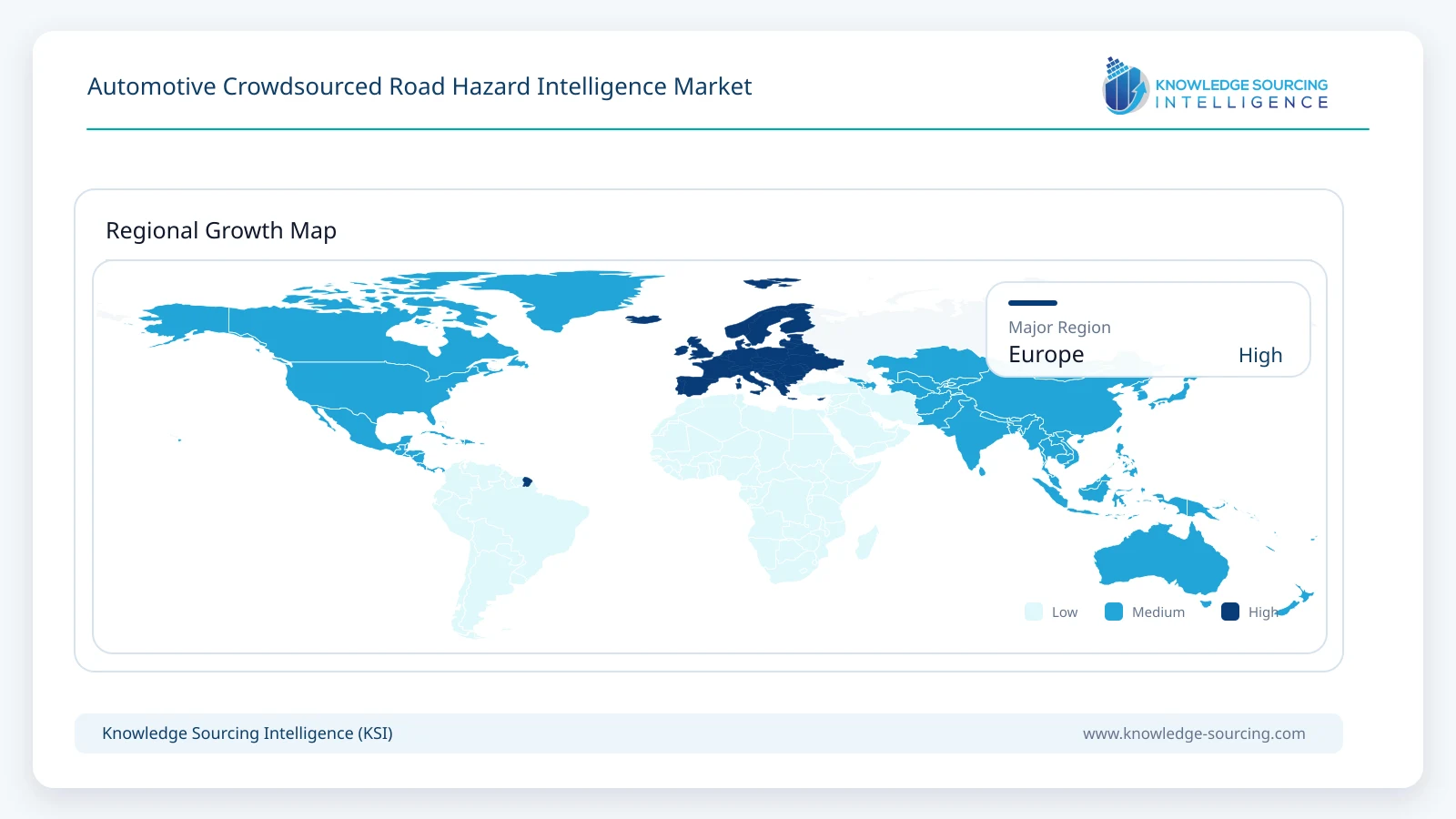
- 4Europe represents the leading market in 2026; Asia Pacific offers the fastest modeled growth through 2031.
- 5Safety assessment and cooperative road-data exchange are encouraging more multi-brand hazard services.
- 6Event confidence, low latency, accurate road matching, and rapid cancellation define competitive performance.
Connected passenger cars increasingly receive road-safety events through navigation, digital cockpits and cloud-connected vehicle services, allowing motorists to respond to stopped vehicles, wrong-way traffic, debris and surface hazards before they become visible. Bosch Connected Map Services, TomTom Hazard Warnings and HAAS Alert Safety Cloud illustrate three complementary routes to delivery: fused swarm sensing, licensed hazard-data APIs and direct public-safety event integration. Each route must associate an event with the correct road segment and travel direction while suppressing stale or repeated warnings.
Automotive manufacturers generally buy event data as part of a vehicle's connected-safety package or integrate a specialist service into existing infotainment and driver-assistance architecture. The commercial opportunity extends beyond passenger vehicles to commercial fleets, map platforms and infrastructure operators, particularly where the warning can protect roadside workers or reduce secondary collisions. As hazard coverage widens, business models are moving from embedded feature contracts toward renewable data-access arrangements and validated multi-source feeds.
Market Overview
Road hazards often develop faster than fixed maps can be revised, whether they involve a breakdown beyond a bend, debris from a passing truck, or an icy bridge during a short weather event. Crowdsourced intelligence platforms consolidate observations generated by connected vehicles, navigation users, roadside fleets and public infrastructure to detect these conditions, verify them and deliver relevant messages to approaching traffic. TomTom's hazard interface documents event creation, refresh, cancellation and expiration, underlining the importance of maintaining a live event lifecycle rather than accumulating permanent map pins.
Cloud-distributed warnings remain the dominant delivery channel because cloud services can pool observations across manufacturers and distribute confirmed hazards to a large receiving population. Bosch combines vehicle dynamics, environmental signals, and community information, while HAAS Alert authenticates alerts from responders, work zones, and participating fleets. Some automakers also support short-range Car2X communications where fast local transmission provides an additional path for warnings with limited network coverage.
Market Trends
Multi-Source Verification Is Replacing Single-Report Warnings
Connected vehicle sensor events are being combined with driver reports, responder data and infrastructure observations to determine whether a hazard remains active and which traffic stream is affected. Bosch's connected-map services use swarm signals alongside road-weather and community data, while HAAS Alert authenticates observations from public-safety and work-zone sources. The growing volume of observations improves coverage but increases the value of correlation rules that can discard duplicates and distinguish separate events on adjacent carriageways.
Automakers need hazard reports that can be acted on safely rather than simply shown as unqualified symbols. TomTom's 2026 hazard integrator documentation specifies confidence, severity, location, event version, and expiration fields, giving developers the information required to manage an event throughout its life. Revenue should shift toward suppliers that can demonstrate low false-positive rates, reliable updates, and consistent event matching under demanding conditions.
Connected Safety Networks Are Opening to Multiple Vehicle Brands
Data sharing between manufacturers reduces the delay between an event occurring and its being recognized by another vehicle fleet, particularly when the first observation comes from a responder or a different brand. HAAS Alert's July 2026 announcement of live feeds into Europe's Data for Road Safety ecosystem alongside BMW and Škoda shows how safety intelligence can move beyond a single manufacturer's captive network. Shared hazard standards can improve coverage while reducing the number of bespoke supplier connections needed.
Open data exchange does not eliminate the commercial value of validating, localizing, and distributing alerts inside vehicle systems. Providers can still earn revenue from premium response times, data quality assurance, regional coverage, specialized event types and production engineering. Competition is likely to concentrate on the measurable value of the final driver warning rather than on ownership of every underlying incident report.
Automakers Are Adding Embedded and Updateable Hazard Applications
Android Automotive and increasingly software-defined cockpit architectures make it practical to add cloud-connected safety functions without designing a separate vehicle controller. HAAS Alert introduced an Android Automotive application in June 2026, enabling participating automakers to use existing connectivity and over-the-air software pathways to present warnings. The approach can reduce integration effort compared with hardware-intensive implementations, although automotive cybersecurity and user-interface validation remain necessary.
Vehicle manufacturers can also refresh event types and alert presentation during the life of a vehicle, making connected hazard intelligence an ongoing software offering rather than a one-time feature release. This creates subscription and maintenance opportunities, but automakers may package essential warnings within broader connected services. Supplier monetization will therefore depend on the attribution of safety-data functions within bundled vehicle contracts.
Roadworker, Breakdown and Emergency Hazards Are Expanding Coverage
Emergency vehicles, towing operators and work-zone fleets can signal their presence in situations where approaching motorists have limited time to react. HAAS Alert's Safety Cloud incorporates verified responder and fleet events, and the September 2026 WJ Group integration links roadwork monitoring to alerts shown in connected vehicles and navigation applications. These use cases widen addressable demand beyond warnings derived only from tire-road friction and weather signals.
Road authorities and commercial fleet operators have a direct interest in reducing near misses around roadworks and stopped vehicles, supporting procurement for verified data exchanges and operational dashboards. Products that serve both traffic managers and approaching drivers can support multiple customer groups, but contracts need distinct deliverables to avoid reselling one identical event stream at several reported revenue levels. Safety applications with clear operator workflows are more likely to justify renewal spending.
Hazard Information Is Becoming an Input for Driver Assistance
Connected driving systems can receive event information beyond onboard camera or radar range and adjust route guidance or driver prompts before reaching a dangerous segment. Bosch describes early warnings about accidents, low road friction, and other risks, while TomTom's guidance distinguishes high-confidence messages suitable for driver assistance from broader alerts used for information displays. Confidence-managed delivery matters because an incorrect event can prompt distracting or unnecessary vehicle responses.
The integration of road intelligence into advanced driver-assistance planning raises requirements for timing, functional boundaries, and traceable data quality. In the near term, driver-facing warnings and navigation guidance remain the larger commercial use cases, while progressively richer ADAS integration should contribute to software value toward 2031. Suppliers that link event validation with predictable in-vehicle delivery are better placed to support higher-value contracts.
Segment Analysis
Revenue Offering
OEM hazard intelligence licenses constitute the largest revenue offering, supported by feature purchases covering eligible vehicle fleets and recurring connected-safety support. The 2026 segment is estimated at USD 93 million, reflecting stronger adoption of factory-integrated hazard warnings than of separately priced fleet or road-authority analytics. TomTom, Bosch and HAAS Alert illustrate different licensing and integration relationships with automakers, while the final consumer may encounter the service as part of navigation or a broader safety package.
Hazard Category
Slippery and unsafe road-surface conditions form an important early segment because stability-control and tire-related signals can provide frequent objective observations. NIRA's connected Road Surface Alerts and Volkswagen Group's Local Hazard Information demonstrate commercial delivery of road-grip and pothole warnings at scale. Accidents, stalled vehicles and unexpected queue tails are also material use cases because these events create abrupt changes to driver reaction time.
Intelligence Input Method
Automated vehicle telemetry holds the largest modeled input-method share because sensor events can be collected repeatedly from large connected fleets without waiting for a driver to submit a manual report. Wheel-speed behavior, braking interventions, unusual deceleration, and vehicle operating signals can provide evidence about hazards, although individual measurements require contextual validation. Manual community reports continue to identify debris, sudden incidents, and other events that are difficult to infer from chassis signals alone.
Customer and Application Outlook
Passenger vehicle automakers remain the largest purchasing group as they add early warnings across new model lines and use software updates to extend coverage. Commercial vehicle manufacturers and fleet operators have more targeted requirements around blocked lanes, work zones, towing activity, and road weather, making their buying decisions dependent on route coverage and measurable operational exposure. Map providers and mobility services purchase road-hazard feeds where data freshness and event confidence improve their own navigation products.
Market Drivers
Expansion of Production Connected-Vehicle Fleets
Vehicle manufacturers are equipping a larger installed base with cellular connectivity, navigation software and remotely maintainable driver-information functions, increasing the potential reach of one verified road hazard. Mercedes-Benz Car-to-X functionality and Volkswagen Group's fleet data services demonstrate that hazard information can be exchanged through production vehicles without relying on roadside infrastructure at every location. More receiving endpoints support recurring licensing opportunities for hazard-data suppliers.
Stronger Recognition of Cooperative Safety Warnings
Euro NCAP's Safe Driving assessment framework includes local-hazard messaging and relevant data exchange capabilities, offering vehicle manufacturers a concrete reason to develop interoperable warning functions. The Data for Road Safety ecosystem provides an established mechanism for distributing safety-related events among participating automakers and information providers. Together, these developments support platform purchases beyond isolated navigation features.
Demand to Protect Roadside Workers and Emergency Responders
Towing trucks, construction vehicles, ambulances, and stopped motorists create dynamic roadside exposure that is difficult to anticipate from static maps. HAAS Alert connects verified incident sources to approaching connected vehicles, and WJ Group's 2026 integration demonstrates a specific road-operator use case for sharing work-zone and stopped-vehicle alerts. These safety requirements widen demand beyond ordinary driver-sourced warning icons.
Growing Integration With Navigation and Driver Assistance
Map providers and vehicle software suppliers use localized hazards to deliver route changes, early driver prompts, and safer speed guidance where onboard sensors have not yet seen an event. TomTom's multi-source hazard service and Bosch's Connected Horizon show how road events can feed vehicle applications without requiring the full navigation or ADAS system to be purchased from the same vendor. This modular delivery expands the addressable set of OEM and mobility customers.
Commercialization of Multi-Brand Road Safety Networks
Single-brand crowdsourced feeds can miss events on routes where few participating vehicles are present, creating a strong benefit from cross-OEM data partnerships. HAAS Alert's July 2026 DFRS contribution alongside BMW and Škoda and its integration of NIRA surface reports illustrate how separate event sources can support a wider safety audience. The broader data network improves warning timeliness and the value of coverage-sensitive services.
Market Restraints
False-Positive Alerts and Poor Event Localization
Hazard reports can be assigned to the wrong carriageway, duplicated by several vehicles, or remain visible after an obstacle has moved, reducing driver trust. TomTom specifies explicit event updates, cancellation, and expiry because alerts must be removed or revised as road conditions change. Mistimed or incorrect warnings create reputational and validation costs for both the data vendor and the automaker.
Data Privacy, Ownership and Cross-Border Restrictions
Fleet-derived location, motion and vehicle-state information must be processed under applicable data protection agreements and user-consent arrangements. Volkswagen Group emphasizes customer consent for vehicle data use, while European safety-information rules create specific expectations about sharing public-interest event data. These obligations affect cloud architecture, data retention, international licensing and the sources that can lawfully be combined.
Bundled Navigation and Free Safety Information
Many drivers already receive basic hazard warnings through general navigation applications, reducing willingness to pay separately for information perceived as a commodity. EU Regulation 886/2013 also provides a framework for safety-related minimum universal traffic information, with free-to-user dissemination where possible. Commercial platforms therefore need differentiated accuracy, availability or application integration to justify enterprise contracts.
Uneven Geographic Coverage and Vehicle Penetration
High-quality road intelligence depends on a sufficient number of eligible reporting vehicles, accurate mapping and reliable cellular or V2X connectivity. Coverage can vary sharply between urban roads, motorway corridors and low-density rural routes, making a national service label a poor indicator of uniform local performance. Weather, vehicle mix and driver behavior can further alter the reporting frequency of different hazard types.
Safety Validation and In-Vehicle Integration Costs
A warning service integrated into a factory-installed cockpit must meet automaker standards for message relevance, distraction control, software updates, and cybersecurity. Input used by driver assistance has additional requirements around confidence, timing and separation from vehicle control decisions. Production approval is therefore more demanding than launching an independent mobile reporting app.
Regional Outlook
Europe
Europe is the leading regional market in 2026 at an estimated USD 73 million, supported by OEM connected safety programs, active data-sharing structures and growing local-hazard assessment requirements. Volkswagen Group's fleet intelligence, Mercedes-Benz Car-to-X, Bosch connected services and the Data for Road Safety initiative provide evidence of commercial maturity and interoperability efforts. Germany, the United Kingdom and France account for a substantial proportion of estimated European demand, while the Netherlands' transport data ecosystem supports specialized public-sector applications.
Regional growth depends on more than the number of connected vehicles because automotive manufacturers must exchange events lawfully and ensure that warnings are useful across national boundaries. Euro NCAP scoring provides an incentive to maintain sending and receiving capability, while European rules for minimum safety traffic information affect how premium providers can monetize the service. Europe is forecast at USD 295 million in 2031, retaining a leading position but growing more slowly than newer deployment regions.
Asia Pacific
Asia Pacific is expected to be the fastest-growing major region as Chinese, Japanese and South Korean manufacturers extend vehicle connectivity, digital navigation and advanced safety software across new models. The region starts from an estimated USD 39 million in 2026, reflecting meaningful vehicle-electronics capacity alongside uneven commercial availability of shared hazard information. Demand is expected to increase through OEM and map-platform purchases before specialist road-operator applications become widely established.
Regional deployment requires localization to different traffic practices, incident sources, data-handling rules and road-network mapping quality. India and Southeast Asia provide longer-run opportunities for connected hazard warning and commercial-fleet safety as reporting vehicle densities improve. Asia Pacific is forecast to reach USD 270 million by 2031, approaching Europe's market size as multi-source alerts become a more common vehicle software function.
Competitive Landscape
The competitive environment includes map and traffic-data suppliers, vehicle electronics companies, specialist connected-safety networks and automaker-owned information systems. TomTom provides structured low-latency hazard APIs, while HERE participates in context-aware road alerts delivered through HARMAN's in-vehicle software. Bosch supplies connected map services that combine vehicle sensors and external safety signals, enabling automakers to integrate a more complete road-awareness function into existing vehicle architecture.
HAAS Alert differentiates through direct relationships with responders, roadside operators and participating fleets, supported by in-vehicle and navigation distribution. NIRA Dynamics provides high-resolution road surface observations that can be passed into larger hazard networks, while Mercedes-Benz and CARIAD demonstrate the importance of OEM-owned data sources and vehicle integration. INRIX supplies road event and incident datasets, and ZF contributes road-condition information with vehicle-system experience.
Recent Developments
16 September 2026: WJ Group and HAAS Alert integrated Safety Cloud alerts with the AVERA roadworks and stopped-vehicle monitoring service, connecting control-room events to approaching vehicles.
16 July 2026: HAAS Alert, BMW Group and Škoda reported live safety event contributions through the Data for Road Safety ecosystem, advancing interoperable local-hazard distribution in Europe.
1 July 2026: Mercedes-Benz confirmed its next-phase participation in the Netherlands Road Monitor programme, expanding the application of fleet observations to road hazards and infrastructure damage.
2 June 2026: HAAS Alert launched a Safety Cloud application for Android Automotive, supporting embedded real-time road safety warnings using existing vehicle connectivity.
13 April 2026: NIRA Dynamics and HAAS Alert announced integration of road surface warnings with a broader connected-safety alert network, extending the range of vehicle-observed hazards.
6 March 2026: HAAS Alert introduced a four-part automotive Safety Cloud portfolio designed for early warnings, incident protection, driver assistance and automated-vehicle applications.
Market Outlook
Crowdsourced road hazard intelligence is expected to become a standard component of connected vehicle safety as more automakers integrate dependable event feeds into navigation, driver information, and assisted driving. The market's strongest expansion will come from growth in license-bearing vehicles and recurring API access rather than from greater numbers of raw reports alone. Better event verification, precise localization and timely cancellation will improve usefulness and help suppliers defend service pricing.
Supplier networks that combine fleet telemetry with verified reports from responders, roadwork operators and infrastructure are likely to offer better hazard coverage than systems built on a single observation source. Regulated exchange of minimum safety information will continue to coexist with commercial services offering premium confidence, latency and interface support. Fleet subscriptions and integration engineering will provide additional revenue as customers require more specialized applications.
Automotive Crowdsourced Road Hazard Intelligence Market Scope:
| Report Metric | Details |
|---|---|
| Total Market Size in 2026 | USD 175.0 million |
| Total Market Size in 2031 | USD 890.0 million |
| Forecast Unit | USD Million |
| Growth Rate | 38.4% |
| Study Period | 2021 to 2031 |
| Historical Data | 2021 to 2024 |
| Base Year | 2025 |
| Forecast Period | 2026 – 2031 |
| Segmentation | Revenue Offering, Hazard Category, Intelligence Input Method, Delivery Architecture |
| Companies |
|
Market Segmentation
By Revenue Offering
OEM Hazard Intelligence Licenses
Road-Hazard Data and API Services
Fleet Safety Subscriptions
Integration and Validation Services
By Hazard Category
Slippery and Unsafe Road Surface
Accident, Breakdown and Queue-Tail Hazard
Road Obstructions and Surface Objects
Wrong-Way, Roadworks and Emergency Events
Severe Road Weather and Visibility
By Intelligence Input Method
Automated Vehicle Telemetry
Driver and Community Reports
Camera and Perception Events
Fused Infrastructure and Multi-Source Data
By Delivery Architecture
Cloud Vehicle-to-Network Services
Direct V2X Hazard Communication
Hybrid Cloud and Direct Communication
By Primary Customer Type
Passenger Vehicle OEMs
Commercial Vehicle OEMs
Commercial Fleets
Mapping and Mobility Technology Providers
Public Safety and Road Operators
By End-Use Application
In-Vehicle Early Hazard Warning
Navigation and Dynamic Rerouting
ADAS and Automated Driving Planning
Fleet Risk and Work-Zone Protection
Public Road Safety Operations
By Connected Vehicle Category
Passenger Cars
Light Commercial Vehicles
Medium and Heavy Commercial Vehicles
Buses and Special-Purpose Vehicles
By Geography
North America
United States
Canada
Mexico
South America
Brazil
Argentina
Others
Europe
Germany
United Kingdom
France
Italy
Spain
Netherlands
Nordic Countries
Others
Middle East and Africa
Saudi Arabia
United Arab Emirates
South Africa
Others
Asia Pacific
China
Japan
South Korea
India
Australia
Indonesia
Thailand
Taiwan
Others
Table of Contents
1. EXECUTIVE SUMMARY
1.1. Market Opportunity and Key Findings
1.2. Crowdsourced Road Hazard Intelligence Market Size, 2026–2031
1.3. Leading Revenue Offerings and Applications
1.4. Regional Market Opportunity
2. MARKET SNAPSHOT
2.1. Market Overview
2.2. Market Definition
2.3. Scope of the Study
2.4. Market Segmentation
3. BUSINESS LANDSCAPE
3.1. Market Drivers
3.1.1. Expansion of Production Connected-Vehicle Fleets
3.1.2. Stronger Recognition of Cooperative Safety Warnings
3.1.3. Demand to Protect Roadside Workers and Emergency Responders
3.1.4. Growing Integration With Navigation and Driver Assistance
3.1.5. Commercialization of Multi-Brand Road Safety Networks
3.2. Market Restraints
3.2.1. False-Positive Alerts and Poor Event Localization
3.2.2. Data Privacy, Ownership and Cross-Border Restrictions
3.2.3. Bundled Navigation and Free Safety Information
3.2.4. Uneven Geographic Coverage and Vehicle Penetration
3.2.5. Safety Validation and In-Vehicle Integration Costs
3.3. Market Opportunities
3.4. Porter's Five Forces Analysis
3.5. Industry Value Chain Analysis
3.6. Policies and Regulations
3.7. Strategic Recommendations
4. TECHNOLOGICAL OUTLOOK
4.1. Automated Vehicle Incident Detection
4.2. Crowdsourced Event Verification and Fusion
4.3. Hazard Localization and Event Lifecycle
4.4. Vehicle-to-Network and Direct V2X Delivery
4.5. Cooperative Safety Data Exchange
4.6. Confidence Management, Privacy and API Architecture
5. AUTOMOTIVE CROWDSOURCED ROAD HAZARD INTELLIGENCE MARKET BY REVENUE OFFERING
5.1. Introduction
5.2. OEM Hazard Intelligence Licenses
5.3. Road-Hazard Data and API Services
5.4. Fleet Safety Subscriptions
5.5. Integration and Validation Services
6. AUTOMOTIVE CROWDSOURCED ROAD HAZARD INTELLIGENCE MARKET BY HAZARD CATEGORY
6.1. Introduction
6.2. Slippery and Unsafe Road Surface
6.3. Accident, Breakdown and Queue-Tail Hazard
6.4. Road Obstructions and Surface Objects
6.5. Wrong-Way, Roadworks and Emergency Events
6.6. Severe Road Weather and Visibility
7. AUTOMOTIVE CROWDSOURCED ROAD HAZARD INTELLIGENCE MARKET BY INTELLIGENCE INPUT METHOD
7.1. Introduction
7.2. Automated Vehicle Telemetry
7.3. Driver and Community Reports
7.4. Camera and Perception Events
7.5. Fused Infrastructure and Multi-Source Data
8. AUTOMOTIVE CROWDSOURCED ROAD HAZARD INTELLIGENCE MARKET BY DELIVERY ARCHITECTURE
8.1. Introduction
8.2. Cloud Vehicle-to-Network Services
8.3. Direct V2X Hazard Communication
8.4. Hybrid Cloud and Direct Communication
9. AUTOMOTIVE CROWDSOURCED ROAD HAZARD INTELLIGENCE MARKET BY PRIMARY CUSTOMER TYPE
9.1. Introduction
9.2. Passenger Vehicle OEMs
9.3. Commercial Vehicle OEMs
9.4. Commercial Fleets
9.5. Mapping and Mobility Technology Providers
9.6. Public Safety and Road Operators
10. AUTOMOTIVE CROWDSOURCED ROAD HAZARD INTELLIGENCE MARKET BY END-USE APPLICATION
10.1. Introduction
10.2. In-Vehicle Early Hazard Warning
10.3. Navigation and Dynamic Rerouting
10.4. ADAS and Automated Driving Planning
10.5. Fleet Risk and Work-Zone Protection
10.6. Public Road Safety Operations
11. AUTOMOTIVE CROWDSOURCED ROAD HAZARD INTELLIGENCE MARKET BY CONNECTED VEHICLE CATEGORY
11.1. Introduction
11.2. Passenger Cars
11.3. Light Commercial Vehicles
11.4. Medium and Heavy Commercial Vehicles
11.5. Buses and Special-Purpose Vehicles
12. AUTOMOTIVE CROWDSOURCED ROAD HAZARD INTELLIGENCE MARKET BY GEOGRAPHY
12.1. North America
12.1.1. United States
12.1.2. Canada
12.1.3. Mexico
12.2. South America
12.2.1. Brazil
12.2.2. Argentina
12.2.3. Others
12.3. Europe
12.3.1. Germany
12.3.2. United Kingdom
12.3.3. France
12.3.4. Italy
12.3.5. Spain
12.3.6. Netherlands
12.3.7. Nordic Countries
12.3.8. Others
12.4. Middle East and Africa
12.4.1. Saudi Arabia
12.4.2. United Arab Emirates
12.4.3. South Africa
12.4.4. Others
12.5. Asia Pacific
12.5.1. China
12.5.2. Japan
12.5.3. South Korea
12.5.4. India
12.5.5. Australia
12.5.6. Indonesia
12.5.7. Thailand
12.5.8. Taiwan
12.5.9. Others
13. COMPETITIVE ENVIRONMENT AND ANALYSIS
13.1. Major Players and Strategy Analysis
13.2. Market Share Analysis
13.3. Mergers, Acquisitions, Agreements and Collaborations
13.4. Competitive Dashboard
14. COMPANY PROFILES
14.1. Robert Bosch GmbH
14.2. HERE Technologies
14.3. TomTom International BV
14.4. HAAS Alert
14.5. NIRA Dynamics AB
14.6. Mercedes-Benz Connectivity Services GmbH
14.7. CARIAD SE
14.8. HARMAN International
14.9. INRIX, Inc.
14.10. ZF Friedrichshafen AG
15. APPENDIX
15.1. Currency
15.2. Assumptions
15.3. Base and Forecast Years Timeline
15.4. Key Benefits for Stakeholders
15.5. Research Methodology
15.6. Abbreviations
Navigate
Trusted by the world's leading organizations











