
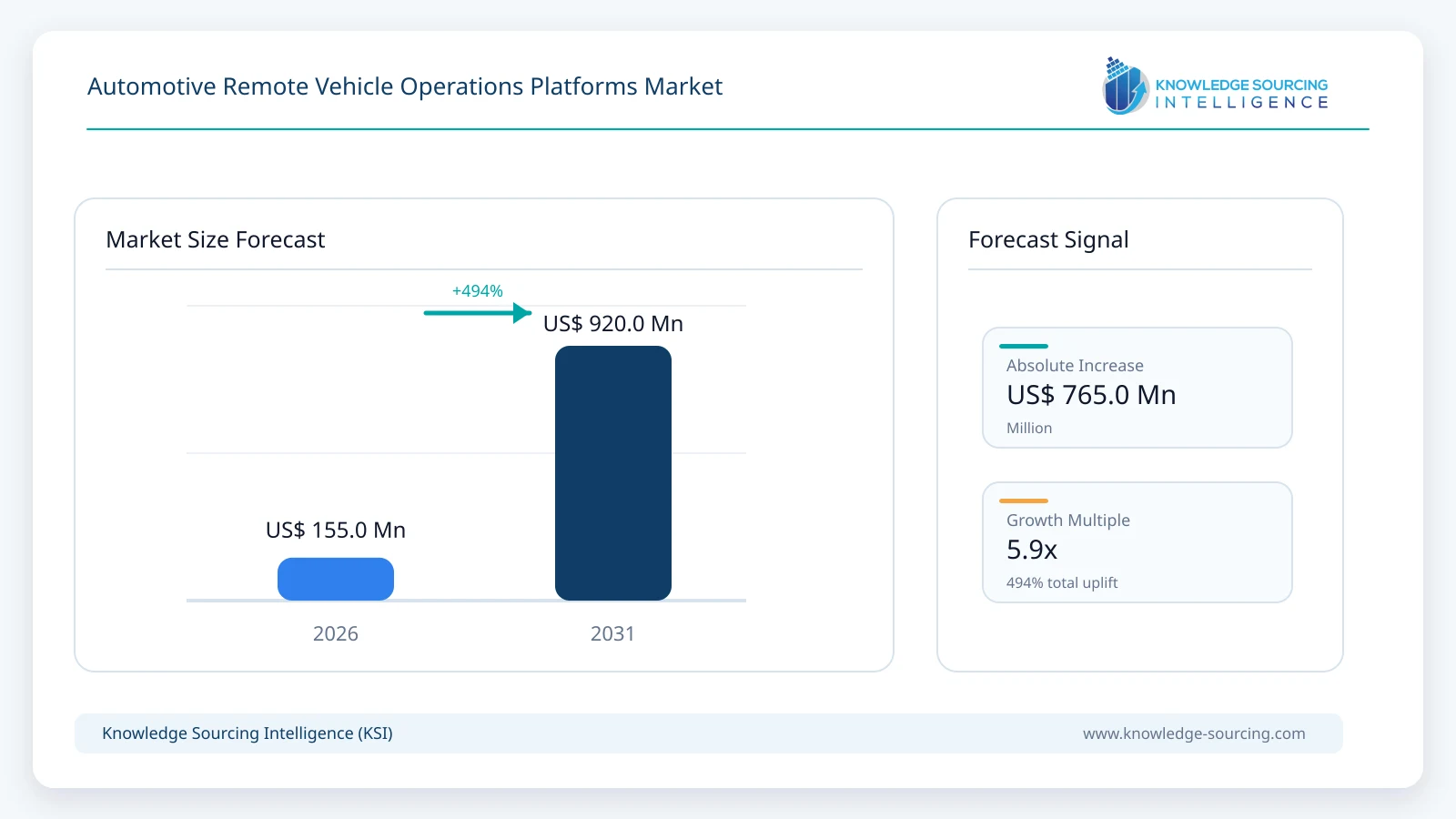
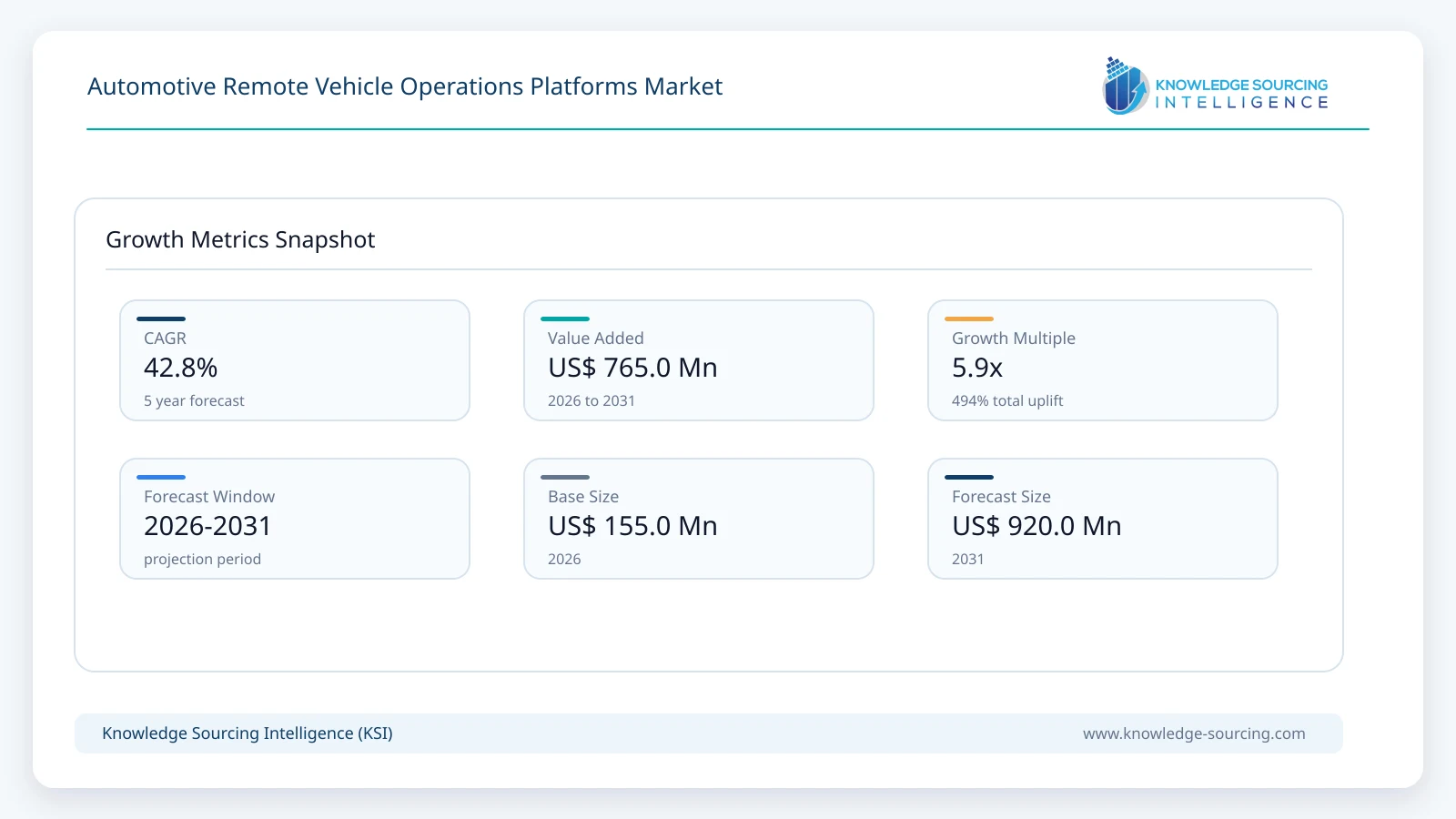
The Automotive Remote Vehicle Operations Platforms Market is projected to expand at a CAGR of 42.8%, increasing from USD 155 million in 2026 to USD 920 million by 2031.
Highlights:
- 1Remote vehicle operations platforms provide remote assistance, direct teledriving and safe operator handoff for selected passenger and commercial fleets.
- 2Remote assistance and guidance accounts for approximately 47.1% of 2026 value, reflecting one-to-many support for automated systems.
- 3Passenger robotaxi and shuttle operations account for approximately 38.7% of 2026 revenue; freight and industrial deployments are also expanding.
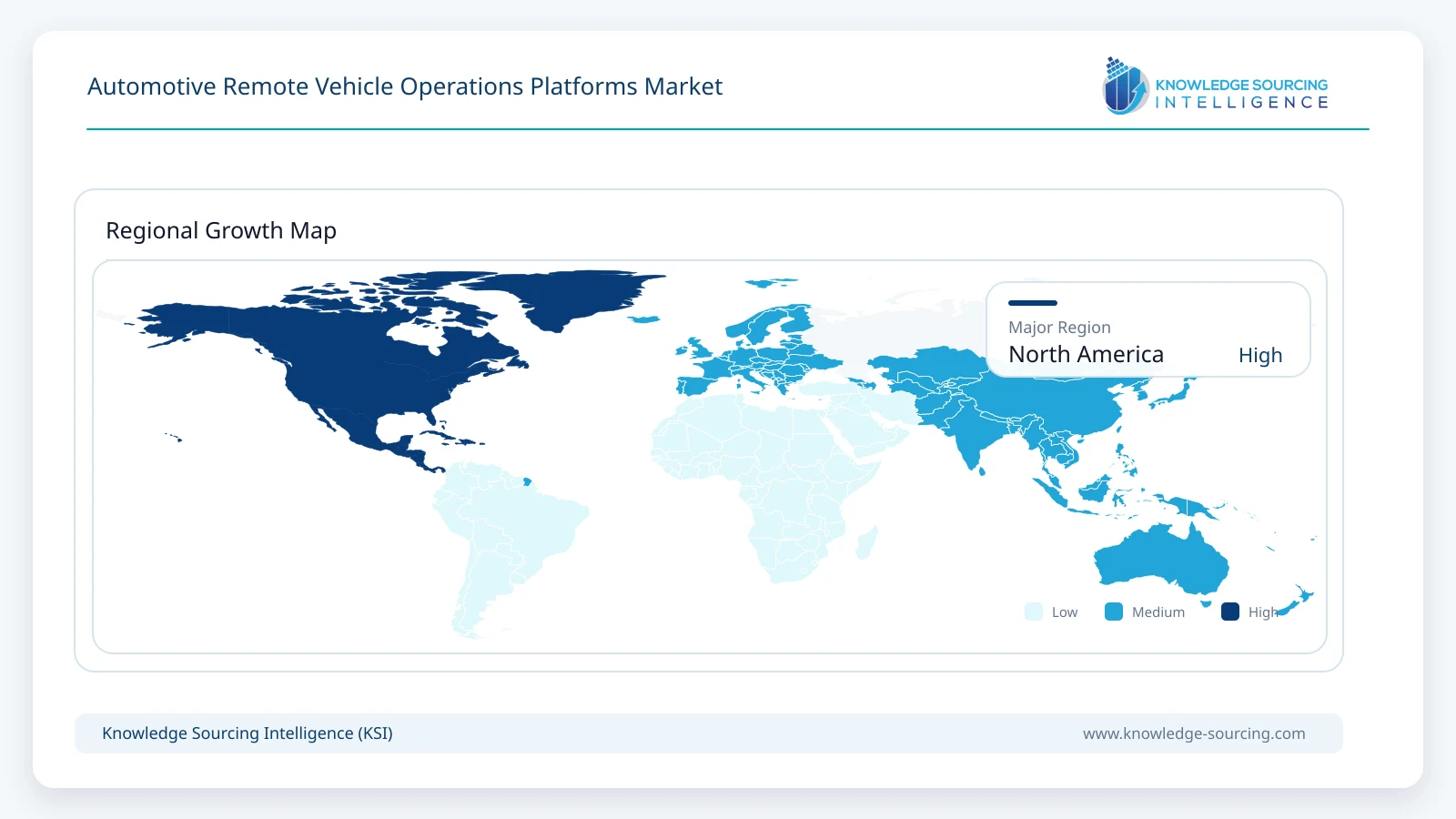
- 4Asia Pacific has the largest modeled regional market in 2026, while North America remains a major center for commercial teleoperations innovation.
- 5Vay expanded its Las Vegas remotely driven fleet to 175 vehicles in April 2026; Waymo reported a 3,000-vehicle fleet in February 2026.
Remote vehicle operations platforms connect vehicles with trained operators who can review camera feeds, resolve complex operational events or, where permitted, take temporary control. Vay demonstrates direct tele-driving through its Las Vegas vehicle delivery service, while Waymo and Aurora distinguish their advisory operations centers from remote manual driving. This distinction affects safety architecture, data transmission and operator staffing.
Platforms must combine end-to-end command authorization, continuous vehicle-state information, resilient video streaming and a documented transition between autonomous and human functions. DriveU.auto markets an open connectivity layer that can move video, sensor data and CAN-bus messages over bonded cellular networks; Ottopia packages remote driving, guidance and a fleet dashboard. Such offerings generate identifiable software and integration spending beyond ordinary telematics.
Commercial adoption depends on the operating environment. Public-road robotaxis require incident handling and auditable intervention boundaries, whereas freight depots and yards favor low-speed remote moves with predictable routes. Regulatory attention is rising, with the US NHTSA distinguishing guidance from direct control and UNECE strengthening the safety-management framework for automated driving.
Market Overview
Remote vehicle operations are used where an automated vehicle needs contextual assistance or a vehicle operator has chosen to relocate certain driving functions to a trained human outside the cabin. The platform links the vehicle to a controlled workstation, carries necessary perception information and records any authorized human input. Safety-critical actions remain subject to the chosen control architecture.
Technical requirements differ across operating modes. Advisory systems must present clear, time-relevant choices to an operator while preserving vehicle decision authority. Remote manual driving requires continuous scene awareness, control-response performance and defined fallback rules; cellular bonding, adaptive streaming and protected command paths are consequently more important.
The value chain includes original vehicle manufacturers, autonomy software developers, teleoperations platform suppliers, fleet operators and networks. Contract structures can combine per-vehicle software, site licenses and integration work. The market measures the attributable platform service, not the full automated driving package or customer mobility fare.
Market Trends
Remote Assistance Is Becoming a Separate Operations Discipline
Waymo disclosed in February 2026 that its remote assistance team supported a fleet of about 3,000 vehicles with roughly 70 agents on duty worldwide. Its advisors respond to system-initiated requests rather than continuously monitor every vehicle or remotely operate its pedals and steering. This one-to-many structure is materially different from direct teledriving and supports the scaling of operations centers.
Aurora similarly describes a system in which remote personnel can suggest actions but the onboard driver remains responsible for deciding whether and how to execute them. Platform suppliers can use this operating model to prioritize event routing, vehicle context and operator workload management, with relatively low intervention frequency but high assurance requirements.
Direct Remote Driving Is Moving Beyond Demonstrations
Vay operated 175 remotely deliverable vehicles in Las Vegas by April 2026 and reported more than 60,000 customer rides. Its remote operators deliver a vehicle to the customer and collect it later, making the remote-driving system an essential part of the service rather than a contingency support function.
The same software architecture can serve car rental repositioning, airport ground movement and selected industrial transport routes. Commercial expansion nevertheless requires operator training, stable network coverage, clear service-area limits and a workable ratio of remote drivers to vehicles.
Connectivity Resilience Is Being Designed into the Safety Case
Kodiak and Verizon announced in December 2025 that their communications arrangement supports Vay-enabled Assisted Autonomy in tightly defined low-speed situations. Video feeds, control messages and vehicle-state data must arrive predictably, even where coverage degrades or cells hand over, because a late command or delayed image can compromise remote intervention.
DriveU.auto uses cellular bonding and dynamic video encoding to mitigate bandwidth variation, latency and packet loss, while Ottopia offers adaptive streaming and resilient connectivity. These specialized functions attract platform software spending without requiring the research market to count the full cellular data bill.
Operations Centers Are Joining Cloud Fleet Architectures
Kodiak stated in October 2026 that AWS supports its simulations and customer-facing operations-center software, illustrating how remote assistance must connect to mission records, vehicle health, incident workflows and compliance documentation. This backend layer differs from generic cloud data storage because operators need rapid context for safety-critical decisions.
Fleet dashboards increasingly combine live operational status with historical incident analysis and staff allocation. Consistent interfaces can improve the handover between first-line assistance, engineering investigation and field support, but platform operators still need to validate each permitted vehicle-control action.
Safety Governance Is Influencing Deployment Models
The US NHTSA devoted part of its 2026 automated-vehicle forum to the differences between human advice, commands and full remote manual driving. UNECE approved its automated-driving regulation in June 2026, emphasizing safety management, credible validation and in-service monitoring. These developments strengthen the incentive to record every operator action and define safe fallback behavior.
Operating permissions are likely to remain jurisdiction-specific even as technical rules converge. Suppliers that provide evidence-ready logging, identity controls, cyber protection and a robust handoff mechanism may gain an advantage over standalone remote-video products.
Segment Analysis
By Operating Mode: Remote Assistance and Guidance
Remote assistance and guidance is estimated at USD 73 million, or 47.1% of the global market, in 2026. It serves fleets whose automated driving systems remain in control while remote personnel clarify road conditions, assess incidents or recommend a path. Waymo and Aurora demonstrate the commercial importance of this architecture without implying that every assistance interaction is a direct driving command.
The segment is projected to reach approximately USD 445 million by 2031. Demand growth depends on wider robotaxi and freight deployment and the ability of a small number of trained agents to support a larger vehicle population without weakening safety review.
By Platform Function: Remote Control and Safety Middleware
Remote control and safety middleware accounts for an estimated USD 50 million in 2026, reflecting the need to arbitrate control authority, protect commands and manage fallback between remote operators and vehicle automation. Such software is a differentiated revenue layer even when a provider also sells video transport or operator consoles.
By 2031 the segment is estimated at USD 315 million as deployments require more vehicle interfaces, safety validation, auditability and secure control-state transitions. These features are particularly important for manual teledriving and tightly scoped low-speed vehicle interventions.
By Application: Robotaxis and Passenger Shuttles
Robotaxis and passenger shuttles contribute an estimated USD 60 million in 2026 as operator support is essential to customer response, local incident management and certain road-edge cases. The addressable platform spend is not the entire fare revenue or autonomous driving system price, but the attributable remote-operation services used to support the fleet.
Increased commercial rides and gradual service-area expansion support a projected USD 395 million segment by 2031. Freight and yard applications provide a second growth channel because vehicles may be dispatched remotely without carrying passengers.
By Revenue Model: Vehicle-Linked Platform Licenses
Vehicle-linked platform licenses account for USD 78 million in 2026, reflecting the use of per-vehicle platform coverage as fleets expand. Prices differ significantly according to video quality, command functionality, safety obligations and operating intensity, particularly between advisory assistance and direct manual driving.
Enterprise command-center licenses and separately invoiced integration remain important for large deployments. Platform providers must avoid embedding both the command-center license and the same vehicle license twice in commercial reporting.
Market Drivers
Growth of Commercial Driverless Fleets
Waymo’s public February 2026 disclosure of a 3,000-vehicle fleet and Baidu’s 3.2 million fully driverless rides in the first quarter of 2026 indicate that remote operational support is becoming necessary for ongoing high-volume service, even where human agents do not directly control vehicles.
As fleet populations grow, a remote platform must connect safety-relevant incidents to trained personnel with appropriate geographic, language and vehicle-specific knowledge. That requirement creates recurring demand for event routing, vehicle telemetry and operator consoles.
Low-Speed Logistics and Freight Assistance
Kodiak’s use of Vay-enabled Assisted Autonomy in defined low-speed settings and FERNRIDE’s human-assisted vehicle platform illustrate a practical middle ground between full manual driving and entirely autonomous industrial operations. Yard exits, trailer positioning and roadside recovery can justify remote support even if an autonomous vehicle performs most driving tasks.
Operators invest where remote assistance reduces the need to dispatch a person to a distant vehicle or prevents a prolonged interruption, provided the safety case permits the intervention.
Higher Availability Through Remote Exception Handling
When an autonomous vehicle encounters an unrecognized obstruction or ambiguous instruction, an operations center can help determine the next valid action and return the vehicle to service. This differs from ordinary fleet monitoring because advice and commands must align with the operating domain and onboard vehicle logic.
Ottopia’s remote-assistance console and Waymo’s event-response teams demonstrate the product and operational features required to manage such events. Smaller deployment interruptions can improve fleet utilization without assuming that every unusual event is resolved remotely.
Maturing Resilient Streaming and Networks
DriveU.auto’s teleoperation-grade streaming and Kodiak’s Verizon arrangement show how adaptable video transmission and communication redundancy support intervention in cellular environments that change from street to street. A viable remote operation platform cannot depend solely on peak network speed.
Suppliers that implement packet-loss mitigation, multipath routing and safe stop behavior may expand operational coverage and offer services to customers with different mobile network conditions.
Emerging Regulatory Clarity and Safety Processes
UNECE’s June 2026 automated-driving framework and NHTSA’s 2026 work on remote-operations guidance create a clearer basis for documenting operator authority, safety monitoring and responsibility allocation. These measures are not blanket approvals of unrestricted remote manual driving.
Nevertheless, demand for audit logs, operator identity, validated fallback logic and documented escalation can benefit vendors delivering mature operations-center software instead of isolated control interfaces.
Market Restraints
Latency, Coverage and Communication Failures
Remote operators must receive accurate, timely video and return authorized instructions despite network handovers, shadowed road sections and overloaded cells. Bonded links reduce but cannot eliminate these risks, especially during complex maneuvers where a delayed image can misrepresent the vehicle position.
Validated minimal-risk behavior, degraded-mode operation and redundant links increase software and test costs. Limited coverage can also restrict available service territories.
Complex Liability and Approval Requirements
Public-road teleoperation faces distinct questions about which person or automated system is responsible for the driving task. Waymo and Aurora explicitly retain driving decisions within the automated system, whereas direct tele-driving involves a remote human making steering and speed decisions.
Permissions, insurance requirements and operator qualification vary by jurisdiction, making cross-border platform deployment slower than a standard fleet SaaS rollout.
Cost of Trained Operators and Control Centers
Direct teledriving requires trained personnel, workstations and around-the-clock supervision processes. The economic benefit depends on how many vehicles one operator can safely support and whether driving work can be pooled across tasks.
Low-intervention advisory systems offer different staffing economics but still require escalation, incident response and quality control. The cost of people should not be confused with the platform software revenues measured in this report.
Vehicle Integration and Cybersecurity Burden
Every remotely controllable vehicle must enforce command validation and protected interfaces to brakes, steering or onboard decision systems. OEMs and autonomous-driving providers do not expose identical communication buses or safety interfaces, creating substantial integration work.
Operators must prevent unauthorized intervention and maintain software assurance across over-the-air updates and vehicle generations, adding cost before commercial scale is achieved.
Uneven Readiness Across Operating Domains
Vay’s Las Vegas commercial service, Waymo’s advisory model and industrial driverless trucking deployments demonstrate different levels of maturity, rather than a universal solution available for any road vehicle. Heavy rain, poor signal coverage or difficult road geometry can sharply constrain permissible intervention.
Public operators may postpone purchases where control authority, reliability or the economic case remains unresolved. Deployment momentum should therefore be assessed by operating domain rather than extrapolated from total global vehicle production.
Regional Outlook
North America
North America accounts for approximately 32.9% of 2026 platform revenue, reflecting the concentration of commercially deployed robotaxis, remote-driving trials and driverless freight programs in the United States. Vay’s Las Vegas operations, Waymo’s remote assistance function and Kodiak’s industrial trucks provide distinct examples of paying or internally funded use cases for human-in-the-loop systems.
The regional market is forecast to reach USD 283 million in 2031 as robotaxi operating areas expand and remote supervision becomes routine for selected freight and industrial fleets. US state-level permissions and highly variable site communications remain significant determinants of deployment speed.
Asia Pacific
Asia Pacific represents an estimated USD 53 million in 2026, supported by China’s large operational robotaxi footprint, Japanese mobility automation efforts and selected industrial site deployments. Baidu reported 3.2 million Apollo Go rides in the first quarter of 2026, although ride volumes do not directly reveal proprietary remote platform receipts.
The region is forecast to reach USD 338 million by 2031, overtaking North America as local fleets add remote assistance infrastructure and more cities operate driverless mobility programs. Revenue attribution remains dependent on whether support software is billed as a distinct platform or retained within an operator’s own autonomous-driving services.
Competitive Landscape
Vay competes through direct teledriving and vehicle-delivery operations, while Ottopia offers both full remote driving and event-based remote assistance. DriveU.auto supplies a specialized video and connectivity layer, and FERNRIDE combines remote oversight with integrated logistics autonomy. These suppliers compete at different portions of the operational technology stack and are not all direct substitutes.
Waymo, Aurora, Baidu and Kodiak represent major internal users or integrators of remote operations rather than necessarily independent software-platform vendors. Differentiation rests on control authority, network reliability, supported vehicle classes, operator efficiency, validation capability and the cost of integration. Procurement decisions are therefore shaped by a supplier’s demonstrated safety architecture as much as by feature breadth.
Recent Developments
October 20, 2026: Kodiak AI reported 64 days of continuous availability by a driverless industrial truck. The milestone supports deployment maturity, while remote support remains a distinct portion of the vehicle operating system.
October 1, 2026: Kodiak AI identified AWS as its principal cloud provider for simulation and customer-facing operations-center software ahead of planned driverless highway deployment. The announcement highlights backend infrastructure demands rather than a disclosed teleoperations contract value.
June 24, 2026: UNECE WP.29 approved a global automated-driving regulatory framework emphasizing safety management, validation and in-service monitoring, increasing attention to accountable operations centers and intervention design.
April 29, 2026: Vay reported 175 remotely deliverable vehicles in Las Vegas and more than 60,000 rides, demonstrating active remote driving on public roads with a defined operations center.
February 17, 2026: Waymo described an approximately 3,000-vehicle fleet supported by about 70 remote-assistance agents on duty worldwide, clarifying that agents advise its automated driver rather than take direct driving control.
December 18, 2025: Kodiak AI and Verizon Business announced a communications agreement supporting Vay-enabled Assisted Autonomy for low-speed scenarios, illustrating the relationship between connectivity resilience and remote-operation workflows.
Market Outlook
Remote operations are becoming a practical operating layer for commercial autonomous vehicles, but expansion will remain uneven across road and industrial domains. The strongest near-term demand arises in fleets with real driverless activity, frequent edge cases and a defined process for transferring contextual information to trained operators.
From 2026 to 2031, a shift toward operator supervision of multiple vehicles, stronger vehicle-control middleware and integrated incident workflows is expected to increase recurring license opportunities. Direct tele-driving may grow rapidly in selected approved service territories, while advisory operations centers continue to support systems that retain all driving decisions onboard.
Competitive success will favor platforms that can prove dependable performance in degraded communications environments and integrate securely into vehicle architectures. The market outlook remains closely linked to commercial autonomy deployment, practical safety regulation and the operating economics of human support.
Automotive Remote Vehicle Operations Platforms Market Scope
| Report Metric | Details |
|---|---|
| Total Market Size in 2026 | USD 155 million |
| Total Market Size in 2031 | USD 920 million |
| Forecast Unit | Million |
| Growth Rate | 42.8% |
| Study Period | 2021 to 2031 |
| Historical Data | 2021 to 2024 |
| Base Year | 2025 |
| Forecast Period | 2026 – 2031 |
| Segmentation | Operating Mode, Platform Function, Application, Revenue Model, Vehicle Category, Connectivity Architecture, Buyer Type, Geography |
| Companies |
|
Market Segmentation
By Operating Mode
Remote assistance and guidance
Remote manual driving
Hybrid remote intervention
By Platform Function
Operator consoles and mission control
Resilient media and data connectivity
Remote control and safety middleware
Fleet supervision and analytics
By Application
Robotaxis and passenger shuttles
Autonomous freight operations
Ports, yards and logistics sites
Car sharing, rental and delivery
Other specialized vehicles
By Revenue Model
Vehicle-linked platform licenses
Enterprise operations-center licenses
Implementation and integration services
By Vehicle Category
Passenger autonomous vehicles
Medium and heavy trucks
Yard and terminal tractors
Shuttles and buses
Other purpose-built vehicles
By Connectivity Architecture
Bonded cellular 4G/5G
Single-network cellular
Site Wi-Fi and private networks
Hybrid satellite and other links
By Buyer Type
Autonomy developers and OEM programs
Logistics and industrial fleet operators
Mobility-service operators
Public and municipal operators
By Geography
North America
United States
Canada
Mexico
South America
Brazil
Argentina
Chile
Others
Europe
Germany
United Kingdom
France
Italy
Spain
Netherlands
Others
Middle East and Africa
Saudi Arabia
United Arab Emirates
Israel
South Africa
Others
Asia Pacific
China
India
Japan
South Korea
Australia
Indonesia
Thailand
Taiwan
Others
Table of Contents
1. EXECUTIVE SUMMARY
1.1. Market Opportunity and Key Findings
1.2. Strategic Outlook and Market Attractiveness
2. MARKET SNAPSHOT
2.1. Market Overview
2.2. Market Definition
2.3. Scope of the Study
2.4. Market Segmentation
3. BUSINESS LANDSCAPE
3.1. Market Drivers
3.1.1. Growth of Commercial Driverless Fleets
3.1.2. Low-Speed Logistics and Freight Assistance
3.1.3. Higher Availability Through Remote Exception Handling
3.1.4. Maturing Resilient Streaming and Networks
3.1.5. Emerging Regulatory Clarity and Safety Processes
3.2. Market Restraints
3.2.1. Latency, Coverage and Communication Failures
3.2.2. Complex Liability and Approval Requirements
3.2.3. Cost of Trained Operators and Control Centers
3.2.4. Vehicle Integration and Cybersecurity Burden
3.2.5. Uneven Readiness Across Operating Domains
3.3. Market Opportunities
3.4. Porter’s Five Forces Analysis
3.5. Industry Value Chain Analysis
3.6. Policies and Regulations
3.7. Strategic Recommendations
4. TECHNOLOGICAL OUTLOOK
4.1. Teleoperation and Operator Workstations
4.2. Remote Assistance and Control Handoff
4.3. Connectivity Resilience and Security
5. AUTOMOTIVE REMOTE VEHICLE OPERATIONS PLATFORMS MARKET BY OPERATING MODE
5.1. Remote assistance and guidance
5.2. Remote manual driving
5.3. Hybrid remote intervention
6. AUTOMOTIVE REMOTE VEHICLE OPERATIONS PLATFORMS MARKET BY PLATFORM FUNCTION
6.1. Operator consoles and mission control
6.2. Resilient media and data connectivity
6.3. Remote control and safety middleware
6.4. Fleet supervision and analytics
7. AUTOMOTIVE REMOTE VEHICLE OPERATIONS PLATFORMS MARKET BY APPLICATION
7.1. Robotaxis and passenger shuttles
7.2. Autonomous freight operations
7.3. Ports, yards and logistics sites
7.4. Car sharing, rental and delivery
7.5. Other specialized vehicles
8. AUTOMOTIVE REMOTE VEHICLE OPERATIONS PLATFORMS MARKET BY REVENUE MODEL
8.1. Vehicle-linked platform licenses
8.2. Enterprise operations-center licenses
8.3. Implementation and integration services
9. AUTOMOTIVE REMOTE VEHICLE OPERATIONS PLATFORMS MARKET BY VEHICLE CATEGORY
9.1. Passenger autonomous vehicles
9.2. Medium and heavy trucks
9.3. Yard and terminal tractors
9.4. Shuttles and buses
9.5. Other purpose-built vehicles
10. AUTOMOTIVE REMOTE VEHICLE OPERATIONS PLATFORMS MARKET BY CONNECTIVITY ARCHITECTURE
10.1. Bonded cellular 4G/5G
10.2. Single-network cellular
10.3. Site Wi-Fi and private networks
10.4. Hybrid satellite and other links
11. AUTOMOTIVE REMOTE VEHICLE OPERATIONS PLATFORMS MARKET BY BUYER TYPE
11.1. Autonomy developers and OEM programs
11.2. Logistics and industrial fleet operators
11.3. Mobility-service operators
11.4. Public and municipal operators
12. GEOGRAPHICAL SEGMENTATION
12.1. North America
12.1.1. United States
12.1.2. Canada
12.1.3. Mexico
12.2. South America
12.2.1. Brazil
12.2.2. Argentina
12.2.3. Chile
12.2.4. Others
12.3. Europe
12.3.1. Germany
12.3.2. United Kingdom
12.3.3. France
12.3.4. Italy
12.3.5. Spain
12.3.6. Netherlands
12.3.7. Others
12.4. Middle East & Africa
12.4.1. Saudi Arabia
12.4.2. United Arab Emirates
12.4.3. Israel
12.4.4. South Africa
12.4.5. Others
12.5. Asia Pacific
12.5.1. China
12.5.2. India
12.5.3. Japan
12.5.4. South Korea
12.5.5. Australia
12.5.6. Indonesia
12.5.7. Thailand
12.5.8. Taiwan
12.5.9. Others
13. COMPETITIVE ENVIRONMENT
13.1. Market Competition and Product Differentiation
13.2. Supplier Partnerships and Commercial Activity
14. COMPANY PROFILES
14.1. Vay Technology GmbH
14.2. Ottopia Technologies Ltd.
14.3. DriveU.auto Ltd.
14.4. FERNRIDE GmbH
14.5. Kodiak AI, Inc.
14.6. Waymo LLC
14.7. Aurora Innovation, Inc.
14.8. Einride AB
14.9. Baidu Apollo Go
14.10. Gatik AI, Inc.
14.11. Zoox, Inc.
15. APPENDIX
15.1. Research Methodology
15.2. Definitions and Abbreviations
Navigate
Trusted by the world's leading organizations











