
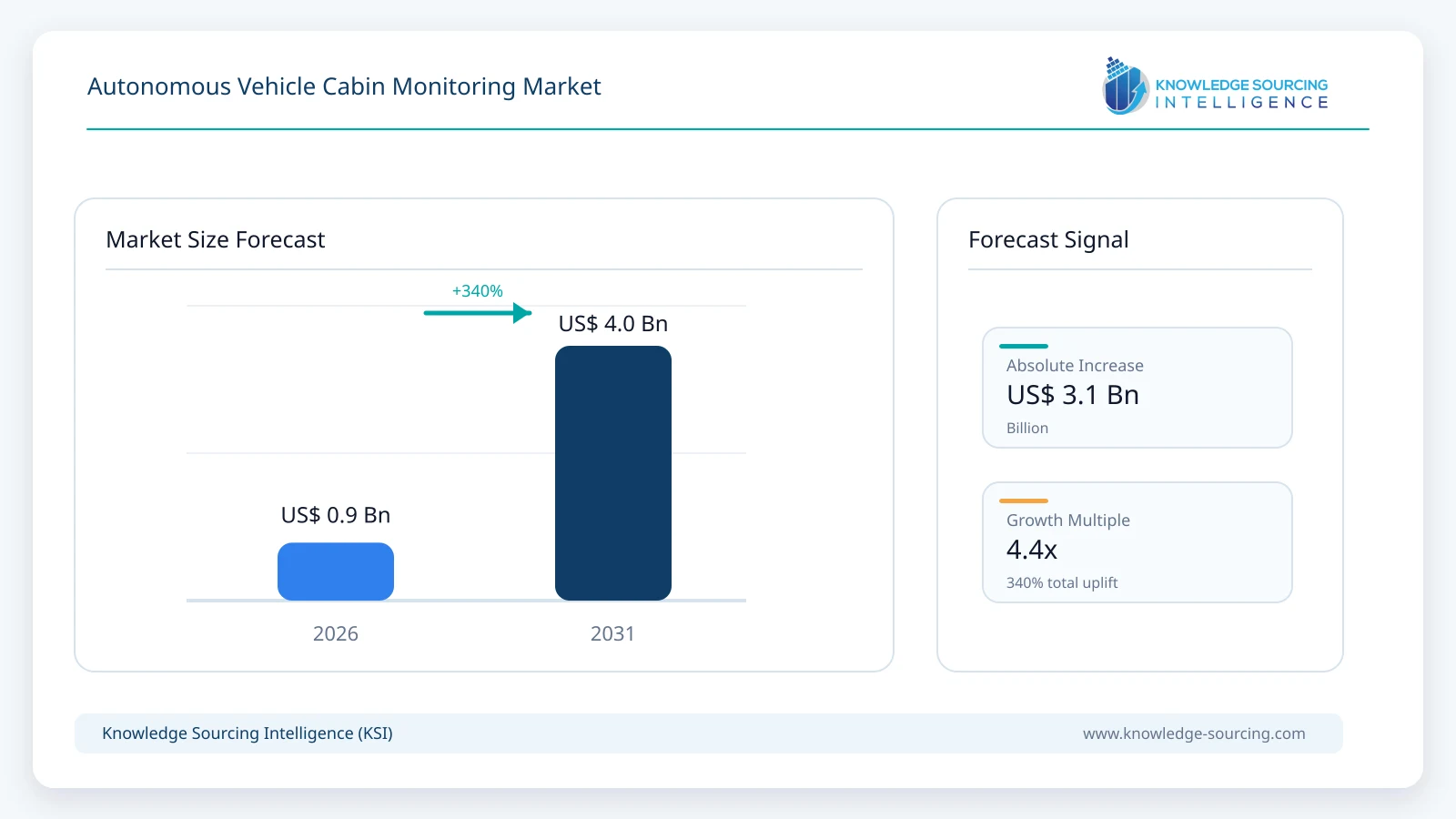
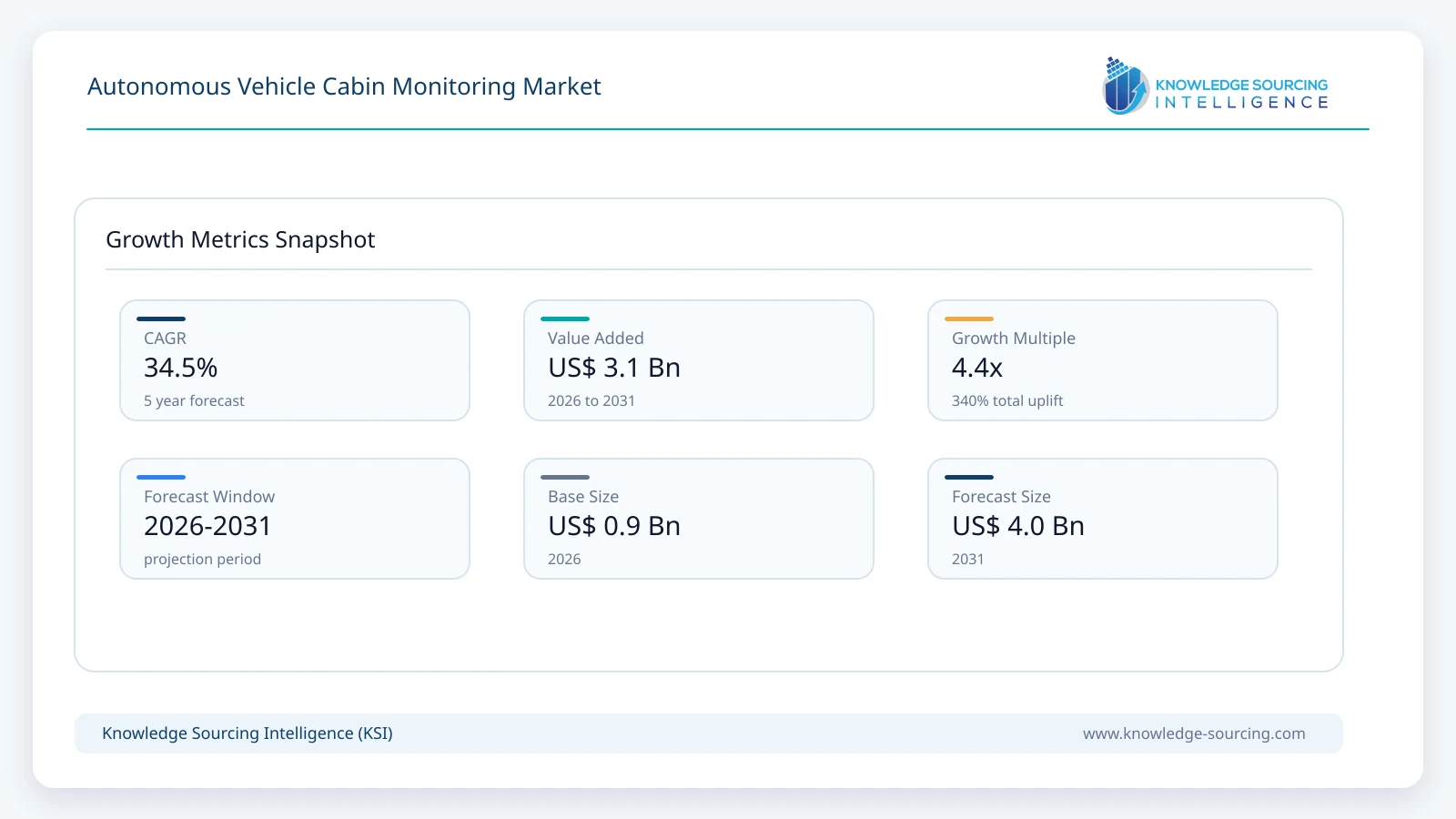
The autonomous vehicle cabin monitoring market is estimated at approximately USD 0.90 billion in 2026 and is projected to reach about USD 3.96 billion by 2031, representing a CAGR of 34.5% during the forecast period.
Highlights:
- 1Camera-based cabin monitoring accounts for approximately 58% of global market value in 2026 because RGB-IR and near-infrared cameras provide the broadest combination of occupant classification, posture recognition, activity analysis and software scalability.
- 2Occupant presence, position and classification functions represent approximately 43% of market value in 2026, reflecting their direct use in seat-belt reminders, airbag control, child detection, seating-state validation and autonomous-cabin safety logic.
- 3Integrated driver and occupant monitoring architectures account for approximately 64% of 2026 market value as OEMs increasingly use one interior-sensing platform, shared compute and a wide-field camera location to support both driver-state and cabin-awareness functions.
- 4SAE Level 3 applications represent approximately 61% of global market value in 2026 because conditional automation requires reliable driver takeover-readiness assessment while simultaneously increasing the value of occupant-position and cabin-state monitoring.
- 5Personally owned autonomous passenger vehicles account for approximately 69% of market value in 2026, while robotaxi and shared autonomous mobility applications are increasing demand for full-cabin presence, behavior, object and post-trip monitoring.
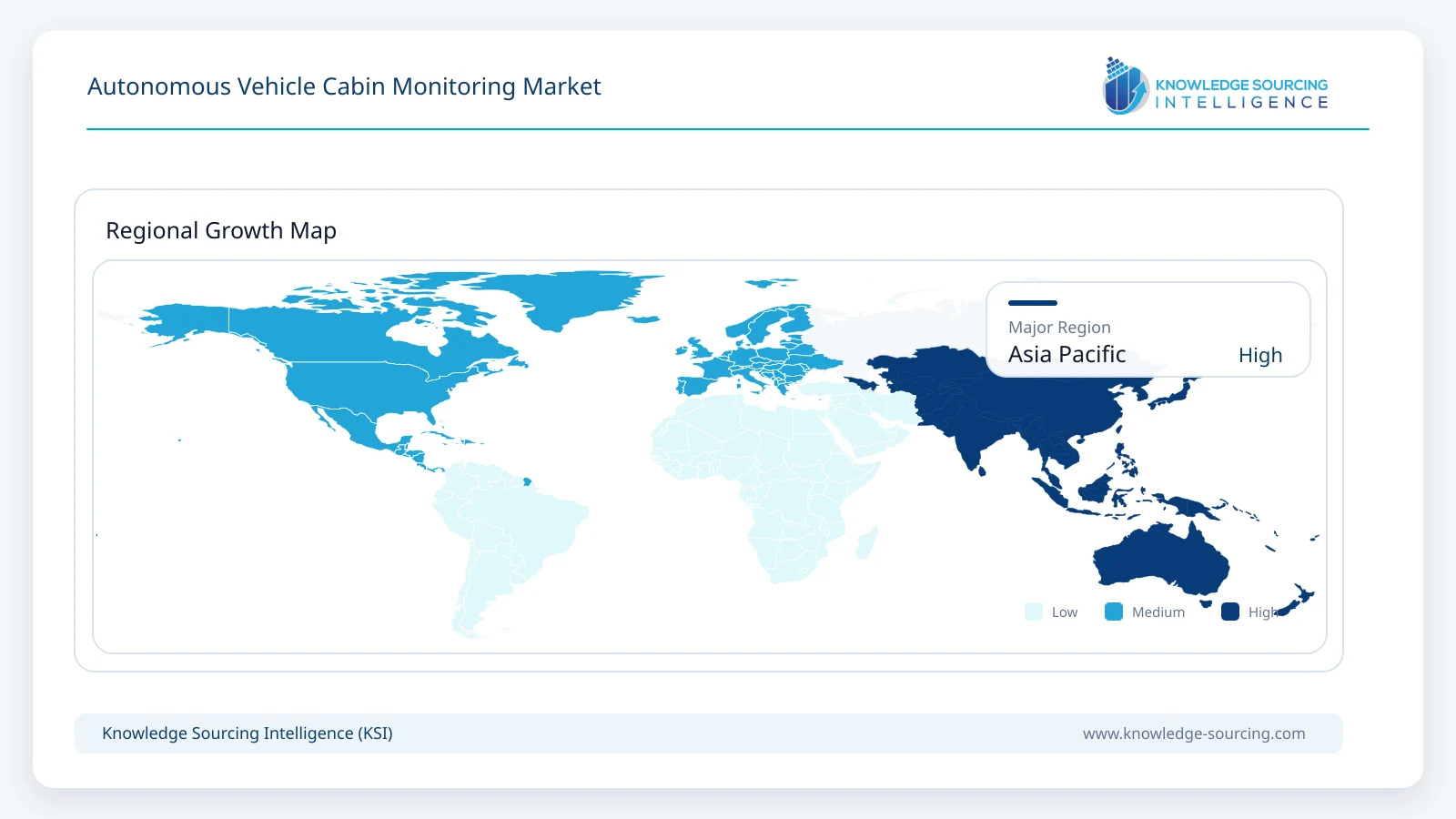
- 6Asia Pacific represents approximately 42% of global market value in 2026, supported by rapid smart-cabin and automated-driving development in China and strong automotive electronics capabilities in Japan and South Korea
The market is moving from separate driver-monitoring and occupant-detection functions toward unified interior-sensing platforms that observe the entire cabin and provide safety-critical information to automated-driving, restraint, climate and HMI systems.
Commercial deployment is accelerating. Magna received a 2026 European OEM award for a platform-level driver and occupant monitoring system, Smart Eye secured a new mirror-integrated DMS/OMS program across three vehicle models, and Gentex reported the successful launch and ramp of an in-cabin monitoring platform in Europe. Valeo and Seeing Machines are jointly presenting integrated driver and occupant monitoring applications, while HARMAN Ready Care combines occupant-position monitoring with vital-sign sensing and proactive cabin responses.
The technical direction is also broadening beyond camera-only monitoring. Bosch combines wide-field occupant cameras with cabin radar to detect seating position, small movements and vital signs. Smart Eye and Airy3D have demonstrated single-sensor 3D depth sensing for adaptive restraints, while Valeo offers radar and ultra-wideband approaches for life-presence detection. These architectures are important for autonomous cabins because occupants may recline, rotate, move between seating modes or become visually occluded in ways that challenge conventional camera-only perception.
Market Overview
Cabin monitoring becomes more important as autonomous vehicles move away from a fixed driver-centric interior. A conventional driver-monitoring camera primarily determines attention, drowsiness and readiness to control the vehicle. A full cabin-monitoring system must interpret multiple occupants, varied postures, seat locations, child presence, restraint use, objects and activity across a larger and more dynamic field of view.
This information increasingly feeds other vehicle domains. Occupant position can influence airbag deployment and belt pretensioning, presence detection can trigger child-left-behind warnings, posture recognition can limit unsafe seat movement, and vital-sign sensing can support health-related alerts or emergency response. In Level 3 vehicles, driver-state information remains necessary for takeover management, while in Level 4 mobility the emphasis shifts toward passenger safety, fleet supervision, accessibility and cabin-state awareness.
Bosch provides a representative multimodal architecture by combining an occupant-monitoring camera with cabin-sensing radar. The camera captures passenger and rear-seat activity, while radar can identify very small movements and vital signs even when direct optical visibility is limited. Valeo similarly combines camera-based interior monitoring with radar and UWB-based occupancy detection, and Gentex is expanding mirror-integrated monitoring from driver-centric functions toward 2D and 3D full-cabin perception.
Software suppliers are becoming equally important. Smart Eye provides DMS and OMS software that can detect occupant presence, position and activity across the cabin, Seeing Machines supplies driver and occupant monitoring perception software for embedded automotive platforms, and HARMAN has expanded Ready Care through Cipia computer-vision assets and CAARESYS radar-sensing capabilities. The competitive market therefore spans sensors, perception software, integrated modules and complete Tier 1 cabin-monitoring systems.
Market Trends
Driver Monitoring and Occupant Monitoring Are Converging into a Unified Interior-Sensing Platform
OEMs are increasingly combining driver-state and cabin-awareness functions on shared hardware rather than deploying isolated systems. Mirror-integrated and overhead wide-field cameras can observe the driver while also detecting passengers, seating position and activity. This reduces visible hardware, simplifies wiring and allows centralized compute to serve multiple safety functions.
Magna and Smart Eye both disclosed new 2026 programs built around combined DMS/OMS architectures, while Gentex and Seeing Machines are also commercializing integrated interior-monitoring platforms. The convergence is particularly relevant to Level 3 vehicles because the same system must understand both driver takeover readiness and broader cabin state.
Camera and Radar Fusion Is Expanding Coverage of Occluded and Low-Light Cabin Conditions
Camera systems offer rich semantic information but can be affected by blankets, seat geometry, darkness and line-of-sight limitations. Radar complements optical sensing by detecting small body movement, breathing and life presence through some visual obstructions. Multimodal systems are therefore becoming more attractive for child detection, rear-seat monitoring and variable autonomous-cabin layouts.
3D Occupant Understanding Is Moving Toward Adaptive Restraint Control
Cabin monitoring is progressing from presence detection toward precise body-position and posture estimation. Smart Eye and Airy3D demonstrated single-sensor passive 3D depth sensing at CES 2026 specifically to support robust occupant and posture understanding for adaptive restraints. Higher-quality depth information allows the vehicle to estimate how an occupant is positioned relative to airbags, belts and interior structures.
Vital-Sign and Health-State Sensing Is Expanding the Function of Cabin Monitoring
Interior sensing is beginning to measure more than visible behavior. HARMAN Ready Care incorporates heart-rate and breathing information, Gentex has demonstrated vital-sign monitoring, Bosch cabin radar can identify physiological motion, and Valeo includes vital-sign detection within its interior-monitoring portfolio. These capabilities can support sudden-illness detection, stress management, post-crash assessment and passenger well-being.
Cabin Monitoring Is Becoming an Input to Personalized Safety and Interior Control
Occupant awareness increasingly influences how the vehicle responds rather than simply generating an alert. Position and classification data can modify airbag deployment, seating movement, temperature, infotainment and accessibility settings. In autonomous cabins, this creates a direct link between interior sensing, adaptive safety and passenger-experience orchestration.
Software-Defined Architectures Are Shifting Inference Toward Shared Domain Compute
Interior perception algorithms are increasingly designed to run on shared cockpit or central compute rather than a dedicated ECU for every camera. Magna describes scalable DMS/OMS architectures that can support camera and radar sensing, Valeo offers algorithms that can be integrated into its own ECU or a domain controller, and Smart Eye is pre-integrating monitoring software with automotive computing platforms. This architecture supports feature upgrades while reducing duplicated hardware.
Segment Analysis
By Sensing Technology: Camera-Based Monitoring
Camera-based cabin monitoring is projected to generate approximately USD 2.06 billion in market value by 2031. RGB-IR and near-infrared cameras can identify occupant presence, face and body position, seat-belt routing, gestures, held objects and activity using one wide-field sensor, making them the most versatile foundation for production cabin-monitoring systems. Continued improvements in low-light performance, wide-angle optics and embedded AI are expected to sustain camera leadership even as radar becomes a more important complementary sensing layer.
By Monitoring Function: Occupant Presence, Position and Classification
Occupant presence, position and classification functions are projected to generate approximately USD 1.56 billion by 2031. These functions directly support restraint adaptation, seat-belt reminders, child-presence detection, seating-state validation and safe operation of reconfigurable interiors. Their value increases in autonomous vehicles because occupants may recline, rotate or move away from conventional seating postures for longer periods.
By System Architecture: Integrated Driver and Occupant Monitoring
Integrated DMS/OMS architectures are projected to generate approximately USD 2.45 billion by 2031. Combining driver and cabin perception on one scalable sensing and compute platform reduces hardware duplication and allows a consistent software layer to support Level 3 takeover management, occupant monitoring, child detection and passive-safety functions. Mirror-integrated systems from Magna, Gentex and Smart Eye-related programs illustrate the commercial direction.
By Automation Level: SAE Level 3
SAE Level 3 applications are projected to generate approximately USD 2.02 billion by 2031. Conditional automation creates a dual monitoring requirement: the vehicle must confirm whether the driver can safely resume control while also understanding occupant posture and cabin state during automated operation. Level 4 cabin monitoring is expected to expand faster over the forecast period as robotaxi and purpose-built mobility fleets scale.
By Vehicle Application: Personally Owned Autonomous Passenger Vehicles
Personally owned autonomous passenger vehicles are projected to generate approximately USD 2.43 billion in cabin-monitoring market value by 2031. Premium and upper-mid vehicles provide the earliest large-scale path for integrated DMS/OMS, adaptive restraint, child-presence and personalization functions, while their centralized electronics architectures can support advanced software and multimodal sensing.
Market Drivers
Expansion of SAE Level 3 and Level 4 Automated Driving
Higher automation changes what occupants do inside the cabin and increases the importance of knowing who is present, where they are seated and whether a driver is ready to resume control. Cabin monitoring therefore becomes part of the operational safety architecture rather than a stand-alone convenience feature.
Stricter Driver and Occupant Safety Requirements
The European regulatory environment and evolving NCAP assessment are accelerating interior sensing adoption. Advanced driver-distraction requirements and occupant-status assessment encourage OEMs to deploy monitoring platforms that can expand beyond driver attention into broader passenger and cabin-safety functions.
Growth of Adaptive Restraints and Position-Aware Passive Safety
Airbag and belt systems can respond more precisely when the vehicle knows occupant size, posture and location. This becomes increasingly valuable as autonomous cabins support reclined, rotated or otherwise non-traditional seating positions. Cabin sensing therefore provides a critical perception layer for adaptive restraint strategies.
Demand for Child-Presence and Life-Detection Functions
Radar, camera and UWB systems can detect babies, children, pets and other living occupants after the vehicle is parked or locked. Child-presence detection has become an important consumer-safety function and provides a strong pathway for radar-based cabin sensing because vital motion can be detected even when optical visibility is limited.
Software-Defined Cabin Personalization
Interior sensing allows the vehicle to identify occupants and adapt safety, climate, seating, HMI and comfort settings to real-time context. Centralized computing and over-the-air software updates make it easier for OEMs to add new cabin-monitoring functions over the vehicle lifecycle, increasing the software value of the sensing platform.
Market Restraints
Occlusion, Lighting and Highly Variable Occupant Postures
Cabin perception must remain reliable across darkness, direct sunlight, sunglasses, blankets, child seats, large objects and unconventional seating positions. Maintaining high detection performance across these conditions increases sensor, illumination and training-data requirements.
Privacy and Data-Governance Requirements
Cabin cameras and biometric sensing can process highly sensitive information about identity, behavior, health and passenger activity. OEMs must limit retention, secure processing and clearly define how interior data are used, particularly as vehicles become more connected and personalized.
Cost, Compute and Thermal Constraints
Wide-field RGB-IR cameras, radar, illumination, higher-resolution image processing and continuous AI inference add cost and power demand. Entry and mid-market vehicles may therefore adopt staged functionality, while higher-end automated vehicles support richer multimodal systems.
False Positives and Validation Across Diverse Occupants
Production systems must perform across different body sizes, skin tones, clothing, accessories, child seats and passenger behaviors. False alerts or missed detections can reduce trust and create safety risk, requiring extensive validation and robust confidence management.
Complex Functional-Safety Integration
Cabin-monitoring outputs increasingly affect airbags, belts, seat movement and automated-driving transitions. As the system becomes safety-critical, sensor diagnostics, redundancy, software validation and interface management become more demanding and can lengthen vehicle-program development.
Regional Outlook
Asia Pacific
Asia Pacific is the largest regional market and is expected to remain the strongest volume-growth center through 2031. China is driving rapid adoption of smart-cabin electronics, automated-driving functions and integrated interior sensing, while Japan and South Korea contribute strong capabilities in imaging, semiconductors, electronics and vehicle systems.
Magna has already expanded DMS/OMS deployment in China with a Germany-based OEM, while Smart Eye has a substantial production footprint across global automotive programs and Sony Semiconductor Solutions has introduced a 5-megapixel RGB-IR image sensor designed for single-camera monitoring of drivers and passengers. Regional OEM competition around intelligent cabins is expected to accelerate demand for wide-field cameras, radar, occupant-perception software and centralized compute.
Europe
Europe is a major commercialization and validation region because safety regulation and consumer-assessment protocols are pushing interior monitoring into mainstream vehicle architectures. The EU framework requires advanced driver-distraction warning for relevant new vehicle types, while Euro NCAP places growing emphasis on driver and occupant monitoring, child presence and status awareness.
Magna received a European OEM DMS/OMS program award in May 2026, Gentex reported the launch and ramp of an in-cabin monitoring platform in Europe, and Smart Eye secured a new global European OEM program in August 2026. The region is therefore expected to remain important for integrated DMS/OMS software, safety validation and deployment of position-aware restraint functions.
Competitive Landscape
The autonomous vehicle cabin monitoring market includes Tier 1 system suppliers, perception-software companies and sensing specialists. Competition is shifting toward complete interior-awareness platforms that combine wide-field imaging, radar or depth sensing, embedded AI, centralized compute integration and direct links to safety and comfort systems.
Magna is expanding mirror-integrated DMS/OMS programs and scalable interior-sensing architectures. Valeo combines wide-field camera monitoring with radar and UWB occupancy technologies and integrates Seeing Machines perception software. Bosch offers occupant cameras and cabin-sensing radar as a multimodal interior-sensing portfolio. Smart Eye focuses on DMS/OMS software and 3D posture understanding, while Seeing Machines supplies embedded driver and occupant perception at production scale. Gentex differentiates through mirror-integrated sensing, 2D/3D cabin monitoring and vital-sign features. HARMAN combines camera and radar-derived occupant intelligence through Ready Care, Cipia and CAARESYS technologies.
Recent Developments
15 September 2026: HARMAN joined the SDVerse automotive software marketplace and made Ready Care available as part of its software portfolio, expanding OEM access to in-cabin driver and occupant monitoring with physiological sensing and proactive interventions.
13 August 2026: Smart Eye secured a mirror-integrated DMS/OMS program for three new vehicles from a major European OEM with global reach. The system uses infrared and color imaging to monitor driver attention and occupant presence, position and activity across the cabin.
19 May 2026: Magna received a driver and occupant monitoring program award from a European OEM, positioning its mirror-integrated DMS/OMS as a platform-level solution across next-generation vehicle architectures.
24 April 2026: Gentex reported the successful launch and ramp of a key in-cabin monitoring system platform in Europe, providing evidence that its monitoring technology had moved into commercial production.
13 January 2026: HARMAN announced new Ready Care capabilities including single-heartbeat detection and enhanced occupant-position monitoring to support safer airbag deployment and more responsive in-cabin interventions.
6 January 2026: Smart Eye and Airy3D demonstrated single-sensor 3D in-cabin monitoring that combines eye tracking and body-posture analysis with passive depth sensing for adaptive-restraint applications.
6 January 2026: Gentex presented a next-generation driver and in-cabin monitoring demonstrator using 2D and structured-light 3D sensing for passenger, behavior, object and life-presence detection, together with vital-sign and cognitive-state functions.
5 January 2026: Valeo and Seeing Machines announced CES 2026 demonstrations of integrated in-cabin monitoring solutions combining Valeo system design with Seeing Machines driver and occupant perception software.
29 October 2025: Magna announced expanded deployment of its driver and occupant monitoring system in China with a Germany-based OEM, strengthening production adoption of mirror-integrated interior sensing.
2 October 2025: Sony Semiconductor Solutions introduced the IMX775 RGB-IR image sensor for in-cabin monitoring cameras, targeting wide-angle single-sensor monitoring of drivers and passengers with planned mass-production shipments in spring 2026.
Market Outlook
The autonomous vehicle cabin monitoring market is expected to expand rapidly through 2031 as interior sensing becomes a core input to automated-driving supervision, occupant protection and software-defined cabin control. Camera-based systems will remain the principal architecture, but radar, depth sensing and multimodal fusion will gain share where occlusion, life detection and precise body-position understanding require additional sensing.
The largest value shift will be from passive detection toward action-oriented cabin intelligence. Monitoring systems will increasingly influence airbag and belt deployment, seat-motion permission, takeover logic, child-presence alerts, emergency response, climate settings and personalized HMI behavior. This will increase the importance of functional safety, low-latency inference and standardized interfaces between interior sensing and other vehicle domains.
Asia Pacific is expected to remain the largest market, while Europe remains a major regulatory and production-validation region. Competitive advantage will depend on perception accuracy across diverse occupants and lighting conditions, sensor fusion, privacy-preserving processing, compute efficiency, integration with centralized vehicle architecture and the ability to support both current safety requirements and future autonomous-cabin functions.
Autonomous Vehicle Cabin Monitoring Market Scope
| Report Metric | Details |
|---|---|
| Total Market Size in 2026 | USD 0.90 billion |
| Total Market Size in 2031 | USD 3.96 billion |
| Forecast Unit | Billion |
| Growth Rate | 34.5% |
| Study Period | 2021 to 2031 |
| Historical Data | 2021 to 2024 |
| Base Year | 2025 |
| Forecast Period | 2026 – 2031 |
| Segmentation | Sensing Technology, Monitoring Function, System Architecture, Automation Level, Vehicle Application, Geography |
| Companies |
|
Market Segmentation
By Sensing Technology
Camera-Based Monitoring
Radar-Based Monitoring
Multimodal Camera + Radar / Depth Systems
Other Interior Sensing Technologies
By Monitoring Function
Occupant Presence, Position and Classification
Posture, Activity and Behavior Monitoring
Child and Life-Presence Detection
Vital-Sign and Health-State Monitoring
Object, Restraint and Cabin-State Monitoring
By System Architecture
Integrated Driver and Occupant Monitoring
Dedicated Occupant / Cabin Monitoring
Multisensor Interior-Sensing Platforms
By Automation Level
SAE Level 3
SAE Level 4 and Above
By Vehicle Application
Personally Owned Autonomous Passenger Vehicles
Robotaxi and Shared Autonomous Mobility
Autonomous Shuttle and Commercial Passenger Mobility
By Geography
North America
United States
Canada
Mexico
South America
Brazil
Argentina
Others
Europe
Germany
United Kingdom
France
Italy
Spain
Others
Middle East and Africa
Saudi Arabia
UAE
South Africa
Others
Asia Pacific
China
Japan
South Korea
India
Singapore
Others
Table of Contents
1. INTRODUCTION
1.1. Market Overview
1.2. Market Definition
1.3. Scope of the Study
1.4. Market Segmentation
1.5. Currency
1.6. Assumptions
1.7. Base and Forecast Years
1.8. Key Benefits to Stakeholders
2. RESEARCH METHODOLOGY
2.1. Research Design
2.2. Secondary Research
2.3. Primary Research
2.4. Market Estimation
2.5. Segment Modelling
2.6. Data Triangulation and Validation
3. EXECUTIVE SUMMARY
3.1. Key Findings
3.2. Autonomous Vehicle Cabin Monitoring Market Size, 2026-2031
3.3. Sensing Technology Outlook
3.4. Monitoring Function Outlook
3.5. System Architecture Outlook
3.6. Automation Level Outlook
3.7. Vehicle Application Outlook
3.8. Regional Opportunity Summary
4. MARKET DYNAMICS
4.1. Market Drivers
4.1.1. Expansion of SAE Level 3 and Level 4 Automated Driving
4.1.2. Stricter Driver and Occupant Safety Requirements
4.1.3. Growth of Adaptive Restraints and Position-Aware Passive Safety
4.1.4. Demand for Child-Presence and Life-Detection Functions
4.1.5. Software-Defined Cabin Personalization
4.2. Market Restraints
4.2.1. Occlusion, Lighting and Highly Variable Occupant Postures
4.2.2. Privacy and Data-Governance Requirements
4.2.3. Cost, Compute and Thermal Constraints
4.2.4. False Positives and Validation Across Diverse Occupants
4.2.5. Complex Functional-Safety Integration
4.3. Market Opportunities
4.4. Porter's Five Forces Analysis
4.5. Industry Value Chain Analysis
4.6. Cabin Monitoring System Economics
4.7. Regulatory, Privacy and Functional-Safety Environment
5. TECHNOLOGY OUTLOOK
5.1. RGB-IR and Near-Infrared Interior Cameras
5.2. Cabin Radar and Life-Presence Sensing
5.3. 3D Depth and Body-Pose Estimation
5.4. Ultra-Wideband Occupancy Sensing
5.5. Multimodal Camera-Radar Sensor Fusion
5.6. Occupant Classification and Position Tracking
5.7. Vital-Sign and Physiological Monitoring
5.8. Child-Presence and Left-Behind Detection
5.9. Adaptive-Restraint Integration
5.10. Centralized In-Cabin AI and Domain Compute
6. AUTONOMOUS VEHICLE CABIN MONITORING MARKET BY SENSING TECHNOLOGY
6.1. Introduction
6.2. Camera-Based Monitoring
6.3. Radar-Based Monitoring
6.4. Multimodal Camera + Radar / Depth Systems
6.5. Other Interior Sensing Technologies
7. AUTONOMOUS VEHICLE CABIN MONITORING MARKET BY MONITORING FUNCTION
7.1. Introduction
7.2. Occupant Presence, Position and Classification
7.3. Posture, Activity and Behavior Monitoring
7.4. Child and Life-Presence Detection
7.5. Vital-Sign and Health-State Monitoring
7.6. Object, Restraint and Cabin-State Monitoring
8. AUTONOMOUS VEHICLE CABIN MONITORING MARKET BY SYSTEM ARCHITECTURE
8.1. Introduction
8.2. Integrated Driver and Occupant Monitoring
8.3. Dedicated Occupant / Cabin Monitoring
8.4. Multisensor Interior-Sensing Platforms
9. AUTONOMOUS VEHICLE CABIN MONITORING MARKET BY AUTOMATION LEVEL
9.1. Introduction
9.2. SAE Level 3
9.3. SAE Level 4 and Above
10. AUTONOMOUS VEHICLE CABIN MONITORING MARKET BY VEHICLE APPLICATION
10.1. Introduction
10.2. Personally Owned Autonomous Passenger Vehicles
10.3. Robotaxi and Shared Autonomous Mobility
10.4. Autonomous Shuttle and Commercial Passenger Mobility
11. AUTONOMOUS VEHICLE CABIN MONITORING MARKET BY GEOGRAPHY
11.1. North America
11.1.1. United States
11.1.2. Canada
11.1.3. Mexico
11.2. South America
11.2.1. Brazil
11.2.2. Argentina
11.2.3. Others
11.3. Europe
11.3.1. Germany
11.3.2. United Kingdom
11.3.3. France
11.3.4. Italy
11.3.5. Spain
11.3.6. Others
11.4. Middle East and Africa
11.4.1. Saudi Arabia
11.4.2. UAE
11.4.3. South Africa
11.4.4. Others
11.5. Asia Pacific
11.5.1. China
11.5.2. Japan
11.5.3. South Korea
11.5.4. India
11.5.5. Singapore
11.5.6. Others
12. COMPETITIVE ENVIRONMENT AND ANALYSIS
12.1. Major Players and Strategy Analysis
12.2. Market Share Analysis
12.3. Cabin Monitoring Technology Benchmarking
12.4. OEM Programs and Production Readiness
12.5. Competitive Dashboard
13. COMPANY PROFILES
13.1. Magna International Inc.
13.2. Valeo
13.3. Robert Bosch GmbH
13.4. Smart Eye AB
13.5. Seeing Machines Limited
13.6. Gentex Corporation
13.7. HARMAN International
14. APPENDIX
14.1. Currency
14.2. Assumptions
14.3. Base and Forecast Years Timeline
14.4. Key Benefits for Stakeholders
14.5. Research Methodology
14.6. Abbreviations
14.7. Data Sources
Navigate
Trusted by the world's leading organizations











