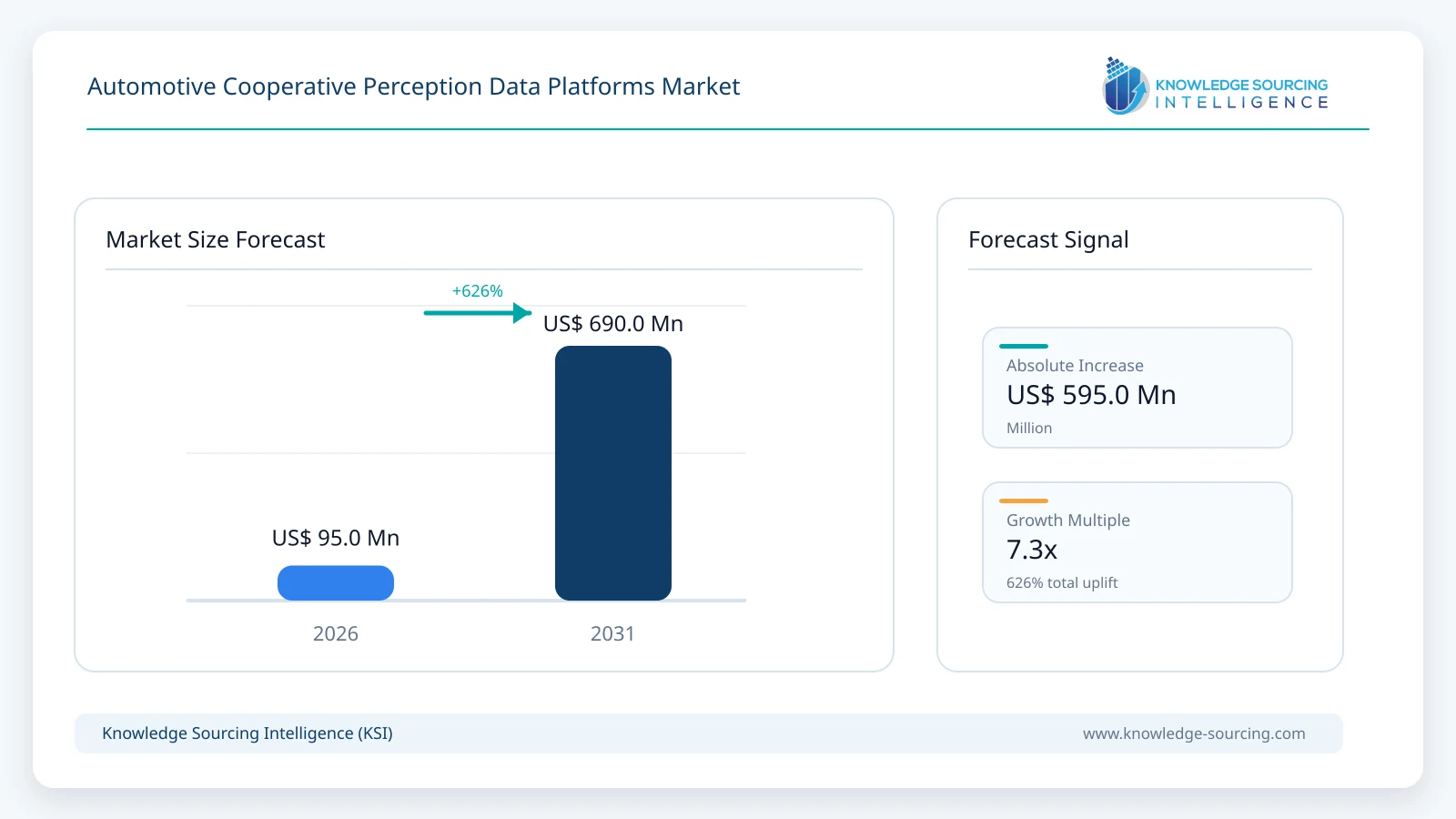
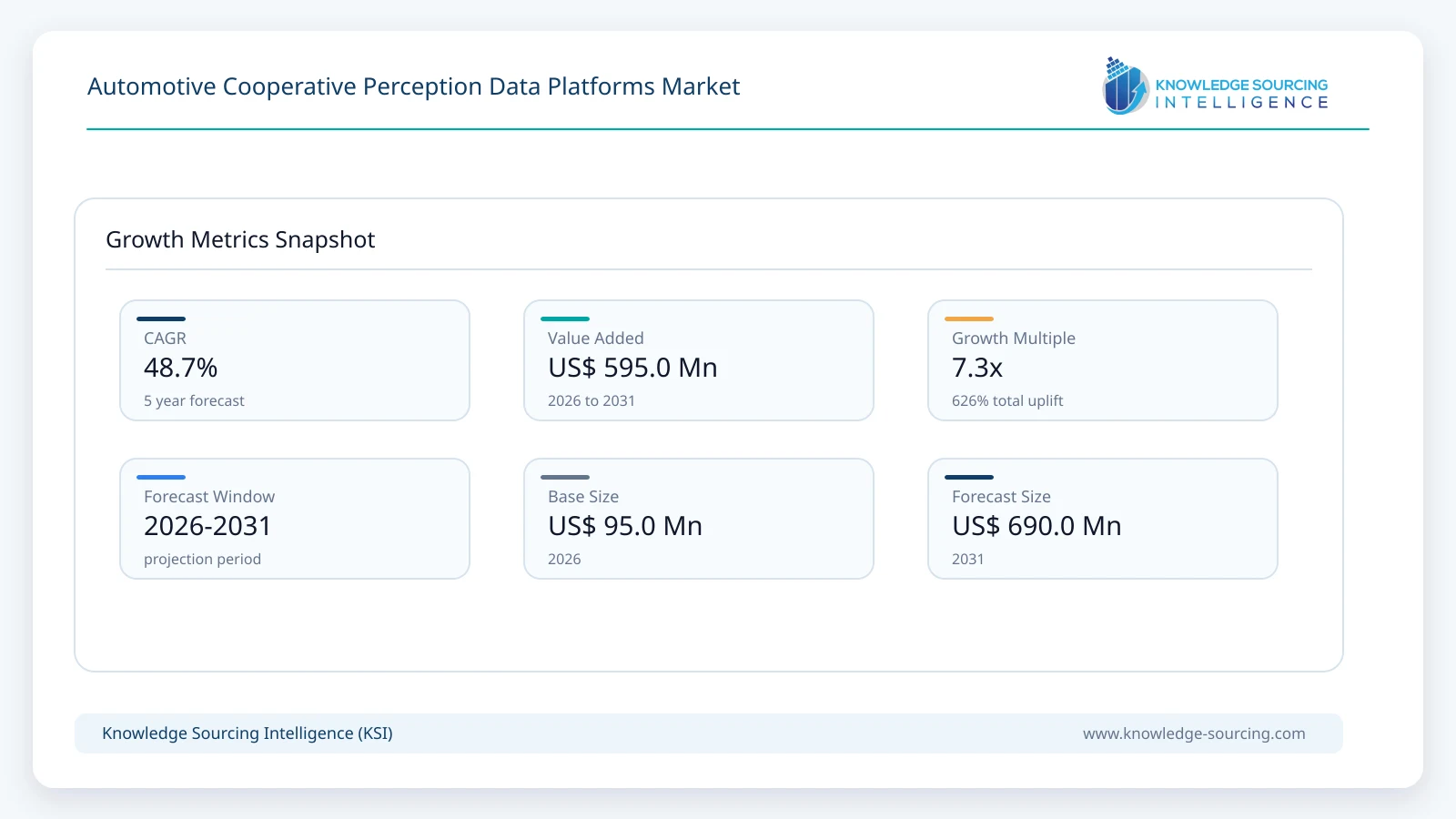
The Automotive Cooperative Perception Data Platforms Market is forecast to grow at a CAGR of 48.7%, reaching USD 690.0 million in 2031 from USD 95.0 million in 2026.
Highlights:
- 1The market is estimated at USD 95 million in 2026 and forecast to reach USD 690 million in 2031, with a 48.7% CAGR.
- 2Vehicle-side perception data licenses represent approximately 36.8% of modeled 2026 revenue.
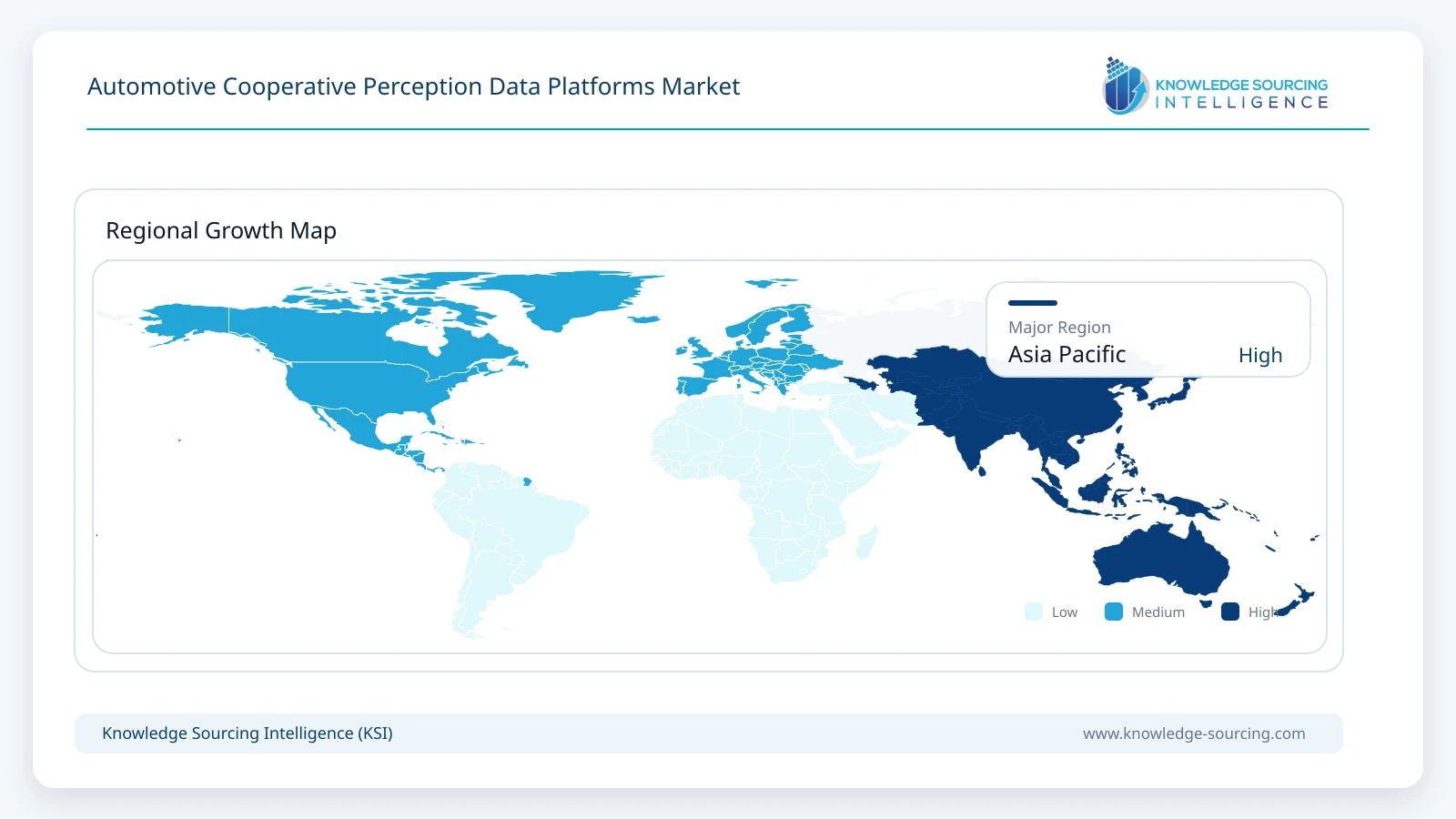
- 3Asia Pacific holds an estimated 47.4% of 2026 revenue, led by China's vehicle-road-cloud ecosystem.
- 4Roadside applications combine local sensor fusion, object tracking and standardized CPM or SDSM distribution.
- 5Hybrid direct and network distribution gains share as object-data services span individual intersections and corridors.
- 6Interoperability, trust in object-level observations and defensible software-only pricing remain central buying criteria.
Collective Perception Messages defined through ETSI TS 103 324 allow intelligent transport stations to exchange detected objects and their characteristics, creating a common information layer beyond simple vehicle-position announcements. Commercial systems normally ingest local object tracks, apply coordinate conversion, timestamps, confidence rules, and de-duplication, then expose coherent observations to connected vehicles or infrastructure applications. An object's inclusion does not itself determine whether a vehicle should brake or change lanes; those decisions belong to a different safety application layer.
Commsignia's June 2026 Trust Engine illustrates the shift from individual connected sensors to validated multi-source scene representation, while Derq's V2X system demonstrates commercially packaged roadside AI and standardized object messages. Yunex Traffic has tested distribution of detected road users through ITS-G5 Collective Perception Messages in an automated merging context. The suppliers use different sensing and delivery architectures, but each shows why platform licensing, integration, and managed data services can be measured separately from complete roadside equipment.
Market Overview
Connected intersections generate camera, radar, and LiDAR tracks that are useful beyond their original traffic-signal application when the observations can be standardized and transmitted to approaching vehicles. An infrastructure sensor may detect a cyclist hidden behind a bus even when an onboard vehicle camera cannot see the person directly. A cooperative perception platform converts this detection into an authenticated, appropriately time-stamped object record, permitting vehicle software to evaluate a wider scene without receiving the original video stream.
The commercial opportunity depends on software that joins many sensors and V2X devices rather than simply installing additional sensors. Ouster BlueCity supports edge object detection and tracking, Derq integrates roadside trajectories with V2X messages, and Commsignia combines authenticated third-party feeds into a unified traffic view. Many public projects purchase these functions in a bundled contract, so the relevant market is the attributable object-sharing and data-platform value rather than the procurement price of the entire junction upgrade.
Market Trends
Object-Level Sharing Replaces Raw Sensor Distribution
ETSI collective perception specifications provide a common approach for transmitting position, motion, and classification attributes of detected traffic participants. Suppliers increasingly build object-level data pipelines that remove unnecessary frames and compress repeated observations while retaining the information needed for cooperative awareness. This improves the feasibility of using wireless vehicle links with limited shared-channel capacity and allows receiving applications to handle observations from different kinds of sensors.
Object-sharing efficiency creates a growing role for track-quality scoring, dynamic update rates, and source-specific confidence indicators. A platform that sends too many redundant objects increases network load, while one that filters too aggressively can hide useful information from connected vehicles. Suppliers with repeatable filtering and track-reconciliation methods can differentiate their software without claiming ownership of the underlying sensor hardware.
Roadside Digital Twins Become Operational Data Products
Commsignia's Trust Engine brings roadside video, LiDAR, and connected-vehicle observations into a validated operational scene for road authorities and OEMs. Derq SENSE likewise uses real-time tracks and virtual representations of traffic participants to bridge infrastructure and connected vehicles. The value of these platforms lies in maintaining object identity and timing across sensor fields of view, rather than displaying a static map of an intersection.
Road operators can reuse a validated scene for safety analytics, real-time situational awareness, and selected cooperative data feeds. This reuse broadens the addressable service opportunity and encourages modular pricing of the resulting data feeds. Data exchange interfaces and identifiable application licenses offer a practical route to wider adoption.
Camera-Radar and LiDAR Inputs Converge at Intersections
Yunex Traffic demonstrated radar-tracking information converted into Collective Perception Messages, while Iteris and Ouster offer roadside perception products based on different sensor combinations. Multisensor installations can preserve useful object tracks across lighting, weather and occlusion conditions, making cooperative messages more reliable than information from a single viewpoint. The emerging commercial unit is often a software function attached to an existing intelligent intersection.
System integrators still have to align sensor calibration, mounting geometry, and detection histories before producing a coherent shared object. Where camera and LiDAR tracks describe the same vehicle with different coordinates, the platform must avoid publishing two separate road users. This installation and validation work supports specialized engineering revenue, although it can slow projects that rely on mixed equipment fleets.
Hybrid Direct and Network Data Distribution Expands
Cooperative perception applications can distribute objects locally using ITS-G5 or cellular sidelink, while network-based paths support managed access, longer-range orchestration and downstream analytics. A hybrid platform decides which observations need local broadcast, which can be delivered over the mobile network, and how to avoid duplicates when a connected vehicle receives both paths. Commsignia's broader direct and cloud architecture shows how vendors are combining these connectivity modes.
The software challenge shifts toward freshness, provenance, and controlled distribution as more participants consume shared tracks. OEMs also need a safe fallback when mobile service is unavailable, or roadside coverage ends. Hybrid architectures gain commercial value where the same object data can serve intersection safety, automated transport operations and a public authority's own traffic-center applications.
Standards Maturity Raises Validation Expectations
ETSI's published Collective Perception Service and continuing 2026 Release 2 drafting provide a defined technical reference for interoperable message behavior. The 5GAA demonstrated cooperative radar in April 2026, underscoring the practical development effort still needed to combine observations from multiple sources. Standards reduce ambiguity about messages but do not guarantee identical behavior across sensor platforms, jurisdictions, or receiving-vehicle safety software.
Commercial buyers increasingly expect repeatable evidence on localization accuracy, object confidence, latency and cybersecurity. A named laboratory demonstration or an RSU security certification should be viewed as a step toward market readiness, not proof of mass-market paid software installation. Platform suppliers that can document performance at deployed intersections are better positioned for repeat corridor contracts.
Segment Analysis
Vehicle Perception Data Licenses
Vehicle-side cooperative data software accounts for an estimated USD 35 million in 2026, equal to 36.8% of the modeled global market. The category includes qualified decoding, fusion, and presentation of externally detected objects to an OEM's vehicle software, while excluding general V2X modem value and onboard camera-based ADAS. Commsignia's automotive software explicitly supports perception sharing and the integration of received objects. Revenue expands as more vehicle lines support external awareness without changing their core autonomous-driving sensor stack.
Roadside Fusion and CPM Applications
Roadside cooperative perception applications represent approximately USD 32 million in estimated 2026 revenue. Intersections and road corridors bring together radar, LiDAR and camera outputs that must be calibrated, synchronized and converted into messages before connected vehicles can use the data. Derq, Yunex Traffic and Iteris provide evidence of this application class, while Ouster offers sensor-attached AI perception. The relevant supplier opportunity lies in reusable sensor-data processing and sharing software that can work within multiple roadside equipment packages.
Vulnerable Road User and Intersection Awareness
Vulnerable-road-user sharing represents the largest modeled use case at about 27.4% of 2026 market revenue, closely followed by occluded intersection awareness. Cooperative data helps infrastructure report pedestrians, cyclists and approaching vehicles that fall outside another vehicle's direct sensor view. The commercial driver is not simply broadcasting a warning; suppliers need accurate multi-object detection and standardized distribution that a variety of vehicle recipients can interpret.
Hybrid Communication and Managed Data Services
Direct V2X remains the leading distribution architecture, but hybrid direct-and-network delivery is projected to grow as corridor operators demand consistent object data across equipment suppliers. Managed perception subscriptions are a smaller revenue stream today and could become more material when fleets and road authorities purchase reliable data feeds rather than a fixed application at each junction. Such services compete on availability, object freshness and quality guarantees rather than on generic mobile connectivity alone.
Market Drivers
Roadside Blind-Spot Coverage for Connected Vehicles
Roadside sensors can observe pedestrians, cyclists and traffic entering an occluded junction before those road users appear in an approaching vehicle's direct camera view. Derq's V2X offerings and the Yunex Traffic AutopleX application show how converting these observations into standardized external tracks creates a practical safety feature. These functions support demand for perception data beyond ordinary self-contained ADAS.
Road authorities can begin with selected high-risk intersections instead of funding a complete connected-road network. Each new location creates a potential sale for track management, sensor integration, message generation and performance validation. Wider geographic coverage then improves the usefulness of onboard licenses, linking public investment and vehicle-software adoption without assuming every road junction will be fitted with roadside AI.
Smart Intersection Sensor Investment
Commercial edge perception platforms are being installed for traffic optimization and multimodal road-user monitoring, giving suppliers a technical base for V2X data sharing. Ouster reported nearly 700 contracted BlueCity sites in March 2026, while Iteris sells video-radar detection products used in connected-infrastructure programs. Only a portion of such installations may include separately sold cooperative perception, but the installed sensor-processing base lowers incremental deployment barriers.
Integration partners can attach standardized object outputs and communications interfaces to infrastructure that already performs detection and classification. This supports a more economical rollout than designing every cooperative deployment from scratch. Contract economics improve when a corridor reuses software templates and validation procedures across multiple intersections, especially where local procurement budgets favor upgrades to existing controllers and sensors.
Movement Toward Standardized Shared Object Information
ETSI TS 103 324 sets out Collective Perception Service semantics, giving V2X developers a common framework for object attributes and shared awareness. That specification helps OEMs and road operators ask for interoperable messages and compare different sensor-platform offerings against a known interface. The standards framework also facilitates cooperation among a hardware vendor, roadside integrator, and vehicle-software supplier.
The continuing Release 2 development process indicates that message behavior and supporting profiles still evolve. Vendors with reusable standards-compliant processing have an opportunity to license software across multiple national deployments, although customer testing remains necessary. Standardization can improve scale economics even where the final safety application and the radio stack are procured from different companies.
Connected and Automated Mobility Corridor Programs
The U.S. Department of Transportation's V2X Accelerator provides a public-deployment pathway for interoperable connected-road applications across Arizona, Texas, and Utah. Separately, China's vehicle-road-cloud direction has encouraged suppliers to develop roadside and vehicle-side data-sharing architectures. Such programs give vendors controlled environments to demonstrate usefulness beyond traditional hazard-message delivery.
Cooperative perception spending is tied to the subset of corridors that acquire object-fusion and data-distribution functions, not to entire grant or construction budgets. Repeatable platform procurement can follow when operational demonstrations show reliable coverage of vulnerable road users and blind junctions. Deployment milestones therefore influence adoption assumptions but should not be converted directly into reported platform revenue.
Reuse of Perception Data Across Public and Vehicle Applications
A validated shared object track can support multiple legitimate users, including traffic centers, connected buses and onboard vehicle perception modules. Commsignia's multi-source Trust Engine and Derq's roadside digital twin make this reuse technically practical by normalizing disparate detections into a consistent environment representation. Commercial value grows when a buyer can add a new recipient without installing a complete second set of roadside sensors.
Multiple applications do not imply that the same underlying software license should be counted several times. The strongest business models separately price data quality assurance, new interfaces, contracted uptime and managed delivery to identifiable users. These paid functions help suppliers expand recurring revenue while preserving a clear distinction from the value of raw sensor acquisition or generic traffic management.
Market Restraints
Sparse Coverage and Uneven Vehicle Participation
A cooperative perception system offers limited everyday benefit when only a few intersections broadcast usable object information or few vehicles can consume it. Urban demonstrations can achieve strong results in a defined corridor while nearby roads lack compatible roadside sensors, radios, or receiving applications. Buyers therefore face a coverage problem that is not solved by improving one perception algorithm alone.
OEMs may prioritize factory installations where the local cooperative network is likely to be used and maintain conventional onboard perception elsewhere. Public agencies, conversely, need evidence that a sufficient number of vehicles will consume the information. This two-sided adoption constraint can produce gradual revenue recognition despite visible technology announcements and demonstration activity.
Object Trust, Position Error and False Tracks
Roadside cameras, radar and LiDAR can generate different object boundaries, coordinate errors and timestamps for the same road user, especially during occlusion or adverse weather. A duplicate object or stale trajectory may make another vehicle's scene model less reliable rather than improving it. Cooperative platforms must therefore manage identity reconciliation, confidence, clock alignment and local-map geometry at operating speeds.
Security of the communications path is necessary but cannot guarantee that a correctly signed object detection is physically correct. Suppliers also need documented validation against real roadside conditions and controlled handling of uncertain detections. These requirements increase both engineering expenses and customer acceptance timelines, favoring vendors that can show verified performance at multiple sites.
Interoperability Across Regional Standards and Platforms
V2X system integrators must connect infrastructure with different radio interfaces, sensor formats, traffic-control systems and regional message profiles. ETSI Collective Perception Messages and U.S. SAE sensor-sharing structures have related purposes but differ in implementation details. Standard compliance at the message layer does not remove the need to port data pipelines or align object definitions with a receiving vehicle platform.
Multi-country automakers and road-technology firms consequently carry parallel testing burdens. Regional variations in infrastructure ownership and secure certificate management add further integration steps. The cost of making a cooperative platform operate reliably in several markets can offset the economic benefit of using the same core perception software everywhere.
Procurement and Lifecycle Support Complexity
Roadside cooperative perception projects frequently require camera or radar upgrades, traffic-controller interfaces, secure communications, and years of operating support before they generate a dependable vehicle-facing data service. Public procurement schedules, traffic permits and multi-vendor integration can delay revenue beyond the date of a technology announcement or award. A certification or pilot therefore should not be confused with completed deployments.
Long-term customers also require continued calibration when lanes change, roadside sensors are moved, or nearby construction alters the junction geometry. Software suppliers must budget for maintenance and service-level commitments, while local infrastructure operators need recurring operations funding. The additional workload can constrain margins on relatively small initial installation contracts.
Bundled Pricing and Uncertain Data Monetization
Perception-data functions are frequently procured inside a complete roadside detection, connectivity, or intersection-control package. Ouster, Iteris and other suppliers combine hardware and analytics, making the separately attributable cooperative object-data price smaller than total contract value. OEMs may similarly procure object-sharing logic within a wider V2X or ADAS software suite.
Subscribers will only pay for recurring shared data when coverage, latency, quality, and legal access rights provide a benefit beyond existing traffic feeds. Standardized messages can also reduce differentiation for basic object formatting. Vendors need measurable track quality, support and interoperability to defend data-platform pricing instead of relying on the value of the entire hardware installation.
Regional Outlook
Asia Pacific
Asia Pacific represents an estimated USD 45 million, or 47.4% of global attributable platform revenue in 2026, with China providing the largest national contribution. China-oriented vehicle-road-cloud initiatives support development of roadside sensors, cloud-connected object tracking and automotive platforms that can receive shared environment information. Japan and South Korea contribute engineering capability and connected-vehicle programs, while other Asian markets remain more selective in public infrastructure installation.
Expansion across Asia Pacific will depend on which cities and automakers buy true object-sharing capability rather than basic connected hazard messaging. Regional variations in radio policies, deployment density, roadway geometry and data-governance requirements support demand for local validation and software adaptation. As production-ready systems develop, connected-vehicle data applications may represent a larger revenue share than early infrastructure-heavy demonstrations.
Europe
Europe accounts for an estimated USD 27 million in 2026 and has a relatively strong technology base for cooperative object messages, roadside sensor integration and cross-border connected mobility. ETSI's published perception service specification provides a common point of reference, while Yunex Traffic has demonstrated roadside sensor fusion and V2X object delivery in the United Kingdom. Commsignia and other European suppliers also work across vehicle software and road-agency applications.
European growth remains dependent on moving from controlled trials to funded, sustained deployments at junctions and automated mobility corridors. Interoperability across national infrastructure operators and evidence of privacy-preserving object sharing will influence tender requirements. Commercial opportunities concentrate on road authorities, specialist sensor-fusion integrators and automotive developers that need reliable external-object interfaces across vehicle programs.
Competitive Landscape
Cooperative perception platform competition spans specialist V2X software providers, roadside AI suppliers and traffic infrastructure integrators. Commsignia and Derq sell identifiable object-sharing and scene-fusion capabilities; Yunex Traffic combines radar-based detections with V2X messages; Ouster and smartmicro provide sensor-attached perception software; Iteris and Econolite address connected smart intersection deployments. Cohda Wireless and Kapsch TrafficCom contribute V2X application and infrastructure platforms that may host or distribute shared object information.
Market leadership cannot be inferred from total V2X radios sold, contracted lidar sites or complete city traffic contract value. Supplier differentiation depends on track continuity, messaging interoperability, low-latency operation and the ability to integrate existing roadside assets. Integration partners with established road-authority relationships may have an advantage in deployment, while specialist software firms can compete on cross-vendor data normalization and measurable perception quality.
Recent Developments
2 July 2026: Cohda Wireless reported completion of its MK6 CPOC Level 1 European security evaluation. This strengthens trust infrastructure for connected systems without establishing cooperative perception software shipment volumes.
10 June 2026: Ouster launched BlueCity with Rev8 native-color lidar and reported an active installation in Stamford, Connecticut. The release expands roadside object-detection capacity; only relevant software/data content is attributable to this market.
8 June 2026: Commsignia introduced its Trust Engine to fuse validated camera, LiDAR and connected-vehicle information for road authorities and automotive customers. The announcement is a platform offering, not a disclosed global paid installed base.
23 April 2026: 5G Automotive Association showcased cooperative radar using multiple sensor observations at its Gothenburg technology demonstrations, evidencing ongoing development of shared scene awareness.
5 March 2026: Ouster reported nearly 700 contracted BlueCity sites and expanded software-attached bookings. These sites provide a potential base for connected perception but cannot all be classified as active cooperative perception installations.
25 August 2025: Commsignia released an upgraded Central platform supporting multi-vendor V2X device and source management, reducing integration friction for cooperative infrastructure networks.
Market Outlook
Automotive cooperative perception data platforms are gaining traction as connected vehicle programs and intelligent intersections increasingly adopt standardized object sharing. Vehicle software and roadside data fusion remain the main revenue contributors, while managed access to validated object feeds is expanding as fleets and public operators use shared infrastructure across multiple applications. Procurement is expected to focus on high-benefit urban junctions, automated corridors and fleet-service areas before broader roadside coverage is established. Growth is supported by the need for real-time environmental awareness, improved traffic coordination and enhanced road safety, while interoperability and infrastructure deployment remain important considerations for wider adoption.
The strongest suppliers are likely to combine sensor-independent data handling with defensible scene-quality evidence, standards-based interoperability and long-term support for mixed roadside installations. A successful growth path requires reliable message trust and proven utility in receiving vehicles, rather than only more connected hardware. The pace of city funding, vehicle penetration, and the commercial terms for reusing road-user observations remain important forecast uncertainties.
Automotive Cooperative Perception Data Platforms Market Scope:
| Report Metric | Details |
|---|---|
| Total Market Size in 2026 | USD 95.0 million |
| Total Market Size in 2031 | USD 690.0 million |
| Forecast Unit | USD Million |
| Growth Rate | 48.7% |
| Study Period | 2021 to 2031 |
| Historical Data | 2021 to 2024 |
| Base Year | 2025 |
| Forecast Period | 2026 – 2031 |
| Segmentation | Revenue Stream, Platform Execution Layer, Perception Input Architecture -, Primary Use Case |
| Companies |
|
Market Segmentation
By Revenue Stream
Vehicle Perception Data Licenses
Roadside Fusion and CPM Applications
Managed Perception Data Services
Engineering, Validation and Integration
By Platform Execution Layer
Vehicle Onboard Processing
Roadside Edge Processing
Telecom Multi-Access Edge
Hybrid Cloud and Edge Orchestration
By Perception Input Architecture
Camera and Radar Fusion
Lidar-Centric Object Sharing
Mixed Vehicle and Roadside Tracks
V2X Object Message Ingestion
By Primary Use Case
Vulnerable Road User Detection and Sharing
Intersection Occlusion Awareness
Work Zone and Roadway Obstacle Awareness
Cooperative Merging and Automated Corridors
Fleet, Shuttle and Transit Awareness
By Communication and Distribution Architecture
Direct PC5 and ITS-G5 Object Sharing
Network-Based V2N Data Distribution
Hybrid Direct and Network Distribution
By Purchasing Customer
Passenger Vehicle OEMs and Tier 1s
Road Authorities and Infrastructure Operators
Commercial Fleets and Automated Mobility Operators
Mobility Platforms and Systems Integrators
By Commercial Delivery Model
Factory-Embedded Software Programs
Roadside Application Licenses
Managed Perception Data Subscriptions
Project-Based Integration and Validation
By Geography
North America
United States
Canada
Mexico
South America
Brazil
Argentina
Others
Europe
Germany
United Kingdom
France
Italy
Spain
Netherlands
Nordic Countries
Others
Middle East and Africa
Saudi Arabia
United Arab Emirates
Israel
South Africa
Others
Asia Pacific
China
Japan
South Korea
India
Australia
Indonesia
Thailand
Taiwan
Others
Table of Contents
1. EXECUTIVE SUMMARY
1.1. Market Opportunity and Key Findings
1.2. Automotive Cooperative Perception Data Platforms Market Size, 2026–2031
1.3. Platform and Buyer Highlights
1.4. Regional Opportunities
2. MARKET SNAPSHOT
2.1. Market Overview
2.2. Market Definition
2.3. Scope of the Study
2.4. Market Segmentation
3. BUSINESS LANDSCAPE
3.1. Market Drivers
3.1.1. Roadside Blind-Spot Coverage for Connected Vehicles
3.1.2. Smart Intersection Sensor Investment
3.1.3. Movement Toward Standardized Shared Object Information
3.1.4. Connected and Automated Mobility Corridor Programs
3.1.5. Reuse of Perception Data Across Public and Vehicle Applications
3.2. Market Restraints
3.2.1. Sparse Coverage and Uneven Vehicle Participation
3.2.2. Object Trust, Position Error and False Tracks
3.2.3. Interoperability Across Regional Standards and Platforms
3.2.4. Procurement and Lifecycle Support Complexity
3.2.5. Bundled Pricing and Uncertain Data Monetization
3.3. Market Opportunities
3.4. Porter's Five Forces Analysis
3.5. Industry Value Chain Analysis
3.6. Policies and Regulations
3.7. Strategic Recommendations
4. TECHNOLOGICAL OUTLOOK
4.1. ETSI Collective Perception and SAE Sensor-Sharing Messages
4.2. Perception Track Association and Confidence Scoring
4.3. Camera, Radar and LiDAR Data Fusion
4.4. Onboard, Roadside and Hybrid Data Platforms
4.5. Direct and Network Object Distribution
4.6. Security, Localization and System Validation
5. AUTOMOTIVE COOPERATIVE PERCEPTION DATA PLATFORMS MARKET BY REVENUE STREAM
5.1. Introduction
5.2. Vehicle Perception Data Licenses
5.3. Roadside Fusion and CPM Applications
5.4. Managed Perception Data Services
5.5. Engineering, Validation and Integration
6. AUTOMOTIVE COOPERATIVE PERCEPTION DATA PLATFORMS MARKET BY PLATFORM EXECUTION LAYER
6.1. Introduction
6.2. Vehicle Onboard Processing
6.3. Roadside Edge Processing
6.4. Telecom Multi-Access Edge
6.5. Hybrid Cloud and Edge Orchestration
7. AUTOMOTIVE COOPERATIVE PERCEPTION DATA PLATFORMS MARKET BY PERCEPTION INPUT ARCHITECTURE
7.1. Introduction
7.2. Camera and Radar Fusion
7.3. Lidar-Centric Object Sharing
7.4. Mixed Vehicle and Roadside Tracks
7.5. V2X Object Message Ingestion
8. AUTOMOTIVE COOPERATIVE PERCEPTION DATA PLATFORMS MARKET BY PRIMARY USE CASE
8.1. Introduction
8.2. Vulnerable Road User Detection and Sharing
8.3. Intersection Occlusion Awareness
8.4. Work Zone and Roadway Obstacle Awareness
8.5. Cooperative Merging and Automated Corridors
8.6. Fleet, Shuttle and Transit Awareness
9. AUTOMOTIVE COOPERATIVE PERCEPTION DATA PLATFORMS MARKET BY COMMUNICATION AND DISTRIBUTION ARCHITECTURE
9.1. Introduction
9.2. Direct PC5 and ITS-G5 Object Sharing
9.3. Network-Based V2N Data Distribution
9.4. Hybrid Direct and Network Distribution
10. AUTOMOTIVE COOPERATIVE PERCEPTION DATA PLATFORMS MARKET BY PURCHASING CUSTOMER
10.1. Introduction
10.2. Passenger Vehicle OEMs and Tier 1s
10.3. Road Authorities and Infrastructure Operators
10.4. Commercial Fleets and Automated Mobility Operators
10.5. Mobility Platforms and Systems Integrators
11. AUTOMOTIVE COOPERATIVE PERCEPTION DATA PLATFORMS MARKET BY COMMERCIAL DELIVERY MODEL
11.1. Introduction
11.2. Factory-Embedded Software Programs
11.3. Roadside Application Licenses
11.4. Managed Perception Data Subscriptions
11.5. Project-Based Integration and Validation
12. AUTOMOTIVE COOPERATIVE PERCEPTION DATA PLATFORMS MARKET BY GEOGRAPHY
12.1. North America
12.1.1. United States
12.1.2. Canada
12.1.3. Mexico
12.2. South America
12.2.1. Brazil
12.2.2. Argentina
12.2.3. Others
12.3. Europe
12.3.1. Germany
12.3.2. United Kingdom
12.3.3. France
12.3.4. Italy
12.3.5. Spain
12.3.6. Netherlands
12.3.7. Nordic Countries
12.3.8. Others
12.4. Middle East and Africa
12.4.1. Saudi Arabia
12.4.2. United Arab Emirates
12.4.3. Israel
12.4.4. South Africa
12.4.5. Others
12.5. Asia Pacific
12.5.1. China
12.5.2. Japan
12.5.3. South Korea
12.5.4. India
12.5.5. Australia
12.5.6. Indonesia
12.5.7. Thailand
12.5.8. Taiwan
12.5.9. Others
13. COMPETITIVE ENVIRONMENT AND ANALYSIS
13.1. Major Players and Strategies
13.2. Market Share Analysis
13.3. Agreements, Collaborations and Deployments
13.4. Competitive Dashboard
14. COMPANY PROFILES
14.1. Commsignia
14.2. Derq
14.3. Yunex Traffic
14.4. Ouster
14.5. Iteris
14.6. Cohda Wireless
14.7. Kapsch TrafficCom
14.8. smartmicro
14.9. Econolite
15. APPENDIX
15.1. Currency
15.2. Assumptions
15.3. Base and Forecast Years
15.4. Key Benefits for Stakeholders
15.5. Research Methodology
15.6. Abbreviations
Navigate
Trusted by the world's leading organizations