
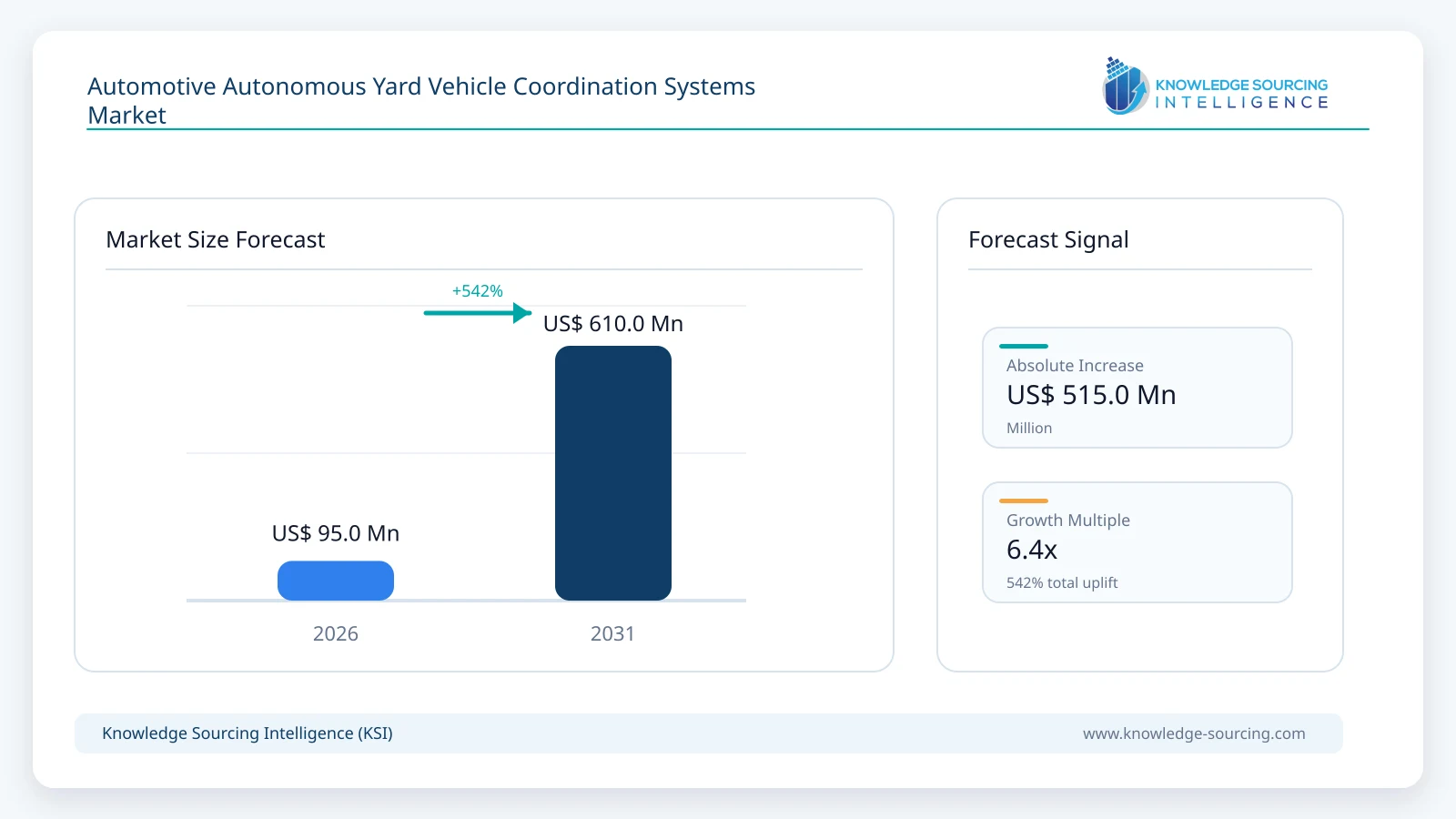
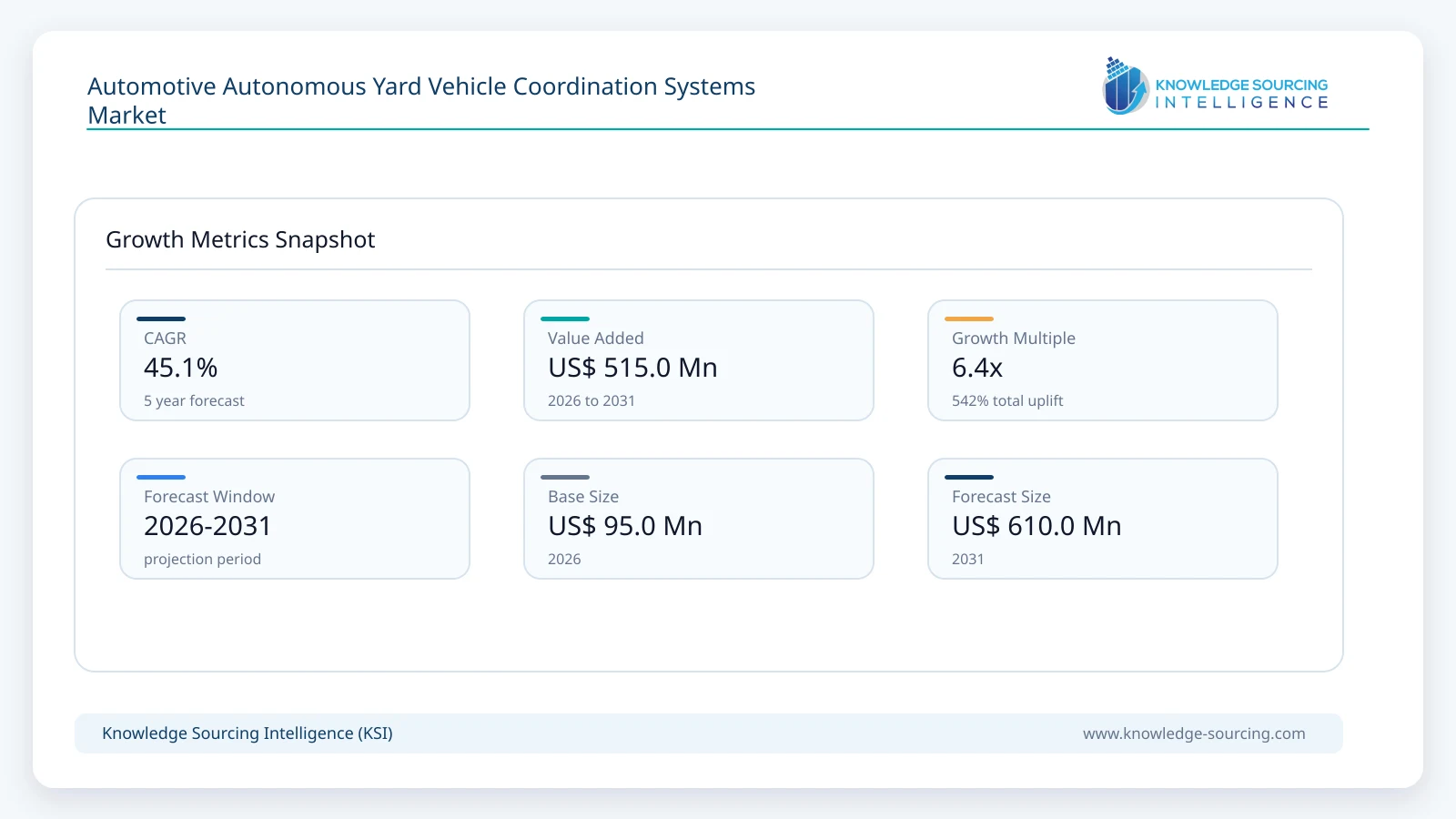
The Automotive Autonomous Yard Vehicle Coordination Systems Market is estimated at USD 95 million in 2026 and is projected to reach USD 610 million by 2031, representing a 45.1% CAGR during the forecast period.
Highlights:
- 1Autonomous yard coordination is shifting from basic vehicle dispatch toward complete operational scheduling, including trailer moves, shared-lane traffic and dock or crane handoffs.
- 2Ports represent the largest initial revenue opportunity, while distribution and manufacturing yards are expected to increase adoption as packaged deployment models mature.
- 3Mixed-traffic control, terminal-system interfaces and remote exception response are central to commercial acceptance because vehicles must work safely alongside personnel and manually driven equipment.
- 4Suppliers are separating fleet-level software from the onboard autonomous driving stack, allowing operators to coordinate vehicles and site infrastructure across existing systems.
- 5Growth to 2031 will depend on sustained operational uptime, clear safety responsibilities, economical site integration and conversion of announced deployments into routine service.
Outrider, FERNRIDE, Embotech and Westwell have shown that autonomous yard vehicles require a common operating layer linking dispatch orders, route availability, trailer locations and real-time safety conditions. Outrider’s management system can schedule and re-queue trailer movements, while FERNRIDE combines a management suite with remote oversight and exception handling. In container terminals, Embotech’s fleet software can exchange instructions with equipment-control and terminal operating systems. These functions determine how vehicle autonomy contributes to daily cargo movement rather than simply demonstrating driverless travel.
The market includes separately attributable revenue from mission dispatch, autonomous traffic and crossing control, remote exception management, site coordination licenses and integration into yard-management, warehouse or terminal systems. Autonomous vehicles, perception sensors, drive-by-wire kits, robotic couplers, complete terminal infrastructure and outsourced spotting labor are part of adjacent markets. Suppliers offering an integrated yard automation contract have to allocate the relevant coordination component rather than treating the full truck or service contract as platform revenue.
Commercial adoption currently ranges from limited vehicle pilots to active, expanding fleets. In April 2026, APM Terminals Maasvlakte II reported ten automated electric terminal tractors on site, progressing toward an intended thirty-vehicle program. Westwell reported Felixstowe orders expanding to one hundred autonomous trucks in July 2026, although ordered equipment should not be confused with fully active units. In October, YMX and Outrider entered a five-year commercial arrangement intended to bring autonomous yard fleets to additional North American shippers. These developments support a gradual transition from single-site projects to coordinated operating networks.
Market Overview
Autonomous terminal tractors perform repetitive container or trailer transfers between loading docks, gates, storage positions and rail or quay interfaces. Scheduling these tasks requires a coordinated view of the site, available vehicles, trailer readiness and human-operated equipment. ICT Logistics’ SmartECS connects automated terminal trucks with crane systems and terminal schedulers, illustrating how a yard coordination layer must translate high-level job orders into executable movements without interrupting established terminal operations.
The business case improves when one operating system can manage several autonomous vehicles in a mixed-traffic environment. Ports with concentrated container flows can justify fleet-level control because small delays around crane exchanges or tight corridors affect throughput. Distribution warehouses face different constraints: trailer identification, available dock doors, unpredictable arrivals and frequent changes to loading schedules. In both environments, coordination software must communicate actual equipment availability rather than assume every planned move can be executed immediately.
Commercial maturity differs substantially between operators. APM Terminals and Embotech have reported operational testing and staged vehicle additions in Rotterdam, while Kalmar and Forterra describe a later production pathway for the AutoTT terminal tractor. Westwell has reported scaled Asian and European port activity, whereas several independent integrations remain at demonstration or system-validation stages. Site-specific commissioning and safety review remain important costs, supporting integration revenue even as reusable software platforms become more common.
Market Trends
Fleet Dispatch Is Moving Toward Closed-Loop Yard Execution
Outrider integrates autonomous trailer dispatch with yard workflows and real-time trailer identification, allowing new move requests to enter the schedule while vehicles continue to work. Its system can re-queue tasks and notify personnel when a dock or parking position is unavailable. YMX introduced an expanded Yard Operating System in April 2026 with automated data capture, decision support and operating controls, demonstrating interest in combining physical moves with the wider warehouse process.
Closed-loop dispatch gives logistics managers a more reliable view of completed tasks, delayed transfers and available capacity than a sequence of manually assigned driver jobs. A vehicle can be rerouted when a dock door remains occupied, reducing idle movements and congestion. Suppliers must still reconcile multiple sources of operational truth, including the yard management system, trailer inventory and orders received from transportation planning software.
Mixed-Traffic Coordination Is Becoming a Purchase Requirement
Embotech and EUROGATE expanded autonomous terminal-tractor testing into Hamburg in February 2026 to assess movements alongside other terminal equipment and manually driven traffic. At Rotterdam, APM Terminals has likewise staged automated terminal tractor operation around existing rail-terminal and container-handling processes. The scheduling layer needs to support crossing rights, safe stopping, handoff zones and controlled movement across shared workspaces.
Industrial yards rarely have the opportunity to stop normal operations for a complete automation redesign. Coordination providers therefore compete on their ability to manage traffic changes without introducing extensive dedicated lanes. A reliable solution requires precise vehicle positions, predictable instructions and defined fallback behaviour whenever another vehicle, pedestrian or loading process blocks a planned path.
Open Terminal Interfaces Are Encouraging Multi-Vendor Platforms
ICT Logistics and EUROGATE announced a next-generation SmartECS collaboration in August 2026 to connect automated terminal equipment from multiple vendors. The software coordinates automated terminal trucks with cranes and operating schedules through a common equipment-control layer, extending earlier integration testing between Embotech PROFLEET and ICT’s SmartECS at Wilhelmshaven.
Operators increasingly want to preserve the option of using autonomous vehicle suppliers alongside existing cranes, conventional trucks and terminal schedulers. Vendor-neutral interfaces can shorten the next deployment and reduce dependence on a single autonomy system. Integration remains technically demanding because safety states, mission status, location references and equipment handoffs may be represented differently across suppliers.
Remote Exception Management Is Supporting Higher Vehicle Utilization
FERNRIDE combines autonomous vehicle management with remote oversight, allowing supervisors to assist when a vehicle encounters conditions outside the normal operating plan. Outrider launched enterprise support services in November 2025 for its 2026 commercial rollout, including monitoring, diagnostics and workflows for problems such as blocked parking positions or maintenance requirements. These functions make remote support part of the platform service rather than a separate emergency measure.
Exception handling affects fleet economics because a stopped tractor can obstruct a dock or terminal lane even when its driving software has behaved safely. Operators value a clear process for identifying faults, asking for help and returning a vehicle to service. The result is growing interest in software that distinguishes remotely resolvable interruptions from those requiring on-site intervention, with explicit records of each decision.
Large Autonomous Port Fleets Are Advancing Fleet-Level Planning
Westwell reported a July 2026 order expanding the Port of Felixstowe’s Q-Truck program toward one hundred vehicles and introduced an upgraded ReeWell intelligent scheduling platform during 2026. In Rotterdam, the Embotech–Terberg–APM Terminals program progressed toward thirty autonomous terminal tractors. These projects bring attention to congestion, fleet readiness and task allocation as operators move beyond single-vehicle validation.
A larger fleet needs more than independent route plans. Coordination software must assign tasks according to vehicle location, battery readiness and the capacity of cranes, docks or charging positions. Platform providers are expected to compete on overall yard productivity and predictable handoffs, while customers will continue demanding evidence from actual operating shifts before committing to multi-site expansion.
Segment Analysis
By Coordination Function: Mission Dispatch and Trailer-Move Scheduling
Mission dispatch and trailer-move scheduling account for an estimated 33% of 2026 revenue because they connect autonomous vehicle operation with the work that customers pay to complete. Outrider integrates move orders and trailer recognition into its yard automation workflow, while Westwell’s ReeWell platform allocates logistics tasks across autonomous equipment. Dispatch applications support timely movement between dock doors, terminal stacks, staging positions and container handoff points.
Demand should become more sophisticated as autonomous fleets expand. Customers will require priority rules, dynamic reassignment and auditable move completion rather than static lists of jobs. Multi-vehicle traffic coordination and terminal-system integration are expected to grow more quickly as deployment complexity increases, making the coordination market broader than basic dispatch software alone.
By Operating Environment: Marine Container Terminals
Marine container terminals represent approximately 52% of modeled 2026 revenue due to early autonomous terminal tractor programs and substantial operational benefits from reducing container-transfer bottlenecks. Automated moves must be synchronized with quay cranes, rail interchanges and stacking equipment. The Embotech, Terberg and APM Terminals project at Maasvlakte II and Westwell installations at Felixstowe illustrate practical purchasing interest in dedicated vehicle coordination.
Distribution and retail logistics yards should increase their share through 2031 as integrated services become easier to deploy across multiple sites. YMX and Outrider’s 2026 partnership targets large shipper facilities where trailer spotting, dock sequencing and inventory tracking are closely related. The commercial opportunity depends on pricing a repeatable coordination service rather than requiring each customer to commission a completely new site operating system.
By Autonomous Vehicle Type: Automated Terminal Tractors
Automated terminal tractors are estimated to generate the largest 2026 coordination revenue share at 52%, reflecting their established use in port container transfers and structured industrial yards. Terberg and Kalmar provide suitable vehicle platforms, while Embotech, FERNRIDE and Forterra contribute autonomy and management capabilities. Coordination software is commercially essential because these tractors need recurring mission assignments, trailer handoffs and controlled movement through restricted working areas.
Autonomous yard spotters and shunters are expected to increase their share as logistics networks adopt packaged yard services. Their workflows may involve more frequent trailer repositioning but shorter routes than terminal container transfers. Managing many small movements makes trailer status, dock availability and response to unexpected human activity particularly important parts of the software value proposition.
By Deployment Architecture: Hybrid Cloud and Site Orchestration
Hybrid cloud and site-based orchestration accounts for an estimated 42% of 2026 revenue because yards need local control of equipment movements while headquarters require fleet visibility and standardized operating policies. FERNRIDE’s operational control approach and Outrider’s cloud management with site support demonstrate how remote monitoring is paired with direct control at the logistics facility.
Local execution must continue to manage safety-related vehicle decisions during network interruptions, while cloud services support reporting, software updates and network-level analysis. Providers capable of keeping the control responsibilities explicit are better positioned to serve customers with strict site uptime requirements or limited connectivity in container handling areas.
Market Drivers
Pressure to Improve Yard Throughput and Trailer Turnaround
Container terminals and distribution facilities rely on coordinated movement between docks, gates and cargo-handling equipment to avoid blocking downstream operations. Outrider’s system automatically manages trailer moves and re-queues work when positions become unavailable, while YMX reports expanded yard operating capabilities designed to connect physical execution with performance data. These functions improve the visibility of bottlenecks that are difficult to manage with manual dispatch alone.
As autonomous vehicles become available across more of a working shift, software that assigns the next useful task can improve asset utilization without proportionally adding supervisors. The benefits depend on actual dock readiness and traffic conditions, so successful platforms must maintain accurate status information rather than optimize only a planned timetable.
Shortage and Cost of Skilled Yard Operations Labour
Freight yards, industrial sites and ports require drivers and staff for repetitive spotting and shunting duties, often across extended operating hours. YMX and Outrider’s October 2026 agreement illustrates a commercial route for operators seeking autonomous trailer movement with managed support. Coordination software allows one control team to manage more vehicle activity while remaining available to resolve exceptions.
Labour-related purchasing interest is strongest where autonomous operations can cover predictable high-volume tasks without introducing excessive on-site technical support. Reliable remote escalation and maintenance handoffs remain necessary, which makes the coordination platform an important part of the full automation cost case.
Expansion of Certified and Tested Autonomous Terminal Programs
Embotech announced TÜV SÜD certification for its autonomous tractor solution in January 2026, while APM Terminals expanded the Maasvlakte II installation to ten automated tractors in April. These developments reduce part of the uncertainty associated with moving from technical proof-of-concept to industrial deployment. Each new vehicle group must be linked to operating schedules and site controls.
As more facilities progress through acceptance testing, operators need repeatable mission-management templates, software safety procedures and interfaces to existing equipment. Deployment schedules remain staggered, so market growth is linked to certified operational readiness rather than announcements of future vehicle availability.
Need for Interoperable Terminal Equipment Orchestration
Port operations include terminals, gantry cranes, automated stacking cranes, manual trucks and autonomous tractors supplied by different manufacturers. ICT Logistics and EUROGATE’s August 2026 SmartECS collaboration demonstrates a purchasing requirement for vendor-independent coordination. Its platform is intended to align automated equipment with terminal scheduling without binding the operator to one vehicle brand.
Interoperable coordination can lower the cost of adding more autonomous trucks or extending systems to another berth, rail interface or storage block. However, each equipment connection must preserve control logic, job ownership and equipment status, supporting specialist integration contracts alongside platform licensing.
Rising Scale of Autonomous Yard Fleets
Westwell’s Felixstowe program advanced toward a hundred autonomous vehicles in 2026, while Kalmar and Forterra are preparing a terminal-tractor offering that integrates with Kalmar One. Larger installations create a requirement to allocate work across vehicles, prevent traffic conflicts and monitor equipment readiness as one operating fleet.
The software value per yard rises when task conflicts and vehicle availability become important constraints on throughput. Larger operators may purchase enterprise-level coordination licenses and standardized rollouts across several sites, supporting recurring revenue beyond initial installation engineering.
Market Restraints
Complex Safety Cases in Mixed-Traffic Yards
Autonomous tractors must share working areas with trucks, pedestrians, cranes and service vehicles, creating site-specific movement risks that cannot be solved through dispatch software alone. Embotech’s Hamburg project and the staged testing at Maasvlakte II both assess autonomous equipment in mixed traffic. Coordination providers must define how vehicles receive stop or proceed instructions and how the site handles a blocked or uncertain route.
Safety validation can extend commissioning timelines and require traffic segregation or site-specific restrictions during early use. Customers may hesitate to expand fleet sizes until the coordination software demonstrates predictable behavior across shift changes, unusual trailer movements and simultaneous equipment activity.
Limited Separation of Bundled Software and Vehicle Revenue
Autonomous yard suppliers often provide a combined package covering vehicles, drive-by-wire equipment, onboard perception, cloud management and technical support. Outrider markets its system as an integrated subscription, while vehicle manufacturers combine autonomous driving and fleet-management software. Buyers may find it difficult to compare the economic value of coordination against the overall automation contract.
Bundling slows the emergence of a transparent independent software market, especially where customers do not receive separate license invoices. Enterprise procurement teams may also prefer one integrated supplier accountable for results, making it harder for standalone coordination specialists to sell directly.
High Integration Costs for Existing Terminal Infrastructure
Older yards typically operate a mixture of terminal operating software, local scheduling tools and equipment-specific communication systems. ICT’s SmartECS work with EUROGATE highlights the engineering needed to translate task instructions among autonomous tractors, cranes and terminal systems. Custom interfaces may be required before a vehicle can safely move cargo without manual intervention.
Software suppliers must support different data models and site procedures, raising project delivery costs and increasing the time to a repeatable rollout. Customers may delay procurement where integration demands extensive downtime or uncertain additional spending beyond the announced system license.
Reliance on Reliable Connectivity and Exception Handling
Fleet-control systems require timely updates on vehicle position, obstacle states, dock availability and completed tasks. A temporary loss of network service or an unexpected physical obstruction can stop a safe operating sequence. FERNRIDE and Outrider both build remote supervision and assistance functions into their systems to address conditions that cannot be resolved automatically.
Operating personnel must retain authority to intervene safely without creating uncertainty about command ownership. Weak escalation protocols can increase stopped-vehicle time and reduce the expected productivity gain, particularly in ports with narrow lanes or crowded transfer points.
Uneven Commercial Maturity and Long Purchasing Cycles
Kalmar’s latest AutoTT product communication targets commercial availability in 2027, while multiple European terminal programs are still advancing through phased acceptance testing. Westwell and Outrider have reported more mature programs, but this does not imply the same level of autonomous deployment in all regions or yard categories.
Industrial buyers commonly evaluate safety, vehicle availability, integration and labor impacts over several budget cycles. A promised 2027 rollout or a signed partnership cannot be treated as 2026 installation revenue, and delays to commissioning may materially change short-term platform demand.
Regional Outlook
Asia Pacific
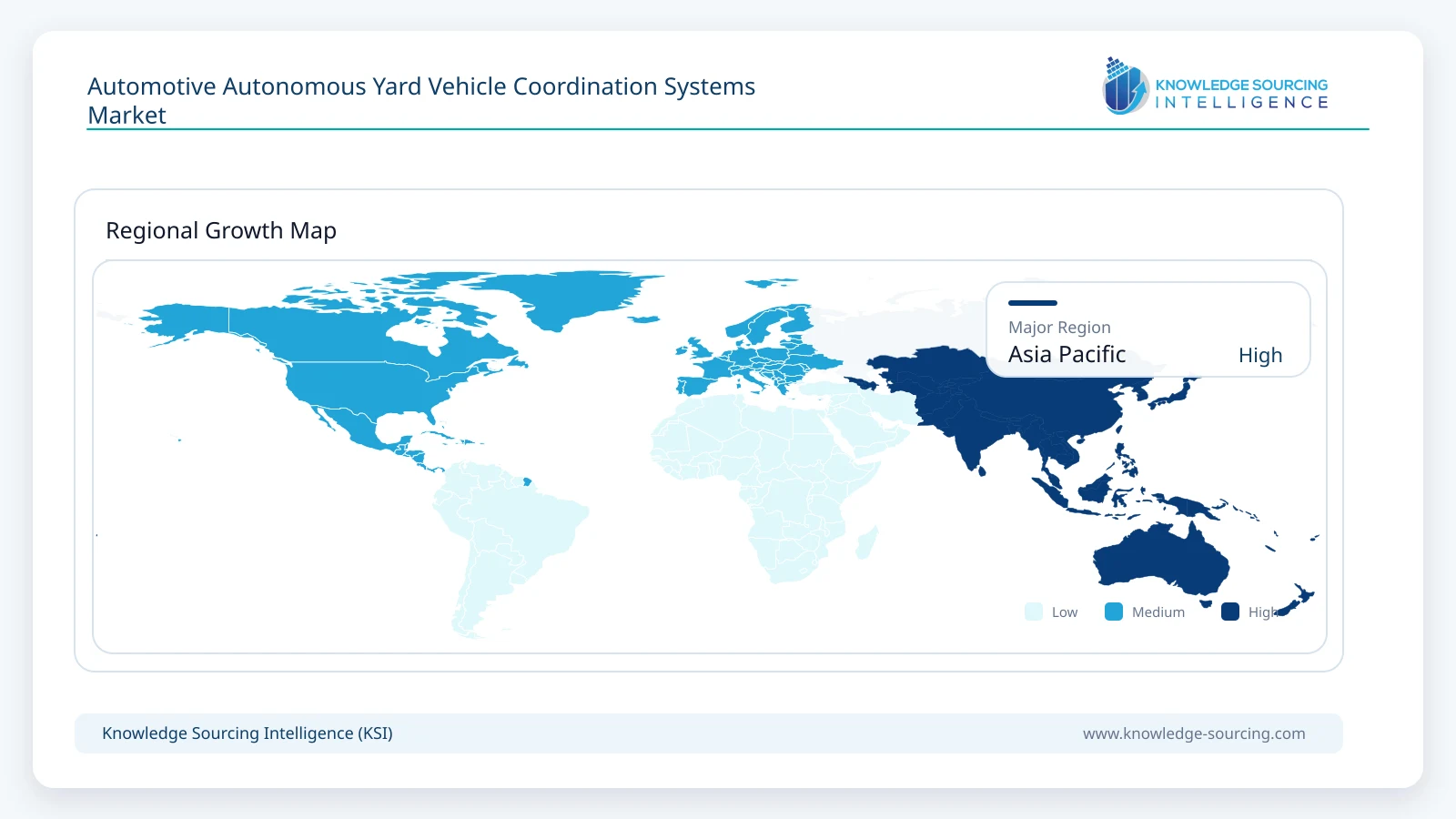
Asia Pacific represents an estimated 34% of the 2026 market and is projected to account for a larger share by 2031, supported by autonomous container transport programs in China and the broader region. Westwell’s Q-Truck and ReeWell operating platform provide practical examples of coordinated autonomous port fleets, including deployments associated with Hong Kong and other Asian logistics locations. The region combines large container throughput with strong demand for reliable automated horizontal transport.
China is expected to remain the largest Asia Pacific market, while India and other developing logistics hubs offer longer-term integration opportunities as facilities invest in automation. Japan, South Korea and Australia are potential buyers for terminal and industrial-yard deployments, but software adoption will depend on locally approved systems and procurement cycles. The transition from individual autonomous vehicles to fleet-wide task management is expected to underpin regional revenue growth.
Europe
Europe represents an estimated 31% of 2026 coordination-system revenue because several early programs are concentrated in container terminals and industrial logistics sites. APM Terminals Maasvlakte II has been testing autonomous terminal tractors with Embotech and Terberg, while FERNRIDE reported driverless terminal operations at HHLA TK Estonia. ICT Logistics and EUROGATE are expanding vendor-independent equipment coordination. These projects create demand for terminal scheduling, traffic management and software integration across different operating environments.
The Netherlands, Germany and the United Kingdom are important opportunities due to their major port networks and their roles in autonomous terminal tractor programs. The Netherlands benefits from Rotterdam project activity, Germany from EUROGATE testing and platform integration, and the United Kingdom from Westwell’s Felixstowe deployment. Wider adoption will depend on successful completion of safety acceptance processes and the ability to reuse software across different sites.
Competitive Landscape
Competition includes specialist autonomous vehicle suppliers, terminal automation groups and logistics operators developing their own software layers. Outrider and FERNRIDE combine on-vehicle autonomy with task management and remote supervision. Embotech works through terminal automation and tractor partnerships, while Westwell provides autonomous container vehicles alongside its ReeWell scheduling system. Kalmar and Forterra are building an integrated terminal tractor and Kalmar One fleet-management proposition. The providers compete on safe routine operations and practical throughput rather than autonomy demonstrations alone.
ICT Group represents a more equipment-neutral model through SmartECS, linking terminal operating systems with automated terminal trucks, cranes and other machinery. YMX Logistics integrates autonomous tractors into a broader yard operating and managed-service model, potentially creating purchasing channels for upstream autonomy suppliers. Terberg and MAFI contribute vehicle platform and integration capabilities; Aidrivers offers related autonomous operating technology. Customers increasingly value a clear division between vehicle control and overall site coordination.
Large-scale opportunities will favor providers able to document fleet availability, recover from blocked moves and introduce additional vehicles without rewriting all site workflows. Pricing is expected to combine fleet-linked coordination software, site licenses and implementation services, but bundled autonomy contracts can obscure the comparable software fee. Open interfaces, service accountability and dependable support are likely to influence competitive decisions as more customers expand beyond one yard.
Recent Developments
1 October 2026 | Outrider and YMX Logistics signed a five-year commercial partnership to deploy autonomous electric yard trucks across enterprise customer facilities, supported by operating and remote technical services.
26 August 2026 | ICT Logistics and EUROGATE announced cooperation on a next-generation SmartECS platform designed to coordinate automated trucks, cranes and terminal schedules across equipment suppliers.
30 July 2026 | Kalmar and APM Terminals announced a strategic partnership covering joint development and deployment of Kalmar One terminal automation software.
9 July 2026 | Westwell announced that a third autonomous truck order would expand the Port of Felixstowe program toward a fleet of 100 Q-Trucks.
2 April 2026 | APM Terminals Maasvlakte II, Embotech and Terberg added five automated electric terminal tractors, bringing the fleet on site to ten while progressing toward the planned thirty.
17 February 2026 | EUROGATE and Embotech began a second autonomous terminal-tractor pilot at Hamburg to evaluate performance in live mixed-traffic rail and container-terminal operations.
Market Outlook
Coordination systems are expected to become more important as ports and industrial yards move from testing autonomous tractors individually to running them as fleets. Larger installations need software to manage task queues, shared-lane access, equipment handoffs and vehicle availability with fewer manual interventions. Operators will increasingly assess the coordination system against completed cargo movements and fleet uptime, rather than the number of driverless kilometers demonstrated.
Growth to USD 610 million by 2031 is expected to depend on a wider installed base of autonomous yard vehicles, more site and enterprise licenses, and integration projects that connect vehicles with terminal operating systems. Progress should be strongest where operations are predictable enough to automate but complex enough to benefit from coordinated traffic and dispatch. The commercial outlook remains sensitive to safety acceptance schedules, phased rollout commitments, network resilience and differences in supplier business models.
Automotive Autonomous Yard Vehicle Coordination Systems Market Scope
| Report Metric | Details |
|---|---|
| Total Market Size in 2026 | USD 95 million |
| Total Market Size in 2031 | USD 610 million |
| Forecast Unit | Million |
| Growth Rate | 45.1% |
| Study Period | 2021 to 2031 |
| Historical Data | 2021 to 2024 |
| Base Year | 2025 |
| Forecast Period | 2026 – 2031 |
| Segmentation | Coordination Function, Operating Environment, Autonomous Vehicle Type, Deployment Architecture, Automated Fleet Size, Commercial Delivery Channel, Revenue Model, Geography |
| Companies |
|
Market Segmentation
By Coordination Function
Mission Dispatch and Trailer-Move Scheduling
Multi-Vehicle Traffic and Crossing Coordination
Terminal and Yard System Integration
Remote Supervision and Exception Response
Vehicle Readiness and Asset Coordination
By Operating Environment
Marine Container Terminals
Distribution and Retail Logistics Yards
Industrial and Manufacturing Yards
Intermodal Rail and Inland Logistics Terminals
By Autonomous Vehicle Type
Automated Terminal Tractors
Autonomous Yard Spotters and Shunters
Driverless Port Container Transport Vehicles
Specialized Industrial Shuttle Vehicles
By Deployment Architecture
Site-Controlled Edge Systems
Hybrid Cloud and Site-Orchestration
Centrally Managed Enterprise Platforms
By Automated Fleet Size
Small Deployments, Under 10 Vehicles
Medium Deployments, 10–49 Vehicles
Large Deployments, 50 or More Vehicles
By Commercial Delivery Channel
Autonomy Developer-Integrated Platforms
Terminal Automation and System Integrators
Independent Platform and Managed-Service Vendors
By Revenue Model
Vehicle-Linked Coordination Software
Site and Enterprise Platform Licenses
Deployment and Coordination Integration
By Geography
North America
United States
Canada
Mexico
South America
Brazil
Argentina
Colombia
Chile
Other South America
Europe
Germany
United Kingdom
France
Italy
Spain
Netherlands
Sweden
Poland
Other Europe
Middle East and Africa
Saudi Arabia
United Arab Emirates
South Africa
Israel
Other Middle East and Africa
Asia Pacific
China
Japan
India
South Korea
Australia
Other Asia Pacific
Table of Contents
1. EXECUTIVE SUMMARY
1.1. Market Opportunity and Key Findings
1.2. Autonomous Yard Operations Outlook
2. MARKET SNAPSHOT
2.1. Market Overview
2.2. Market Definition
2.3. Market Scope
2.4. Market Segmentation
3. BUSINESS LANDSCAPE
3.1. Market Drivers
3.1.1. Pressure to Improve Yard Throughput and Trailer Turnaround
3.1.2. Shortage and Cost of Skilled Yard Operations Labour
3.1.3. Expansion of Certified and Tested Autonomous Terminal Programs
3.1.4. Need for Interoperable Terminal Equipment Orchestration
3.1.5. Rising Scale of Autonomous Yard Fleets
3.2. Market Restraints
3.2.1. Complex Safety Cases in Mixed-Traffic Yards
3.2.2. Limited Separation of Bundled Software and Vehicle Revenue
3.2.3. High Integration Costs for Existing Terminal Infrastructure
3.2.4. Reliance on Reliable Connectivity and Exception Handling
3.2.5. Uneven Commercial Maturity and Long Purchasing Cycles
3.3. Market Opportunities
3.4. Porter’s Five Forces Analysis
3.5. Industry Value Chain Analysis
3.6. Policies and Regulations
3.7. Strategic Recommendations
4. TECHNOLOGICAL OUTLOOK
4.1. Mission Dispatch and Yard Traffic Coordination
4.2. Terminal System Interfaces and Safety Controls
4.3. Remote Exception Handling and Fleet Readiness
5. AUTOMOTIVE AUTONOMOUS YARD VEHICLE COORDINATION SYSTEMS MARKET BY COORDINATION FUNCTION
5.1. Mission Dispatch and Trailer-Move Scheduling
5.2. Multi-Vehicle Traffic and Crossing Coordination
5.3. Terminal and Yard System Integration
5.4. Remote Supervision and Exception Response
5.5. Vehicle Readiness and Asset Coordination
6. AUTOMOTIVE AUTONOMOUS YARD VEHICLE COORDINATION SYSTEMS MARKET BY OPERATING ENVIRONMENT
6.1. Marine Container Terminals
6.2. Distribution and Retail Logistics Yards
6.3. Industrial and Manufacturing Yards
6.4. Intermodal Rail and Inland Logistics Terminals
7. AUTOMOTIVE AUTONOMOUS YARD VEHICLE COORDINATION SYSTEMS MARKET BY AUTONOMOUS VEHICLE TYPE
7.1. Automated Terminal Tractors
7.2. Autonomous Yard Spotters and Shunters
7.3. Driverless Port Container Transport Vehicles
7.4. Specialized Industrial Shuttle Vehicles
8. AUTOMOTIVE AUTONOMOUS YARD VEHICLE COORDINATION SYSTEMS MARKET BY DEPLOYMENT ARCHITECTURE
8.1. Site-Controlled Edge Systems
8.2. Hybrid Cloud and Site-Orchestration
8.3. Centrally Managed Enterprise Platforms
9. AUTOMOTIVE AUTONOMOUS YARD VEHICLE COORDINATION SYSTEMS MARKET BY AUTOMATED FLEET SIZE
9.1. Small Deployments, Under 10 Vehicles
9.2. Medium Deployments, 10–49 Vehicles
9.3. Large Deployments, 50 or More Vehicles
10. AUTOMOTIVE AUTONOMOUS YARD VEHICLE COORDINATION SYSTEMS MARKET BY COMMERCIAL DELIVERY CHANNEL
10.1. Autonomy Developer-Integrated Platforms
10.2. Terminal Automation and System Integrators
10.3. Independent Platform and Managed-Service Vendors
11. AUTOMOTIVE AUTONOMOUS YARD VEHICLE COORDINATION SYSTEMS MARKET BY REVENUE MODEL
11.1. Vehicle-Linked Coordination Software
11.2. Site and Enterprise Platform Licenses
11.3. Deployment and Coordination Integration
12. GEOGRAPHICAL SEGMENTATION
12.1. North America
12.1.1. United States
12.1.2. Canada
12.1.3. Mexico
12.2. South America
12.2.1. Brazil
12.2.2. Argentina
12.2.3. Colombia
12.2.4. Chile
12.2.5. Other South America
12.3. Europe
12.3.1. Germany
12.3.2. United Kingdom
12.3.3. France
12.3.4. Italy
12.3.5. Spain
12.3.6. Netherlands
12.3.7. Sweden
12.3.8. Poland
12.3.9. Other Europe
12.4. Middle East and Africa
12.4.1. Saudi Arabia
12.4.2. United Arab Emirates
12.4.3. South Africa
12.4.4. Israel
12.4.5. Other Middle East and Africa
12.5. Asia Pacific
12.5.1. China
12.5.2. Japan
12.5.3. India
12.5.4. South Korea
12.5.5. Australia
12.5.6. Other Asia Pacific
13. COMPETITIVE ENVIRONMENT
13.1. Market Share Analysis
13.2. Strategic Developments
13.3. Competitive Benchmarking
14. COMPANY PROFILES
14.1. Outrider, Inc.
14.2. FERNRIDE GmbH
14.3. Embotech AG
14.4. Westwell Technology Co., Ltd.
14.5. Kalmar Corporation
14.6. Forterra, Inc.
14.7. ICT Group N.V.
14.8. YMX Logistics
14.9. Terberg Special Vehicles
14.10. MAFI Transport-Systeme GmbH
14.11. Aidrivers Ltd.
15. APPENDIX
15.1. Research Methodology
15.2. Data Sources
15.3. Assumptions
15.4. Abbreviations
Navigate
Trusted by the world's leading organizations











