
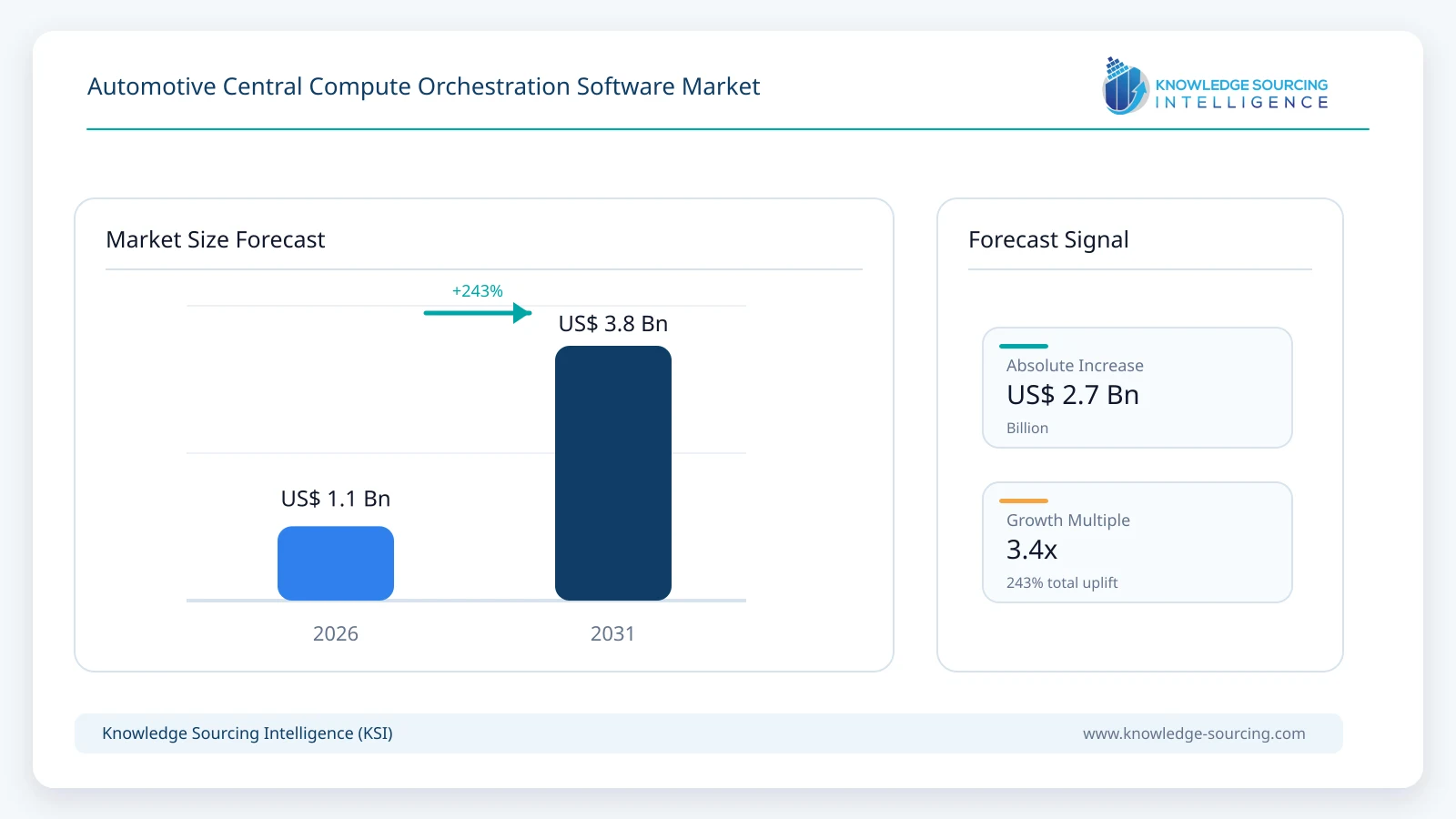
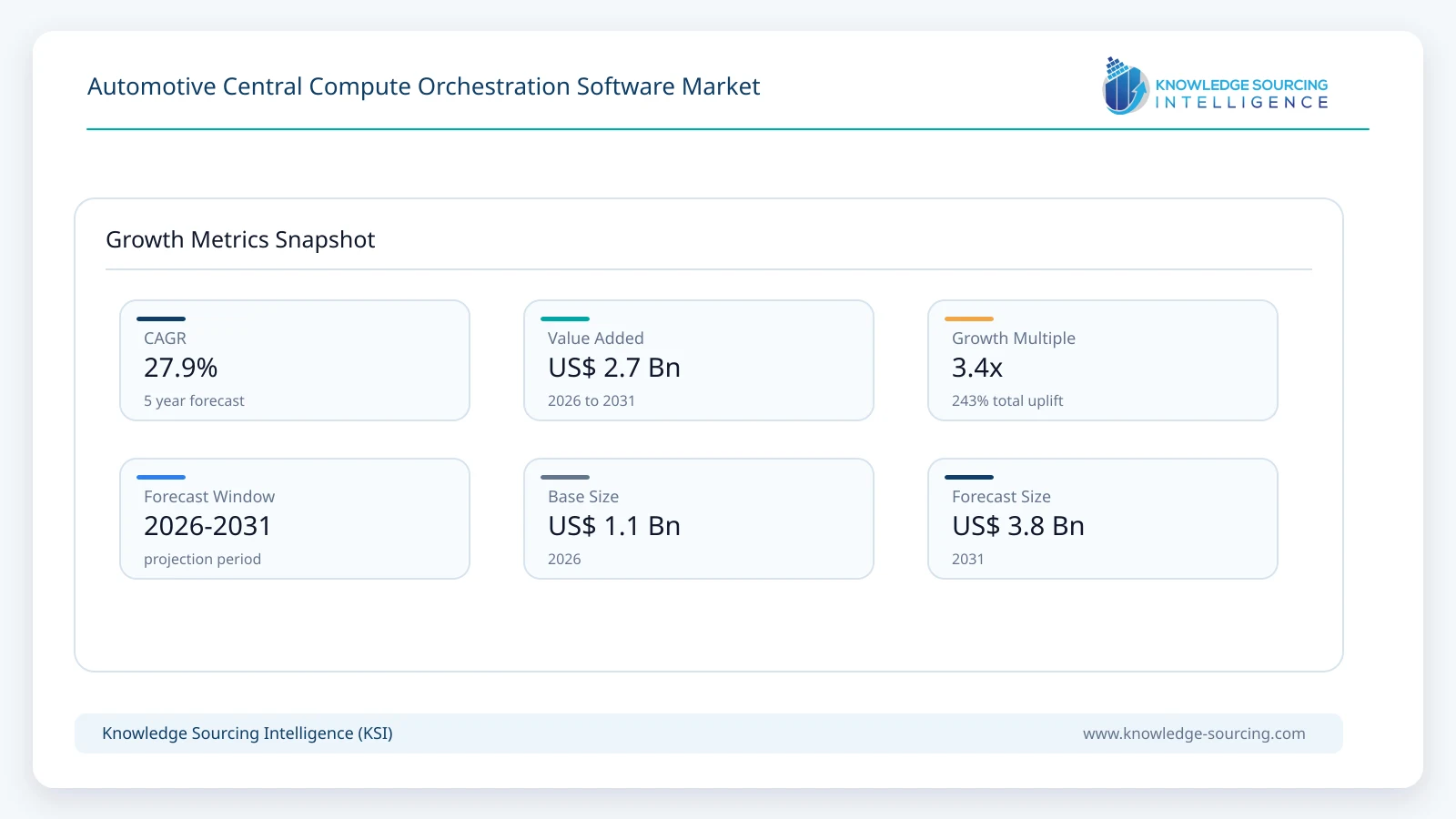
The automotive central compute orchestration software market is projected to grow from USD 1.12 billion in 2026 to USD 3.84 billion by 2031, at a CAGR of 27.9% throughout the forecast period.
Highlights:
- 1Global market value is estimated at USD 1.12 billion in 2026, reaching USD 3.84 billion in 2031, at 27.9% CAGR.
- 2Runtime orchestration and middleware licensing accounts for approximately 63% of 2026 value and gains share as vehicle-program adoption broadens.
- 3Service and execution coordination represents the largest software-function group in 2026, reflecting the need to connect distributed vehicle functions safely.
- 4Cross-domain central computers gain the largest architecture share by 2031 as cockpit, body, gateway and selected assistance functions converge.
- 5Asia Pacific holds the largest regional value pool, while Europe remains a major software architecture and functional-safety engineering center.
- 6Automotive-grade isolation, reproducible software updates and platform portability are becoming primary supplier-selection criteria.
Central-compute software increasingly mediates between hardware-resource management and the vehicle applications used by OEMs. AUTOSAR Adaptive defines execution management, service-oriented communication, health monitoring and update-related capabilities for high-performance automotive computers. Vector MICROSAR Adaptive and Elektrobit EB corbos AdaptiveCore provide commercial implementations of software foundations for modular applications, while Bosch describes its vehicle runtime environment as the platform layer supporting shared vehicle-computer functions.
Automotive processing consolidation now extends beyond the digital cockpit. Qualcomm and Leapmotor introduced a dual-Snapdragon central controller for the D19 in January 2026 that brings cockpit, driver assistance, body control and gateway functions onto one computing system. The announcement identifies a service-oriented architecture with more than 200 modular capabilities, illustrating the volume of interfaces that platform software must organize. Actual deployment still depends on OEM-specific scheduling, integration and safety qualification.
The supplier ecosystem combines independent automotive middleware specialists, semiconductor-linked platform providers and engineering organizations. NXP acquired TTTech Auto in 2025, and the business adopted the TrustMotion name in April 2026 while retaining MotionWise safety middleware. Aptiv markets container orchestration within its LINC software platform, and ETAS is developing a vehicle software platform suite around the Eclipse S-CORE foundation. OEMs continue to retain application ownership, placing value on interfaces and middleware that can operate across hardware generations.
Market Trends
Cross-domain computers are replacing isolated workload islands
Central vehicle computers are being designed to host functions previously separated between cockpit, gateways, body controllers and driver-assistance hardware. Leapmotor’s announced D19 architecture and Qualcomm’s Ride Flex platforms show how multiple software domains can share common computing resources while retaining distinct execution and safety needs. The orchestration layer determines how services are started, supervised and coordinated as vehicle states change.
Production adoption is uneven across vehicle classes because centralization increases platform complexity even when it reduces hardware duplication. OEMs with new electrical architectures can define orchestration policies at the platform stage, whereas legacy platforms face migration and validation work. This creates a mixed market of new central computers and transitional domain computers requiring multi-workload coordination.
Safety-aware scheduling is moving into common platform software
Applications sharing a processor do not necessarily share acceptable failure modes or timing constraints. TrustMotion MotionWise addresses deterministic coordination and safety-critical software integration, while AUTOSAR Adaptive formalizes execution and health-management interfaces. Automotive suppliers must demonstrate that updateable convenience functions cannot disrupt safety-relevant processes or prevent prescribed recovery behavior.
Virtualization can provide isolation between operating systems, but an automotive orchestration framework must still coordinate resource budgets, task start sequences, inter-domain communication and fault response. Validation therefore extends beyond the hypervisor itself and supports specialized software products rather than general-purpose container management transplanted unchanged from enterprise IT.
Service-oriented middleware is becoming a reusable vehicle interface
Vector MICROSAR Adaptive combines service-oriented communication with application lifecycle capabilities for high-performance ECUs. AUTOSAR’s adaptive runtime dynamically connects service providers and clients, allowing software components to be reused as vehicle hardware changes. Such interfaces are commercially important when OEMs want one vehicle-function implementation across different processors and regional configurations.
Service compatibility also needs explicit version control and diagnostics when a function spans central and zonal controllers. Manufacturers that define common service contracts can limit vehicle-program-specific integration, although they must maintain compatibility with legacy CAN-based and AUTOSAR Classic endpoints. Platform suppliers compete on the breadth and reliability of these interfaces.
Software deployment is becoming a vehicle-wide operating discipline
Aptiv LINC includes automotive-grade container orchestration and software lifecycle management intended to coordinate modular updates across the vehicle. The AUTOSAR Update and Configuration Management working group addresses package dependencies, installation, rollback and update coordination across Adaptive and Classic platforms. These capabilities matter because a failed update to one service can affect several applications that rely on it.
Pre-production engineering increasingly mirrors the in-vehicle runtime to test deployment before release. Qualcomm describes a virtual SoC development workflow with cloud-to-vehicle environment parity, while ETAS emphasizes software portability across hardware configurations. Commercial value depends on reliable production deployment and release assurance, not simply the ability to run development containers.
Common software foundations are changing vendor economics
ETAS presented a Vehicle Software Platform Suite enabled by Eclipse S-CORE in June 2026, while AUTOSAR released CAPI 1.0 in August 2026 with a common Adaptive Platform code implementation. Shared foundations can reduce duplicated base-software engineering and increase the importance of implementation quality, safety cases, integration services and long-term support. Software suppliers may face pressure on commodity interfaces while preserving pricing for qualified orchestration functions.
Automakers increasingly seek portable software stacks that can support different chip families without repeating the entire integration program. Open interfaces can widen supplier choice, but the resulting multi-vendor system needs stronger ownership of release management, safety evidence and defect resolution. Providers able to supply production accountability around standardized components retain a meaningful commercial role.
Automotive Central Compute Orchestration Software Market Segment Analysis
By Software Function
Execution and Resource Orchestration
Execution and resource orchestration accounts for approximately 34% of 2026 value, reflecting the importance of startup sequencing, health supervision, resource allocation and controlled scheduling on shared vehicle computers. Safety-aware processes must remain available during partial system faults, while lower-priority applications can be suspended or restarted. AUTOSAR Adaptive execution-management specifications provide a common framework, and TrustMotion supplies safety-oriented middleware for complex platform integration.
The function gains value as more vehicle workloads are consolidated into cross-domain computers. Customers increasingly test response under CPU, memory and network contention, making qualified runtime behavior and integration evidence part of a supplier’s differentiation rather than an invisible software utility.
By Software Function
Service and Communication Orchestration
Service and communication orchestration contributes approximately 31% of market value in 2026. High-performance controllers require stable application interfaces to sensor data, vehicle states and actuator services, including when those services are physically hosted in zonal or domain controllers. Vector and Elektrobit supply Adaptive AUTOSAR software with service-oriented functionality, while Bosch VRTE supports integration of vehicle functions on a common computer.
The group remains a substantial source of revenue as software functions spread across multiple ECU locations. Its economic advantage lies in limiting custom interfaces and preserving application portability, although interoperability validation and service-version management become more difficult with the expansion of supplier ecosystems.
By Deployment Component
Embedded Runtime Licensing
Embedded orchestration runtime and middleware licenses represent approximately USD 708 million in 2026. Per-vehicle software content includes execution coordination, service management and relevant deployment control, without assigning the full operating system or hypervisor value to this category. Software-platform suppliers can scale their revenue through multi-year vehicle nominations after substantial program-specific qualification.
By 2031, embedded runtime revenue is modeled at USD 2.94 billion as qualifying deployment volume increases and attributable orchestration content rises. Higher volume is the primary driver, while mixed-criticality service requirements and additional application interfaces add software value to selected central-compute architectures.
By Compute Architecture
Cross-Domain Central Computing
Cross-domain central computing accounts for about 41% of 2026 market value and is modeled to reach 64% by 2031. These installations coordinate workloads across at least two substantive vehicle domains and create substantial need for fault containment, startup state management, platform service discovery and coordinated updates. Leapmotor’s D19 and integrated cockpit-assistance platforms show the architectural direction.
Domain-level high-performance controllers remain commercially important in 2026, particularly where cluster and infotainment or body and gateway workloads share compute without complete vehicle consolidation. Central-to-zonal supervisory orchestration is a smaller deployment group; the underlying zonal ECUs and their general basic software are not counted as orchestration software revenue.
Market Drivers
Rising adoption of consolidated high-performance vehicle computers
Automakers are integrating multiple functions into domain and central computers to reduce ECU duplication and enable common vehicle software platforms. Qualcomm’s January 2026 Leapmotor announcement identifies cockpit, assistance, body and gateway functions on a central controller, while Bosch describes vehicle-computer fusion architectures intended to scale across segments. Every additional workload increases dependencies that must be managed during normal operation and system faults.
Consolidation creates demand for execution management, dynamic service coordination and policy-based scheduling. The software opportunity is strongest when several functions genuinely share a computing and deployment environment, rather than when a new controller merely replaces one older ECU with similar functionality.
Need for deterministic operation across mixed-criticality workloads
Safety-related processes must meet timing and recovery requirements while infotainment, navigation and connected applications execute on neighboring resources. NXP’s acquisition of TTTech Auto brought MotionWise middleware into CoreRide, indicating the commercial importance of safety-oriented coordination. AUTOSAR Adaptive specifies execution and health-management structures intended for such complex computing environments.
Central computer platforms need demonstrable limits on task interference and a defined response to failure. Validation of these properties gives specialized suppliers a durable engineering and software-content role, particularly in premium and assisted-driving vehicles where shared computers host heterogeneous workloads.
OEM pressure to reuse software across processors and vehicle families
Vehicle manufacturers typically develop software for several years before production and must support it through long service lifetimes. Vector MICROSAR Adaptive, ETAS Vehicle Software Platform Suite and Elektrobit’s AdaptiveCore use standards-based interfaces that reduce dependency on individual processor configurations. Common service contracts also help separate vehicle-function design from the exact locations of physical ECUs.
Reuse can lower the cost of moving software between vehicle generations, but it depends on stable interfaces and release processes. OEM procurement is consequently placing greater importance on portability, tooling and long-term lifecycle support alongside initial software-license cost.
Growth of coordinated over-the-air deployment and rollback
Over-the-air updates are more demanding when several vehicle domains share software services and version dependencies. Aptiv offers vehicle-grade container orchestration within LINC, while AUTOSAR defines mechanisms for package installation, dependency handling and rollback across Adaptive and Classic environments. A central computer may need to maintain essential functions while noncritical applications are updated or recovered.
Manufacturers require the ability to test releases, record configuration status and return safely to a previous version when a deployment fails. These requirements broaden demand for runtime deployment controls and program integration, particularly where features are maintained across multiple trim levels after vehicle sale.
Expansion of common automotive software platforms and supplier ecosystems
ETAS’s June 2026 Eclipse S-CORE-based suite and AUTOSAR’s August 2026 CAPI release reflect a shift toward shared components and more open software integration. Semiconductor vendors and software specialists can combine standardized runtime foundations with differentiated safety, diagnostics and deployment capabilities. The approach is attractive to automakers seeking to avoid repeated implementation of common infrastructure.
Common platforms increase the volume of integrations requiring support and certification while changing the value of proprietary interfaces. Vendors with established automotive safety processes, compatible tools and production support can monetize deployment assurance even as selected foundation components become more accessible.
Market Restraints
Safety qualification complexity of multi-domain shared computers
Consolidating safety-relevant and convenience workloads onto common hardware creates difficult verification requirements around resource interference, health supervision and failure containment. A correct service-orchestration design must remain predictable when processes restart, one partition fails or a domain loses network access. Vehicle programs can require repeated verification when the processor, hypervisor, service middleware or application mix changes.
The high cost of maintaining evidence for different criticality levels may reduce short-term deployment breadth. Automakers often retain dedicated safety controllers where full consolidation would introduce disproportionate program risk, limiting the immediate software addressable base.
Fragmentation across processors, operating systems and AUTOSAR implementations
Central vehicle platforms often combine POSIX software, real-time controllers, Classic AUTOSAR endpoints and proprietary supplier APIs. Even when applications follow AUTOSAR Adaptive concepts, differences in operating-system behavior, communication implementation and hardware services can complicate deployment. OEMs can become dependent on custom integration bridges that raise future migration costs.
Suppliers need support for multiple chipsets, hypervisors and version combinations, which consumes engineering capacity and makes certification reuse more difficult. The commercial benefit of portability is reduced when vehicle programs demand extensive proprietary extensions to otherwise standard middleware.
Limited willingness to pay for separately itemized middleware
Automakers commonly purchase high-performance computers with bundled base software and extensive system engineering. OEM procurement may not isolate runtime orchestration from the wider platform contract, especially when component suppliers include middleware within controller pricing. The value of execution and service coordination is therefore commercially real but not always represented by an independent software purchase order.
Long qualification cycles and OEM bargaining power can constrain standalone software prices. Suppliers often need to demonstrate measurable savings in integration time, hardware portability or field maintenance before customers accept additional license costs.
Resource contention, boot behavior and vehicle-network constraints
Applications that share CPUs, memory, accelerators and high-speed networking can compete for resources under peak operating conditions. Boot-time targets and degraded-mode behavior are particularly sensitive when central computers serve instrument information, cabin control and safety-related workloads. A scheduler or container framework that behaves acceptably on a development server may fail automotive latency requirements.
Engineering teams must profile timing, memory bandwidth and network congestion across realistic load cases. This extends validation schedules and can encourage domain separation when a consolidated design cannot prove stable behavior within power, thermal and cost limits.
Cybersecurity obligations and long vehicle-software support periods
Central orchestration layers have broad privileges over deployment states, service communication and application access. Security weaknesses in these interfaces could affect several vehicle functions at once, while patching a central runtime may require extensive compatibility testing. UNECE R155 and R156 create system-level expectations for cybersecurity and software update governance in applicable vehicle approvals.
Vehicle manufacturers must maintain vulnerability response, evidence of update integrity and supplier accountability well beyond initial production. Extended maintenance commitments raise lifecycle costs and can delay acceptance of new container, service-discovery or platform-management components.
Regional Outlook
Asia Pacific
Asia Pacific represents approximately 43% of 2026 market value, supported by China’s large automotive production base and active rollout of centralized electrical architectures among new-energy vehicle manufacturers. The Leapmotor and Qualcomm D19 program demonstrates the commercial use of cross-domain compute, while regional Tier 1s are developing high-performance integrated cockpit and assistance controllers. Japan and South Korea also contribute mature embedded software engineering and vehicle-program procurement.
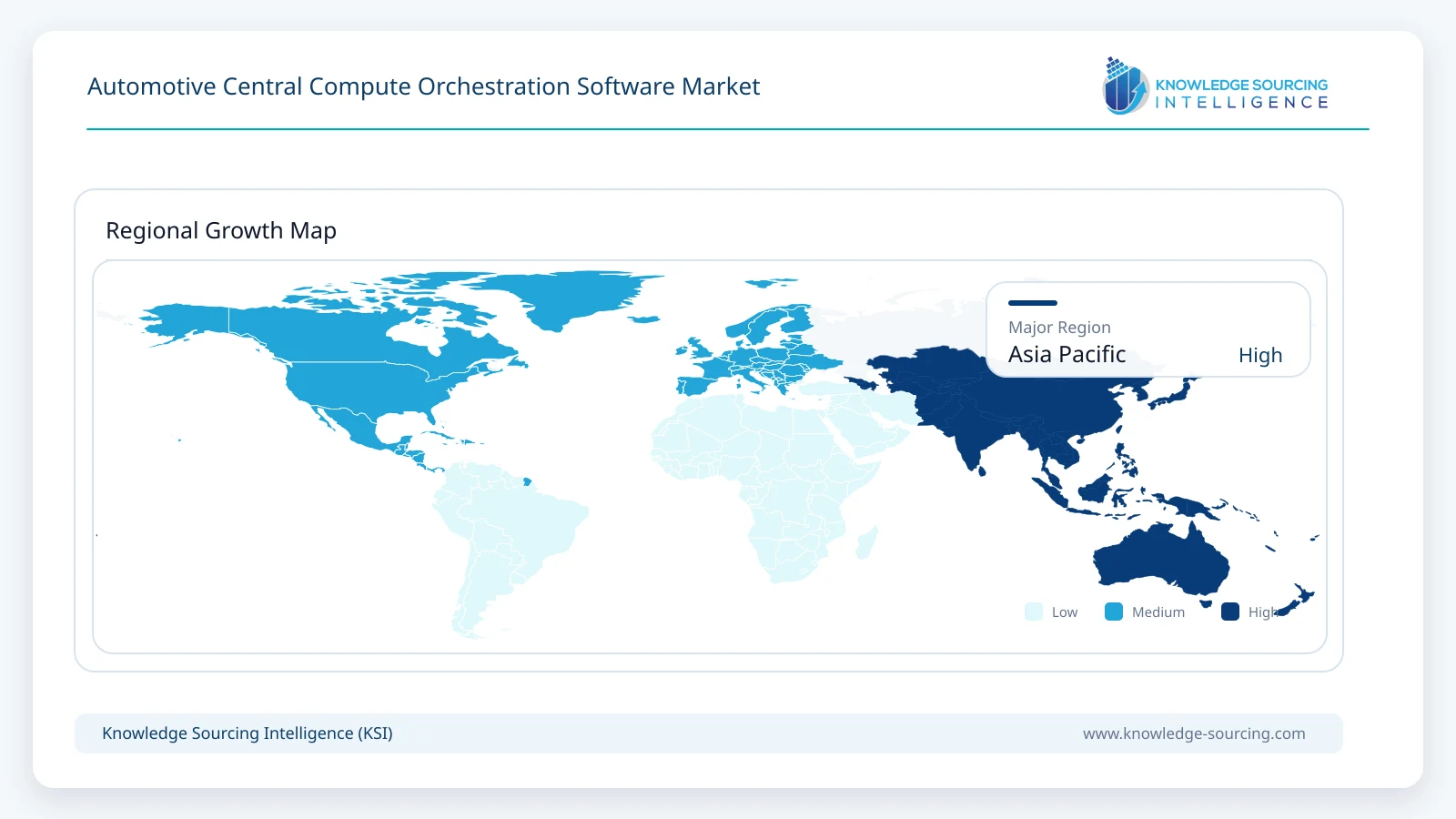
China remains the largest country opportunity within the region as software-rich vehicle lineups increase requirements for service interfaces, coordinated deployment and software reuse. By 2031, Asia Pacific is projected to generate about USD 1.81 billion, reflecting greater qualifying system volumes and the transition from bounded cockpit consolidation toward broader vehicle-wide computer architectures.
Europe
Europe accounts for approximately 29% of 2026 market value, with Germany providing a concentrated base of vehicle manufacturers, Tier 1 suppliers and automotive platform-software specialists. ETAS, Elektrobit, Vector, TrustMotion and Bosch supply important parts of the software stack, covering Adaptive AUTOSAR, safety integration, execution management and vehicle-computer runtimes. European OEM programs impose substantial functional-safety, cybersecurity and traceability requirements.
Europe is projected to reach approximately USD 1.00 billion by 2031 as automotive groups migrate more functions to high-performance and zonal architectures. Revenue growth comes from both production licensing and systems engineering, although reuse of common platform components and OEM control over proprietary software can moderate per-vehicle pricing.
Competitive Landscape
Automotive central-compute orchestration software is supplied through several commercial models. Vector, Elektrobit and ETAS sell or integrate automotive middleware and platform functions; TrustMotion specializes in safety-critical coordination; Aptiv combines central-compute software with vehicle architectures and lifecycle management. Bosch contributes vehicle runtime technology as part of its broader mobility software portfolio. QNX, Wind River and SYSGO provide operating and virtualization foundations that support orchestrated mixed-criticality platforms.
NXP’s ownership of TrustMotion places safety middleware within a semiconductor-led software-defined vehicle ecosystem, but the supplier continues to position its tools as hardware-neutral. OEMs commonly combine different vendors for hypervisor, Adaptive AUTOSAR, container controls and application services. The main competitive advantage lies in production evidence, stable interfaces, safety qualification and the ability to maintain releases across chip generations.
Company market shares are not disclosed on a comparable basis because middleware is bundled into controllers, licensed under program contracts or developed internally by automakers. Competition is therefore more meaningfully assessed through production nominations, standards implementation, validation capability and the share of a platform’s engineering effort that can be reused.
Recent Developments
August 2026: AUTOSAR released CAPI 1.0, providing a common Adaptive Platform software implementation and code generators that include execution and communication functions. The release improves access to shared platform foundations; production qualification remains the responsibility of adopters.
June 2026: ETAS introduced the Vehicle Software Platform Suite enabled by Eclipse S-CORE at Bosch Connected World 2026, targeting portable and reusable foundations for automotive software programs.
May 2026: Elektrobit and ETAS announced an integrated ADAS software foundation that combines EB corbos Linux for Safety Applications with the ETAS Vehicle Software Platform Suite ADAS profile, reducing middleware and OS integration work.
April 2026: TTTech Auto adopted the TrustMotion name following its acquisition by NXP while continuing to offer MotionWise safety middleware and hardware-neutral integration capabilities.
January 2026: Qualcomm and Leapmotor introduced a dual-Snapdragon Elite central computer for the D19, bringing cockpit, driver-assistance, body and gateway functions together through a service-oriented architecture.
June 2025: NXP completed its acquisition of TTTech Auto, strengthening the CoreRide ecosystem with MotionWise safety middleware and software-integration expertise.
Market Outlook
Central vehicle-computer adoption should shift the orchestration-software opportunity from engineering-heavy early platforms toward broader runtime licensing across production programs. Cross-domain computers are expected to become the largest deployment architecture by 2031, while domain-level HPCs remain relevant for manufacturers following a staged transition. OEMs will favor software that preserves application interfaces when functions move between central and zonal nodes.
Service coordination and execution management remain essential as vehicle platforms acquire more updateable functions with distinct safety and timing requirements. Shared implementations such as AUTOSAR CAPI and Eclipse S-CORE may reduce duplicated base-platform development, increasing competition around integration quality, qualification evidence, lifecycle operations and multi-processor support.
Asia Pacific is positioned to deliver the largest production-volume expansion, with Europe continuing to lead important areas of automotive software engineering and validation. Suppliers that can show dependable mixed-criticality behavior and shorten program integration without weakening safety assurance should command a larger proportion of platform software expenditure.
Automotive Central Compute Orchestration Software Market Scope:
| Report Metric | Details |
|---|---|
| Total Market Size in 2026 | USD 1.12 billion |
| Total Market Size in 2031 | USD 3.84 billion |
| Forecast Unit | USD Billion |
| Growth Rate | 27.9% |
| Study Period | 2021 to 2031 |
| Historical Data | 2021 to 2024 |
| Base Year | 2025 |
| Forecast Period | 2026 – 2031 |
| Segmentation | Software Function, Revenue Component, Compute Architecture, Vehicle Type, Geography |
| Companies |
|
Market Segmentation
By Software Function
Execution and Resource Orchestration
Service and Communication Orchestration
Application Deployment and Lifecycle Orchestration
Safety Monitoring and Policy Coordination
By Revenue Component
Embedded Runtime and Middleware Licensing
Engineering, Integration and Validation Services
By Compute Architecture
Cross-Domain Central Vehicle Computers
Consolidated Domain High-Performance Computers
Central-to-Zonal Supervisory Computing
By Vehicle Type
Passenger Vehicles
Light Commercial Vehicles
Medium and Heavy Commercial Vehicles
By Geography
North America
United States
Canada
Mexico
South America
Brazil
Argentina
Others
Europe
Germany
United Kingdom
France
Italy
Spain
Others
Middle East and Africa
Saudi Arabia
United Arab Emirates
Israel
South Africa
Others
Asia Pacific
China
India
Japan
South Korea
Indonesia
Thailand
Australia
Taiwan
Others
Table of Contents
1. EXECUTIVE SUMMARY
1.1. Key Findings
1.2. Market Size and Forecast, 2026–2031
1.3. Software Function Outlook
1.4. Central-Compute Architecture Outlook
1.5. Regional Opportunity Summary
2. MARKET SNAPSHOT
2.1. Market Overview
2.2. Market Definition
2.3. Scope of the Study
2.4. Market Segmentation
3. BUSINESS LANDSCAPE
3.1. Market Drivers
3.1.1. Rising adoption of consolidated high-performance vehicle computers
3.1.2. Need for deterministic operation across mixed-criticality workloads
3.1.3. OEM pressure to reuse software across processors and vehicle families
3.1.4. Growth of coordinated over-the-air deployment and rollback
3.1.5. Expansion of common automotive software platforms and supplier ecosystems
3.2. Market Restraints
3.2.1. Safety qualification complexity of multi-domain shared computers
3.2.2. Fragmentation across processors, operating systems and AUTOSAR implementations
3.2.3. Limited willingness to pay for separately itemized middleware
3.2.4. Resource contention, boot behavior and vehicle-network constraints
3.2.5. Cybersecurity obligations and long vehicle-software support periods
3.3. Market Opportunities
3.4. Porter’s Five Forces Analysis
3.5. Industry Value Chain Analysis
3.6. Policies and Regulations
3.7. Strategic Recommendations
4. TECHNOLOGICAL OUTLOOK
4.1. AUTOSAR Adaptive Execution and State Management
4.2. Cross-Domain Workload Scheduling and Resource Policies
4.3. Safety-Aware Process Supervision and Fault Containment
4.4. Service-Oriented Middleware and Dynamic Service Discovery
4.5. Container Deployment and Application Lifecycle Management
4.6. Hypervisor Interfaces and Mixed-Criticality Partition Coordination
4.7. Central-to-Zonal Service and Communication Orchestration
4.8. Software Update Dependency and Rollback Coordination
5. AUTOMOTIVE CENTRAL COMPUTE ORCHESTRATION SOFTWARE MARKET BY SOFTWARE FUNCTION
5.1. Introduction
5.2. Execution and Resource Orchestration
5.3. Service and Communication Orchestration
5.4. Application Deployment and Lifecycle Orchestration
5.5. Safety Monitoring and Policy Coordination
6. AUTOMOTIVE CENTRAL COMPUTE ORCHESTRATION SOFTWARE MARKET BY REVENUE COMPONENT
6.1. Introduction
6.2. Embedded Runtime and Middleware Licensing
6.3. Engineering, Integration and Validation Services
7. AUTOMOTIVE CENTRAL COMPUTE ORCHESTRATION SOFTWARE MARKET BY COMPUTE ARCHITECTURE
7.1. Introduction
7.2. Cross-Domain Central Vehicle Computers
7.3. Consolidated Domain High-Performance Computers
7.4. Central-to-Zonal Supervisory Computing
8. AUTOMOTIVE CENTRAL COMPUTE ORCHESTRATION SOFTWARE MARKET BY VEHICLE TYPE
8.1. Introduction
8.2. Passenger Vehicles
8.3. Light Commercial Vehicles
8.4. Medium and Heavy Commercial Vehicles
9. AUTOMOTIVE CENTRAL COMPUTE ORCHESTRATION SOFTWARE MARKET BY GEOGRAPHY
9.1. North America
9.1.1. United States
9.1.2. Canada
9.1.3. Mexico
9.2. South America
9.2.1. Brazil
9.2.2. Argentina
9.2.3. Others
9.3. Europe
9.3.1. Germany
9.3.2. United Kingdom
9.3.3. France
9.3.4. Italy
9.3.5. Spain
9.3.6. Others
9.4. Middle East and Africa
9.4.1. Saudi Arabia
9.4.2. United Arab Emirates
9.4.3. Israel
9.4.4. South Africa
9.4.5. Others
9.5. Asia Pacific
9.5.1. China
9.5.2. India
9.5.3. Japan
9.5.4. South Korea
9.5.5. Indonesia
9.5.6. Thailand
9.5.7. Australia
9.5.8. Taiwan
9.5.9. Others
10. COMPETITIVE ENVIRONMENT AND ANALYSIS
10.1. Major Players and Strategy Analysis
10.2. Market Share Analysis
10.3. Mergers, Acquisitions, Agreements and Collaborations
10.4. Competitive Dashboard
11. COMPANY PROFILES
11.1. Aptiv PLC
11.2. TrustMotion GmbH
11.3. NXP Semiconductors N.V.
11.4. ETAS GmbH
11.5. Elektrobit Automotive GmbH
11.6. Vector Informatik GmbH
11.7. Robert Bosch GmbH
11.8. QNX (BlackBerry Limited)
11.9. Wind River Systems, Inc.
11.10. SYSGO GmbH
11.11. KPIT Technologies Limited
12. APPENDIX
12.1. Currency
12.2. Assumptions
12.3. Base and Forecast Years Timeline
12.4. Key Benefits to Stakeholders
12.5. Research Methodology
12.6. Abbreviations
Navigate
Trusted by the world's leading organizations











