
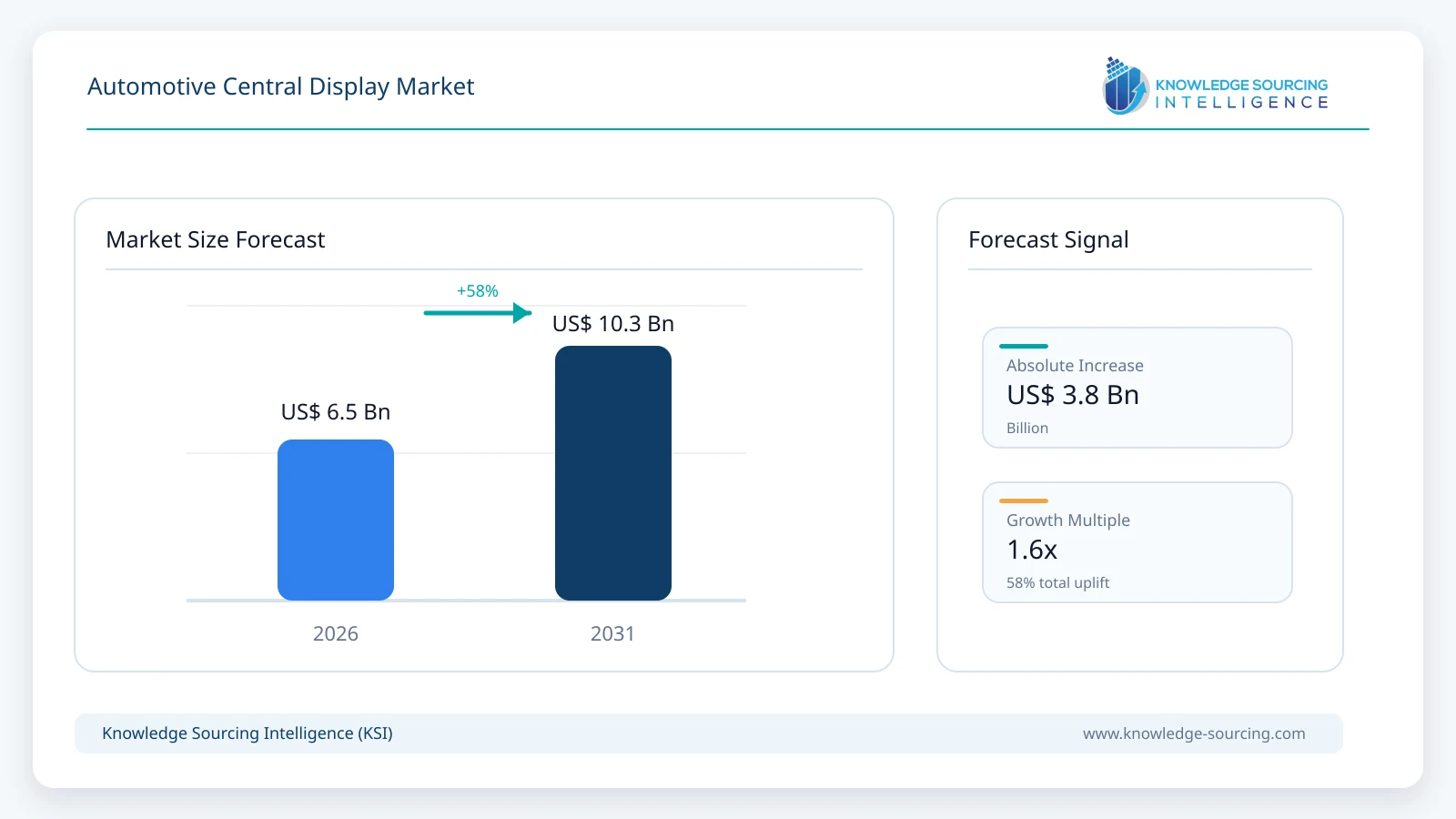
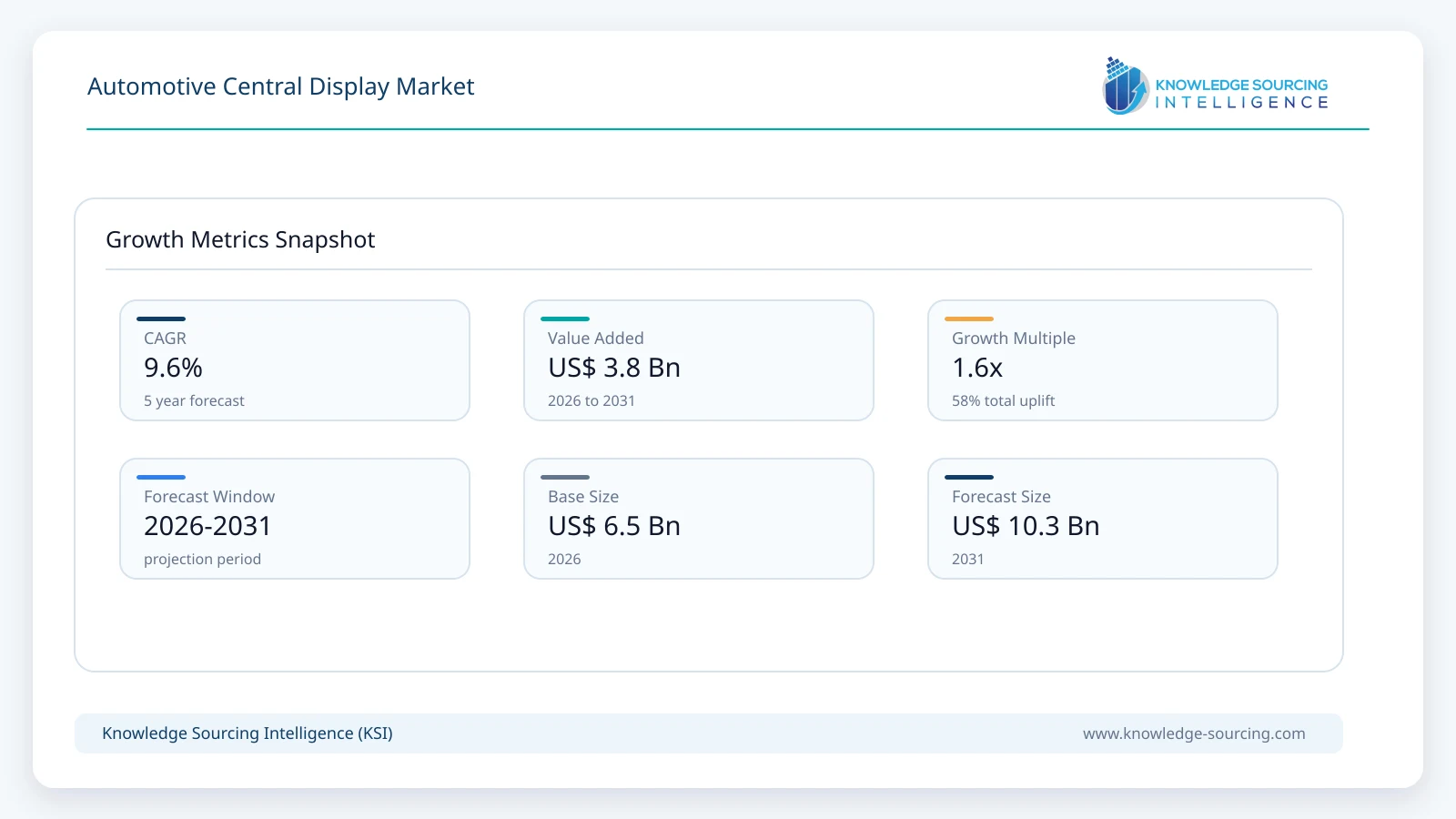
The automotive central display market is estimated at approximately USD 6.50 billion in 2026 and is projected to reach about USD 10.28 billion by 2031, representing a CAGR of 9.6% during the forecast period.
Highlights:
- 1TFT-LCD and MiniLED-backlit LCD central displays account for approximately 76% of global market value in 2026 because they combine mature automotive qualification, high brightness, scalable sizes and improving contrast at lower cost than OLED across mainstream vehicle programs.
- 2Standalone center-stack and center-console displays represent approximately 57% of 2026 market value, while integrated dual-screen, panoramic and pillar-to-pillar assemblies are gaining share as OEMs consolidate driver, center and passenger information under common glass or display structures.
- 3Displays between 10 and 15 inches account for approximately 49% of 2026 market value because this size range remains the most common balance between cockpit packaging, touch usability and content density across mid-range and premium vehicles.
- 4Touch-enabled and haptic-ready central displays represent approximately 84% of market value in 2026 as climate, media and vehicle-setting controls continue to migrate from mechanical switches into configurable digital interfaces.
- 5Passenger vehicles account for approximately 96% of global market value in 2026 because digital-cockpit penetration, large-screen adoption and premium display content are concentrated in passenger cars, SUVs and MPVs.
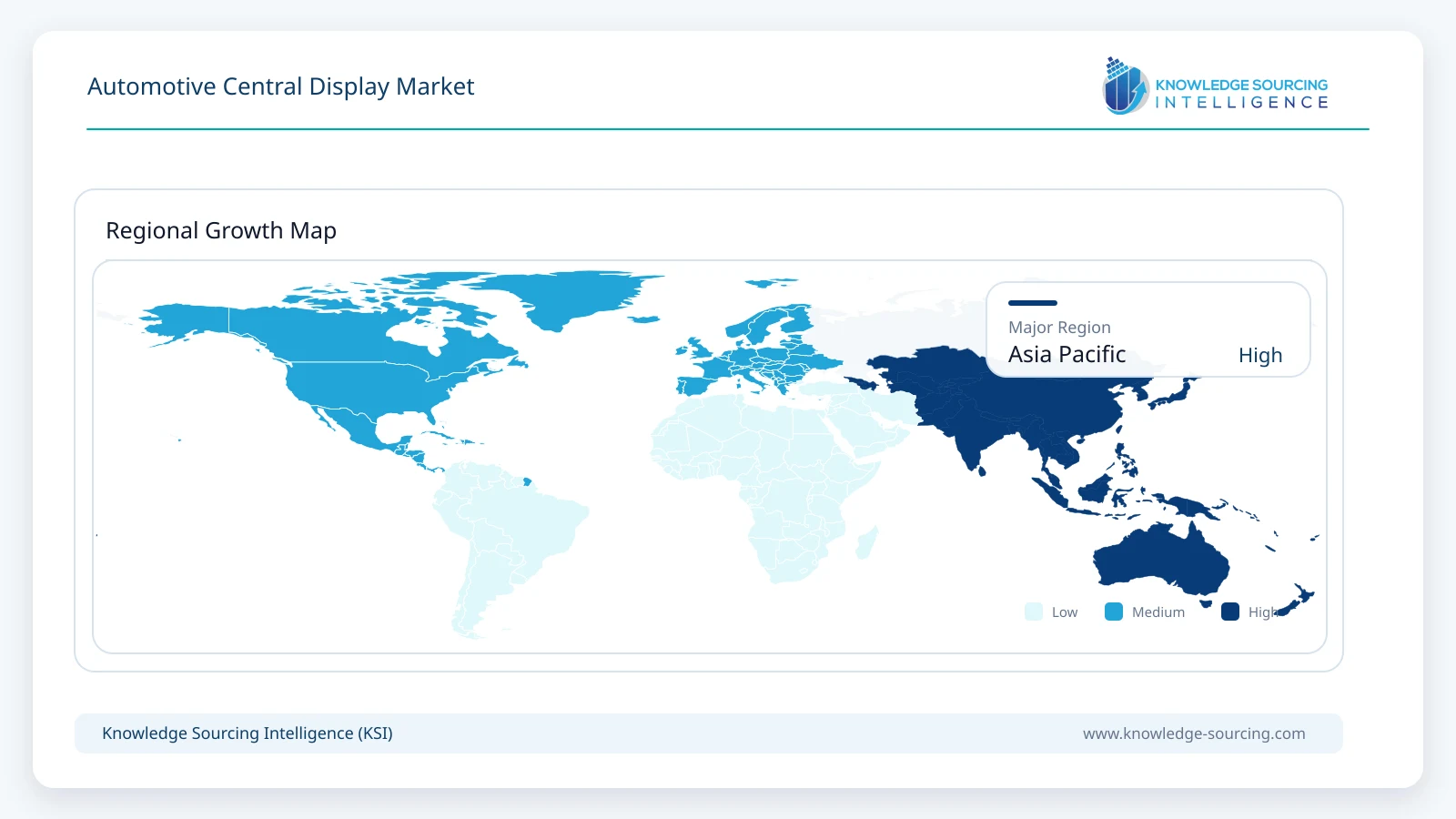
- 6Asia Pacific represents approximately 46% of global market value in 2026, supported by high vehicle production, rapid smart-cockpit adoption in China and strong automotive display supply chains across China, Japan, South Korea and Taiwan.
Central displays are evolving from standalone infotainment screens into high-resolution cockpit control surfaces that combine navigation, media, climate, vehicle settings, connected services and increasingly AI-driven interaction within a common visual interface. The value per vehicle is rising as screen area expands, optical quality improves and OEMs add haptic feedback, local dimming, curved glass, anti-reflection coatings, privacy functions and passenger-oriented content to the central display assembly.
Commercial competition spans automotive display specialists, cockpit Tier 1 suppliers and consumer-electronics companies moving deeper into vehicle platforms. BOE Varitronix is expanding flexible OLED and high-contrast LCD display solutions through its HERO smart-cockpit initiative, HARMAN is commercializing HDR10+ Automotive-certified Ready Display products based on Samsung Neo QLED technology, LG is integrating multi-display experiences with Android Automotive and single-SoC cockpit architectures, and Visteon continues to win OLED and multi-display programs across premium and high-performance EV platforms. AUO Mobility Solutions and BHTC are also combining MicroLED display technology with central-control and haptic HMI, reinforcing the shift from a display-panel purchase toward a display-centric cockpit module with deeper software and interaction integration.
Market Overview
The central display has become the primary software-facing control surface in modern vehicle interiors because infotainment, navigation, connectivity, climate and vehicle settings increasingly share one configurable interface. Earlier center stacks combined a small display with dedicated knobs and buttons, whereas current designs use larger capacitive screens that can change layout by vehicle mode, user profile or software update, making display quality and interaction design central to the perceived digital experience of the vehicle.
LCD-based architectures remain dominant because high-brightness TFT panels, local-dimming MiniLED backlights and advanced optical bonding can deliver strong sunlight readability and automotive durability across a wide cost range. BOE, Continental/AUMOVIO, Visteon and other suppliers are extending LCD performance through local dimming, curved cover glass and integrated touch, while premium programs increasingly use OLED where deep blacks, thin packaging and flexible form factors justify higher panel and lifetime-management cost.
Central displays are also becoming physically integrated with driver and passenger screens through dual-panel, V-shaped, curved ultrawide and pillar-to-pillar formats. Continental's production-oriented Curved Ultrawide Display combines a 47.5-inch panel with a haptic control interface, while Visteon, BOE and AUO are developing multi-display and panoramic structures that visually merge several information zones. This integration changes sourcing because the center display can no longer be treated as an isolated module when optics, touch, compute and software span the full cockpit width.
Software-defined cockpit architecture is increasing the functional value of the display beyond panel specifications because one central screen now hosts personalized profiles, streaming media, app ecosystems, voice and AI outputs, vehicle controls and multi-user content. LG's Android Automotive multi-display framework shows how several screens can share one operating system and SoC while maintaining independent user sessions, and HARMAN's Ready Display portfolio adds adaptive visuals and automotive HDR. The strongest platforms therefore combine display hardware with graphics, touch, content, privacy and cockpit-software integration rather than competing on resolution alone.
Market Trends
Central Displays Are Expanding from Standalone Screens into Panoramic Cockpit Assemblies
OEMs are increasingly integrating the central display with driver and passenger information zones under one curved or continuous surface because a shared visual architecture simplifies cockpit styling and creates more space for digital content. Continental's Curved Ultrawide Display, BOE's integrated cockpit concepts and Visteon's multi-display programs illustrate how the center screen is becoming one section of a larger display system rather than a separate rectangular module.
Panoramic integration raises the value per program but also increases optical bonding, mechanical tolerance, touch zoning and repair complexity. Suppliers that can manage panel sourcing, cover glass, backlighting, electronics and software across several display zones are therefore better positioned than vendors limited to an individual center screen.
OLED and Advanced Local-Dimming LCD Are Raising Premium Image Quality
Premium central displays are moving toward deeper black levels, higher contrast and thinner form factors as OLED, MiniLED local dimming and advanced high-dynamic-range processing become more automotive-ready. HARMAN's Ready Display uses Samsung Neo QLED technology with HDR10+ Automotive certification, while Visteon has secured dual-OLED awards and BOE is expanding flexible OLED and high-zone-count MiniLED solutions.
OLED offers design flexibility and strong contrast but requires careful thermal, lifetime and burn-in management, while MiniLED improves LCD contrast without abandoning a mature panel architecture. The market is therefore likely to support several display technologies by vehicle class rather than converge on one universal premium solution.
Haptic Feedback and Force Sensing Are Returning Tactile Confirmation to Flat Displays
As central displays absorb climate and vehicle controls, OEMs are adding haptic feedback, force sensing and localized tactile response to reduce the uncertainty associated with touch-only interfaces. HARMAN Ready Display supports configurable haptics, Continental's ultrawide architecture includes an active-haptic control panel, and AUO/BHTC use morphing and tactile center controls within display-centric cockpit concepts.
Tactile integration increases usability but adds actuator, calibration and surface-mechanics requirements to what was previously a visual module. Central display suppliers increasingly need to coordinate touch, haptics, graphics and audio confirmation so digital controls feel deliberate rather than simply replacing buttons with flat icons.
Single-SoC Multi-Display Architectures Are Reducing Electronics Duplication
Cockpit electronics are consolidating as one high-performance processor drives the center display, driver display and passenger screen instead of assigning independent head units or controllers to every screen. LG's 2026 Android Automotive solutions demonstrate simultaneous multi-display control from one SoC, while Visteon and other cockpit suppliers combine display modules with SmartCore and high-performance compute platforms.
Shared compute can reduce hardware cost and simplify data consistency across screens, but it makes display software, graphics scheduling and functional isolation more important. A central display may therefore depend increasingly on the cockpit-compute platform even when the physical panel and touch module remain sourced from a separate supplier.
Privacy, Passenger Content and Context-Aware Displays Are Increasing Functional Differentiation
Larger central and panoramic displays create opportunities for passenger entertainment and productivity, but visible passenger content can distract the driver unless display directionality or privacy controls are used. BOE and other suppliers are developing switchable privacy and anti-peeping technologies, while multi-user cockpit software can present different content to driver and passenger zones on shared hardware.
Context-aware display behavior allows brightness, layout and visible content to change according to driving mode, occupant identity or vehicle state. This moves competitive value toward integrated display intelligence because privacy, personalization and distraction management are becoming part of the display specification rather than separate cockpit features.
Segment Analysis
By Display Technology: TFT-LCD and MiniLED-Backlit LCD
TFT-LCD and MiniLED-backlit LCD central displays are projected to generate approximately USD 7.45 billion of market value by 2031 because they provide a broad performance and cost range from mainstream high-brightness screens to premium local-dimming systems. Automotive qualification, high production capacity and flexible backlight design make LCD particularly suitable for high-volume center displays where sunlight readability and long service life remain critical.
OLED should gain share in premium and flexible-display programs, but LCD retains a cost and durability advantage for mainstream vehicles. MiniLED local dimming also narrows the perceived contrast gap by improving black levels and HDR performance without requiring OEMs to adopt a fundamentally different panel technology.
By Display Form Factor: Standalone Center-Stack and Center-Console Display
Standalone center displays are projected to generate approximately USD 5.55 billion of market value by 2031 because many vehicle platforms still separate the central infotainment screen from the digital cluster and passenger display. The architecture is easier to package, replace and scale across trims than a full-width panoramic assembly and remains compatible with both portrait and landscape cockpit layouts.
Integrated panoramic and multi-display assemblies should grow faster as premium EVs move toward continuous glass and unified cockpit styling, but standalone center displays retain substantial volume in mass-market and mid-range vehicles. Their value will increasingly depend on larger size, thinner bezels, optical quality and deeper software integration rather than architectural novelty.
By Screen Size: 10 to 15 Inches
Central displays between 10 and 15 inches are projected to generate approximately USD 4.80 billion of market value by 2031 because the range provides sufficient area for navigation, climate and multimedia without dominating dashboard packaging. This category is already common across mainstream and upper-mid-range vehicles and can be supported by mature LCD and OLED supply chains.
Displays above 15 inches should gain share as panoramic cockpits and premium EV interiors expand, while sub-10-inch screens continue to decline outside entry vehicles and specialized applications. The 10-to-15-inch category nevertheless remains the largest value pool because it balances high unit penetration with meaningful panel and touch-module content.
By Interface Architecture: Touch-Enabled and Haptic-Ready Central Display
Touch-enabled and haptic-ready central displays are projected to generate approximately USD 9.10 billion by 2031 because most infotainment, climate and vehicle-control functions now require direct interaction with the screen or an integrated touch surface. Capacitive multi-touch, force sensing and haptic confirmation increasingly sit within the same module rather than being sourced as completely separate controls.
Voice and gesture interaction can reduce touch dependence, but the center display remains the primary visual confirmation and fallback interface for most cockpit functions. Suppliers that combine low-reflection cover glass, responsive touch, localized haptics and strong graphics performance can therefore capture more value per display than panel-only vendors.
By Vehicle Class: Premium and Upper-Mid-Range Vehicles
Premium and upper-mid-range vehicles are projected to generate approximately USD 5.35 billion of market value by 2031 because these platforms adopt larger displays, curved glass, OLED, local dimming, passenger extensions and advanced haptic or privacy functions earlier than mass-market vehicles. Central display quality is also a highly visible part of interior differentiation, giving OEMs greater willingness to pay for premium optics and integrated HMI features.
Mass-market vehicles will contribute the largest unit volume as digital displays become standard, but premium platforms retain higher value per vehicle through larger screen area and richer electronics. Premium and upper-mid-range programs also remain the main launch environment for flexible OLED, panoramic displays and advanced privacy technologies before cost reduction enables wider deployment.
By Vehicle Type: Passenger Vehicles
Passenger vehicles are projected to generate approximately USD 9.85 billion of central-display market value by 2031 because digital infotainment and touchscreen control are now standard across passenger cars, SUVs and MPVs in most major markets. Passenger-vehicle platforms also carry the broadest range of screen sizes and technologies, from cost-optimized LCD to large OLED and panoramic systems.
Commercial vehicles increasingly use larger displays for navigation, fleet applications and camera views, but lower production volumes keep their aggregate market value smaller. Passenger vehicles therefore remain dominant even as digital cockpits expand across trucks, vans and other specialized vehicle categories.
Market Drivers
Software-Defined Cockpits Are Making the Central Display the Primary Control Surface
Software-defined vehicle architectures move more functions into configurable applications, increasing the need for a central display capable of presenting changing controls, services and content throughout the vehicle lifecycle. Navigation, media, climate, charging, vehicle settings and AI-assistant outputs can all share one screen rather than requiring dedicated hardware for each function.
The value of the central display therefore rises with software breadth because screen quality, touch performance and graphics capability directly affect access to a growing number of vehicle features. OTA updates also allow OEMs to redesign layouts after sale, making a high-quality display platform more valuable over the full ownership lifecycle.
Increasing Screen Size and Multi-Display Adoption Are Raising Content per Vehicle
Central screens are growing in physical area and are increasingly connected visually or electronically with driver and passenger displays, increasing panel, touch, cover-glass and controller content per vehicle. Continental's broader display-market outlook identifies increased display sizes and multi-display adoption as primary industry growth drivers.
Larger screen area supports more simultaneous information and entertainment, but it also requires better brightness uniformity, local dimming, optical bonding and mechanical rigidity. These requirements raise system value even when display unit growth is only moderate.
EV and Smart-Cockpit Competition Is Accelerating Premium Display Adoption
Electric-vehicle manufacturers increasingly differentiate interiors through large center displays, minimalist physical controls and software-rich user experiences, making display performance highly visible to consumers. Chinese EV brands in particular have accelerated adoption of oversized screens, passenger displays and high-resolution cockpit graphics across a wider price range.
Competitive pressure encourages established OEMs to increase display size and image quality in response, supporting demand for OLED, MiniLED and integrated panoramic formats. The effect is especially strong in upper-mid-range vehicles where cockpit technology can create a premium perception without major mechanical changes.
Advanced Display Technologies Are Improving Brightness, Contrast and Packaging
Automotive OLED, MiniLED, high-transmittance LCD and emerging MicroLED technologies are improving image quality while enabling thinner bezels, curved surfaces and more flexible cockpit layouts. BOE, AUO, Samsung/HARMAN and LG are all developing automotive display solutions that combine premium contrast with touch, haptics or integrated cockpit software.
Improved display efficiency and optical performance broaden the range of conditions in which central screens remain readable and visually consistent. Technology progress also gives OEMs more design freedom to integrate displays into curved dashboards, hidden surfaces or shared panoramic structures.
Passenger Entertainment and Connected Services Are Expanding Display Utilization
Streaming media, gaming, video calls and connected-service ecosystems increase the amount of time central and adjacent passenger displays are used when the vehicle is parked, charging or operating with advanced automation. LG's Automotive Content Platform and multi-user Android Automotive solutions illustrate how the cockpit display is becoming a content surface rather than only a control panel.
Higher utilization supports investment in larger screens, premium audio-visual quality and independent passenger sessions. OEMs can also use display software to monetize subscriptions and content partnerships, adding lifecycle value beyond the original hardware sale.
Market Restraints
Large Touch Displays Can Increase Driver-Distraction Risk
Moving climate, media and vehicle functions into a central touchscreen can require drivers to look away from the road to locate controls that were previously identifiable by touch. The risk increases when screen layouts change by menu level or software update, reducing muscle memory for frequently used functions.
OEMs are responding with haptic feedback, voice control, larger touch targets and selective retention of physical controls, but these measures add cost and HMI complexity. Central-display growth therefore depends on interface design that improves usability rather than simply maximizing screen area.
OLED and Premium Display Technologies Carry Higher Cost and Lifetime Requirements
OLED and advanced local-dimming architectures improve contrast and styling but add panel cost, thermal-management requirements and long-term image-retention considerations. Automotive displays must maintain consistent appearance through wide temperature ranges and vehicle lifecycles that are substantially longer than consumer electronics.
Premium technologies therefore remain concentrated in higher-value platforms unless manufacturing scale and lifetime performance improve further. Mass-market programs often continue to favor mature LCD solutions even when OLED provides a visibly superior showroom experience.
Cockpit Heat, Sunlight and Reflections Create Demanding Optical Conditions
Central displays operate under direct solar load, large cabin-temperature swings and strong reflections from windows and interior surfaces, requiring higher brightness, robust polarizers and low-reflection cover glass. These conditions can increase power consumption and accelerate thermal stress compared with indoor consumer displays.
Optical bonding, coatings and local dimming improve readability but raise manufacturing complexity and repair cost. Suppliers must therefore balance premium image quality with thermal efficiency and durability rather than optimizing the display only for laboratory contrast or resolution.
Panoramic Integration Increases Replacement and Manufacturing Complexity
A conventional center display can be replaced as an individual module, while integrated curved or pillar-to-pillar assemblies may combine several display zones, touch sensors and large cover-glass structures into one expensive component. Manufacturing yield and serviceability become more challenging as panel area and glass complexity increase.
OEMs may limit full-width architectures where repair economics or platform reuse outweigh styling benefits. Modular electronics behind a common visual surface can reduce some risk, but large integrated assemblies remain more sensitive to damage and production variation than separate screens.
Fast Consumer-Electronics Cycles Can Make Vehicle Displays Appear Outdated
Display size, resolution and user-interface expectations change rapidly in consumer electronics while automotive programs can remain in production for many years. A center display selected early in vehicle development may look dated relative to smartphones or newer vehicle launches before the platform reaches the end of its lifecycle.
Hardware standardization and software updates can extend useful life, but physical screen size and panel technology cannot be upgraded easily after production. OEMs therefore face pressure to select forward-looking display specifications without overinvesting in premium hardware that may not be necessary across every trim.
Regional Outlook
Asia Pacific
Asia Pacific is estimated to be the largest regional automotive central display market in 2026 because China combines very high passenger-vehicle production with rapid adoption of large center screens, passenger displays and software-defined cockpit architectures. The region also contains major panel and module suppliers including BOE, LG Display, AUO and multiple Chinese display manufacturers, giving OEMs close access to advanced LCD, OLED and emerging MicroLED technologies.
BOE Varitronix has expanded beyond RMB 10 billion in annual automotive-display revenue and continues to develop flexible OLED, high-contrast LCD and integrated smart-cockpit displays, while AUO Mobility Solutions combines display technology with BHTC HMI and center-control systems. LG and Korean display ecosystems add high-value OLED, cockpit software and content integration, supporting both domestic OEMs and global export programs.
Regional growth through 2031 should remain strongest where high vehicle volumes allow premium display technologies to move rapidly from flagship EVs into mid-range platforms. Chinese smart-cockpit competition will continue to push screen size, resolution and multi-display integration, while Japan, South Korea and Taiwan remain important technology and supply-chain centers.
Europe
Europe represents the second major high-value central-display market because premium OEMs and Tier 1 suppliers continue to develop curved, panoramic and integrated cockpit displays with strong emphasis on ergonomics and driver-distraction management. Continental/AUMOVIO's V-shaped and Curved Ultrawide Display programs, Visteon's premium OLED awards and European HMI engineering capabilities provide a strong commercialization base.
European programs increasingly combine center displays with digital clusters, passenger zones and haptic control under common glass while retaining clear driver-focused information architecture. Premium brands also create demand for OLED, local dimming, curved cover glass and privacy technologies that support higher value per vehicle than basic infotainment screens.
Growth will depend on balancing visual simplification with regulatory and consumer pressure for intuitive controls. Central displays that integrate haptic feedback, voice support and stable high-frequency control zones are likely to be favored over designs that remove physical controls without providing an effective tactile or hands-free alternative.
Competitive Landscape
The automotive central display market combines panel manufacturers, cockpit Tier 1 suppliers, display-module integrators and consumer-electronics companies with automotive businesses. BOE Varitronix, HARMAN International, LG Electronics Vehicle Solution Company, Visteon Corporation, AUMOVIO, AUO Mobility Solutions, Panasonic Automotive Systems and Hyundai Mobis are directly relevant through center displays, panoramic cockpit modules, OLED and LCD technology, touch integration and display-centric cockpit platforms.
BOE Varitronix competes through scale in automotive panels and modules, with flexible OLED, MiniLED and integrated smart-cockpit products spanning center and panoramic displays. HARMAN combines Samsung display technology with automotive-ready integration through Ready Display, while LG links display hardware with infotainment, content platforms and multi-display Android Automotive software.
Visteon differentiates through integrated display modules and cockpit electronics, including premium OLED and multi-display awards, while AUMOVIO combines production display systems with cockpit-control and user-experience technologies. AUO Mobility Solutions and BHTC integrate panel technology with HMI controls and computing, strengthening their position as a display-centric smart-cockpit supplier rather than a panel-only vendor.
Competitive advantage increasingly depends on more than panel resolution because OEMs need low-reflection optics, reliable touch, haptic readiness, efficient backlighting, curved-glass integration, software compatibility and long automotive lifecycles. Suppliers that can provide complete display modules across several sizes and technologies while supporting one cockpit software architecture are positioned to capture more program value than vendors limited to commodity panels.
Recent Developments
28 May 2026: LG Electronics announced new Android Automotive OS and SDV solutions that allow multiple in-vehicle displays to operate simultaneously from a single SoC, supporting shared navigation, vehicle information and personalized passenger content.
13 January 2026: HARMAN introduced its latest Ready Display portfolio using Samsung Neo QLED technology, including HDR10+ Automotive-certified displays, adaptive visual processing and production-ready cockpit integration.
17 December 2025: LG announced CES 2026 AI-powered in-vehicle solutions that combine advanced display technology, on-device AI and in-cabin sensing, including passenger display experiences and context-aware visual content.
Third Quarter 2025: Visteon reported new business wins, including a dual OLED display program for multiple models at a premium luxury OEM and a multi-display module for a high-performance EV platform.
8 April 2025: AUO and BHTC presented Smart Cockpit 2025 at Touch Taiwan with MicroLED display HMI, a Morphing Center Control, foldable cockpit displays and integrated automotive computing.
10 January 2025: BOE highlighted its HERO smart-cockpit initiative at CES 2025, including flexible OLED center-console displays and integrated high-end automotive display technologies developed with global cockpit partners.
Market Outlook
The automotive central display market is expected to expand from approximately USD 6.500 billion in 2026 to about USD 10.279 billion by 2031 as larger screens, higher image quality and deeper cockpit-software integration increase display value per vehicle. LCD-based systems should remain the largest technology pool, while OLED and advanced MiniLED solutions gain share in premium and upper-mid-range platforms.
The largest structural shift will be from isolated center screens toward integrated multi-display and panoramic cockpit architectures driven by common compute and software. This transition will increase demand for optical bonding, curved cover glass, haptic integration, privacy functions and shared graphics frameworks even when the number of separate display controllers declines.
Asia Pacific is expected to retain the largest regional value pool, while Europe remains a major premium engineering and commercialization market. Competitive performance will depend on screen-area scalability, sunlight readability, power efficiency, touch and haptic quality, long-term panel durability and the ability to combine display hardware with cockpit software and content without creating excessive system cost or driver distraction.
Automotive Central Display Market Scope
| Report Metric | Details |
|---|---|
| Total Market Size in 2026 | USD 6.50 billion |
| Total Market Size in 2031 | USD 10.28 billion |
| Forecast Unit | Billion |
| Growth Rate | 9.6% |
| Study Period | 2021 to 2031 |
| Historical Data | 2021 to 2024 |
| Base Year | 2025 |
| Forecast Period | 2026 – 2031 |
| Segmentation | Display Technology, Display Form Factor, Screen Size, Interface Architecture, Vehicle Class, Vehicle Type, Geography |
| Companies |
|
Market Segmentation
By Display Technology
TFT-LCD and MiniLED-Backlit LCD
OLED and Flexible OLED
MicroLED and Other Emerging Display Technologies
By Display Form Factor
Standalone Center-Stack and Center-Console Display
Integrated Dual-Display and V-Shaped Display
Curved Ultrawide and Panoramic Display
Foldable, Slidable and Morphing Display
By Screen Size
Below 10 Inches
10 to 15 Inches
Above 15 Inches
By Interface Architecture
Touch-Enabled and Haptic-Ready Central Display
Touch-Only Central Display
Voice- and Gesture-Integrated Central Display
Passive or Non-Touch Information Display
By Vehicle Class
Premium and Upper-Mid-Range Vehicles
Mid-Range Vehicles
Mass-Market and Economy Vehicles
By Vehicle Type
Passenger Vehicles
Light Commercial Vehicles
Medium and Heavy Commercial Vehicles
Shared and Autonomous Mobility Vehicles
By Geography
North America
United States
Canada
Mexico
South America
Brazil
Argentina
Others
Europe
Germany
United Kingdom
France
Italy
Spain
Others
Middle East and Africa
Saudi Arabia
UAE
South Africa
Others
Asia Pacific
China
Japan
South Korea
India
Singapore
Others
Table of Contents
1. INTRODUCTION
1.1. Market Overview
1.2. Market Definition
1.3. Scope of the Study
1.4. Market Segmentation
1.5. Currency
1.6. Assumptions
1.7. Base and Forecast Years
1.8. Key Benefits to Stakeholders
2. RESEARCH METHODOLOGY
2.1. Research Design
2.2. Secondary Research
2.3. Primary Research
2.4. Market Estimation
2.5. Segment Modelling
2.6. Data Triangulation and Validation
3. EXECUTIVE SUMMARY
3.1. Key Findings
3.2. Automotive Central Display Market Size, 2026-2031
3.3. Display Technology Outlook
3.4. Display Form Factor Outlook
3.5. Screen Size Outlook
3.6. Interface Architecture Outlook
3.7. Vehicle Class Outlook
3.8. Vehicle Type Outlook
3.9. Regional Opportunity Summary
4. MARKET DYNAMICS
4.1. Market Drivers
4.1.1. Software-Defined Cockpits Are Making the Central Display the Primary Control Surface
4.1.2. Increasing Screen Size and Multi-Display Adoption Are Raising Content per Vehicle
4.1.3. EV and Smart-Cockpit Competition Is Accelerating Premium Display Adoption
4.1.4. Advanced Display Technologies Are Improving Brightness, Contrast and Packaging
4.1.5. Passenger Entertainment and Connected Services Are Expanding Display Utilization
4.2. Market Restraints
4.2.1. Large Touch Displays Can Increase Driver-Distraction Risk
4.2.2. OLED and Premium Display Technologies Carry Higher Cost and Lifetime Requirements
4.2.3. Cockpit Heat, Sunlight and Reflections Create Demanding Optical Conditions
4.2.4. Panoramic Integration Increases Replacement and Manufacturing Complexity
4.2.5. Fast Consumer-Electronics Cycles Can Make Vehicle Displays Appear Outdated
4.3. Market Opportunities
4.4. Porter's Five Forces Analysis
4.5. Industry Value Chain Analysis
4.6. Display Panel, Module, Touch and Optical-Bonding Economics
4.7. Driver-Distraction, Display Safety and Automotive Qualification Environment
5. TECHNOLOGY OUTLOOK
5.1. Automotive TFT-LCD Central Displays
5.2. MiniLED-Backlit LCD and Local-Dimming Architectures
5.3. Automotive OLED and Flexible OLED
5.4. MicroLED and Emerging Self-Emissive Displays
5.5. Curved, Freeform and Panoramic Display Structures
5.6. Optical Bonding, Cover Glass and Anti-Reflection Coatings
5.7. Capacitive Multi-Touch and Force Sensing
5.8. Haptic-Integrated Central Displays
5.9. Privacy, Anti-Peeping and Directional Display Technologies
5.10. Display Controllers, Timing Controllers and Graphics Interfaces
5.11. Single-SoC Multi-Display Architecture
5.12. Adaptive Brightness, Local Dimming and Power Management
5.13. OTA-Configurable HMI and Display Software
6. AUTOMOTIVE CENTRAL DISPLAY MARKET BY DISPLAY TECHNOLOGY
6.1. Introduction
6.2. TFT-LCD and MiniLED-Backlit LCD
6.3. OLED and Flexible OLED
6.4. MicroLED and Other Emerging Display Technologies
7. AUTOMOTIVE CENTRAL DISPLAY MARKET BY DISPLAY FORM FACTOR
7.1. Introduction
7.2. Standalone Center-Stack and Center-Console Display
7.3. Integrated Dual-Display and V-Shaped Display
7.4. Curved Ultrawide and Panoramic Display
7.5. Foldable, Slidable and Morphing Display
8. AUTOMOTIVE CENTRAL DISPLAY MARKET BY SCREEN SIZE
8.1. Introduction
8.2. Below 10 Inches
8.3. 10 to 15 Inches
8.4. Above 15 Inches
9. AUTOMOTIVE CENTRAL DISPLAY MARKET BY INTERFACE ARCHITECTURE
9.1. Introduction
9.2. Touch-Enabled and Haptic-Ready Central Display
9.3. Touch-Only Central Display
9.4. Voice- and Gesture-Integrated Central Display
9.5. Passive or Non-Touch Information Display
10. AUTOMOTIVE CENTRAL DISPLAY MARKET BY VEHICLE CLASS
10.1. Introduction
10.2. Premium and Upper-Mid-Range Vehicles
10.3. Mid-Range Vehicles
10.4. Mass-Market and Economy Vehicles
11. AUTOMOTIVE CENTRAL DISPLAY MARKET BY VEHICLE TYPE
11.1. Introduction
11.2. Passenger Vehicles
11.3. Light Commercial Vehicles
11.4. Medium and Heavy Commercial Vehicles
11.5. Shared and Autonomous Mobility Vehicles
12. AUTOMOTIVE CENTRAL DISPLAY MARKET BY GEOGRAPHY
12.1. North America
12.1.1. United States
12.1.2. Canada
12.1.3. Mexico
12.2. South America
12.2.1. Brazil
12.2.2. Argentina
12.2.3. Others
12.3. Europe
12.3.1. Germany
12.3.2. United Kingdom
12.3.3. France
12.3.4. Italy
12.3.5. Spain
12.3.6. Others
12.4. Middle East and Africa
12.4.1. Saudi Arabia
12.4.2. UAE
12.4.3. South Africa
12.4.4. Others
12.5. Asia Pacific
12.5.1. China
12.5.2. Japan
12.5.3. South Korea
12.5.4. India
12.5.5. Singapore
12.5.6. Others
13. COMPETITIVE ENVIRONMENT AND ANALYSIS
13.1. Major Players and Strategy Analysis
13.2. Market Share Analysis
13.3. Central Display Technology Benchmarking
13.4. LCD versus OLED versus MiniLED/MicroLED Comparison
13.5. Standalone versus Integrated Panoramic Display Comparison
13.6. Screen Size, Brightness and Contrast Benchmarking
13.7. Touch, Haptic and Privacy Feature Benchmarking
13.8. Multi-Display and Single-SoC Architecture Benchmarking
13.9. OEM Programs and Production Readiness
13.10. Competitive Dashboard
14. COMPANY PROFILES
14.1. BOE Varitronix Limited
14.2. HARMAN International
14.3. LG Electronics Vehicle Solution Company
14.4. Visteon Corporation
14.5. AUMOVIO
14.6. AUO Mobility Solutions Corporation
14.7. Panasonic Automotive Systems Co., Ltd.
14.8. Hyundai Mobis
15. APPENDIX
15.1. Currency
15.2. Assumptions
15.3. Base and Forecast Years Timeline
15.4. Key Benefits for Stakeholders
15.5. Research Methodology
15.6. Abbreviations
15.7. Data Sources
Navigate
Trusted by the world's leading organizations











