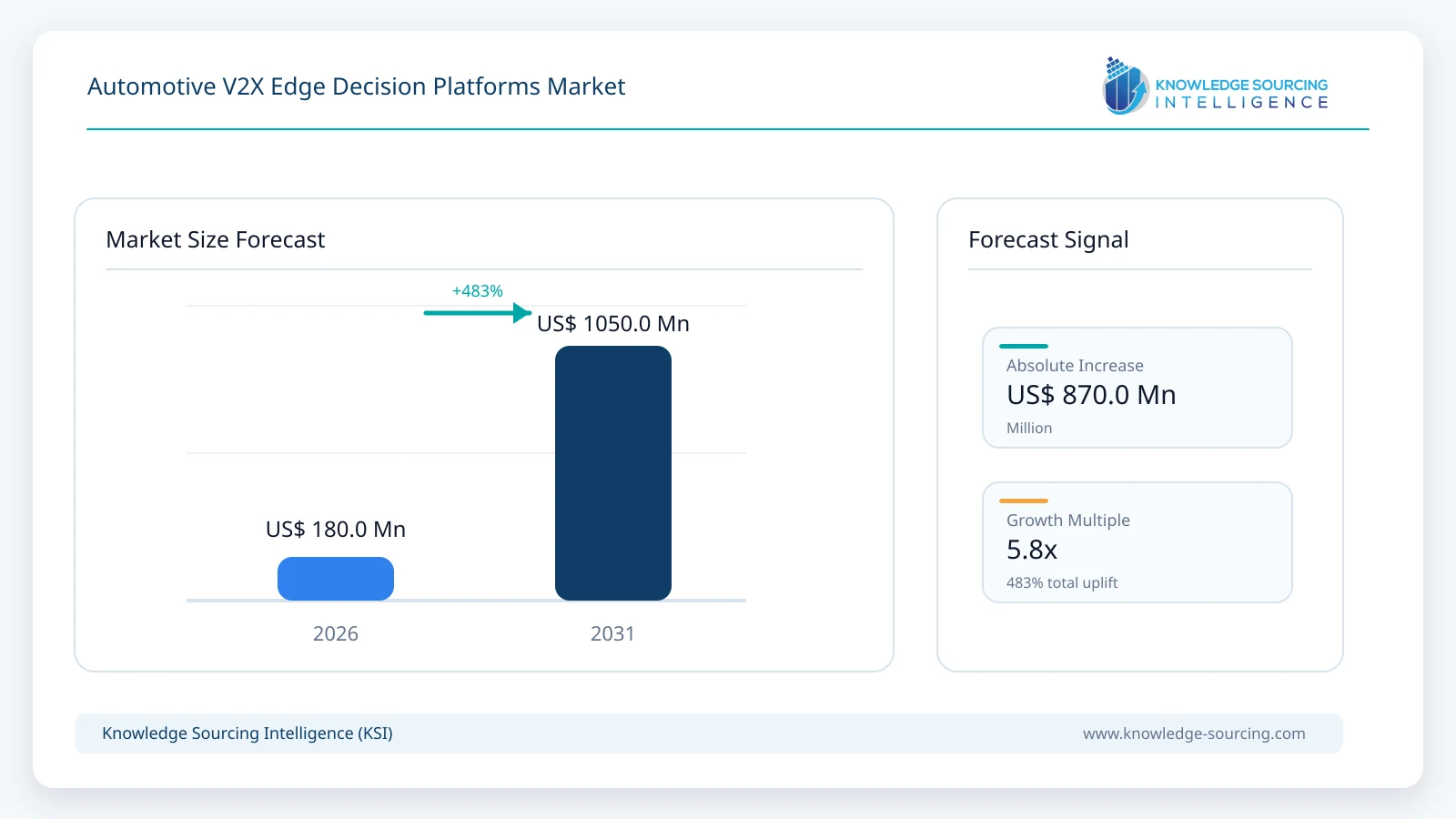
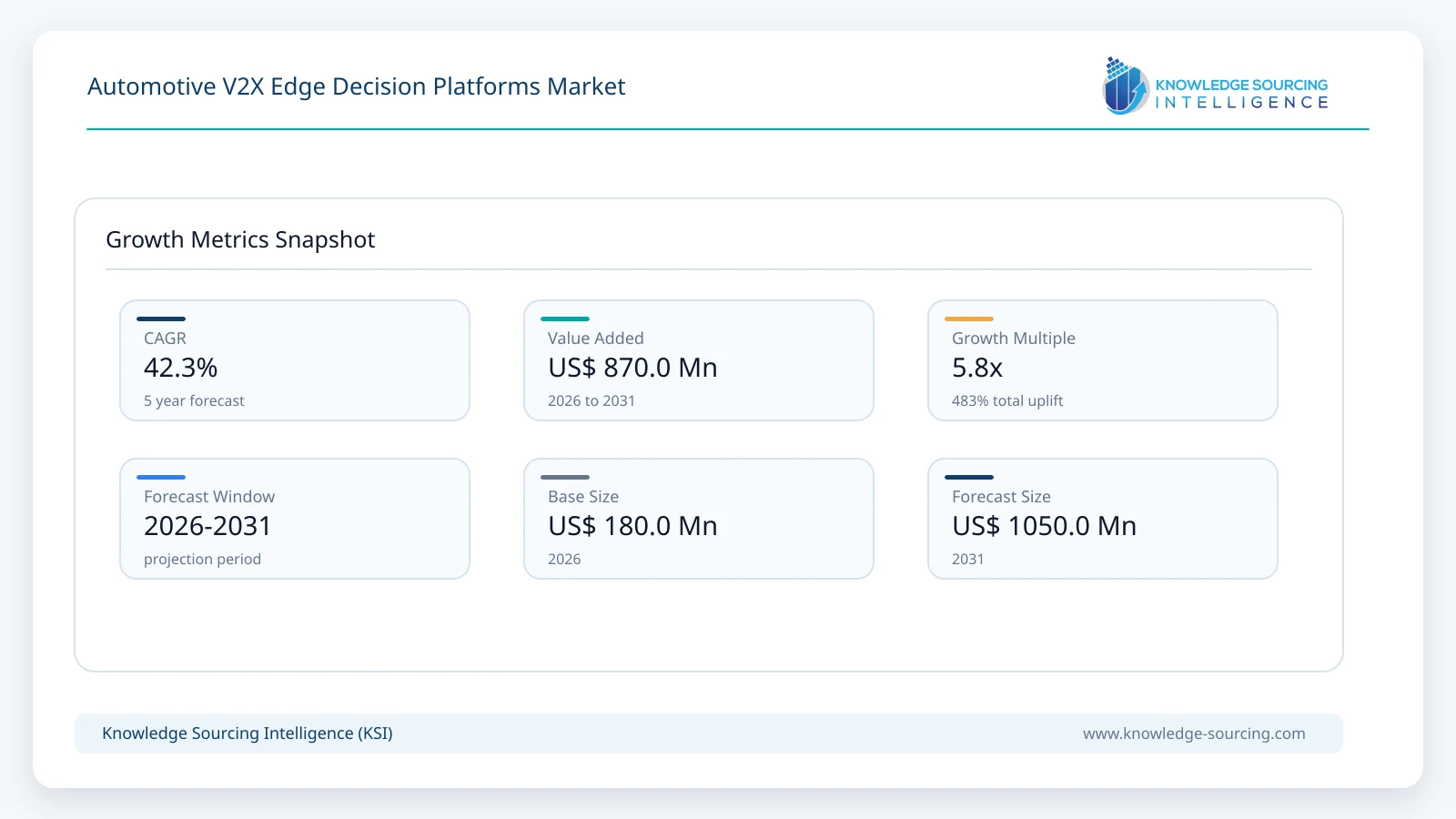
The global Automotive V2X Edge Decision Platforms Market is forecast to grow at a CAGR of 42.3%, reaching USD 1,050.0 million in 2031 from USD 180.0 million in 2026.
Highlights:
- 1The market is estimated at USD 180 million in 2026 and projected to reach USD 1,050 million in 2031.
- 2Onboard edge decision software represents approximately 61% of the estimated 2026 revenue pool.
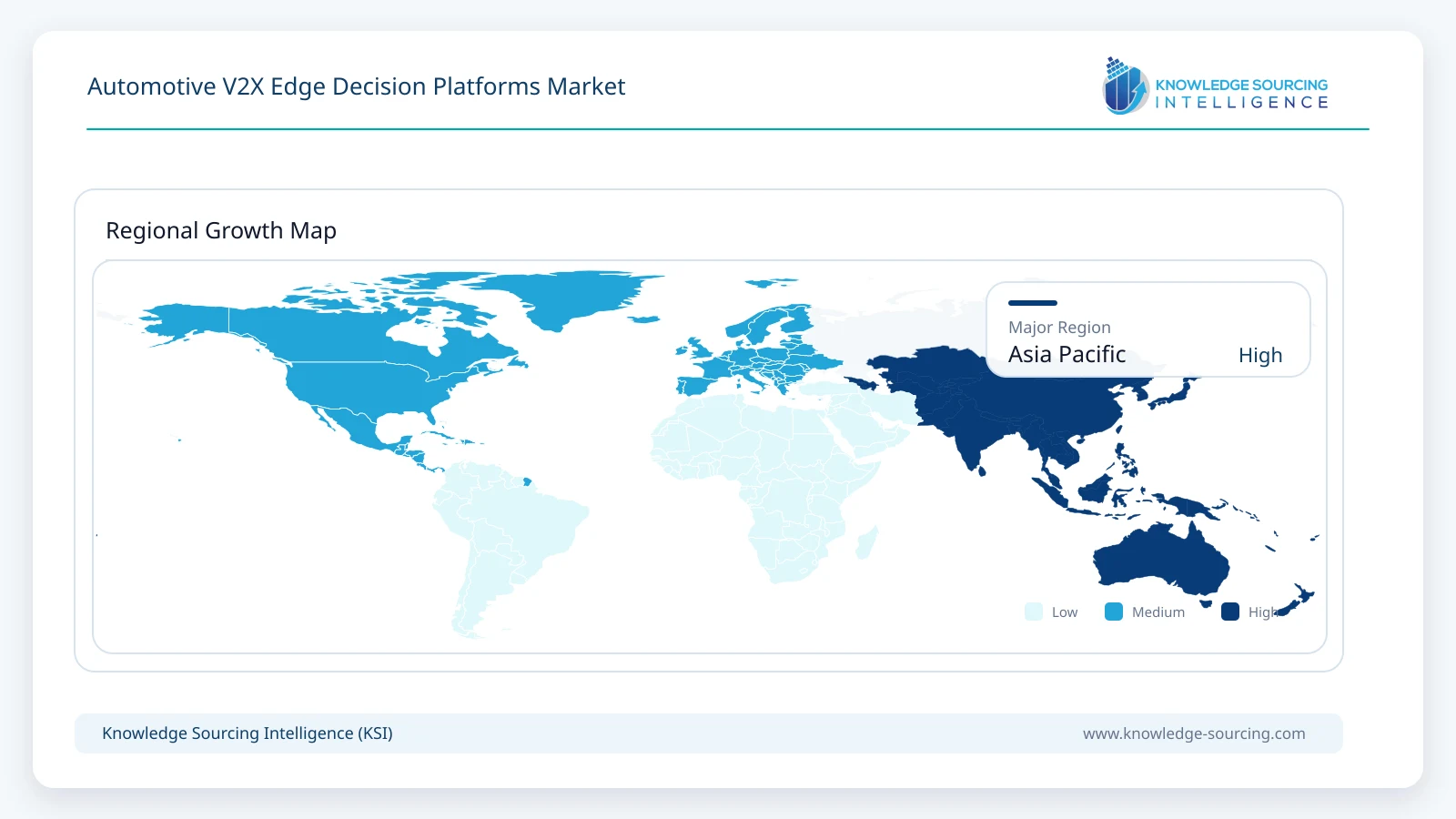
- 3Asia Pacific leads regional revenue in 2026, supported by connected vehicle-road deployments in China.
- 4Intersection safety remains the largest modeled application; cooperative sensor fusion gains share through 2031.
- 5Hybrid V2X paths increasingly combine direct messages with network-based edge intelligence.
- 6Interoperable roadside software, accurate decision confidence and long-term application support are key supplier differentiators.
Connected road infrastructure and increasingly software-defined vehicles require a decision layer between receiving external V2X information and presenting an alert or authorizing traffic coordination. The study assesses separately identifiable software licenses, roadside and MEC decision applications, managed runtimes and contract engineering sold to automakers, road agencies, fleets and mobility operators. It considers direct C-V2X, network V2X and hybrid architectures, but not the full value of radios, roadside cabinets, perception sensors or traffic-control hardware.
Implementation maturity differs substantially by region and application. Commsignia supplies onboard and roadside V2X application software; Cohda Wireless has a named 2026 deployment selection in Arizona; and Kapsch has announced live roadside-to-vehicle transactions and connected mobility projects. Production installations, agency pilot programs and certification events therefore have different implications for licensing volumes and forecast adoption.
Market Overview
Intersection and corridor safety depend on whether external information reaches the correct road user before a potential conflict. Roadside processors can fuse vehicle positions with camera or radar detections, filter irrelevant messages, and forward precise alerts, while onboard computing evaluates lane position, speed, and expected trajectories. The 5G Automotive Association's 2026 technical work addresses complex intersection and vulnerable-road-user scenarios where the distinction between communications availability and a reliable vehicle decision is especially important.
The commercial architecture is becoming more modular as automakers integrate safety applications with centralized vehicle compute and public agencies purchase standards-based roadside equipment. The studied market allocates value to the actual decision rules, confidence management, cooperative sensor processing, and related runtime services, rather than treating all V2X-capable devices as paying customers. Asia Pacific holds the largest estimated regional revenue in 2026 because of more advanced Chinese deployments, while North America has substantial opportunity from funded corridor programs.
Market Trends
Roadside Cooperative Perception Becomes More Application-Specific
Roadside units increasingly accept observations from cameras, radar, and connected vehicles so that local software can assess whether a pedestrian, crossing vehicle, or occluded obstacle represents an immediate conflict. Commsignia's roadside platform provides both V2X processing and sensor-fusion interfaces, and the US Department of Transportation's 2026 intersection-safety work explicitly includes AI-supported conflict mitigation. These capabilities create purchased decision applications beyond basic radio message forwarding.
Public agencies nevertheless require repeatable safety performance, reliable actor tracking, and maintained interfaces to existing signal controllers. Where the supplier sells a bundled intersection installation, only the decision-specific software and integration value belongs to this market. The transition toward more demanding risk assessments raises software value per active corridor even as computing hardware becomes more standardized.
Direct and Network V2X Combine in Hybrid Decisions
Automotive developers can use direct PC5 links to distribute nearby safety signals and network V2X to exchange information over a larger geography or connect to managed edge compute. The 5G Automotive Association's 2026 dynamic use-case study examines how these communication paths complement one another during non-line-of-sight events. Software must reconcile message timing, location confidence and duplicate incident observations before issuing driver or system recommendations.
Hybrid decision stacks are expected to gain share as direct radio coverage and telecom availability vary along a journey. The architecture can provide continuity, but merging message sources without generating conflicting warnings requires additional logic and testing. Platform suppliers with reusable, standards-aligned interface layers can spread those engineering costs across multiple automakers and public infrastructure programs.
Interoperable Roadside Deployments Move Beyond Isolated Pilots
The Maricopa County Connected Vehicle Acceleration Zone was announced with up to 750 physical or virtual roadside units and approximately 400 on-board units, offering a specific operational environment for transit priority, emergency preemption and vulnerable-road-user alerts. Cohda Wireless was selected to support the project in May 2026, while Kapsch reported its participation in an Avondale corridor work package in October. Multi-vendor deployment introduces a commercial need for consistent application behavior across equipment brands.
Road agencies expect roadside installations to remain useful for years and support software upgrades as new safety cases emerge. Edge application management, scenario tuning and remote validation can therefore create recurring service revenue in addition to one-time software licensing. The transition from equipment pilots to sustained operations will depend on procurement funding and demonstrated interoperability rather than announcements alone.
Vehicle Software Platforms Gain Regional V2X Flexibility
Qualcomm's October 2026 announcement of support for Japan's 760 MHz ITS Connect standard alongside its existing 5.9 GHz V2X capabilities reduces regional hardware fragmentation for automotive platforms. The company also completed its acquisition of Autotalks in 2025, bringing direct communications solutions into a wider digital-chassis portfolio. For decision software suppliers, a more common platform can simplify application porting and testing across vehicle families.
Hardware interoperability does not by itself establish that OEMs are shipping advanced cooperative-decision software in every region. Applications still have to pass local message, cyber-security, and safety requirements and must demonstrate reliable responses in the specific driving environment. The commercial effect is likely to emerge as program design wins convert into production vehicles over several model years.
Managed Edge Runtimes Improve Upgrade and Operations Economics
HARMAN's Savari MECWAVE architecture provides a reference for distributing low-latency V2X applications over multi-access edge infrastructure, while Iteris introduced CV App Manager capabilities for roadside edge applications in April 2026. Such software reduces the need for separate one-off deployments every time an agency adds a traffic-priority or warning use case. Remote application supervision becomes commercially meaningful when operating fleets of diverse roadside nodes.
The business case for managed runtimes rests on measurable uptime, bounded latency, software lifecycle support and a defensible share of the buyer's traffic-management budget. Public availability of open-source V2X reference tools can limit simple messaging-license prices, shifting spending toward validation, customization, multi-site orchestration and service-level commitments. These differentiated tasks support ongoing supplier relationships.
Segment Analysis
Onboard Edge Decision Software
Onboard decision applications represent an estimated USD 110 million of 2026 revenue, as automakers pay for localized hazard evaluation, V2X message relevance filtering and integration into vehicle warnings. Commsignia supplies automotive V2X software for multiple target computers, while Qualcomm's connectivity ecosystem expands available deployment hardware. Vehicles with a radio but no separately attributable cooperative-decision capability are not treated as part of this revenue pool.
Roadside Edge Computing
Roadside applications hold an estimated USD 52 million within the execution-location view in 2026, driven by intersection conflict detection, emergency-vehicle priority and road-user protection. Local computation permits agencies to combine signal status with connected observations while minimizing reliance on continuous wide-area connectivity. The software value in this segment excludes the physical roadside unit, traffic cabinet and installed sensor costs.
Intersection Safety and Vulnerable Road Users
Intersection conflict warning is the leading use case with an estimated 31.7% share in 2026, while vulnerable-road-user protection gains importance as roadside sensors fill blind spots around crossings. US demonstration programs increasingly evaluate warning behavior under live traffic conditions, and Commsignia's roadside capabilities allow external perception inputs to enrich the decision logic. Buyers place considerable weight on false-warning rates, precise positioning and safety-validation records.
Hybrid Direct and Network V2X
Direct communication currently represents the largest communication-architecture segment, but hybrid architectures are forecast to gain ground by coordinating PC5 and network inputs on a single decision pipeline. Relevant uses include early hazards, cooperative perception and long-range warning delivery during changes in local radio coverage. Integrated software must check message freshness, de-duplicate reports, and protect decision paths from untrusted data.
Market Drivers
Investment in Interoperable V2X Corridors
The US Department of Transportation's V2X Accelerator funds corridor programs in Arizona, Texas and Utah with operational readiness milestones reached in 2026. These deployments create specific purchases for intersection-warning logic, priority algorithms, application validation, and operations software in addition to equipment. Road authorities can extend a functioning corridor by adding new decision use cases through software rather than replacing every roadside unit.
Demand for Visibility Beyond Onboard Sensors
Blind intersections, parked trucks, and occluded pedestrians limit what a single vehicle's camera and radar can observe, increasing the benefit of external V2X messages. Cooperative decisions use transmitted positions or roadside detections to warn road users before an obstacle enters direct view. The 5GAA dynamic use-case work addresses scenarios where a reliable decision about message relevance is essential to achieve the safety benefit.
Growth of Software-Defined Vehicle Platforms
Automakers are adopting centralized compute and updatable software architectures that can host multiple V2X applications across model ranges. Standardized application interfaces make it more feasible to add collision relevance, lane-level event assessment, and cooperative behavior on common hardware. Qualcomm's broader V2X platform work and Commsignia's deployable software stack support this shift from dedicated fixed-function equipment toward reusable application licenses.
Expanded Public Transit and Emergency Prioritization
Emergency vehicles and public transport fleets can use roadside V2X decisions to request intersection priority while preserving controller safety constraints. Maricopa County's connected corridor project includes emergency vehicle preemption, transit signal priority and freight priority use cases, supporting identifiable agency and fleet software spending. These operational benefits create a more tangible procurement case than general connected-car awareness alone.
Regulatory and Standards Momentum
SAE's February 2026 report on network V2X and India's August 2026 proposed V2V rules establish clearer technical pathways for future deployments. Standard work also addresses interoperability, positioning, and secure message exchange, helping buyers assess whether equipment and software can work across supplier ecosystems. India's proposal is not yet a final mandate, but it is an important sign of expanding policy attention to cooperative road safety.
Market Restraints
Fragmented Geographic Rollouts and Uneven Vehicle Penetration
V2X-equipped vehicles and roadside units remain unevenly distributed among national markets and individual corridors, limiting how often a local decision engine receives useful external information. A software function that works in a funded intersection zone may offer little additional value outside that operating footprint. Suppliers must support deployment plans based on corridor density and specific participating vehicle fleets rather than assuming universal network effects.
Message Trust, Position Accuracy and False Alerts
A cooperative safety decision depends on accurate sender location, current timestamp, authenticated messages and confidence in external perception data. Incorrect lane matching or repeated alerts can produce unnecessary warnings and reduce driver confidence, especially at complex junctions. The 5GAA's work on dynamic trustworthiness underscores why validation and adversarial testing are major costs for safety-oriented applications.
Hardware and Software Interoperability Costs
Roadside platforms contain diverse radio technologies, application processors, traffic controllers, and transportation management interfaces, making integration more demanding than deploying a general cloud API. OEMs must also reconcile embedded systems with their own vehicle software and human-machine interface policies. Even where PC5 and network interfaces follow common standards, suppliers face prolonged certification and software-porting work before wide commercial use.
Public Procurement Timelines and Demonstration Risk
Road-authority demand depends on funding authorization, equipment procurement, field testing, and sustained operational budgets. The 2026 Maricopa and US DOT announcements provide evidence of deployment progress but do not mean every planned intersection is already operating or generating recurring paid application revenue. Pilot-focused vendors may therefore experience uneven bookings while commercial contracts move through safety and procurement approval.
Price Pressure from Bundled Infrastructure and Open Software
Vehicle manufacturers often procure radios, communication stacks and safety functions within larger electronics contracts, making it difficult for an external software supplier to capture a separate application price. Publicly funded open-source V2X reference applications can further reduce differentiation for basic warnings and message processing. Vendors need measurable improvements in risk classification, multi-source fusion and ongoing service quality to defend higher decision-platform pricing.
Regional Outlook
Asia Pacific
Asia Pacific is estimated to generate USD 90 million in 2026, representing half of global attributable decision-platform revenue, with China accounting for the majority of regional demand. A broader ecosystem of connected road infrastructure, vehicle software integration, and regional cooperative mobility programs supports higher adoption of onboard and roadside V2X applications. Japan and South Korea offer additional technical maturity, while India provides a policy-led opportunity following its 2026 draft V2V standardization initiative.
Regional market development is uneven, and China-focused applications cannot be assumed to operate identically across Japan, India or Southeast Asia. Different radio practices, procurement systems, and safety expectations raise the value of reusable localization and security integration. Increasing regional compatibility of V2X silicon may support cross-platform software investment, but production ramp assumptions remain more conservative outside verified deployments.
North America
North America is estimated at USD 36 million in 2026 and is projected to show strong growth as public agencies extend interoperable V2X operations beyond pilot corridors. The US DOT Accelerator projects and the Maricopa County deployment establish concrete demand for intersection safety, emergency preemption and infrastructure application maintenance. Suppliers such as Cohda, Kapsch, Commsignia and Iteris support a local ecosystem spanning onboard messages, roadside software and device management.
North American adoption depends on meeting certification, cybersecurity and multi-vendor interoperability requirements across state and municipal deployments. Agencies require validated deployment economics because the full cost of a V2X-ready intersection is much greater than the decision software portion. Canada's connected-mobility activity and Mexico's longer-term opportunities contribute to regional growth but remain smaller than the United States.
Competitive Landscape
The V2X decision-platform competitive environment combines specialist V2X software providers, automotive connectivity firms, roadside traffic technology vendors and managed edge-platform suppliers. Commsignia and Cohda offer integrated hardware-software solutions, Kapsch and Econolite address roadside and traffic management requirements, and HARMAN provides telecom-edge application capabilities. Iteris focuses on road-network applications and device operations, while Qualcomm supplies an expanding interoperability platform that can enable separate decision software spending.
Competitive differentiation rests on road-scene accuracy, low-latency operation, cybersecurity, software portability and the ability to support deployed infrastructure for years. Vendor participation in certification or a funded pilot does not by itself establish share of decision-layer revenue, and proprietary market shares should not be inferred from project size. Contracts that combine equipment and applications require careful separation before supplier activity can be compared on a consistent basis.
Recent Developments
20 October 2026: Qualcomm announced broader regional interoperability for V2X chipsets, adding planned support for Japan's 760 MHz ARIB-T109 to its existing 5.9 GHz capabilities. This could simplify multi-market vehicle platform support.
13 October 2026: Kapsch TrafficCom reported selection to supply V2X roadside units for the Avondale corridor within Maricopa County's multi-vendor deployment. The work supports safety and traffic priority decision applications.
September 2026: US Department of Transportation reported operational readiness demonstrations at the Texas A&M and Utah V2X Accelerator sites. The milestones test practical warning and priority use cases before extended operation.
August 2026: Cohda Wireless announced OmniAir certification for its MK6 C-V2X on-board unit in the United States. Certification strengthens interoperability readiness but does not by itself prove a production vehicle order.
1 July 2026: 5G Automotive Association published research on dynamic V2X safety use cases using direct and network links, strengthening technical requirements for intersection and vulnerable-road-user decisions.
May 2026: Cohda Wireless announced selection for the Maricopa County Connected Vehicle Acceleration Zone, planned to support hundreds of roadside and on-board units and multiple cooperative safety applications.
Market Outlook
Automotive V2X edge decision platforms are gaining traction as vehicle-local safety logic, roadside cooperative perception and managed edge services expand beyond early commercial programs. Software integrated into factory-built vehicle platforms remains a key revenue stream, while roadside decision applications gain momentum as transportation corridors adopt vulnerable-road-user detection and prioritized emergency and transit movements. These developments are strengthening demand for low-latency decision-making, improved road safety and coordinated traffic management. Increasing deployment of connected vehicles, intelligent transportation infrastructure and cooperative mobility systems is further supporting adoption across automotive and roadside applications.
Long-term commercialization will depend on connecting certified communications systems to a demonstrably valuable safety application, not simply increasing the number of radios installed. Suppliers with repeatable risk models, strong message validation and a sustained software support capability are positioned to monetize this shift. Regional regulatory divergence, procurement timing and uncertain paid application penetration remain important factors in how rapidly the forecast is achieved.
Automotive V2X Edge Decision Platforms Market Scope:
| Report Metric | Details |
|---|---|
| Total Market Size in 2026 | USD 180.0 million |
| Total Market Size in 2031 | USD 1,050.0 million |
| Forecast Unit | USD Million |
| Growth Rate | 42.3% |
| Study Period | 2021 to 2031 |
| Historical Data | 2021 to 2024 |
| Base Year | 2025 |
| Forecast Period | 2026 – 2031 |
| Segmentation | Revenue Stream, Decision Execution Location, Application, Communication Architecture |
| Companies |
|
Market Segmentation
By Revenue Stream
Onboard Edge Decision Software
Roadside Decision Applications
MEC Orchestration and Services
Engineering and Safety Validation
By Decision Execution Location
Vehicle Onboard Edge
Roadside Edge Compute
Telecom Multi-Access Edge
Distributed Hybrid Edge
By Application
Intersection Collision and Conflict Warning
Vulnerable Road User Protection
Emergency and Transit Signal Priority
Cooperative Perception and Maneuver Support
Work Zone and Road Hazard Decisions
By Communication Architecture
Direct V2X PC5 or ITS-G5
Cellular Network V2N/V2X
Hybrid Direct and Network V2X
By Customer Group
Passenger Vehicle OEMs and Tier 1s
Commercial Vehicle and Transit Operators
Road Authorities and Smart City Operators
Telecom and Mobility Platform Operators
By Commercial Deployment Channel
Factory-Embedded OEM Programs
Roadside Infrastructure Contracts
Fleet and Aftermarket Deployments
Managed Mobility and Integration Partners
By Decision Intelligence Method
Rule-Based Message Risk Assessment
Cooperative Sensor Fusion
Predictive Trajectory and Conflict Assessment
Priority and Traffic Coordination Logic
By Geography
North America
United States
Canada
Mexico
South America
Brazil
Argentina
Others
Europe
Germany
United Kingdom
France
Italy
Spain
Netherlands
Nordic Countries
Others
Middle East and Africa
Saudi Arabia
United Arab Emirates
Israel
South Africa
Others
Asia Pacific
China
Japan
South Korea
India
Australia
Indonesia
Thailand
Taiwan
Others
Table of Contents
1. EXECUTIVE SUMMARY
1.1. Market Opportunity and Key Findings
1.2. Automotive V2X Edge Decision Platforms Market Size, 2026–2031
1.3. Technology and Customer Highlights
1.4. Regional Market Opportunities
2. MARKET SNAPSHOT
2.1. Market Overview
2.2. Market Definition
2.3. Scope of the Study
2.4. Market Segmentation
3. BUSINESS LANDSCAPE
3.1. Market Drivers
3.1.1. Investment in Interoperable V2X Corridors
3.1.2. Demand for Visibility Beyond Onboard Sensors
3.1.3. Growth of Software-Defined Vehicle Platforms
3.1.4. Expanded Public Transit and Emergency Prioritization
3.1.5. Regulatory and Standards Momentum
3.2. Market Restraints
3.2.1. Fragmented Geographic Rollouts and Uneven Vehicle Penetration
3.2.2. Message Trust, Position Accuracy and False Alerts
3.2.3. Hardware and Software Interoperability Costs
3.2.4. Public Procurement Timelines and Demonstration Risk
3.2.5. Price Pressure from Bundled Infrastructure and Open Software
3.3. Market Opportunities
3.4. Porter's Five Forces Analysis
3.5. Industry Value Chain Analysis
3.6. Policies and Regulations
3.7. Strategic Recommendations
4. TECHNOLOGICAL OUTLOOK
4.1. Direct and Network V2X Communication
4.2. Onboard, Roadside and MEC Decision Architectures
4.3. Cooperative Perception and Sensor Fusion
4.4. Message Confidence and Conflict Assessment
4.5. Intersection Priority and Vulnerable Road User Intelligence
4.6. Cybersecurity, Positioning and Software Lifecycle
5. AUTOMOTIVE V2X EDGE DECISION PLATFORMS MARKET BY REVENUE STREAM
5.1. Introduction
5.2. Onboard Edge Decision Software
5.3. Roadside Decision Applications
5.4. MEC Orchestration and Services
5.5. Engineering and Safety Validation
6. AUTOMOTIVE V2X EDGE DECISION PLATFORMS MARKET BY DECISION EXECUTION LOCATION
6.1. Introduction
6.2. Vehicle Onboard Edge
6.3. Roadside Edge Compute
6.4. Telecom Multi-Access Edge
6.5. Distributed Hybrid Edge
7. AUTOMOTIVE V2X EDGE DECISION PLATFORMS MARKET BY APPLICATION
7.1. Introduction
7.2. Intersection Collision and Conflict Warning
7.3. Vulnerable Road User Protection
7.4. Emergency and Transit Signal Priority
7.5. Cooperative Perception and Maneuver Support
7.6. Work Zone and Road Hazard Decisions
8. AUTOMOTIVE V2X EDGE DECISION PLATFORMS MARKET BY COMMUNICATION ARCHITECTURE
8.1. Introduction
8.2. Direct V2X PC5 or ITS-G5
8.3. Cellular Network V2N/V2X
8.4. Hybrid Direct and Network V2X
9. AUTOMOTIVE V2X EDGE DECISION PLATFORMS MARKET BY CUSTOMER GROUP
9.1. Introduction
9.2. Passenger Vehicle OEMs and Tier 1s
9.3. Commercial Vehicle and Transit Operators
9.4. Road Authorities and Smart City Operators
9.5. Telecom and Mobility Platform Operators
10. AUTOMOTIVE V2X EDGE DECISION PLATFORMS MARKET BY COMMERCIAL DEPLOYMENT CHANNEL
10.1. Introduction
10.2. Factory-Embedded OEM Programs
10.3. Roadside Infrastructure Contracts
10.4. Fleet and Aftermarket Deployments
10.5. Managed Mobility and Integration Partners
11. AUTOMOTIVE V2X EDGE DECISION PLATFORMS MARKET BY DECISION INTELLIGENCE METHOD
11.1. Introduction
11.2. Rule-Based Message Risk Assessment
11.3. Cooperative Sensor Fusion
11.4. Predictive Trajectory and Conflict Assessment
11.5. Priority and Traffic Coordination Logic
12. AUTOMOTIVE V2X EDGE DECISION PLATFORMS MARKET BY GEOGRAPHY
12.1. North America
12.1.1. United States
12.1.2. Canada
12.1.3. Mexico
12.2. South America
12.2.1. Brazil
12.2.2. Argentina
12.2.3. Others
12.3. Europe
12.3.1. Germany
12.3.2. United Kingdom
12.3.3. France
12.3.4. Italy
12.3.5. Spain
12.3.6. Netherlands
12.3.7. Nordic Countries
12.3.8. Others
12.4. Middle East and Africa
12.4.1. Saudi Arabia
12.4.2. United Arab Emirates
12.4.3. Israel
12.4.4. South Africa
12.4.5. Others
12.5. Asia Pacific
12.5.1. China
12.5.2. Japan
12.5.3. South Korea
12.5.4. India
12.5.5. Australia
12.5.6. Indonesia
12.5.7. Thailand
12.5.8. Taiwan
12.5.9. Others
13. COMPETITIVE ENVIRONMENT AND ANALYSIS
13.1. Major Players and Strategies
13.2. Market Share Analysis
13.3. Partnerships and Technology Agreements
13.4. Competitive Dashboard
14. COMPANY PROFILES
14.1. Commsignia Ltd.
14.2. Cohda Wireless Pty Ltd
14.3. Qualcomm Technologies, Inc.
14.4. HARMAN International
14.5. Kapsch TrafficCom AG
14.6. Iteris, Inc.
14.7. Econolite Group
14.8. AUTOCRYPT Co., Ltd.
14.9. Yunex Traffic
14.10. Miovision Technologies Incorporated
15. APPENDIX
15.1. Currency
15.2. Assumptions
15.3. Base Year and Forecast Year
15.4. Key Benefits for Stakeholders
15.5. Research Methodology
15.6. Abbreviations
Navigate
Trusted by the world's leading organizations