
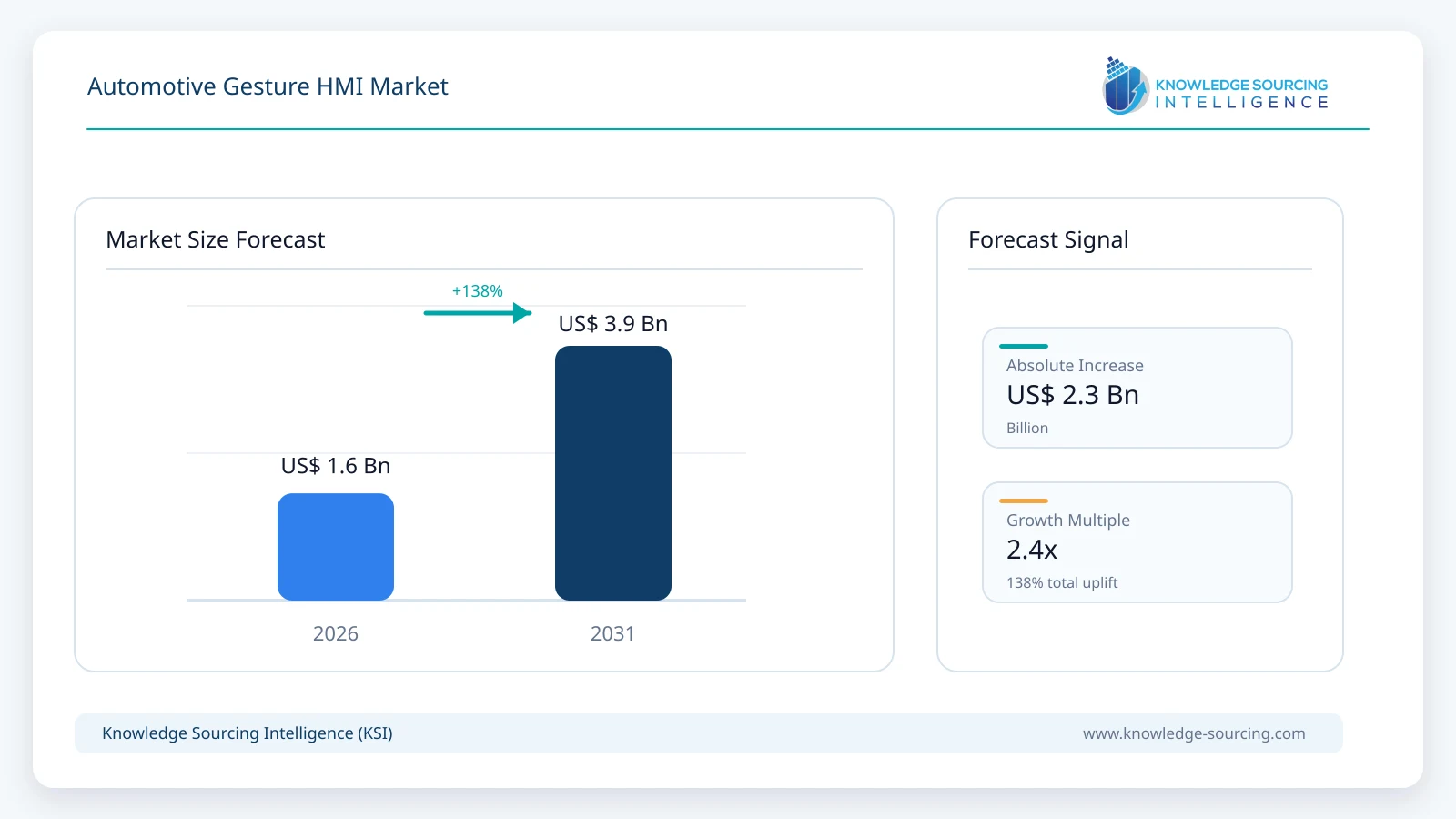
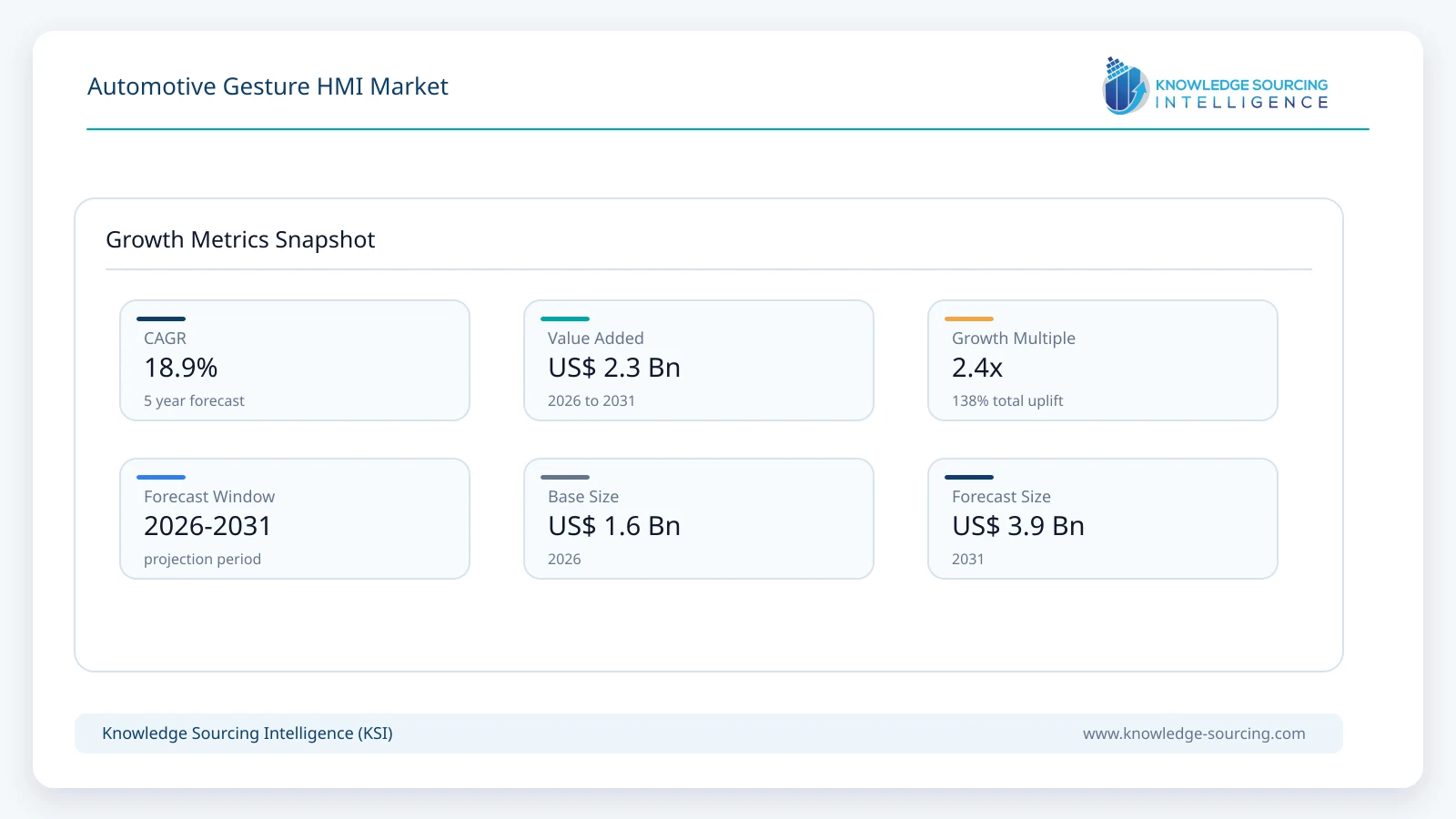
The Automotive Gesture HMI Market is forecast to grow at a CAGR of 18.9%, reaching USD 3.92 billion in 2031 from USD 1.65 billion in 2026.
Highlights:
- 1Camera, infrared, and 3D optical sensing account for approximately 58% of global market value in 2026 because these technologies provide detailed hand-shape, direction, and position information and can share hardware with broader driver and occupant monitoring.
- 2Hand and finger gesture recognition represents approximately 67% of market value in 2026 because swipe, point, rotate, pinch and shortcut gestures remain the most practical control vocabulary for infotainment, navigation and cabin functions.
- 3Multimodal gesture-plus-voice, gaze or touch architectures account for approximately 61% of 2026 market value as OEMs increasingly use gestures to complement rather than replace other HMI channels.
- 4Infotainment, media and navigation control represent approximately 43% of market value in 2026 because gesture interaction is most commercially mature for high-frequency non-safety-critical cockpit functions.
- 5Passenger vehicles account for approximately 95% of global market value in 2026 due to premium cockpit adoption, smart-cabin programs and higher volumes of camera- and display-rich vehicle platforms.
- 6Asia Pacific represents approximately 42% of global market value in 2026, supported by rapid smart-cockpit development in China and strong display, electronics and in-cabin sensing ecosystems in Japan and South Korea.
Gesture interaction is moving beyond simple swipe and wave commands toward richer multimodal systems that combine hand or finger movement with gaze, voice, displays and cabin context so the vehicle can determine who initiated the gesture, what object or function the occupant is referring to and whether the command should be executed immediately or confirmed through another interface. This evolution increases the value of gesture-recognition software, three-dimensional sensing and sensor fusion relative to early single-camera gesture modules.
Commercial development is broadening as camera, radar, cockpit and HMI suppliers reuse common in-cabin sensing hardware to add gesture interaction without creating a separate control stack for every vehicle function. Valeo embeds machine-learning gesture recognition in compact 3D camera systems and dome modules, Infineon combines REAL3 Time-of-Flight and XENSIV 60 GHz radar for gesture and cabin sensing, Texas Instruments positions 60 GHz radar as a privacy-preserving multifunction input sensor, and Aptiv uses interior-camera software to extend gesture recognition from hardware already deployed for occupant monitoring. LG, Garmin and AUO Mobility Solutions are simultaneously demonstrating gesture interaction within AI-driven or immersive cockpits, indicating that future value will come from integrating gesture with voice, gaze and visual feedback rather than treating it as an isolated touchless-control feature.
Market Overview
Gesture HMI occupies the input layer between occupant movement and vehicle action, allowing users to control selected cockpit functions without locating a physical switch or touching a display. The commercial value is strongest where gesture reduces visual demand or extends interaction to locations that are difficult to reach, such as passenger displays, roof modules or wide cockpit surfaces, while still providing clear confirmation through graphics, audio or haptic feedback.
Camera and three-dimensional optical sensing remain the most information-rich architectures because 2D vision can classify broad movements while Time-of-Flight or structured-light sensors add depth, distance and finger-position information needed for more precise interaction. Valeo's compact 3D camera gesture recognition and Infineon's REAL3 ToF platform illustrate how optical sensing can support gesture alongside occupant classification, posture and other in-cabin functions, improving hardware reuse across the smart-cabin stack.
Radar adds a complementary gesture path because 60 GHz sensors can detect hand movement without collecting recognizable imagery and can operate reliably in darkness or through selected interior materials. Infineon and Texas Instruments position in-cabin radar as a multifunction sensor capable of gesture detection together with child presence, occupancy, intrusion and vital-sign sensing, which improves the economics of radar-based HMI when one device supports several safety and convenience functions.
Multimodal interaction is becoming the long-term architecture because a gesture becomes more useful when the vehicle can combine movement with gaze, voice, seating position and display context. LG's AI-powered mobility concepts use gesture and eye tracking together, Garmin has demonstrated wrist-sensed micro gestures through Meta Neural Band integration, and AUO Mobility Solutions links gesture commands with immersive window and display experiences. These approaches shift gesture HMI from fixed command recognition toward contextual interaction in which the system interprets both movement and intent.
Market Trends
Gesture Control Is Shifting from Standalone Commands toward Multimodal Interaction
Gesture systems are increasingly being designed as one input channel within a broader HMI stack rather than as a complete replacement for touch or voice. Combining a hand movement with gaze, seat position or spoken intent allows the vehicle to determine who issued the command and which function the gesture refers to, reducing ambiguity compared with a gesture-only interface.
Multimodal integration also improves user acceptance because gestures can handle quick spatial commands while voice or touch remains available for detailed selection and confirmation. The strongest production opportunity therefore lies in gesture platforms that share perception software, displays and context with the wider cockpit architecture instead of requiring a separate gesture-specific user experience.
3D Time-of-Flight and Interior Cameras Are Increasing Gesture Precision
Three-dimensional sensing is expanding the usable gesture vocabulary because depth information helps distinguish finger, hand and arm position more accurately than conventional 2D image recognition alone. Infineon's REAL3 Time-of-Flight platform supports gesture control alongside occupant monitoring, while Valeo uses compact 3D camera architectures to embed gesture recognition into interior modules.
Higher precision enables pointing, rotation, pinch and near-surface interaction rather than only broad swipe motions, but it also increases calibration and processing requirements. OEMs must maintain performance across different seating positions, hand sizes, ambient lighting and sensor locations if precise gestures are to remain reliable in production vehicles.
60 GHz Radar Is Emerging as a Privacy-Preserving Gesture Sensor
Automotive radar is gaining relevance for gesture control because high-frequency micro-motion sensing can detect hand movement without capturing conventional images. Texas Instruments and Infineon both support gesture detection on 60 GHz in-cabin radar platforms that can also perform occupancy, child-presence and intrusion functions.
Radar-based gesture HMI is particularly attractive where sensor privacy, hidden installation or low-light robustness are important, although camera and ToF systems still provide richer semantic information. The competitive opportunity therefore centers on multifunction radar designs that lower incremental gesture cost by sharing the same sensor with safety and cabin-monitoring use cases.
Micro-Gesture and Wearable Input Are Expanding the Definition of In-Vehicle Gesture HMI
Gesture interaction is beginning to move beyond camera-observed arm movement toward subtle finger and wrist inputs that require little physical travel. Garmin and Meta demonstrated an automotive proof of concept in which electromyography from Meta Neural Band translates thumb, index and middle-finger movements into infotainment commands within Garmin Unified Cabin.
Micro-gesture input can reduce fatigue and support passenger interaction in relaxed seating positions, but commercialization depends on wearable adoption, pairing, identity management and OEM willingness to support an external input device. The technology is therefore best viewed as an emerging extension of multimodal HMI rather than a near-term replacement for embedded camera or radar sensing.
Gesture HMI Is Expanding into Immersive and Passenger-Centric Cockpits
Future gesture interaction is increasingly associated with wide displays, transparent windows, projected surfaces and passenger entertainment rather than only center-stack control. AUO Mobility Solutions uses voice and gesture commands in its XR Interactive Window, while LG combines gesture and gaze recognition with AI-generated in-vehicle content and personalized information.
Passenger-centric use cases reduce the safety burden associated with driver control and give OEMs more freedom to experiment with spatial interaction, gaming, shopping and entertainment. As automated driving and lounge-like interiors expand, gesture HMI can therefore gain value from passenger experience even if driver-facing gesture control remains deliberately limited to simple, low-distraction commands.
Segment Analysis
By Sensing Technology: Camera, Infrared and 3D Optical Gesture Recognition
Camera, infrared and 3D optical gesture recognition is expected to remain the largest sensing segment and could generate approximately USD 2.20 billion in market value by 2031. The technology benefits from existing in-cabin camera penetration and can classify hand shape, direction, position, and motion while sharing hardware with occupant monitoring, gaze tracking, and personalization.
Three-dimensional Time-of-Flight and structured-light sensing should gain share within the optical category because depth improves finger-level precision and reduces ambiguity between foreground gestures and background motion. Suppliers able to reuse one optical stack across gesture, body-position, and occupant-recognition functions should retain a cost advantage over dedicated gesture-only camera modules.
By Gesture Type: Hand and Finger Gestures
Hand and finger gestures are projected to generate approximately USD 2.55 billion of market value by 2031 because they provide the most intuitive vocabulary for swipe, point, rotate, pinch, select and shortcut commands. These movements can be learned quickly and mapped to infotainment, media, climate, lighting and display functions without requiring the large body motion associated with broader arm gestures.
Recognition software will increasingly focus on context rather than expanding the command library indefinitely because too many gestures reduce memorability and increase false activation risk. Production systems are therefore likely to prioritize a smaller set of highly reliable gestures that work consistently across users, seating positions and driving environments.
By Interaction Architecture: Multimodal Gesture, Voice, Gaze and Touch HMI
Multimodal gesture HMI is projected to approach approximately USD 2.65 billion by 2031 as OEMs combine movement with voice, gaze and display context to reduce command ambiguity. A pointing gesture can identify an object, gaze can confirm user intent and voice can specify the requested action, creating a more flexible interaction model than gesture recognition alone.
Multimodal architectures also allow graceful fallback because a user can switch to touch or voice if the gesture is not recognized, improving robustness in real-world conditions. The integration burden is higher, however, because camera, radar, microphone, display and vehicle-control software must share a common user-context model and response framework.
By Application: Infotainment, Media and Navigation Control
Infotainment, media and navigation control is projected to generate approximately USD 1.70 billion by 2031 because these functions provide the clearest low-risk use case for gesture interaction. Volume adjustment, media selection, call handling, menu navigation and display interaction can benefit from touchless commands without directly affecting safety-critical vehicle control.
Gesture penetration into climate, lighting and seat functions should expand as multimodal HMI becomes more common, but OEMs are likely to retain tactile or voice alternatives for functions that require precise confirmation. The commercial value of gesture control therefore depends on reducing interaction effort rather than maximizing the number of functions assigned to gestures.
By Vehicle Class: Premium and Upper-Mid-Range Vehicles
Premium and upper-mid-range vehicles are projected to generate approximately USD 2.05 billion of market value by 2031 because these platforms have the highest penetration of interior cameras, depth sensors, wide displays and advanced HMI compute. Premium OEMs also use gesture interaction as a visible differentiation feature and can justify the additional sensing, validation and software cost more readily than entry-level programs.
Adoption should broaden into mid-range vehicles as gesture recognition is added to cameras or radar already required for occupant monitoring, reducing incremental hardware cost. Premium vehicles will nevertheless retain disproportionate value because they are more likely to combine gesture with gaze, immersive displays and personalized multimodal interaction.
By Vehicle Type: Passenger Vehicles
Passenger vehicles are projected to generate approximately USD 3.70 billion of gesture-HMI market value by 2031 because smart-cockpit content, interior sensing and multimodal HMI investment are concentrated in passenger cars, SUVs and MPVs. Higher production volumes also allow recognition software and sensor modules to be amortized across large global platforms.
Commercial vehicles can use gesture control for infotainment, communication or driver-assistance interfaces, but operator training and preference for tactile controls limit near-term penetration. Shared and autonomous mobility may eventually support richer passenger gesture interaction, although unit volumes remain smaller than mainstream passenger-vehicle production.
Market Drivers
Expansion of In-Cabin Cameras and Shared Interior-Sensing Hardware
Driver and occupant monitoring programs are placing more cameras, infrared emitters, radar and depth sensors inside vehicles, creating a hardware base that can support gesture recognition without a dedicated sensor for every HMI function. Aptiv, Infineon and Valeo all illustrate architectures in which gesture capability can coexist with occupancy, gaze, posture or safety monitoring.
Shared hardware lowers the incremental cost of gesture HMI and makes software activation across trims more practical. The business case is strongest when gesture recognition uses sensing already justified by regulation or other cabin functions rather than requiring a stand-alone gesture module.
Demand for Lower-Distraction Alternatives to Touchscreen Interaction
Large touchscreens increase feature flexibility but can require drivers to look away from the road to locate controls, creating demand for interaction methods that can be executed with less visual search. Simple air gestures, pointing or shortcut movements can provide rapid access to media, calls, lighting or display functions while preserving the driver's seated posture.
Gesture control does not eliminate distraction automatically, so OEMs must limit command complexity and provide clear confirmation. Systems that reduce the number of steps required for high-frequency tasks without forcing users to memorize a large gesture vocabulary are more likely to achieve durable adoption.
Multimodal HMI Is Increasing the Value of Gesture as a Contextual Input
Voice, gaze, touch and gesture become more useful when the vehicle can fuse them into a shared intent model rather than process each channel independently. LG, Garmin and AUO Mobility Solutions are demonstrating this direction through gesture-plus-gaze, wearable micro-gesture and immersive gesture-controlled experiences.
Contextual fusion improves recognition confidence and allows gesture to handle spatial intent while another modality manages confirmation or detailed input. This makes gesture commercially relevant even when it is not the primary HMI channel, broadening the addressable market beyond vehicles designed around gesture-first control.
Advances in Edge AI Are Improving Real-Time Gesture Recognition
Automotive processors and optimized perception models can now classify hand movement, pose, and short gesture sequences locally with lower latency than earlier cloud-dependent or compute-intensive approaches. On-device processing also avoids transmitting raw cabin imagery, which strengthens privacy for camera-based gesture recognition.
Higher edge compute makes more sophisticated gesture vocabularies possible, but the commercial benefit depends on maintaining deterministic response and low false activation. Suppliers that can run gesture models efficiently on existing cockpit or cabin-monitoring processors reduce the need for dedicated compute and improve OEM scalability.
Passenger-Centric and Automated Cockpits Are Creating New Spatial Interaction Use Cases
As interiors gain passenger displays, wider surfaces and more relaxed seating positions, touch controls may become difficult to reach or less natural for certain interactions. Gesture can provide a spatial input method for entertainment, content discovery, window displays and smart-cabin functions without requiring fixed physical controls near every occupant.
The opportunity is especially relevant to premium EVs, shared mobility and future automated vehicles where the cabin is treated as a digital living space rather than a conventional driver-centered cockpit. Passenger-facing applications can also tolerate richer gesture experimentation because they are less constrained by driver-distraction requirements.
Market Restraints
False Recognition and Accidental Activation Can Undermine User Trust
Gesture HMI must distinguish deliberate commands from ordinary hand movement, passenger activity, conversations and objects moving within the cabin. False activation is particularly damaging because users may disable the feature after repeated unintended media, climate or display changes.
Robust systems therefore require confidence thresholds, gesture-state logic and contextual filtering based on gaze, seat position or interface state. The need to suppress accidental input limits how large and permissive the gesture vocabulary can become in production vehicles.
Occlusion, Lighting and Cabin Geometry Affect Optical Gesture Performance
Camera and Time-of-Flight systems must recognize gestures across varying sunlight, darkness, sleeves, hand sizes, steering-wheel positions and partially blocked fields of view. A gesture that performs well in a laboratory can degrade when the sensor is mounted behind trim or when the user's hand moves outside the calibrated interaction zone.
Vehicle-specific camera placement and calibration therefore remain important engineering costs, particularly when one gesture stack must support multiple seat positions or left- and right-hand-drive variants. Radar improves lighting robustness but introduces its own range, multipath and classification challenges.
Gesture Vocabulary Must Remain Simple Enough to Be Learnable and Predictable
A large command set can make gesture HMI technically impressive but difficult to remember, especially when different vehicle brands map similar movements to different functions. Unclear conventions also create hesitation because users need confidence that a gesture will produce the intended action before relying on it while driving.
OEMs are therefore likely to standardize around a limited number of high-confidence gestures and use multimodal confirmation for more complex tasks. This usability constraint caps the number of functions that can be monetized through gesture alone and reinforces the role of gesture as a complementary rather than dominant HMI channel.
Dedicated Gesture Hardware Can Be Difficult to Justify in Cost-Sensitive Vehicles
Standalone depth cameras, infrared emitters or radar modules add bill of materials, power, packaging and validation cost when gesture is the only supported function. Entry and mid-range programs may prefer voice, touch or steering-wheel controls if gesture requires a separate hardware stack.
Multifunction sensing is the main route to broader adoption because the same camera or radar can support occupant monitoring, child presence, authentication or gesture recognition. Suppliers that cannot demonstrate this shared-system value are likely to remain concentrated in premium or niche programs.
Privacy and Social Acceptance Can Limit Camera-Based Interaction
Interior gesture cameras may also capture faces, passenger activity and other personal information, which can create privacy concerns even when the intended function is simple hand recognition. Users may be especially sensitive in shared or rented vehicles where they do not control data settings or system ownership.
Local processing, minimal retention of raw imagery and visible privacy controls can reduce concern, while radar or wearable micro-gesture input offers alternative sensing paths. Technology choice may therefore be influenced by data-governance requirements as much as by gesture-recognition accuracy.
Regional Outlook
Asia Pacific
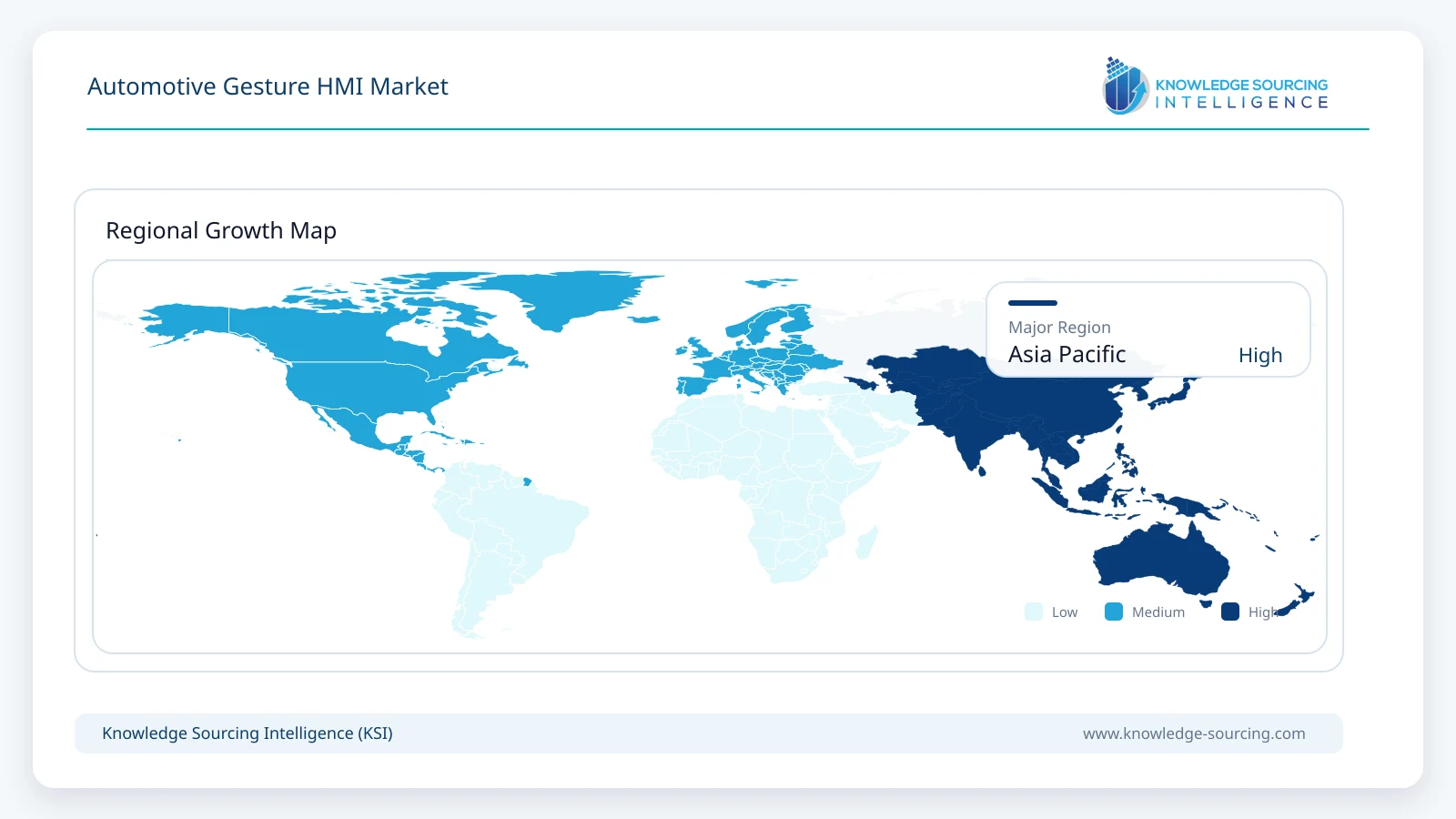
Asia Pacific is estimated to be the largest regional automotive gesture HMI market in 2026 because China combines rapid smart-cockpit adoption with aggressive experimentation in multimodal displays, AI interfaces and passenger-centric interior technologies. Japan and South Korea add strong camera, display, semiconductor and HMI supply chains, while regional OEMs increasingly use gesture, gaze and voice together to differentiate software-rich EV interiors.
LG's gesture- and gaze-enabled AI mobility concepts, AUO Mobility Solutions' gesture-controlled XR Interactive Window and BOE's multimodal smart-cockpit portfolio illustrate the region's emphasis on immersive interaction. Infineon, Texas Instruments and other sensor suppliers also support Asian Tier 1 development through Time-of-Flight and radar platforms that can add gesture recognition alongside broader in-cabin sensing.
Growth through 2031 should be strongest where gesture functionality is embedded in shared smart-cabin hardware rather than sold as a dedicated module. High regional vehicle volumes and fast cockpit-refresh cycles favor software-led gesture activation on common cameras, radar and domain-compute platforms, allowing adoption to move beyond premium models.
Europe
Europe represents the second major high-value gesture HMI market because premium OEMs and Tier 1 suppliers continue to invest in intuitive, low-distraction cockpit interaction and integrated in-cabin sensing. Valeo, Infineon and AUMOVIO all maintain relevant gesture-control capability through 3D cameras, radar, cabin sensing and broader HMI systems, while European vehicle programs provide a strong commercialization base for premium multimodal interfaces.
Valeo's gesture-recognition software is integrated with compact 3D camera architectures, Infineon's REAL3 and 60 GHz portfolio supports both optical and radar gesture sensing, and AUMOVIO includes gesture control and multimedia interaction within its advanced cabin-sensing capability. The region's strong emphasis on driver attention and HMI safety also encourages systems that combine gesture with gaze, voice or visual confirmation rather than relying on unrestricted free-air commands.
European growth will depend on whether suppliers can demonstrate measurable distraction reduction, low false activation and privacy-preserving processing while keeping hardware cost under control. Premium models should remain the main proving ground, with wider penetration following as gesture recognition is added to sensors already required for DMS, OMS or smart-cabin functions.
Competitive Landscape
The automotive gesture HMI market combines interior-sensing specialists, semiconductor suppliers, cockpit integrators and multimodal UX providers. Valeo, Infineon Technologies, Texas Instruments, Aptiv, LG Electronics Vehicle Solution Company, Garmin, AUMOVIO and AUO Mobility Solutions are directly relevant through camera, Time-of-Flight, radar, occupant-sensing, wearable-input or smart-cockpit gesture technologies.
Valeo differentiates through machine-learning gesture recognition embedded in compact 3D cameras and interior modules, while Infineon spans REAL3 Time-of-Flight and XENSIV 60 GHz radar, allowing OEMs to choose between optical and RF-based gesture sensing. Texas Instruments competes through privacy-preserving multifunction 60 GHz radar that can combine gesture input with child presence, occupancy and security functions.
Aptiv extends gesture capability from interior cameras already used for occupant classification, reducing the need for a dedicated sensor, while LG and AUO Mobility Solutions integrate gestures into richer AI, gaze and immersive-display experiences. Garmin's Meta Neural Band proof of concept expands the competitive landscape toward wearable electromyography and micro-gesture input, showing that future gesture HMI may not depend exclusively on sensors embedded in the vehicle.
Competitive advantage increasingly depends on recognition robustness, false-activation control, sensor reuse, contextual fusion and UX design rather than on raw gesture-detection accuracy alone. Suppliers that can combine gesture with gaze, voice and display feedback on common cockpit software are better positioned than vendors offering a stand-alone recognition module with limited integration into the wider HMI stack.
Recent Developments
September 2026: JSW MG Motor India introduced the MG Hector Tomahawk with i-SWIPE technology using 2-, 3- and 5-finger gesture controls, bringing multi-finger gesture interaction into a production connected-vehicle interface.
8 June 2026: Aptiv introduced its Advanced Occupancy Classification (AOC) platform and highlighted gesture recognition among more than fifteen additional safety and comfort functions that can be enabled from the same interior camera hardware.
27 April 2026: Infineon highlighted REAL3 Time-of-Flight in-cabin sensing for driver monitoring, smart-airbag applications and gesture control, reinforcing the use of 3D optical sensing as a shared interior-perception platform.
7 January 2026: AUO Mobility Solutions demonstrated its XR Interactive Window at CES 2026, allowing passengers to use voice or gesture commands to tag landmarks, shop, order food and interact with entertainment content.
6 January 2026: Garmin and Meta announced an automotive OEM proof of concept connecting Meta Neural Band electromyography with Garmin Unified Cabin, enabling thumb, index and middle-finger micro gestures to control selected infotainment functions.
17 December 2025: LG announced CES 2026 AI-powered in-vehicle solutions that track driver movement, gaze, attention and gestures in real time and use eye tracking and gesture control to expand context-aware information and entertainment interaction.
Market Outlook
The automotive gesture HMI market is expanding as gesture interaction becomes a software extension of increasingly common in-cabin camera, depth and radar hardware. Camera and 3D optical sensing remain the most established technology base, while radar and emerging micro-gesture inputs gain relevance where privacy, hidden installation or subtle interaction are important. Increasing integration of advanced driver assistance systems, in-cabin monitoring, and multimodal interfaces is supporting the adoption of gesture-based controls across modern vehicle platforms. Automakers and technology suppliers are also focusing on intuitive, touchless interaction to reduce driver distraction and complement voice, touch and physical controls. As vehicle interiors become more digitally connected, gesture recognition is gaining relevance for functions such as infotainment, climate control, lighting and other cabin features.
The largest structural shift will be from standalone gesture commands toward multimodal intent recognition in which movement is interpreted alongside gaze, voice, seating position and interface context. This transition should increase the value of sensor fusion and HMI software while limiting demand for gesture-only hardware that cannot support broader cabin-sensing functions.
Asia Pacific is expected to retain the largest regional value pool, while Europe remains a major premium engineering and commercialization market. Competitive performance will depend on low false-activation rates, robust sensing across real-world cabin conditions, privacy-preserving processing, shared-sensor economics and the ability to integrate gesture naturally with touch, voice and visual feedback rather than forcing users to learn a separate control language.
Automotive Gesture HMI Market Scope:
| Report Metric | Details |
|---|---|
| Total Market Size in 2026 | USD 1.65 billion |
| Total Market Size in 2031 | USD 3.92 billion |
| Forecast Unit | USD Billion |
| Growth Rate | 18.9% |
| Study Period | 2021 to 2031 |
| Historical Data | 2021 to 2024 |
| Base Year | 2025 |
| Forecast Period | 2026 – 2031 |
| Segmentation | Sensing Technology, Gesture Type, Interaction Architecture, Application |
| Companies |
|
Market Segmentation
By Sensing Technology
Camera, Infrared and 3D Optical Gesture Recognition
Radar-Based Gesture Recognition
Capacitive, Proximity and Other Embedded Sensing
Wearable and Electromyography-Based Gesture Input
By Gesture Type
Hand and Finger Gestures
Wrist and Micro Gestures
Arm and Body Gestures
Pointing and Spatial Selection
By Interaction Architecture
Multimodal Gesture, Voice, Gaze and Touch HMI
Standalone Touchless Gesture HMI
Gesture-Plus-Display and Haptic HMI
By Application
Infotainment, Media and Navigation Control
Climate, Lighting and Comfort Control
Communication and Call Handling
Display, Window and Passenger Entertainment Interaction
Door, Trunk and Other Convenience Functions
By Vehicle Class
Premium and Upper-Mid-Range Vehicles
Mid-Range Vehicles
Mass-Market and Economy Vehicles
By Vehicle Type
Passenger Vehicles
Light Commercial Vehicles
Medium and Heavy Commercial Vehicles
Shared and Autonomous Mobility Vehicles
By Geography
North America
United States
Canada
Mexico
South America
Brazil
Argentina
Others
Europe
Germany
United Kingdom
France
Italy
Spain
Others
Middle East and Africa
Saudi Arabia
UAE
South Africa
Others
Asia Pacific
China
Japan
South Korea
India
Singapore
Others
Table of Contents
1. INTRODUCTION
1.1. Market Overview
1.2. Market Definition
1.3. Scope of the Study
1.4. Market Segmentation
1.5. Currency
1.6. Assumptions
1.7. Base and Forecast Years
1.8. Key Benefits to Stakeholders
2. RESEARCH METHODOLOGY
2.1. Research Design
2.2. Secondary Research
2.3. Primary Research
2.4. Market Estimation
2.5. Segment Modelling
2.6. Data Triangulation and Validation
3. EXECUTIVE SUMMARY
3.1. Key Findings
3.2. Automotive Gesture HMI Market Size, 2026-2031
3.3. Sensing Technology Outlook
3.4. Gesture Type Outlook
3.5. Interaction Architecture Outlook
3.6. Application Outlook
3.7. Vehicle Class Outlook
3.8. Vehicle Type Outlook
3.9. Regional Opportunity Summary
4. MARKET DYNAMICS
4.1. Market Drivers
4.1.1. Expansion of In-Cabin Cameras and Shared Interior-Sensing Hardware
4.1.2. Demand for Lower-Distraction Alternatives to Touchscreen Interaction
4.1.3. Multimodal HMI Is Increasing the Value of Gesture as a Contextual Input
4.1.4. Advances in Edge AI Are Improving Real-Time Gesture Recognition
4.1.5. Passenger-Centric and Automated Cockpits Are Creating New Spatial Interaction Use Cases
4.2. Market Restraints
4.2.1. False Recognition and Accidental Activation Can Undermine User Trust
4.2.2. Occlusion, Lighting and Cabin Geometry Affect Optical Gesture Performance
4.2.3. Gesture Vocabulary Must Remain Simple Enough to Be Learnable and Predictable
4.2.4. Dedicated Gesture Hardware Can Be Difficult to Justify in Cost-Sensitive Vehicles
4.2.5. Privacy and Social Acceptance Can Limit Camera-Based Interaction
4.3. Market Opportunities
4.4. Porter's Five Forces Analysis
4.5. Industry Value Chain Analysis
4.6. Gesture Sensor, Software and Integration Economics
4.7. Driver-Distraction, Privacy and HMI Safety Environment
5. TECHNOLOGY OUTLOOK
5.1. 2D Camera and Computer-Vision Gesture Recognition
5.2. 3D Time-of-Flight and Structured-Light Gesture Sensing
5.3. Infrared and Proximity Gesture Sensing
5.4. 60 GHz Radar Gesture Recognition
5.5. Electromyography and Wearable Micro-Gesture Input
5.6. Hand, Finger, Wrist and Arm Pose Estimation
5.7. Pointing, Swipe, Rotate, Pinch and Shortcut Gesture Recognition
5.8. Gesture-Gaze Fusion
5.9. Gesture-Voice and Gesture-Touch Multimodal Interaction
5.10. Edge AI and Gesture Perception Software
5.11. False-Activation Rejection and Confidence Scoring
5.12. Visual, Audio and Haptic Gesture Confirmation
6. AUTOMOTIVE GESTURE HMI MARKET BY SENSING TECHNOLOGY
6.1. Introduction
6.2. Camera, Infrared and 3D Optical Gesture Recognition
6.3. Radar-Based Gesture Recognition
6.4. Capacitive, Proximity and Other Embedded Sensing
6.5. Wearable and Electromyography-Based Gesture Input
7. AUTOMOTIVE GESTURE HMI MARKET BY GESTURE TYPE
7.1. Introduction
7.2. Hand and Finger Gestures
7.3. Wrist and Micro Gestures
7.4. Arm and Body Gestures
7.5. Pointing and Spatial Selection
8. AUTOMOTIVE GESTURE HMI MARKET BY INTERACTION ARCHITECTURE
8.1. Introduction
8.2. Multimodal Gesture, Voice, Gaze and Touch HMI
8.3. Standalone Touchless Gesture HMI
8.4. Gesture-Plus-Display and Haptic HMI
9. AUTOMOTIVE GESTURE HMI MARKET BY APPLICATION
9.1. Introduction
9.2. Infotainment, Media and Navigation Control
9.3. Climate, Lighting and Comfort Control
9.4. Communication and Call Handling
9.5. Display, Window and Passenger Entertainment Interaction
9.6. Door, Trunk and Other Convenience Functions
10. AUTOMOTIVE GESTURE HMI MARKET BY VEHICLE CLASS
10.1. Introduction
10.2. Premium and Upper-Mid-Range Vehicles
10.3. Mid-Range Vehicles
10.4. Mass-Market and Economy Vehicles
11. AUTOMOTIVE GESTURE HMI MARKET BY VEHICLE TYPE
11.1. Introduction
11.2. Passenger Vehicles
11.3. Light Commercial Vehicles
11.4. Medium and Heavy Commercial Vehicles
11.5. Shared and Autonomous Mobility Vehicles
12. AUTOMOTIVE GESTURE HMI MARKET BY GEOGRAPHY
12.1. North America
12.1.1. United States
12.1.2. Canada
12.1.3. Mexico
12.2. South America
12.2.1. Brazil
12.2.2. Argentina
12.2.3. Others
12.3. Europe
12.3.1. Germany
12.3.2. United Kingdom
12.3.3. France
12.3.4. Italy
12.3.5. Spain
12.3.6. Others
12.4. Middle East and Africa
12.4.1. Saudi Arabia
12.4.2. UAE
12.4.3. South Africa
12.4.4. Others
12.5. Asia Pacific
12.5.1. China
12.5.2. Japan
12.5.3. South Korea
12.5.4. India
12.5.5. Singapore
12.5.6. Others
13. COMPETITIVE ENVIRONMENT AND ANALYSIS
13.1. Major Players and Strategy Analysis
13.2. Market Share Analysis
13.3. Gesture HMI Technology Benchmarking
13.4. Camera/ToF versus Radar versus Wearable Gesture Architecture Comparison
13.5. Gesture Vocabulary and False-Activation Benchmarking
13.6. Gesture-Gaze-Voice Multimodal Interaction Benchmarking
13.7. OEM Programs and Production Readiness
13.8. Competitive Dashboard
14. COMPANY PROFILES
14.1. Valeo
14.2. Infineon Technologies AG
14.3. Texas Instruments Incorporated
14.4. Aptiv PLC
14.5. LG Electronics Vehicle Solution Company
14.6. Garmin Ltd.
14.7. AUMOVIO
14.8. AUO Mobility Solutions Corporation
15. APPENDIX
15.1. Currency
15.2. Assumptions
15.3. Base and Forecast Years Timeline
15.4. Key Benefits for Stakeholders
15.5. Research Methodology
15.6. Abbreviations
15.7. Data Sources
Navigate
Trusted by the world's leading organizations











