
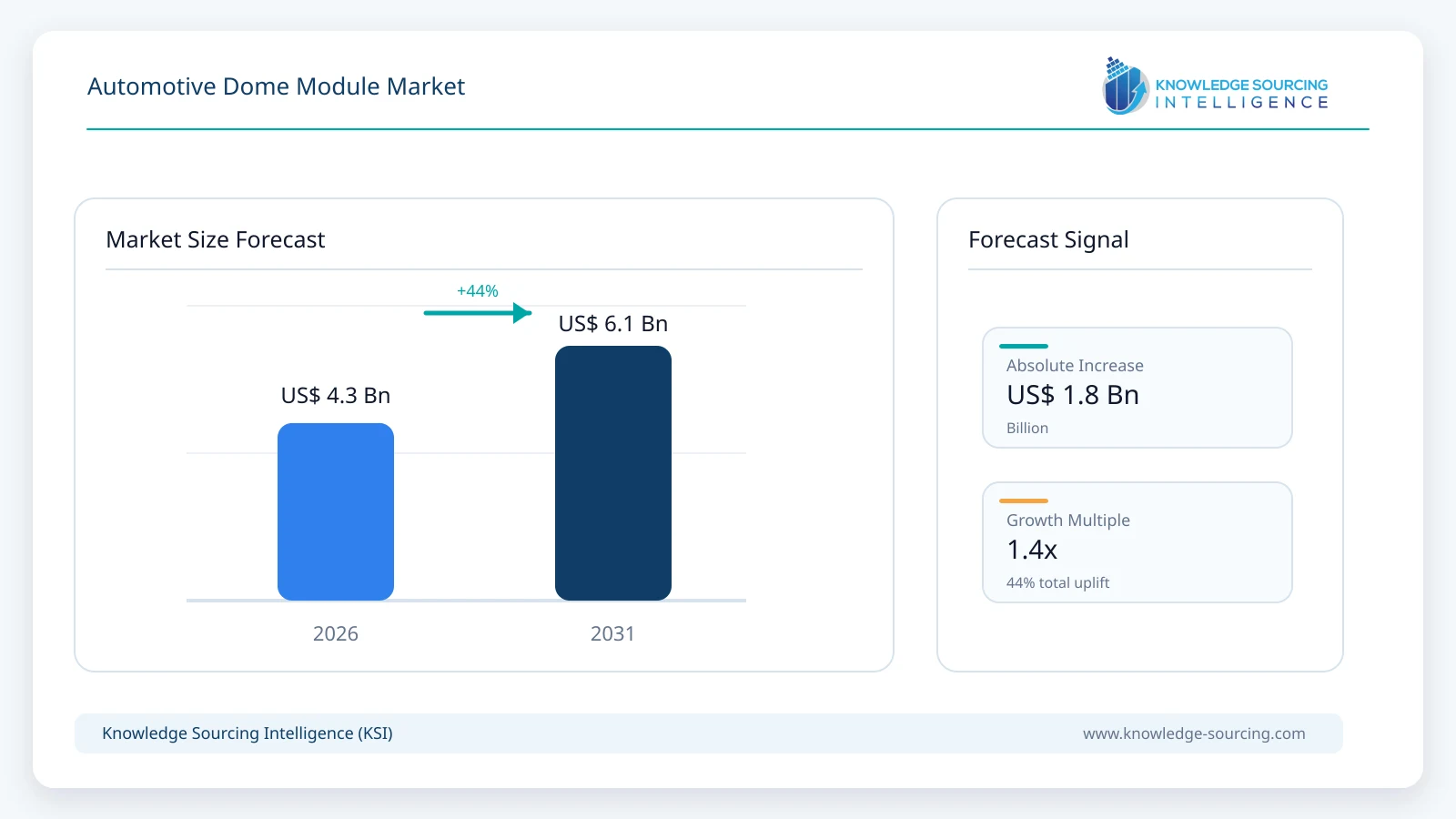
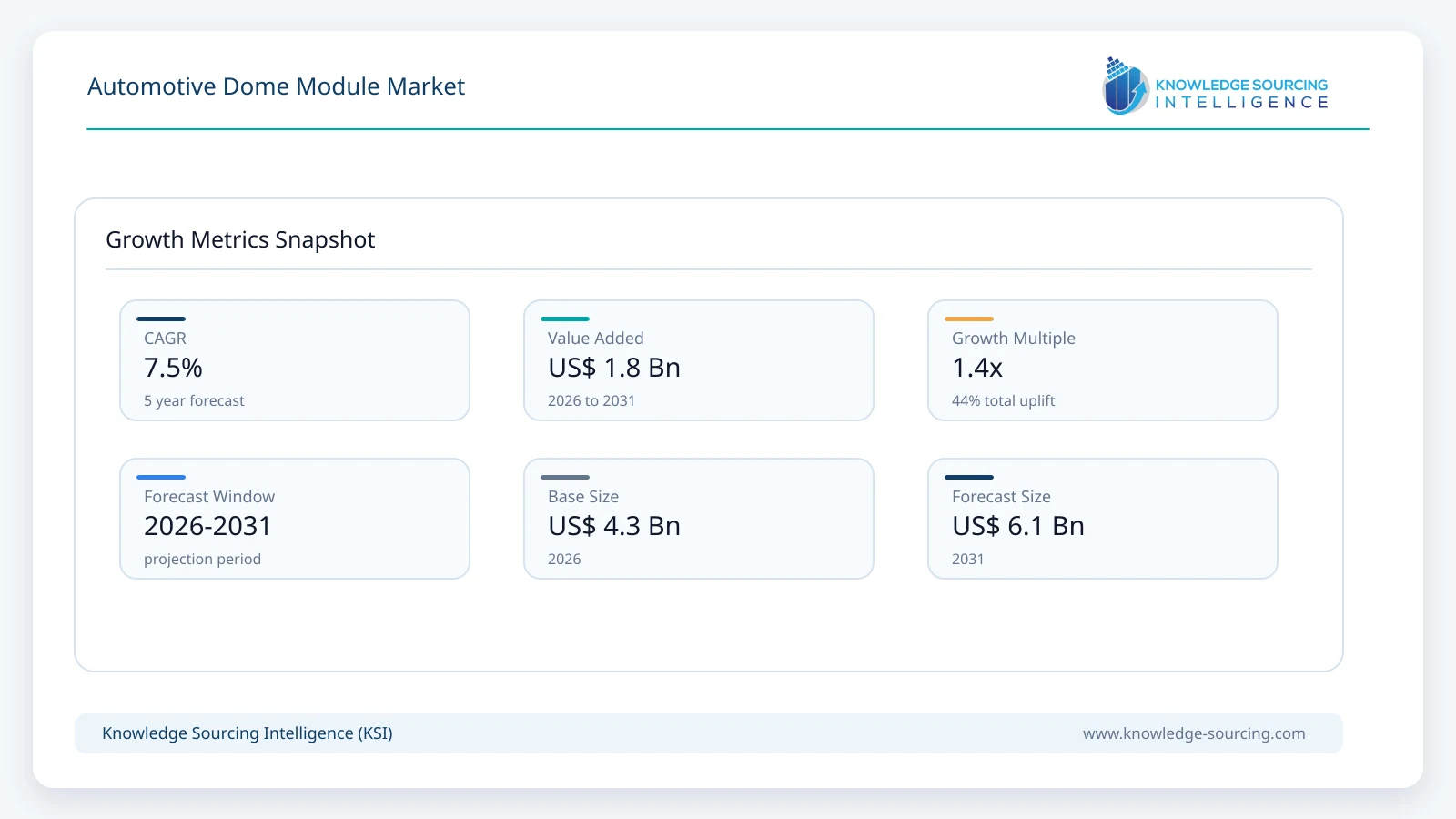
The Automotive Dome Module Market is forecast to grow at a CAGR of 7.5%, reaching USD 6.10 billion in 2031 from USD 4.25 billion in 2026.
Highlights:
- 1Integrated multifunction dome and overhead modules account for approximately 64% of global market value in 2026 because lighting, roof controls, SOS/eCall, microphones and connectivity functions are increasingly packaged in a common assembly.
- 2LED-based functional and ambient lighting represents approximately 91% of 2026 market value, reflecting the near-complete shift away from incandescent roof lamps and the growing use of tunable-white, RGB and animated lighting.
- 3Physical and tactile switches represent approximately 58% of control-interface value in 2026, although capacitive, hidden-surface and hybrid haptic interfaces are gaining share in premium and software-defined cabins.
- 4Dome modules integrating telematics, microphones, alarm or in-cabin sensing account for approximately 46% of 2026 market value as the roof area becomes an electronics and perception node rather than only a lighting location.
- 5Passenger vehicles represent approximately 93% of global market value in 2026 because multifunction overhead consoles are most widely deployed across passenger cars, SUVs, MPVs and premium EV platforms.
- 6Asia Pacific represents approximately 44% of global market value in 2026, supported by the region's scale in passenger-vehicle production and rapid adoption of feature-rich smart-cabin architectures in China, Japan and South Korea.
The market is moving beyond basic roof lamps toward multifunction overhead assemblies that combine lighting, switchgear, SOS/eCall, microphones, roof controls, sensors, and local electronics. Valeo extends the module into electronic fusing and CAN/LIN networking, while FORVIA HELLA combines functional and animated lighting with CabinCAM and electronic-mirror capability.
Value growth is increasingly tied to functional consolidation rather than lighting hardware alone. A roof module already required for reading lights and emergency-call controls can also host anti-theft sensing, occupant-monitoring cameras, radar, intelligent-glass interfaces and roof-zone power distribution, reducing separate housings and wiring. Continental's In2Visible Overhead Console follows the same direction by integrating roof electronics, glass control and in-cabin sensing behind a unified surface.
Market Overview
The dome module occupies a strategically useful roof position, allowing one assembly to combine lighting, sunroof or sunshade controls, SOS/eCall buttons, microphones, alarm sensing and local electronics close to the headliner harness. LEDs remain the universal lighting platform because they offer low power consumption, compact optics and flexible control, while premium systems add tunable-white reading light, RGB effects and animated signatures. FORVIA HELLA demonstrates how these functions are becoming part of the wider cabin experience rather than a stand-alone lamp.
Control, connectivity and perception content are increasing the electronic value of the roof module. Capacitive interfaces, telematics controls and voice microphones can be combined with cameras or radar that benefit from a high central field of view, while Valeo extends the concept into roof-zone power and networking and Continental integrates glass and sensor functions within a common surface. The dome module can therefore serve as a shared mechanical and electrical carrier for several roof-zone functions.
Market Trends
Dome Modules Are Evolving into Roof-Zone Electronics Hubs
Distributed roof functions traditionally used separate switches, small control boards and point-to-point wiring for lamps, sunroofs, microphones and sensors. Zonal E/E architectures create an opportunity to consolidate these functions at the roof. Valeo's dome-module concept includes electronic fusing, CAN connectivity and LIN-master functionality and can operate as a roof-area zone controller, reducing cable routing and duplicated electronics.
Roof-zone consolidation is changing supplier competition because module value increasingly depends on power distribution, networking, software and validation rather than only molding and optics. Suppliers that combine lighting, HMI and body-electronics capability can capture more content while helping OEMs reduce harness weight, connector count and assembly complexity.
Smart and Hidden Surfaces Are Replacing Dense Button Clusters
Roof consoles historically contained clearly separated pushbuttons for lighting, sunroof operation and emergency services. New concepts are moving toward flush surfaces, concealed icons, and capacitive interaction that remain visually quiet until activated. Continental's In2Visible Overhead Console uses surface materials to hide and integrate roof electronics while supporting variant management across different feature levels.
Mechanical switches will remain important because overhead controls must be easy to locate without excessive visual distraction. The likely production direction is therefore hybrid: essential emergency and high-frequency controls retain tactile confirmation, while secondary lighting, glass and personalization functions migrate toward capacitive or hidden-surface interfaces with illumination and haptic feedback.
Interior Lighting Is Becoming Functional, Adaptive and Communicative
LED roof lighting is moving from simple on/off illumination toward adjustable color temperature, segmented reading beams and ambient animation. FORVIA HELLA's overhead-console platform combines functional cabin light with animated ambient lighting and tunable-white reading light, while its 2026 commercial-vehicle work demonstrates how RGB lighting can also communicate warnings and vehicle status.
Adaptive and communicative lighting raises the electronics and software content of the dome module because one LED and control architecture can support welcome sequences, task lighting, rest modes, safety messages, and brand-specific effects. Roof lighting therefore becomes both a comfort feature and a human-machine-interface channel, particularly in premium vehicles and software-defined cabins.
In-Cabin Cameras, Microphones and Radar Are Migrating into the Roof Module
The roof provides a high central field of view and is already wired for lighting and communications, making it a logical location for interior cameras, digital microphones and radar. Valeo lists cameras, microphones and radar among the technologies that can be integrated with its dome module, while FORVIA HELLA's platform can incorporate CabinCAM and additional perception hardware.
Sensor integration increases the commercial value of a common roof assembly because one packaging location can serve voice recognition, eCall, driver and occupant monitoring, child presence, anti-theft sensing and gesture interaction. The challenge is that optical field of view, microphone acoustics, radar transparency and thermal requirements must all be resolved within a compact decorative component.
Panoramic Roofs and Intelligent Glass Are Expanding Roof-Control Content
Panoramic roofs, powered shades and switchable glazing increase the number of roof-area functions that need intuitive control. Continental's In2Visible concept explicitly combines actuator-driven sunroof functions, intelligent-glass control and sensors within one overhead interface, illustrating the convergence between roof mechatronics and cabin HMI.
Panoramic-roof and intelligent-glass functions increase value per vehicle even when the physical dome-module footprint remains similar because the assembly must manage more commands, network communication, and trim variants. Configurable electronics and software-defined controls can therefore allow one hardware platform to serve several roof-option packages and vehicle derivatives.
Segment Analysis
By Product Configuration: Integrated Multifunction Dome and Overhead Modules
Integrated multifunction modules lead the market because modern roof assemblies increasingly combine lighting, reading lamps, SOS/eCall, microphones, sunroof or sunshade controls, alarm functions and local electronics in one unit. Consolidation reduces separate trim pieces and allows OEMs to manage roof functions through one validated assembly. The configuration is especially common in mid-range and premium passenger vehicles where connected services, panoramic roofs and richer ambient-light packages are already present.
Integrated multifunction modules represent approximately USD 2.72 billion in 2026 and could approach USD 4.25 billion by 2031. Growth will outpace simple lamp-only modules as cameras, radar, intelligent-glass controls and zonal electronics move into the roof. Basic dome lamps will remain important in entry vehicles and commercial fleets, but their share of total market value will decline as electronic content rises.
By Lighting Technology: LED Functional and Ambient Lighting
LED technology dominates automotive dome modules because it enables compact optics, low power consumption, long life, and direct electronic control. LEDs support separate map-light beams, soft cabin illumination, dimming, ambient color, animated sequences, and tunable-white functions within the same module architecture. This flexibility makes LED content central to both value engineering and premium differentiation.
LED-based modules account for approximately USD 3.87 billion of 2026 market value and are expected to exceed USD 5.7 billion by 2031. Incremental growth will come less from basic LED conversion and more from higher pixel count, RGB integration, tunable-white reading lights, and software-controlled light scenarios that raise electronics and optical value per module.
By Control Interface: Physical and Tactile Switch Controls
Physical buttons and tactile switches remain the largest interface category because roof controls must be easy to find and operate with minimal visual attention. Emergency-call buttons, reading-light switches and sunroof controls particularly benefit from clear detents, tactile differentiation and predictable activation. Mature switch technology also performs reliably across temperature, vibration and contamination conditions.
Physical and tactile controls account for approximately USD 2.47 billion in 2026. Their absolute value will continue to rise, but share is expected to fall as capacitive, hidden and hybrid surfaces spread across premium and EV interiors. The strongest long-term architecture is likely to combine tactile emergency controls with illuminated capacitive areas for lighting, glass and personalization functions.
By Electronics Integration: Telematics, Microphone and Sensor-Integrated Modules
Sensor- and connectivity-integrated modules are gaining importance as the roof becomes a shared location for microphones, eCall interfaces, alarm sensing, interior cameras and radar. Consolidating these devices with lighting and controls reduces separate housings and can simplify cable routing, while the central roof position provides favorable acoustic and optical coverage for several use cases.
Telematics, microphone and sensor-integrated dome modules represent approximately USD 1.96 billion in 2026 and could approach USD 3.25 billion by 2031 as driver/occupant monitoring and connected services expand. Valeo, FORVIA HELLA and Continental demonstrate different forms of this convergence, although the architecture carries a higher validation burden when safety, telematics, perception and comfort functions depend on one integrated roof assembly.
By Vehicle Type: Passenger Vehicles
Passenger cars, SUVs, crossovers and MPVs dominate dome-module demand because they carry the widest range of roof functions and the highest penetration of panoramic roofs, eCall, hands-free voice, ambient lighting and in-cabin sensing. Premium and upper-mainstream vehicles often use front and rear reading modules, illuminated touch surfaces and integrated roof electronics, materially increasing content per vehicle.
Passenger vehicles generate approximately USD 3.95 billion of market value in 2026 and are expected to exceed USD 5.6 billion by 2031. Commercial vehicles will grow from a smaller base as cab comfort and adaptive interior lighting improve, but passenger platforms will remain the largest value pool because of production scale and faster adoption of smart-cabin features.
Market Drivers
Increasing Functional Consolidation in the Vehicle Roof
OEMs are reducing the number of discrete electronic modules and harness branches as vehicle E/E architectures move toward domain and zonal control. The roof contains lighting, glass actuation, microphones, telematics controls, alarm sensors and increasingly cabin perception, making the dome module a logical aggregation point for these functions.
Roof-function consolidation can reduce connectors, wiring length and assembly operations while creating a single interface between the overhead system and the central vehicle network. The architecture strengthens the business case for higher-value dome modules even as individual lighting or switch functions become less expensive.
Growth of eCall, Voice Interaction and Connected Cabin Services
Emergency-call controls and hands-free microphones are now common in many new vehicles, and voice assistants are increasing microphone performance requirements. The dome module provides an advantageous acoustic location near front occupants and can house the visible SOS interface without adding another trim component.
As connected services expand, the roof module can support microphone arrays, telematics switches, status lighting and local signal conditioning. The added electronics increase average selling value and encourage OEMs to source the module as a complete tested subsystem rather than separate lamp, switch and microphone parts.
Expansion of Panoramic Roofs, Powered Shades and Intelligent Glass
Large glass roofs and powered sunshades have moved from premium cars into mainstream SUVs and EVs, increasing the need for compact, intuitive roof controls. Smart or switchable glazing adds another control layer because occupants may adjust opacity, shading, or segmented glass states in addition to physical roof movement.
The dome module is the natural HMI location for these functions. As roof systems become more complex, module suppliers can capture additional switch, touch, control-electronics, and network content, especially when one configurable design supports several roof-option packages.
Rising Demand for Smart Interior Lighting and Personalization
Interior lighting has become an important part of perceived cabin quality and brand identity. Consumers increasingly expect configurable ambient light, reading-light precision, welcome effects, and coordinated lighting across doors, instrument panels, and roof modules. Dome modules provide the primary functional overhead light and can act as one node in a synchronized interior-lighting system.
Dynamic LEDs and software control increase content without requiring large mechanical changes. This favors suppliers with optics, electronics, and software capability and helps move dome modules from commodity lamp assemblies toward differentiated smart-interior components.
Integration of Driver and Occupant Monitoring Sensors
Driver monitoring, occupant monitoring and child-presence functions increase demand for well-positioned interior sensors. The roof area offers a broad cabin view and can support cameras, radar or microphone-based sensing while remaining integrated with existing trim and power connections.
Embedding perception hardware into the dome module can reduce visible sensor clutter and simplify installation. As NCAP and regulatory programs expand monitoring requirements, the roof module can capture incremental value as the mechanical and electrical carrier for safety-related sensing.
Market Restraints
High Cost Pressure and Feature-Variant Complexity
Dome modules are produced in high volumes and face aggressive OEM cost targets even as feature content increases. A single vehicle line may require multiple variants for sunroof, SOS, microphone count, ambient-light level, headliner color, and regional telematics requirements, creating tooling, inventory, and validation complexity.
Suppliers must therefore design common electronics and housings that can support option variation without multiplying part numbers. Hidden-surface and software-configurable controls can reduce visible variation, but they add electronics and development cost that may be difficult to justify in entry-level vehicles.
Tight Roof Packaging, Head-Impact and Thermal Constraints
The overhead area is crowded by headliner structure, airbags, sunroof mechanisms, glass frames, microphones, cameras, wiring and sometimes electronic mirrors. The dome module must fit within limited depth while meeting occupant head-impact requirements and maintaining acceptable surface temperature.
Adding processors, radar, cameras or high-output LEDs increases thermal load and may require heat spreading or careful duty-cycle management. Packaging limitations can therefore slow the migration of high-compute functions into the roof and favor architectures that place heavy processing in a central computer.
Reliability Requirements for High-Touch Controls and Moving Roof Functions
Reading-light switches, sunroof controls and SOS buttons are used repeatedly over the life of the vehicle and must remain consistent despite vibration, dust, temperature cycling and mechanical abuse. Capacitive interfaces introduce different failure modes because unintended activation, moisture or gloves can affect operation.
Functional concentration increases failure consequence because a defect in one integrated module can affect lighting, roof controls, telematics or other unrelated functions at the same time. OEMs therefore require extensive durability, EMC, environmental and software validation, raising development cost and extending launch cycles for highly integrated roof assemblies.
Sensor Field-of-View, Acoustic and EMC Integration Challenges
Cameras require an unobstructed field of view, microphones need controlled acoustic paths and radar requires materials with suitable RF transparency. At the same time, the module contains LEDs, switching electronics, network transceivers and power circuitry that can generate electromagnetic interference.
Combining all of these functions in one decorative assembly creates cross-domain engineering complexity. A trim change or headliner material can affect camera visibility, microphone response or radar performance, which means the dome module often requires vehicle-specific calibration rather than simple carryover.
Serviceability and Single-Point Failure Risk
Functional consolidation reduces part count but can raise replacement cost. If the lamp, microphone, touch surface or roof-control electronics fail inside one integrated assembly, service procedures may require replacement of the complete module rather than a low-cost individual component.
Single-point failure risk becomes more important when eCall, anti-theft or safety-monitoring functions share the same housing. OEMs must balance integration with diagnostic isolation, replaceable subcomponents and robust degradation strategies so a convenience-function fault does not disable a critical service.
Regional Outlook
Asia Pacific
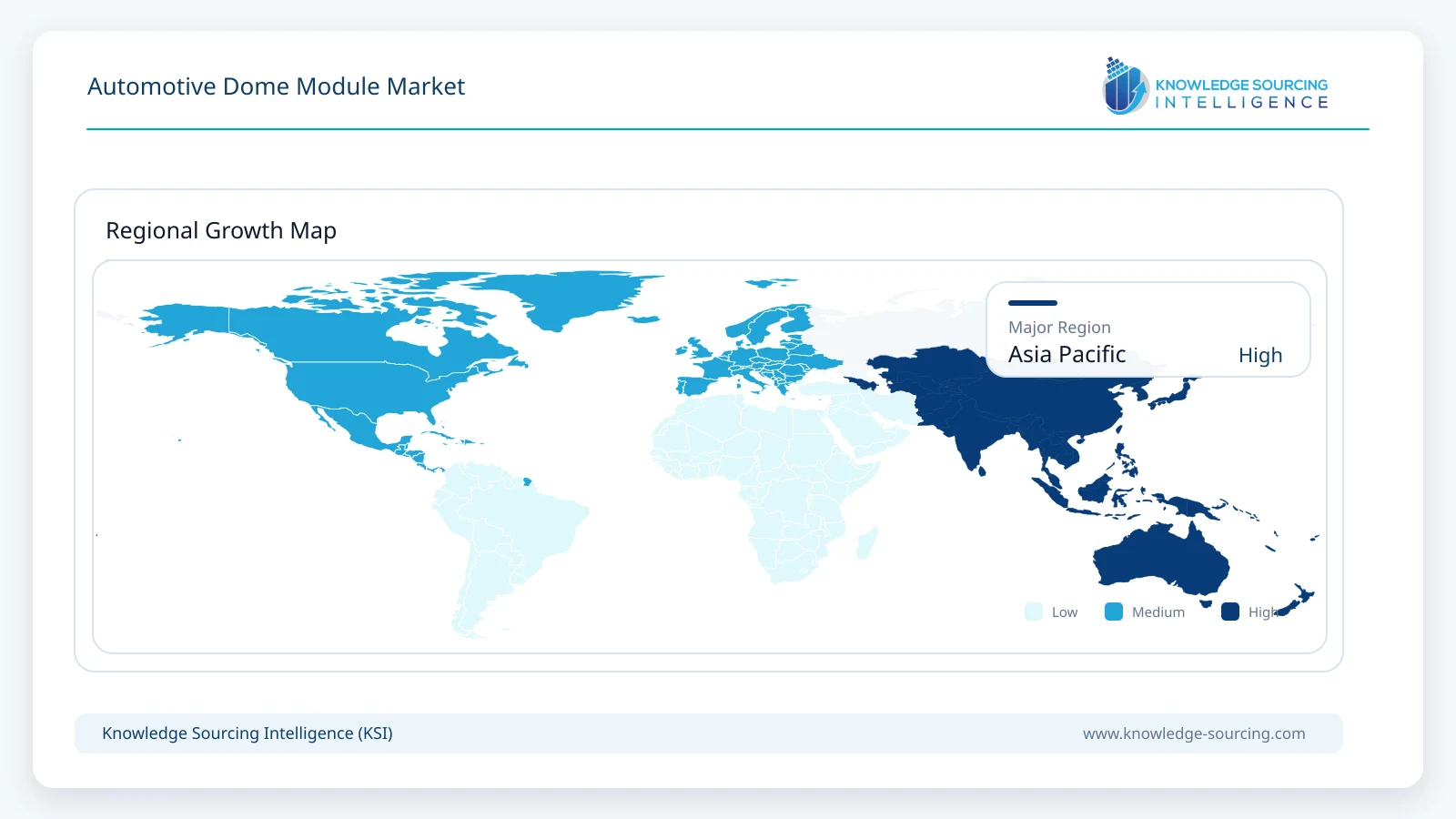
Asia Pacific is the largest regional automotive dome module market in 2026, supported by the scale of passenger-vehicle production in China, Japan, South Korea and India. High-volume mainstream vehicles sustain demand for conventional overhead lamps and switches, while Chinese EV and smart-cabin platforms are accelerating adoption of touch surfaces, panoramic-roof controls, voice interaction and integrated cabin sensing.
Asia Pacific also has a broad roof-electronics and interior-lighting supplier base. LS Automotive mass-produces overhead-console lamps and is developing occupant-recognition and matrix-lighting functions, while major Korean, Japanese and global lighting suppliers support local OEM programs; China is especially important for fast-cycle smart-cabin development where overhead controls increasingly participate in coordinated lighting and software-defined HMI strategies.
Growth through 2031 will be driven by rising content per vehicle more than by unit production alone. Panoramic roofs, intelligent glass, advanced ambient lighting and integrated microphones or sensors will move from premium EVs toward higher-volume segments, increasing average dome-module value across the region.
Europe
Europe is a high-value dome module market because premium vehicle production, eCall penetration, panoramic-roof adoption and advanced interior-lighting systems create relatively high electronic content per vehicle. European suppliers including Valeo and FORVIA HELLA have positioned the overhead module as an integrated platform for lighting, control, sensing and local electronics rather than a stand-alone lamp.
European suppliers are also shaping higher-integration roof architectures. Valeo's dome module can function as a roof-zone controller with power and network integration, FORVIA HELLA combines dynamic light, tunable reading functions, CabinCAM and electronic-mirror capability, and Continental's In2Visible concept adds hidden-surface controls, intelligent-glass interfaces and in-cabin sensors.
European market growth will be more content-led than volume-led. Dynamic interior lighting, driver and occupant monitoring, zonal E/E architectures and increasingly sophisticated glass roofs will support higher module value even if regional vehicle production expands slowly.
Competitive Landscape
The automotive dome module market combines interior-lighting specialists, body-electronics suppliers, HMI companies and large integrated-interior manufacturers. Valeo and FORVIA HELLA have particularly broad positions because they combine optics, interior lighting, electronics, sensing and software. Valeo extends the module into power distribution and roof-zone control, while FORVIA HELLA integrates functional and ambient lighting with cameras and electronic-mirror capability.
AUMOVIO, through the former Continental automotive portfolio, represents the smart-surface and roof-electronics direction with the In2Visible Overhead Console. LS Automotive competes through high-volume overhead-console lamps, switches and emerging cabin-camera/radar integration. Antolin brings deep expertise in headliners, overhead systems and lighting, giving it an advantage where the dome module is engineered as part of the complete roof trim system.
Asian lighting and electronics suppliers including Hyundai Mobis, Toyoda Gosei, Stanley Electric and Koito remain important through OEM relationships, manufacturing scale and lighting competence. Marelli and Preh add broader smart-interior and HMI capabilities that can support integrated controls and illuminated surfaces even where the dome module is not marketed as a stand-alone product family.
Competitive advantage is shifting from lamp cost toward integration capability. Suppliers able to provide configurable electronics, optical systems, tactile and capacitive HMI, microphones, sensors and vehicle-network interfaces in one validated module can capture higher content and reduce OEM integration effort. Manufacturing quality, variant management and vehicle-specific calibration remain critical because roof modules often differ by trim, glass-roof configuration and regional telematics package.
Recent Developments
3 September 2026: FORVIA HELLA presented adaptive RGB interior-lighting technology for commercial vehicles at IAA Transportation 2026, combining comfort, visual communication and safety-related functions within modular cabin-lighting architectures.
20 January 2026: Valeo announced a major premium-automaker interior-lighting program using TactoTek IMSE technology, moving integrated lighting and electronics into a thin, unified smart structure designed for high-volume production.
20 June 2025: Valeo updated its dome-module portfolio around a multifunctional roof hub incorporating interior and ambient lighting, electronic fusing, CAN/LIN networking, anti-theft functionality and optional camera, microphone and radar integration.
24 April 2025: FORVIA presented Saphir at Auto Shanghai 2025, extending its annual integrated-interior concept program and emphasizing software, lighting, surface integration and holistic cabin HMI.
15 April 2025: Continental announced the debut of the In2Visible Overhead Console at Auto Shanghai, integrating sunroof actuation, intelligent-glass control, roof electronics and in-cabin sensors behind a unified surface.
2025: LS Automotive's technology disclosures highlighted mass production of overhead console lamps alongside development of occupant-recognition lighting and occupant-position-based matrix light distribution, linking roof lighting with cabin sensing.
Market Outlook
The automotive dome module market is expected to expand from approximately USD 4.250 billion in 2026 to about USD 6.101 billion by 2031. Basic LED dome and map lights will remain universal, but most incremental value will come from multifunction overhead consoles that combine lighting, roof controls, telematics, microphones, sensors, and local electronics.
Roof-zone integration will be the largest structural change through 2031 as electronic fusing, local networking and configurable software allow one dome module to replace several distributed switches and controllers while supporting cameras, radar, intelligent glass and dynamic lighting. Smart surfaces will reduce visible button density, but tactile controls will remain important for emergency and high-frequency functions.
Asia Pacific will remain the largest regional volume and value pool, while Europe will continue to lead high-content integration. Competitive advantage will depend on platform scalability, optical quality, touch and switch usability, sensor integration, EMC performance, thermal management, and the ability to reuse one module architecture across multiple roof and trim configurations.
Automotive Dome Module Market Scope:
| Report Metric | Details |
|---|---|
| Total Market Size in 2026 | USD 4.25 billion |
| Total Market Size in 2031 | USD 6.10 billion |
| Forecast Unit | USD Billion |
| Growth Rate | 7.5% |
| Study Period | 2021 to 2031 |
| Historical Data | 2021 to 2024 |
| Base Year | 2025 |
| Forecast Period | 2026 – 2031 |
| Segmentation | Product Configuration, Lighting Technology, Control Interface, Integrated Electronics |
| Companies |
|
Market Segmentation
By Product Configuration
Integrated Multifunction Dome and Overhead Modules
Lighting-Dominant Dome and Map-Light Modules
Sensor and Monitoring-Integrated Roof Modules
Roof-Zone Controller Integrated Modules
By Lighting Technology
Standard LED Functional Lighting
RGB and Dynamic Ambient Lighting
Tunable-White and Adaptive Reading Lighting
Smart Surface and Backlit Graphic Lighting
By Control Interface
Physical Buttons and Tactile Switches
Capacitive Touch and Hidden-Surface Controls
Hybrid Haptic and Touch Interfaces
Gesture, Voice and Context-Aware Interaction
By Integrated Electronics
Lighting and Basic Roof Control
SOS/eCall and Telematics Controls
Microphone and Voice Interface
Sunroof, Sunshade and Intelligent-Glass Control
Camera, Radar and Cabin-Sensing Integration
Zone Control, Power Distribution and Network Functions
By Vehicle Type
Passenger Vehicles
Light Commercial Vehicles
Medium and Heavy Commercial Vehicles
Buses, Coaches and Special Vehicles
By Geography
North America
United States
Canada
Mexico
South America
Brazil
Argentina
Others
Europe
Germany
United Kingdom
France
Italy
Spain
Others
Middle East and Africa
Saudi Arabia
UAE
South Africa
Others
Asia Pacific
China
Japan
South Korea
India
Indonesia
Thailand
Others
Table of Contents
1. INTRODUCTION
1.1. Market Overview
1.2. Market Definition
1.3. Scope of the Study
1.4. Market Segmentation
1.5. Currency
1.6. Assumptions
1.7. Base and Forecast Years
1.8. Key Benefits to Stakeholders
2. RESEARCH METHODOLOGY
2.1. Research Design
2.2. Secondary Research
2.3. Primary Research
2.4. Market Estimation
2.5. Segment Modelling
2.6. Data Triangulation and Validation
3. EXECUTIVE SUMMARY
3.1. Key Findings
3.2. Automotive Dome Module Market Size, 2026-2031
3.3. Product Configuration Outlook
3.4. Lighting Technology Outlook
3.5. Control Interface Outlook
3.6. Electronics Integration Outlook
3.7. Vehicle Type Outlook
3.8. Regional Opportunity Summary
4. MARKET DYNAMICS
4.1. Market Drivers
4.1.1. Increasing Functional Consolidation in the Vehicle Roof
4.1.2. Growth of eCall, Voice Interaction and Connected Cabin Services
4.1.3. Expansion of Panoramic Roofs, Powered Shades and Intelligent Glass
4.1.4. Rising Demand for Smart Interior Lighting and Personalization
4.1.5. Integration of Driver and Occupant Monitoring Sensors
4.2. Market Restraints
4.2.1. High Cost Pressure and Feature-Variant Complexity
4.2.2. Tight Roof Packaging, Head-Impact and Thermal Constraints
4.2.3. Reliability Requirements for High-Touch Controls and Moving Roof Functions
4.2.4. Sensor Field-of-View, Acoustic and EMC Integration Challenges
4.2.5. Serviceability and Single-Point Failure Risk
4.3. Market Opportunities
4.4. Porter's Five Forces Analysis
4.5. Industry Value Chain Analysis
4.6. Dome-Module Cost, Content and Platform Economics
4.7. Roof Electronics, eCall, EMC and Interior-Safety Requirements
5. TECHNOLOGY OUTLOOK
5.1. LED Dome, Map and Reading-Light Optics
5.2. RGB and Dynamic Ambient Roof Lighting
5.3. Tunable-White and Glare-Controlled Reading Light
5.4. Mechanical, Capacitive and Hybrid Roof HMI
5.5. SOS/eCall and Telematics Control Integration
5.6. MEMS and Digital Microphone Integration
5.7. Sunroof, Sunshade and Intelligent-Glass Controls
5.8. Cabin Camera and Occupant-Monitoring Integration
5.9. 60 GHz Radar and Interior Presence Sensing
5.10. Electronic Fusing, CAN/LIN and Roof-Zone Control
5.11. Hidden Surfaces, In-Mold Electronics and Backlighting
5.12. Thermal, EMC, Acoustic and Optical Validation
6. AUTOMOTIVE DOME MODULE MARKET BY PRODUCT CONFIGURATION
6.1. Introduction
6.2. Integrated Multifunction Dome and Overhead Modules
6.3. Lighting-Dominant Dome and Map-Light Modules
6.4. Sensor and Monitoring-Integrated Roof Modules
6.5. Roof-Zone Controller Integrated Modules
7. AUTOMOTIVE DOME MODULE MARKET BY LIGHTING TECHNOLOGY
7.1. Introduction
7.2. Standard LED Functional Lighting
7.3. RGB and Dynamic Ambient Lighting
7.4. Tunable-White and Adaptive Reading Lighting
7.5. Smart Surface and Backlit Graphic Lighting
8. AUTOMOTIVE DOME MODULE MARKET BY CONTROL INTERFACE
8.1. Introduction
8.2. Physical Buttons and Tactile Switches
8.3. Capacitive Touch and Hidden-Surface Controls
8.4. Hybrid Haptic and Touch Interfaces
8.5. Gesture, Voice and Context-Aware Interaction
9. AUTOMOTIVE DOME MODULE MARKET BY INTEGRATED ELECTRONICS
9.1. Introduction
9.2. Lighting and Basic Roof Control
9.3. SOS/eCall and Telematics Controls
9.4. Microphone and Voice Interface
9.5. Sunroof, Sunshade and Intelligent-Glass Control
9.6. Camera, Radar and Cabin-Sensing Integration
9.7. Zone Control, Power Distribution and Network Functions
10. AUTOMOTIVE DOME MODULE MARKET BY VEHICLE TYPE
10.1. Introduction
10.2. Passenger Vehicles
10.3. Light Commercial Vehicles
10.4. Medium and Heavy Commercial Vehicles
10.5. Buses, Coaches and Special Vehicles
11. AUTOMOTIVE DOME MODULE MARKET BY GEOGRAPHY
11.1. North America
11.1.1. United States
11.1.2. Canada
11.1.3. Mexico
11.2. South America
11.2.1. Brazil
11.2.2. Argentina
11.2.3. Others
11.3. Europe
11.3.1. Germany
11.3.2. United Kingdom
11.3.3. France
11.3.4. Italy
11.3.5. Spain
11.3.6. Others
11.4. Middle East and Africa
11.4.1. Saudi Arabia
11.4.2. UAE
11.4.3. South Africa
11.4.4. Others
11.5. Asia Pacific
11.5.1. China
11.5.2. Japan
11.5.3. South Korea
11.5.4. India
11.5.5. Indonesia
11.5.6. Thailand
11.5.7. Others
12. COMPETITIVE ENVIRONMENT AND ANALYSIS
12.1. Major Players and Strategy Analysis
12.2. Market Share Analysis
12.3. Dome Module Functional-Content Benchmarking
12.4. Conventional Dome Lamp versus Integrated Overhead Console Comparison
12.5. Physical Switch versus Hidden-Surface HMI Benchmarking
12.6. Lighting, Telematics and Sensor-Integration Benchmarking
12.7. Roof-Zone Architecture and Platform Scalability
12.8. Competitive Dashboard
13. COMPANY PROFILES
13.1. Valeo
13.2. FORVIA HELLA
13.3. AUMOVIO SE
13.4. Antolin
13.5. LS Automotive Technologies
13.6. Marelli
13.7. Hyundai Mobis
13.8. Toyoda Gosei Co., Ltd.
13.9. Stanley Electric Co., Ltd.
13.10. Koito Manufacturing Co., Ltd.
13.11. Preh GmbH
13.12. Motherson
14. APPENDIX
14.1. Currency
14.2. Assumptions
14.3. Base and Forecast Years Timeline
14.4. Key Benefits for Stakeholders
14.5. Research Methodology
14.6. Abbreviations
14.7. Data Sources
Navigate
Trusted by the world's leading organizations











