
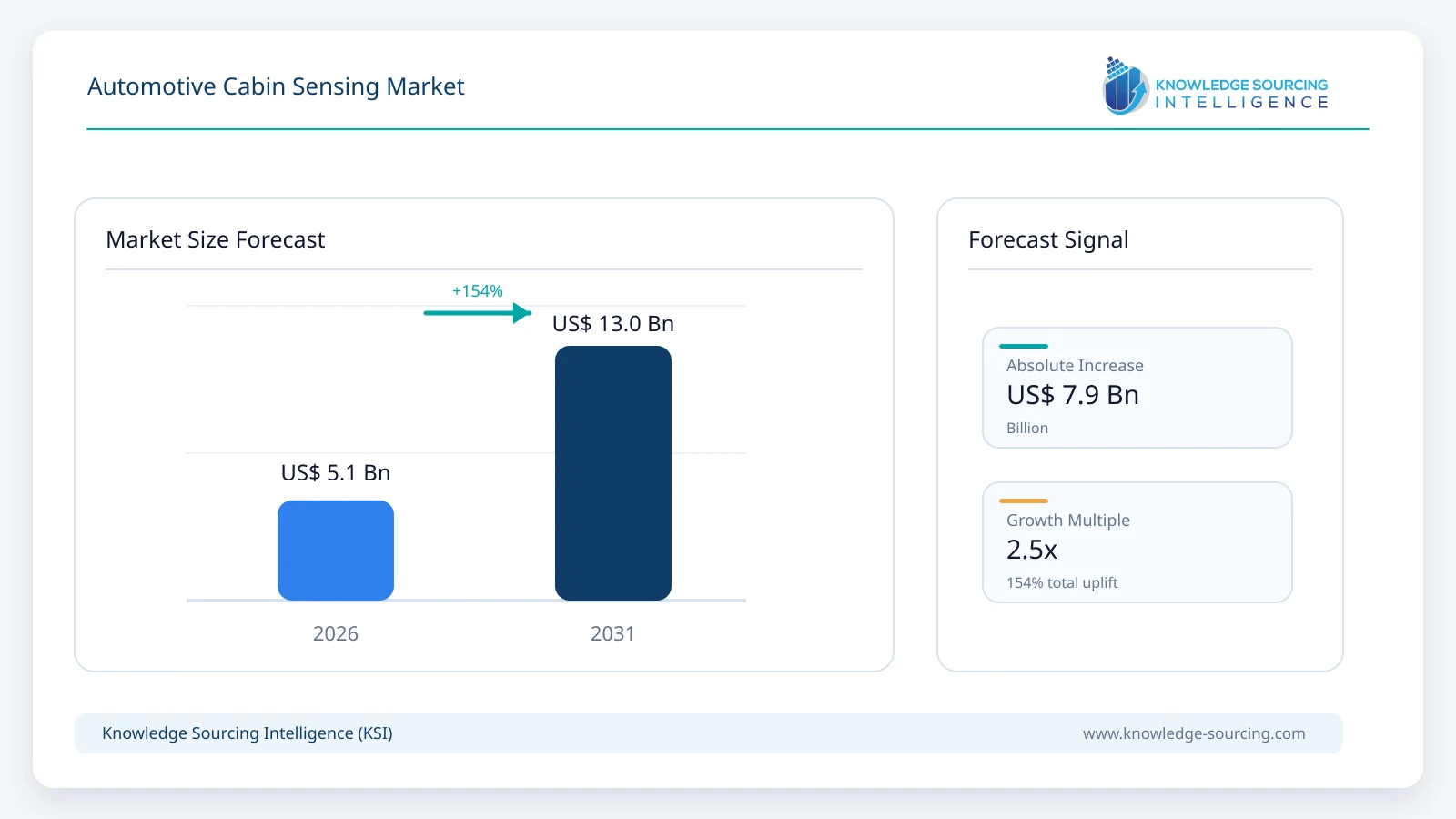
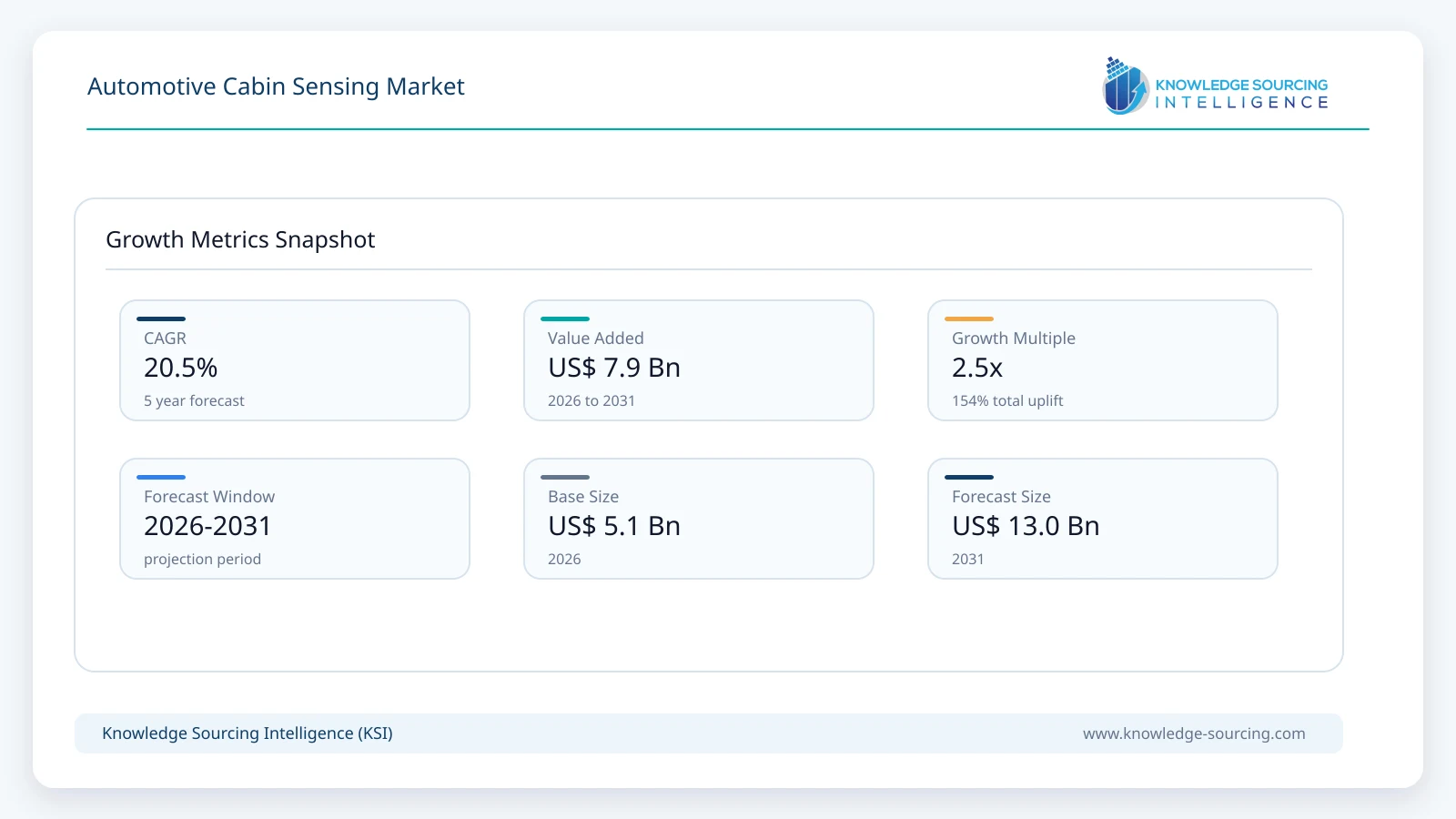
The automotive cabin sensing market is estimated at approximately USD 5.10 billion in 2026 and is projected to reach about USD 12.96 billion by 2031, representing a CAGR of 20.5% during the forecast period.
Highlights:
- 1Camera-based optical sensing accounts for approximately 53% of global market value in 2026 because driver and occupant cameras provide the richest information for gaze, posture, identity, activity and object recognition.
- 2Driver state, attention and behavior sensing represents approximately 40% of market value in 2026, reflecting the maturity of driver monitoring and the regulatory push toward distraction and drowsiness detection.
- 3Safety and regulatory applications account for approximately 52% of 2026 market value as OEMs deploy sensing for driver attention, child presence, occupant classification, seat-belt reminders and adaptive passive safety.
- 4Integrated DMS/OMS/ICMS architectures represent approximately 63% of market value in 2026 as automakers increasingly share cameras, radar, compute and software across multiple interior-sensing functions.
- 5Passenger vehicles account for approximately 87% of global market value in 2026 due to large production volumes and rapid adoption of in-cabin cameras and occupant-sensing features across passenger-car platforms.
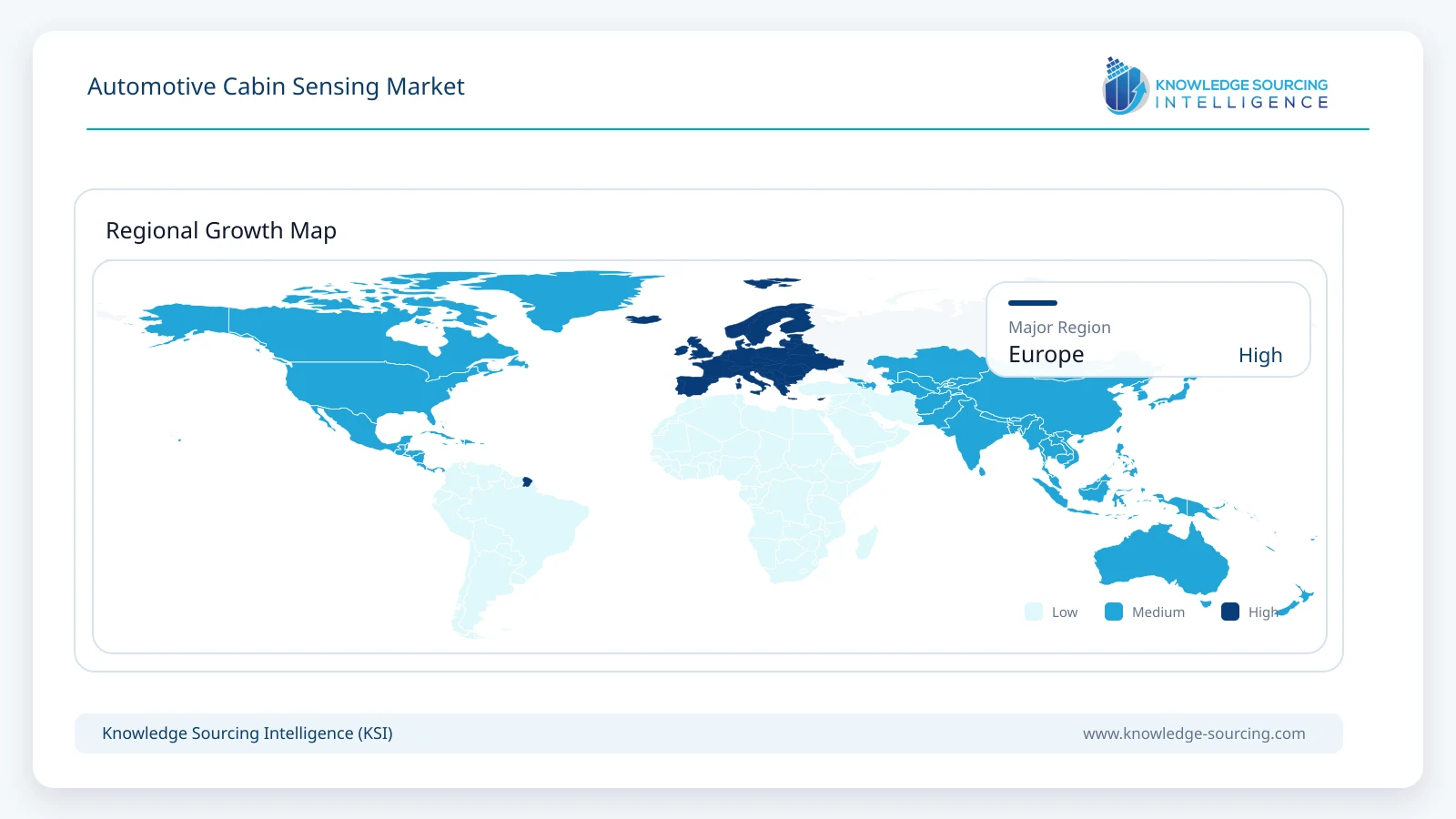
- 6Europe represents approximately 37% of global market value in 2026, supported by the EU General Safety Regulation, Euro NCAP requirements and strong premium-vehicle adoption of driver and occupant monitoring.
Cabin sensing is expanding from driver-focused camera monitoring toward whole-cabin perception that combines vision, radar, depth and contact inputs to determine who is present, where occupants are positioned, how they are behaving and whether a safety, restraint or automated-driving response is required.
Commercial deployment is moving rapidly into production as Smart Eye expands mirror-integrated DMS and OMS programs, Gentex scales mirror-based in-cabin monitoring in Europe, Valeo and Seeing Machines integrate driver and occupant perception, NOVELIC moves 60 GHz cabin radar into production and Infineon supports radar and 3D Time-of-Flight architectures for child presence, occupancy, vital signs and gesture functions. The same sensing stack can increasingly support distraction detection, child presence, seat-belt reminders, adaptive restraints, passenger activity recognition, biometric authentication, personalization and health monitoring, making centralized compute and sensor fusion important sources of system value beyond any single application.
Market Overview
Cabin sensing is becoming a foundational layer of the software-defined interior because driver, passenger and object context can now be shared across safety, restraint, comfort, security and HMI functions. Driver monitoring began with gaze, eyelid and head-pose analysis, but production architectures increasingly extend perception to all occupants, rear seats, footwells and objects, creating a continuous view of the complete cabin rather than a driver-only sensing channel.
Camera-based sensing remains the principal technology because RGB, near-infrared and RGB-IR imagers can extract high-information signals for face, gaze, posture, seat-belt use, mobile-phone activity and passenger behavior from common hardware. Wider-field occupant cameras extend coverage beyond the driver, while mirror-integrated and under-display placements help OEMs improve field of view and styling without adding conspicuous sensor housings.
Radar and three-dimensional sensing strengthen cabin perception where optical information alone is insufficient. 60 GHz mmWave radar can detect breathing, presence and occupancy through blankets or partial occlusion, while Time-of-Flight, structured-light and passive-depth systems provide geometric information for out-of-position detection, adaptive restraints, gesture recognition and full-body tracking. Infineon and NOVELIC illustrate the radar route, while depth technologies are increasingly used to improve body-position and restraint context.
Fused interior perception is the long-term architecture because camera, radar, depth, seat sensors and vehicle data can be processed through common software to generate one consistent digital representation of the cabin. A shared perception layer allows the same hardware base to support regulatory safety, automated-driving handover, personalization, health, security and intelligent-cabin functions, increasing software value and reducing the need for isolated sensing systems.
Market Trends
Camera and Radar Fusion Is Replacing Single-Sensor Interior Monitoring
Camera-radar fusion is gaining importance because visual sensors provide semantic detail on posture, gaze and objects, while radar preserves life-presence and micro-motion detection in darkness, under coverings and through partial occlusion. Combining the modalities improves confidence in occupant localization, child presence and vital-sign detection and reduces dependence on the failure modes of a single sensor.
Production-oriented implementations already reflect this convergence: Bosch combines occupant-monitoring cameras with cabin radar, while Infineon positions radar and 3D ToF as complementary elements of in-cabin monitoring. As Euro NCAP and OEM requirements place greater emphasis on reliable occupant and child detection across difficult cabin conditions, multi-sensor fusion should capture a larger share of higher-content architectures.
60 GHz Radar Is Expanding from Child Presence into Whole-Cabin Sensing
Automotive 60 GHz radar is moving beyond single child-presence functions toward seat occupancy, adult-versus-child classification, vital signs, intrusion detection and gesture sensing. One radar module can cover the full cabin without requiring direct line of sight.
NOVELIC's ACAM production program and Infineon's integrated 60 GHz platform illustrate how radar economics improve when one installation supports child presence, seat occupancy, vital signs, intrusion detection and other cabin functions. Spreading hardware and validation cost across several applications makes radar more competitive than treating it as a single-purpose child-presence sensor.
Mirror-Integrated and Under-Display Cameras Are Solving Packaging Constraints
OEMs increasingly want interior cameras placed in positions that provide strong geometry without disrupting cockpit design. Rear-view mirrors and instrument clusters are becoming important integration points because they offer central or driver-facing views with limited visible hardware.
Smart Eye's mirror-integrated DMS/OMS program and its under-display demonstrations with Alps Alpine and Visteon show that camera location is becoming part of the vehicle's cockpit architecture rather than an afterthought. OEMs can preserve styling while maintaining direct driver geometry and wider cabin visibility, which improves reuse of one sensing concept across multiple vehicle derivatives.
Occupant Sensing Is Becoming an Input to Adaptive Passive Safety
New sensing systems identify occupant position, body posture, child seats and seat-belt use so airbags and restraints can respond more appropriately. 3D sensing and full-body perception are particularly relevant when occupants recline, move or adopt non-standard postures.
Adaptive-restraint applications are becoming more credible as Smart Eye and Airy3D demonstrate single-sensor 3D body-position estimation and Bosch links occupant classification and localization with seat-belt reminders and automatic airbag suppression. The commercial value comes from allowing restraint logic to respond to real occupant geometry rather than relying only on fixed seat assumptions or basic weight sensing.
Centralized Compute Is Increasing Sensor Reuse across Cabin Domains
Interior-sensing functions are increasingly consolidated into central cockpit or vehicle computers instead of using separate ECUs for every camera or radar. This allows one sensing stack to support safety, personalization, authentication, wellness and HMI functions.
Centralized processing can lower duplicated hardware cost and simplify software upgrades because several cabin functions share one compute environment, but it also makes common data models, privacy protection and deterministic separation between safety-critical and convenience applications more important. Platform scalability therefore depends as much on middleware and system architecture as on the sensing hardware itself.
Segment Analysis
By Sensor Technology: Camera-Based Optical Sensing
Camera-based optical sensing is projected to generate approximately USD 5.96 billion of market value by 2031. Growth will be driven by wider deployment of DMS and OMS cameras, higher-resolution imagers, RGB-IR architectures and improved integration in mirrors, displays and roof modules.
Camera-based optical sensing should remain the largest technology pool because one imaging stack can support gaze, identity, posture, activity and object recognition across both driver and passenger applications. Radar and depth sensing are nevertheless expected to gain share where optical line-of-sight is unreliable or where precise three-dimensional geometry materially improves occupant classification and restraint decisions.
By Sensing Function: Driver State, Attention and Behavior Sensing
Driver state, attention and behavior sensing is projected to generate approximately USD 4.53 billion of market value by 2031. The function includes gaze, distraction, drowsiness, head pose, phone use, impairment indicators and readiness to resume manual control.
Regulatory deployment creates the largest installed base for driver-state sensing, while higher levels of automation increase the value of continuous attention and takeover-readiness assessment beyond basic compliance. The same camera and perception software can therefore support distraction, drowsiness and readiness functions across several ADAS operating states rather than remaining a single-purpose warning system.
By Application: Safety and Regulatory Sensing
Safety and regulatory applications are projected to generate approximately USD 6.22 billion of market value by 2031. The category includes distraction and drowsiness detection, child presence, occupant classification, seat-belt reminder support, adaptive restraints and post-crash occupant information.
Safety and regulatory sensing should remain the largest application pool because regulation and consumer-test protocols create direct OEM deployment requirements for driver attention, child presence, occupant classification and restraint context. Once the hardware is installed for these mandatory or rating-driven functions, comfort and personalization software can be layered onto the same sensing stack at a lower incremental cost.
By System Architecture: Integrated DMS/OMS/ICMS Architectures
Integrated DMS/OMS/ICMS architectures are projected to generate approximately USD 8.81 billion of market value by 2031. These systems share cameras, radar, compute and perception software across driver and full-cabin monitoring instead of using independent subsystems.
Integrated DMS/OMS/ICMS architectures improve economics by combining driver attention, passenger position, occupancy and other cabin states within one perception model instead of validating separate sensing stacks for each function. Centralized processing should reinforce this architecture through 2031 by allowing common cameras, radar and software to support multiple safety and user-experience domains.
By Vehicle Type: Passenger Vehicles
Passenger vehicles are projected to generate approximately USD 10.88 billion of cabin-sensing market value by 2031. Regulatory requirements, large production volumes and rapid digital-cockpit adoption make passenger cars the principal commercialization channel for camera, radar and depth sensing.
Commercial vehicles will remain important for driver monitoring and fleet safety, while robotaxi and shuttle platforms can support higher cabin-sensing content per vehicle because operators need full-cabin occupancy, security and passenger-state information without a conventional driver present. Passenger vehicles nevertheless retain the dominant value pool because regulatory coverage and annual production volumes are materially larger.
Market Drivers
Mandatory Driver Monitoring and Expanding Euro NCAP Interior-Sensing Requirements
The EU General Safety Regulation and Euro NCAP protocols are accelerating adoption of direct driver and occupant sensing. Driver distraction warning is now mandatory across new EU vehicle types, while consumer testing increasingly rewards child-presence detection and more sophisticated occupant-state information.
Mandatory driver and occupant monitoring requirements create a broad installed hardware base that can later support comfort, personalization and health functions through additional software. Regulatory deployment therefore improves the economics of higher-quality cameras, illumination, radar and centralized perception by spreading their value across both compliance and non-safety features.
Growing Demand for Child Presence, Occupancy and Adaptive Restraint Sensing
Cabin sensing is increasingly required to determine whether a child, adult or object is present and how occupants are positioned. Radar and 3D sensing can improve detection in rear seats, footwells and covered conditions where conventional weight sensors or cameras may be less robust.
More accurate child, occupant and body-position data improve seat-belt reminders, airbag suppression, restraint deployment and post-crash response because the vehicle can distinguish who is present and how that person is positioned. This shifts cabin sensing from simple occupancy confirmation toward context that directly influences passive-safety decisions.
Higher Levels of Driver Assistance and Automated Driving
Conditional automation requires the vehicle to determine whether the driver is attentive and capable of taking back control. Full-cabin sensing also becomes more important as occupants adopt more relaxed positions or use the cabin for activities beyond driving.
Higher levels of driver assistance expand demand for continuous gaze, posture, occupancy and readiness assessment because the vehicle must understand both whether the driver can retake control and how passengers are positioned when automated functions are active. Cabin sensing therefore becomes part of the operating logic of advanced assistance rather than only a warning feature.
Expansion of Occupant-Aware Comfort, Personalization and Health Functions
The same sensing hardware used for safety can identify occupant identity, position, activity, vital signs and preferences. This allows seats, climate, lighting, audio and HMI systems to adapt automatically to the person and context.
Cross-domain reuse improves the business case for higher-resolution cameras, radar and centralized perception software because one sensing stack can support safety requirements and differentiated comfort, personalization and health functions. OEMs can therefore justify richer hardware when its cost is distributed across several feature families rather than tied to one application.
Falling Sensor Cost and Growth of Centralized Processing Architectures
Automotive cameras, 60 GHz radar and depth sensors are becoming more integrated and power efficient, while centralized compute reduces the need for separate processing hardware for every function. This lowers system cost and supports broader feature consolidation.
Scalable software platforms strengthen this cost trend by allowing OEMs to activate different sensing functions across trims and regions while retaining a common sensor architecture. Hardware standardization can reduce engineering and purchasing complexity, while software differentiation preserves feature flexibility across vehicle variants.
Market Restraints
Privacy and Acceptance of Continuous Interior Monitoring
Cabin cameras and microphones can capture highly personal information about occupants, activities and behavior. Consumers may resist continuous monitoring if it is unclear how data are processed, stored or shared.
Privacy-preserving design becomes a product requirement when cabin sensing captures faces, behavior, voice or physiological information, making local processing, data minimization and visible user controls important to consumer acceptance. OEMs also need clear separation between mandatory safety processing and optional commercial or personalization uses to reduce distrust around continuous monitoring.
Performance Challenges from Occlusion, Lighting and Occupant Variability
Cameras can be affected by sunglasses, masks, low light, direct sunlight, seating position and objects blocking the field of view. Radar and depth sensing improve robustness but introduce their own calibration and classification challenges.
Real-world robustness requires the sensing stack to maintain performance across body sizes, skin tones, clothing, child seats, seating positions and cabin layouts while illumination and occlusion change continuously. This expands data-collection and validation requirements and makes multi-sensor confidence scoring important for production approval.
Sensor Fusion, Calibration and Validation Complexity
Combining cameras, radar, ToF and seat sensors requires precise spatial calibration, synchronized timing and consistent software interpretation. Errors between modalities can produce false occupancy or position estimates.
Validation effort rises substantially when one fused sensing stack supports multiple safety and comfort functions because a calibration or synchronization error can propagate across several downstream features. Each vehicle variant may also require geometry-specific tuning, increasing the value of automated calibration tools, common coordinate frameworks and robust confidence management.
Compute, Power and Thermal Requirements for High-Resolution Sensing
Higher-resolution cameras, multiple emitters, radar signal processing and 3D perception increase compute demand and electrical power consumption. These loads must be managed within tight packaging and thermal limits in mirrors, displays and roof modules.
Compute and thermal limits force OEMs to balance sensing accuracy against processor capacity, hardware cost and long-term energy efficiency, particularly when cameras, radar and depth processing operate continuously. Architectures that offload noncritical features, reuse accelerators or scale processing by vehicle state can therefore have an advantage over always-on maximum-compute designs.
Long Vehicle Lifecycles and Rapidly Changing Safety Protocols
Interior-sensing requirements are evolving quickly as regulations, Euro NCAP protocols and automated-driving functions change. Hardware selected years before production must remain capable of meeting future software and performance expectations.
Rapidly changing protocols place pressure on OEMs to preserve over-the-air software flexibility, scalable sensing and sufficient compute headroom so hardware selected years before production can accommodate later requirements. Excessive headroom raises initial cost, however, making lifecycle planning and hardware abstraction important parts of cabin-sensing platform design.
Regional Outlook
Europe
Europe is the largest regional market in 2026 and remains a major commercialization centre for cabin sensing. The EU General Safety Regulation, Euro NCAP protocols and high penetration of premium driver-assistance systems are driving broad adoption of driver monitoring, occupant monitoring and child-presence functions.
Smart Eye secured new European OEM interior-sensing business in 2026, Gentex is ramping an in-cabin-monitoring platform in Europe and Bosch provides integrated camera-plus-radar interior sensing designed around regulatory and consumer-test requirements. These deployments create a strong base for full-cabin sensing beyond minimum DMS compliance.
European growth through 2031 will increasingly come from adding OMS, radar, 3D sensing and adaptive-restraint functionality to DMS architectures already being deployed across mass-market vehicle programs. This favors suppliers that can extend an existing regulatory camera base into broader cabin perception without requiring a complete hardware redesign.
Asia Pacific
Asia Pacific is expected to be the fastest-growing regional market through 2031, supported by high vehicle production, rapid smart-cabin adoption in China and strong sensor, semiconductor and electronics capabilities in Japan and South Korea.
Infineon supplies automotive 60 GHz radar and 3D Time-of-Flight technologies for in-cabin monitoring, while Smart Eye has secured Interior Sensing design wins with Korean manufacturers entering production from 2026. Regional OEMs are also combining sensing with personalization, entertainment and AI-driven cabin functions.
Asia Pacific growth should be strongest where OEMs use one sensor platform for both regulatory safety and differentiated smart-cabin features, allowing higher sensing content without proportional increases in hardware cost. The region's large vehicle volumes make hardware reuse and common software platforms especially important to scaling full-cabin sensing beyond premium models.
Competitive Landscape
The automotive cabin sensing market includes Tier 1 system integrators, perception-software specialists, semiconductor companies and radar suppliers. Robert Bosch GmbH, Infineon Technologies, Smart Eye, Valeo, Gentex, Seeing Machines and NOVELIC are directly relevant through driver and occupant cameras, 60 GHz radar, 3D sensing, perception software and integrated in-cabin monitoring systems.
Bosch competes through system-level integration of driver and occupant cameras with cabin radar, while Infineon provides 60 GHz radar and 3D ToF components and Smart Eye supplies DMS and Interior Sensing software across a large OEM design-win base. Valeo adds another integration route by combining its system engineering with Seeing Machines perception software, illustrating how competitive positions increasingly span both sensing hardware and the software layer that interprets it.
Gentex differentiates through mirror-integrated sensing and scalable 2D/3D cabin monitoring, while NOVELIC targets cost-efficient whole-cabin radar for child presence and seat occupancy. Across the market, competitive advantage increasingly depends on sensor reuse, real-world robustness, packaging flexibility, regulatory readiness and the ability to fuse multiple modalities on centralized compute without increasing validation complexity disproportionately.
Recent Developments
13 August 2026: Smart Eye secured a new mirror-integrated Interior Sensing program with a global European OEM covering three vehicle models and combining DMS and OMS using infrared and colour imaging for driver attention and full-cabin occupant activity detection.
9 June 2026: Smart Eye introduced remote vital-sign monitoring for existing camera-based DMS hardware, adding contactless heart-rate and estimated breathing-rate sensing without requiring a separate dedicated sensor.
27 April 2026: Infineon highlighted updated in-cabin sensing solutions combining REAL3 Time-of-Flight imaging with XENSIV 60 GHz radar for driver monitoring, occupancy sensing, child presence, gesture control and vital-sign applications.
1 April 2026: NOVELIC announced its expansion into India and confirmed that a newly established 60 GHz radar production line would begin producing in-cabin monitoring radar modules for a major Western Tier 1 supplier during 2026.
6 January 2026: Gentex presented a new driver and in-cabin monitoring demonstrator at CES 2026 with mirror-integrated sensing, 2D and structured-light-based 3D cabin monitoring, passenger and object detection and emerging vital-sign and cognitive-state functions.
5 January 2026: Valeo and Seeing Machines announced CES 2026 demonstrations of integrated In-Cabin Monitoring Solutions combining Valeo system design and integration with Seeing Machines driver and occupant perception software.
Market Outlook
The automotive cabin sensing market is expected to expand rapidly through 2031 as driver monitoring evolves into full-cabin perception. Camera-based sensing will remain the largest technology value pool, while 60 GHz radar and 3D sensing will gain share in child presence, occupancy, vital-sign and adaptive-restraint applications.
Fused interior perception will become the defining architecture as vehicles combine gaze, posture, occupancy, micro-motion, depth and contextual data into a continuous cabin model shared by safety, automated-driving, comfort, health, security and HMI systems. This transition concentrates more value in perception software, confidence management and centralized integration rather than in any single camera, radar or depth sensor.
Europe is expected to remain a major regulatory-led commercialization market, while Asia Pacific is projected to deliver the fastest growth. Competitive advantage will depend on real-world sensing robustness, privacy-preserving processing, centralized integration, regulatory readiness and the ability to reuse one sensing architecture across multiple vehicle functions.
Automotive Cabin Sensing Market Scope
| Report Metric | Details |
|---|---|
| Total Market Size in 2026 | USD 5.10 billion |
| Total Market Size in 2031 | USD 12.96 billion |
| Forecast Unit | Billion |
| Growth Rate | 20.5% |
| Study Period | 2021 to 2031 |
| Historical Data | 2021 to 2024 |
| Base Year | 2025 |
| Forecast Period | 2026 – 2031 |
| Segmentation | Sensor Technology, Sensing Function, Application, System Architecture, Vehicle Type, Geography |
| Companies |
|
Market Segmentation
By Sensor Technology
Camera-Based Optical Sensing
Radar-Based Cabin Sensing
3D ToF and Depth Sensing
Seat, Pressure and Contact Sensing
Multimodal Sensor Fusion
By Sensing Function
Driver State, Attention and Behavior Sensing
Occupant Presence, Position and Classification
Child and Life Presence Detection
Vital Signs and Physiological Sensing
Gesture, Activity and Object Recognition
Biometric Identity and Authentication
By Application
Safety and Regulatory Sensing
Adaptive Restraints and Passive Safety
Comfort and Personalization
HMI and Gesture Interaction
Health and Wellness Monitoring
Security and Access Control
By System Architecture
Integrated DMS/OMS/ICMS Architectures
Centralized Cabin Perception Platforms
Standalone Driver Monitoring Systems
Dedicated Occupant and Radar Modules
By Vehicle Type
Passenger Vehicles
Commercial Vehicles
Shared and Autonomous Mobility Vehicles
By Geography
North America
United States
Canada
Mexico
South America
Brazil
Argentina
Others
Europe
Germany
United Kingdom
France
Italy
Spain
Others
Middle East and Africa
Saudi Arabia
UAE
South Africa
Others
Asia Pacific
China
Japan
South Korea
India
Singapore
Others
Table of Contents
1. INTRODUCTION
1.1. Market Overview
1.2. Market Definition
1.3. Scope of the Study
1.4. Market Segmentation
1.5. Currency
1.6. Assumptions
1.7. Base and Forecast Years
1.8. Key Benefits to Stakeholders
2. RESEARCH METHODOLOGY
2.1. Research Design
2.2. Secondary Research
2.3. Primary Research
2.4. Market Estimation
2.5. Segment Modelling
2.6. Data Triangulation and Validation
3. EXECUTIVE SUMMARY
3.1. Key Findings
3.2. Automotive Cabin Sensing Market Size, 2026-2031
3.3. Sensor Technology Outlook
3.4. Sensing Function Outlook
3.5. Application Outlook
3.6. System Architecture Outlook
3.7. Vehicle Type Outlook
3.8. Regional Opportunity Summary
4. MARKET DYNAMICS
4.1. Market Drivers
4.1.1. Mandatory Driver Monitoring and Expanding Euro NCAP Interior-Sensing Requirements
4.1.2. Growing Demand for Child Presence, Occupancy and Adaptive Restraint Sensing
4.1.3. Higher Levels of Driver Assistance and Automated Driving
4.1.4. Expansion of Occupant-Aware Comfort, Personalization and Health Functions
4.1.5. Falling Sensor Cost and Growth of Centralized Processing Architectures
4.2. Market Restraints
4.2.1. Privacy and Acceptance of Continuous Interior Monitoring
4.2.2. Performance Challenges from Occlusion, Lighting and Occupant Variability
4.2.3. Sensor Fusion, Calibration and Validation Complexity
4.2.4. Compute, Power and Thermal Requirements for High-Resolution Sensing
4.2.5. Long Vehicle Lifecycles and Rapidly Changing Safety Protocols
4.3. Market Opportunities
4.4. Porter's Five Forces Analysis
4.5. Industry Value Chain Analysis
4.6. Cabin Sensing System Economics
4.7. Privacy, Functional Safety and Regulatory Environment
5. TECHNOLOGY OUTLOOK
5.1. Driver Monitoring Cameras and NIR Illumination
5.2. Wide-Angle Occupant Monitoring Cameras
5.3. RGB-IR and Multi-Spectral Imaging
5.4. 60 GHz mmWave Cabin Radar
5.5. 3D Time-of-Flight and Structured-Light Sensing
5.6. Passive Depth and Single-Sensor 3D Imaging
5.7. Seat Occupancy, Pressure and Contact Sensors
5.8. Vital-Sign and Micro-Motion Sensing
5.9. Sensor Fusion and Interior Perception Software
5.10. Mirror, Display and Roof-Module Sensor Integration
5.11. Centralized Cabin Sensing Compute and Middleware
6. AUTOMOTIVE CABIN SENSING MARKET BY SENSOR TECHNOLOGY
6.1. Introduction
6.2. Camera-Based Optical Sensing
6.3. Radar-Based Cabin Sensing
6.4. 3D ToF and Depth Sensing
6.5. Seat, Pressure and Contact Sensing
6.6. Multimodal Sensor Fusion
7. AUTOMOTIVE CABIN SENSING MARKET BY SENSING FUNCTION
7.1. Introduction
7.2. Driver State, Attention and Behavior Sensing
7.3. Occupant Presence, Position and Classification
7.4. Child and Life Presence Detection
7.5. Vital Signs and Physiological Sensing
7.6. Gesture, Activity and Object Recognition
7.7. Biometric Identity and Authentication
8. AUTOMOTIVE CABIN SENSING MARKET BY APPLICATION
8.1. Introduction
8.2. Safety and Regulatory Sensing
8.3. Adaptive Restraints and Passive Safety
8.4. Comfort and Personalization
8.5. HMI and Gesture Interaction
8.6. Health and Wellness Monitoring
8.7. Security and Access Control
9. AUTOMOTIVE CABIN SENSING MARKET BY SYSTEM ARCHITECTURE
9.1. Introduction
9.2. Integrated DMS/OMS/ICMS Architectures
9.3. Centralized Cabin Perception Platforms
9.4. Standalone Driver Monitoring Systems
9.5. Dedicated Occupant and Radar Modules
10. AUTOMOTIVE CABIN SENSING MARKET BY VEHICLE TYPE
10.1. Introduction
10.2. Passenger Vehicles
10.3. Commercial Vehicles
10.4. Shared and Autonomous Mobility Vehicles
11. AUTOMOTIVE CABIN SENSING MARKET BY GEOGRAPHY
11.1. North America
11.1.1. United States
11.1.2. Canada
11.1.3. Mexico
11.2. South America
11.2.1. Brazil
11.2.2. Argentina
11.2.3. Others
11.3. Europe
11.3.1. Germany
11.3.2. United Kingdom
11.3.3. France
11.3.4. Italy
11.3.5. Spain
11.3.6. Others
11.4. Middle East and Africa
11.4.1. Saudi Arabia
11.4.2. UAE
11.4.3. South Africa
11.4.4. Others
11.5. Asia Pacific
11.5.1. China
11.5.2. Japan
11.5.3. South Korea
11.5.4. India
11.5.5. Singapore
11.5.6. Others
12. COMPETITIVE ENVIRONMENT AND ANALYSIS
12.1. Major Players and Strategy Analysis
12.2. Market Share Analysis
12.3. Cabin Sensing Technology Benchmarking
12.4. Camera, Radar and 3D Sensor Architecture Comparison
12.5. OEM Programs and Production Readiness
12.6. Regulatory and Euro NCAP Readiness
12.7. Competitive Dashboard
13. COMPANY PROFILES
13.1. Robert Bosch GmbH
13.2. Infineon Technologies AG
13.3. Smart Eye AB
13.4. Valeo
13.5. Gentex Corporation
13.6. Seeing Machines Limited
13.7. NOVELIC
14. APPENDIX
14.1. Currency
14.2. Assumptions
14.3. Base and Forecast Years Timeline
14.4. Key Benefits for Stakeholders
14.5. Research Methodology
14.6. Abbreviations
14.7. Data Sources
Navigate
Trusted by the world's leading organizations











